Snowed in

For the second time this late Autumn (remember: winter isn’t official until December 21, give or take a day according to some refinement that messes up my tidy grade-school precision), our Liturgy is cancelled because of hazardous travel conditions. Today, it’s sub-zero cold and winds whipping around perhaps seven inches of yesterday’s light powdery snow.

Learning to pray as we ought

No one may mock another’s form of prayer. Extempore prayers and set prayers both reach the Throne if there is any spark of desire in the one praying that they do so. God is not a literary critic or a speech teacher. He does not grade our prayers. But it is for us to realize that there is great help available for us in our prayers. Spontaneity is impossible sooner or later; there only remains for us to choose which set of phrases we will make our own. The prayers of the church lead us into regions that, left to our own resources, we might never have imagined. Also, in this connection, it is worthwhile remembering that prayer is as much a matter of our learning to pray what we ought to pray, as it is expressing what we feel at given moments. The prayer of the church gives us great help here.

Tom Howard, Evangelical is Not Enough.

I have doubtless been guilty of facile caricatures of evangelicalism. But what struck me when I first read Evangelical is Not Enough is that the evangelicalism in which Howard was raised was utterly sane and genuinely pious (it made my sane and pious childhood home look almost secular). Its fruit was not only Tom Howard, but his less-renowned sister, Elizabeth Elliot Leach.

Although I swam the Bosporus instead of the Tiber, I benefited greatly from his conclusion that even great Evangelical piety was not enough. The quote above is reflects just one of the glories of traditional Christian churches, and it’s one that I appreciated.

The inadequacies of Evangelicalism, combined with the compelling character of Jesus Christ and, these days, the shallowness of much Evangelicalism, is at the root of young people flooding into Roman Catholic and Orthodox Churches.

Music in the House of Love

Not all Evangelicalism (broadly construed) is as healthy as that of the Howard household:

My music phobia began when I first converted to Christianity in my early twenties. During that time, I came into contact with well-meaning but strict Pentecostals who tended to view secular music as spiritually dangerous. Though I’d grown up with parents who had the classic and independent rock stations on all day (even when we weren’t home), and though my happiest memory was seeing Counting Crows at Jones Beach Theater with my mom at eight years old, the Pentecostals’ caution rubbed off on me. And it rubbed off badly.

In an effort to purge my home of demons, I deleted all of my favorite music (to the extent that it’s possible to do so in our digital age). I burned all my musical biographies in the wood-burning stove, including my prized possession: A large gray book of Bob Dylan’s lyrics from 1962-85, complete with recreations of sketches and notes from his journal. I tore up my collections of Leonard Cohen lyrics, frantically praying, “Lord, is there anything he has written that pleases you?”

And I swear, when I flipped open the book, it opened to Cohen’s poem “Prayer for Messiah.” I wish I could say this small miracle kept me from burning the book, but it didn’t.

Emily Ruddy, Music in the House of Love

This kind of thing was part of the Bill Gothard cult, the nascent version of which my Evangelical high school foolishly allowed in. But it was not ubiquitous in the sort of Evangelicalism I experienced. I rejected Gothard’s view and any others like it.

Ruddy continues:


Several years into my conversion to Orthodoxy, after a long stretch of heartbreaking silence and bad Christian pop, I’ve fallen in love with music again, my music. I’ve replaced the Bob Dylan book with an identical copy I found on Poshmark. According to my Spotify Wrapped playlist, I’m actually in the top 0.001% of Dylan listeners worldwide. I’m not in the 0.001% of many things in life, so I’ll take what I can get.

My healing in this area corresponds to my entry into this ancient incarnational tradition. Orthodox Christians, for the most part, truly believe what they pray: That God is everywhere present and fills all things. They have a much healthier relationship with music, literature and culture than my Pentecostal companions did, which was a part of the draw. That, and the fact that the Orthodox sanctuary truly felt like a sanctuary. No yelling, no flailing, no smoke except incense smoke. Only worship.

Nicea and its Creed

This year marks the 1700th anniversary of the First Council of Nicaea, a milestone observed by churches, seminaries, and religious institutions but largely ignored by the secular press. Perhaps that is to be expected, since most readers who don’t know their homoousios (of same substance) from their homoiousios (of like substance) can hardly be expected to care about a few hundred bishops, priests, monks, and ascetics convened nearly two millennia ago in an Anatolian backwater. Sadly, that is the public’s loss. Whatever the intricacies of theology debated at Nicaea, this first of seven ecumenical councils did nothing less than create (or rather confirm) the core doctrine of orthodox Christianity.

Constantine, who had not yet converted to Christianity or declared it the official religion of his empire, convened the gathering to address the difficult questions raised by Arius concerning the nature of Christ’s divinity: namely, whether the Son of God was created by or coeternal with the Father. “The main imperial Churches in the Latin West and the Greek East, but also on the imperial frontier, all agreed on the outcome,” writes historian Diarmaid MacCulloch in his provocatively titled book, A History of Christianity: The First Three Thousand Years, “Jesus Christ the Son of God is not created and is equal to the Father in the Trinity.” 

That interpretation was more a confirmation than a conclusion, the purpose of the council having been to rectify the supposed errors of Arius and his considerable following who maintained that Christ, though divine, was still created by the Father …

High Church or low church, smells and bells or white-washed walls, Gregorian chants or praise bands, all orthodox believers affirm the words of that early credo. 

Although I am not attempting to write apologetics on behalf of those long-dead bishops or even some kind of “mere orthodoxy” for the millennial set, I would note that when it comes to the major controversies that preceded Nicaea, those who maintain that the heretical is always more radical, subversive, and ecstatic than orthodoxy are misinformed. In truth, the orthodox position was more at home with mystery and paradox than the interpretations or imaginings of erstwhile renegades.

[W]hen believers eschew the language of paradox, they display discomfort with the faith. A 2025 poll from the Cultural Research Center at Arizona Christian University reports that only 16 percent of American Christians are Trinitarian, even though the vast majority are members of denominations that profess the Nicene Creed. On one hand, who can blame them? The Nicene Creed, and other statements of the early Church, are complicated, counterintuitive, baroque, and Byzantine (in both senses of that last word). Better to streamline it, clean it up, rationalize it, tame it.

Ed Simon, The Legacy of Nicaea.

Appreciative, I nevertheless beg to differ a bit. 28+ years ago, I thought I affirmed the Nicene Creed, without mental reservation, and as for the person of Jesus Christ, I probably did. But when it came to “… in one holy, catholic and apostolic Church,” I meant something other than what the 318 Holy Fathers assembled at Nicea had meant.

That was one of the two major epiphanies that shamed me out of the constellation of Protestant and Evangelical assemblies, who thought nothing of schism and who fancied the “one holy, catholic and apostolic Church” a ghostly, invisible, spiritual fellowship among all individuals who trusted Jesus properly, wheresoever they might be on Sunday morning.

(The other epiphany was that the Reformation principle of sola scriptura, scripture alone, was a Pandora’s Box of mischief, schism and disunity.)

Averting our eyes

Walking backwards into our own graves, so filled with denial because we lived not really once thinking that such a thing could one day happen to us. We miss the needed consciousness that sitting with a dead body will sober and sanctify us into. We haven’t been done a favour by having the end of life ushered out of sight.

Part of getting made into a human is the final part. Getting un-made. That preparing for death is not the same as what was before it. Denial is not just a river in Egypt. It’s not my time is not the appropriate mantra of a grown up. One day, any day, it will be my time, is better.

Martin Shaw


Religious ideas have the fate of melodies, which, once set afloat in the world, are taken up by all sorts of instruments, some woefully coarse, feeble, or out of tune, until people are in danger of crying out that the melody itself is detestable.

George Elliot, Janet’s Repentance, via Alan Jacobs

[N]one of the things that I care about most have ever proven susceptible to systematic exposition.

Alan Jacobs, Breaking Bread With the Dead

You can read most of my more impromptu stuff here and here (both of them cathartic venting, especially political) and here (the only social medium I frequent, because people there are quirky, pleasant and real and it has no-algorithms). All should work in your RSS aggregator, like Feedly or Reeder, should you want to make a habit of it.
Sunday, November 2

The final blow

A campaign led by the kings of France and England to recapture it had failed. A second expedition, launched in 1202 in obedience to Innocent’s own summons, had been diverted to Constantinople. In 1204 it had stormed and sacked the city. A stronghold that for long centuries had withstood the envy of pagan warlords had fallen at last—to a Christian army. Its captors justified their storming of the city by charging that its inhabitants were rebels against the papacy: for the churches of Rome and Constantinople, ever since the age of Gregory VII, had been divided by an ever-widening schism. Innocent, however, appalled by the despoliation of Christendom’s bulwark, lamented the fall of Constantinople as a work of hell.

Tom Holland, Dominion.

The Great Schism between the papacy and Eastern Christian patriarchs is conventionally dated 1054, and not without reason. But those who dig deeper (or, like me, who read those who have dug deeper) tend to think that the 1054 schism was curable until this sacking of Constantinople by Crusaders.

A quintessential American heresy

[L]iving by no rule but the Bible turned out to be a defense against virtually the same list of enemies as living up to the standards of republicanism: “Many are republicans as to government, and are yet half republicans, being in matters of religion still bent to a Catechism, creed, covenant, or a superstitious priest. Venture to be as independent in things of religion as in those which respect the government in which you live.” Few Protestants expressed themselves as flamboyantly as [Elias] Smith in the early republic, but most followed where he led.

Mark A. Noll, America’s God.

I was reminded this week of a distinction that’s relevant here. I believe I learned it from the late Richard John Neuhaus, who I followed closely starting sometime in the 1980s. I won’t give a name (other than “quintessential American heresy”) to the view expressed so flamboyantly by Elias Smith, a view which I once effectively held, but I’m now in the camp of “ecclesial Christians”: those for whom faith in Christ and faith in His Church is one act of faith, not two.

I decidedly do not venture to be independent in things of religion, but very consciously submitted to the tradition of the Church particularly about Mary, the Mother of God-in-the-flesh, who was a stumbling-block to me as she has been to other Protestants (who in our generation call her “blessed” only sullenly, bound by scripture to do so).

The worst of the worst

Church management is a tricky and complicated business. I am glad that it is not my job. But I do know this much: The church is there for Gyp the Blood and Humpty Jackson, for Charlie Whitman and John Wilkes Booth and me. If there is no room for the worst of the worst in your church, then you do not have a church: You have a crappy book club.

Kevin D. Williamson (hyperlinks added).

Work and play

But there is the question. What, precisely, is “the business of life”? We can get onto an endless carousel if we try to decide which is the serious stuff of life, work or play. It is possible to take either view: either we toil away our eight hours so that we can get down to the real stuff—pleasure and love and recreation—or we enjoy periodic intervals of escape from the real stuff, the work.

Thomas Howard, Chance or the Dance? I would not have retired had I thought the real stuff was work; that’s just livelihood, not life.

What evangelism can obscure

With the clergy focused on the task of evangelism, their doctrines received so little scrutiny that laypeople took them for granted: the Bible was an infallible guide in every situation, and the church taught what was written in it. Coming into contact with people who read the Bible differently, southerners, unconscious of their own scrim of interpretation, concluded that those others were not Christians.

Frances Fitzgerald, The Evangelicals.

Fallen hero

Jérôme Lejeune was a hero of the National Right to Life Committee for his stance against aborting unborn children with Down syndrome.

He also was a thief—a stealer of glory that belonged to others.

It was apparently how the game was played back then. (Gift Link) That may not have changed much.

There’s probably a better moral to this little story than I can write: convention is no assurance of morality.

Upright life, sound doctrine

Over and over again he insisted that in electing an abbot upright life and soundness of doctrine were to be the prime considerations, not rank or family influence. ’I tell you in all sincerity,’ he said, ‘that as a choice of evils I would far rather have this whole place where I have built the monastery revert forever, should God so decide, to the wilderness it once was, rather than have my brother in the flesh, who has not entered upon the way of truth, succeed me as abbot. Take the greatest care, brothers, never to appoint a man as father over you because of his birth; and always appoint from among yourselves, never from outside the monastery.

Bede et al, Bede


Religious ideas have the fate of melodies, which, once set afloat in the world, are taken up by all sorts of instruments, some woefully coarse, feeble, or out of tune, until people are in danger of crying out that the melody itself is detestable.

George Elliot, Janet’s Repentance, via Alan Jacobs

[N]one of the things that I care about most have ever proven susceptible to systematic exposition.

Alan Jacobs, Breaking Bread With the Dead

You can read most of my more impromptu stuff here and here (both of them cathartic venting, especially political) and here (the only social medium I frequent, because people there are quirky, pleasant and real and it has no-algorithms). All should work in your RSS aggregator, like Feedly or Reeder, should you want to make a habit of it.

Sunday, 10/12/25

Total apostasy?

… Mormons claim that “total” apostasy overcame the church following apostolic times, and that the Mormon Church (founded in 1830) is the “restored church.” …

A bullet-point in an anti-Mormon tweet after the attack on a Michigan Mormon meeting place. (My source identified the tweeter as “fundamentalist.”) The bullet-points built to the conclusion that Mormons (Latter-Day Saints) are not Christian.

Fine. But the Evangelical and Evangelical-adjacent world in which I spent many decades believes something very much like that Mormon “total apostasy” story. They may think it started in the 4th century and ended in the 16th instead of the 19th, but a lot of them (including former-me) functionally think it ended in the 19th, with the revivals of the “Second Great Awakening,” when the distinctive style of Evangelicalism emerged. (BTW: Try to define “Evangelical.”)

Here, I submit, is a more accurate summary of Church history:

There’s no need of a restored church because Christ’s One Holy Catholic and Apostolic Church never went away.

And I stumbled onto it …

Speaking of which, I had occasion this week to reread an eight year-old blog constituting, my only published spiritual biography (it was reprinted elsewhere one time). There are a few things I’ve written over the years that stick in my mind as worthy efforts, not throw-away lines or curations, and that post is one of them.

Some things bear repeating, and so I shall:

Having settled in for a few decades, what have I found uniquely true about the Orthodox Church?

It’s hard to put into words. That’s why Orthodox evangelism tends to consist of “come and see.”

Harder still for me personally, I need to find words for feelings and tendencies that an intellectualoid has trouble trusting — things that may be true but approach ineffability. I have a Dostoyevsky “Beauty Will Save the World” sticker on my office window, but long habit and self-image keep pulling me back toward “Spock-like logic (think of that tidy, air-tight 5-Point Calvinism) will save the world.”

But here goes. Turn on your feeler.

I’ve found, again, the love of God. Over and over and over and over we hear liturgical exclamations “for You are a gracious God and love mankind.” There’s no contrary stream of wrath that I’ve noted. The steadfast love of the Lord endures forever.
I’ve found true worship of God, which was something I longed for and agitated for in my prior Evangelicalism and Calvinism, as best as I then understood worship. For instance, I wanted no “hymns” in worship that were addressed to encouraging one another rather than praising God. Yet somehow bathos kept cropping up, and emotionally manipulative gospel songs kept elbowing out too many hymns. I really had no idea what real worship looked like, but my longing was wholesome. I am very much a member of homo adorans.
I have found sobriety and balance. The Christian Reformed Church was on the right track when it aspired to “Catechism Preaching,” an effort to tie sermons to the prescribed portion of the Heidelburg Catechism appointed for that Sunday, rather than letting pastors riff on whatever they read in Saturday’s newspaper or National Review. But Catechism Preaching was a tradition honored more in the breach than in the observance. I have found the Orthodox liturgical cycles (very complex and overlapping) to produce sobriety and balance in homilies, but more, in the entire service (hymnody, Epistle and Gospel readings, etc.)
I have found a hard path which, if I faithfully walk it, will make me more Christlike — a nice Protestant way of referring to becoming a “partaker of the divine nature.”
I have found a Church that really is a hospital for sinners instead of a club for self-styled saints. Some patients have more embarrassing ailments than others, but we’re all chronic cases; sacramental confession helps to drive that home. Not one of us is a hopeless case: the lives of the Saints help drive that home. Some check out of the hospital against medical advice, but we don’t do involuntary discharges of anyone who knows (s)he’s sick and wants to get well.

Another’s conversion

She elaborates the point with more than a little self-deprecation: “I’d backed myself into a corner. There wasn’t anyone else in the world who talked about ‘the Platonic ideal of the Good as an active agent with a special care for humankind’ without shortening that whole cumbersome phrase to simply God.”

In short, although she resisted the conclusion (or was it a solution?) with all her strength, she finally welcomed its inevitability. “I had just enough love in me to be able to be warmly surprised to find out the rules I loved, loved me back.”

… If one can know what she thinks by reading the Catechism, what’s left to surprise?

Answer: not her background convictions, but how she applies them to concrete questions, especially questions about public policy and the modern household ….

Brad East, quoting Leah Libresco Sargeant’s conversion from atheism to Roman Catholicism. The occasion, of course, is that she has written a new book, The Dignity of Dependence: A Feminist Manifesto.

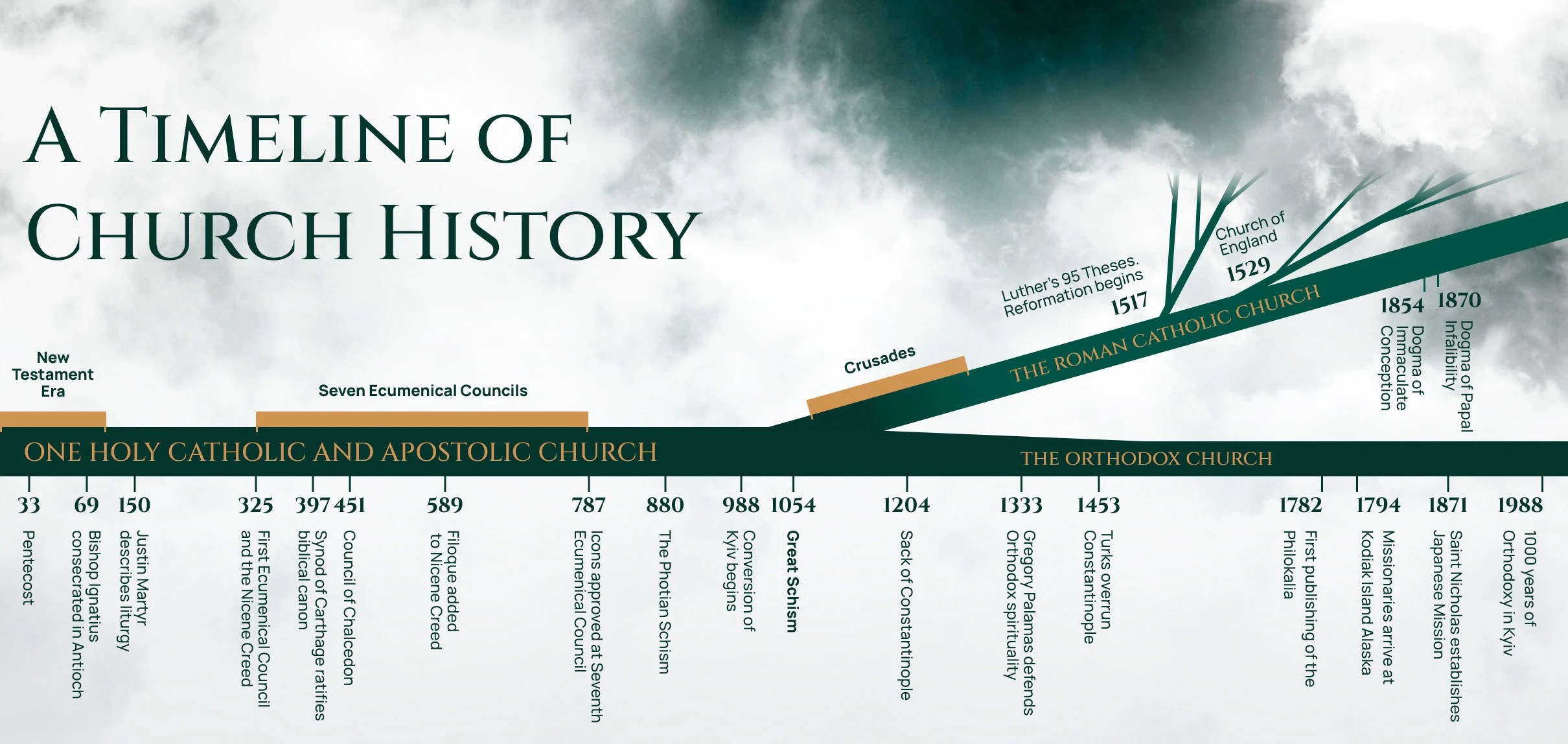
Orthodoxy and Roman Catholicism are not in communion with each other since, in the simplified version, the Great Schism of 1054 (see the timeline above). But a lot of people coming out of Protestant traditions have felt that those were the only two viable Christian alternatives, and I have never found it in me to criticize those who made the wrong-but-plausible choice, like Leah did.

Fallen

Of course, we speak of human beings as “fallen.” However, in Orthodox teaching, this does not refer to our nature itself. Rather, it refers to the fact that we have been made subject to death – we are mortal. It is “death at work in us” that we describe as “sin.” But the origin of sin is not found in our nature. Our nature is inherently good. Understanding this makes a huge difference when we think about human relationships and the character of our common life.

If you take the view (which is common in certain corners of Western Christianity) that human beings have a “sin nature” – that we are, in fact, essentially bad – then how we view one another and the character of our common life takes on a different caste. In an Orthodox understanding, a Bible verse such as, “Spare the rod and spoil the child,” can mean little more than “children need discipline in their lives to help them”. Whereas in a world in which human nature is held to be a “sin nature,” then “sparing the rod,” would be seen as letting evil run amok. It would hold that our nature not only needs to be restrained but requires a vigorous regime of reward and punishment. It has not been that long since the notion of “beating the evil out of a child” was common.

When we speak of our nature as “good,” we are not declaring that human beings are born as saints. Rather, we are saying that our nature (“what we are”) tends towards the good, desires the good. We desire beauty. We desire well-being. We desire truth. Even when we engage in evil actions, they are most often grounded in a misperception of the good. Dictators do not come to power by asking people to be evil – they come to power by distorting the image of the good.

Fr. Stephen Freeman, The Nature of Being Human


Religious ideas have the fate of melodies, which, once set afloat in the world, are taken up by all sorts of instruments, some woefully coarse, feeble, or out of tune, until people are in danger of crying out that the melody itself is detestable.

George Elliot, Janet’s Repentance, via Alan Jacobs

[N]one of the things that I care about most have ever proven susceptible to systematic exposition.

Alan Jacobs, Breaking Bread With the Dead

You can read most of my more impromptu stuff here and here (both of them cathartic venting, especially political) and here (the only social medium I frequent, because people there are quirky, pleasant and real and it has no-algorithms). All should work in your RSS aggregator, like Feedly or Reeder, should you want to make a habit of it.

Sunday, 8/31/25

I enjoyed my Evangelical boarding school experience. I looked forward to the end of Summer Vacation and moving back into the dorm.

For that and a few other reasons, this has long been my favorite time of the year.

It began 62 years ago tomorrow, when my dad and I packed up the car and headed north. The day ended up being quite an adventure, involving fuel pump failures on both family vehicles. I’m not sure the story is worth retelling – except for the possibility that my dad was wondering “Is God trying to tell us this was a mistake?”

I don’t think it was, despite all the Evangelical problems I now can’t un-see. “Evangelical” is where my family was, and we couldn’t imagine wanting to be otherwise.

PSA

No, not prostate-specific antigen, nor public service announcement.

We’re talkin’ Penal Substitutionary Atonement. It is not the sine qua non that so many think it is.

Grace

I can think of few phrases in modern Christian speech that have been more abused through misuse and overuse than “we are saved by grace.” As a young Protestant, this was explained to me thus: “We are saved by God’s unmerited favor.” This has the unfortunate implication that, whatever salvation may be, it’s something that’s happening in the mind of God – His unmerited favor. It strikes me as somewhat empty.

Its emptiness belongs to that nefarious doctrine (as I would describe it) of the Penal Substitutionary Atonement (PSA), in which God’s justice demands our condemnation, while God’s mercy demands the blood of Jesus. All of which, it would seem, leaves us as bystanders in a cosmic court where the eternal disposition of our wretched souls is worked out.

In Orthodox understanding (which is the understanding of the early Church), grace is ever so much more. Indeed, grace is the Divine Energies, the very life of God. I have given this article the title, “Saved by the Stuff of Grace,” to draw attention to the ontological character of grace. Grace is not an aspect of a Divine psychology. Grace is the very life of God. We are saved by becoming partakers in the life of God: He becomes what we are that we might become what He is – i.e., that we might dwell in Him and He in us.

Fr. Stephen Freeman, Saved by the Stuff of Grace

Vladimir Lossky

The inadequacy of this theology was brilliantly deconstructed by Vladimir Lossky, whose analysis reveals why this opinion results in other problems that manifest themselves in Western Christian theology: Christian horizons are limited by the drama played between God, who is infinitely offended by sin, and man, who is unable to satisfy the impossible demands of vindictive justice. The drama finds its resolution in the death of Christ, the Son of God who has become man in order to substitute Himself for us and pay our debt to divine justice. What becomes of the dispensation of the Holy Spirit here? His part is reduced to that of an auxiliary, an assistant in redemption, causing us to receive Christ’s expiated merit. . . . The price of our redemption having been paid in the death of Christ, the resurrection and the ascension are only a glorious happy end of his work, a kind of apotheosis without direct relationship to our human destiny. This redemptionist theology, placing all the emphasis on the passion, seems to take no interest in the triumph of Christ over death. The very work of the Christ-Redeemer, to which this theology is confined, seems to be truncated, impoverished, reduced to a change of the divine attitude toward fallen men, unrelated to the nature of humanity.

Dr. Eugenia Scarvelis Constantinou, Thinking Orthodox

Taming the Church

There was a subtle repressiveness behind this seemingly innocuous pluralism. Niebuhr failed to describe the various historical or contemporary options for the church. He merely justified what was already there—a church that had ceased to ask the right questions as it went about congratulating itself for transforming the world, not noticing, that in fact the world had tamed the church.

Stanley Hauerwas, Resident Aliens

Work

No one should imagine that the work he does is an end in itself; it has the role of beautifying his nature, with the virtues of patience, of self-control, of love for his neighbor, of faith in God, and in turn of opening his eyes to the wise principles placed by God in all things.

Dumitru Staniloae, Orthodox Spirituality

A hundred fine names for the Sulks

Ye see it easily enough in a spoiled child that would sooner miss its play and its supper than say it was sorry and be friends. Ye call it the Sulks. But in adult life it has a hundred fine names—Achilles’ wrath and Coriolanus’ grandeur, Revenge and Injured Merit and Self-Respect and Tragic Greatness and Proper Pride.’

C.S. Lewis, The Great Divorce

The Creed

I have said elsewhere that I deliberately will never adopt any theological “ism” that isn’t clearly derived from the Creed. Far from being a cynically contrived statement or a politically motivated one, the Creed was formulated to be as dogmatically expansive as possible, without opening the doors to needless speculation on the one hand or to doctrinal reduction for the sake of accommodation on the other.

Addison Hodges Hart, “God concepts,” the “impersonal transcendent,” and “superstitious” babushkas

Bad Religion

Ross Douthat wrote a book a few years back titled “bad religion.” a book like that wouldn’t be much use unless there was some definition of his terminology:

bad religion: the slow-motion collapse of traditional Christianity and the rise of a variety of destructive pseudo-Christianities in its place.

[A] religious mistake has been to fret over the threat posed by explicitly anti-Christian forces, while ignoring or minimizing the influence that the apostles of pseudo-Christianity exercise over the American soul.

Question: how can you tell whether your church is pushing one of the varieties of destructive pseudo-Christianity? The answer is not “do they use the Bible as their source of authority?” The arch-heretics have always used the Bible, sometimes quite cunningly.

If you’re not Orthodox, I want this question to be a burr under your saddle, as it became under my saddle 34 or so years after I first headed off to Boarding School.


Religious ideas have the fate of melodies, which, once set afloat in the world, are taken up by all sorts of instruments, some woefully coarse, feeble, or out of tune, until people are in danger of crying out that the melody itself is detestable.

George Elliot, Janet’s Repentance, via Alan Jacobs

[N]one of the things that I care about most have ever proven susceptible to systematic exposition.

Alan Jacobs, Breaking Bread With the Dead

You can read most of my more impromptu stuff here and here (both of them cathartic venting, especially political) and here (the only social medium I frequent, because people there are quirky, pleasant and real). All should work in your RSS aggregator, like Feedly or Reeder, should you want to make a habit of it.

Sunday, 8/10/25

No nonsense

A veteran Orthodox Priest recalls some wedding planning:

Three occasions stand out in my memory.

In the first, the mother of the bride arrived for the wedding rehearsal fifty minutes late, carrying aloft one of those rather tedious middle-class books of wedding etiquette, exclaiming that she wanted the wedding to be just “like this.” It wasn’t.

On another occasion, I was telephoned by another bride’s mother, a woman I had never met. It was quite obvious that she regarded the church as a sort of wedding shop at which she simply ordered the things she wanted and skipped things that did not look attractive. She didn’t want crowns at her daughter’s wedding, though I cannot now remember why. We had crowns.

On a third occasion, a marriage consultant had been hired to look after the wedding. When we met in the church, she told me that she was going to put in a rose bower right over where the couple would stand, and that she wanted piped music from various show tunes to “set the mood.” She got neither wish.

One of the great blessings in the Orthodox Church is that we do not have to create occasions. The Orthodox wedding service is so powerful, so profound, that we do not have to dress it up, give it atmosphere, or otherwise make it other than it already is. This allows people to relax. They may have problems at the wedding reception—crowds and alcohol are always a bit risky, and banquet food is rarely worth the money—but the marriage service of the Orthodox Church is a glimpse of heaven without making any particular fuss or effort at all.

Fr. Meletios Webber, Bread & Water, Wine & Oil.

My wife and I were fortunate in the early 70s when my then-pastor, of New England Congregationalist stock, effectively decreed that we would follow the Book of Common prayer pretty closely. It wasn’t Orthodox, but it wasn’t kitsch, either.

Life in the monastery

All my bad habits, disinfected, it is true, of formal sin, had sneaked into the monastery with me and had received the religious vesture along with me: spiritual gluttony, spiritual sensuality, spiritual pride. . . .

Thomas Merton, The Seven-Story Mountain

The reprobate in heaven

I will venture to say more than this; – it is fearful, but it is right to say it; – that if we wished to imagine a punishment for an unholy, reprobate soul, we perhaps could not fancy a greater than to summon it to heaven. Heaven would be hell to an irreligious man… He would find no one like himself; he would see in every direction the marks of God’s holiness, and these would make him shudder. He would feel himself always in His presence. He could no longer turn his thoughts another way, as he does now, when conscience reproaches him. He would know that the Eternal Eye was ever upon him; and that Eye of holiness, which is joy and life to holy creatures, would seem to him an Eye of wrath and punishment. God cannot change His nature. Holy He must ever be. But while He is holy, no unholy soul can be happy in heaven.

John Henry Newman via Addison Hodges Hart.

It is common in Orthodox Christianity to suggest that the presence of God is light to the righteous, searing heat to the unrighteous. Neither that nor Newman’s sermon is systematic theology; both are analogies to address a question that people have about God’s justice, heaven and hell.

The opposite of war

The opposite of war is not peace, but liturgy – the cognitive, bodily, totalizing act that steadily increases communion, instead of cutting it. Liturgy is an act that purifies and knits the character together, whereas trauma unravels our character. In liturgy, I give my life for my brother and sister, I renounce retaliation, and I give my very body and blood for the life of the entire world.

Timothy Patitsas, The Ethics of Beauty

Not much of a stretch

If Christianity is the one, true religion, is it that much of a stretch to believe that there is one, true expression of Christianity?

Carlton, Clark, The Way, 1998 Edition

That one true expression builds on the one foundation with gold, silver and precious stones, not wood, hay and straw.

Well-being declining

Since the 1960s we have adopted values that are more secular, more individualistic and more oriented around self-expression than the values that prevail in the Eastern Orthodox European countries such as Serbia, the Confucian countries like South Korea and the mostly Catholic Latin countries like Mexico.

The countries that made this values shift are seeing their well-being decline, according to that Gallup thriving survey. The countries that resisted this shift are seeing their well-being improve. The master trend in recent Western culture has been to emancipate the individual from the group, and now we are paying the social and spiritual price.

David Brooks, Why More People in the World Are Feeling Hopeful (Except Us) (gift link).

The Culture Wars: cui bono?

While at Brookings, [Os Guinness] helped to draft a public document that could have had the domestic impact of a Universal Declaration of Human Rights if events had only unfolded differently. Aided by the likes of Richard John Neuhaus and George Weigel, Guinness led the drafting of the Williamsburg Charter for the bicentennial celebration of the First Amendment in 1988. The document called for a “reaffirmation and reappraisal of its vision and guiding principles.” Signed by a broad coalition of religious faiths and politicians across the aisle (including presidents, chief justices, and members of Congress), the charter spelled out the importance of the First Amendment’s twin guarantees of religious liberty: the No Establishment and the Free Exercise clauses. Both clauses work together to protect religious liberty, not limit it.

Enshrining these at the heart of the Constitution as America’s “first liberty” was necessary, as the document spells out, because

[our] form of government depends upon ultimate beliefs, for otherwise we have no right to the rights by which it thrives, yet rejects any official formulation of them… The result is neither a naked public square where all religion is excluded, nor a sacred public square with any religion established or semi-established. The result, rather, is a civil public square in which citizens of all religious faiths, or none, engage one another in the continuing democratic discourse. … The Framers’ intention is indisputably ignored when public policy debates can appeal to the theses of Adam Smith and Karl Marx, or Charles Darwin and Sigmund Freud but not to the Western religious tradition in general and the Hebrew and Christian Scriptures in particular.

The document was commemorated with a signing ceremony in the Hall of the House of Burgesses in Williamsburg, and many smaller events, including a conference that featured papers from intellectual luminaries like James Davison Hunter, Michael Sandel, Charles Taylor, and Peter Berger. Even still, it never made quite the impact it could have in reframing the conversation about the place of religion in society (a shame especially in light of recent controversies: e.g., Christian groups being kicked off campus, religious monuments being stripped from public locations, and the debated ‘failures’ of classical liberalism).

The Williamsburg Charter’s failure came down to the absence of a single signature: that of the sitting president, “whose backing was crucial to the practical rollout of the Charter.” At the end of the day, “strong opposition from the Religious Right blocked the participation of President Reagan.” “The culture wars are in the interests of Republicans so you will only get to the president over my dead body,” one of Reagan’s cabinet secretaries told Guinness. This destroyed any opportunity to articulate why Americans needed to bring their faith with them into the public square. While Guinness’ campaign has continued on in the work of John Inazu and that of others, the cultural capital it once had within arm’s reach is spent.

John Shelton, Os Guinness: The Christian Public Intellectual After Jacques Maritain (bold added).

Limits of redemptionist theology

The inadequacy of this theology was brilliantly deconstructed by Vladimir Lossky, whose analysis reveals why this opinion results in other problems that manifest themselves in Western Christian theology:

Christian horizons are limited by the drama played between God, who is infinitely offended by sin, and man, who is unable to satisfy the impossible demands of vindictive justice. The drama finds its resolution in the death of Christ, the Son of God who has become man in order to substitute Himself for us and pay our debt to divine justice. What becomes of the dispensation of the Holy Spirit here? His part is reduced to that of an auxiliary, an assistant in redemption, causing us to receive Christ’s expiated merit. . . . The price of our redemption having been paid in the death of Christ, the resurrection and the ascension are only a glorious happy end of his work, a kind of apotheosis without direct relationship to our human destiny. This redemptionist theology, placing all the emphasis on the passion, seems to take no interest in the triumph of Christ over death. The very work of the Christ-Redeemer, to which this theology is confined, seems to be truncated, impoverished, reduced to a change of the divine attitude toward fallen men, unrelated to the nature of humanity.

Dr. Eugenia Scarvelis Constantinou, Thinking Orthodox


Religious ideas have the fate of melodies, which, once set afloat in the world, are taken up by all sorts of instruments, some woefully coarse, feeble, or out of tune, until people are in danger of crying out that the melody itself is detestable.

George Elliot, Janet’s Repentance, via Alan Jacobs

[N]one of the things that I care about most have ever proven susceptible to systematic exposition.

Alan Jacobs, Breaking Bread With the Dead

You can read most of my more impromptu stuff here and here (both of them cathartic venting, especially political) and here (the only social medium I frequent, because people there are quirky, pleasant and real). All should work in your RSS aggregator, like Feedly or Reeder, should you want to make a habit of it.

Great and Holy Race Day

I’m situated geographically in a place so sports- and Indy500-obsessed that in my former Church, men would disappear en masse on “Race Day.” Granted, I lived away from here 20-ish years, but it’s still a point of sinful pride that I’ve never been. Not to the race, not to the trials, not to carburation day.

(I apologize for some funky formatting today. After all these years, I still have trouble dealing with numbered or bulleted lists within block quotes.)

Filioque

As a protestant, I had no idea that the filioque (the words “and from the Son” in the Nicean Creed concerning the procession of the Holy Spirit) was added to the Creed hundreds of years later, nor that it was rejected from the beginning by Christians outside the jurisdiction of the Roman Patriarch, nor even (very distinctly at least) that there were catholic Christians outside the jurisdiction of the Roman Patriarch.

Since becoming Orthodox, I have taken it as a matter of high importance to reject the filioque, but I don’t recall previously seeing all of these reasons for the rejection:

Eastern Europe was converted to Christianity by Byzantine missionaries, the most prominent of whom are Saint Cyril and Saint Methodius. These bonds of religion created a deep sympathy between Bulgar to Byzantine. The Franks attempted to sever these bonds by sending missionaries into Eastern Europe, claiming that the Byzantines had taught them a heterodox version of Christianity and encouraging them to use the filioque.

I know Catholics are tired of Orthodox apologists going on about the Franks. But this really is an important test-case, for the following reasons:

  1. The threat of Arianism was resolved 300 years before the Schism. So, adding the filioque served no pastoral function. On the contrary, it was deeply divisive.  
 2. The underlying theology of the filioque was hotly disputed, especially by the Eastern patriarchs. So, adding the filioque did not express the mind of the universal Church.  
 3. The original Creed had been drafted in Council for a reason: it was supposed to express the *consent* and *concensus* of the orthodox, catholic bishops. So, adding the filioque defeated the whole purpose of the Creed.  
 4. For about six hundred years, Popes had taught the dangers of inserting the filioque into the Creed. So, adding the filioque violated even Rome’s local customs.  
 5. The Ecumenical Councils had ruled that the Creed should not be modified. So, adding the filiioque violated the Holy Canons.  
 6. Rome was advancing the *filioque* for worldly reasons only. So, adding the filioque would have allowed a single bishop to advance his own political and economic interests at the whole Church’s expense.  

The Eastern Patriarchs had every reason to reject the insertion of the filioque, and no reason to accept it—none except, “The pope said so, and we have to do whatever the pope says.”

Michael Warren Davis, ‘Papal Minimalism’ Is Eastern Orthodoxy

Worship

To anyone who has had, be it only once, the true experience of worship, all this is revealed immediately as the ersatz it is. He knows that the secularist’s worship of relevance is simply incompatible with the true relevance of worship. And it is here, in this miserable liturgical failure, whose appalling results we are only beginning to see, that secularism reveals its ultimate religious emptiness and, I will not hesitate to say, its utterly anti-Christian essence.

Alexander Schmemann, For the Life of the World

Protestant, Catholic, Non-Denom

As my readers know, I’ve been an Orthodox Christian ever since I began blogging. The more attentive readers may know that before that I was Reformed (i.e., Calvinist, and specifically Christian Reformed) and before that, I was a generic Wheaton-College type evangelical.

Or maybe I should say “a generic Wheaton-College type evangelical as evangelicalism was configured in the 1950s through the mid-1970s.” Because it has come to my attention more forcefully, and in a way that more painfully implicates and pronounces doom on the kinds of Christian I once was, that things are changing. The evangelicalism I knew is not as powerful as it once was; evangelical denominations are shrinking and dying. So are Calvinist denominations. The Protestantism I knew most closely is increasingly nondenominational, and doesn’t care much about doctrine or sacraments, and increasingly doesn’t even want to be called “evangelical” or even “Protestant.”

This affects me closely because my wife remains Christian Reformed, and I consider it a pretty good penultimate tradition for an Orthodox Christian. And there is a very strong trend toward those denominational Churches dying out in favor of non-denoms.

And it worries me because those nondenominational Churches tend far too much to be personality cults and hotbeds of rampant sexual and other clergy abuse. And God only knows what they’re teaching, insofar as they’re teaching anything other than a mooshy-gooshy relationship with Jesus and a firm commitment to the GOP as a way of gaining power.

Yeah, this means I’ve gained some fresh respect even for the progressive Protestant denominations (which are also dying, even faster than the conservatives). At least there’s some accountability to hierarchies less likely than local parishioners to be mesmerized by Mr. Charisma. And some of them retain a liturgy that will expose worshippers to more scripture and doctrine than Joel Osteen can even imagine.

In any event, I say all that to introduce you to four of the thought-provoking articles (presented in the order in which I encountered them) that brought to my attention how much things are changing in my former haunts. A common thread is that denominational Protestantism is in deep, deep trouble; one goes so far as to suggest that nondenominational Churches are not really Protestant, but a whole new tradition:

  1. Goldilocks Protestantism – First Things
  2. LONG FORM: Does Traditional Protestantism Have a Future?
  3. How ‘Christian’ Overtook the ‘Protestant’ Label – Christianity Today
  4. Low Church in High Places: The Fate and Future of American Protestantism – Public Discourse

Religious ideas have the fate of melodies, which, once set afloat in the world, are taken up by all sorts of instruments, some woefully coarse, feeble, or out of tune, until people are in danger of crying out that the melody itself is detestable.

George Elliot, Janet’s Repentance, via Alan Jacobs

[N]one of the things that I care about most have ever proven susceptible to systematic exposition.

Alan Jacobs, Breaking Bread With the Dead

You can read most of my more impromptu stuff here and here (both of them cathartic venting, especially political) and here (the only social medium I frequent, because people there are quirky, pleasant and real). All should work in your RSS aggregator, like Feedly or Reeder, should you want to make a habit of it.

Cheesefare 2025

Gymnasiums

The gym where God retrains our hearts

Worship is the arena in which God recalibrates our hearts, reforms our desires, and rehabituates our loves. Worship isn’t just something we do; it is where God does something to us. Worship is the heart of discipleship because it is the gymnasium in which God retrains our hearts.

James K.A. Smith, You Are What You Love

And that, my friend, is why I [still] don’t mind singing in an empty Church.

Smith gets a lot of things right.

The gym where amnesiacs stultify our hearts

[T]he practices and prayers set out for God’s people in the prayer book have been amongst the most formative in western and, indeed, global Christianity. But to American evangelicals in the 2020s, living after nearly 50 years in which our corporate liturgy and prayer life has soaked in the corrosive acid of seeker sensitive church life, the practices and even the language of the prayer book can feel strange and foreign and even a bit frightening, I think. We have become accustomed to three songs and a TED talk, to spectacle, and to spontaneity. And while I think there are a great many of us who are quite tired of such things, it is not easy for those on the far side of a great forgetting to regain what previous generations misplaced—unless they have help ….

Jake Meador.

Jake is a young man, so it’s understandable that he thinks the great forgetting began with seeker-sensitivity. I think it started earlier, perhaps more than a century earlier. But I’m neither a historian nor an eyewitness.

Miscellany

Out of my yawns, a grabber

Ross Douthat was being interviewed by Andrew Sullivan about his forthcoming book, Believe. For the most part, I am uninterested in this book (which gives all kinds of rational, scientific arguments for the reasonableness of belief and some kind of God) simply because I think God‘s existence per se is not very interesting.

However, there was one argument of a sort that I had not heard before, and that caught my attention: Why is mankind so gifted with intelligence and curiosity that he penetrates many of the secrets of the universe? Why was our intelligence not limited to that degree that, for instance, would allow us to be subsistence, farmers or herders? If we merely evolved, why didn’t evolution stop there? Might it be that we are given much greater intelligence than that in order that we could both discover facts about the universe and commune more fully with God?

(I’m not sure where Douthat ends and I begin in the prior paragraph.)

Some day, a story

I’m fatigued by politics at the moment – I have to be careful with attempting punditry in this state – as Gary Snyder said, “Don’t be a slave to your lesser talents”. But at some point a story rather than a polemic will appear that speaks to the moment we are in and I will proceed from there. Nobody needs more clever arguments. I miss the woods, the sea, the swooping buzzard, I don’t miss any more retina-blitzing bit of adrenal-wrecking rhetoric.

Martin Shaw, 2/23/25

Correctness < Theology

Nothing is as difficult as true theology. Simply saying something correct is beside the point. Correctness does not rise to the level of theology. Theology, rightly done, is a path towards union with God. It is absolutely more than an academic exercise. Theology is not the recitation of correct facts, it is the apprehension and statement of Beauty.

It is this aspect of liturgical life that makes it truly theological. It is also the failure of most contemporary Christian worship efforts. Gimmicks, emotional manipulation and a musical culture that barely rises above kitsch reveal nothing of God – and embarrassingly much about us.

Fr. Stephen Freeman

Catholic or Orthodox?

It happened one afternoon last autumn. I was praying before an icon of the Holy Family. “What should I do? Should I stay Catholic or become Orthodox? Please give me some sign.”

A tear rolled down Mary’s face. I wiped it away. My fingers were wet. I burst into the living room and called to my wife. “The icon is weeping,” I told her. She looked incredulous. “Call Father T.,” she said.

Father T. was the priest of our Eastern-Catholic parish. He retired from the local police force as a homicide detective before taking holy orders. I told him what happened. “I’m an old cop,” he said, “so I assume there are natural causes before I start looking for supernatural ones.” As we were talking, I watched a tear form in Joseph’s eye and roll down his face.

“It’s happening again,” I said.

Father T. was silent for a moment. “Oh.”

We hung up. I was staring at the icon when another tear formed in Mary’s eye. This time I brought it to my wife. “Do you see this?” I asked her. She wiped the tear from the icon and tasted it. “It’s sweet.”

A few hours later I called Father T. back. He said that, in his opinion, the weeping icon was a sign to remain Catholic. Surely, Mary and Joseph were crying because I was thinking about leaving the Church. Also, icons of the Holy Family are definitely “Western-style.” (Mrs. Davis and I bought the icon shortly after we were married, at a conference hosted by the Society of St. Pius X.) Isn’t that significant? Besides, in the East, miraculous icons usually stream myrrh all over, like a glass of ice water sweating in the hot sun. Ours wept tears from its eyes, more like the miraculous statues one finds in the West. This was a “hybrid” miracle: no doubt a sign to remain Eastern Catholic. All of which are perfectly good arguments.

Afterwards I called Father A., an old Russian priest in whom I’d been confiding. Father A. also happens to be a master iconographer. I asked him, “Is this a sign to become Orthodox?” To my surprise, he demurred. Weeping icons are not like Ouija boards, he said. They don’t give yes-or-no answers to the questions we ask God in prayer. First and foremost, they are gifts. They remind us of God’s presence in our lives, and of His love for us. Secondly, they call us to repentance—to enter more deeply into a life of prayer and fasting.

Father A. told me that, of course, he would love for us to become Orthodox. He felt that our fasting and prayer would, in time, lead us to the Orthodox Church. But God is not like you and me, he said. His gifts are never purely utilitarian.

Michael Warren Davis

It may well be that “Father T” opined badly by the standards of his own Church and that Orthodox Priests exist who, unlike Father A, would play the same game. But I’m pretty sure Father A is in the Orthodox mainstream.

Lazarus on Cyprus

It is well-known among Cypriots, not to mention a matter of national pride, that St. Lazarus lived on the island of Cyprus after the Lord’s Resurrection. Saint John’s Gospel tells us that the Jewish leaders had resolved to kill both Jesus and Lazarus. They considered it necessary to kill Lazarus because belief in Jesus as the Messiah increased after he raised Lazarus to life when he had been dead for four days (John 12:9–11). Lazarus was literally living proof of this extraordinary miracle. The New Testament itself does not tell us that Lazarus went to Cyprus later, but this was known in the tradition of the Church of Cyprus. The gospel message came to Cyprus very early, and the Church was established there even before St. Paul became a missionary (Acts 11:19–21).

My husband, Fr. Costas, was born and lived on the island of Cyprus when it was still a British colony. He related to me that the Cypriots would boast about St. Lazarus to the British there. But the British would often scoff at this claim, saying there was no proof that Lazarus had ever come to Cyprus.

A very old church dedicated to St. Lazarus, dating back to the 800s, is located in Larnaca, Cyprus. In 1972 a fire caused serious damage to the church building. The subsequent renovation required digging beneath the church to support the structure during reconstruction. In the process of digging, workers uncovered the relics of St. Lazarus located directly below the altar in a marble sarcophagus engraved with the words “Lazarus, the four-day dead and friend of Christ.”

Dr. Eugenia Scarvelis Constantinou, Thinking Orthodox

Why do we find it implausible that Lazarus lived somewhere after Christ raised him, and that it/he was important enough that people there preserved the memory?


Religious ideas have the fate of melodies, which, once set afloat in the world, are taken up by all sorts of instruments, some woefully coarse, feeble, or out of tune, until people are in danger of crying out that the melody itself is detestable.

George Elliot, Janet’s Repentance, via Alan Jacobs

[N]one of the things that I care about most have ever proven susceptible to systematic exposition.

Alan Jacobs, Breaking Bread With the Dead

You can read most of my more impromptu stuff here and here (both of them cathartic venting, especially political) and here (the only social medium I frequent, because people there are quirky, pleasant and real). All should work in your RSS aggregator, like Feedly or Reeder, should you want to make a habit of it.

Sunday, 1/19/25

Here’s the thing about αμαρτία

This excerpt from the Orthodox Trisagion prayers (Thrice-Holy prayers) grabbed my attention 27+ years ago:

O Lord, cleanse us from our sins. O Master, pardon our transgressions. O Holy One, visit and heal our infirmities for Thy Name’s sake.

That left an impression that is still with me.

I learned fairly early in my catechesis that sin in Greek is αμαρτία, commonly rendered “hamartia” in English. It literally means “missing the mark.”

As an Evangelical, and then as a Calvinist (though to a lesser degree), I’d gotten the impression that “sin” was simply rebellion against God. But that wasn’t true to all that I saw in me that missed the mark. There was self-absorption feeding obliviousness to the concerns of others. I didn’t choose that to rebel against God. There was such limitation that I sometimes didn’t know what I should do and chose something that harmed others. I also didn’t choose that to rebel against God (I’d have preferred omniscience).

The three sentences from the Trisagion Prayers seemed a perceptive taxonomy where my Church and pastors saw only uniformity: rebellion. For some kinds of mark-missing we need cleansing, for others pardon, for still others, healing.

My soul said “Yes! They’ve got it!” And so the case for Orthodoxy grew weightier.

I don’t remember mentioning this before. Perhaps it will help someone with the same perception I had.

But now that I’ve got that down on paper (so to speak), connections occur to me. Maybe my Protestant mentors didn’t think about human failures that aren’t acts of rebellion toward God because the common Protestant theory of atonement (basically, God the Father already gave God the Son the punishment we deserve for our rebellion and so He won’t punish us as well) is an uncomfortable fit for non-rebellious mark-missing like self-absorption and lack of omniscience, for which we need something more than pardon.

To call that idea half-baked may be too generous, but now it’s on my mind.

How liberal theology works

I pay a lot of critical attention to American Evangelicalism because in important ways it was my religious world and we’re collectively still swimming in its latest iterations.

Also, I don’t think I ever understood the Protestant mainline. I recently got some help in that regard (recently because I’m gradually catching up with the podcast series from which this transcript comes):

Fr. Stephen: … I don’t think people fundamentally understand how liberal theology works, and this can give us a window into how liberal theology works. Liberal theology is in keeping with Hegel, the Hegel we’re rejecting on this show, just to be clear. Not promoting liberal theology, but we need to understand liberal theology and how it works.

The reason I’m just saying “liberal theology”— I’m not saying “liberal” as opposed to “conservative.” I’m saying “liberal” in the sense of post-Enlightenment, that doesn’t think the Enlightenment was a bad thing. I’m talking about post-Enlightenment theology; I’m talking about— Well, let’s get to brass tacks. …

But liberal theology essentially, like Hegel, takes whatever point in time they stand at as being the apex of history to that point. This means— And I’ve critiqued it this way on the show before, but I’m going to do it again. This means that liberal theology is always innately chauvinist, at least somewhat racist, colonial, because, again, you have to take your culture and civilization as being the apex, which means the other ones who might disagree with you are somehow primitive, backward, unenlightened, etc. So there’s always overtones of that, always overtones of that within liberal theology. But you take your point as being the apex of history to that point, and you ascribe the developments that have led to that apex as being the work of the Holy Spirit.

So if now we, European-derived Western culture, have a new understanding of gender or sexuality or biological sex or any other ethical, moral issue of who God is, whatever—whatever has developed historically, in this Western—dare I say often white—culture, whatever is developed in that culture, this is the work of the Holy Spirit that has brought us to this, and therefore it is endorsed, and we re-shape our theology based on this. So a new understanding of gender that arises within culture and society is, for them—the work of God has brought that about within society.

Fr. Andrew: Yeah… This is where you hear people use language like “the right side of history.”

Fr. Stephen: So it doesn’t matter if the person questioning that is from the same culture but who says, “Hey, I don’t this historical development—” they’re doing more like what we’re advocating for, which is saying, “Well, no, we have to sift through this and say what is from God and what isn’t”; or if it’s someone from another culture, who might have another skin color, might be from another continent. It doesn’t matter who’s questioning it: whoever’s questioning it is innately backwards, is innately rejecting the work of the Holy Spirit in the world.

Fr. Andrew: Yeah, this is also where you hear people say things like: “It’s 2023!” Like that’s an argument! “It’s current year!”

Fr. Stephen: Yeah, but you have to understand, this is their understanding. And this is why trying to take any kind of approach with them, of “well, but this previous understanding…” or “this thing from the past,” no matter what it is, fundamentally doesn’t work, because they have this underlying presupposition that their culture now at this point in time is the apex of all human cultures and civilization and that God has brought it there. This is why, when I— when you hear me critiquing liberal theology, it’s often from what sounds like a liberal perspective, like I’ll say to people who express these ideas— They’ll be attacking, for example, African bishops in their own church for not going along. What’s nice about me using that example is there are at least three different denominations I could be talking about.

When they, as white, bourgeois Americans or Europeans, attack African bishops and call them “backwards” and all of these things for not being on-board with their new liberal consensus, I will call them white supremacists, because that’s what that is.

Fr. Andrew: Colonialism.

Fr. Stephen: Right? That is colonialism. It’s: all the things they claim to hate, they’re actually doing. But that’s why I— If people hear me critique it that way, I know some people might get confused, but that’s why I critique it that way, because that’s the only critique that can function on their own presuppositions. That’s the only critique that’s valid from their— based on their own presuppositions. Any critique from tradition is going to fall flat on its face, because they’ve substituted—instead of our understanding of tradition, they have this alien understanding of history, so trying to talk tradition doesn’t work. That’s the only kind of critique—

And that’s because, ultimately, that line of thinking is an ouroboros. It’s a snake eating its own tail. It can’t— Its first principles are incoherent. That’s why you can critique their beliefs based on their beliefs, because they don’t fit together. But so, we add that at the end this is the deviant view of how the Spirit works and how Tradition works, that we need to be aware of, because I don’t think we can have productive dialogue with people who have imbibed liberal theology and who are coming at things from that perspective when we come at them from a completely alien perspective that shares none of their presuppositions. I don’t think there’s any way for that to be productive, other than, you know, maybe just saying, “You have to abandon everything you think you know. Change everything,” which may work sometimes, and maybe if you show them how self-refuting their own ideas are, maybe that’ll help that happen, but there’s a fundamental lack of communication between those who have fallen prey to that kind of liberal theology and the rest of us. That it would be good for their sakes if we could find a bridge to try to bring them back to the truth.

Fathers Andrew Stephen Damick and Stephen DeYoung on the Lord of Spirits podcast for December 29, 2023.

I share this because I found it helpful in understanding United Methodists and Episcopalians over my lifetime. They’re treating the Zeitgeist as the Heiliger Geist, and they contemn Africans in their communions whose Zeitgeist isn’t keeping up with the latest fashions.

Secularizations

After he had twice visited the United States in the 1930s, Dietrich Bonhoeffer wrote a perceptive essay contrasting Christian development in America with parallel developments in the parts of Europe most directly shaped by the Protestant Reformation. His assessment included an observation that was as shrewd in its comparative wisdom as it is relevant for the themes of this book: “The secularization of the church on the continent of Europe arises from the misinterpretation of the reformers’ distinction of the two realms [of church and society]; American secularization derives precisely from the imperfect distinction of the kingdoms and offices of church and state, from the enthusiastic claim of the church to universal influence in the world.” What Bonhoeffer saw has been described with other terms here: The key moves in the creation of evangelical America were also the key moves that created secular America.

Mark A. Noll, America’s God. This surely is relevant to my inquiry into Carlo Lancelotti’s Touchstone article.

Truth gets a rocky start

Schaff’s work in America got off to a rocky start. In his inaugural address at Mercersberg, The Principle of Protestantism, Schaff argued that American Protestantism needed to reject its antihistorical, sectarian tendencies and recognize its place within the historic church, which had organically developed through time.

Paul J. Gutacker, The Old Faith in a New Nation.

Schaff wasn’t wrong.

Religious versus Secular

Why accept the substantivist definition of religion as about belief in transcendence? Taylor thinks he needs such a definition in order to keep his subject matter properly delimited; if nationalism were a religion, then the whole religious/secular distinction would get thrown into confusion. But there might be good reasons to question this distinction. The distinction has come under increasing scrutiny from scholars who view the religious/secular distinction as both historically constructed and politically motivated.

William T. Cavanaugh, The Uses of Idolatry

Authenticity

The Reformation is the first great expression of the search for certainty in modern times. As Schleiermacher put it, the Reformation and the Enlightenment have this in common, that ‘everything mysterious and marvellous is proscribed. Imagination is not to be filled with [what are now thought of as] airy images.’ In their search for the one truth, both movements attempted to do away with the visual image, the vehicle par excellence of the right hemisphere, particularly in its mythical and metaphoric function, in favour of the word, the stronghold of the left hemisphere, in pursuit of unambiguous certainty. … What is so compelling here is that the motive force behind the Reformation was the urge to regain authenticity, with which one can only be profoundly sympathetic. The path it soon took was that of the destruction of all means whereby the authentic could have been recaptured.

Iain McGilchrist, The Master and His Emissary


Religious ideas have the fate of melodies, which, once set afloat in the world, are taken up by all sorts of instruments, some woefully coarse, feeble, or out of tune, until people are in danger of crying out that the melody itself is detestable.

George Elliot, Janet’s Repentance, via Alan Jacobs

[N]one of the things that I care about most have ever proven susceptible to systematic exposition.

Alan Jacobs, Breaking Bread With the Dead

You can read most of my more impromptu stuff here and here (both of them cathartic venting, especially political) and here (the only social medium I frequent, because people there are quirky, pleasant and real). All should work in your RSS aggregator, like Feedly or Reeder, should you want to make a habit of it.

Sunday, 12/15/24

Theology isn’t all deductive

Catholics find it impossible to theologize without deductive reasoning—a characteristic shared by virtually all Western Christians…

Dr. Eugenia Scarvelis Constantinou, Thinking Orthodox

Puritan Phobia

The Puritans quickly developed a phobia about ritual, going so far as to resist “rote” recitation of the Lord’s Prayer:

Henry’s Method culminates with his most fascinating phrase-collection of all, “A Paraphrase on the Lord’s Prayer, in Scripture Expressions.” Christ’s own form of prayer given to his disciples had long been a thorn in Puritans’ sides, to be plucked out by being understood as only a general guideline. Henry’s strategy is to neutralize the prayer’s form in a pages of verses elaborating on the one phrase “Our Father, who art in similar method; he provides, for instance, an amazing two and a half Heaven” (MP, 163-65), a general topos, he says, from which begins. Many editions of the Method were printed as Henry intended, interleaved with one blank page between each printed one, to enable the reader to pen in his own collection of phrases to supplement Henry’s own. Like Bunyan’s demand for scrupulous sincerity, Henry’s lists and blank pages, figures of accumulation and abstraction, combine literally to efface the Lord’s Prayer and erase it from Dissenting practice.

Between the ledgerlike pages of Henry’s collected phrases and the blank sheets for scribbled lists of readers’ personal prayer phrases, one senses of variety of fears: that without this careful accounting, the business might go bankrupt, that in the copious, nervous quoting from God’s word to talk and talk and talk to God, God might not listen or respond at all.

Lori Branch, Rituals of Spontaneity

Hyperpluralism’s roots

Moreover, Reformation scholars tend analytically and in their division of labor to hive off the magisterial Reformation-Lutheranism, Reformed Protestantism, and the Church of England-from the radical Reformation. Consequently, whether oriented primarily toward theology or toward social history, they have overlooked the significance of the principle of sola scripture for contemporary hyperpluralism.

Brad S. Gregory, The Unintended Reformation

A catholic vision of Christian faith

When I first opened A Severe Mercy nearly 20 years ago I had needed a vision of Christian faith that was unapologetically devoted to Christian doctrine without being materialistic, more American than Christian, and completely uprooted from history. Up to that point, the expressions of Christianity I had encountered were simply different forms of sectarian faith—a vapid progressivism or a parochial and narrow fundamentalism. Vanauken gave me catholicity ….

Jake Meador (hyperlink added)

Know-it-alls

In practical terms, the Reformed commitment to the theological significance of everyday life led to the development of something like Protestant metaphysics, Protestant epistemology, Protestant science, Protestant politics, Protestant social and economic theory, Protestant art, and Protestant poetics. The development of these Reformed spheres of intellectual and cultural activity never occurred without substantial influence from sources not specifically religious. In Switzerland, the southern German regions, Hungary, Holland, and the British Isles, the Reformed perspective could be used to mask economic or political aggression. More commonly, it emerged from a complicated mix of sacred and secular motives. Yet wherever sufficient Reformed strength existed, the assumption also existed that biblical Christianity had something fairly definite to say about everything.

Mark A. Noll, America’s God

Some of us have been glued to the BBC on a Sunday evening this autumn watching Mark Rylance return mesmerically as Thomas Cromwell in the second series of Wolf Hall. This all takes place in the era of the Reformation, and a particular scene has stayed with me. Surrounded by crosses lifted from churches, Cromwell says the following:

The English will discover God in daylight, not hidden in a cloud of incense. They will hear his word in their own language from a minister who faces them, not turning his back and muttering in some obscure, foreign tongue…no one will ever believe the poor once bowed and scraped to stocks of wood, and prayed to lumps of plaster.

I have such a mixed response to this brilliant bit of writing.

I went to such a daylight church and could not find God there. I didn’t find him in a cloud of incense either. I found him in a moonlit, midnight forest. I found him in a place with almost no human imprint. That was where he suddenly said NOW.

And I suppose I have become someone who ‘bows and scrapes’ to icons and prays to ‘lumps of plaster’. But, of course, to reduce them as Cromwell does is to misunderstand their function, what they do to the spirit and heart of the faithful. It’s not to the wood or plasterness of them I am praying. It’s just that I am not entirely just a brain on legs fed by sermons. These scorned ‘lumps’ of Cromwell become luminous by attention and repetition, by their physicality, by their evocation of tradition, what exudes through them. They gather and focus devotion, taking it from a lyric (entirely personal) into an epic (collective) encounter with the divine. Their materials are not the thing.

I have sympathies with all that want to hear gospel in their own language, and I’m glad that happened. Surely we all, really, want a profound sense of both tradition and innovation?

Maybe we long for a God of daylight and moonlight, of lyric and epic, of straight talking and unknowable mystery. I’d find it hard to imagine someone who didn’t. We stand on the Mount of Olives with our teacher and surely all is possible. Surely anything less than this is just silly.

But human history is human history and we make our choices. They are rarely ideal, but we chew, we rail, then we decide.

Martin Shaw

A personal favorite

I have three lists of Maxims or such that I review regularly. This one, which I think was originally embedded in a longer blog post by Father Stephen Freeman, seems more precious (in the good sense, not the snarky sense) every time I read it:

  1. First, live as though in the coming of Jesus Christ, the Kingdom of God has been inaugurated into the world and the outcome of history has already been determined. (Quit worrying)
  2. Second, love people as the very image of God and resist the temptation to improve them.
  3. Third, refuse to make economics the basis of your life. Your job is not even of secondary importance.
  4. Fourth, quit arguing about politics as though the political realm were the answer to the world’s problems. It gives it power that is not legitimate and enables a project that is anti-God.
  5. Fifth, learn to love your enemies. God did not place them in the world for us to fix or eliminate. If possible, refrain from violence.
  6. Sixth, raise the taking of human life to a matter of prime importance and refuse to accept violence as a means to peace. Every single life is a vast and irreplaceable treasure.
  7. Seventh, cultivate contentment rather than pleasure. It will help you consume less and free you from slavery to your economic masters.
  8. Eighth, as much as possible, think small. You are not in charge of the world. Love what is local, at hand, personal, intimate, unique, and natural. It’s a preference that matters.
  9. Ninth, learn another language. Very few things are better at teaching you about who you are not.
  10. Tenth, be thankful for everything, remembering that the world we live in and everything in it belongs to God.

Sometimes this whole 2000-year-old faith seems like a living koan. Chew on this until you are enlightened. Keep walking.

Paul Kingsnorth

You can read most of my more impromptu stuff here and here (both of them cathartic venting, especially political) and here (the only social medium I frequent, because people there are quirky, pleasant and real). All should work in your RSS aggregator, like Feedly or Reeder, should you want to make a habit of it.

Sunday, October 27

Booknotes

From Mark A. Noll, America’s God from Jonathan Edwards to Abraham Lincoln.

The startling reversal in which America’s religious leaders took up the language of republicanism was the most important ideological development for the future of theology in the United States.

Mark A. Noll, America’s God from Jonathan Edwards to Abraham Lincoln.

[I wish I had a better handle on this very central thesis of Noll’s dense book. All I really can say is that American Christians were essentially alone in embracing republicanism; European Christians rejected it fairly vehemently.]

Although identifiably evangelical churches by 1860 made up the vast majority of American congregations (at least 85%), these churches did not present a homogeneous faith. In fact, evangelicals fought each other over a host of Streitpunkte—over how to interpret the Scriptures; over the definition of many Christian doctrines, including human free will, the atonement, eschatology, the meaning of the sacraments, and the nature of the church; over slavery and other social issues; over the ecclesiastical roles of women and laymen; over whether to sing hymns or psalms only; over whether churches should use creeds; over principles and practices of the market economy; and over every imaginable kind of personality conflict. … Evangelicals called people to acknowledge their sin before God, to look upon Jesus Christ (crucified—dead—resurrected) as God’s means of redemption, and to exercise faith in this Redeemer as the way of reconciliation with God and orientation for life in the world.

The most important conclusion that can be drawn from a survey of writings about money, markets, and the economy in this period is that Protestants regularly, consistently, and without sense of contradiction both enunciated traditional Christian exhortations about careful financial stewardship and simply took for granted the workings of the United States’ expanding commercial society.

Finney’s Lectures on Revivals of Religion (1835), which is discussed at greater length below in chapter 15, was important for summarizing a new approach toward reaching the lost. Since God had established reliable laws in the natural world and since humans were created with the ability to discern those laws, it was obvious that the spiritual world worked on the same basis. Thus, to activate the proper causes for revivals was to produce the proper effects: “The connection between the right use of means for a revival and a revival is as philosophically [i.e., scientifically] sure as between the right use of means to raise grain and a crop of wheat. I believe, in fact, it is more certain, and there are fewer instances of failure.” Because the world spiritual was analogous to the world natural, observable cause and effect must work in religion as well as in physics. The wine of revival—confidence in God’s supernatural ability to convert the sinner—may have looked the same in antebellum America as it had in earlier centuries, but the wineskin was of recent manufacture.

[Finney’s “scientific” revivalism strikes me as a terrible error, but a persistent one. However, this mechanistic approach has been instantiated in evangelistic crusades during my adolescence, and I assume since then as well. The rising and falling of the preaching voice; the shouting followed by the whisper; these are the rhetorical tricks (science) to get people to “make decisions for Jesus” – or Amway or Tupperware or just about anything else.]

On that score there was for Smith not a dime’s worth of difference between Samuel Miller and John Henry Hobart. Through a life of energetic peripateticism (from Lyme, Connecticut, to Vermont and then Portsmouth, New Hampshire, later to Boston, Philadelphia, Providence, and Portland, Maine), as well as frequent redirection of career (as minister—successively Baptist, “Christian,” Universalist, and “Christian” again—physician, dentist, publisher, and merchant), and in the midst of incessant polemical creativity, one thing remained constant for Elias Smith. His anchor was unshakable belief in a radically egalitarian biblicism. If the religion of formalist Presbyterians and Episcopalians was tinctured with American values, Smith’s religion represented a more complete assimilation. That religion was, in the words of a solid recent biography, “a specifically Christian republicanism growing out of a New Light evangelical heritage, conjoined with a rapidly evolving national political culture in a climate of strident partisan conflict.”46 Smith was especially important as a founder of New England’s “Christian” movement, a radically antielitist drive that sought a harmonious, unified church for all who wished to live according to the New Testament’s “perfect law of liberty.” To build such a church, however, it was necessary to clear away traditional biblical interpretations, traditional denominations, and traditional clerical authority.

“The Bible is to the theologian what nature is to the man of science. It is his store-house of facts; and his method of ascertaining what the Bible teaches, is the same as that which the natural philosopher adopts to ascertain what nature teaches…. The duty of the Christian theologian is to ascertain, collect, and combine all the facts which God has revealed concerning himself and our relation to Him. These facts are all in the Bible.” On the basis of these assertions, Hodge then went on to suggest that “the Theologian [is] to be guided by the same rules as the Man of Science.”

[I once admired Hodge, and would have been pleased, if not thrilled, by this declaration.]

[No longer. But this sort of approach was part of how “America’s God” became so unlike the true God.]

Selective resistance to secularity

In his book Fault Lines, Voddie Baucham argues that

The social sciences may be useful tools, but they are far from necessary. ‘All Scripture is breathed out by God and profitable for teaching, for reproof, for correction, and for training in righteousness, that the man of God may be complete, equipped for every good work’ (2 Timothy 3:16–17). In no area does God require me to walk in a level of righteousness for which the Scriptures do not equip me — including any and all aspects of justice.

The logic of Baucham’s argument, which permeates his book, is that the Bible is enough. It is enough to parse the complexity of race in the United States, and enough to provide a roadmap for justice. Let’s be clear: Baucham agrees that the gospel has social implications. He is also clear that the social sciences are simply unnecessary to illuminate what those social implications are, and how the gospel compels us to act.

This is, in fact, explicitly outlined in the Dallas Statement:

We deny that Christian belief, character, or conduct can be dictated by any other authority, and we deny that the postmodern ideologies derived from intersectionality, radical feminism, and critical race theory are consistent with biblical teaching. We further deny that competency to teach on any biblical issue comes from any qualification for spiritual people other than clear understanding and simple communication of what is revealed in Scripture.

According to Baucham and the signers of the Dallas Statement, the claim that secular scholarship is necessary to understand and address the contemporary racial landscape are violating the doctrine of sufficiency, and compromising their fidelity to Scripture. Despite passing affirmations that Christians ought to read broadly, insofar as it pertains to matters of race and justice, Baucham, et al., clearly view secular scholarship as suspect, and inessential to comprehending and shaping responses to the social problems we face.

Of course, in their view, not all secular sources are suspect. Many of the signers of the Dallas Statement happily employ the work of James Lindsay or Thomas Sowell in their analysis of our social realities. The real concern lies in a particular set of sources: “postmodern ideologies derived from intersectionality, radical feminism, and critical race theory.” It is these sources which consume massive amounts of energy expended by Owen Strachan, Voddie Baucham, Tom Ascol, and many others. Summarized by many under the slushy appellation “wokeness,” these writers are convinced that reliance on anything that smacks of woke is deleterious to the faith given once for all to the saints.

Josh Fenska, Thin Discipleship


Religious ideas have the fate of melodies, which, once set afloat in the world, are taken up by all sorts of instruments, some woefully coarse, feeble, or out of tune, until people are in danger of crying out that the melody itself is detestable.

George Elliot, Janet’s Repentance, via Alan Jacobs

You can read most of my more impromptu stuff here and here (both of them cathartic venting, especially political) and here (the only social medium I frequent, because people there are quirky, pleasant and real). All should work in your RSS aggregator, like Feedly or Reeder, should you want to make a habit of it.