Thursday, 1/22/26

Political Theory

The next two items, though illustrated by our present political circumstances, are intended to make points that will continue to be important in new circumstances.

Integrity matters

The health of the American experiment rests far more on the integrity of any given American president than we realized.

We trusted that presidents would impose accountability on the executive branch. We trusted that presidents wouldn’t abuse their pardon power — or, if they did, then Congress could impeach and convict any offenders. And so we manufactured doctrine after doctrine, year after year, that insulated the executive branch from legal accountability.

It’s hard to overstate how much this web of immunities — combined with the failure of Congress to step up and fulfill its powerful constitutional role — has made the United States vulnerable to authoritarian abuse.

In Federalist No. 51, James Madison wrote some of the most famous words of the American founding. “If men were angels, no government would be necessary,” Madison wrote. “If angels were to govern men, neither external nor internal controls on government would be necessary. In framing a government which is to be administered by men over men, the great difficulty lies in this: You must first enable the government to control the governed; and in the next place oblige it to control itself.”

David French (shared link)

The Prerogative State

The David French column continues. I broke it in two because I thought it was important, once again, to warn against ever again electing high officials of such low character.

But there’s a specific ramification I hadn’t identified:

[Y]ou can see the emerging dual state in action in Minneapolis right now. In much of the city, life is routine. People create new businesses, enter into contracts, file litigation and make deals as if life were completely normal and the rule of law exists, untainted by our deep political divide.

But if you interact with ICE, suddenly you risk coming up against the full force of the prerogative state. One of the most heartbreaking aspects of the ICE agent’s video of the fatal encounter between Renee Good and ICE is that it’s plain that Good thinks she’s still in the normative state. She has no idea of the peril she’s in.

She seems relaxed. She even seems to have told the agent that she’s not mad at him. In the normative state, your life almost never depends on immediate and unconditional compliance with police commands.

But she wasn’t in the normative state. She had crossed over the border to the prerogative state, and in that state you can be shot dead recklessly, irresponsibly and perhaps even illegally, and no one will pay the price. You might even be rewarded with more than $1 million in donations from friends and allies.

David French (shared link)

Competing, revealing, metaphors

In February … I spoke at a gathering of conservatives in London called the Alliance for Responsible Citizenship …

As the conference went on, I noticed a contest of metaphors. The true conservatives used metaphors of growth or spiritual recovery. Society is an organism that needs healing, or it is a social fabric that needs to be rewoven. A poet named Joshua Luke Smith said we needed to be the seeds of regrowth, to plant the trees for future generations. His incantation was beatitudinal: “Remember the poor. Remember the poor.”

But others relied on military metaphors. We are in the midst of civilizational war. “They”—the wokesters, the radical Muslims, the left—are destroying our culture. There were allusions to the final epochal battles in The Lord of the Rings. The implication was that Sauron is leading his Orc hordes to destroy us. We are the heroic remnant. We must crush or be crushed.

The warriors tend to think people like me are soft and naive. I tend to think they are catastrophizing narcissists. When I look at Trump acolytes, I see a swarm of Neville Chamberlains who think they’re Winston Churchill.

David Brooks, I Should Have Seen This Coming, April, 2025.

Occasionally, I achieve a complete mind-meld with Brooks. This was one of those times, at least for the first third of his article; after that, he notes some things that I hadn’t noticed until he pointed them out.

Sanctuary City primer

So-called “sanctuary cities” and “sanctuary states” choose not to assist the federal government in finding or deporting illegal aliens, and they have a constitutional right to make that choice.

What does noncooperation look like on the ground? A flash point involves immigration detainer orders, which call on state and local law enforcement agents to transfer into ICE custody illegal aliens who are about to be released from state custody.

The administration says that Minnesota is refusing to honor ICE detainers and has released hundreds of illegal aliens “onto the streets” instead of turning them over to ICE. Minnesota denies this accusation and insists that it’s honoring all immigration detainers.

Whichever side is correct, federal courts have held that ICE detainers issued to state agencies are “requests,” not “orders.” …

The federal government does have a mechanism for getting states and cities to voluntarily do what they can’t be forced to do. It’s called money. Congress could deny states or cities certain funds unless they abolish their sanctuary policies. There are limits to this strategy: Washington can’t shut off unrelated funds that states or cities need to keep functioning. But immigrant-related federal funding—for example, money devoted to sheltering new, legal immigrants—could presumably be denied to states and cities that maintain sanctuary policies.

On Tuesday, President Donald Trump declared that after February 1, “We are not making any payments to sanctuary cities or states having sanctuary cities.” But while Congress could condition state and local funding on cooperation with ICE, the president’s powers are more limited. Trump has tried this strategy before. Both in his first term and second, he issued executive orders calling for sanctuary states and cities to be denied federal monies. Except in narrow circumstances, courts have not been receptive, holding that without congressional approval, the president could not unilaterally deny states money that Congress had already appropriated for them.

Jed Rubenfeld

The name “Sanctuary City” has always struck me as a bit preening, but the principle that that cities and states are not (normally, though if there are exceptions, I can’t think of one) obliged to assist in enforcement of federal law or in advancement of federal priorities. A non-immigration example is marijuana legalization by the states, whereas marijuana remains illegal in national law. If and when the DEA comes to bust up a dispensary, local officials presumably won’t help, but the principle doesn’t allow them to interfere, either.

Of being a conservative radio talk-show host back in the day

So for years, when someone sent me something that was a conspiracy theory, or false, or just misleading or unfair, I would be able to push back and say “this is not true; there are not bodies stacked up in the Clinton warehouses; no this is not happening over here,” and people would say “thank you, Charlie for setting me straight” …

[I]n 2015 and 2016, what I found, very gradually but very forcefully, was that it became harder and harder to push back; it became harder and harder to give them any information that would change their mind.

And that’s when I realized that we had been too successful, that we had destroyed all the immune system to false information, to this kind of propaganda. And this was kind of an “Oh, shit!” moment for me.

Charlie Sykes, interviewed by Andrew Sullivan.

Morality, Law and Religion

The public should be absolutely concerned about whether a nominee for judicial office will be willing and able to set aside personal preferences. That’s not a challenge just for religious people. That’s a challenge for everyone.

Amy Coney Barrett (italics added)

Pet peeve: The idea that “separation of church and state” requires religious public officials and employees to set aside their religious beliefs when conducting public business. The tacit message in that is either that (1) morality and law are completely separate or (2) that religion is inherently irrational whereas other moral beliefs are not. In truth, there is no neutral, preference‑free judicial standpoint, and the available standpoints all are larded with moral intuitions that either can be accused of irrationality.

Yes, I have advocated in public meetings where I wished that others on “my side” would shut up if all they had to contribute was dubiously-applicable Bible proof-texts. But those kinds of folks never get nominated for any federal bench, and they’d be eaten alive if they were.

Consequences

The yield spread between three-month Treasury bills and 10-year bonds has widened by some 0.6 percentage points since early November. “The Fed may want lower interest rates, but the market ain’t buying it,” said Willian Adler, an Elliott Wave technical analyst.

He warns that the conditions are in place for a serious sell-off across risk assets. It could be similar to the bond rout that spooked Trump after the “liberation day” tariffs.

This rising spread may simply reflect fears of resurgent inflation as front-loaded stimulus from the “one big beautiful bill” juices the economy over the coming months, with the risk of full-blown overheating if Trump hands out $2,000 a head as a pre-electoral bribe.

But it may also be the first sign that America is starting to pay a price for the collapse of political credibility.

(Telegraph UK via John Ellis)

Unpopular opinions

I keep a private list of my truly unpopular opinions – opinions so far outside the Overton Window that I could lose friends if I voiced them.

I review and supplement the list occasionally, but never before have I decided that something doesn’t belong on the list any more (or maybe never belonged on it in the first place). This one probably never belonged on the list:

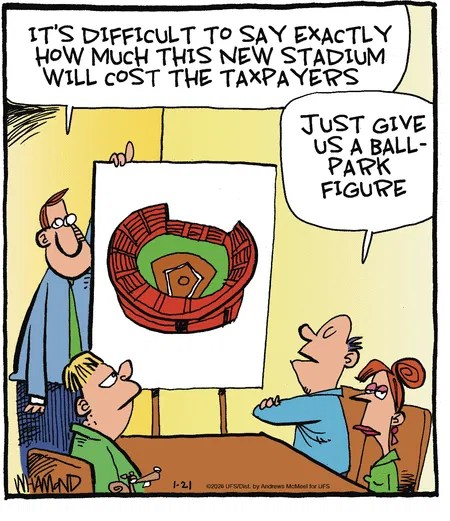
1. Subsidies for pro sports, including stadium construction, are damnable boondoggles. I would vote against every one of them until the franchise-owning billionaires ran me out of office.
While I’m at it, these too can come off the list:

2. Abolitions I supported that may well have hurt America:

  • The military draft Politicians who have anything to do with war policy should have skin in the game, even if it’s the skin of their descendants.
  • The Fairness Doctrine. We opened Pandora’s box before cable TV and the internet obliterated it. I don’t see a way back to sanity through reinstating the policy.

While I’m on a roll, here’s one that’s never been on the list:

3. The states should stop running primary elections. Neither major party is worth the powder to blow it up. Let them run their own elections or go back to “smoke-filled rooms” (which incidentally yielded better candidates than crackpot “base voters” have been yielding).

Logic mincing

Q: Which is better: a ham sandwich or complete happiness in life?
A: A ham sandwich, of course! Nothing is better than complete happiness in life and a ham sandwich is better than nothing.

  1. Something must be done!
  2. This is something.
  3. This must be done!

Shorts

  • No one is really working for peace unless he is working primarily for the restoration of wisdom. The assertion that “foul is useful and fair is not“ is the antithesis of wisdom. (E.F. Shumacher) Small Is Beautiful is a classic for good reason.
  • The national emergency is avoiding a national emergency. (Treasury Secretary Scott Bessent, citing the president’s authority to impose tariffs in an economic emergency, arguing that America’s supposed need to control Greenland is a national emergency.)
  • The health of the American experiment rests far more on the integrity of any given American president than we realized. (David French)
  • The pervasiveness of legal sports gambling can make an undefeated season and a 6-point victory in the national championship game feel like a loss if “the margin” was 7.5. (Moi)
  • At some point, we’ll reach the bottom of this dystopian populist abomination, but no one thinks we’re there yet, do they? (Nick Catoggio)
  • “The Trump Denmark letter is his Biden debate moment,” one Twitter user claimed.
  • Donald Trump is a peacock among the dull buzzards of American politics. (Martin Gurri, The Revolt of the Public and the Crisis of Authority in the New Millennium).
  • A clown with a flame thrower still has a flamethrower. (Charlie Sykes to Andrew Sullivan)
  • When you light a candle, you also cast a shadow. (Ursula K. Le Guin)
  • TikTok is still a danger. America no longer cares.
  • The souvenir is a fetish object that substitutes for the finite experience of the destination. (William T. Cavanaugh, The Uses of Idolatry)

Elsewhere in Tipsyworld


A devil is no less a devil if the lie he tells flatters you and stands to help you defeat your enemies and achieve power.

Rod Dreher

I don’t do any of the major social media, but I have two sub-domains of the domain you’re currently reading: (a) You can read most of my reflexive stuff, especially political here. (b) I also post some things on my favorite no-algorithm social medium.

Tuesday, 12/19/23

Why I write curate others’ writing

I write here not as a teacher to students but rather as a reader to other readers, a citizen to other citizens. I write because I think I have learned a few things in my teaching life that are relevant to our common life. You will see what those are if you read on.

My approach here is anything but systematic. Of all the literary genres, I am fondest of the essay, with its meandering course that (we hope) faithfully represents the meanderings of the human mind … certain images in advance and people will recur throughout this book, returning perhaps when you think we’re done with them. I write this way because none of the things that I care about most have ever proven susceptible to systematic exposition.”

Alan Jacobs, Breaking Bread With the Dead

For the most part, my essay-writing days are over (you’ll find much more of my own musings in earlier blog posts), but my curation of attributed quotes and their frequent juxtaposition of quotes that seem kindred express, I think, the same spirit Jacobs articulates here.

Mea culpae

Harvard polls versus polls of Harvard

Last Saturday, I gently mocked the idea that a poll at Harvard University could be a reliable indicator of the leanings of 18-24 year-olds nationwide.

Well, it turns out that it was a Harvard-Harris poll, not a poll of Harvard students.

In my defense, the writer I was gently mocking very specifically said that it was “a representative survey at Harvard University.”

On the shocking substance of the poll, see the questions raised by Ilya Somin.

Absolutely immune

I confess that I too quickly dismissed Donald Trump’s claim of absolute immunity — a claim that was rebuffed by the trial court, which decision Special Prosecutor Jack Smith now asks the U.S. Supreme Court to affirm. (I don’t think I scoffed here, but I did scoff.)

There are reasons why some officials enjoy absolute immunity for certain kinds of acts. Michael Warren and Sarah Isgur explain:

How would the Supreme Court decide it? 

This is the big question and it goes to the very heart of why we give immunity to some public officials. Judges, for example, enjoy absolute immunity from prosecution for their judicial acts—even if they acted corruptly or maliciously—because we don’t want every judicial act subject to meta-litigation. (We should note this doesn’t apply to actions outside legal decisions they make on the bench, which is why we see some judges prosecuted on bribery charges, for instance.) Legislators and prosecutors also enjoy absolute immunity for most of their official acts too. Why? Because we want these people to do their jobs without fear or favor. So how should we think about a president?

On one end of the spectrum, not many people would argue that a former president can’t be charged with murder for, let’s say, shooting someone on Fifth Avenue just because he was president at the time he pulled the trigger. On the other end, it would seem like a bad idea to allow a current president to bring fraud charges against his predecessor for overpromising and underdelivering on a policy proposal, such as “if you like your health care plan, you can keep it.” 

And to make this discussion more concrete, one of the things that Trump is charged with is “attempt[ing] to use the power and authority of the Justice Department to conduct sham election crime investigations.” Where does that fall on our spectrum?

It’s hard to guess where each justice will fall on this question because it involves questions about executive power, separation of powers, and all the future hypotheticals about how someone might abuse their power. In one outcome, presidents could be afraid to perform basic parts of their job because they might be charged with a crime down the road. In the other, current presidents could break the law with impunity for four years without fear of any future consequences. 

I’d expect the Supreme Court to decide whether to take the case just before the New Year.

Hard cases make bad law, and Donald Trump’s odious persona makes every case hard. Tread carefully — as I trust SCOTUS will if it takes the case.

Political follies

West Coast Big Mouths

Meanwhile on the West Coast it’s now looking nearly impossible to fund what would have been the country’s most expensive and unjust experiment in civic wokeness. Jose Martinez reports for CBS News in San Francisco:

The future of African-American reparations in San Francisco is facing an uncertain future after Mayor London Breed announced that a proposed office won’t be funded due to budget cuts.

The office would have been a precursor to attempting to redistribute money from people who never owned slaves to people who were never enslaved. It wasn’t just the principle of such a plan that was troubling, or the difficulty of trying to precisely define the level of ancestral guilt or victimhood within the great American melting pot. It was also the money. In March this column noted the work of a city-appointed reparations committee and asked:

How massive would this new race-based spending scheme end up being? “The committee hasn’t done an analysis of the cost of the proposals,” reported the AP at the time.

But Lee Ohanian, a fellow at Stanford’s Hoover Institution, examined the work of the committee and wrote in January:

I have analyzed some parts of this proposal and estimate that its cost, presented on a per-household basis, will be nearly $600,000 per non–African American San Francisco household.

He warned that “this estimate may be too low” but provided a ballpark number of recipients set to receive the proposed payouts:

Paying $5 million to 35,455 individuals totals about $175 billion. To put this in perspective, the city’s budget for the current fiscal year is $14 billion, while this proposed sum exceeds the current state budgets of all US states except for California, New York, and Texas.

Speaking of Texas, it would surely become the new home for much of San Francisco’s current population if this proposal is ever enacted.

James Freeman, Wall Street Journal

I wouldn’t be too hasty about moving to Texas, though I’d surely move somewhere if my household was going to get hit so heavily for something nobody in it ever did. Texas has an Attorney General who should have been convicted on his impeachment plus a legislature that seemingly cannot pass intelligible and reasonable laws plus a vendetta against public education.

I think one could do better.

Book-burning

This week, I watched videos of people literally burning Harry Potter books, like latter-day Nazis, in the cause of transgender liberation. It’s safe to say, I think, that many of these people have lost their minds — just by staying online. And they not only think they’re perfectly sane; they think they’re heroes.

Andrew Sullivan, We Are All Algorithms Now (September 2020)

If you are skeptical about the transgender social contagion, you should read The secret life of gender clinicians (UnHerd) and bear in mind that most of “trans” kids, if not “transitioned,” turn out gay or lesbian, but recovered from dysphoria; in other words, they are no longer uncomfortable with their sexed bodies. That’s why there’s dark humor that the gender clinicians are killing off a generation of gay kids, and this perverse aspect is a perennial source of concern for Andrew Sullivan.

For my money, insofar as a physician refuses to exercise a “paternalistic” or “gatekeeper” function, he or she has ceased being a professional and might as well be taking orders at a burger joint (where it really is no concern whether the customer’s burger-craving conceals something deeper).

Giuliani, a genuinely tragic figure

The first thing you need to know about a MAGA Man like Giuliani is that he’s dishonest. Truthfulness is incompatible with Trumpism. Trump is a liar, and he demands fealty to his lies. So Giuliani’s task, as Trump’s lawyer, was to lie on his behalf, and lie he did. He even repeated his lies about Freeman and Moss — the same lies to which he’d already confessed — outside the courthouse during his trial.

A MAGA Man such as Giuliani supplements his lies with rage. To watch him pushing Trump’s election lies was to watch a man become unglued with anger. The rage merged with the lie. The rage helped make the lie stick. Why would a man like Giuliani, former prosecutor and hero mayor, be so angry if he hadn’t discovered true injustice? MAGA Men and Women are very good at using their credibility from the past to cover their lies in the present.

Amid the lies and rage, however, a MAGA Man like Giuliani also finds religion. But not in the way you might expect. No, MAGA Man is not sorry for what he’s done. Instead, he feels biblically persecuted. Freeman and Moss aren’t the real victims; he is. Moreover, he also knows that the base is religious and likes to hear its politicians talk about God.

Giuliani learned that lesson well. So during the trial, he compared himself to Christians in the Colosseum, battling the lions like the martyrs of old. He’s not alone in this, of course. Trump shared an image of Jesus sitting by his side as he stood trial. Stone got so religious that he claimed to see supernatural sights, including, he said, a “demonic portal” that’s “swirling like a cauldron” about the Biden White House.

David French

We weren’t hallucinating when we admired Rudy’s mayoralty, were we? But some horrible flaw attached him to Donald J. Trump in a way that, as other Trump sycophants have learned, ruined him.

Crunchy Left Populist Conservatism

Dreher proposed the best way forward for the Republican Party when he wrote Crunchy Cons. In case anyone has forgotten the manifesto, here it is again in brief:

  • Conservatism should focus more on the character of society than on the material conditions of life found in consumerism.
  • Big business deserves as much skepticism as big government.
  • Culture is more important than politics and economics.
  • A conservatism that does not practice restraint, humility, and good stewardship—especially of the natural world—is not fundamentally conservative.
  • Small, local, old, and particular are almost always better than big, global, new, and abstract.
  • Beauty is more important than efficiency.
  • The relentlessness of media-driven pop culture deadens our senses to authentic truth, beauty, and wisdom.
  • The institution most essential to conserve is the traditional family.

Arthur Hunt III, Live Not by Lies From Neither the Left Nor Right How much is today’s “conservative” party, the GOP, interested in such values? If I hold my head just right and squint, I think they might be inchoately interested in several of them, but the way they express it is pretty off-putting.

(See also Ashley Colby, The Case for Left Conservatism and Fr. Stephen Freeman, A Day Off Versus The Day Of)

Culture

El Rushbo revisited

His obituaries in the mainstream press were mostly judgment, no mercy. It’s not nice when malice gets a final, unanswered shot. On the conservative side, TV commentaries were cloying to the point of cultish. It gives a sense of horror to see people who are essentially cold enact warmth of feeling.

Peggy Noonan, on the “complicated legacy” of Rush Limbaugh

More:

What made Rush Limbaugh’s show possible was the repeal of the Fairness Doctrine, which, starting in 1949, mandated that holders of broadcast licenses must both give airtime to important issues and include opposing views. It asserted a real public-interest obligation from broadcasters.

By the 1980s it was being argued that the doctrine itself was hurting free speech: It was a governmental intrusion on the freedom of broadcasters, and, perversely, it inhibited the presentation of controversial issues. There were so many voices in the marketplace, and more were coming; fairness and balance would sort themselves out.

In 1987 the doctrine was abolished, a significant Reagan-era reform. But I don’t know. Let me be apostate again. Has anything in our political culture gotten better since it was removed? Aren’t things more polarized, more bitter, less stable?

I’m not sure it was good for America.

War and poetry

It has been said that the Second World War did not produce great poets like the First War did. The Second War did not produce a Wilfred Owen or even a Siegfried Sassoon.

But that is because the great poems of the Second World War were not written in English. They were written in German and in Russian.

Douglas Murray, Things Worth Remembering: A Grave You Will Have in the Clouds, introducing Paul Celan.

Rod Dreher

Sometimes, it feels as if one of my roles in the world is to read Rod Dreher so others don’t have to. His hair is frequently on fire (or he’s gotten good at pretending it is; for the sake of his soul, it’s probably better that it be authentic, not feigned).

Why do I follow him? Well, I became a fan with his book Crunchy Cons (and see above, too), lo these seventeen years past. I’ve bought every book since, though some didn’t touch me and one made me cringe. I followed him at American Conservative, where his cultural catastrophizing enabled him to blog prolifically. I followed his departure from the Roman Catholic Church, gutted, and his prompt discovery of the Orthodox Church. I’ve attended a conference where he was a keynoter and chatted one-on-one. Now I’ve followed him through his divorce, the causes of which he has concealed beyond the generalities that both were at fault in some measure but neither was unfaithful, and which has left him, once again, gutted.

I’d call it “friendship” were it not that he almost certainly doesn’t remember me (he might say he’s met me before if he saw a picture). That, plus he so frequently puts his finger on something with pretty articulate analysis.

So it was twice this week. First (though second chronologically):

So: in the Church of Pope Francis, a priest can bless a gay couple who are engaged in sodomy, but that priest cannot say the Tridentine mass. This is where Catholicism in in 2023. When I became a Catholic, and after I left the Catholic Church, I have always believed that the health and stability of Christianity in the West depends on the health and stability of the Catholic Church, as the mother church of the West. This is not a day for any Protestant or Orthodox Christian living in the West to feel smug and superior. The loss of Rome to the Great Queering — and if you think Rome will stop here, you need to talk to some people who have lived through the queering of their Protestant communions — is going to be a massive blow to all Biblically faithful Christians living in Western civilization.

The next papal conclave — one of the most important in Church history — will determine if Francis was an aberration, or if his liberalizing is the new normal. And if the next pope reverses some or all of this, what kind of fight will he have on his hands?

(See section III of this for background; it’s very fresh news)

And as if anticipating this development:

It is worth thinking about, though, why homosexuality has become the pre-eminent wedge issue across Christian churches. Church progressives have this dishonest strategy of pretending that it’s a minor issue, except for the fact that they won’t give it up and reach a compromise with conservatives. I suppose if I believed what progressives do about homosexuality and transgenderism, I would be bound to think that this is an issue on which compromise is impossible, for the same reason I would find it impossible to compromise with Christians inside my ecclesial body who believed that (say) black people were living in a state of sin by being black.

I do not believe what progressives do on the point, however. I do not believe that homosexuality and/or transgenderism is a characteristic like race. I won’t argue the point here and now, but I simply want to highlight the profundity of the disagreement with Christian progressives here. If you believe that LGBT status is in the same moral category as race, then everything else follows. It becomes incomprehensible, outside of raw bigotry, why conservatives within the church object.

The reason why homosexuality, and human sexuality in general, is the pre-eminent wedge issue is because of Christian anthropology. That is to say, the Bible gives us a clear idea of what it means to be a being made in the image of God. We know from direct Scriptural teaching, as well as from reasoning from revealed first principles, that homosexuality runs contrary to bedrock Christian teaching. That homosexuality is, to use the language of the Roman catechism, “intrinsically disordered” — meaning that by its very nature it cannot be reconciled to the Logos. I am unaware that the Bible has anything to say about transgenderism, but if that’s not intrinsically disordered, nothing is.

In contemporary times, many, perhaps most, people do not see either homosexuality or, increasingly, transgenderism as disordered, in part because they do not recognize an intrinsic order, at least not one that excludes either phenomenon.

That “homosexuality runs contrary to bedrock Christian teaching” is a hard teaching in this age, and obviously there are progressives in the Church of England (and elsewhere) that think otherwise. But when one sees Christianity as a way of life suited to the salvation of human persons rather than a checklist of doctrines to affirm, anthropology because pretty central.

I’m increasingly inclined to renew Dreher’s Rod’s Substack at annual renewal time in a few months, despite how I felt a few months ago.

This is water

As they say, something can be so obvious that it becomes invisible.

The old saw that “courts decide cases” is not accurate when the subject is the United States Supreme Court. It decides issues that it thinks important.

That said, I think Ben Johnson, The Supreme Court Doesn’t Just Decide Cases, gets a lot wrong (I don’t see, and Johnson doesn’t try to show, how picking issues turns the court into a legislature), though I’m (we’re?) indebted to him for pointing out the novelty (a mere 80 years) of abstracting issues from the case context, and the shaky legal basis for doing so.

Shorts

Donald Trump dishonors America in so many ways that it isn’t possible to keep them all in mind and still remember to brush your teeth.

George Packer

* * *

A good science fiction story should be able to predict not the automobile but the traffic jam.

Fredrik Pohl

* * *

… an age which advances progressively backwards …

T.S. Eliot, Choruses from The Rock

* * *

Over 280 million electric mopeds, scooters, motorcycles, and three-wheelers are displacing four times as much demand for oil as all the world’s electric cars at present.

Dense Discovery #269


So walk on air against your better judgement

(Seamus Heaney)

You can read most of my more impromptu stuff here (cathartic venting) and here (the only social medium I frequent, because people there are quirky, pleasant and real). Both should work in your RSS aggregator, like Feedly or Reeder, should you want to make a habit of it.