Immigration

The firehose of commentary on last Thursday’s birthright citizenship/nationwide injunction Supreme Court argument is now more a squirt gun. But I’ve had two very smart takes clipped for days now, and I think it’s time to get them out to readers:

Justice Ketanji Brown Jackson put it well in [last Thursday’s] argument:

[T]he real concern, I think, is that your argument [meaning that of the federal government] seems to turn our justice system, in my view at least, into a “catch me if you can” kind of regime from the standpoint of the executive, where everybody has to have a lawyer and file a lawsuit in order for the government to stop violating people’s rights.

Justice Kagan says let’s assume for the purpose of this that you’re wrong about the merits, that the government is not allowed to do this under the Constitution. And yet it seems to me that your argument says we get to keep on doing it until everyone who is potentially harmed by it figures out how to… file a lawsuit, hire a lawyer, et cetera. And I don’t understand how that is remotely consistent with the rule of law

This is especially true when, as in the birthright citizenship case, there are hundreds of thousands of victims of the government’s illegal policies, and many of them are poor or otherwise unable to readily file a lawsuit.

Ilya Somin, A Simple Defense of Nationwide Injunctions

Only the Supreme Court, the Administration asserts, can declare the policy unconstitutional as to persons who are not party to any lawsuit, and only the Supreme Court can enjoin the government from revoking the citizenship of persons similarly-situated to Able, Baker, and Charlie but located in other judicial districts.

It’s not a totally unreasonable position: only the Supreme Court has truly nationwide jurisdiction, and it alone should be permitted to decide “the law of the land,” not some district court in Texas or Massachusetts or Colorado.

But Justice Kagan identified the fatal flaw in the argument:

If [the government] wins this challenge and we say that there is no nationwide injunction and it all has to be through individual cases, then I can’t see how an individual who is not being treated equivalently to the individual who brought the case would have any ability to bring the substantive question to us…. In a case like this, the government has no incentive to bring this case to the Supreme Court because it’s not really losing anything. It’s losing a lot of individual cases, which still allow it to enforce its EO against the vast majority of people to whom it applies. . . . I’m suggesting that in a case in which the government is losing constantly, there’s nobody else who’s going to appeal; they’re all winning! It’s up to you, [the government], to decide whether to take this case to us. If I were in your shoes, there is no way I’d approach the Supreme Court with this case.

Which is exactly what happened here! …

… paradoxically enough, the more egregious the executive’s conduct – the more obviously and incontrovertibly unconstitutional it is – the more likely it is that it will lose every case, which will mean that the question of its constitutionality never gets to the Supreme Court for a conclusive ruling.

Clever, no? Another seam, or fault-line, in the web of constitutional protections and the separation of powers has been exposed.

I regard this as a fatal objection to a rule prohibiting non-party injunctions in all cases because it fails what we might call the Hitler Test: if we are ever so unfortunate as to have a president who wanted to do Hitler-ian things, would this rule help to prevent that from happening or not? It’s not a terribly high bar, but a rule prohibiting non-party injunctions in all cases doesn’t make it over.

David Post, Nationwide Injunctions and the Rule of Law

I have almost no doubt that the Trump administration will never bring the merits of its absurd birthright citizenship theories to the Supreme Court so long as it can continue acting on them against everyone who lacks the moxie or the wherewithal to file a lawsuit and get an injunction preventing enforcement against them personally. It will feel just fine if 10,000 successful plaintiffs can’t be deported so long as hundreds of thousands or millions can be plausibly threatened because they haven’t sued.

By the way: there are almost no honest politicians in the immigration fights. Everyone knows how to reduce illegal immigration to almost nothing: Congress must make e-Verify mandatory. They won’t do it because the economy relies on the mostly-menial labor of illegal immigrants, but they will bluff and bluster. And I’d give you pretty good odds that Donald J. Trump won’t deport them all for that reason, too. There will be just enough performative cruelty to keep MAGA happy.


Your enemies are not demonic, and they are not all-powerful and the right hasn’t always lost and the left hasn’t always won. But if you convince yourself of that, you give yourselves all sorts of permission to do a lot of stupid and terrible things under the rubric of “Do you know what time it is?”

Jonah Goldberg.

Regarding said “lot of stupid and terrible things,” my failure to call out anything about the current regime does not mean I approve. There’s just too much, and on some of the apparent illegalities I don’t want to abuse my credentials without thinking it through.

I don’t do any of the major social media, but I have two sub-domains of the domain you’re currently reading: (a) You can read most of my reflexive stuff, especially political here. (b) I also post some things on the only social medium I frequent, because people there are quirky, pleasant and real.


Musings, 2/21/25

Can there be a lawful order to act unethically?

I’m struggling with the agreement between Sarah Isgur and David French on the Advisory Opinions podcast that the orders from the Trump Department of Justice to dismiss the charges against New York City Mayor Eric Adams was a lawful order, even if compliance by federal prosecutors would have been unethical. I’d like to think that an order to a professional to do something unethical is ipso facto not a lawful order.

If nothing else, this confirms the wisdom of not allowing non-lawyers to own a law firm (e.g., Model Rules of Professional Conduct 1.17(b)) lest this kind of thing pervade the legal profession rather than remaining an application of the unitary executive theory to the Department of Justice.

This is why we can’t have nice things

Speaking of unitary executive theory, I have more or less been persuaded to become a “soft unitarian.” But the test case that Donald Trump has set up by firing the head of the Special Counsel’s office is straining my recently-acquired conviction.

Mafia Don has fired Hampton Dellinger, current head of the Office of Special Counsel, without invoking “inefficiency, neglect of duty, or malfeasance in office” as required by statute. A federal District Court has ordered that he be reinstated. A federal Court of Appeals has rejected Trump’s appeal on technical grounds (the District Court decision is only preliminary, not final). He now seeks review by the US Supreme Court.

I shudder because unitary executive theory makes the substance of his appeal plausible.

So here’s the deal on the Constitutional issues.

The Constitution establishes three branches of the federal government: Congress (Article I), the Executive (Article II), and the Judiciary (Article III). The opening words of Article II are “The executive Power shall be vested in a President of the United States of America.“

So what is the status of supposedly “independent” agencies, created by Congress, like the Office of Special Council? Are they a fourth branch of government, hiding in the shadows of the constitution, or are they simply unconstitutional because all executive power is vested in the presidency? If the latter (which is substantially the position of President after President since the Office was created, but nobody before The Don cared so little about chaos to provoke a fight over it), then what checks the power of the Presidency? Are we doomed to live under a kakistocracy if the President goes haywire?

The conventional answer is that Congress’s impeachment power checks the power of the presidency. If you are satisfied that this Congress has the cojones to impeach this president, you are living in a different reality than I am.

As I sit here in my easy chair, six years retired and 43 years out of law school, the best response I can come up with for SCOTUS is (1) refuse to hear the case because the District Court decision is only preliminary or (2) take the case and rule that independent agencies are not exercising executive power, but rather are serving as a check on executive power, and thus really are “hiding in the shadows” of the Constitution.

I think this would be a satisfactory ground to uphold the District Court. But I remember how conservatives derided Justice Harry Blackmun’s finding a right to abortion in the “emanations of the penumbrae” of the constitution?

The electorate having decided that Mafia Don was the lesser evil (a perception I gradually came to find defensible within the 5 or 6 months preceding January 20) has thrust us into the Constitutional crisis of an utterly corrupt President who will never be impeached because not only can he suborn and fund primary candidates against those who would impeach him, but he can with winks, nods, and stochastically violent rhetoric unleash fanatics that make Congressmen literally fear for their families if they cross him.

A decision either way from the Supreme Court will deepen the crisis.

First, they came for the radical liberal communists …

Pundit tribalism

That issue—how intellectuals are supposed to comport themselves in their political engagements—is one that matters a lot to me. On top of the policy disagreements, what drove me away from the intellectual right two decades ago was the expectation, as an editor for First Things magazine, that I defend a political line in public. I wasn’t allowed to write a conservative case for not invading Iraq, for example, because that would risk making myself and the magazine appear “unreliable.” There was simply too much at stake, my boss told me, to risk a dissent from the conservative movement and its presidential champion. The War on Terror had to be won—and even more fundamentally, George W. Bush needed to have a successful presidency. We couldn’t risk contributing to its failure by directing criticisms its way.

Damon Linker

I’m very sympathetic to Linker about this kind of tribalism.

Our local rag used to have a very lively letters to the editor section (they don’t even have an opinion page anymore). When my religious Right co-belligerents expressed particularly idiotic opinions or called for perverse boycotts (example omitted because it was so idiotic you wouldn’t believe me), I tended to refute them vigorously, and at least once received an anonymous phone call implying that I was a Judas (no threat, just bile).

Why can’t the world be unanimously sane and moderate, just like Damon Linker and me?

Our four-party system

I enjoyed Ezra Klein’s little essay the other day as a partial explanation of how polarization got worse:

The two-party system of the 20th century was really a four-party system. The Democrats were split between the liberals we know today and the Dixiecrats, whose primary goal was upholding segregation. The Republicans were split between conservatives and Northern liberals. It is astonishing from our vantage point, but it was true for much of the 20th century: To say you were a Republican or a Democrat didn’t reveal whether you were a liberal or a conservative. As a senator, Joe Biden opposed the Roe v. Wade decision in 1973. President Richard Nixon proposed a universal health care bill and created the Environmental Protection Agency. George Wallace started out as a Democrat. Politics was different then.

Parties that contained so many different places and ideologies could not act in lock step, and so bipartisanship was common. The Civil Rights Act of 1964 was pushed by a Democratic president, but congressional Republicans were crucial to its passage. When Watergate began coming to light, Congress acted as a collective. Only four House Republicans voted against opening the impeachment inquiry into Nixon, and a delegation of congressional Republicans ultimately persuaded him to resign.

And it wasn’t just impeachment. When Nixon refused to spend the money Congress had appropriated — a policy known as impoundment — Congress acted to protect its power: The Congressional Budget and Impoundment Control Act of 1974 passed the House with only six “no” votes; it passed the Senate without a single vote in opposition.

(Emphasis added) I remember guys like Scoop Jackson, Dick Gephart, Mark Hatfield, Nelson Rockefeller, John Lindsey. Joe Manchin proves there’s no room for that kind any more. There’s just two tribes, each controlled from the wings, not the center.

Clamoring aboard the ARC

A Jordan Peterson-adjacent, Christian-coded “Alliance for Responsible Citizenship” recently convened. Two Orthodox Christian friends have diverging thoughts:

As I wrote yesterday, it is strange that it has taken a non-believing clown like Donald Trump to be the Great Disrupter. We do not have to agree with everything he does …, but I believe people like me can work with people like him in ways we simply could not do with those who were in power before.

Rod Dreher, whose “responsible citizen” culture-warring is a bone of contention between him and his friend Kingsnorth:

Jesus didn’t come to Earth to teach us how to be ‘responsible citizens’, of any political stripe. Responsible citizens don’t leave their own fathers unburied. They don’t hate their own mother and father, or give away all of their wealth, or compare the religious authorities to whitewashed tombs full of rotting flesh. And they don’t usually end up being crucified.

Paul Kingsnorth commenting in advance.

My sympathies lie almost completely with Kingsnorth, but I understand Dreher’s point — though I would rephrase it as “Unlike the Democrats, Trump is not actively and operationally hostile toward America’s motley array of ‘conservative’ Christians.”

Back in the days when I blogged longer-form original material more than curating other folks’ stuff, I declared myself a “Conscientious Objector to the Culture Wars” (a status that’s hard to maintain consistently) in a long-form blog that holds up well as a description of why I disengaged. This was about 80% Kingsnorthian a decade before I’d heard of the guy. It’s a posture that has spared me the ignominy of ever hallucinating that “we can work with” Trump 2.0 toward any truly edifying end.

(By the way: my shift from longer-form original material toward curation is, I think, a recognition that I’ve blogged most of my idées fixes in long-form and to my personal satisfaction; there’s no need to inflict them on others constantly, though I’m toying with a blogroll of my landmark posts.)

Just because …

… I thought this image was beautiful.

Jozef Pankiewicz, Market Square of Warsaw by Night, 1892 (Wikimedia Commons)


O Lord of hosts be with us, for we have none other help in times of sorrow but Thee. O Lord of hosts, have mercy on us.

I don’t do any of the major social media, but I have two sub-domains of the domain you’re currently reading: (a) You can read most of my reflexive stuff, especially political here. (b) I also post some things on the only social medium I frequent, because people there are quirky, pleasant and real.

Saturday 9/28/24

This is Purdue’s Homecoming weekend. They’re playing football — or pretending to. I’m looking forward to basketball season.

Miscellany

An odd job title, if you think about it

“Content Creator” is a title that inadvertently tells on itself. It’s a tacit admission that the nature of the “content“ is meaningless and it exists to fill space. Might as well call yourself “Stuff Maker” or “Thing Doer.”

Dominic Armato via Alan Jacobs

As wrong as possible

“Poverty just doesn’t happen,” Rep. [Barbara] Lee, a California Democrat, declared at the launch of the “Children’s Budget,” a kind of progressive wish list, last week. “It’s a policy choice.” Rep. Lee has run up against a kind of metaphysical limit there: She is as wrong as it is possible for a human being to be. 

As practically every serious thinker about the issue has understood for a few thousand years at least, poverty does just happen—it is, in fact, one of the few things that does just happen. Poverty is the natural state of the human animal. Do nothing, and you will have poverty. Thomas Hobbes knew it. Aristotle knew it 2,000 years before Hobbes. Hesiod knew it centuries before Aristotle. The authors of the Upanishads knew it centuries before Hesiod. “Throughout history, poverty is the normal condition of man,” the American sci-fi writer Robert Heinlein observed. Or, as Thomas Sowell spent a lifetime explaining to an apparently impenetrable public, poverty has no causes—the absence of poverty has causes. Rep. Lee’s error is not novel. Her mistake repeats—nearly verbatim—the error of Rep. Ayanna Pressley: “Poverty is not naturally occurring; it is a policy choice.”

Kevin D. Williamson

Nothing more freeing

Of The Bulwark’s Mona Charen:

In 2018, she appeared on a panel at the Conservative Political Action Conference. When asked about feminism, she attacked her own tribe, saying, “I’m disappointed in people on our side for being hypocrites on sexual harassers and abusers of women who are in our party, who are in the White House, who brag about their extramarital affairs, who brag about mistreating women. And because he happens to have an R after his name, we look the other way; we don’t complain.”

The crowd erupted in jeers and shouts of “Not true!” Charen had been a speechwriter for Nancy Reagan! This was CPAC, Republican prom! Security guards escorted her out for her own protection.

The incident didn’t seem to shake her. “There is nothing more freeing than telling the truth,” Charen later wrote in a New York Times op-ed.

Olga Khazan, Never Trump, Forever

Decades ago, Mona Charen was one of my favorite conservative columnists. I rarely read her these days because, in the anti-Trump cosmos, I’m on planet Dispatch and find planet Bulwark a bit weird tedious. Thus has the black hole of Donald Trump disrupted the cosmos.

What unites us

Americans are less divided politically than the media likes to pretend.

Yes, it’s a big, diverse electorate, but there are certain opinions we all share. Like this one: I can’t believe the party I hate isn’t getting clobbered in the polls.

From the Liz Cheney left to the Robert F. Kennedy Jr. right, ask any voter at random whether they’re surprised at how close this race is, and my guess is they’ll talk your ear off in exasperation.

Nick Catoggio

Banned Books Week

The Orwellian Evolution of Banned Books Week

Vice and Virtue

Neither fear nor courage saves us. Unnatural vices
Are fathered by our heroism. Virtues
Are forced upon us by our impudent crimes.
These tears are shaken from the wrath-bearing tree.

T.S. Eliot, Gerontion, via J. Bottum

The gay guy pundits agree

Harris’ Context

I can’t say what Vice President Kamala Harris’s favorite word is — the one time I met with her, I didn’t ask — but I’d put a big stack of chips on “context.” She said it not once, not twice, but three times in her signature May 2023 “coconut tree” riff, and I’ve heard it tumble from her lips on other occasions as well. It’s like some oratorical caftan, warming and comforting her.

That turns out to be apt. Her bid for the presidency is all about context.

Any realistic response to it hinges not on the policy details that she has or hasn’t provided, not on the fine points of her record over time, not on her interview with Stephanie Ruhle of MSNBC on Wednesday, not on her previous sit-down with CNN’s Dana Bash. It hinges on context. She cannot be sized up outside of or apart from the alternative, a man of such reprehensible character, limitless rage, disregard for truth, contempt for democracy, monumental selfishness and incoherent thinking that even discussing Harris’s virtues and vices feels ever so slightly beside the point. She’s not Donald Trump.

Frank Bruni

The words are different but the melody’s the same

In the culture war, we know exactly what she is: an equity leftist, a strong believer in race and sex discrimination today to make up for past race and sex discrimination yesterday, and a politician who favors redefining womanhood to include biological men, and conducting medical experiments on gay, autistic and trans children, based entirely on self-diagnosis. These are her values, they are the values of every Dem special interest group, and she assures us they have not changed. I believe her.

I have yet to hear her say a single interesting or memorable thing in her entire career. Have you?

If a serious Republican candidate were up against her — even Nikki Haley — this election would not be even faintly close.

But we do not have a serious Republican candidate.

We have the most shameless charlatan in American political history — and there are plenty of competitors. He is unfit in every respect to be president of the United States …

Trump does not merely break norms. He has broken the norm, the indispensable norm for the continuation of the republic, the norm first set by George Washington when he retired from office, the norm that changed the entire world for the better: accepting the results of an election … I do not think this is even within his personal control. He is so genuinely psychologically warped that he has never and will never agree to the most basic requirement of public office: that you quit when you lose; and that the system is more important than any individual in it.

He is not lying when he insists that he won in 2016 and 2020 by massive landslides in the popular vote. He believes it. He believes he will win by a landslide in November, and there is no empirical evidence that could convince him otherwise. If he loses the election, he will call it a massive fraud one more time, and foment violence to protest it. We know this more certainly than we know anything about Kamala Harris. He tried to leverage mob violence to disrupt our democracy once. If that was not disqualifying, nothing is …

So I will vote for Harris, despite my profound reservations about her. Because I have no profound reservations about him. I know who he is and what he is. I know what forces he is conjuring and the extremes to which he will gladly take his own personal crusade. To abstain, though temptingly pure, is a cop-out. I vote not for Harris as such, but for a conservatism that can emerge once the demon is exorcized.

And exorcize it we must. Now, while we still can.

Andrew Sullivan

Other thoughts on POTUS Election 2024

Uninteresting and unmemorable

We have to guard that spirit. Let it always inspire us. Let it always be the source of our optimism, which is that spirit that is uniquely American. Let that then inspire us by helping us to be inspired to solve the problems.

Kamala Harris. I hate to belittle her, because her context is him, and he is everything that Bruni and Sullivan said. If Indiana is in play, I’ll vote for the sane-but-empty suit who’ll leave office in 2028 if defeated, leaving our political system intact.

Suttons Bay, MI, last week

Donald Trump According to Those Who Know Him

My last NYT “gift article” for September, and one of the most important. Donald Trump According to Those Who Know Him

Even when he’s right, he’s wrong

Somebody apparently told Trump about, say, ProPublica attacking the Dobbs decision (substantially reversing Roe v. Wade). His over-the-top response, directionally right, was this:

When speaking to supporters from the swing state, where both Trump and Vice President Kamala Harris have doubled efforts to capture the election count in November, Trump lamented the criticism aimed at the Supreme Court‘s conservative supermajority and said it should be “illegal.”

“They were very brave, the Supreme Court. Very brave. And they take a lot of hits because of it,” said the former president. “It should be illegal, what happens. You know, you have these guys like playing the ref, like the great Bobby Knight. These people should be put in jail the way they talk about our judges and our justices, trying to … sway their vote, sway their decision”

Trump Says People Criticizing Supreme Court Justices Should Be Jailed

So he also is profoundly ignorant of our most fundamental rights, including the right to say stupid things about any branch of government we care to kvetch about.

Some Nationalist, this

Donald Trump is a funny kind of patriot. 

He loves America—except for the cities, the people who live in the cities, about half of the states, the universities, professional sports leagues, Hollywood, Silicon Valley, Wall Street, the legal system, immigrants, the culture. He thinks the Capitol Police are murderers and that the FBI is a gestapo, that the government is an illegitimate junta maintained through election fraud, that the January 6 rioters are political prisoners, that the nation is a ruin, that it is “failed.” And when it fell to him to explain to [a] debate audience why he should be president, he spent most of his time repeating the praise of Hungarian autocrat Viktor Orbán.

Trump’s enemies are all Americans, his friends are all foreign dictators, and his money lives in Dubai and Indonesia. Some nationalist. 

Trump lives in a very strange little bubble: His world is Palm Beach, a handful of golf courses and hotels, and Fox News. The smallness of his frame of reference is a problem for him ….

Kevin D. Williamson

Trump’s victims

Depending on how you count them, 19 or 26 or 67 women have accused Mr. Trump of sexual misconduct. Women who have said he “squeezed my butt,” “eyed me like a piece of meat,” “stuck his hand up my skirt,” “thrust his genitals,” “forced his tongue in my mouth,” was “rummaging around my vagina,” and so on.

Mr. Trump has denied any misconduct. He, in turn, has accused the women of being “political operatives,” plotting a “conspiracy against you, the American people,” looking for their “10 minutes of fame” and not being his “type.”

“It couldn’t have happened, it didn’t happen,” Mr. Trump sneered during a recent news conference, referring to Ms. Leeds, the one who accused him of assaulting her on an airplane. “And she would not have been the chosen one.”

Jessica Bennett, Trump’s Female Accusers Are Begging You Not to Forget Them

He can’t even deny his sexual assaults without:

  1. Sneering at how homely his accuser is and
  2. Tacitly admitting that he assaults women lucky enough to be “chosen.”

I suffer more from the humiliations inflicted by my country than from those inflicted on her.

Simone Weil, from a letter to Georges Bernanos.

I don’t do any of the major social media, but I have two sub-domains of the domain you’re currently reading: (a) You can read most of my reflexive stuff, especially political here. (b) I also post some things on the only social medium I frequent, because people there are quirky, pleasant and real.
Friday, 7/12/2

Culture

Anti-Christian, anti-religion, anti-tradition

The modern West is said to be Christian, but this is untrue: the modern outlook is anti-Christian, because it is essentially anti-religious; and it is anti-religious because, still more generally, it is anti-traditional; this is its distinguishing characteristic and this is what makes it what it is.

René Guénon Guénon, The Crisis of the Modern World.

Creepier than frank laxity

Just don’t do it again, promise? Remember those kids who got suspended from Harvard after setting up encampments on the lawn and then harassing other students? Well, the Harvard College Administrative Board has reversed the decision, a win for the “student intifada,” which I thought was slanderous but is actually just what they call themselves. And then over at Columbia, the administrators who texted each other vomit emojis during a panel discussing a rabbi’s op-ed about his fears for Jews on campus—they were fired, right? Well, actually they were just put on leave and will be assigned to different jobs later. And remember the Columbia students who were arrested after they occupied a campus building? Most of their charges were dropped. There’s something way creepier about punishing people in the moment only to reverse it as soon as the zeitgeist moves on to the next thing versus not punishing them at all.

Suzy Weiss

Prescient

This was not written of Team Biden, but it sure seems to fit:

The elites who manage the system no longer believe in a way forward. Stuck in the muck, they strive simply to endure: après moi le deluge.

Martin Gurri, The Revolt of the Public and the Crisis of Authority in the New Millennium

Not a flattering juxtaposition

  • In The Guardian, Marina Hyde: “It’s incredible to think that only a short while ago we thought we’d eradicated measles and Nigel Farage. Both have now been brought back, largely by the same people.”

Via Frank Bruni. (I didn’t call this “Politics” because it’s foreign politics.)

Enemies of Article III

Federal Court critics

Never forget, most commentary about the Supreme Court is performative. Critics have a vested interest in making the decisions seem so much worse than they really are.

Josh Blackman, Everyone Needs To Take A Deep Breath About Trump v. United States

AOC, ever-performative, is “trying” to impeach Justices Alito and Thomas — a kind of performative commentary uniquely available to congress-critters.

The Consumer Financial Protection Bureau, supported by left-wing interest groups, demanded that Judge Don Willett of the Fifth Circuit U.S. Court of Appeals recuse himself from a case challenging the CFPB’s rule on credit-card late fees. One of Judge Willett’s child college savings accounts held around $2,000 of stock in Citigroup, which wasn’t a party to the case.

Normally, parties to a lawsuit have a strong incentive not to provoke judges with baseless recusal demands. That makes it surprising the CFPB would join in such an unwarranted demand. But the bureau seems to be more an extension of certain Democratic politicians these days than a federal agency respectful of the rule of law. Several members of Congress, led by Sen. Elizabeth Warren, responded to the committee’s opinion with a hyperbolic letter declaring that the opinion and Judge Willett’s decision not to recuse himself “represent ongoing threats to the integrity of the judicial system.”

Recusal tactics have become more outrageous. Normally, only parties directly involved in the litigation can file a motion to recuse a judge for an alleged conflict of interest. But we now see coordinated campaigns to pressure recusals. Left-wing interest groups are submitting demands for recusal, coupled with press releases and press conferences. This practice should stop. There is no formal mechanism for outsiders to file such recusal demands, and for good reason. They clog courts with additional briefings and hearings, causing delays and distorting outcomes. Courts should refuse to entertain these ill-intended requests, and the lawyers and litigants responsible should be subjected to sanctions.

Theodore B. Olson, Proliferating Recusal Demands Threaten the Judiciary

Politics, more or less

What liberal democracy sounds like

In America, it can be easy to forget what liberal democracy sounds like. But it used to sound something like this:

Whilst he has been my political opponent, Sir Keir Starmer will shortly become our prime minister. In this job, his successes will be all of our successes and I wish him and his family well. Whatever our disagreements in this campaign, he is a decent public-spirited man who I respect. He and his family deserve the very best of our understanding as they make the huge transition to their new lives behind this door, and as he grapples with this most demanding of jobs in this increasingly unstable world.

Those are the words of former British prime minister Rishi Sunak in his farewell speech last week outside Number 10, Downing Street. This is how Keir Starmer responded:

I want to thank the outgoing Prime Minister Rishi Sunak, his achievement as the first British-Asian prime minister of our country. The extra effort that that will have required should not be underestimated by anyone, and we pay tribute to that today. And we also recognize the dedication and hard work he brought to his leadership.

He went on:

If you voted Labour yesterday, we will carry the responsibility of your trust as we rebuild our country. But whether you voted Labour or not, in fact, especially if you did not, I say to you directly, my government will serve you.

And, if you listen to them say these words, they even seemed to mean it. That’s what it takes to put a toxically divided country back on track toward liberal democracy, after a woundingly divisive period centered on Brexit.

No one claimed fraud. No one derided the lopsided unfairness of the parliamentary results, where Labour got 34 percent of the vote and a whopping 63 percent of the seats, and where the new rightist Reform Party won 14 percent of the vote and got only 5 seats. Those were the rules ahead of the game, and they were the rules everyone had agreed to.

There is one reason and one reason only why this kind of conciliatory exchange cannot happen any time soon in America, and that is Donald J. Trump ….

Andrew Sullivan, pitch-perfect.

I wish it were true that Trump is the whole problem, but he tapped into something that won’t go away just because he sheds this mortal coil.

Art of the Deal

  • “That the sheep are still on the air, dispensing undiminished certitudes, is evidence of two things. That — outside of a few bastions of meritocracy and accountability, such as professional sports — there is no penalty for failure in contemporary America. And that many prominent people have the scary strength that comes from being incapable of embarrassment.” (George Will on the Dem/MSM bunker)
  • “If Trump is elected again, Dems should get over it and try to do more deals with him like they did on the USMCA and First Step Act. Trump isn’t an ideologue and just has an enormous ego anyone can exploit,” – Zaid Jilani.
  • “Some will say now that I am calling America a Christian Nation. So I am. And some will say that I am advocating Christian Nationalism. And so I do,” – Josh Hawley.

Via Andrew Sullivan.

Comments:

  • Zaid Jilani’s advice is brilliant! We need more like that!
  • There is all kinds of play in the joints of “Christian Nationalism,” but any politician of Josh Hawley’s intelligence who demagogues the term is playing with fire and is going to find me unmoved when he tries to disambiguate it into something benign. Once a bright hope for the GOP, he’s gone shamelessly whoring after Trump.

You can have my delegates when you pry them from my cold, dead fingers

In his selfish desperation to retain control of his party, the president has resorted to political hostage-taking. His pitch to Democrats for sticking with him has nothing to do with sketching out a compelling plan to win or demonstrating his mental agility by holding numerous live events or even outlining a policy program for a second term. It’s simply this: The delegates he earned by winning this year’s primary (under false pretenses about his fitness) are pledged to him and he’s not giving them up.

Nick Catoggio, The Return of the Smoke-Filled Room

The window into Trump’s id

The best window into Trump’s ignorant and destructive id is often his Truth Social account. While normal Americans were making plans for Independence Day, an obsessive on Truth Social was declaring, “Elizabeth Lynne Cheney is guilty of treason. Retruth if you want televised military tribunals.” “Retruth,” in the idiom of Truth Social, means “to repost.” Trump of course retruthed. The former president also took time to retruth a post calling for Mike Pence, Mitch McConnell, Cheney, and a dozen prominent Democrats to be jailed because they saw fit to tell the American people the truth that the 2020 “elections were fair.” Republicans would be wise to remember that character is destiny and that Trump has never had any.

National Review, The Week


I suffer more from the humiliations inflicted by my country than from those inflicted on her.

Simone Weil, from a letter to Georges Bernanos.

I don’t do any of the major social media, but I have two sub-domains of the domain you’re currently reading: (a) You can read most of my reflexive stuff, especially political here. (b) I also post some things on the only social medium I frequent, because people there are quirky, pleasant and real.
A change in blog direction

The pundits all agree that the Republican Presidential Primary is over and that Donald Trump is the winner.

There’s no sign that Joe Biden will step down.

So we’re headed for a General Election between two geriatric cases (one of whom feels non-geriatric because of his manic narcissism).

I probably didn’t start railing against Trump when first he descended the Golden escalator if only because I did not take him seriously. Unfortunately, he soon became somebody who needed to be taken seriously and I have been contemning him loudly ever since at least since June 2016. It’s getting pretty old.

I never intended any implied endorsement of Hillary Clinton or Joe Biden. But then I never was a Democrat, and I don’t think I’ve ever written anything that would cause a reasonable person to think I was a Democrat. Let them sort out their own problems.

Rather, I was a lifelong Republican until age 56 when a Republican president I had voted for twice used his second inaugural address to commit the United States to a foreign policy that, if taken seriously, meant that the United States would be at perpetual war. “Eradicate tyranny from the world” is how he put it, as I recall.

Despite my having at that moment repudiated the Republican party, my atavistic political impulses still tilted Republican, and that’s why I’ve cared to warn about Trump.

Today’s Republican party is not the one I repudiated. I’m not entirely sure what it is, other than Donald Trump’s party. And neither are you, because it hasn’t adopted a platform since 2016. It’s still metamorphizing.

I think, however, that it is more anti-war than the old party was and by all accounts is a better representation of middle America than the old Republican party or the Democrat party. However, it has chosen as its avatar, a man who is utterly unfit to hold high office, and who wouldn’t care about a party platform even if there were one. And I’m not completely sold on the values of “middle America,” though it’s important to hear its voices. So whatever I might someday like about the GOP when it has finished its makeover, it’s still my former party, not my current party.

“But the Supreme Court!” doesn’t even work any more. Trump II will nominate cronies and certified jackasses, having discovered as Trump I that Leonard Leo‘s favorites take their oaths to the Constitution seriously and are not Trump lackeys.


Within the past few days, my logorrheic buddy, Rod Dreher and Friend of Bari Martin Gurri both have both detailed how far toward the insane Left the Biden administration has drifted (or sprinted). Duly noted, guys. Thanks. I probably was paying insufficient attention.

Both parties think, for reasons that make sense within their respective echo chambers, that the victory of the other spells the end of America as they’ve known it.

I have consistently registered my opposition to Donald Trump. (I withhold judgment on notional “Trumpism without Trump.”)

I now register my opposition to Joe Biden for some of the reasons Dreher and Gurri spotlight but mostly because he seems to have lost most of whatever he once had as a leader and, assuming the best about his intentions, to be captive of the crazies in his party for lack of the chops to fight back.

America is in bad Presidential shape for the third Presidential cycle. Trump’s problems don’t mean Biden’s okay. Biden’s problems don’t mean Trump’s okay. A fortiori, neither’s problems make the other a prince among men. I’m not taking any comfort in any Presidential politics, let alone putting any trust in princes, in sons of men in whom there is no salvation.

I plan to write in the candidates of the American Solidarity Party for the third Presidential election in a row. I would do so even if my state was “in play,” which it almost certainly will not be.


If any of this changes, I’ll let you know. Meanwhile, I intend to stop harping on it. As they say of sermons, “nobody gets saved after the first 20 minutes,” and I’ve been going on much longer than that.

I’m trying not even to read about the election, but political clickbait is something of a weakness. I only regret that this means I can’t share things like the image of Trump as a cocaine-crazed squirrel with a stick of dynamite.

All this will probably lessen this blog’s frequency, as politics is convenient filler for lazy writing. I hope it will free up headspace for better things, and that my quality, if not my quantity, will improve.

Wednesday, 12/7/22

Today is my father’s 103rd birthday. I’m now officially past the "I wish he were still with us" stage (though he regularly appears in dreams), since he presumably would be pretty miserable if he were.

Yes, his 22nd birthday got quite a cloud over it.

Legalia

How long, O Lord?

How many times do Republican- and Trump-appointed federal judges have to totally smack down Team Trump arguments before the mainstream media stop insinuating that Republican judges uniquely cannot separate law and politics?

303 Creative

Cage Fighting comes to SCOTUS

I listened to about an hour of Supreme Court Oral Argument in Monday’s 303 Creative case.

I thought I was confused because I’m old and rusty, but two younger, un-rusty commentators, Sara Isgur and David French, flagged the argument as very low-caliber and peppered with lurid hypotheticals designed not to explore the the implications of each advocate’s position, but to make the advocates whose arguments they disfavored look monstrous.

In other words, it was more like a televised Senate hearing than an ordinary Oral Argument. (Pro tip: if you consistently defend free speech, you can be “hypoed” into defending really abhorrent speech. Get a backbone.)

I am relieved. I may be rusty, but it was a poor argument, courtesy of the Justices.

Look for very sharp dissents from the justices on the losing side, because both sides seemed pretty heavily-invested.

An academic frames the question

The question is whether civil rights protections properly include the suppression of speech that disagrees with legal norms, or compels speech that celebrates those norms. Alternatively: do artists (including web designers) have the freedom to depict what subjects they wish, and how—even if they take money for doing it, and even if their perspective is hurtful (to some people)?

Prof. Michael McConnell

Moore v. Harper

Prof. Akhil Amar’s oddly-compelling, low-tech podcast had a couple of podcasts (October 26 and followup episodes with Steven Calabresi) on the Independent State Legislature doctrine purportedly at issue in Wednesday’s Moore v. Harper SCOTUS oral argument.

For the first time, though, I’m now feeling misled by Prof. Amar. Wednesday’s Wall Street Journal features two pieces, one by the Editorial Board and one by lawyers, casting the controversy in terms that seem to make Prof. Amar’s argument peripheral if not irrelevant to the real issues.

Prof. Amar legitimately notes that each state legislature is created by that state’s constitution, and the boundaries of the “legislature” vary according to things like whether the governor has veto power, thus making him a part of the legislative process. This matters because elections are unusually entrusted not to the states generally, but specifically to their legislatures.

The Wall Street Journal pieces legitimately note that under no sane construal are state courts part of the legislative process. Thus, state courts have no role in overseeing federal elections, though federal courts may.

That is perhaps an over-simplification, but it struck me as a powerful point against the backdrop of state courts making up anti-gerrymander rules not found explicitly in their state constitutions, or overruling the legislature’s absentee ballot deadlines in favor of their own.

Maybe litigants took more extreme positions, justifying Prof. Amar’s characterization of ISL’s danger.

I expect SCOTUS, as I almost always do, to adopt narrow reasoning in Moore v. Harper — to deal with the case(s) at hand without sweeping pronouncements that they might regret later.

P.S.: I listened to a half-hour or so of arguments in the case Wednesday, and it seems that SCOTUS views the case more as does Wall Street Journal, less as does Akhil Reed Amar.

Trumpish

Snivelling cowards cool on Florida Man

He used us to win the White House. We had to close our mouths and eyes when he said things that horrified us.

Mike Evans, a former member of Trump’s evangelical advisory board, via Michelle Goldberg

You only had to close your mouth if you valued power and proximity over integrity. Don’t come snivelling to me now.

Pissing away Georgia — again

I’m gratified at the loss of Herschel Walker in the Georgia runoff for U.S. Senate.

I loved Walker as a football player. I probably could tolerate him as a former football player, bastard children and absentee fatherhood notwithstanding.

But his only claim to qualification for the U.S. Senate is that Florida Man endorsed him and encouraged him, despite patent unfitness intellectually. And when his sins found him out, his response was not that of a repentant Christian, but of someone with a sense of entitlement.

To drive a stake squarely through Florida Man’s heart, I only wish Walker had lost by more. He now has twice cost the GOP some national elective offices from Georgia that really should have been theirs:

All of this [context of Trump behavior] predictably helped make the runoff a fractal of the larger 2022 pattern: Under Trump’s influence, with Trump’s preferred candidates, the Republican Party first sacrificed a potential Senate majority and then sacrificed one more Senate seat for good measure.

Ross Douthat

Unrealistic, but instructive nonetheless

National Review’s Charlie Cooke would like a word with those arguing that, because Donald Trump’s call to suspend the Constitution won’t be heeded, it doesn’t really matter. “During the closing days of the 2020 election, I wrote repeatedly about the seriousness of Joe Biden’s refusal to reject his party’s growing demand to ‘pack’—i.e. destroy—the United States Supreme Court,” Cooke writes. “Not once did I receive an email from a Trump voter telling me that my alarm was misplaced on the grounds that, in all likelihood, Biden would not have the votes to do it. Back then—and rightly so—the mere fact that Biden was entertaining the idea was deemed instructive: ‘When people tell you what they want to do with power,’ my correspondents invariably opined, ‘you should believe them. Joe Biden cannot be trusted with power.’ Well, so it is with Donald Trump once again. … American patriots do not seek to overturn legitimate election results or recommend the suspension of the United States Constitution; they respect and defend both at all costs. Donald Trump is not a patriot. He is, in his heart of hearts, a tyrant. Take note, America.”

The Morning Dispatch


[S]ubordinating truth to politics is a game which tyrants and bullies always win.

Jonathan Rauch, The Constitution of Knowledge

To believe that wealth is the only significant measure of the worth of an individual, a family, or a community is to reject the teaching of nearly every religion and wisdom tradition that ever was.

Mark Mitchell and Nathan Schlueter, The Humane Vision of Wendell Berry

The Orthodox "phronema" [roughly, mind-set] cannot be programmitized or reduced to shibboleths.

Fr. Jonathan Tobias

You can read most of my more impromptu stuff here (cathartic venting) and here (the only social medium I frequent, because people there are quirky, pleasant and real). Both should work in your RSS aggregator, like Feedly or Reeder, should you want to make a habit of it.

Thursday Tidbits 12/16/21 (remember that date)

Brevity is the soul of opacity

Although the parties’ briefs, the record on appeal, our caselaw, and even IDEA itself contain an alphabet soup of administrative acronyms, we will spell things out for the sake of clarity. E.g., 20 U.S.C. § 1414(d)(1)(A)(i) (referring to an “individualized education program” as an “IEP”); Appellants’ Br. (using no fewer than twenty-two unique initialisms); Appellee’s Br. (similar). Given their frequency and intelligibility, we nonetheless will continue to abbreviate IDEA and RISD.

For those who prefer acronymic efficiency, however, our holding is roughly as follows: RISD did not violate IDEA with respect to K.S. because, as the SEHOs correctly found at the DPHs: (1) the ARDC’s IEPs for K.S., which included PLAAFP statements, TEKS goals for K.S.’s grade level, various accommodations, and a transition plan, were appropriately individualized in light of K.S.’s SLD; and (2) no actionable violation resulted from wrongly excluding K.S. from the Sept. MDR, which reviewed K.S.’s prior FIEs, FBA consultations, his IIE, Ms. H.’s reports of K.S.’s ADHD (an OHI), TBI, and mood disorders, and concluded that K.S.’s SLD did not cause him to commit the assault for which he was assigned to DAEP. And, in sum, the D. Ct. did not err in holding that K.S. received a FAPE in the LRE in compliance with IDEA.

Footnote 2, Leigh v. Riesel Independent School District, 5th U.S. Circuit Court of Appeals, November 22, 2021. H/T Advisory Opinions podcast

Cloning S.B. 8

California Governor Gavin Newsom may need to wash some egg off his face after his preening announcement that he’s going to imitate Texas S.B. 8 but in the context of chilling gun sales:

In oral arguments last month, Justice Brett Kavanaugh asked Texas’ solicitor general if allowing S.B. 8 to stand would incentivize states to pass similar laws infringing upon other protected liberties. “It could be free speech rights, it could be free exercise of religion rights, it could be Second Amendment rights,” he said. “If this position is accepted here, the theory of the amicus brief is that it can be easily replicated in other states that disfavor other constitutional rights.”

That’s the theory that Newsom is now hoping to put to the test in California, but constitutional scholars warn that his proposed gun control legislation may not be analogous to what Texas did with abortion.

“I think the Court would treat similar legislation dealing with guns or free exercise or what have you the same way. … So there’s nothing about this unique to abortion,” said Will Baude, faculty director of the Constitutional Law Institute at the University of Chicago Law School. “That said, I don’t think Gavin Newsom … fully understands what S.B. 8 is and how it works. For it to work—at a minimum, for instance—he would have to eliminate the ability of the state to prosecute people for those assault weapons or ghost weapons and things like that. I don’t know that he really means that. My guess is nobody will actually try to replicate this law’s particulars because it’s pretty complicated how it works.”

“To replicate this law and its effects in other contexts, you’ve got to pretty much do almost everything the law does,” added Jonathan Adler, professor at Case Western Reserve University School of Law. “It’s not merely private enforcement, and it’s not merely retroactivity. You have to, for example, divest state officials of any authority to enforce the same law. There are a whole bunch of other things you’ve got to do. Is California willing to do all of those things with regard to guns or with regard to assault weapons or whatever? Maybe, maybe not.”

‌The Morning Dispatch: Newsom Vows to Model Gun Legislation on Texas Abortion law

The dumbest audience in America

Sean Hannity, radio host and off-the-books Donald Trump adviser, demands to know. After all, Hannity points out, there have been scores of riots, some of them deadly, over the past couple of years. Why fixate on that one?

Sean Hannity apparently believes that he has the dumbest audience in America.

The sacking of the Capitol on January 6 by a gang of enraged Trump acolytes acting on the president’s complaint that the election had been stolen from him is different from other riots because of its particular political character. Stealing Nikes is one thing, and stealing the presidency is another. Hannity knows this. Most of you know this.

But, apparently, some people need to have it explained to them.

Kevin D. Williamson

The Morning Dispatch is favorably impressed by both Williamson and Michael Brendan Dougherty:

There are a pair of pieces up at National Review about the recent January 6 Select Committee disclosures. First, Kevin Williamson makes the case that comparing January’s Capitol riot with the riots that subsumed American cities in the summer of 2020 is a false equivalence. “There were 21,570 homicides in the United States in 2020. If one of the victims had been the president of the United States, we would have made a pretty big deal about it,” he writes. “What has been clear to some of us for a long time—and what is becoming more difficult to deny every day—is that the events of January 6 were part of an attempted coup d’état. … A riot that is part of a coup d’état is not very much like a riot that is part of a coup de Target.” Second, Michael Brendan Dougherty looks at how right-wing narratives about that day have shifted over the past year. “In the months after January 6, the politically correct move for Trump’s cable-news apologists has been to ignore the fact that the people who set about ‘investigating’ the supposed vote fraud have turned up nothing of consequence or merit,” he writes. “But the riot at the Capitol happened because President Donald Trump simply lied, and lied, and lied. … Treating Trump like a baby whose feelings had to be coddled at the end resulted in Ashli Babbitt’s getting shot as she tried to break into Congress against a lawful order to desist. He could no more Stop the Steal than make Mexico pay for the wall. But, pay for his actions? Some people did.”

And Jonah Goldberg, recently resigned from Fox, lays it on:

A "law and order" conservatism that says, "As long as liberals fail to condemn thuggish violence for their side, we feel no obligation to condemn thuggish violence on our side," cares neither about law and order nor conservatism.

Desperate times call for desperate nonsense

The left’s argument this week is that adoption is so traumatic for a child, who bonds in utero with the mother, that abortion is a mercy. The idea that the fetus can bond with the mother in utero seems to make the implicit case against legal abortion but no matter. Last week, a New York Times piece written by an adoptee argued this: “Babies bond with their mothers in utero and become familiar with their behaviors. When their first caretaker is not the biological mother, they register the difference and the stress of it has lasting effects.” Interracial adoption is apparently especially problematic: smells of white colonization.

The other issue is that good progressives are having a hard time talking about abortion as a women’s rights issue, since men can and do become pregnant (remember, the phrase now is “pregnant people”). …

Nellie Bowles, ‌Abortion, Guns, and Other Polite Topics of Conversation

Bowles also mentions:

This week, Lia Thomas, who competed for years on the men’s swimming team before joining the women’s team, has broken several women’s swimming records and finished one race a full 38 seconds before her nearest rival.

The Turn(s)

[A]fter 225 long and fruitful years of this terminology, “right” and “left” are now empty categories, meaning little more than “the blue team” and “the green team” in your summer camp’s color war. You don’t get to be “against the rich” if the richest people in the country fund your party in order to preserve their government-sponsored monopolies. You are not “a supporter of free speech” if you oppose free speech for people who disagree with you. You are not “for the people” if you pit most of them against each other based on the color of their skin, or force them out of their jobs because of personal choices related to their bodies. You are not “serious about economic inequality” when you happily order from Amazon without caring much for the devastating impact your purchases have on the small businesses that increasingly are either subjugated by Jeff Bezos’ behemoth or crushed by it altogether. You are not “for science” if you refuse to consider hypotheses that don’t conform to your political convictions and then try to ban critical thought and inquiry from the internet. You are not an “anti-racist” if you label—and sort!—people by race. You are not “against conformism” when you scare people out of voicing dissenting opinions.

When “the left” becomes the party of wealthy elites and state security agencies who preach racial division, state censorship, contempt for ordinary citizens and for the U.S. Constitution, and telling people what to do and think at every turn, then that’s the side you are on, if you are “on the left”—those are the policies and beliefs you stand for and have to defend.

So look at the list of things supported by the left and ask yourself: Is that me? If the answer is yes, great. You’ve found a home. If the answer is no, don’t let yourself be defined by an empty word. Get out. And once you’re out, don’t let anyone else define you, either. Not being a left-wing racist or police state fan doesn’t make you a white supremacist or a Trump worshipper, either. Only small children, machines, and religious fanatics think in binaries.

Liel Leibovitz, ‌The Turn

We need people to abandon the right as well for its betrayal of conservative principle, and the Trump era has produced a bumper crop of them.

Now we need to figure out how to build a home for the politically homeless from both ends of the political spectrum.

(For what it’s worth, I keep stumbling onto good stuff at Tablet magazine. I may feel honor-bound to contribute if this keeps up.)

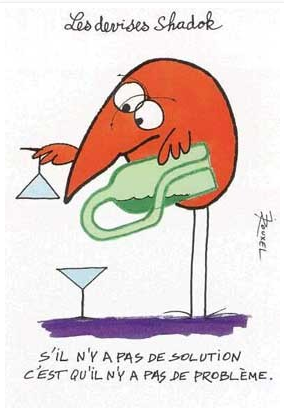
S’il n’y a pas de solution, c’est qu’il n’y pas de problèm

Two choristers tested positive between Monday’s Lessons and Carols rehearsal and Wednesday’s. Rehearsal cancelled.

Sunday’s performances? Who knows. Brings to mind this oldy:

(If there’s no solution, there’s no problem.)

The decade of ideological fantasy

The years 1991 and 2001 are commonly treated as breakpoints, markers that inaugurate distinctive chapters of history, the first labeled “Post-Cold War,” the second “Post-9/11.” Yet there is a strong case to be made for amalgamating the two decades into a single period: call it the “era of ideological fantasy,” when U.S. self-regard and Washington’s confidence in its ability to remake the world in America’s image reached unprecedented heights.

Bacevich, Weyrich, Lind et al, The Essence of Conservatism

Not at all sure I agree (but then I wouldn’t be, would I?)

The characteristic feature of the loser is to bemoan, in general terms, mankind’s flaws, biases, contradictions, and irrationality-without exploiting them for fun and profit.

Nassim Nicholas Taleb, The Bed of Procrustes.

How would I monetize flaws, biases, contradictions, and irrationality? Rupert Murdoch already founded Fox, back around 1988 (I remember where I was when I heard, and scoffed, that he was starting a fourth network).

Mythbusters

Second, Amar explains how the Chief Justice and Justice Sotomayor misread Marbury.

And what does Marbury v. Madison really mean? Marbury got invoked today by the United States Supreme Court. They don’t actually cite Marbury v. Madison in every single case. So they ratcheted up the stakes today, they meaning John Roberts and Sonia Sotomayor, and this is what I teach Marbury vs. Madison isn’t just ConLaw, it’s FedCourts, you know, 101, and this is what I was hired actually at the law school to teach so so I want to actually go through it with just a little bit of care here. Here’s what Marbury does not say, quote, "The Supreme Court is the ultimate interpret the Constitution" unquote. It doesn’t say that at all. Our audience will put the will put the case up on our website, so they can do a word search, they will not find that they will find if they go online, the Supreme Court at least half a dozen times in the 20th and 21st century, citing Marbury for that proposition, but never with a page cite. The Supreme Court, the ultimate interpreter of the Constitution. Marbury actually didn’t say that. It actually didn’t say much at all about the Supreme Court as such. It actually talked about courts in General, the judicial department which includes, at a minimum, all federal courts, maybe state courts as well, which which Ed invoked.

Amar is 100% correct. This mythical account of judicial supremacy comes from Cooper v. Aaron, and not from Marbury v. Madison. I explain this history in my article, The Irrepressible Myth of Cooper v. Aaron.

Josh Blackman (based on an Otter transcription of a podcast)

Misplaced sentimentality

Americans are a little sentimental about revolutions, because we had one of the very few good ones. But the revolutionary family tree gets pretty ugly pretty quickly: The American Revolution helps to inspire the French Revolution, with its purges and terror; the French Revolution provides a model for Lenin and his gang; the Russian Revolution informs the Iranian revolution. The line from the Boston Tea Party to the Iran hostage crisis is not a bold, straight one, but it can be seen, if you want to see it. Revolutions are dangerous, often in ways that are not obvious at the time and become understood only decades later.

Kevin D. Williamson, March of the New American Leninists

The January 6 insurrectionists vigilantes

The problem with treating every Republican more supportive of Trump than token GOP committee members Liz Cheney (Wyo.) and Adam Kinzinger (Ill.) as an existential threat to the republic is twofold. One, the reason the more serious legal efforts to overturn the election failed is because there were people with fidelity to the Constitution working for Trump. Sidney Powell wasn’t White House counsel. The second is that strengthening Capitol security — the riots were quashed the moment they were met with an appropriate level of response — is probably a better deterrent than trying to marginalize eccentric but widely held political views.

Republicans should take Jan. 6 more seriously, but they are also correct to resist treating ordinary members of their party as horn-wearing, violent extremists.

Damon Linker, The dangerous vigilantism that fueled Jan. 6

Rain Man

I thought Dustin Hoffman was brilliant in Rain Man, but then I’m a sucker for autism spectrum movies (Mozart & The Whale is another). Particularly effective was the bit about him memorizing the phone book — and then card-counting.

This came to mind as I overheard a 59-year-old Aspie of my close acquaintance recounting some trivial event that occurred when he was 7, on December 16, 1969 (see the post title, above).

The human mind is a marvel.


You can read most of my more impromptu stuff at here. It should work in your RSS aggregator, like Feedly, should you want to make a habit of it.

Deep in the heart of Texas

If I were pro-abortion (I still refuse the "pro-choice" label, though in some cases it is no doubt subjectively accurate) but too busy to read beyond the mainstream press, I’d be very queasy and alarmed about the Supreme Court’s refusal Wednesday to prevent Texas’s unprecedented new abortion law from taking effect. As a pro-lifer (yes, I do oppose capital punishment; thanks for asking), I’m surprised, but doubt after reading the nitty-gritty that we’ll finally rid ourselves of the 50-year pretense that our national constitution requires the free world’s most permissive abortion regime.

Wednesday’s decision was preliminary, and "complex and novel antecedent procedural questions on which [petitioners did not carry] their burden" mean that it’s not necessarily even an indication that the Supreme Court thinks the law’s challengers are unlikely to prevail ultimately (as denial of preliminary injunction usually implies).

Perhaps the best way to characterize [the situation] is that the law is built specifically to make it as difficult as possible for the courts to temporarily stop its implementation while they ponder its constitutionality. In other words, the law was designed specifically to bring about the situation Texas now finds itself in.

“The reason this is significant is, injunctions only apply to individuals,” Gabriel Malor, an appellate litigator and writer based in Virginia, told The Dispatch. “We have this thing, especially in legal commentary, where we say, ‘Oh, the law was enjoined.’ What we really mean was that an official was enjoined from implementing the law. And here it’s impossible—literally impossible—to enjoin all the citizens of the state of Texas from filing these civil suits. … So we get this weird procedural circumstance where the normal tools that are applied in abortion cases don’t really work here.”

The Morning Dispatch: SCOTUS Lets Texas Heartbeat Law Take Effect

How many citizens of Texas will come forward to file civil suits, given the likelihood that those suits will fail ultimately? I’m afraid that the answer is "None, except those that have very deep convictions (pockets, too) or are fronting for anti-abortion advocacy groups."

But when the smoke clears, assuming the Texas law is ultimately upheld and the Supreme Court’s reasoning effectively reverses Roe, the abortion issue will return to the state legislatures where it belongs. Considering the shift in our sexual culture over the decades, I expect that first trimester abortions will remain legal in most states, which will bring us into line with the rest of the Western world.

But the legislative fights will be ugly, and mainstream media will report limitations on second- and third-trimester abortions in apocalyptic terms.


You can read most of my more impromptu stuff at here. It should work in your RSS aggregator, like Feedly, should you want to make a habit of it.

Miscellany, 6/19/21

“The ‘Friends’ reunion we just had looked weird, because if you even suggested a show today about six people all of whom were straight and white, the network would laugh you out of the room and then cancel you on Twitter. And yet there is a recurrent theme on the far left that things have never been worse.”

The comedian Kevin Hart had recently told the New York Times, “You’re witnessing white power and white privilege at an all-time high.” Mr. Maher: “This is one of the big problems with wokeness, that what you say doesn’t have to make sense or jibe with the facts, or ever be challenged, lest the challenge itself be conflated with racism.”

He added: “Saying white power and privilege is at an all-time high is just ridiculous. Higher than a century ago, the year of the Tulsa race massacre? Higher than when the KKK rode unchecked and Jim Crow unchallenged?” …

Bill Maher, quoted by Peggy Noonan (Bill Maher Diagnoses Liberal ‘Progressophobia’ – WSJ)


In essence, [Employment Division v.] Smith demoted the Free Exercise Clause of the First Amendment to a glorified nondiscrimination doctrine. Rather than granting Americans an affirmative right to practice their religion absent compelling governmental reasons to restrict that practice, the Free Exercise Clause becomes almost entirely defensive—impotent against government encroachment absent evidence of targeted attack or unequal treatment.

David French, Four Things You Need to Know After a Huge Day at SCOTUS


The Obamacare battle created an unwritten Roberts rule. The fight against Obamacare has never been the GOP’s finest hour. The party hated the law yet couldn’t repeal the law, even when it controlled the presidency, House, and Senate. It hated the law, yet it couldn’t agree on a replacement for the law. There was never a realistic plan. It’s over, and Obama won.

But I’d also add that the Obamacare trilogy has not represented the Supreme Court’s finest hour …

[I]f you step back and look at the entire trilogy, the contortions … tell me that something was going on, that an unwritten rule might be in play. Remember that Justice Roberts always has one eye on the institutional credibility of the Supreme Court. Overturning an immense piece of social legislation passed by a filibuster-proof legislative majority would create a cultural and political convulsion. Roberts doesn’t want a convulsive court.

So what’s Roberts’s unwritten rule? Perhaps it’s something like this: When the elected branches of government enact truly significant social reforms, opponents should focus on winning elections more than winning cases. Any other approach degrades the cultural and political capital of the court.

David French, Four Things You Need to Know After a Huge Day at SCOTUS


Antifa did it. And it was totally peaceful. And we were expressing our righteous and justified indignation at the Democratic vote steal. And Portland was worse. And the FBI entrapped us.

David Frum, H/T Andrew Sullivan


Discretion to grant exceptions makes a law less than generally applicable, even if no exception has ever been granted, because discretion creates the potential for discrimination. Some lower courts have said that, but this is the first time in the Supreme Court. The Court has long invalidated standardless discretion in free speech cases, and the same rule should apply to free exercise, but they had never said that before.

There is no compelling interest in protecting same-sex couples here, because they are fully served in Philadelphia. And the liberals joined that. This passage clearly implies that the fact that gays are angry and offended by the continued existence of CSS does not give rise to a compelling interest. Here too, they had repeatedly so held in free speech cases, and the same rule should apply to free exercise, but whether it does has been disputed.

Douglas Laycock, via National Review, on Fulton v. City of Philadelphia (emphasis added).


In recognizing the Church’s role in providing moral leadership, we acknowledge and accept the tension that comes with being in disagreement with the Church in some areas. We recognize that no political party is perfectly in accord with all aspects of Church doctrine. This fact speaks to the secular nature of American democracy, not the devotion of our democratically elected leaders. Yet we believe we can speak to the fundamental issues that unite us as Catholics and lend our voices to changing the political debate – a debate that often fails to reflect and encompass the depth and complexity of these issues.

We believe the separation of church and state allows for our faith to inform our public duties and best serve our constituents.

Excerpt from Statement of Principles by nearly 60 Catholic Democrats in the U.S. House of Representatives. The occasion of the statement was the reported progress of the U.S. Bishops’ Conference toward denying communion to politicians who support legal abortion, with our current President serving as Exhibit A.

But I can’t find anything objectionable in this excerpt — and I note that the same sort of logic about "the depth and complexity of issues" gives Catholic neocons clear consciences about opposing the Church on capital punishment and economic policy that seems contrary to Catholic Social Teaching.

(By the way: one signer was Congressman Frank Mrvan, who in the Indiana legislature was foremost among pro-life Democrats.)


You can read most of my more impromptu stuff at here. It should work in your RSS aggregator, like Feedly, should you want to make a habit of it.

John Paul Stevens

I write a second time to note the death of Justice John Paul Stevens. I withdrew the first, this morning, because, almost as soon as I published it, details came back to me that I thought I had forgotten.

My first stab at it.

As noted by Prof. Friedman and five scholars whose work he links at Religion Clause, Justice Stevens was a big fan of our fabled church-state separation, so he caught my motivated attention.

What I can add as a particular sort Christian believer is that Stevens’ reasoning in his opinions did not seem remotely to apprehend what it means to be integrally religious — religious in a way that become part of one’s very identity. His lamentable judicial characterizations of religion frequently struck me as tone-deaf and micro-aggressive. It was as if religion were a hobby like bridge or golf, but markedly less intelligent and quite unworthy of the Right People.

What later came to me was a more detailed account of wherein his view of religion went awry.

Justice Stevens seemed to view religion more or less as LARPing: religious people are in a role-playing game in which a putative (if not punitive) god, our gamemaster, has set the rules, some of which are quite arbitrary. They are, however, The Rules, and some people really, really get into the game, and think that they will suffer terribly through eternity if they break those rules (Don’t ask too many questions. Just believe.). For some reason, probably related to how deadly serious some people are about it, our Founders privileged religious LARPing in the First Amendment.

Integral Christianity (I can’t speak for any other religion, and can speak only second-hand of LARP Christianity), in contrast, thinks that the “one God … almighty, creator of … all things visible and invisible,” has created and invited us into a reality, parts of which we cannot see or conclusively prove. Our loving God has not laid down arbitrary rules for slavish observance, but relates to us lovingly in ways variously analogized to marriage, adoption — even “partaking of the divine nature.”

Integrally Christian people, in short, think they are the true “reality-based community.” They realize that not everybody can perceive the reality. They realize that some (like me) have had no visions or ecstasies or direct revelations and are operating, more or less, on faith — having seen just enough to make faith itself reasonable.

In Justice Stephens’ defense, there’s a depressingly large proportion of LARPers among self-identified religious people. I’ve fulminated about it before, under the rubric of Nominalism versus Realism, and Realism is foundational to Natural Law thought as well.

I don’t think I had acquired even a rudimentary vocabulary of Nominalism versus Realism when Justice Stevens was alive and writing, but I knew that how he described religiosity rang false to how I lived it. He’s entitled to his own opinion, but he’s not entitled to his own facts.

I have never, as best I can recall, read or heard anyone else remark on the oddity of Justice Stevens’ characterizations of what it means to be religious, on the Nominalism he assumed, over against Realism. I never even heard, as best I can recall, anyone else remark on his strange compulsion to provide a gratuitous metanarrative of “religion,” a term so diverse that angels fear to define it.

I consider that academic silence a bad omen for religious liberty cases in the future, for Justice Stevens’ metanarrative of religion would surely subordinate it just about any “right” rooted in something deemed essential, not accidental.

I was happy when Justice Stevens retired, but I cannot allow myself to be happy about anyone’s death. That’s less because my faith commands me against it than because the way reality works is that grudges that deep would deface my soul.

I doubt that he’d have understood that distinction.

R.I.P. anyway.

UPDATE:

As if it weren’t enough to write this, then pull it down and re-write, I now cite with delight a better description of integral/classical Christianity from Fr. Stephen Freeman, as well as my commentary on it as a supplement to this blog entry.

* * * * *

You can read most of my more impromptu stuff at here. It should work in your RSS aggregator, like Feedly, should you want to make a habit of it.

I highly recommend blot.im as a crazy-easy alternative to Twitter (if you’re just looking to get your stuff “out there” and not pick fights).