But in this case, to understand is not to be reassured. There is a dictatorial theory behind Trump’s assertion that “He who saves his country breaks no law,” and it is limited only if he gets tired of declaring bogus emergencies (from which to “save America”) or declines to defy the courts.
[Leo] Strauss sets out a timeless moral standard of what is “intrinsically good or right” in normal situations as the just allocation of benefits and burdens in a society. But there are also “extreme situations” — those in which “the very existence or independence of a society is at stake.” In such situations, the normally valid rules of “natural right” are revealed to be changeable, permitting officeholders to do whatever is required to defend citizens against “possibly an absolutely unscrupulous and savage enemy.”
Who gets to determine “extreme situations?” Strauss answers that it is “the most competent and most conscientious statesman” who decides. The statesman must also identify foreign enemies as well as “subversive elements” at home.
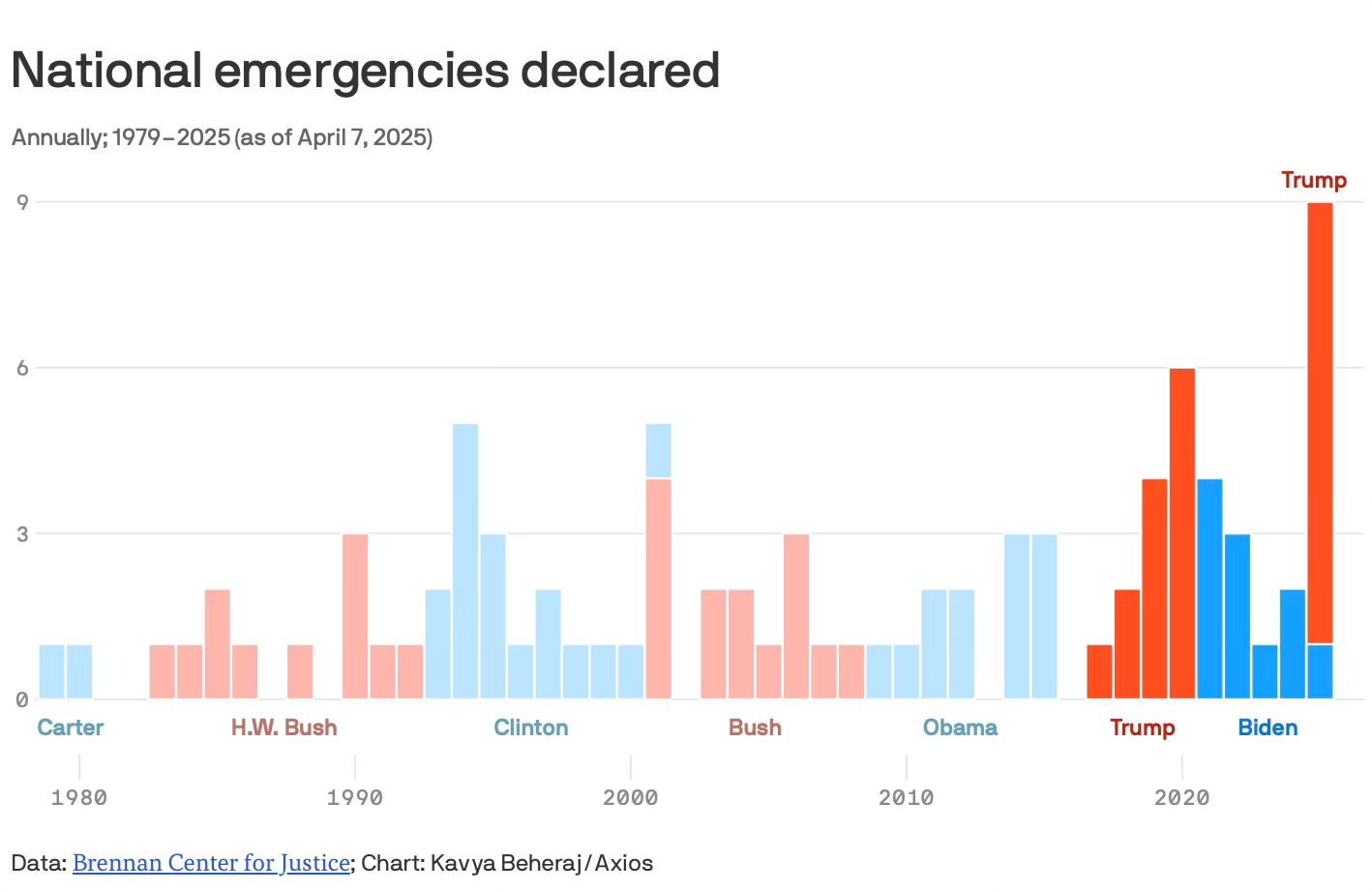
In recent decades, presidents of both parties have used emergency declarations to enhance their freedom of action. Barack Obama declared a dozen emergencies during his eight years in office. Mr. Trump declared 13 in his first presidency, while Joe Biden declared 11.
In only the first few months of his second term, Mr. Trump has declared eight ….
Coincidentally, Paul Dans, muse of Project 2025 (and a misogynist abuser and demeaner), defends Trump’s actions as absolutely necessary to “save America” in the Economist a few days ago. His argument eerily reflects what Linker has identified, but as ipse dixit rather than as the realization of intellectual theories that have been floating around a while.
The fit between Dans’ propaganda and Linker’s explanation adds to my assurance that Linker has nailed it.
One brief thing I want to add here that I don’t explicitly spell out in the op-ed: What’s typically called unitary executive theory is primarily about the president asserting power over the executive branch in a vertical way. Trump’s claim to possess the power to hire and fire executive branch employees as he sees fit, like his denial of their independence from presidential will, can be described as applications of that theory, which has been around since (at least) the Reagan administration.
But Trump has also been seeking to elevate the executive branch over the legislative and judicial branches of the federal government. He’s done this by refusing to enforce the law banning TikTok (which was passed by Congress, signed into law by Joe Biden, and deemed constitutional by a 9-0 Supreme Court decision), by claiming the power to impound congressionally appropriated funds, by defying judicial rules and expressing contempt for federal judges and courts, including when it comes to permitting due process to noncitizens marked for deportation. All of that can be described as a horizontal assertion of power that denies the doctrine of separate co-equal branches of government in favor of executive supremacy. (I’m relying here on a distinction drawn by Jack Goldsmith in his interview with Ross Douthat. I wrote about that interview in a post I published a couple of weeks ago.)
It’s primarily in the latter assertions of power that the tradition I’m writing about in today’s op-ed comes into play. The people I highlight genuinely believe that politics at its peak involves great statesmen looking out at the world, sizing up the situation (often deemed an emergency requiring decisive action), and making singular, unimpeded life-and-death decisions about what it will take to preserve the polity against an existential threat. That’s a justification for absolute executive governance.
I’ve been quoting Jonah Goldberg in my footer for a few months now, but never has it been more apt:
Your enemies are not demonic, and they are not all-powerful and the right hasn’t always lost and the left hasn’t always won. But if you convince yourself of that, you give yourselves all sorts of permission to do a lot of stupid and terrible things under the rubric of “Do you know what time it is?”
I don’t do any of the major social media, but I have two sub-domains of the domain you’re currently reading: (a) You can read most of my reflexive stuff, especially political here. (b) I also post some things on the only social medium I frequent, because people there are quirky, pleasant and real.
I don’t know about your Inbox, but mine tends to fill up especially on Friday. So I’m posting this now rather than in the wee hours tomorrow.
Trump 2.0
I haven’t been able to eliminate sharp criticism of Trump from today’s post because there are too many issues and I’ve read too much that isn’t just “same old same old.” As has become my habit, I’ve posted most of my anti-Trump stuff here.
United States law allows for a quite expedited process to remove people from the country, to deport them. You don’t get a big trial. You don’t get a jury trial. You are moved rapidly because the theory of the case is: First, you don’t have a right to immigrate to the United States, so you have not been deprived of your rights. And secondly, once you’re removed from the United States, you remain a free person. You are sent back to the place you came from or some other place to which you have some connection, and then you’re free to go about your business. You’re not sent to a prison—not sent to a prison for life.
But as I talk about this, the thing that has most gripped my mind with worry and anxiety is not only the effect on the individuals themselves, some of whom may be genuinely innocent, but the effect on those who are sending human beings to a prison without a hearing.
You know, the United States government is now building an apparatus of lawyers, of officials of all kinds, who plan and think every day, How can we apprehend people on American soil and bundle them to a prison without giving them any show of a hearing? They’re building skills and competencies at non-due-process forms of arrest and incarceration that are going to be very hard to limit.
… I remember when I was a Canadian citizen in the United States on a student visa, we were warned if you got into a bar fight, you could theoretically lose your student visa. Now, in those days, that meant that you’d have to go back to Canada and go to school in Canada, which is not the end of the world. In today’s America, that could mean you could lose your student visa and be accused of terrorism, and a bag put over your head and be put into a car and sent to a prison in El Salvador for the rest of your life.
Now, maybe that doesn’t happen in every case. Maybe that doesn’t happen in many cases. But there are people in the employ of the United States government, paid by taxpayers to think about how can we daily broaden the category of people who can be arrested and detained and imprisoned without any showing to any authority at all, without any opportunity to make themselves heard, without any evaluation by an independent fact finder—by any of the things we call due process.
David Frum, introducing a terrific conversation about The Crisis of Due Process with Peter Keisler. (bold added)
Do we really believe in free speech?
Trump 2.0 has been deporting foreign students and others for constitutionally protected speech, using as its current go-to bad-faith excuse that the speech is antisemitic.
The late British-American journalist Christopher Hitchens is a more recent testament to the long tolerance of America toward foreign dissent. Before becoming a U.S. citizen in 2007, Hitchens spent decades as a legal resident—and as one of America’s most acerbic public intellectuals. He accused Ronald Reagan of being “a liar and trickster,” called Israel America’s “chosen surrogate” for “dirty work” and “terrorism,” lambasted Bill Clinton as “almost psychopathically deceitful,” and accused the George W. Bush administration of torture and illegal surveillance. If a student can be deported for writing a campus op-ed critical of Israel, any of Hitchens’ views could have been used to justify deporting him.
This isn’t how our system is supposed to work. When a president does the kinds of things Donald Trump is doing, his popularity should sink so low that Congress will feel empowered to stand up to him. Ideally, they would impeach and remove him from office for attempting to govern like an absolute monarch. Short of that, Congress and the courts would be working in tandem to impose and enforce constraints on the wayward executive until the next election strengthens their hand against him.
But none of this is happening—because our system has broken down. The parties are ideologically sorted, with almost no remaining overlap. And Trump has transformed the GOP into a cult of personality more loyal to him personally than to the Republican Party, the other institutions of American democracy, the law, or the Constitution.
In a situation like this, the only thing preventing the president from transforming himself into a tyrant is his own willingness to do it. The courts can tell him to stop. But will he? If he does, democracy survives, at least for the time being. If he doesn’t, democracy is over, at least until it can be reconstituted at some point in the future.
One should never hope to live through a moment of great political precarity like our own. But one tiny compensation is that such moments bring clarity about certain fundamental matters. How has the United States managed to survive for nearly 250 years without evolving into a dictatorship? The answer really may be this simple: By never electing a man willing to do what it takes to effectuate the change.
It’s not clear that the courts will suffice, but the courts — having already, and deservedly, come to treat the Administration as bad-faith, untrustworthy actors — will provide partial deterrence and may help sway public opinion by the cogency (and sometimes, the tartness) of their reasoning.
[I]f you want a really extraordinary example of that, you would look at the order that the Court issued at 1 a.m. on Saturday morning this last weekend, because even though they had held that everybody has to be given meaningful notice before they could be removed in this way, there was credible evidence that the administration was loading people onto buses without giving them anything like the notice that was required. And the ACLU went to the Supreme Court and said, you know, Please, as you listen to the rest of this case and get briefing, stop this from happening.
And if the administration were a normal administration and had compiled a record so far of being a normal administration, the Court would’ve said, Well, I can be confident they’re not going to do this while we are hearing your petition, so let’s give the government a chance to respond. Let’s see what they say, and then we’ll decide what to do. Because, of course, the government wouldn’t spirit these people away while we are actually in the process of deciding whether it can do so on this emergency application you filed. But they knew that the government had done exactly that with the first 200 or so people they had sent away.
The case was before a district judge, and they rushed to secretly get the people out before he could issue an order. And they didn’t quite succeed on that, which is why you have these issues of contempt floating around now. But at 1 a.m., the Court by a 7–2 vote said, Don’t remove anybody in the class represented by these lawyers until you hear otherwise from us.
And that shows that there is a cost to the administration of acting the way it’s acting towards the courts, because if you squander the reputation that governments of both parties have had for credibility and fair dealing and honest brokering with the Court, then they’re going to treat you different because they know they can’t quite trust you.
The barstool right, which is a genuinely new constituency made up of hedonistic anti-woke libertarians that has replaced the Christian conservatives
The neo-conservative foreign policy hawks, who are the weakest member of the coalition, but can still get what they want on certain issues, as seen with the attacks on the Houthis as well as the saber rattling regarding Greenland
In other words, the Christian influence on actual Republican policy items and their political vision is going to be exceedingly negligible going forward. Sure, Vice President Vance will make an appearance at the March for Life. President Trump will show up to the National Prayer Breakfast. But even when he does acknowledge a Christian event, it often will come loaded with hatred and vile self-aggrandizement, as seen yesterday:
And ultimately when push comes to shove on the policy level, Christian concerns will always be backgrounded or eliminated relative to the priorities of the three above groups, as we have already seen on abortion, marriage, and PEPFAR.
I originally thought to post this on a Sunday, when my focus is narrower, but it didn’t fit there because I don’t value “religion” for its instrumental partisan-political value.
It was a very few years ago when I warned (as had others) “If you don’t like the Religious Right, just wait ‘till you see the irreligious Right.” Well you’ve been seeing them in power for three months now.
Beta-testing tyranny in the Sunshine State
Ron DeSantis walked so that Donald Trump could run. When the time came to formulate a policy response to the woke left, no one mattered more than the governor of Florida.
And through it all, DeSantis declared that Florida was the place where “woke goes to die.”
In his second term, Trump is a scaled-up version of DeSantis. Every element of the DeSantis model has been deployed against Trump’s ideological enemies …
…
At first I was optimistic about the anti-woke right. Their free speech argument resonated with me. I’d spent decades litigating free speech cases, after all, and I’d never really seen anything like a mass movement for free expression.
But my optimism quickly faded. In 2021, the anti-woke right embraced a series of state laws that were designed to ban critical race theory. Rather than meet critical race theorists in the marketplace of ideas, the right chose to try to suppress their expression.
By this time I was familiar with the right’s authoritarian turn — and getting very worried about it. In 2019, parts of the intellectual right were consumed with a fight over liberalism itself, with the new right arguing that liberal values — freedom of speech and free trade, for example — were hollowing out American culture, creating a nation of atomized individuals who were consumed with self-actualization (and consumption itself) at the expense of family and community.
Ironically, the left, now alarmed by the federal government’s intrusive reach [into, say, Harvard], bears direct responsibility for crafting the very legal weapons wielded against the universities it dominates. Almost four decades ago, progressive legislators demanded sweeping amendments to civil rights law, expanding federal oversight over higher education. The sequence of events reveals a cautionary tale of political hubris: progressive confidence that state power would reliably serve their ends overlooked the reality that governmental authority, once unleashed, recognizes no ideological master. Today’s circumstances starkly illustrate how expansive federal control over civil society, originally celebrated by progressives, returns to haunt its architects. The left’s outrage ought to focus not on this particular administration but on its own reckless empowerment of the state.
Yet for all its courage, Harvard’s response stopped short of making the argument that would best protect the values for which it was fighting. It defended the university’s independence without explaining why that independence deserves protection. It invoked values like “pluralism” and “inquiry,” but it did not fully explain why those values are essential to a liberal democratic society. The letter therefore missed an opportunity to articulate what a university is for — not just to students or donors, but to the country. And this matters, because Trump’s attack against this and other universities is not only about the balance of power between universities and the government. It is, at bottom, about the legitimacy of higher education as a public good.
The danger of being a professional exposer of the bogus is that, encountering it so often, one may come in time to cease to believe in the reality it counterfeits.
Your enemies are not demonic, and they are not all-powerful and the right hasn’t always lost and the left hasn’t always won. But if you convince yourself of that, you give yourselves all sorts of permission to do a lot of stupid and terrible things under the rubric of “Do you know what time it is?”
Regarding said “lot of stupid and terrible things,” my failure to call out anything about the current regime does not mean I approve. There’s just too much, and on some of the apparent illegalities I don’t want to abuse my credentials without thinking it through.
I don’t do any of the major social media, but I have two sub-domains of the domain you’re currently reading: (a) You can read most of my reflexive stuff, especially political here. (b) I also post some things on the only social medium I frequent, because people there are quirky, pleasant and real.
The normative approach to learning draws the analytical after it, whereas the analytical approach repels the normative. The fragmentation of arts and letters into academic disciplines (literature, history, philosophy, religion, social studies, and so forth) answers an analytical need that pushes normative inquiry into the interstices between disciplines. This is the strongest argument for reuniting the arts and letters.
A capitalist society required not just capitalist practices among urban elites, but a demographically widespread social acceptance among Christians of the counter-biblical notion that the good life was the goods life.
Brad S. Gregory, The Unintended Reformation
Empty gestures
Playing the “The Star-Spangled Banner” at sporting events has become an empty gesture of patriotism—so empty that, when the NBA’s Dallas Mavericks quietly began skipping the ritual, 13 preseason and regular-season games passed before anyone noticed. On Tuesday, The Athletic reported that the Mavericks had abandoned the national anthem, making them the first team in the recent history of major professional sports to take such a stance. The next day, the National Basketball Association issued a statement declaring that every team must play the song, in accordance with league rules. Inevitably, the Mavericks reversed course.
Over the past decade a new, and very revealing, locution has drifted from our universities into the media mainstream: Speaking as an X . . . This is not an anodyne phrase. It tells the listener that I am speaking from a privileged position on this matter. (One never says, Speaking as a gay Asian, I feel incompetent to judge this matter.) It sets up a wall against questions, which by definition come from a non-X perspective. And it turns the encounter into a power relation: the winner of the argument will be whoever has invoked the morally superior identity and expressed the most outrage at being questioned.
Mark Lilla, The Once and Future Liberal
MAGA-lite
“Sad to agree [that] the Free Press (for which I had high hopes) has ‘descended into MAGA-lite.’ Yes, PC-SJW-Critical-Woke-Intersectionality is bad, but some perspective, please: Blowing up the international order, sucking up to autocrats, wrecking the world economy, sowing doubt about vaccines, spreading medical quackery, strangling lifesaving foreign aid, pardoning violent rioters, preventing data collection, spewing nonstop lies, & extorting the press, law firms, and universities is worse,” – Steven Pinker.
I haven’t cancelled yet, but it’s getting close. Part of it is the MAGA-lite vibe, but another part is that it’s trying to be too much like a full-blown newspaper, right down to the culture vultures fluff.
On the other hand, it’s not terribly expensive — if one excludes the “cost” of wading through some of it.
My visit to the Xitter
I wanted to communicate something positive to a restaurant chain, and couldn’t find a way to do it other than @ing them on X.com:
@Wendys Your Panko fish sandwich is easily the best in the fast food biz. Could you find in your hearts to have it all year, not just in Lent?
Then I made the mistake of looking around, finding tons of tacit confirmation of Fr. Stephen Freeman’s advice:
Quit arguing about politics as though the political realm were the answer to the world’s problems. It gives it power that is not legitimate and enables a project that is anti-God.
I’m not going to get more specific than that advice because that would be like the kid at the table who says “Mom! Joey had his eyes open while Dad was praying!”: You can’t fault someone for anti-God politics without arguing about politics.
Political
To see ourselves as others see us
4. The US needs to “stop whining” about being a victim after “taking a free ride on the globalization train”, China’s official state media said, as the trade war between the two countries continued to spiral. Last week’s tit-for-tat tariff rises appear to have paused, but the conflict between the two biggest economies is showing no signs of letting up. On Tuesday evening, China Daily, the ruling Chinese Communist party’s (CCP) English-language mouthpiece, published an editorial saying Donald Trump’s frequent claims of the US being “ripped off” were “hoodwinking the US public”. “The US is not getting ripped off by anybody,” it said. “The problem is the US has been living beyond its means for decades. It consumes more than it produces. It has outsourced its manufacturing and borrowed money in order to have a higher standard of living than it’s entitled to based on its productivity. Rather than being ‘cheated’, the US has been taking a free ride on the globalization train.” (Source: theguardian.com)
Religious populism, reflecting the passions of ordinary people and the charisma of democratic movement-builders, remains among the oldest and deepest impulses in American life.
4. The US needs to “stop whining” about being a victim after “taking a free ride on the globalization train”, China’s official state media said, as the trade war between the two countries continued to spiral. Last week’s tit-for-tat tariff rises appear to have paused, but the conflict between the two biggest economies is showing no signs of letting up. On Tuesday evening, China Daily, the ruling Chinese Communist party’s (CCP) English-language mouthpiece, published an editorial saying Donald Trump’s frequent claims of the US being “ripped off” were “hoodwinking the US public”. “The US is not getting ripped off by anybody,” it said. “The problem is the US has been living beyond its means for decades. It consumes more than it produces. It has outsourced its manufacturing and borrowed money in order to have a higher standard of living than it’s entitled to based on its productivity. Rather than being ‘cheated’, the US has been taking a free ride on the globalization train.” (Source: theguardian.com)
Political persecution this, political persecution that: The Trump administration is seeking criminal charges against New York attorney general Letitia James, Trump’s public enemy number one. Federal Housing Finance Agency head William Pulte accused James of mortgage fraud, saying she misrepresented her building to get a better loan deal. He also accused James of claiming a Virginia property as her primary residence while she was New York’s AG in order to secure a lower interest rate on a loan.
You’ll recall that Letitia James literally campaigned for attorney general on a platform of prosecuting Trump on anything she could. Here she was back in 2018: “We will use every area of the law to investigate President Trump and his business transactions, and that of his family as well.” But now, with the shoe on the other foot, James is accusing Trump of politically persecuting her. Her team said that Trump was weaponizing “the federal government against the rule of law and the Constitution.” Such are the consequences of lawfare: always in litigation, always filing briefs, never settling, never quite winning.
It is difficult in some cases to get to the very heart of the matter. But in this case, it is not hard at all. The government is asserting a right to stash away residents of this country in foreign prisons without the semblance of due process that is the foundation of our constitutional order. Further, it claims in essence that because it has rid itself of custody that there is nothing that can be done.
This should be shocking not only to judges, but to the intuitive sense of liberty that Americans far removed from courthouses still hold dear.
…
The Executive possesses enormous powers to prosecute and to deport, but with powers come restraints. If today the Executive claims the right to deport without due process and in disregard of court orders, what assurance will there be tomorrow that it will not deport American citizens and then disclaim responsibility to bring them home? {See, e.g., Michelle Stoddart, ‘Homegrowns are Next’: Trump Doubles Down on Sending American ‘Criminals’ to Foreign Prisons, ABC News (Apr. 14, 2025); David Rutz, Trump Open to Sending Violent American Criminals to El Salvador Prisons, Fox News (Apr. 15, 2025).}
And what assurance shall there be that the Executive will not train its broad discretionary powers upon its political enemies? The threat, even if not the actuality, would always be present, and the Executive’s obligation to “take Care that the Laws be faithfully executed” would lose its meaning.
…
The basic differences between the branches mandate a serious effort at mutual respect. The respect that courts must accord the Executive must be reciprocated by the Executive’s respect for the courts. Too often today this has not been the case, as calls for impeachment of judges for decisions the Executive disfavors and exhortations to disregard court orders sadly illustrate.
It is in this atmosphere that we are reminded of President Eisenhower’s sage example. Putting his “personal opinions” aside, President Eisenhower honored his “inescapable” duty to enforce the Supreme Court’s decision in Brown v. Board of Education II to desegregate schools “with all deliberate speed.” Address by the President of the United States (Sept. 24, 1957). This great man expressed his unflagging belief that “[t]he very basis of our individual rights and freedoms is the certainty that the President and the Executive Branch of Government will support and [e]nsure the carrying out of the decisions of the Federal Courts.” Indeed, in our late Executive’s own words, “[u]nless the President did so, anarchy would result.”
Now the branches come too close to grinding irrevocably against one another in a conflict that promises to diminish both.
Judge J. Harvie Wilkinson, conservative icon Reagan appointee, mincing no words. Via Eugene Volokh.
This is true. Blackman’s Trump-era meta-theme seems to be that federal courts are getting out of their proper constitutional lane trying to solve ills wrought by Velveeta Voldemort.
The reality that the Bill of Rights is deliberately counter-majoritarian doesn’t always mean that the courts can beat back “populist” majoritarian idiocies. In the political process, it has pleased the sovereign will of the American people to well and truly screw the pooch.
On the other hand …
Perhaps the federal courts are incited to action by the pugilistic stance this Administration takes in the lower courts, its demands for impeachment of judges who rule against it, and its murmurs about maybe defying the courts:
Yesterday Justice Alito published a fiery statement explaining his dissent from the Supreme Court’s early Saturday morning order directing the U.S. government “not to remove any member of the putative class of detainees [subject to Alien Enemy Act removal] from the United States until further order.”
Alito’s statement highlighted the rushed and unusual nature of the Court’s order. What it neglected to mention was that the Court probably acted so quickly because the U.S. government cannot be trusted to comply in good faith with the Court’s April 7 order that the “AEA detainees must receive notice . . . within a reasonable time and in such a manner as will allow them to actually seek habeas relief in the proper venue before such removal occurs.”
I’m trying to keep our contemptible President out of this blog. If you want to see what I’m reading (and thinking) about him, I’m keeping them here.)
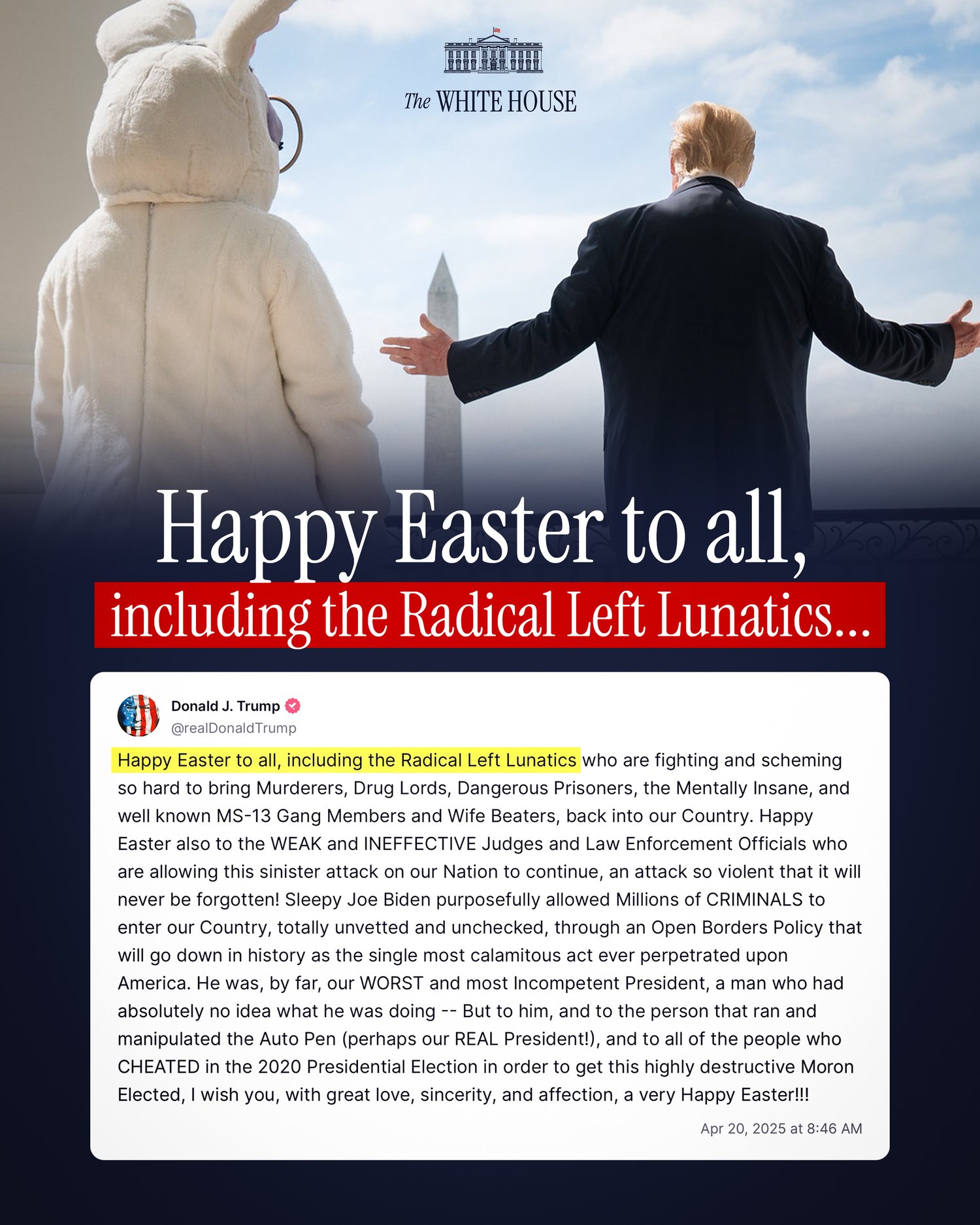
But I’ve got to call attention to his Easter Greeting. (Trigger warning: blasphemy) “Christian” Trumpists take note.
NEW!
Your enemies are not demonic, and they are not all-powerful and the right hasn’t always lost and the left hasn’t always won. But if you convince yourself of that, you give yourselves all sorts of permission to do a lot of stupid and terrible things under the rubric of “Do you know what time it is?”
I don’t do any of the major social media, but I have two sub-domains of the domain you’re currently reading: (a) You can read most of my reflexive stuff, especially political here. (b) I also post some things on the only social medium I frequent, because people there are quirky, pleasant and real.
Much of what Illich had to say to those bright-eyed students preparing to spend their summer volunteering in Mexico are summed up in these early lines:
“I do have deep faith in the enormous good will of the U.S. volunteer. However, his good faith can usually be explained only by an abysmal lack of intuitive delicacy. By definition, you cannot help being ultimately vacationing salesmen for the middle-class ‘American Way of Life,’ since that is really the only life you know.”
Illich recognized that “development” work, as it was happening in the 1960s, was, in fact, a vehicle by which a whole complex nexus of values and systems was being exported to and imposed upon the “under-developed” world, and ultimately in such a way that the recipients of this aid would be subjected to new forms of poverty and dependence—“modernized poverty,” as Illich called it elsewhere.
…
Illich tells his audience that “next to money and guns, the third largest North American export is the U.S. idealist, who turns up in every theater of the world: the teacher, the volunteer, the missionary, the community organizer, the economic developer, and the vacationing do-gooders”—to which list, of course, we can add the tech evangelist. It is then that he drops this devastating line:
Perhaps this is the moment to instead bring home to the people of the U.S. the knowledge that the way of life they have chosen simply is not alive enough to be shared.
‘Young man,’ he said, ‘don’t you know you can’t go home again?’ And he went on to speak of the advantages, for a young writer, of living in New York among the writers and the editors and the publishers.
The conversation that followed was a persistence of politeness in the face of impossibility. I knew as well as Wolfe that there is a certain metaphorical sense in which you can’t go home again – that is, the past is lost to the extent that it cannot be lived in again. I knew perfectly well that I could not return home and be a child, or recover the secure pleasures of childhood.
But I knew also that as the sentence was spoken to me it bore a self-dramatizing sentimentality that was absurd. Home – the place, the countryside – was still there, still pretty much as I left it, and there was no reason I could not go back to it if I wanted to.
Wendell Berry, The World-Ending Fire
More from the same source:
Our model citizen is a sophisticate who before puberty understands how to produce a baby, but who at the age of thirty will not know how to produce a potato.
Extremisms
Knee-jerk whataboutism—citing left-wing extremism to brush away concerns of right-wing extremism—is a way of saying, effectively, “I don’t actually care about right-wing extremism. Left-wing extremism is so overwhelmingly bad it’s okay to turn a blind eye to the conspiracy theorists, thugs, and terrorists on my side.”
Slavery was never less than a statement about the sovereignty of capital, and its rights, in relation to human rights. In the South, economic restrictions on religious organization by black Christians was part and parcel of the racial system undergirding slavery and the marginalization of free African Americans.
Mark A. Noll, America’s God
Terribly prophetic
When you have attention, you have power, and some people will try and succeed in getting huge amounts of attention, and they would not use it in equal or positive ways.
The big tech platform debates about online censorship and content moderation? Those are ultimately debates about amplification and attention. Same with the crisis of disinformation. It’s impossible to understand the rise of Donald Trump and the MAGA wing of the far right or, really, modern American politics without understanding attention hijacking and how it is used to wield power … the attempted Capitol insurrection in January [2021] was the result of thousands of influencers and news outlets that, in an attempt to gain fortune and fame and attention, trotted out increasingly dangerous conspiracy theories on platforms optimized to amplify outrage.
Unlike cynicism, hopefulness is hard-earned, makes demands upon us, and can often feel like the most indefensible and lonely place on Earth. Hopefulness is not a neutral position either. It is adversarial. It is the warrior emotion that can lay waste to cynicism.
I don’t do any of the major social media, but I have two sub-domains of the domain you’re currently reading: (a) You can read most of my reflexive stuff, especially political here. (b) I also post some things on the only social medium I frequent, because people there are quirky, pleasant and real.
I won’t waste my time or yours weighing in on what has predictably been labeled “Signalgate” except to note that Trump, Gabbard and Hegseth are all trying to brazen it out with transparent lies.
Most chilling of all
The ochre emperor, having figured out that he cannot control life-tenured federal judges, has taken to kidnapping law firms, negotiating ransoms that include not taking any cases he doesn’t like.
Courts decide cases. They don’t inject themselves unbidden into the affairs of the Executive and Legislative branches. If Trump’s kidnappings work (and so far they have worked pretty well), don’t trust the courts to keep him in line because people won’t be able to get law firms to represent them against the Administration’s already-lawless behaviors.
Earlier this month, President Donald Trump delivered a speech in the Great Hall of the Justice Department. But he did not laud the impartial application of the law, as past presidents have done in the staid space. Instead, he took the opportunity to signal some score-settling against the lawyers involved in legal challenges against him.
“They spied on my campaign; launched one hoax and disinformation operation after another; broke the law on a colossal scale; persecuted my family, staff, and supporters; raided my home, Mar-a-Lago; and did everything within their power to prevent me from becoming the president of the United States,” Trump said, referencing his past campaigns and some of the criminal and civil cases brought against him. He went on to single out several lawyers allegedly involved in the scheme by name, including “radicals like Marc Elias, Mark Pomerantz” and “scum” like “Andrew Weissmann, deranged Jack Smith.”
As of Tuesday, each of those attorneys has something else in common: They all have current or former ties to law firms now in Trump’s crosshairs. Over the last month, Trump has threatened four law firms in what appears to be a broader campaign of intimidation directed at the legal profession. Coinciding with the administration’s recent attacks on judges, legal scholars fear the moves could represent a serious threat to the independence of the bar and the ability of individuals to effectively challenge the government in court.
You’d think that BigLaw could stand up and fight, but it’s a dog-eat-dog world out there, and Paul Weiss found the other dogs trying to poach their top lawyers and clients rather than offering help. That’s why they felt they had to pay Trump’s ransom demand.
Let me get this straight …
Donald Trump is, as he will tell you, the world’s greatest negotiator, and he feels the need to renegotiate the existing U.S.-Canada trade deal, which was negotiated by an utter incompetent: Donald Trump, whose administration oversaw the replacement of NAFTA by the (rather lightly modified) USMCA the last time he was president. And now Canadians have learned what banks, investors, vendors, small business partners, wives, ex-wives, and pornographic performers rapidly approaching their expiration dates have all learned over the years: If you think you have a deal with Donald Trump, you are a fool.
[T]he tone was a diatribe, the kind of ill-informed, red-meat rant Tucker Carlson honed throughout the first Trump administration every weeknight in prime time on Fox News: Come out of gate with guns blazing and never relent. Concede nothing to any less severe view of the topic. Reject any form of nuance. Illustrate the absolute truth of one’s position by giving a handful of outrageous-sounding anecdotes cherry-picked to demonstrate the absurdity of holding any other position.
On that day three years ago, it took Vance exactly 40 seconds to declare how important it was for conservatives like himself to “honestly and aggressively attack the universities in this country”—just as it took just a few weeks for the second Trump administration to follow through on precisely this agenda.
Damon Linker. I quote it because the bolded part is the Trump style, which he learned from the infamous Roy Cohn. That’s why you dare not rely on anything anyone in this administration says.
More:
I know enough about what goes on in the country’s universities to recognize that the right-wing thugs currently running the executive branch and taking a baseball bat to higher education are utterly full of shit. They are poised to do an immense amount of damage to something valuable and good. And much of the broader public appears not to care—in no small part because of the incendiary lies the ideological propagandists behind the MAGA movement have been propagating for years. I won’t say they must be stopped, because I don’t know if they can be stopped. Still, it’s important we recognize exactly what they’re doing and the price our country and our world are going to end up paying for their destructive zealotry.
Of course a narcissist would feel this way
I believe that CNN and MS-DNC, who literally write 97.6 percent bad about me, are political arms of the Democrat Party and in my opinion, they’re really corrupt and they’re illegal, what they do is illegal, … And it has to stop, it has to be illegal, it’s influencing judges and it’s really changing law, and it just cannot be legal. I don’t believe it’s legal, and they do it in total coordination with each other.
I don’t do any of the major social media, but I have two sub-domains of the domain you’re currently reading: (a) You can read most of my reflexive stuff, especially political here. (b) I also post some things on the only social medium I frequent, because people there are quirky, pleasant and real.
President Trump does not seem to notice or care that if you betray people, or jerk them around, they will revile you. Over the last few weeks, the Europeans have gone from shock to bewilderment to revulsion. This period was for them what 9/11 was for us — the stripping away of illusions, the exposure of an existential threat. The Europeans have realized that America, the nation they thought was their friend, is actually a rogue superpower.
In Canada and Mexico you now win popularity by treating America as your foe. Over the next few years, I predict, Trump will cut a deal with China, doing to Taiwan some version of what he has already done to Ukraine — betray the little guy to suck up to the big guy. Nations across Asia will come to the same conclusion the Europeans have already reached: America is a Judas.
This is not just a Trump problem; America’s whole reputation is shot. I don’t care if Abraham Lincoln himself walked into the White House in 2029, no foreign leader can responsibly trust a nation that is perpetually four years away from electing another authoritarian nihilist.
An anti-constitutional act is one that rejects the basic premises of constitutionalism. It rejects the premise that sovereignty lies with the people, that ours is a government of limited and enumerated powers and that the officers of that government are bound by law.
The new president has, in just the first two months of his second term, performed a number of illegal and unconstitutional acts. But the defining attribute of his administration thus far is its anti-constitutional orientation. Both of its most aggressive and far-reaching efforts — the impoundment of billions of dollars in congressionally authorized spending and the attempt to realize the president’s promise of mass deportation — rest on fundamentally anti-constitutional assertions of executive authority.
…
There is much to say about the administration’s decision to seemingly ignore a court order to halt or reroute deportation flights for these people and return them to United States. For now, let’s focus on the Justice Department’s initial defense of the president’s order, in which government lawyers argued the following: “Beyond the statute, the President’s inherent Article II authority is plainly violated by the district court’s order. As a function of his inherent Article II authority to protect the nation, the President may determine that [Tren de Aragua, a criminal gang] represents a significant risk to the United States … and that its members should be summarily removed from this country as part of that threat.”
In other words, according to the Justice Department, the president of the United States has an “inherent” power to summarily deport any accused member of Tren de Aragua (and presumably, any foreign national accused of membership in any gang) without so much as a hearing. What’s more, under this logic, the president can then direct his administration to send that person, without due process, to prison in a foreign country.
This is a claim of sovereign authority. This is a claim that the president has the power to declare a state of exception around a group of people and expel them from the nation — no questions asked. It is anti-constitutional — a negation of the right to be free, in Locke’s words, of “the inconstant, uncertain, unknown, arbitrary will of another man.”
There is nothing in this vision of presidential power that limits it to foreign nationals. Who is to say, under the logic of the Department of Justice, that the president could not do the same to a citizen?
If Congressional Republicans took their oaths of office seriously, they’d be impeaching Trump and removing him from office. He has already destroyed many of our most important international relationships (see David Brooks, above), and by “destroyed,” I mean that we face a long period of repair even if he were removed this afternoon.
Dems and Damon in the same headspace?
[M]y assumptions and style of analysis bring me back again and again to a feeling of fatalism rooted in the conviction that the time to stop Trump was in November 2016, in the immediate aftermath of the January 6 insurrection (via conviction in his second impeachment trial), or in November 2024. I don’t want to succumb to the feeling that it’s already too late to stop him. It’s just that I’m still trying to figure out how to break out of that cul-de-sac.
To collapse the structure of American justice and replace it with a proper banana republic, each pillar holding it up needs to be weakened.
The president spent most of his first two months in office focused on a single pillar: law enforcement. He purged officials at the Justice Department and FBI and replaced them with clownish toadies like Pam Bondi, Kash Patel, and Dan Bongino. That was a sensible way for an authoritarian to prioritize: Of the institutional players I’ve mentioned, corrupt cops and prosecutors can do the most damage. As long as the DOJ is willing to behave like a secret police force, Donald Trump doesn’t need to send Liz Cheney or Mark Milley to prison to make their lives miserable. Investigations are punishment enough.
His Castro-esque speech on Friday to Justice Department officials reflected his priorities. The president labeled political enemies like former special counsel Jack Smith “scum,” claimed that CNN and MSNBC are behaving “illegally” somehow, babbled about the supposedly rigged 2020 election, and insisted that the January 6 defendants he pardoned were “grossly mistreated.” The speech ended with the song “YMCA,” as you might hear at one of his political rallies.
Watching it felt like watching a dog mark his territory.
I may not have said this before: Trump’s shock and awe assault on norms, perceived enemies, constitutional limitations and the independence of “independent agencies” are so comprehensive, and so blur together in news coverage, that I couldn’t keep up, and couldn’t cogently predict which actions will ultimately be found unlawful, even if I tried.
And I’m trying not to try.
Oh, I still listen to legal podcasts, and they typically cover some of the cases brewing. If you get an opinion from me on a case, I’ll probably be regurgitating some of them, lightly post-processed.
I don’t feel responsible for Trump. He’s something I’m suffering along with everyone else — and my situation means I’m not personally suffering all that much except anxiety for my living descendants.
I don’t think Trump is the eventuality of true conservatism, though he may be the eventuality of the Moral Majority and other Religious Right activism starting in the 70s. I was never on board with them; I’m even less on board with them since becoming an Orthodox Christian; and I’m pleased to contemplate a knife fight between the New, Improved Religious Right (The New Apostolic Reformation! All you loved about the Moral Majority, but now with added Charismatic flakery!) and the Catholic Integralist “Common Good Constitutionalism.”
(Thoughts prompted by my deciding not to read a Wall Street Journal article on a Federal District court ruling against the demolition of USAID.)
Inflicting trauma
Russell Vought, a graduate of Wheaton College, now describes himself as a “Christian nationalist.” He also says:
“We want the bureaucrats to be traumatically affected,” he said. “When they wake up in the morning, we want them to not want to go to work because they are increasingly viewed as the villains. We want their funding to be shut down so that the EPA can’t do all of the rules against our energy industry because they have no bandwidth financially to do so.
“We want to put them in trauma.”
He may be a nationalist, but he puts his Christianity open to serious question by such hateful intentions. (Mark 8:36.) He’s rather unpopular at Wheaton, too, which is much to its credit.
Free speech lies
The president brags about ‘ending censorship’ while describing negative coverage about him as ‘illegal.’
I don’t do any of the major social media, but I have two sub-domains of the domain you’re currently reading: (a) You can read most of my reflexive stuff, especially political here. (b) I also post some things on the only social medium I frequent, because people there are quirky, pleasant and real.
[I] n The New Yorker, Ruth Marcus, who recently resigned from The Washington Post, explained that she and other columnists were confused by the Post owner Jeff Bezos’ new edict that the Opinions section write only in favor of “personal liberties and free markets”: “Without further clarification, we were like dogs that had been fitted with shock collars but had no clue where the invisible fence was.” (Susan Casey, Palm City, Fla.)
After a federal judge blocked the Trump administration’s effort to stop $2 billion in foreign-aid spending, Justice Amy Coney Barrett joined with Chief Justice John Roberts and all three Democratic-appointed justices to leave that order in place. The decision provoked a fiery and warranted dissent from Justice Samuel Alito, as well as some bitter complaints about Barrett from the right-leaning commentariat. It is understandable that conservatives might be nervous about the Supreme Court. For good reason, the names “Stevens,” “Souter,” “Kennedy,” and “O’Connor” echo eerily in the originalist mind. But while she was wrong in this particular case, there is no evidence that Barrett is at risk of joining their ranks. She concurred in Dobbs, the case that overturned Roe; in Students for Fair Admissions, Inc., the case that barred affirmative action; and in Bruen, the case that expanded the protections of the Second Amendment. More important than those outcomes is how she did so. Unlike the judicial nomads of the past, Barrett has a transparent and well-considered approach to the law that explains her actions even when she disappoints. In the case that prompted the criticisms, she was likely motivated by her mistrust of the shadow docket and her dislike of big cases built atop disputed facts. To conclude from this that Barrett was “a mistake”—or, worse, “a DEI hire”—is absurd. Judges are not supposed to play for a team.
National Review email for 3/14/25
Meritocracy is the death of noblesse oblige
In some ways, we’ve just reestablished the old hierarchy rooted in wealth and social status—only the new elites possess greater hubris, because they believe that their status has been won by hard work and talent rather than by birth. The sense that they “deserve” their success for having earned it can make them feel more entitled to the fruits of it, and less called to the spirit of noblesse oblige.
I’ve shunned Bitcoin as an investment because it’s useless other than for criming and speculation.
I’ve always shunned gold for similar reasons. Its industrial and jewelry uses are not the reason for it rising to more than $3,000 per troy ounce.
Regarding this Presidency
Trump censorship worse than cancel culture
I’ve been relegating most of my bile toward Trump and his goons to another blog, referenced in the footer below, but this is so patently un-American that it needs the widest exposure I can give it:
[T]his is not about protection from woke professors or ideologically captured deans. It’s protection from direct surveillance by the federal government. The Trump administration has launched a massive, all-of-government, AI-assisted program called “Catch and Revoke,” which will scan every social media comment and anything online they can use to flush out any noncitizen who might be seen as anti-Semitic or anti-Zionist or anti-Israel or indeed just getting on Marco Rubio’s wrong side.
Mahmoud Khalil, a green card holder, has not been accused of a crime. And that is the point. …
…
JD Vance — who lectured Europeans on free speech online, while his own administration was using AI to police the web for dissent! — said on Fox that a green card holder “doesn’t have an indefinite right to stay in America.”
In a Feb. 6 editorial, [Purdue] Exponent editors wrote: “And don’t get it twisted: When letters of visa revocation arrive in these students’ mailboxes and federal agents come to Purdue’s campus, no distinction will be made between ‘pro-jihadist’ and pro-Palestinian. Pro-ceasefire will continue to be conflated with ‘antisemitic.’ Anti-war can only now mean ‘pro-Hamas.’ Such twisting of language to be used as a weapon is contrary to the First Amendment, which gives the Exponent its right to exist just as much as it gives the right to students to protest as they see fit. It is the opinion of the Exponent that standing back while our website is potentially used to identify the state’s enemies would be directly against those principles.”
The statute cited by the Trump administration for expelling Khalil is very broad — and vague. I don’t think it will be struck down in its entirety, but surely permanent residents are entitled to know with some clarity what behaviors could get them kicked out of the country.
So I think the likeliest outcome is “unconstitutional as applied” to Khalil.
Living in fear
I spoke on Thursday to a university president who told me he was just advised to hire a bodyguard. He said he’d never seen so much fear in the world of higher education — that many college presidents are “scared to death” about the Trump administration cutting their funding, Elon Musk unleashing Twitter mobs on them, ICE agents coming on campus, angry email flooding their inboxes, student protests over Gaza and Israel, and worries about being targeted for violence. I was a higher education reporter two decades ago, when universities were widely admired in America, and so I asked this president — what went wrong?
He said presidents and professors had taken too many things for granted — they thought they’d always be seen as a “public good” benefiting society, but came to be seen as elitist and condescending toward regular Americans. And Americans hate a lot of things, but they really hate elites condescending to them. Now we are seeing a big reckoning for higher education — ideological, cultural, financial — driven by Donald Trump and the right.
Patrick Healy, introducing a conversation with M. Gessen, Tressie McMillan Cottom and Bret Stephens.
Just sayin’
Narcissism has a very high correlation with conspicuous consumption in an effort to boost social status and self-esteem. Narcissists are focused on the symbolic, rather than functional, importance of commodities, and the symbolism of the products they purchase is often used to compensate for fragile egos and fluctuating self-esteem.
As I have said any number of times, I have voted for the American Solidarity Party in each of the last three election cycles. But in the 2024 election, I was beginning to feel some sympathy for the people who thought Trump was less bad than Kamala Harris in the forced binary choice too many voters feel.
I no longer have any sympathy for that position, although I’m obviously working with the benefit of hindsight: Ready, Fire, Aim — over and over again ad infinitum. This is no way to run anything, quite apart from the autocracy.
I suffer more from the humiliations inflicted by my country than from those inflicted on her.
I don’t do any of the major social media, but I have two sub-domains of the domain you’re currently reading: (a) You can read most of my reflexive stuff, especially political here. (b) I also post some things on the only social medium I frequent, because people there are quirky, pleasant and real.
I think these go beyond saying, explicitly or implicitly, that someone on the internet really, really don’t like Donald Trump. The common theme may be “retribution,” the campaign promise Trump and his goons are most zestfully fulfilling, and so they seem worth sharing.
It’s happening
When you see important societal actors — be it university presidents, media outlets, C.E.O.s, mayors, governors — changing their behavior in order to avoid the wrath of the government, that’s a sign that we’ve crossed the line into some form of authoritarianism.
Steven Levitsky, a professor of government at Harvard and the co-author of the influential 2018 book “How Democracies Die,” via the New York Times.
More:
One prominent first-term critic of Mr. Trump said in a recent interview that not only would he not comment on the record, he did not want to be mentioned in this article at all. Every time his name appears in public, he said, the threats against him from the far right increase.
University presidents are largely silent because they are protecting their institutions, said Ted Mitchell, the president of the American Council on Education. “Don’t wrestle with a pig,” he said. “You’ll just get muddy and annoy the pig.”
[T]hat business leader thinks that chief executives see the way that Mr. Musk is going about slashing the federal work force as “totally crazy” — but would say so only on the condition of anonymity, fearing retribution.
Representative Eric Swalwell, a California Democrat and a frequent critic of Mr. Trump, said the real fear among Republicans in the House who might otherwise voice criticism of the administration on some issues was violence against their families.
Senator Todd Young, Republican of Indiana, was called a “deep state puppet” by Elon Musk after he asked tough questions about Mr. Trump’s nominee for director of national intelligence.
(I must note the Folksy Failure by Ted Mitchell. The canonical folk form is “Never wrestle with a pig. You get all muddy and the pig loves it.”)
The SOTU that wasn’t
I’m told that Tuesday’s speech by the Chaos Monkey In Chief was not a State of the Union address, but it came across as one from what I’ve seen of the reporting.
David Brooks has thoughts:
Healy: David, it’s so important to underscore that with speeches like this, a lot of Americans aren’t sitting there with a scorecard, rating and fact-checking and assessing policies. It is about how these speeches make people feel.
That moment that you touched on about the young boy who wanted to be a cop. That is the moment when my phone blew up from both Republicans and Democrats. People who I hear from in politics. Trump made people feel something with moments like that. And again, it’s not that people in America are sitting around doing a fact-check on these speeches. They’re looking to feel the impact of them.
Brooks: Well, take a couple other examples. He talked about all the people allegedly getting Social Security benefits, even though they’re 160 years old. Now, people like us, we’re media obsessed, so we know that was all disproved, that there really are no 320-year-old people getting Social Security benefits. There are no 160-year-olds getting those benefits. That has been shot down by Trump’s own Social Security administrator. But when you’re sitting there reading and you’re just a normal person who pays normal attention to politics, you think: “Wow, that’s ridiculous. I’m glad he’s getting rid of this stuff.”
Healy: Yep.
…
Brooks: I would advise Democrats to take some time off. They’re not in control. They don’t have power. But mostly a lot of the categories Democrats have used to understand reality don’t describe actual reality.
I don’t think Democrats have coped with the fact that they’re more the party of the elites now than the party of the working class. I don’t think they expected so many Black and brown voters to go for Donald Trump, and it just takes an intellectual revolution to adjust.
And they have to make some fundamental decisions. Do they want to work really hard to once again become the party of the working class? Is that even possible? Joe Biden tried with good economic policies — a large percentage of his policies helped working-class voters. It did him no political good because you can’t solve with economics a problem that’s fundamentally about culture and respect.
Or, maybe they should accept the fact that they’re the party of the college educated and urban classes, and that’s who they are, and they’re going to represent those people and hopefully build some majorities around those people.
Going back to the 19th century, Andrew Jackson — who’s the closest politician we’ve ever had to Donald Trump. He was a narcissist, he was power hungry, and didn’t fundamentally know what he was doing to screw up. And lo and behold, Andrew Jackson made a terrible decision to close the Second Bank of the United States and the end result was, basically, a decadelong depression.
So Democrats right now have to wait for Donald Trump to screw up. I think the tariffs may be that screw-up. The policy toward Ukraine may be that screw-up. I’m assuming that a guy who doesn’t know what he’s doing will make some major errors and then the Democrats will see some opportunities.
…
As for the faux populism, I’ve been around these people all my life. I graduated from college in 1983, I worked in National Review in 1984, and my first encounter with Trumpians was way back then, though we didn’t know it at the time. There was a group at Dartmouth, called the Dartmouth Review. Famous people have emerged from there — Laura Ingraham, Dinesh D’Souza — but they were very different from us. We were earnest. We read Adam Smith and Edmund Burke. They were like, “Let’s take on the left.”
And the classic Dartmouth Review action took place in 1986. A group of progressive students had erected a shanty on the quad at Dartmouth to protest apartheid, a thing very much worth opposing. And the Dartmouth Review guys, in the middle of the night, used sledgehammers and broke it all down. And I remember thinking that’s appalling. First, apartheid really is terrible. We should not be defending it. But also, coming in with sledgehammers, that’s more Gestapo than Edmund Burke.
And yet, that kind of person who’s in the elite universities, but who is a dissenter in the elite universities, who’s fed up with the progressive orthodoxy that dominates those universities — you get Elon Musk who went to Penn, Vivek Ramaswamy who went to Harvard and Yale, Stephen Miller went to Duke — these are elite dissenters from the university culture. They are not populists.
As a result, when they come to power, they don’t really do all that much to help the working class. I would love it if the Trump administration would take on the health disparities, the education disparities, the family disparities that make it hard to be working class right now. But they don’t do that. They go after N.I.H. They go after the Department of Education. They go after U.S.A.I.D. They go after the places where they think elite liberals live.
Why there will be no recession despite Trump’s antics
If critics point out that Canada and Mexico have done nothing to warrant the imposition of these punishing penalties, this will be irrelevant. Trump will simply lie about his reasons, accusing these rival nations of some imaginary transgression, which many Republican voters will believe is true. Along the way, as Trump lowers and raises these penalties at will, domestic companies will seek exemptions in return for favors (financial and otherwise), which Trump will gladly grant and accept. Meanwhile, senior members of his administration will be free to enrich themselves by shorting the stock market just before the announcement of an increase in tariffs (which often produces a drop in prices). If these trading partners retaliate in a way that harms the United States, Trump will use this retroactively to justify his protectionist moves. See? It’s us against them, as I always said.
But what about economic reality? Won’t the data show that Trump’s policies are hurting the economy? The answer is: Only if the government continues to put out trustworthy and accurate economic data. Earlier this week, The Bulwark’s Jonathan Last suggested that the Trump administration could well be planning to stop doing that.
[Trump] doesn’t care about the numbers because he’s planning to have his government monkey with the economic data. There won’t be a recession because Trump’s government is never going to release data showing a recession. He’s planning on doing to economic data what he tried to do with COVID case numbers and testing. And he thinks that he’ll be able to sell the “data” his government produces to voters.
Later the same day Last published these words, a member of the Federal Economic Statistics Advisory Committee (FESAC) announced that the committee was “terminated abruptly,” with “all upcoming meetings … also canceled.” The committee has existed for 25 years and met twice a year to advise the Bureau of Economic Analysis, the Bureau of Labor Statistics, and Census Bureau, and the Department of Commerce “on matters related to federal economic statistics.” The very next day, the Secretary of Commerce likewise disbanded the 2030 Census Advisory Committee, claiming its purpose had been fulfilled.
I don’t do any of the major social media, but I have two sub-domains of the domain you’re currently reading: (a) You can read most of my reflexive stuff, especially political here. (b) I also post some things on the only social medium I frequent, because people there are quirky, pleasant and real.
Some Zen Buddhists hold that the entirety of human suffering can be boiled down to this effort to resist paying full attention to the way things are going, because we wish they were going differently (“This shouldn’t be happening!”), or because we wish we felt more in control of the process.
I realized suddenly on Wednesday morning that I could not bear listening to Trump — not even short sound clips from his address to Congress as part of a critical story.
Every other word Trump utters is a lie, and the words come in Tsunami waves. Some people apparently don’t care about the lies because letting those waves roll over them feels good.
They don’t make me feel good, and I don’t have the bandwidth or patience to filter out the lies. Hate-listening is spiritually sick even outside of Lent, so better not to listen at all.
It can’t be happening here
The extent to which the United States is embroiled in a major political crisis would be obvious and apparent if these events were unfolding in another country. Unfortunately, the sheer depth of American exceptionalism is such that this country’s political, media and economic elites have a difficult time believing that anything can fundamentally change for the worse. But that, in fact, is what’s happening right now.
It’s typical political rhetoric to say you “stand with Israel” or that you “stand with Jewish Americans against antisemitism.” Trump offers a different claim: If you fail to support him, you hate your own religion. Trump wants to judge religion in light of his political interest, but detests a religious judgment on him or his politics. Politicians have long appealed to religious voters, but Trump wants religious voters to appeal to and accommodate him.
Have you noticed that the term “values voters” is essentially absent from national political discourse since Trump solidified his hold on the GOP? It’s not because the media is more progressive or antagonistic toward social conservatives now than they were pre-Trump. It’s because Trump’s case was not based on shared values. George W. Bush said at a presidential debate that his favorite philosopher was Jesus Christ. Donald Trump told a crowd of Christian conservatives that he does not need God’s forgiveness. He rejected Jesus’ teaching to love your enemies at the National Prayer Breakfast. He does and says these things all while insisting on his audience’s religious obligation to support him. In so doing, Trump fundamentally disrupted the typical understanding of what large, influential swaths of religious voters were looking for in a politician, and how a politician must approach them. It’s hard to sustain the moniker “values voters” when the candidate receiving the support of those voters regularly disregards, or even flagrantly undermines, those values.
… It took an extra four years, but with Trump’s second administration underway, the leader of GOP—the party that has been viewed as more “friendly to religion”—is casting aspersions on the very idea of religious organizations receiving federal money, and openly attacking the credibility and sincerity of the Catholic Church regarding work it has done for centuries.
…
Not even the pope provokes magnanimity or respect from Trump and his White House. When asked about Pope Francis’ letter to American bishops regarding God’s care for migrants and the dignity of the human person, Trump’s border czar, Tom Homan, responded: “I got harsh words for the pope: the pope ought to fix the Catholic Church … and focus on his work, and leave border enforcement to us.”
…
Trump’s new paradigm doesn’t have to be what replaces the old one. The paradigm Trump offers requires a set of circumstances, real and perceived, that make it plausible. To seek a protector, you must feel you need—and therefore prioritize—protection. To cut a deal, you must feel sufficient anxiety about the future without one. To seek refuge with someone who will make light of what you believe, you must feel that discomfort to be more desirable than the alternatives on offer.
What Trump promises is a future for Christianity, while claiming that the future he is promising is the only one on offer. Eric Trump claimed his father “literally saved Christianity.” During the last presidential campaign, Donald Trump told a gathering of Christians that “in four years, you don’t have to vote again. We’ll have it fixed so good, you’re not going to have to vote.”
To borrow from Josh Barro (about the Democrat base, below), “These people don’t have good intentions; they have a worldview that is wrong, and they need to be stopped.” I’m feeling very affirmed in rejecting both major parties in the last three election cycles. And I’m blessed not to be in a cult that cheerfully votes en masse for an Antichrist.
TDS is dead (because it’s now totally rational)
Trump 2.0 is what you get when you take Trump 1.0 and subtract nearly every element of accountability. Since his first term in office, the president has gained a considerable degree of legal impunity from the Supreme Court, almost limitless political impunity from his supporters and the cowards in Congress who represent them, absolute administrative impunity from the slavish cronies with whom he’s staffed his government, and electoral impunity from the fact that, one way or another, he’ll never face voters again.
…
If there ever were such a thing as irrational “Trump Derangement Syndrome,” it died in the Oval Office on Friday.
Yet Buttigieg pulled his punches, emphasizing the good “intentions” of the people who have led Democrats down this road of being off-putting and unpopular.
These people don’t have good intentions; they have a worldview that is wrong, and they need to be stopped.
I don’t do any of the major social media, but I have two sub-domains of the domain you’re currently reading: (a) You can read most of my reflexive stuff, especially political here. (b) I also post some things on the only social medium I frequent, because people there are quirky, pleasant and real.
Today is my son’s 49th birthday. Such a thing is impossible. I can’t have a son that old.
I recall watching M.A.S.H. in my wife’s room as she labored into the evening. The next day, I ran into my ex-fianceés husband at a Pizza Hut, I being 70 miles from home (a town of 4,000 with no OB/GYNs, and it was a tricky pregnancy) and he being several hundred miles from home leading a high school band in something-or-other.
The rest of it’s kind of a blur.
The rest of this post is pretty political. Summary: I’m unhappy with our course, but I’d have been unhappy with the alternative, too.
We need friends in the world
After the Cold War Ukraine agreed to relinquish the nuclear weapons housed there for a promise the U.S. would always have its back. They trusted us. Must American presidents honor the honestly made vows of their predecessors? In this case surely yes, at pain of announcing to every friend we have, “You’re on your own, Uncle Sam has left the building.” Trump supporters think they want that message sent. It is a careless and destructive one.
…
The future will be a hard place. All the unfortunate aspects of man’s nature will be sped up and made more fateful by technology such as artificial intelligence. In that world we will need old friends. There is a speech by St. Thomas More in “A Man for All Seasons”: “Oh? And when the last law was down, and the Devil turned round on you—where would you hide, Roper, the laws all being flat? This country’s planted thick with laws . . . and if you cut them down—and you’re just the man to do it—d’you really think you could stand upright in the winds that would blow then?” Replace “law” with “friend.”
The book’s emotional climax is Mr. Rauch’s endorsement of Joe Biden’s characterization of Mr. Trump as “semifascist.” Mr. Rauch generously concedes that MAGA partisans aren’t sending their opponents to death camps, but he insists there are similarities between Mr. Trump and Hitler. “Rejection of elections? Check. Contempt for law? Check. Corrupt use of government power? Check.” And so on for two pages. The possibility that these criticisms might apply as much to Mr. Trump’s opponents, or more so, doesn’t occur to Mr. Rauch.
Barton Swaim, Wall Street Journal (emphasis added), reviewing Jonathan Rauch’s latest book.
I haven’t voted for a Democrat for President since 1972, and I haven’t voted for a Republican for President since 2012.
Swaim’s last sentence alludes, though, to the bipartisan rot that made me less uncomprehending of Trump voters late in the 2024 election season than I had been in 2016 and 2020.
So we elected Trump and Babylon USA is now falling in a Trumpian manner than a Democrat manner.
History rhyming again
The politics of the backcountry consisted mainly of charismatic leaders and personal followings, cemented by strong and forceful acts such as Jackson’s behavior at Jonesboro. The rhetoric that these leaders used sometimes sounded democratic, but it was easily misunderstood by those who were not part of this folk culture. The Jacksonian movement was a case in point. To easterners, Andrew Jackson looked and sounded like a Democrat. But in his own culture, his rhetoric had a very different function. Historian Thomas Abernethy observes that Andrew Jackson never championed the cause of the people; he merely invited the people to champion him. This was a style of politics which placed a heavy premium upon personal loyalty. In the American backcountry, as on the British borders, loyalty was the most powerful cement of political relationships. Disloyalty was the primary political sin.
I really have been astonished at the Jackson/Trump parallels Fischer brings out implicitly (because the book came out in 1989 — long before Mafia Don descended the golden escalator).
Liberation — for satyrs
…men have created the social structures that determine how our culture dispenses money and creates fame. For women, this is almost always tied to the sexual exploitation of their bodies — most often to make corporations lots and lots of money.
Far right [is]one of those labels around whose use we could do with having some hygiene. I’ve only ever been called ‘far-right’ by Islamists and far-leftists who want to try to stigmatize me like I’m a totally unreasonable head-banger. It is a smear, designed to shut down debate.
The so-called Department of Government Efficiency is not a department, it is really only quasi-government at most, and its aim is not efficiency. It is the right-wing mirror image of those “diversity” offices whose aim is the enforcement of homogeneity and conformity. George Orwell (I hope he is pleasantly surprised by his position in the afterlife) is somewhere laughing his immortal ass off.
…
It is obvious that Musk and his disreputable little gaggle of pudwhacking throne-sniffers simply do not know what they are doing: For example, they ordered the dismissal of a bunch of federal employees who were “on probation” because they seem to have thought that this probationary condition was disciplinary rather than a formality related to those employees being new hires. Employees with stellar evaluations were fired in emails that cited their supposed performance problems.
Loving “disreputable little gaggle of pudwhacking throne-sniffers” so much probably makes me a bad person. But it’s closer to the literal truth than mass firings of probationary employees for “performance problems.”
I suffer more from the humiliations inflicted by my country than from those inflicted on her.
I don’t do any of the major social media, but I have two sub-domains of the domain you’re currently reading: (a) You can read most of my reflexive stuff, especially political here. (b) I also post some things on the only social medium I frequent, because people there are quirky, pleasant and real.