
Tag: misogyny
Atheist Delusions I
I recently read David Bentley Hart’s Atheist Delusions: The Christian Revolution and Its Fashionable Enemies (Yale, 2009). Although Hart is Orthodox, a world-class philosopher, and not half bad at popularizing, I hesitated to buy it.
For one thing, I’ve read plenty of books on the supposed historical conflict between “religion” and science, and my views have been pretty settled for rather a long time now. (Were I a scientist, I’d share them, but I’m not — and can’t imagine that they’re of keen interest to others.) I’m unfazed when I read some “New Atheist” screed. “Been there, done that, and other atheists do it better,” is my attitude in a yawn.
For another, I bogged down on Hart’s The Beauty of the Infinite: The Aesthetics of Christian Truth.
But people I respect kept recommending it, and it sounded as if he might take a different tack on The New Atheists. They were right.
I may be posting some more on this book over the next few days or weeks. What I post now is just some select thought.
First of all, Hart doesn’t make the mistake of arguing, in effect, that Christianity is safe and harmless and perfectly compatible with modernity, as if modernity were the measure of truth:
It is not difficult, for instance, to demonstrate the absurdity of the claim that the rise of Christianity impeded the progress of science; but if one thereby seems to concede that scientific progress is an absolute value, upon which Christianity “respectability” somehow depends, one grants far too much … That Christendom fostered rather than hindered the development of early modern science, and that modern empiricism was born not in the so-called Age of Enlightenment but during the late Middle Ages, are simply facts of history, which I record in response to certain popular legends, but not in order somehow to “justify” Christianity. And I would say very much in the same regard to any of the other distinctly modern presuppositions — political, ethical, economic, or cultural — by which we now live. My purpose in these pages is not (I must emphasize) to argue that Christianity is essentially a “benign” historical phenomenon that need not be feared because it is “compatible with” or was a necessary “preparation for” the modern world of its most cherished values … Above all, I am anxious to grant no credence whatsoever to the special mythology of “the Enlightenment.” Nothing strikes me as more tiresomely vapid than the notion that there is some sort of inherent opposition — or impermeable partition, between faith and reason, or that the modern period is marked by its unique devotion to the latter. One can believe that faith is mere credulous assent to unfounded premises, while reason consists in pure obedience to empirical fact, only if one is largely ignorant of both.
Second, Hart isn’t trying to spark a religious revival, and a war against the New Atheist featherweights, on some utilitarian grounds that we need “religion” even if it’s false. For a few examples:
To be honest, my affection for institutional Christianity as a whole is rarely more than tepid; and there are numerous forms of Christian belief and practice for which I would be hard-pressed to muster a kind word from the depths of my heart, and the rejection of which by the atheist or skeptic strikes me as perfectly laudable.
…
I can honestly say that their many forms of atheism that I find far more admirable than many forms of Christianity or of religion in general.
…
I should note here — not in order to strike a mournful note on departing, but only to clarify my intentions — that I have not written this book as some sort of frantic exhortation to an improbable general religious renewal. Such a renewal may in fact take place, I imagine, as the spirit moves, and as a result of social and political forces I cannot hope to foresee. I have operated throughout from the presupposition that in the modern West, the situation of Christianity and culture at large is at least somewhat analogous to the condition of paganism in the days of Julian, though Christianity may not necessarily be quite as moribund. I do not, at any rate, anticipate a recovery under current circumstances, and I cannot at the moment envisage how those circumstances might change. Even in America, I assume, despite its special hospitality to transcendental ecstasies and enduring pieties, the intellectual and moral habits of materialism will ultimately prevail to an even greater degree than they have in Europe. And neither a person nor a people can will belief simply out of dread of the consequences of its absence. In one sense, Christianity permeates everything we are, but in another it is disappearing, and we are changing as a result; and something new is in the centuries-long process of being born.
(I heartily agree with Hart about lacking any deep commitment to “institutional Christianity as a whole,” and my appreciation for the superiority of some honest atheism to some Christian traditions.)
Third, Hart not only mocks the poseurs of the New Atheism, but mounts a systematic attack on myths about Christian history. He’s no Polyanna, but he ably defends Christianity (not “religion” generally, and he explains why) as a social and cultural revolution that is innocent of much of what it routinely and insouciantly stands accused of:
- Special Irrationality
- Destruction of sources of pagan wisdom and philosophy
- Constraint on human freedom
- Misogyny
- Opposition to science or any special promotion of bad science
- Persecution
- Provocation of war — including “The Wars of Religion”
I would send one caution, however. I’m reminded as I read Hart, of the late Francis Schaeffer (not the mouthy, living Frank Schaeffer). Like some of Schaeffer’s polymath musings, I suspect that Hart’s history wouldn’t 100% hold up as history in a room full of historians, and that his social psychology (I think that’s probably the best phrase for his speculations about why the New Atheists have caught on better than their arguments merit) wouldn’t fare perfectly well in a room of whatever academics are expert about that.
But that’s a risk of writing of writing a broad book on a multi-faceted (or is it Hydra-headed?) phenomenon. Hart’s book overall strikes me as solid and moderately important.
Just don’t expect the push-back to cease. Hart doesn’t expect it and neither do I.
Faces, Burquas and Decolletage
There’s a bill in France proposing that “no one can wear a garment intended to hide the face in the public space”.
Unless it’s a fashion show, I guess:
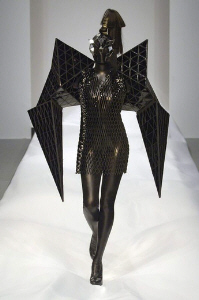
The good folks over at Mercator.net ask if what’s going on really has to do the dignity of women as persons:
[I]t is difficult to escape the impression that the real issue at stake for the French is not the oppression of Muslim women but the visibility of Muslim culture and the way it challenges feminist and secularist assumptions.
Those assumptions also produce blind spots when it comes to the dignity of women. A person who takes that dignity seriously is more likely to be offended by the dress sense of the crowd rather than of an isolated Muslim in a burqa, for the typical European/American/Australian woman today also goes about with something that obscures her face: the exposed breast cleavage just below it.
As western women cling to fashions that aim to reveal everything about the body, they too are depersonalised. The stranger’s eye is not drawn to the face where they might encounter the person, but to the body as a sexual object. And this leads also to oppression, even if the woman, just like the one in the burqa, does not understand that she is oppressed.
Oppressed or not, Muslim women are fighting back. Some who wear the face veil told a group of reporters in France this week that they would not obey the ban (which is expected to come into force next year) and they would not leave the country. They say it is tantamount to denying freedom to practice one’s religion. They talked about having recourse to the European Court of Human Rights if arrested.
As for their dignity, they say it cannot be dictated by the state. The secularism of the state should guarantee religious freedom, they argue. Also, they ask, if the French are such feminists, why do women make up less than 20 per cent of the 577 members of the National Assembly, the lower house of parliament?
Good points, ladies. But the truth that human dignity is not defined by decrees of the state does not mean it is defined by the customs of any particular group, either. For all that some women embrace it willingly, there is something very undignified about hiding the face. The dignity of a woman is the dignity of a person, and the face veil suggests, quite simply, that the wearer is not a person — for her husband and children, maybe, but not for you and me.
This is a sad state of affairs but not one that governments can solve with bans. If anything, these will provoke resentment among Muslims at large and rebellion among the young (watch for more veils appearing, not less). As Muslim leaders themselves say, the answer lies with the education and empowerment of Muslim women.
What would help a lot is a decision by European women to dress and conduct themselves in a style consistent with feminine dignity. Half-bared bosoms and burqa rage are definitely not the way to persuade our Muslim sisters to give up the veil.
Despite all our surface feminism, we really don’t treat women with dignity.
(But do we treat men with dignity, either?)
 Tipsy Teetotaler ن