
Labor Day 2025

HHS

America at last has its own Trofim Lysenko, a crank whose screwy ideas about science gained influence over policy not because of their methodological rigor but because their contrarianism reflected the prejudices of a feral populist revolutionary movement. … You tell me: Is a country that’s transitioning from relying on vaccines to prevent disease—including brain cancer, perhaps—to relying on Ivermectin and beef tallow more or less of a sh-thole than it used to be?

The only good news is that Robert F. Kennedy Jr. is unlikely to rack up a body count as large as his Soviet predecessor. But he’s sure gonna try.

[A] first-world public health agency, the most well-known of its kind on Earth, is about to become a third-world soapbox for voodoo and superstition.

The best-case scenario for public health until 2029 is that no one except the populists pays the slightest bit of attention to the federal government’s medical recommendations. Mass resignations would encourage that.

But if that’s not enough, I think resigning is also compelled by basic dignity. Refusing to participate in a corrupt enterprise is a mark of good character and an act of moral hygiene. What Trump and Kennedy are doing is indecent, and decent people being involved in it both obscures that fact and subjects those people to temptations to behave indecently themselves.

Nick Catoggio, Our Own Lysenko

TGIF

Here’s a pet theory of mine: The Democrats’ struggle to cobble together a winning message is at least partly a result of Democratic strategists and spokespeople sucking at their jobs. They expect favorable coverage from the legacy press and have an irksome habit of talking to reporters as though they’re essentially lower-rung party employees.

For example, a guy named TJ Ducklo—a truly fantastic name for a party hack—was briefly a deputy White House press secretary under Biden until he reportedly accused a female reporter of “jealousy” and threatened to “destroy” her. He presumably expected he’d get away with it, because he thought the press worked for him …

Or take Ian Sams, a top Democratic spokesman who was tasked with reassuring reporters that Biden, despite his visible decline, was sharp as a tack. He was in the news recently after he admitted that he met Biden face-to-face only twice. But I’ll always think of him as the guy who, while working for Kamala Harris’s 2020 campaign, became furious when a BuzzFeed journalist tweeted something mildly critical of one of Harris’s debate performances.

As reported by The Washington Free Beacon, he went whining to BuzzFeed’s editor-in-chief at the time, Ben Smith, that the critical tweet was “whiteness manifest,” whatever that means, and a “really bad look” for the publication. Smith’s reply was spot on: “Do you seriously not have real problems? This text makes me think you are totally, totally unready for an actual presidential campaign.”

Will Rahn, filling in for Nellie Bowles at TGIF. Rahn contrasts Republican press relations, where the GOPsters don’t expect fawning coverage, but I don’t want to borrow too much.

Rahn then pivots to this:

A shooting in Minneapolis: The biggest news of the week is a mass shooting at a Catholic school in Minnesota called Annunciation, and there are no jokes to be made about it. It horrifies me. It’s demonic. And, for the life of me, I cannot understand the Democratic impulse to diminish the power of praying for the victims, children who were shot while praying. It’s like a preprogrammed, knee-jerk reaction that, especially in this instance, is just bizarre and offensive.

Those who seek solace in prayer pray in these situations. We pray for the dead and wounded. We pray for the families. We pray for ourselves. Some might even pray for the soul of the shooter.

I get that you want to make this about gun control. My suggestion is that you shut up about the prayer stuff and just make it about gun control.

Amen! He’s not as funny as Nellie, but I wouldn’t mind too much if Nellie took more time away, leaving him in charge.

He can’t unsee it; I’m trying to bring it into focus

The reason I feel such a tinge of discomfort by the Center Gai scene is not because I care what travelers do, but because I can’t unsee: the forces driving mass hyper-consumptive tourism are the same ones fomenting fascism, science skepticism, kleptocracy, billionaire veneration, labubus, and entertaining ourselves with little colored bubbles until the very second before we die.

Craig Mod via John Brady.

That’s a big claim that I need to chew on a bit. I thought you might want to as well.

Lone-wolf violence in America

In recent years, certain supporters of transgender rights have developed a public language of militancy and conflict, in which familiar habits of left-wing activism — attempts to shut down controversial speech, claims that contrary opinions are fascist or genocidal — are supplemented by an armed-and-dangerous iconography that’s usually associated with the American right.

In the wake of the murders of Catholic school children in Minnesota, the second attack in three years carried out by a transgender shooter against children at a Christian school, it would be relatively easy to write a column holding such militancy responsible for the carnage. All I would have to do is adapt the scripts so often used to blame conservatives for violence, from the J.F.K. assassination (which the scribes of Camelot quickly attributed to the angry rhetoric of Dallas right-wingers) down through the Tea Party and the Trump eras.

If I were making that argument, I would insist that words have consequences: If you tell people that they’re facing “trans genocide,” and that religious conservatives especially are agents of their fascist subjugation, why wouldn’t you expect some troubled souls to opt for vigilante action?

Likewise, if I were laying blame this way, I would insist that violent images inspire violent action: If you sport a shirt with the slogan “Protect Trans Kids” underneath a hunting knife (as the lieutenant governor of Minnesota did in 2023), or if you put a transgender writer toting an AR-15 on your magazine cover (as an alternative weekly in the Pacific Northwest did just two months ago) with a headline asking “Are You Triggered?” you bear some responsibility when the trigger actually gets pulled. Especially when the Minneapolis killer’s own manifesto reportedly trafficked in the same imagery, featuring a “Defend Equality” sticker overlaid with an image of a machine gun.

But I’m not making that case, because it would betray a consistent theme of this column, going all the way back to the attempted assassination of Representative Gabby Giffords in 2011: namely, that all attempts to blame extreme political rhetoric for mass shootings should be treated extremely skeptically, because the phenomenon of lone-wolf violence in America rarely attaches easily to either left-wing or right-wing ideology.

“Diabolos in Greek means accuser, and in that sense the dark spirit that inspires these crimes suffers a defeat when we react with unity and solidarity rather than immediate recriminations.

Whereas it gains a victory every time we respond by immediately blaming our political rivals, and trying to prove over the bodies of the dead that, yes, our ideological opponents are even more evil than we thought.

Ross Douthat, Politics Rarely Explains Mass Shootings (gift link)

Grand Jury Nullification

A federal magistrate found that there was probable cause to support the charge. Yet, on three occasions, a grand jury in the District of Columbia declined to indict. Instead, the U.S. Attorney filed an information for a misdemeanor violation of Section 111. A writer at MSNBC suggests that the grand jury’s refusal to indict may be due to a weak cases being brought by the U.S. Attorney.

Since the failed indictment for Reid, there have been two more grand juries that failed to return a true bill.

It is possible that these juries are carefully attuned to the gradation between felonies and misdemeanors. May I suggest another possibility? Federal grand juries in the District of Columbia, made up (almost) entirely of critics of President Trump, are engaging in nullification of the Trump Administration’s law federal enforcement efforts. I imagine this sort of active resistance will increase as more federal officers are fanned throughout the District of Columbia. …

Historically, at least, the concept of jury nullification was viewed as a popular check against tyrannical governments. I imagine an average D.C. resident who can take time off from work to serve extended periods of federal grand jury duty may see himself in that fashion.

Josh Blackman. This is all the more remarkable because the received wisdom is that prosecutors can get grand juries to indict anyone for anything.

Occam’s Razor

Whenever the White House announces a new criminal investigation into one of Donald Trump’s enemies—an event that occurs with Stalinesque frequency—the administration and its allies have a go-to line: “No one is above the law.” FBI Director Kash Patel, Federal Housing Finance Agency Director Bill Pulte, and others have gleefully deployed the tagline. It’s a smirking, knowing stand-in for the claim that Joe Biden did the same thing to Trump while insisting that Trump was not above the law, and so turnabout is merely fair play.

[Account of why that dog don’t hunt omitted.]

The Occam’s-razor account of how it is that Trump became the first ex-president to face criminal investigation is that Trump is the first professional crook to be elected president. This would also neatly explain why he invented the idea of locking up the president’s enemies. Crooks are generally cynics who think that everybody in power is a criminal, and the only difference is that some people are hypocrites about it. (“My father’s no different than any other powerful man,” Michael Corleone says in The Godfather.)

Barack Obama did not threaten to lock up John McCain or Mitt Romney. The idea that the law is a weapon the president uses to protect his friends and harass his enemies was brought into American politics by one man. He now happens to be the one man who is very definitively above the law.

Jonathan Chait, MAGA Has a New Favorite Slogan

Summing up
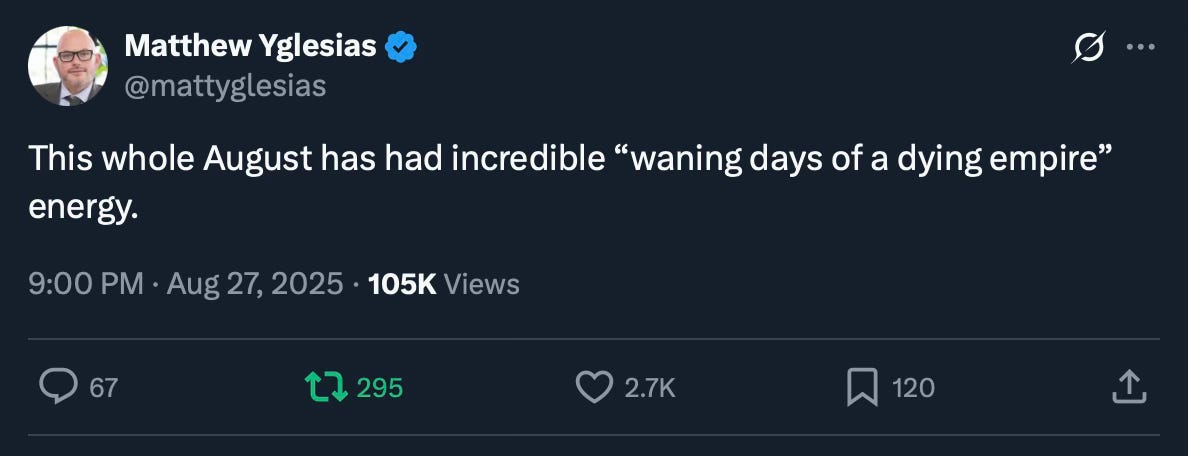

[A] critical mass of the American people … no longer want[s] to govern themselves, … are sick of this republic and no longer want to keep it if it means sharing power with those they despise.

Nick Catoggio

I don’t do any of the major social media, but I have two sub-domains of the domain you’re currently reading: (a) You can read most of my reflexive stuff, especially political here. (b) I also post some things on my favorite social medium.

Saturday, 5/31/25

AI doomsday?

[Jaron] Lanier agreed that it’s up to humans to protect the truth in the age of AI, but was less optimistic that we will do so: “The issue with AI is not the AI. It’s not the large language model. It’s the concentration of power and wealth around who owns it,” he said. “You have to look at the big system, including the people, the money, the business, the society, the psychology, the mythmaking, the politics.”

A Free Press Debate on Artificial Intelligence in San Francisco

Jaron Lanier had fallen off my radar for a few years. I’ll forever be interested in his take on anything regarding computers and humanity (together, not separately).

Bon mots

Codgers and technology go together like peanut butter and sardines.

Frank Bruni. Then this, merely via Frank Bruni, not from him:

In the quarterly journal Sapir, Bret Stephens made a kind of peace with the heavily partisan slant of so much cable television news: “To demand scrupulous impartiality on their broadcasts is like expecting fancy linens at a Motel 6.” (Naomi Lerner, West Orange, N.J.)

A non-tribal Democrat

Some of my subscribers dislike when I throw elbows to my left. They share my disdain for Donald Trump and his party, and my commitment to understanding them in light of political theory and history, but they are also devoted Democrats who have warm feelings for Joe Biden, were thrilled by the campaign of Kamala Harris and Tim Walz, and still seethe about Hillary Clinton’s loss in 2016.

That isn’t me. I vote for Democrats. I directionally agree with them on most issues. And I consider the Republican alternative thoroughly unacceptable. Yet I am not a devoted Democrat. A big part of the reason is that I’m not a joiner—of anything. I value my own independence too much and temperamentally resist deploying my talents to advance a cause—any cause, even a worthy one, and even one wrapped up, at this moment, with the fate of liberal democratic self-government in the United States.

But this way of thinking presumes that working to help the Democrats should take the form of deferring to and falling in line behind party leadership and elected officials, taking marching orders, rallying around candidates and nominees endorsed by the party bigwigs, and then maintaining message discipline to get them elected. That’s what I resist. But there’s another kind of devotion—one that expresses itself as tough love and a willingness to speak candidly, and even harshly, about faults.

… a Democratic researcher is quoted as saying that when she asks swing voters to liken the two parties to animals, they consistently describe Republicans as lions, tigers, and sharks—“apex predators” that “take what they want when they want”—but Democrats as tortoises, slugs, or sloths, creatures typically considered “slow, plodding, [and] passive.”

Damon Linker, A Party of Sloths

Substance, process

One of this crazy-making aspects of life in Trump 2.0 is that the media coverage of the administration’s antics focuses, mostly on the substance of what they are doing, ignoring the process, and the question of whether they have the authority to do it at all.

Such, I feared, was the infirmity of NPR and PBS Aren’t Entitled to Your Tax Dollars, a Free Press article by a serious Ivy league constitutional law professor. I slogged my way through it, agreeing with the author again and again, but frustrated that he was ignoring the elephant in the room. Finally, in literally the last paragraph, he mentioned the elephant almost as a throwaway line:

NPR also alleges in its complaint that the federal statute creating the Corporation for Public Broadcasting prohibits Trump from making this defunding decision. That’s a very different argument, which I’m not addressing here ….

I would venture a guess that nine out of ten people who read this column will come away with the impression that NPR and PBS are suffering from a liberal sense of entitlement to tax dollars, and miss the point about there being some limits to executive power.

In the end, it may not matter because this Congress is sufficiently servile that if Trump asks Congress to defund CPB, PBS and NPR (a longtime GOP talking point), it almost certainly will oblige him.

But process does matter, tremendously. Where the power to do something resides also matters.

Dissing Adoption

The New York Times … has never found a basic human good it couldn’t ponderously criticize with the shuffling-foot smarm of the ideas festival class. There’s “I Was Adopted From China as a Baby. I’m Still Coming to Terms With That. There’s “World’s Largest ‘Baby Exporter’ Admits to Adoption Fraud.” There’s “Given Away: Korean Adoptees Share Their Stories.” (In easily-digestible video format!) There’s “I Was Adopted. I Know the Trauma It Can Inflict.” (Subtle.) The New Yorker, a $12,000 espresso machine transformed into a magazine by a mischievous wizard, has “How an Adoption Broker Cashed In on Prospective Parents’ Dreams,” “Living in Adoption’s Emotional Aftermath,” and “Where is your Mother?” (The answer is that she has been separated from her child by a cruel and fickle child welfare system despite being perfectly fit, which I’m sure is how it usually goes.) The Atlantic has “No One’s Children: America’s long history of secret adoption.” (Would you be shocked to learn that said history isn’t a good one?) They’ve got “The New Question Haunting Adoption,” the question being whether adoption is really a secretly selfish act, you know, the selfish act of taking a severely-disabled toddler into your home to provide them with support and love after their birth parents smoked meth throughout pregnancy. They also have, incredibly, “What Adoption ‘Salvation’ Narratives Get Wrong,” “Adoption Is Not a Fairy-Tale Ending,” “The Dark, Sad Side of Domestic Adoption”…. I could go on, and that’s just three prestigious publications. There’s a whole world out of this out there.

This is all, for the record, a really excellent example of what we used to mean when we used the word ideology. Once upon a time, one wouldn’t say “My ideology is…” because ideology referred to the hidden, unexplored, unconscious politics that lay beneath the public, open, explicit politics. An ideology was those pre-political assumptions and beliefs which conditioned and limited political thought, which made the conscious political philosophy of any individual what it was. Ideology is the skeleton that hides unseen within the animal of politics but nevertheless determines the structure of that which is seen. Ideology exists in both the macro and the micro; this bizarre upper-caste antipathy towards ideology is a good example. If you asked leadership at these publications if they had any particular interest in leading a charge against the practice of adoption, they’d say no, of course not, what a weird question! If you were to show them just how repetitively this particular set of critiques and questions and hrm hrm hrm noises gets published in their pages, they’d swear to you that it reflects no underlying party line. And yet there it is, the evidence, in black and white. Something about the current constitution of the anxious educated urbanite liberal soul cries out inside of them: the real problem is adoption.

Freddie deBoer, Adoption is Good

If the shoe fits

A well-regarded Evangelical pastor published this weeks before the 2020 Election.

[T]his is a long-overdue article attempting to explain why I remain baffled that so many Christians consider the sins of unrepentant sexual immorality (porneia), unrepentant boastfulness (alazoneia), unrepentant vulgarity (aischrologia), unrepentant factiousness (dichostasiai), and the like, to be only toxic for our nation, while policies that endorse baby-killing, sex-switching, freedom-limiting, and socialistic overreach are viewed as deadly.

I think it is a drastic mistake to think that the deadly influences of a leader come only through his policies and not also through his person.

This is true not only because flagrant boastfulness, vulgarity, immorality, and factiousness are self-incriminating, but also because they are nation-corrupting. They move out from centers of influence to infect whole cultures. The last five years bear vivid witness to this infection at almost every level of society.

Christians communicate a falsehood to unbelievers (who are also baffled!) when we act as if policies and laws that protect life and freedom are more precious than being a certain kind of person. The church is paying dearly, and will continue to pay, for our communicating this falsehood year after year.

The justifications for ranking the destructive effects of persons below the destructive effects of policies ring hollow.

I find it bewildering that Christians can be so sure that greater damage will be done by bad judges, bad laws, and bad policies than is being done by the culture-infecting spread of the gangrene of sinful self-exaltation, and boasting, and strife-stirring (eristikos).

I think it is baffling and presumptuous to assume that pro-abortion policies kill more people than a culture-saturating, pro-self pride.

When a leader models self-absorbed, self-exalting boastfulness, he models the most deadly behavior in the world. He points his nation to destruction. Destruction of more kinds than we can imagine.

It is naive to think that a man can be effectively pro-life and manifest consistently the character traits that lead to death — temporal and eternal.

John Piper, Policies, Persons, and Paths to Ruin: Pondering the Implications of the 2020 Election

Piper did not say who he was voting for. He did not name names. For that reason, I’m blogging this separately from pointed political material.

But I’m not going to deny that my heart soared to see that our current President had not captured and reduced to servility the entirety of one of America’s most prominent Christian traditions.

The right to know isn’t the whole story

To further clarify our situation, consider W. H. Auden’s discussion, which I’ve cited before, of the idea that, as he put it, “the right to know is absolute and unlimited.” “We are quite prepared,” Auden wrote,

“to admit that, while food and sex are good in themselves, an uncontrolled pursuit of either is not, but it is difficult for us to believe that intellectual curiosity is a desire like any other, and to recognize that correct knowledge and truth are not identical. To apply a categorical imperative to knowing, so that, instead of asking, ‘What can I know?’ we ask, ‘What, at this moment, am I meant to know?’ — to entertain the possibility that the only knowledge which can be true for us is the knowledge that we can live up to — that seems to all of us crazy and almost immoral.”

L.M. Sacasas, Structurally Induced Acedia (The Convivial Society)

Harvard and the Trump administration

Harvard and the Trump administration have each finally met an adversary too big to push around. America’s richest university never really considered how much it depends on government policy, including lavish federal research funding, federal student aid, and a permissive immigration regime for the foreign students—who make up a third of the university’s student body and often subsidize the rest by paying more. Progressives also never thought through how the many tools they devised for using government leverage against private institutions—including threatening tax exemptions, as the Supreme Court allowed on dubious grounds in Bob Jones University v. United States (1983)—could be used against universities that engage in race discrimination for the “right” reasons, cultivate a political monoculture among the faculty, and permit campus mobs to terrorize minority groups who are out of progressive favor (Jews). Now, Trump is trying to strip Harvard of everything—tax exemption, federal funding, and visas for foreign students already enrolled. While the comeuppance for Harvard is admittedly delicious, the president is abusing powers he ought not to have, and Harvard has deep enough pockets to fight him in court.

National Review Weekly email.

Some cases don’t have valid arguments on both sides. That I find nothing “delicious” about Harvard’s “comeuppance” is an example of why I ignore National Review’s regular email invitations to resubscribe.

Can a car have a “catfish smile”?

“Behind that catfish smile, the company’s twin-turbo 4.0-liter DOHC V8 now discharges a drama-drenched 656 hp and 590 lb-ft—153 hp and 85 lb-ft more than the previous Vantage Roadster—thanks to larger turbochargers, revised camshaft profiles, optimized compression ratio and upgraded fueling and cooling.”

Kudos to Dan Neil for the spot-on “catfish smile.”

The car, by the way, is a 2025 Aston Martin Vantage Roadster, which will set you back $300,000 as equipped (this week’s ephemeral tariffs not included).

Credentials, good times, and genuine learning

Most young people today feel, with considerable justification, that they live in an economically precarious time. They therefore want the credential that will open doors that lead to a good job, either directly or (by getting them into good graduate programs) indirectly …

But those same young people also want to have a good time in college, a period of social experience and experimentation that they (rightly) think will be harder to come by when they enter that working world …

… Yes, students understand — they understand quite well, and vocally regret — that when they use chatbots they are not learning much, if anything. But the acquisition of knowledge is a third competing good, and if they pursue that one seriously they may well have to sacrifice one of the other two, or even both. Right now they can have two out of three, and as Meat Loaf taught us all long ago, two out of three ain’t bad.

Alan Jacobs, responding to Ted Gioia on the topic of ending AI cheating.

Potpourri

  • After Trump held a crypto dinner last Thursday night, crypto moguls who paid to be there felt scammed that the president didn’t even stick around at the event they’d hoped to do their own scams at. I saw someone describe him as the apex scammer. Our Scammander in Chief.
  • In other Russia news, a new statue of Joseph Stalin in a Moscow metro station was unveiled this month. President Putin has called Stalin an “effective manager,” and has said that enemies of Russia use the “excessive demonization” of Stalin to attack “the Soviet Union and Russia.” Stalin is back, big time. Interesting that “effective manager” is being used here to describe a man who facilitated the death of millions—and not efficiently. But I’m not a businessman.
  • The continued reckoning: A postmortem on Kamala Harris’s campaign cited a “perception gap” as one of the reasons she lost, saying voters believed she held positions that she didn’t. “Over 80% of swing voters who chose Trump believed Harris held positions she didn’t campaign on in 2024, including supporting taxpayer funding for transgender surgeries for undocumented immigrants (83%), mandatory electric vehicles by 2035 (82%), decriminalizing border crossings (77%), and defunding the police (72%).” But Harris had, in fact, supported all of these positions. Like, she is on record supporting each of those positions (here, here, here, and here). So it’s not really a perception problem so much as a reception problem, like these ideas are not popular even though I support them. There’s a sense among Dems that people should simply ignore the things that are unpopular and that referencing them is fake news. Like, how dare you talk about the surge of migrants coming through our new open borders thanks to swift changes from the Biden admin. Yes, it’s technically true, but it’s disinformation-coded.
  • Leave Bruce alone: A bar in New Jersey canceled a performance by a Bruce Springsteen tribute band after the real Springsteen called Trump “corrupt, incompetent, and treasonous” while on tour in England. Citing the bar’s MAGA clientele, the bar owner said that a Springsteen cover band would be “too risky at the moment.” And: “Whenever the national anthem plays, my bar stands and is in total silence, that’s our clientele. Toms River is red and won’t stand for his bull—.” [But MAGA doesn’t have a violent streak. No way. That’s fake news.]
  • Things that are not antisemitism: The Democratic Socialists of America “Liberation Caucus” has announced its support for Elias Rodriguez, the suspect arrested for slaughtering two Israeli Embassy staffers outside D.C.’s Capital Jewish Museum last week. Here’s the statement signed by the DSA Liberation folks and a bunch of others: “As imperialism has made the entire world its battlefield, it is justified to fight it, by any means necessary, without regard for geography.” And: “[T]here must be consequences for genocidal [Z]ionist imperialism, and those consequences are righteous.”

Nellie Bowles

Fake my …

The latest fitness craze is surely going to be Fake My Run. It fits perfectly with the national ethos whereby university students are already doing Fake My Education.


Your enemies are not demonic, and they are not all-powerful and the right hasn’t always lost and the left hasn’t always won. But if you convince yourself of that, you give yourselves all sorts of permission to do a lot of stupid and terrible things under the rubric of “Do you know what time it is?”

Jonah Goldberg.

Trumpism can be seen as a giant attempt to amputate the highest aspirations of the human spirit and to reduce us to our most primitive, atavistic tendencies.

David Brooks)

I don’t do any of the major social media, but I have two sub-domains of the domain you’re currently reading: (a) You can read most of my reflexive stuff, especially political here. (b) I also post some things on my favorite social medium. I am now exploring Radiopaper.com as well.

Political (5/27/25)

Shooting us in the foot

Defunding Science

I don’t think I elevate science unduly, and I even try to burst the bubbles of those who do. I think we’ve neglected the humanities in worshiping the almight STEM.

But Steven Pincker has a long and passionate defense of Harvard in the New York Times opinion section. Remembering that Trump’s attack is largely based on alleged antisemitism at Harvard, this in particular struck me as key:

Just as clear is what won’t work: the Trump administration’s punitive defunding of science at Harvard. Contrary to a widespread misunderstanding, a federal grant is not alms to the university, nor may the executive branch dangle it to force grantees to do whatever it wants. It is a fee for a service — namely, a research project that the government decides (after fierce competitive review) would benefit the country. The grant pays for the people and equipment needed to carry out that research, which would not be done otherwise.

Mr. Trump’s strangling of this support will harm Jews more than any president in my lifetime. Many practicing and aspiring scientists are Jewish, and his funding embargo has them watching in horror as they are laid off, their labs are shut down or their dreams of a career in science go up in smoke. This is immensely more harmful than walking past a “Globalize the Intifada” sign. Worse still is the effect on the far larger number of gentiles in science, who are being told that their labs and careers are being snuffed out to advance Jewish interests. Likewise for the current patients whose experimental treatments will be halted, and the future patients who may be deprived of cures. None of this is good for the Jews.

The concern for Jews is patently disingenuous, given Mr. Trump’s sympathy for Holocaust deniers and Hitler fans. The obvious motivation is to cripple civil society institutions that serve as loci of influence outside the executive branch. As JD Vance put it in the title of a 2021 speech: “The Universities Are the Enemy.”

Steven Pinker, Harvard Derangement Syndrome (shared link)

Leave them all alone

A German concept used to validate the society-saturating politics infecting Europe 90 years ago was Gleichschaltung. It denoted totalistic government: the “coordinating” or “harmonizing” of all important social institutions. A foreign word, but no longer a foreign practice.

As a candidate in 2023, Donald Trump vowed to “choke off the money” to schools assaulting “Western civilization itself.” As he defines this, and as he defines “assaulting” it. What could go wrong?

America’s research universities are sources of U.S. economic dynamism and vital to technology-dependent national security. It is folly (and unlawful) to punish entire institutions for the foolishness of a few departments. When English departments are “decolonized” — dead White men purged from the curriculum — the only victims are students deprived of Shakespeare. Ideological indoctrination is rarer in engineering departments, where knowing the right facts rather than having the right feelings matters, otherwise bridges crumble and skyscrapers tumble. Leave all departments alone, some because their silliness does not matter much, others because their excellence matters greatly. (Source: washingtonpost.com)

George Will via John Ellis

Keeping score

SCOTUS and the “Shadow Docket”

We have plenty of things to worry about in constitutional law today. But those worried about how the court will confront the unprecedented and sometimes unlawful actions of the Trump administration should save their outrage for other cases.

In the two cases here, the court held that the president was likely to prevail in his unitary executive claim, that the administration was unduly harmed by allowing the officials to keep their offices while the case was pending, and that this reasoning would not imperil the independence of the Federal Reserve. It did all of this in an emergency order, rather than waiting for the issues to arrive on the court’s regular docket.

The president’s ruinous tariffs, purported cancellation of birthright citizenship, renditions to foreign prisons and retaliations against his political opponents all raise far graver constitutional problems than the court’s ultimately unsurprising order in these cases. We should focus our concern there.

Will Baude in the New York Times.

I had Will’s father, Pat Baude, for several Constitutional Law classes, and he, too, was brilliant. I only wish he had lived long enough to bust his buttons at his son’s brilliance and esteem in the legal community.

The Big Picture: A Hostage Crisis

This newsletter concerns itself with the great patriotic project to turn America into a banana republic, but something gets lost by doing that episodically. Each day we study some crooked new tree that Donald Trump’s administration has planted; rarely do we step back and consider how large the forest has already become.

Here’s Andy Craig at The UnPopulist, stepping back:

Since Jan. 20, the United States has been in a state of rapid constitutional collapse. Congress’ power of the purse, its most fundamental prerogative, has been usurped; statutory laws have been suspended by claimed “emergency” powers; the requirement for Senate confirmation has been made irrelevant; a transparently political purge of both the civil service and the armed forces has been launched; the president has threatened aggressive military force against longtime allies; a decree was issued to strip constitutional citizenship rights; our treaty obligations have been blown up with a self-sabotaging trade war; mass pardons have been used to gleefully sanction political violence; courts have been defied to send innocent people to a Central American torture camp; the world’s richest man has deployed a gaggle of racist hackers to shut down government agencies on a whim; and, just as we were going to press, news broke that Harvard University has been barred from enrolling foreign students because of its refusal to hew to the president’s ideological demands.

What Craig is describing is essentially a hostage crisis.

An authoritarian state is a national hostage crisis … Most hostage crises aren’t orchestrated by coolly ingenious master-planners. They’re what happens when someone who’s ruthless, audacious, volatile, and cunning but not very bright makes a mess of his caper, like a bank robber whose hold-up takes longer than expected. He turns to leave and finds cop cars pulling up outside, causing him to panic and to start taking hostages instead.

There’s no “plan.” He just doesn’t know what else to do now that a wildly reckless, dangerous course of action like robbing a bank has suddenly gone sideways.

That was also the theme of yesterday’s newsletter, not coincidentally. The One Big Beautiful Bill that passed the House on Thursday is incomprehensible as a plan to strengthen America fiscally. It makes sense only as a desperate act in the midst of a dangerous caper gone bad: Having decided long ago that making Trump happy is more important than protecting the country, House Republicans acted accordingly when forced to choose.

Nick Catoggio

Amnesiac Nation

The background fact of this second Trump impeachment trial was how broadly popular it was. In January, a Monmouth survey found that 56 percent of Americans wanted Trump convicted. Quinnipiac reported that 59 percent regard him as responsible for inciting violence against the U.S. government. According to ABC/The Washington Post, 66 percent believe that Trump acted irresponsibly during the post-election period. According to polls, fewer than a quarter believed that Trump did “nothing wrong” on January 6.

Those are not the numbers on which to base a Grover Cleveland–style comeback tour—especially not when the majority of Americans also believe that Donald Trump did a bad job handling the COVID-19 pandemic and that President Joe Biden is doing a good job.

David Frum.

There came a time when “President Joe Biden” became a legal fiction, and that boosted Trump’s stock.

Abundance Agenda

Jonathan Chait writes about the civil war in the Democrat party over a proposed “abundance agenda” for the party.

Here are the pieces of that agenda, according to Chait:

[T]he canonical abundance agenda consists of three primary domains.

The first, and most familiar, is the need to expand the supply of housing by removing zoning rules and other legal barriers that prevent supply from meeting demand …

The second focus of abundance is to cut back the web of laws and regulations that turns any attempt to build public infrastructure into an expensive, agonizing nightmare …

The third domain, and the one that has received the least attention from commentators, is freeing up the government, especially the federal government, to be able to function. Policy wonks call this issue “state capacity.” The government itself is hamstrung by a thicket of rules that makes taking action difficult and makes tying up the government in lawsuits easy. The abundance agenda wants to deregulate the government itself, in order to enable it to do things.

The problem is that there’s a bloc of progressive special interests within the party (“the groups,” per the abundance agenda proponents), and the groups are large and unified (or at least in alliance):

The progressive movement seeks to maintain solidarity among its component groups, expecting each to endorse the positions taken by the others.

Much of the most vociferous opposition to the abundance agenda has zeroed in on its betrayal of this principle. The Roosevelt Institute’s Todd Tucker attacked Ezra Klein on X for his “survivor island approach to coalitions—first unions and Dems team up to vote enviros off the island, and then Dems turn on labor.” David Sirota, a left-wing journalist, complained, “Abundance Libs are insisting the big problem isn’t corporate power & oligarchs, it’s zoning laws & The Groups? Come on.” Austin Ahlman, a researcher at the Open Markets Institute, an anti-monopoly advocacy organization, mused, “You have to wonder whether the Abundance faction stuff would have landed better if the proponents had not laid the groundwork for it by first broadsiding every other organized constituency in the democratic tent.”

This angry response is not merely a knee-jerk reaction to criticism, but the logical outgrowth of a well-developed belief system. Since the Obama era, many of the component groups in the progressive coalition have drifted further left on their core demands. (Single-issue lobbies are naturally incentivized to grow more extreme over time—what organization is going to decide its pet cause is too unpopular or costly to merit a strident defense?)

At the same time, they have grown more purposeful about their belief that each group must stand behind all the positions outlined by the others. That is why civil-rights groups will demand student-debt relief, abortion-rights groups endorse abolishing the police, or trans-rights groups insist that Palestine should be liberated. Leah Hunt-Hendrix, an heir to the Hunt oil fortune who became a full-time progressive organizer, and who has raised and donated millions to causes such as the Sunrise Movement, the Debt Collective, and Black Lives Matter, articulated the principle of cross-endorsements in her book, Solidarity. She argues for “the necessity of working in coalition with progressive social movements,” and of resisting the opposition’s efforts “to weaponize a movement’s fault lines.”

Such progressives are not wrong to see the abundance agenda as a broader attack on their movement.

The Coming Democratic Civil War – The Atlantic

I have long believed that “the groups” impede Democrat success by alienating Democrats in the cultural mainstream. And as I’ve long said, whatever else Trump’s triumph means, it means major political realignment. The Democrat party’s travails over the abundance agenda, and controlling the toxic “groups,” could further advance that realignment, but I’m not sure it will benefit the Democrats all that much.

But then what do I know? I’m almost completely alienated from a country that can elect Velveeta Voldemort.


Your enemies are not demonic, and they are not all-powerful and the right hasn’t always lost and the left hasn’t always won. But if you convince yourself of that, you give yourselves all sorts of permission to do a lot of stupid and terrible things under the rubric of “Do you know what time it is?”

Jonah Goldberg.

Regarding said “lot of stupid and terrible things,” my failure to call out anything about the current regime does not mean I approve. There’s just too much, and on some of the apparent illegalities I don’t want to abuse my rusty credentials without thinking it through.

I don’t do any of the major social media, but I have two sub-domains of the domain you’re currently reading: (a) You can read most of my reflexive stuff, especially political here. (b) I also post some things on my favorite social medium. I am now exploring Radiopaper.com as well.

Special Emergency Edition

Emergencies seem to be all the rage these days, so I’m following suit by abandoning all my usual blogging practices and rushing this out with no second thoughts.


On Thursday, former FBI Director James Comey posted a picture on Instagram with the caption: “Cool shell formation on my beach walk.” The shells were arranged to spell out “8647.”  This became an outrage on social media because, obviously, Comey was calling for Donald Trump (the 47th president) to be murdered. 

Murdered? Yes. Murdered.

Donald Trump Jr. responded, “Just James Comey casually calling for my dad to be murdered.” Department of Homeland Secretary Kristi Noem leaped into action, tweeting, “Disgraced former FBI Director James Comey just called for the assassination of  @POTUS Trump. DHS and Secret Service is investigating this threat and will respond appropriately.” Current FBI Director Kash Patel, no doubt poolside in Vegas, said he was monitoring the situation closely, but the Secret Service was taking the lead. 

Not to be out done, Director of National Intelligence Tulsi Gabbard scrambled to deal with this emergency the way leaders in national security and intelligence have since the old OSS days: She ran to a camera to talk to Fox News’ Jesse Watters and told him, “The danger of this [Instagram photo of some shell-numbers] cannot be underestimated.”

Watters got to the real crux of the issue quickly. “Do you believe Comey should be in jail?”

“I do,” Gabbard replied … 

I don’t want to belabor this, because you’re either embarrassed for the country by this unconstrained idiocy and asininity or you should probably be reading Gateway Pundit’s coverage of this very serious assassination plot. I don’t think Comey was calling for Trump’s assassination. Nor do I think there’s a person out there who would be motivated to assassinate the president by the numbers 8647, whether spelled in seashells, Cheetos, or the decapitated heads of Barbie dolls. But just for the record, even if the shells spelled out “Trump should be fed face first to bears,” Comey would be in no legal jeopardy.  

I do love that the same crowd that bragged about restoring the First Amendment and vowed to end the era of weaponizing the justice system went straight to the claim that Comey’s obvious incitement of violence demands that he be put behind bars.  

There’s no rule saying you have to be this dumb.

Jonah Goldberg

(All my email signature blocks now end with “86 47”)


In political circles there are four subjects much discussed: (1, 2 and 3) President Trump and (4) How does the Democratic Party get its mojo back?

John Ellis


The past 24 hours have been something of a Rorschach Test for the Supreme Court. In the birthright citizenship case, the Court made clear that in emergencies, the judiciary must retain the power to enter universal injunctions, even if Article III does not otherwise permit such injunctions. And in A.A.R.P. v. Trump, the Court made clear that in emergencies, the court should certify a class without going through Rule 23, and grant an ex parte tro without considering any of the usual TRO factors.

What lesson should lower court judges take away? In cases of perceived emergencies, forget all the rules and make stuff up. When the executive branch takes such actions we call it an autocracy. When the courts do it, they call it the “rule of law.”

I will have much more to say about this order in due course.

Josh Blackman


Your enemies are not demonic, and they are not all-powerful and the right hasn’t always lost and the left hasn’t always won. But if you convince yourself of that, you give yourselves all sorts of permission to do a lot of stupid and terrible things under the rubric of “Do you know what time it is?”

Jonah Goldberg.

I don’t do any of the major social media, but I have two sub-domains of the domain you’re currently reading: (a) You can read most of my reflexive stuff, especially political here. (b) I also post some things on the only social medium I frequent, because people there are quirky, pleasant and real.

Lazarus Saturday

Today, we commemorate Christ raising Lazarus from the dead. Essentially, I’m now in an eight-day marathon until Pascha/Easter — serving at least two services daily.

Miscellany

FWIW

There was a time when I’d have devoured an article like Best Wireless Headphones (2025): Tested Over Many Hours | WIRED.

Now I think “why bother; what I’ve got is amazing, and quite good enough even if it’s not ‘best’.”

What is the point of being a Republican senator?

“What is the point of being a Republican senator?” one of my editors asked this morning.

It was a rhetorical question.

The remark was inspired by news that former New Hampshire Gov. Chris Sununu won’t run for Democrat Jeanne Shaheen’s Senate seat next year

No thanks, Sununu said Tuesday. “It’s not for me,” he explained in an interview. “I talked to the White House this morning. I talked to Tim Scott [the head of the National Republican Senatorial Committee]. Thanked him for all their support and confidence. But I don’t have to be the candidate, and I’m not going to be the candidate.”

“I don’t have to be the candidate” is interesting phrasing. It’s what you’d say when refusing an unwelcome burden ….

Nick Catoggio

Nellie Bowles excerpts

  • Chiming in on the factory work fetish is—who else?—former gay-turned-antigay Milo Yiannopoulos: “Men are depressed and addicted and broken because they have nothing to do. They get no stimulation or satisfaction from BS email jobs. I’m telling you, white Americans will love working in factories again. Making things, in the image and likeness of God the Maker.” Let me tell you: The image of God is not in the microscopic iPhone screw you’ll be mastering until your eyes burn out, Milo. Installing airbags until your elbows give out is—well, that one’s maybe in His image.
  • [Trump tariff advisor Peter] Navarro’s books have often cited an economist named Ron Vara, who is entirely made up. It’s just an imaginary friend Navarro uses in arguments, created through an anagram of his last name. So he earned his nickname [Peter Retarrdo].
  • Mississippi now has the best standardized test scores for fourth graders, when adjusted for demographics (i.e., taking into account socioeconomic status, native language, race, whether your parents raised you to have enough self-esteem, ate enough broccoli, etc.). The rise follows a 2013 decision to use phonics-based learning statewide and to hold back third graders who failed to pass a reading test, which may seem mean until you realize that blue states are letting entirely illiterate kids graduate into the world, a world that—for now—still requires literacy. Meanwhile, Oregon, whose fourth graders have the lowest demographically adjusted test scores, has paused the use of any standardized test as a graduation requirement until at least 2029 and is, of course, obsessed with the Lucy Calkins school of teaching kids reading with vibes. Sigh. The real tragedy is that these kids will never be able to read my columns. Luckily for them, I will read it out loud!
  • During a lowkey argument over lawn chairs at a track meet, a teenager named Karmelo Anthony allegedly stabbed Austin Metcalf in the heart, killing him. Within days, both 17-year-olds had fundraisers opened in their names. Karmelo’s has raised $330,000, keeping a rough pace with the victim’s. The moment has turned into a race war, with people donating as if these were two teams in some cosmic battle. As if supporting one or the other is part of racial pride. It’s very scary ….
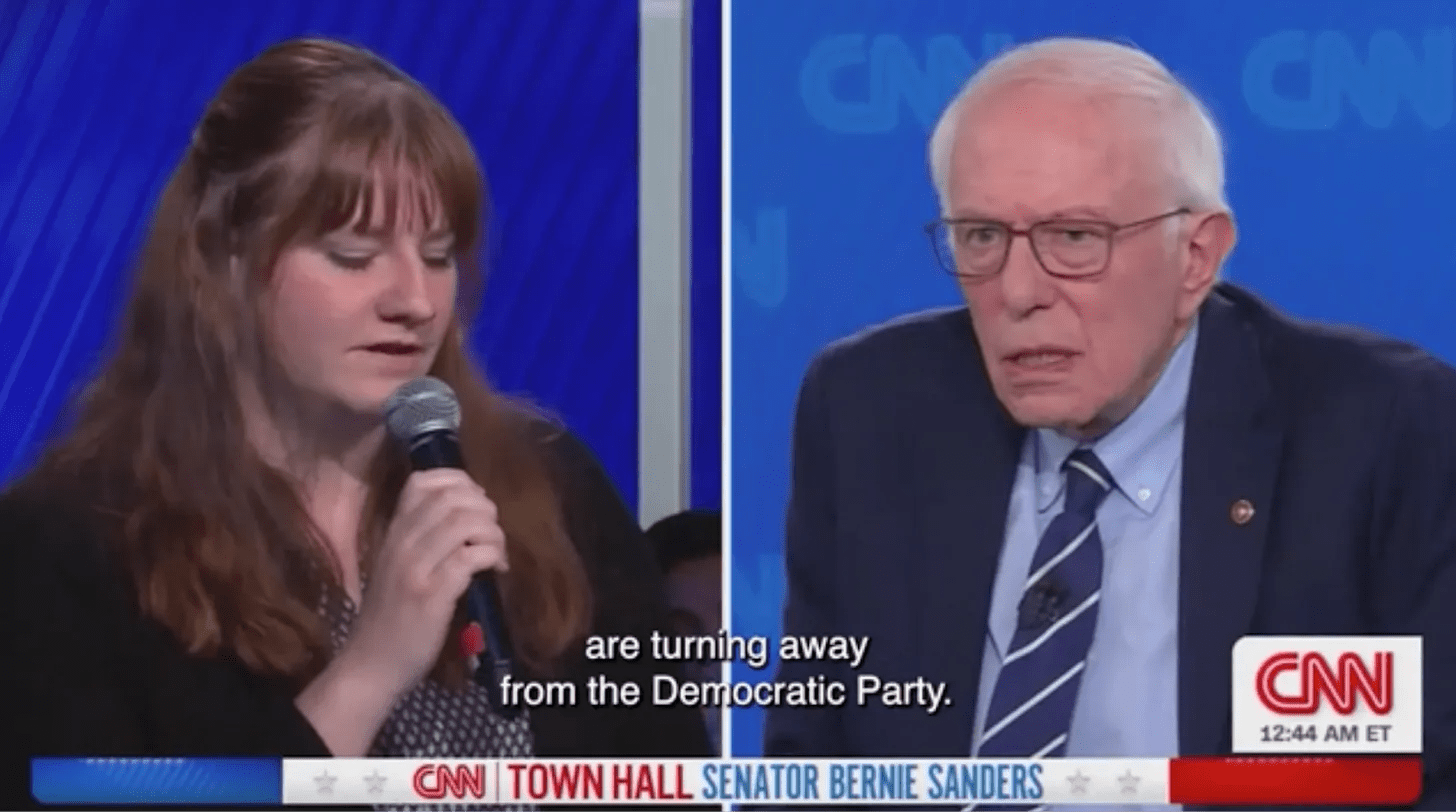
  • Anderson Cooper, leading a town hall with Bernie Sanders, got chastised for using she/her pronouns for a completely normal-looking woman, with a completely normal-woman name of Grace. Called upon by Cooper, she snaps: “I use they/them pronouns actually, thank you,” clearly annoyed, clearly relishing the moment. Then she starts her question, which is about why men aren’t compelled by the Dems anymore, and no, I’m not kidding: “Polling and turnout data indicate that men of all racial demographics are turning away from the Democratic Party. . . ” Yes, it is a great mystery, Grace, they/them. I’m obsessed with Bernie’s face as this is unfolding:
  • John Oliver dedicated his entire show to a monologue about how there are no differences between men and women in athletics, and transwomen should be able to compete against natal females. “Bigger and stronger bodies are not automatically advantaged in every scenario. . . we have no research about how being trans or undergoing gender-affirming treatment impacts athletic performance in teens.” Which is sort of like saying we have absolutely no research indicating that a giraffe is bigger than a goldfish—no double-blind peer-reviewed studies have been done to date, so really, how can you say which is bigger? …

Nellie Bowles

Speaking of John Oliver

Oliver is such a pitch-perfect caricature of progressive self-regard – snarky, aloof, judgmental, incurious – that I sometimes wonder if his show is a brilliant op pulled off by the Heritage Foundation.

Freddie DeBoer

Over/Under

I’ve been puzzling over the term “over/under,” which increasingly seems to be one of the two numbers reported in sports stories where I’m looking for a straightforward prediction of who wins and by how many points.

Since I do not bet on sporting events, I never bothered to try to figure out the term. But the increasingly it is appearing as shorthand in political reporting, e.g.:

One Dispatch colleague told me he’d set the over/under on how many Senate Republicans would vote to convict in the scenario I described at 1.5—and that he’d take the under.

Nick Catoggio

So I finally took the trouble to look it up. You can, too, if you’d like.

It’s not a useless way to express a prediction, but I really hate gambling terminology, becoming obligatory for political discourse. Nick’s Dispatch colleague could have said “I don’t think Senate Republicans could get more than one vote.”

Not so much about Trump as about DC

In a recent members-only Dispatch conversation, Steve Hayes argued that Trump enjoys nothing as much as the exercise of power, and I disagreed with him: It seems to me that Trump does not at all enjoy the actual exercise of power, which is very difficult and demanding work of precisely the sort that he has spent a lifetime avoiding. The counterintuitive fact is that one of the big problems in Washington is that almost nobody enjoys the actual exercise of power, which is why the three branches of government keep trying to hand responsibilities off to each other: from our drama-queen president to our do-nothing Congress to the tortured pseudo-institutionalism of the chief justice, we have a government run by a team of Bizzaro World Kobe Bryants—guys who only know how to pass and never take a shot. Trump wields power in Washington in approximately the way a man playing Macbeth wields power in Scotland. In Trump’s case—which is our case—the damage is real, of course, but that is no more an actual exercise of political power than a drunk crashing his Buick into a school bus is an example of motorsport.

Kevin D. Williamson

Five Current U.S. Protestant Political Outlooks

[MAGA Christianity] is nostalgic for America’s past but not necessarily for America’s founding constitutional principles, which can impair its ambitions.

Mark Tooley, Juicy Ecumenism.

Strongly agree. More:

It mostly hat tips to traditional Christian views about abortion and marriage but is willing to subordinate those stances to wider political ambitions. With the rest of MAGA, it is skeptical if not hostile to American international commitments and to free trade. It’s also impatient with the humanitarian values of the old Religious Right, which it sometimes disdains as signs of weakness if not wokeness. Pentecostal preacher Paul White Cain, the White House faith advisor sometimes associated with the New Apostolic Reformation, is a leading figure. But many others who were conventional Religious Right have aligned with MAGA Christianity. Charlie Kirk of Turning Point USA is a leading cheerleader.

The overall story was about “Five Current U.S. Protestant Political Outlooks.” The other four are:

  1. Religious Left
  2. Religious Right
  3. neo-Anabaptist left
  4. TheoBro right

I find all five options unpalatable. There’s no paywall, so take a look for yourself.

Let’s us three make a deal

Strikingly, … some of the shrewdest officials and analysts in such capitals as Beijing, Brussels and Washington are focused on a challenge to the established world order that is harder to see or hear. To them, the most disruptive force in geopolitics today is Mr Trump’s apparent desire to huddle with other world leaders, and quietly carve up the world together.

The Economist, The dangers of Donald Trump’s instinct for dealmaking

Trump 2.0

For the good of my soul, I’ve got to stop paying so much attention to Donald Trump.

(That paragraph replaces several paragraphs of TMI.)

Due Process

Of all the lawless acts by the Trump administration in its first two and a half months, none are more frightening than its dumping of human beings who have not had their day in court into an infamous maximum-security prison in El Salvador — and then contending that no federal court has the authority to right these brazen wrongs.

Lawrence Tribe and Erwin Chemerinsky

I have been reminded several times lately that this doesn’t quite tell the entire story.

Many of the people swept up and shipped to El Salvador did have their day in court: in ordinary procedures under the Immigration and Naturalization Act, where they were adjudicated deportable. Instead of self-deporting, they remained in the US where nobody got around to deporting them until someone quite suddenly did with lots of fanfare.

Others indeed had no day in court, but were swept up dubiously under the Foreign Enemies Act and summarily deported. They are fairly described by Tribe and Chemerinsky. Moreover, without due process we have no reason to trust that they were deportable at all.

None of this is to defend the prison conditions to which any of the deportees are being subjected and for which we are paying.

Chris Krebs

Lost yesterday amid the public jubilation over being liberated from “Liberation Day” was the signing of two new executive orders, one aimed at Chris Krebs, the other at Miles Taylor.

Krebs led the Cybersecurity and Infrastructure Security Agency during Trump’s first term, placing him in charge of, among other things, detecting and preventing any tampering with America’s election technology. The president fired him on November 17, 2020 not for doing his job poorly but for doing it honestly and well. Krebs insisted repeatedly after Election Day that there had been no security breaches involved in Joe Biden’s victory. That qualified as insubordination in the Trump White House.

Trump’s new memorandum on Krebs accuses him of various offenses, including “censoring” conservative viewpoints, but the true nature of his grievance is right there in the text: “Krebs, through CISA, falsely and baselessly denied that the 2020 election was rigged and stolen, including by inappropriately and categorically dismissing widespread election malfeasance and serious vulnerabilities with voting machines.”

That’s nakedly retaliatory, just like the executive orders targeting law firms that caused legal trouble for the president in the past. Once again, Trump’s corruption is right out in the open. But I believe this is the first time he’s gone as far as to officially penalize someone for rejecting his conspiratorial nonsense about the 2020 election, a position shared by a large majority of the American public and even by some of his own Cabinet nominees. Or former nominees, anyway.

Nick Catoggio

And if he had said there were security breeches, he’s be saying he’d failed at his job.

Dare I suggest that you cannot win working for Donald Trump?

We should have seen this coming

I highly recommend David Brooks’ Article in the Atlantic, I Should Have Seen This Coming


I suffer more from the humiliations inflicted by my country than from those inflicted on her.

Simone Weil, from a letter to Georges Bernanos.

[N]one of the things that I care about most have ever proven susceptible to systematic exposition.

Alan Jacobs, Breaking Bread With the Dead

I don’t do any of the major social media, but I have two sub-domains of the domain you’re currently reading: (a) You can read most of my reflexive stuff, especially political here. (b) I also post some things on the only social medium I frequent, because people there are quirky, pleasant and real.

Saturday, 8/24/24

Politics

Truly weird

Y’know what’s weird in a hopeful sort of way? Nostaligia across ideological lines, that’s what.

… programming on Thursday night, which seemed to aim at appealing to Nikki Haley voters from the GOP primaries. There were a lot of respectful references to Ronald Reagan. From Arizona Sen. Mark Kelly. From old-time national security hand Leon Panetta, who talked about killing Osama bin Laden.

Damon Linker, Well done, Dems

[L]et’s face it, even some European conservatives find Trump so distasteful that they are eager to believe the best about Harris—especially the idea that she really might be Obama in a pants suit.

Rod Dreher, Kamala Harris and her ‘Good Vibes’ Campaign

Almost she maketh me straight

I’m reluctant to write about Kamala Harris’s smile because I’m going to get all gushy and mushy about it, and the Harris lovefest is a jammed jamboree without need of another journalist. She’s enjoying more than a routine political honeymoon; she’s in the priciest suite on the poshest cruise ship sailing through a tropical paradise where coconuts tumble juicily from their trees into her aloe-moistened hands.

But I can’t stop noticing and basking in her happy face. Actually, happy doesn’t do it justice — it’s exuberant. Sometimes even ecstatic. When she made her surprise appearance onstage in Chicago during the prime-time portion of the Democratic National Convention on Monday night, she beamed so brightly I reached for my sunglasses. When she high-fived her running mate’s wife, Gwen Walz, during a campaign rally in Rochester, Pa., the day before, she sparkled like a gemstone. Even when she talked about the economy — the economy! — in Raleigh, N.C., two days before that, she found places and pauses for her mouth to widen and her eyes to light up. Those smiles of hers communicate an elation that I immediately want to share, an optimism that I instantly want to embrace.

Frank Bruni, who may be confusing Kamala with Judy Garland.

Kamala’s hostile work environment

And now for the anti-Bruni:

The Harris-Walz messaging indeed projects a pair of lovable scamps out to defend old-fashioned American decency against two mean, corrupt weirdos, Trump and J.D. Vance. Harris’s bubbly likability is a façade. In fact, Harris has a behind-the-scenes reputation as a high-maintenance diva. As vice president, she has had an unusually high staff turnover, with burned-out aides leaving feeling chewed up and spit out.

“People are thrown under the bus from the very top, there are short fuses and it’s an abusive environment,” a person with direct knowledge of how Harris’ office is run told Politico, in a 2021 report. “It’s not a healthy environment and people often feel mistreated. It’s not a place where people feel supported but a place where people feel treated like s—.”

To be sure, Donald Trump is famously a difficult boss. And yes, the presidency is not a therapy session. Still, when Kamala Harris gasses on, as she did in her convention speech, about the need for charity, and about the mandate to treat others as you want to be treated, it is all an act to create, well, a trippy California vibe that contrasts with Trump’s meanness.

Rod Dreher, Kamala Harris and her ‘Good Vibes’ Campaign

Noonan’s take

The Democratic Party has more substantial characters of recent American history to parade around on stage. The Clintons, the Obamas, Jesse Jackson, who, whatever your view of him, was there, on the balcony at the Lorraine Motel, when Martin Luther King was shot. This conveyed a party with a storied past, and if you join it you’re joining something real. The Republican Party, in its great toppling, has rejected its past. You lose something when you cast your history aside, and all you’ve got for prime time is Trump sons.

Donald Trump is famously off his game. He knows his old insult shtick isn’t working. Some of his supporters say, “All he has to do is read from the teleprompter!” but they’re wrong. He’s no good when he reads from the prompter, he doesn’t respect what’s on it. It bores him, and he talks like a tranquilized robot. He knows what he does well—shock, entertain, mention two or three big issues. He’s having trouble making a stinging critique of Democratic policy because he’s insulted everything over the years, and when he says something’s bad now it just seems part of his act and doesn’t land.

Peggy Noonan

Normal people

The Obamas managed to strike a tone that was at once a little bit angry and a little bit hopeful. Barack spoke about how most Americans don’t want to go to war with our neighbors over politics. He’s right: In fact, most of us normal people don’t actually care how our neighbors vote, just as long as the guy next door isn’t blasting Mexican polka after 8 p.m. He also nicely articulated what’s so grating about Trump: Trump is the guy who has everything and still whines about not having enough. He’s always talking about himself: his problems, his successes, his goddamn golf score.

Meanwhile, Trump focuses on what really matters—cocaine: Trump took a brief moment away from listing his grievances to educate himself on America’s drug problem during an appearance on comedian Theo Von’s podcast. You’d think a rich man who lived in New York in the 1980s would know a little something about the white stuff, but listening to Trump ask Von about coke is like hearing a five-year-old ask where babies come from. “And is that a good feeling? Why would you do it?”

Honestly, the whole thing is sort of endearing, and as Helen Lewis said, it’s the first time Trump has shown an interest in someone other than himself.

Katie Herzog

Conspiracy theory of the Left

If you think, as Kamala Harris thinks, or says she thinks—(“thinks”)—that inflation in grocery prices is the result of “price gouging,” then I don’t want to hear you ever complaining about conspiracy theories. Because that is a big, dumb conspiracy theory, the sort of thing that can be taken seriously only by asses of exceptional asininity.

Kevin D. Williamson

Populists versus the credentialed experts

Populist politics defies experts in favor of deferring to the people (the voters).

The reason why such a politics still seems disorienting to so many of us is that we just lived through several decades when highly credentialized experts enjoyed uncommon levels of deference. This was the highwater mark of technocratic-managerial neoliberalism. What should the president do about an economic problem? Talk to economists and follow their advice. What about a foreign policy crisis unfolding abroad? Talk to experts ensconced in Washington’s many think tanks devoted to international affairs. The same holds for any area of policy. Whatever the problem, solving it involves finding the experts, listening to what they say, and then going along with their recommendations.

But not anymore. Or at least not consistently. The experts are still around, and they are still shown respect by journalists who focus on national politics. But they don’t have the political clout and don’t exercise the overwhelming influence they once did. This is true in both parties. And taking note of it is crucial for understanding where we are and where we’re going.

Damon Linker

How to get the press to blurt out inconvenient truth

Even a blind squirrel finds a nut once in a while, and so it goes with journalistic “fact checkers.” Sen. J.D. Vance made a slip of the tongue last week, which prompted CBS News to reveal the truth unwittingly.

In an Aug. 11 “Face the Nation” interview with Margaret Brennan, Mr. Vance said that Donald Trump is “trying to find some common ground” on abortion. Meanwhile, “you have Democrats who supported abortion right up to the moment—and sometimes even beyond the moment—of birth, which is just sick stuff.”

“That’s not accurate,” Ms. Brennan admonished him.

“It is accurate,” he replied. “In fact, the Born Alive Act, multiple members of the current Democratic administration, including our vice president, supported that legislation—they have supported taxpayer-funded abortions up to the moment of birth.”

The screen, moments later, cuts to the studio, where Ms. Brennan reads from a script: “We want to clarify what Sen. Vance said about the Born Alive [Abortion] Survivors Protection Act and his claim that Vice President Harris supported the legislation. A CBS News fact-check finds that Harris voted against advancing the bill twice when she was a senator, and has previously called it extreme and a setback to reproductive rights in America. We found no evidence that anyone who currently serves in the Biden administration voted for it either.” Then the interview continues.

Sierra Dawn McClain and Nicholas Tomaino, Vance Flips the ‘Fact Check’ Script

Culture, education

Myth

Myths are basic truths twisted into mnemonics, instructions posted from the past, memories waiting to become predictions.

Richard Powers, The Overstory

Breaking political taboos

Getting inside the heads of these kinds of voters became an obsession for Mr. Schoen. As a doctoral student at Oxford, he wrote a dissertation on Enoch Powell, a Conservative legislator, who stunned Britain in 1968 with a speech predicting that if current levels of immigration continued, soon “the Black man will have the whip hand over the white man.” After sifting through polls and election returns, Mr. Schoen convincingly argued that Powell drew millions of these voters to the right in the first election after his incendiary speech, shaking the foundations of British politics and setting the template for a new kind of right-wing populism.

Mr. Schoen came to believe that people were drawn to firebrands like Powell not just because they agreed with him on the issues, but also because he was saying something political elites had tried to keep out of public debate. It proved that he was in touch with a constituency that wasn’t being heard — and it gave his movement a frisson of excitement. You didn’t need a grass-roots campaign or a lavish advertising blitz to win over the public, just the right words and voters ready to hear them.

… Ignoring a problem on the electorate’s mind doesn’t make it go away; it only sends voters searching for a candidate who will listen. Views can shift over time, but probably not over the course of a campaign. Elections aren’t a battle for hearts and minds. They’re a fight to give voters what they already want.

Timothy Shenk, 30 Years Ago, Two Young Strategists Cracked How to Beat a Guy Like Trump. Are Democrats Ready to Listen?

Learning to desire the right things

We normally pay attention to what we desire without thinking about whether our desires are good for us. But that is a dangerous trap in a culture where there are myriad powerful forces competing for our attention, trying to lure us into desiring the ideas, merchandise, or experiences they want to sell us.

Besides, late modern culture is one that has located the core of one’s identity in the desiring self—a self whose wants are thought to be beyond judgment. What you want to be, we are told, is who you are—and anybody who denies that is somehow attacking your identity, or so the world says. The old ideal that you should learn—through study, practice, and submission to authoritative tradition—to desire the right things has been cast aside. Who’s to say what the right things are, anyway? Only you, the autonomous choosing self, have the right to make those determinations. Anybody who says otherwise is a threat.

Excerpt from Rod Dreher’s forthcoming book Living in Wonder (emphasis added). The highlight describes a an “old ideal” that is a major thrust of classical education.

Bearing (false?) witness

Some more Kevin D. Williamson. This time, it’s a book review:

As a Catholic, I suppose I should try harder not to enjoy Protestant factional infighting as much as I do. But every time I read something as bog-bottom dumb as Megan Basham’s excruciatingly imbecilic new book, Shepherds for Sale: How Evangelical Leaders Traded the Truth for a Leftist Agenda, I am reminded of the poetic justice arising from American-style choose-your-own-adventure theology and exegesis: There never was a better advertisement for the benefits of maintaining a Magisterium.

Reviewing a book like this is like trying to argue with an avalanche—an avalanche of stupidity and error, to be sure, but an avalanche all the same. I have the same problem with this book I had reviewing Alissa Quart’s similarly idiotic Bootstrapped: The author can make enough errors in a dozen words that the critic needs 400 words to correct them. And so one ends up writing an annotated companion to a work that was not worth reading in the first place, much less annotating. (If you would like a more conventional review of the book, please do check out Warren Cole Smith’s excellent contribution.) And while readers have often suspected otherwise, I do not generally get paid by the word.

This is a book about, and for, Christians, which means there is something on the table more important than journalistic incompetence. There is the matter of bearing false witness. Megan Basham has some apologies to make and a public record to correct. Judgment, I am reliably informed, comes like a thief in the night.

Kevin D. Williamson, Bearing False Witness

I appreciate Williamson’s assessment of George Soros, which is one I reached independently:

There isn’t any question that Soros and his Open Society project hope to influence prominent institutions, including conservative-leaning churches and religious associations. Soros is engaged in a social change project, and that is what social change projects do. His ends are not generally ends that I share, but that doesn’t make it nefarious.

Considering Soros’ ongoing status as whipping-boy for the American Right, it’s nice to see someone else with conservative bona fides who doesn’t think Soros is nefarious.

(Noted that Bethel McGrew thinks Basham’s book is just fine. I trust Williamson more, and don’t care enough to buy and read the book. Not my circus, not my monkeys.)

Karma Update

The Italian Coast Guard on Wednesday recovered the body of British tech mogul Mike Lynch from the wreckage of the Bayesian superyacht that sunk on Monday. The 56-meter yacht owned by Lynch’s wife, Angela Bachares, had been described by its builders as “unsinkable.” Italian investigators believe the yacht sank quickly on Monday morning after being hit by a waterspout, essentially an oceangoing tornado. Fifteen people who were on the yacht have survived, with six confirmed dead and one unaccounted for. Lynch, considered “Britain’s Bill Gates,” was acquitted in June by a San Francisco jury of fraud charges related to the sale of his company, Autonomy, to Hewlett Packard in 2011. His co-defendant in the trial, Stephen Chamberlain, also died Monday after being struck by a car while jogging in Cambridgeshire on Saturday.

The Morning Dispatch

I don’t know anything about Lynch or Chamberlain, and I have no actual opinion on their guilt of things for which they were acquitted in court. But if others can cite divine intervention in the failed attempt to assassinate Trump with a gunshot, and others can say “miraculous” of the meteoric rise of the Democrats’ prospects for November, I can hint at divine justice in two related deaths of acquitted co-defendants — especially since one sank on an unsinkable yacht.

Just six weeks ago, as a bullet whizzed past Donald Trump’s ear and he popped back up onstage with one fist raised and the other clutching a bald eagle, it appeared the Democrats were doomed. No more. Against all odds, the party that until recently had the pallor of a 80-year-old on day sixteen of a Covid infection has regained its mojo, and that was abundantly clear at the DNC this week.

Katie Herzog

(FWIW, I’m still not voting for either major party for POTUS.)


I suffer more from the humiliations inflicted by my country than from those inflicted on her.

Simone Weil, from a letter to Georges Bernanos.

I don’t do any of the major social media, but I have two sub-domains of the domain you’re currently reading: (a) You can read most of my reflexive stuff, especially political here. (b) I also post some things on the only social medium I frequent, because people there are quirky, pleasant and real.

Monday, 7/29/24

From nobody’s Synaxarion except mine: On this, the 29th day of July, we commemorate the chastening of Tipsy the not-yet-Orthodox, who was wounded in a stupid motorcycle accident in Lafayette in the year 1965.

Politics

Be it remembered

The president of the United States summoned this mob, assembled the mob, and lit the flame of this attack. Everything that followed was his doing. None of this would have happened without the president. The president could have immediately and forcefully intervened to stop the violence. He did not. There has never been a greater betrayal by a president of the United States of his office and his oath to the Constitution.

Liz Cheney via Peggy Noonan, Liz Cheney Shows What Leadership Looks Like, January 14, 2021.

If only the GOP had more persons with balls like Liz Cheney’s! Speaking of which …

Toxic Masculinity rightly so called

The Democratic Party must join the battle for the hearts and minds of young men … Trumpist masculinity is rooted in grievance and anger. [Admiral William] McRaven’s message centers on honor and courage.

There’s a seductive quality to Trump’s masculinity. Grievance is a form of counterfeit purpose, and anger is a form of counterfeit courage. For a time, your grievance can give you a mission — fighting the hated foe. And when you’re in the midst of an online temper tantrum, taking on all comers in your social media feed, you can feel a little bit brave, even if all you’re doing is tapping out vitriolic posts from the safety and comfort of your couch.

When you center masculinity on grievance and anger rather than honor and courage, you attract men like Hogan and Kid Rock and White. Worse, that is how you mold the men in your movement, including men like [VP Candidate JD] Vance.

Many conservatives rightly decry the way in which parts of the far left tend to use the words “straight white male” as a virtual epithet, as if there were something inherently suspect in the identities of tens of millions of men and boys. And if men feel that Democrats are hostile to them, they’ll go where they feel wanted, the gender gap will become a gender canyon, and more men will embrace Trumpism because that’s just what men do.

David French, Hulk Hogan Is Not the Only Way to Be a Man

So what?

It will take a victorious Trump all of 30 seconds to begin discussing the “many, many people saying we should probably change the Constitution” to allow presidents to serve more than two terms. Sorry to be gloomy, but it seems unrealistic to think that the extreme polarization, the massive proliferation of disinformation and conspiracy theories, and the erosion of faith in elections will retreat or dissipate. If anything, they seem to be strengthening and accelerating.

A “dissent” to something Andrew Sullivan said.

Hyperbole aside, I don’t much care if Trump does say that. There’s no way a constitutional amendment to that effect would pass within 3 years or so (i.e., in time for him to run again) — if ever.

Kamala

I think it’s very important, as you have heard from so many incredible leaders, for us at every moment in time, and certainly this one, to see the moment in time in which we exist and are present, and to be able to contextualize it, to understand where we exist in the history and in the moment as it relates not only to the past but the future.

Kamala Harris (via Andrew Sullivan)

What the fuck does any of that mean? And what does she actually believe in? From locking up criminals as California’s AG to pushing bail for BLM rioters, from imprisoning cannabis users to favoring national weed legalization — is quite a journey.

Harris is one of the weakest and wokest Democratic candidates there is. She cannot credibly appeal to the center after such extreme-left posturing; she cannot run a campaign; she cannot run an executive office; she has never been able to win elections outside the left-liberal, one-party state of California; and she has nothing to offer to those of us who really, really don’t want to vote for Trump but don’t want to unburden ourselves of every moderate or conservative principle we ever had. Apart from that, she’s perfect.

Andrew Sullivan

JD Vance has said some things he needs to explain or walk back. But so has Kamala Harris — at least when she’s not utterly vacuous in a pseudo-smart sort of way.

Public Affairs

Beacon of hope

Matthew Crawford is a guy with a PhD who still, compulsively, does things with his hands. Thus, he sometimes needs tools — like an “indicator base.”

The one from Harbor Freight was a real POS, as apparently are most things from there, their “thing” being selling really cheap Chinese stuff. He went to Grainger for a replacement:

The lady behind the counter had never heard of an indicator base, but I expected this. It is a common enough tool, but in a big, publicly-traded company, people who know things don’t sit behind counters or answer phones. The less someone knows, the cheaper they are. So she got on her computer and looked it up. The one that came up had a price of $465. I told her that can’t be right; a decent one costs about $50 and a good one about $100 (the HFT one I am replacing currently sells for $13). There must have been a misplaced decimal point. Trying again, she hit a few key strokes that brought her to a screen with a series of search filters. The first filter asked me to choose the holding strength of the magnet, from a list of options. These were listed in a hodgepodge of different units. One such unit was Newtons, which is a legitimate unit for specifying force, but one that most people in the US (certainly machinists) don’t use, unless they are the type who also get into Esperanto.

My point is that the desk lady and I were dealing with a bunch of random shit on a screen that had little connection to reality as I understood it, and we couldn’t get past this screen without pretending otherwise. The inventory system was surely built by a web designer, someone who has probably never used any of the tools listed in the vast Grainger catalogue. Or rather, it was likely built by a whole team of such people, unknown to one another, speaking several different languages and dispersed across the globe.

And so forth and so on. But there’s a better alternative, with some trade-offs:

I could end on this gloomy note. But let me tell you about another industrial supply house, McMaster-Carr, because the difference is remarkable. (They are my go-to source, but they have no storefronts as Grainger does, and I wanted my indicator base immediately.)

My point is that the catalogue [“3,592 pages of dense type”] is written as though it matters, by people involved with material things. They want to sell stuff that enables people to do things. How is this allowed in 2024?!

The answer is surely connected to the fact that this family business, with 1,000 employees, which opened in the Chicago Loop in 1901, remains private, while Grainger is publicly traded. McMaster is said to be “secretive”, but a business intelligence site says the company “has historically raised $0 in funding,” meaning it has no debt. Meaning, it isn’t subject to the imperatives of what I like to call “systematized irrationality.”  Global capital isn’t just impatient for returns, it is invested in models of reality that offer portability and scalability, allowing metrics to be applied across sectors and industries and communicated to people sitting in high-rise office buildings. Legibility-from-afar always means partial and hence fake legibility. It can be achieved by substituting representations for reality, but representations of a particular kind: they must be emptied of rich layers of content derived from the situated knowledge of particular practices – the very practices in which you might use the tool or material in question. This entails the destruction of knowledge, for the sake of uniformity and financial abstraction.

By contrast, the McMaster-Carr catalogue is like a modern-day version of Diderot’s Encyclopedie. If the final cataclysm were to happen, but you somehow had access to the catalogue and everything in it, you would be able to reconstruct the modern world. They have kept finance and IT in their proper place.

I decidedly do not work with my hands (unless you count typing). I used to be pretty handy in a general sort of way, but it’s gone away from decades of disuse. (My son must have picked up his dual mind-hand propensities from his maternal grandfather. His musical keyboard abilities are a total mystery. Milkman?)

But I can appreciate Crawford, and his story, and a privately-held company that does things right.

No storefronts? No problem!

Irish microcosm

Ardnacrusha was a revolutionary piece of technology in its time, enabling the newly-independent Irish state to provide huge amounts of electricity for a nation for which it was still a rarity (you can see fascinating photos and accounts of its construction here and here.) But the march of the Machine has consequences. In this case, those consequences included a 90% collapse in the salmon population of the Shannon, which previously had been world-famous for its salmon runs, along with the mass death of trout and eels, the silting up of parts of the waterway, an increase in flooding and the raising of the water level of Lough Derg.

Still at least Ireland now has a carbon-free electricity supply, right? Well, no. When it was built, Ardnacrusha was the biggest hydroelectric scheme in the world, until it was beaten to that title by America’s Hoover Dam. On completion, it produced enough power to meet the electricity demand of the whole of Ireland. Today it produces just 2% of it. That’s how much the thirst for electricity has increased in one short century. An astonishing seventy per cent of all that electricity will be swallowed by Internet server farms by the end of this decade.

Behold! Sustainability!

The giant wind turbines – subject to similar local protests across the land – are the latest Big Tech solution to the power ‘needs’ of the country: ‘needs’ which have accelerated a thousandfold in a century, and will continue to do so. Everybody wants insta-access to the shiny flicky pictures on the little Satanic Rectangle in their back pockets, but nobody wants to live in the middle of the power station needed to supply it. Well, get used to it, people, because the whole landscape will be a power station soon. Then there’ll be nowhere to hide except inside your VR headsets. Got a problem with that? Then take a hammer to your phone!

Paul Kingsnorth

Music today

We have two camps, and you really need to pick a side:

(1) The dominant view in the economy treats music as something of little consequence or value. You shouldn’t even have to pay a penny to hear it. And if it can be replaced by an AI track—or even a podcast or twerking video or some other form of ‘content’—that’s perfectly fine. That’s because musicians don’t create sufficient value to deserve better treatment.

Or you can align yourself with the other view:

(2) Music is our most trusted pathway into a world of beauty and enchantment. It transforms our lives in a way that everyday products of consumption can’t replicate. And even though it is intangible, it endures longer than these consumer goods. At the end of your life, you will still turn to your beloved songs for comforts, long after other products have worn out and lost their value.

Make no mistake, this is a huge issue. The wealthiest people in the world—namely, the owners of the dominant web platforms—are trying to subjugate all cultural endeavors (or as they call it, content) in their digital domains. But this can only happen if they are allowed to manipulate the economy value of creativity, and force it into subservience to their centralized technologies.

We can’t afford to let that happen. So, as you might guess, I have an easy time picking (2) above as my chosen pathway.

And it’s not just my opinion. Plato and Socrates finally came to the same conclusion at the end of their lives. Is it too much to hope that the people who control our music economy will eventually make that same discovery?

Ted Gioia

“Private” matters

Remembering Crunchy Rod

Dreher proposed the best way forward for the Republican Party when he wrote Crunchy Cons. In case anyone has forgotten the manifesto, here it is again in brief: Conservatism should focus more on the character of society than on the material conditions of life found in consumerism. Big business deserves as much skepticism as big government. Culture is more important than politics and economics. A conservatism that does not practice restraint, humility, and good stewardship—especially of the natural world—is not fundamentally conservative. Small, local, old, and particular are almost always better than big, global, new, and abstract. Beauty is more important than efficiency. The relentlessness of media-driven pop culture deadens our senses to authentic truth, beauty, and wisdom. The institution most essential to conserve is the traditional family.

Arthur Hunt III, Live Not by Lies from Neither the Left nor Right

Crunchy Cons was my introduction to Rod Dreher, and I liked it very much. “Beauty is more important than efficiency”? now that is counter-cultural!

I rather miss that sunnier, more optimistic version of him — which I did not read as a way forward for the GOP so much as a way forward for the culture. Speaking of which …

Living decently

What I hold out for is the possibility that a man can live decently without knowing all the answers, or believing that he does—can live decently even in the understanding that life is unspeakably complex and unspeakably subtle in its complexity. The decency, I think, would be in acting out of the awareness that personal acts of compassion, love, humility, and honesty are better and more adequate responses to that complexity than any public abstraction or theory or organization.

— Wendell Berry, “Notes from an Absence and a Return,” in A Continuous Harmony (Berkeley: Counterpoint, 2012), page 51, via Gracy Olmstead


I suffer more from the humiliations inflicted by my country than from those inflicted on her.

Simone Weil, from a letter to Georges Bernanos.

I don’t do any of the major social media, but I have two sub-domains of the domain you’re currently reading: (a) You can read most of my reflexive stuff, especially political here. (b) I also post some things on the only social medium I frequent, because people there are quirky, pleasant and real.

Friday, 7/12/2

Culture

Anti-Christian, anti-religion, anti-tradition

The modern West is said to be Christian, but this is untrue: the modern outlook is anti-Christian, because it is essentially anti-religious; and it is anti-religious because, still more generally, it is anti-traditional; this is its distinguishing characteristic and this is what makes it what it is.

René Guénon Guénon, The Crisis of the Modern World.

Creepier than frank laxity

Just don’t do it again, promise? Remember those kids who got suspended from Harvard after setting up encampments on the lawn and then harassing other students? Well, the Harvard College Administrative Board has reversed the decision, a win for the “student intifada,” which I thought was slanderous but is actually just what they call themselves. And then over at Columbia, the administrators who texted each other vomit emojis during a panel discussing a rabbi’s op-ed about his fears for Jews on campus—they were fired, right? Well, actually they were just put on leave and will be assigned to different jobs later. And remember the Columbia students who were arrested after they occupied a campus building? Most of their charges were dropped. There’s something way creepier about punishing people in the moment only to reverse it as soon as the zeitgeist moves on to the next thing versus not punishing them at all.

Suzy Weiss

Prescient

This was not written of Team Biden, but it sure seems to fit:

The elites who manage the system no longer believe in a way forward. Stuck in the muck, they strive simply to endure: après moi le deluge.

Martin Gurri, The Revolt of the Public and the Crisis of Authority in the New Millennium

Not a flattering juxtaposition

  • In The Guardian, Marina Hyde: “It’s incredible to think that only a short while ago we thought we’d eradicated measles and Nigel Farage. Both have now been brought back, largely by the same people.”

Via Frank Bruni. (I didn’t call this “Politics” because it’s foreign politics.)

Enemies of Article III

Federal Court critics

Never forget, most commentary about the Supreme Court is performative. Critics have a vested interest in making the decisions seem so much worse than they really are.

Josh Blackman, Everyone Needs To Take A Deep Breath About Trump v. United States

AOC, ever-performative, is “trying” to impeach Justices Alito and Thomas — a kind of performative commentary uniquely available to congress-critters.

The Consumer Financial Protection Bureau, supported by left-wing interest groups, demanded that Judge Don Willett of the Fifth Circuit U.S. Court of Appeals recuse himself from a case challenging the CFPB’s rule on credit-card late fees. One of Judge Willett’s child college savings accounts held around $2,000 of stock in Citigroup, which wasn’t a party to the case.

Normally, parties to a lawsuit have a strong incentive not to provoke judges with baseless recusal demands. That makes it surprising the CFPB would join in such an unwarranted demand. But the bureau seems to be more an extension of certain Democratic politicians these days than a federal agency respectful of the rule of law. Several members of Congress, led by Sen. Elizabeth Warren, responded to the committee’s opinion with a hyperbolic letter declaring that the opinion and Judge Willett’s decision not to recuse himself “represent ongoing threats to the integrity of the judicial system.”

Recusal tactics have become more outrageous. Normally, only parties directly involved in the litigation can file a motion to recuse a judge for an alleged conflict of interest. But we now see coordinated campaigns to pressure recusals. Left-wing interest groups are submitting demands for recusal, coupled with press releases and press conferences. This practice should stop. There is no formal mechanism for outsiders to file such recusal demands, and for good reason. They clog courts with additional briefings and hearings, causing delays and distorting outcomes. Courts should refuse to entertain these ill-intended requests, and the lawyers and litigants responsible should be subjected to sanctions.

Theodore B. Olson, Proliferating Recusal Demands Threaten the Judiciary

Politics, more or less

What liberal democracy sounds like

In America, it can be easy to forget what liberal democracy sounds like. But it used to sound something like this:

Whilst he has been my political opponent, Sir Keir Starmer will shortly become our prime minister. In this job, his successes will be all of our successes and I wish him and his family well. Whatever our disagreements in this campaign, he is a decent public-spirited man who I respect. He and his family deserve the very best of our understanding as they make the huge transition to their new lives behind this door, and as he grapples with this most demanding of jobs in this increasingly unstable world.

Those are the words of former British prime minister Rishi Sunak in his farewell speech last week outside Number 10, Downing Street. This is how Keir Starmer responded:

I want to thank the outgoing Prime Minister Rishi Sunak, his achievement as the first British-Asian prime minister of our country. The extra effort that that will have required should not be underestimated by anyone, and we pay tribute to that today. And we also recognize the dedication and hard work he brought to his leadership.

He went on:

If you voted Labour yesterday, we will carry the responsibility of your trust as we rebuild our country. But whether you voted Labour or not, in fact, especially if you did not, I say to you directly, my government will serve you.

And, if you listen to them say these words, they even seemed to mean it. That’s what it takes to put a toxically divided country back on track toward liberal democracy, after a woundingly divisive period centered on Brexit.

No one claimed fraud. No one derided the lopsided unfairness of the parliamentary results, where Labour got 34 percent of the vote and a whopping 63 percent of the seats, and where the new rightist Reform Party won 14 percent of the vote and got only 5 seats. Those were the rules ahead of the game, and they were the rules everyone had agreed to.

There is one reason and one reason only why this kind of conciliatory exchange cannot happen any time soon in America, and that is Donald J. Trump ….

Andrew Sullivan, pitch-perfect.

I wish it were true that Trump is the whole problem, but he tapped into something that won’t go away just because he sheds this mortal coil.

Art of the Deal

  • “That the sheep are still on the air, dispensing undiminished certitudes, is evidence of two things. That — outside of a few bastions of meritocracy and accountability, such as professional sports — there is no penalty for failure in contemporary America. And that many prominent people have the scary strength that comes from being incapable of embarrassment.” (George Will on the Dem/MSM bunker)
  • “If Trump is elected again, Dems should get over it and try to do more deals with him like they did on the USMCA and First Step Act. Trump isn’t an ideologue and just has an enormous ego anyone can exploit,” – Zaid Jilani.
  • “Some will say now that I am calling America a Christian Nation. So I am. And some will say that I am advocating Christian Nationalism. And so I do,” – Josh Hawley.

Via Andrew Sullivan.

Comments:

  • Zaid Jilani’s advice is brilliant! We need more like that!
  • There is all kinds of play in the joints of “Christian Nationalism,” but any politician of Josh Hawley’s intelligence who demagogues the term is playing with fire and is going to find me unmoved when he tries to disambiguate it into something benign. Once a bright hope for the GOP, he’s gone shamelessly whoring after Trump.

You can have my delegates when you pry them from my cold, dead fingers

In his selfish desperation to retain control of his party, the president has resorted to political hostage-taking. His pitch to Democrats for sticking with him has nothing to do with sketching out a compelling plan to win or demonstrating his mental agility by holding numerous live events or even outlining a policy program for a second term. It’s simply this: The delegates he earned by winning this year’s primary (under false pretenses about his fitness) are pledged to him and he’s not giving them up.

Nick Catoggio, The Return of the Smoke-Filled Room

The window into Trump’s id

The best window into Trump’s ignorant and destructive id is often his Truth Social account. While normal Americans were making plans for Independence Day, an obsessive on Truth Social was declaring, “Elizabeth Lynne Cheney is guilty of treason. Retruth if you want televised military tribunals.” “Retruth,” in the idiom of Truth Social, means “to repost.” Trump of course retruthed. The former president also took time to retruth a post calling for Mike Pence, Mitch McConnell, Cheney, and a dozen prominent Democrats to be jailed because they saw fit to tell the American people the truth that the 2020 “elections were fair.” Republicans would be wise to remember that character is destiny and that Trump has never had any.

National Review, The Week


I suffer more from the humiliations inflicted by my country than from those inflicted on her.

Simone Weil, from a letter to Georges Bernanos.

I don’t do any of the major social media, but I have two sub-domains of the domain you’re currently reading: (a) You can read most of my reflexive stuff, especially political here. (b) I also post some things on the only social medium I frequent, because people there are quirky, pleasant and real.

April Fools Day

AI

I finally dipped my toe into ChatGPT, having been inspired by a story of a mom who used it to plan her child’s birthday party.

I had it draft a policy on delinquent tuition payment for a private school. High marks. Over the coming days, I’ll see what other logjams it can break on my project list.

I asked it “What are some real-world applications of the quadratic equation?” It gave a plausible answer, which I cannot evaluate since I haven’t used the equation since high school and cannot remember it. (If any kids are reading this, that’s probably because I became a lawyer, not an engineer.)

Since I get too easily enamored of technology, it behooves me to read smart critiques and concerns as they come along, if only to guide my personal conduct toward AI.

Nashville shooting

Journalistic lacunae

Why not explore [journalistically] how the attack on children and teachers in a Christian school affects Christians. This massacre may have been what some call a “hate-crime” against a religious group. And it’s odd that the community whose actual children were murdered seems less deserving of coverage than the community wrongly associated with a child-killer. It would be the equivalent of asking the Muslim community how they felt about a mass shooting in a synagogue, but never asking Jews.

It also seems legit to me to cover how violent memes and slogans and rhetoric can prime already-unstable people to commit violence. If it’s fair to call out the NRA’s materials after a mass killing (and I think it is), it’s also fair to note how common violent imagery and rhetoric has become in the TQIA+ world.

“Kill Terfs” is not a fringe slogan; it’s everywhere. A leader of the TQIA+ movement, Chase Strangio, has written that laws restricting child sex-changes are, in fact, laws to “criminalize known survival care for trans youth … That goal is akin to a goal of killing us.“ He has also claimed that his opponents “want to control and eradicate” trans people. Last weekend, a trans activist assaulted a gender-critical speaker with tomato juice in New Zealand, telling a crowd that “I want her to be full of blood, because that’s what she’s advocating for. She’s advocating for our genocide … our extermination.” The mob violently shut the event down. Then there are the many

grimacing skulls that promise “DEATH BEFORE DETRANSITION”, knives, baseball bats wrapped in barbed wire, assault rifles painted in the pastel tones of the trans flag, torrents of rape and death threats, the grim vow that “EVERY DAY IS TRANS DAY OF VENGEANCE.

And it would also be great if the press could fact-check not just the falsehood that trans people are more likely to murder, but also the idea, constantly reiterated by TQIA+ groups, of an “epidemic” of anti-trans, hate-motivated murders. That notion has been repeatedly debunked ….

Andrew Sullivan

Why don’t the police release the "manifesto"?

I was just about ready to join the demand for release of the Nashville Christian School shooter’s reported “manifesto” when this brought me up short:

consider this other possibility: Might the shooter’s manifesto contain accusations of some kind against family, school, church or others? If that’s the case, police and legal officials may be investigating these claims before airing them to the public.

That’s not an entirely idle speculation, as you’ll see if you follow the hyperlink, nor is it implausible: an extremely conservative Presbyterian church in my hometown badly mishandled sexual abuse in the congregation.

So, yes, sooner or later we need to see the “manifesto.” If they’re investigating claims of the manifesto, it would be nice to know.

The Trump Indictment

Selected quotes

I’ve written a bit about the New York case against Trump, now gone to indictment. None of it was particularly original, and neither is this, but then I’m pretty selective about what sources I’ll spend time reading.

That said, some notable commentary by others:

  • David Frum notes that the charges might not even be about Stormy Daniels. (Deciding what a grand jury’s up to is a bit like reading chicken entrails.)
  • In his statement responding to the indictment, the former president said, “Never before in our Nation’s history has this been done.” But never before in our nation’s history have we had a president as dishonorable, as unethical, and as malicious as Donald Trump. (Peter Wehner)
  • There’s something very, well, Trumpy about this: He has a way of making everything sordid. Instead of a dramatic discussion about the meaning of accountability for a president who sought to overthrow the will of the voters to stay in power, we’re arguing about the dirty mechanics of hush-money payments to an adult-film star. (Quinta Jurecic)
  • I worry that a failed prosecution might strengthen Trump. Yet I’d also worry — even more — about the message of impunity that would be sent if prosecutors averted their eyes because the suspect was a former president. [Paragraph break omitted] The former president’s fixer, Michael Cohen, was sentenced to three years in prison for doing Trump’s bidding, and a fundamental principle of justice is that if an agent is punished, then the principal should be as well. That is not always feasible, and it may be difficult to replicate what a federal prosecution achieved in Cohen’s case. But the aim should be justice, and this indictment honors that aim. (Nicholas Kristoff, I Worry About a Failed Prosecution of Trump, but I Worry More About No Prosecution)
  • There is a counterargument that this is America’s moment for prosecutorial discretion to allow the country to recover and move on. As a teenager, I was outraged when President Gerald Ford pre-emptively pardoned former President Richard Nixon, yet over time I came to think that it was the right call and allowed the country to heal. Yet one difference is obvious: Nixon in 1974 was already completely discredited, ostracized and broken, while Trump denies any wrongdoing and is running again for the White House. (Nicholas Kristoff, I Worry About a Failed Prosecution of Trump, but I Worry More About No Prosecution)

Extradition

When someone on the Right accuses a progressive of being funded by George Soros, it damages my regard for the accuser more than for the accused. It’s a mark either of stupidity by the accuser or of his contempt for those listening. (The same goes for Lefties’ obsessions with the Koch brothers or Peter Thiel.)

Ron DeSantis is not stupid. You draw the necessary inference.

By the way, as Radley Balko points out, DeSantis famously removed a local prosecutor from office last year for declaring that he wouldn’t enforce the law as written for political reasons. That’s no different from what DeSantis himself is guilty of here [in claiming that “Florida will not assist in an extradition request”].

Nick Cattogio

Politics

Benchmarks

I want to leave a note here, because I expect to have many occasions to link back to it in the next several months.

Americans and Republicans, remember: You asked for this. Given the choice between a dozen solid conservatives and one Clinton-supporting con artist and game-show host, you chose the con artist. You chose him freely. Nobody made you do it.

I will be reminding you all of that, from time to time.

Kevin D. Williamson, May 4, 2016, right after Donald Trump secured the votes to be the Republican presidential nominee.

But he was wrong about something: he has had “occasions to link back to it” for years, not several months.

Williamson has another epochal column, Witless Ape Rides Escalator with perhaps the most on-point succinct summary of that ape:

[W]hen Trump sings “How Great Thou Art,” he sings it in a mirror.

When Ruy Teixeira talks

When Ruy Teixeira talks (Republicans Really Are the Party of the Working Class), Democrats should listen attentively.

In a lot of ways, the reversal of party affiliation by the white working class, in increasingly by “POCs” in the working class, is the most astonishing part of the realignment since witless ape rode escalator.

Elite Populism

There is an elite version of populism that masquerades as technocracy.

Jonah Goldberg

Freddie on “all that politics is”

I’m not sure who first said it, but it’s been observed that Trump’s fundamental political proposition is not really populism, or foreign policy isolationism, or economic protectionism. Trump’s political pitch is, simply, “I will destroy your enemies.” Which is part of what makes him a monster, his zeal for attacking his targets and the targets he picks. But when I see people who favor police and prison abolition exactly up until the police and prisons become useful tools to them, it convinces me even more that “I will destroy your enemies” is all that politics is. When you scrape the surface even a little bit, that’s all that you find, the will to destroy the other side.

Freddie deBoer, May "Destroy My Enemies" Be All of Our Law

I do not agree with Freddie on “all that politics is,” but he’s got an awfully good point about Trump.

Freddie gems

  • I am waiting for someone to tell me what the radical left approach to law and order adds up to, these days, other than an injunction against ever calling the cops for anything and people screaming on Twitter that it’s fine if you smoke meth in a crowded elevator. No one has taken me up on the offer to explain how any of this works. Because none of it works, and it’s not clear if it was ever intended to work as an actionable set of proposals. It’s all pose, all fashion. Three years after “defund the police” became a ubiquitous slogan in left spaces, nobody knows what it means, nobody feels any pressure to figure that out, but everyone is still sure that if you expect any enforcement of basic order at all, you’re a fascist.
  • Trump stood for very little in any conventional political terms, barely attempted to define a political agenda on the campaign trail, and was most notable in policy terms for his willingness to defend Medicare and Social Security after Paul Ryan’s former stranglehold on Republican fiscal ideals. Instead, he offered the ritualistic scourging of the people his fans found detestable – first in the primary, mocking John McCain and Jeb Bush and whoever else stood in his way, then the effete liberals who were allowing immigrants and criminals to ruin the country. His potential successor, Ron Desantis, is something of an idea man, but he tilts those ideas towards the urge to destroy constantly. His signature policies are all oriented towards reminding voters that he will target their enemies and use government to oppose them. He has to; it’s a political necessity for a 21st-century Republican with great ambitions.
  • What all of us have to recognize is that the nihilism and score-settling of the past seven years are not the fault of a single awful man but emergent properties of a toxicity deeply embedded in the guts of this country. We can’t cure that toxicity if we spend all of our time diagnosing it in the other side. Of course I think Republicans are mostly to blame. But that belief tells us nothing about how to build a better, healthier political culture.

Freddie deBoer

Indirect evidence on gun control

Here’s the funny thing: while conservatives balk at even the mildest gun control efforts on account of it being a slippery slope (fine), progressives have absolutely no intention of enforcing even existing gun control laws. What could I mean by this? Just listen to Philadelphia District Attorney Larry Krasner this week on how his office won’t prosecute illegal gun possession:

We do not believe that arresting people and convicting them for illegal gun possession is a viable strategy to reduce shootings,” the DA’s office said.

This is the ur-progressive prosecutor, saying gun control doesn’t stop shootings and that he’s just not going to do it. Because enforcing gun control laws would mean—it’s almost too terrible to say—enforcing laws. And that’s a line that America’s progressive prosecutors simply cannot cross.

Nellie Bowles

Gun control gets a boost every time there’s a mass shooting, especially of schoolchildren. But when you get into the weeds, the details, where the devil notoriously lurks, it’s far from obvious what to do. We can wish that we’d never become so gun-infatuated as a nation, but we did.

Kevin D. Williamson demolishes (as have countless others before him) the case against the AR-15 in The Washington Post Misfires—Again. The only thing particularly dangerous about the AR-15 seems to be its cool factor, its status as an icon of toughness.

So what now? “Do something! (however symbolic, ill-advised or constitutionally provocative)” is not an answer I’ll accept.

Challenge

Purity … is NOT the one thing needful; and it is better that a life should contract many a dirt-mark, than forfeit usefulness in its efforts to remain unspotted.

William James

Pure religion and undefiled before God and the Father is this, To visit the fatherless and widows in their affliction, and to keep himself unspotted from the world.

James 1:27

I’ve done the hard part, gathering the epigraphs. Would you now like to write the essay?

(H/T James K.A. Smith, by whose standard these epigraphs are far too direct for the essay I might write.)

Curiosities

Notable oddity to add a little seasoning to life: Vollis Simpson Whirligig Park

Wordplay

Anisogamy: Sexual reproduction involving two types of gametes that differ in size.


Walking:

  • All horsepower corrupts. (Patrick Leigh Fermor)
  • Walking “is how the body measures itself against the earth.” (Rebecca Solnit)
  • I only went out for a walk and … going out, I found, was really going in. (John Muir)
  • I took a walk in the woods and came out taller than the trees. (Henry David Thoreau)

Via Andrew McCarthy


If I were to support, much less endorse, Donald Trump for president, I would actually have to go back and apologize to former President Bill Clinton.

Southern Baptist Seminary President Al Mohler, 2016. “By 2020, Mohler had nonetheless become a public supporter of Trump, even standing by his vote for Trump after the Jan. 6 insurrection. ‘Based upon the binary choice we faced on November the third, I believe then that that was the right action to take,’ Mohler said on his podcast on January 7, 2021. ‘And going back to November the third, I would do the same thing again.’ To my knowledge, Mohler has yet to issue an apology to Bill Clinton.” (Robert P. Jones, Why a Trump indictment will matter so little to most of his Christian supporters)


Then the angel of the Lord went forth, and smote in the camp of the Assyrians a hundred and fourscore and five thousand: and when they arose early in the morning, behold, they were all dead corpses.

Isaiah 37:36 (King James Version)


‘Traditional art invites a look’, she wrote. ‘[Modernist art] engenders a stare’. The stare is not known for building bridges with others, or the world at large: instead it suggests alienation, either a need to control, or a feeling of terrified helplessness.

Iain McGilchrist, The Master and His Emissary. (I don’t recall who he was quoting.)


Disneyland is presented as imaginary in order to make us believe that the rest [of America] is real.

Jean Baudrillard


The irony of Chat GTP asking me to verify I’m a human

@philbowell on micro.blog


… the difference between what Rowling says she believes and what her critics claim she does ….

J.K. Rowling Addresses Her Critics


For all its piety and fervor, today’s United States needs to be recognized for what it really is: not a Christian country, but a nation of heretics.

Ross Douthat, Bad Religion

You can read most of my more impromptu stuff here (cathartic venting) and here (the only social medium I frequent, because people there are quirky, pleasant and real). Both should work in your RSS aggregator, like Feedly or Reeder, should you want to make a habit of it.

Happy Birthday to Me

Social Media, Crypto, and such

Trump, Musk, Ye

When Jaron Lanier writes, I read:

I encountered Donald Trump a few times in the pre-social-media era, and he struck me as someone who was in on his own joke. He no longer does. Elon Musk used to be a serious person more concerned with engineering and building businesses than with petty name-calling. He didn’t seem like the kind of person to amplify a preposterous, sordid story about Paul Pelosi. Kanye West was once a thoughtful artist. Now known as Ye, he radiates antisemitism on top of his earlier slavery denialism.

I have observed a change, or really a narrowing, in the public behavior of people who use Twitter or other social media a lot. (“Other social media” sometimes coming into play after ejection from Twitter.) When I compare Mr. Musk, Mr. Trump and Ye, I see a convergence of personalities that were once distinct. The garish celebrity playboy, the obsessive engineer and the young artist, as different from one another as they could be, have all veered not in the direction of becoming grumpy old men, but into being bratty little boys on a schoolyard. Maybe we should look at what social media has done to these men.

I believe “Twitter poisoning” is a real thing. It is a side effect that appears when people are acting under an algorithmic system that is designed to engage them to the max. It’s a symptom of being part of a behavior-modification scheme.

The same could be said about any number of other figures, including on the left. Examples are found in the excesses of cancel culture and joyless orthodoxies in fandom, in vain attention competitions and senseless online bullying.

Twitter poisoning is a little like alcoholism or gambling addiction, in that the afflicted lose all sense of proportion about their own powers. They can come to believe they have almost supernatural abilities. Little boys fantasize about energy beams shooting from their fingertips.

Jaron Lanier in the New York Times.

Tulip mania

I started to read a story on Sam Bankman-Fried and the collapse of FTX, his cryptocurrency venture. But I stopped when aI realized that I still don’t understand crypto, which I accordingly never trusted, and that I was reading the story mostly for the schadenfreude.

That I mention this, and allude to tulip mania, shows that I, a sinner, still take pleasure in being vindicated.

… an endless stream of content

Instead of facilitating the modest use of existing connections—largely for offline life (to organize a birthday party, say)—social software turned those connections into a latent broadcast channel. All at once, billions of people saw themselves as celebrities, pundits, and tastemakers. A global broadcast network where anyone can say anything to anyone else as often as possible, and where such people have come to think they deserve such a capacity, or even that withholding it amounts to censorship or suppression—that’s just a terrible idea from the outset. And it’s a terrible idea that is entirely and completely bound up with the concept of social media itself: systems erected and used exclusively to deliver an endless stream of content.

Ian Bogost via The Morning Dispatch

What a waste!

The best minds of my generation are thinking about how to make people click ads. That sucks.

Data scientist Jeff Hammerbacher via Nellie Bowles

Please, God, let Twitter live!

The best argument I’ve heard for praying fervently that Twitter survives is this:

Just FYI if Twitter dies, TGIF goes with it. (Nellie Bowles)

Election 2022

The Democrats’ greatest electoral asset

What will Democrats do when Donald Trump isn’t around to lose elections? We have to wonder because on Tuesday Democrats succeeded again in making the former President a central campaign issue, and Mr. Trump helped them do it.

Trumpy Republican candidates failed at the ballot box in states that were clearly winnable …

Since his unlikely victory in 2016 against the widely disliked Hillary Clinton, Mr. Trump has a perfect record of electoral defeat. The GOP was pounded in the 2018 midterms owing to his low approval rating. Mr. Trump himself lost in 2020. He then sabotaged Georgia’s 2021 runoffs by blaming party leaders for not somehow overturning his defeat. That gave Democrats control of the Senate …

Now Mr. Trump has botched the 2022 elections, and it could hand Democrats the Senate for two more years. Mr. Trump had policy successes as President, including tax cuts and deregulation, but he has led Republicans into one political fiasco after another.

Wall Street Journal Editorial Board, Trump Is the Republican Party’s Biggest Loser

Smartest political money of 2022

The smartest money spent in this whole election was the tens of millions the Democratic party spent to help ensure Republicans picked the craziest candidates in nine different state primaries. It was a risky, cynical move for Dems to boost the most radical Republicans—and it paid off. The most effective (i.e.: dangerous) Republican candidate is someone reasonable like Virginia governor Glenn Youngkin. Trumpist Republicans reject these types as RINOs, and Dems were only too happy to help. 

Americans also rejected the #resistance stars. Georgia gubernatorial candidate Stacey Abrams lost again. And Texas’s Beto O’Rourke lost, again again. Not that it will deter either of them from running for President (certainly not from fundraising at least). TGIF looks forward to the Abrams-O’Rourke ticket in 2024.

Nellie Bowles

Look for the Republicans to copy “back the Dems’ craziest primary candidates” to their own playbook.

A Teachable Moment

An esteemed Tory political figure summed it up succinctly in London in August: “Donald Trump ruined the Republican Party’s brand.”

It will now stick with him or not. It will live free or die.

If, in 2024, Republicans aren’t serious about policy—about what they claim to stand for—they will pick him as their nominee. And warm themselves in the glow of the fire as he goes down in flames. If they’re serious about the things they claim to care about—crime, wokeness, etc.—they’ll choose someone else and likely win.

[Of a Trump rally in Ohio:] What I am seeing is the end of something. I am seeing yesterday. This is a busted jalopy that runs on yesteryear’s resentments. A second term of this would be catastrophic, with him more bitter, less competent, surrounded by collapsed guardrails. He and his people once tried to stop the constitutionally mandated electoral vote certification by violently overrunning the U.S. Capitol. If America lets him back, he will do worse. And America knows.

… All About Me is a losing game, because politics is all about us …

The old saying is there’s no education in the second kick of a mule. This is the third kick, after 2018 and 2020. Maybe they will learn now.

Peggy Noonan

The weakness of our major parties

The election of 2022 marked the moment when America began to put performative populism behind us. Though the results are partial, and Trump acolytes could still help Republicans control Congress, this election we saw the emergence of an anti-Trump majority.

According to a national exit poll, nearly 60 percent of voters said they had an unfavorable view of Trump. Almost half of the voters who said they “somewhat disapprove” of Biden as president still voted for Democrats, presumably because they were not going to vote for Trumpianism.

The telling election results were at the secretary of state level. The America First Secretary of State Coalition features candidates who rejected the 2020 election results and who would have been a threat to election integrity if they had won Tuesday. Most either lost or seem on their way to losing. Meanwhile, Brad Raffensperger, the secretary of state of Georgia who stood up to Trump’s bullying, won by a wide margin.

There are two large truths I’ll leave you with. The first is that both parties are fundamentally weak. The Democrats are weak because they have become the party of the educated elite. The Republicans are weak because of Trump. The Republican weakness is easier to expunge. If Republicans get rid of Trump, they could become the dominant party in America. If they don’t, they will decline.

Second, the battle to preserve the liberal world order is fully underway. While populist authoritarianism remains a powerful force worldwide, people, from Kyiv to Kalamazoo, have risen up to push us toward a world in which rules matter, practicality matters, stability and character matter.

David Brooks

This is one of Brooks’ best in a while.

Why Biden should announce his 2024 retirement

By saying he would not run again, Mr Biden would not surrender political leverage so much as enhance his chance to reach at least some deals. And he would make any Republican investigations of him and his family seem like malicious irrelevancies.

Joe Biden should not seek re-election | The Economist

Freddie’s not-so-grand conclusions

  • Trumpism continues to define American politics in many ways. Trumpian candidates appeared to do not great – JD Vance won, but he has a relationship to Trump that’s more complicated than Oedipus’s with Jocasta – but every single Republican Senate candidate had to define him- (or her-, but really him-) self in relationship to Trump. He wasn’t on the ballot, but our country’s political gravity sucks toward him at all times. What’s scary about him is knowing that, for him, nothing else matters – I don’t think he gives a single merciful shit about passing a conservative agenda, so long as people are talking about him. Including – especially – the haters!
  • I think people continue to underestimate the downsides of Trump’s influence on American politics. Yes, he served as president for a term, and just about everyone in politics (if speaking honestly) would say that electing your guy to the presidency is worth any cost. But Trump’s benefits are in some tension – he famously refused to put Social Security or Medicare in harm’s way, defying Paul Ryan’s previous stewardship of the GOP; he made just enough substance-free waves at economic populism and trade protectionism to let some people look past the fact that he’s a lunatic who says wild shit about whatever he wants and appears to barely be holding it together, cognitively. That’s one set of advantages. The other advantage is that he’s a lunatic who says wild shit about whatever he wants and appears to barely be holding it together, cognitively. A lot of Republican primary voters loved him because he would say absolutely whatever it took to most insult his enemies.
  • Finally, I continue to think that the outlook can’t look too rosy for Democrats given a basic question: what happens if an actually-competent populist Republican rises out of the morass of the party? What happens if someone takes Trump’s refusal to threaten SS and Medicare, takes his populist feints, and keeps a little bit of the performative rudeness, but isn’t, you know, absolutely fucking nuts? What if we get a Trump that hasn’t admitted to sexual misconduct on video? What if we get a Trump who doesn’t mock disabled reporters? What if we get a Trump who doesn’t have a mountain of oppos sitting out in the open for any reporter to get a hold of? What happens if, instead, we get a Reaganite figure who preaches a small government gospel while being smart enough to leave entitlements for the elderly alone, can give a speech without telling a thousand lies, and who doesn’t appear seriously cognitively compromised? Hypothetically, that figure could win 40 states. I truly believe that.

Freddie deBoer’s modest post-election analysis. Oddly, Freddie doubts that Ron DeSantis is the hypothetical candidate in his third-quoted excerpt.

Attempted extortion

Ron DeSantis, a Republican, won re-election as governor of Florida by a whopping margin. He is now well placed to run for the presidency in 2024. Donald Trump warned “Mr DeSanctimonious” to stay out of that race, hinting that he might dish up dirt on him if he challenges Mr Trump for the Republican nomination.

True Leadership

The voters have spoken, and they’ve said that they want a different leader. And a true leader understands when they have become a liability.

Virginia Lt. Gov. Winsome Sears on why she will not support 45 if he tries to become 47.

Groveling businesses

In the Holy Land and Jordan in late-October, I encountered the occasional pay toilet (usually, an attendant outside).

Considering the direction of American business, and even my big-clinic doctor, I’m almost surprised I haven’t gotten texts asking me to “Rate you experience breaking wind in our loo” — with a followup robocall if I don’t take the original bait.


[S]ubordinating truth to politics is a game which tyrants and bullies always win.

Jonathan Rauch, The Constitution of Knowledge

The Orthodox “phronema” [roughly, mind-set] cannot be programmitized or reduced to shibboleths.

Fr. Jonathan Tobias

You can read most of my more impromptu stuff here (cathartic venting) and here (the only social medium I frequent, because people there are quirky, pleasant and real). Both should work in your RSS aggregator, like Feedly or Reeder, should you want to make a habit of it.