On an Australian podcast episode, exploring an emerging narrative that the American Orthodoxy is full of toxic, hypermasculine “Orthobros,” Khouria Frederica Matthewes-Green expressed appreciation for how Orthodox Christianity doesn’t change. Another participant, Fr. Doru Costache, challenged that by noting, correctly, that the Liturgy we do now isn’t exactly what the Orthodox Church used to do.
It’s possible that people raised in the Orthodox Church, “cradle Orthodox” (I’ll adopt Fr. Doru’s term), don’t see the Church’s essential changelessness like outsiders do, because they’ve never experienced the raucous, rending change that drove converts to their doors. I could only think, you have no idea what I mean by “change.”
Change is when your bishop says that the Theotokos was not a virgin, and the evangelist Matthew “invented the Virgin Birth to respond to criticism that Jesus was a bastard.”
Change is when your bishop says it wouldn’t matter if an archeologist found Jesus’ remains, because the Resurrection was not “a conjuring trick with bones.”
Change is when a Protestant pastor asks his bishop what he thinks of a famous bishop’s assertion that Jesus did not rise from the dead, and he replies, “I haven’t made up my mind about that yet.”
(This pastor told me, “I went home and started packing.” He ended up as an Orthodox priest.)
Change is when a national gathering of bishops doesn’t have enough votes to pass this resolution: “Clergy should abstain from sex outside of marriage.”
Change is when a diocesan convention doesn’t have enough votes to pass this resolution: “Jesus is the Way, the Truth, and the Life; no one comes to the Father except by him” (John 14:6).
Or, to go from tragedy to absurdity:
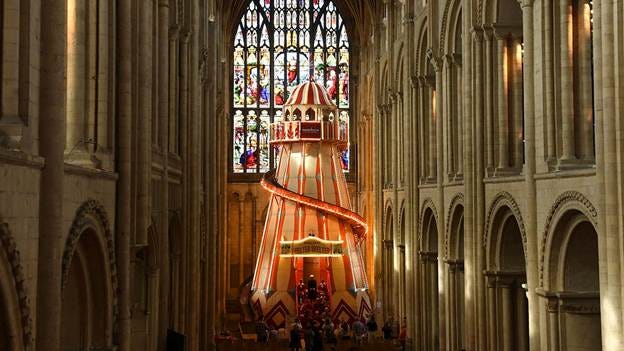
Change is when your bishop builds a giant “helter skelter” carnival ride inside the cathedral.
Isn’t there something really creepy about this? Creepy in a Tolkien sense. [Fox News 2019-8-8; photo PA News Agency, dist. by Associated Press]
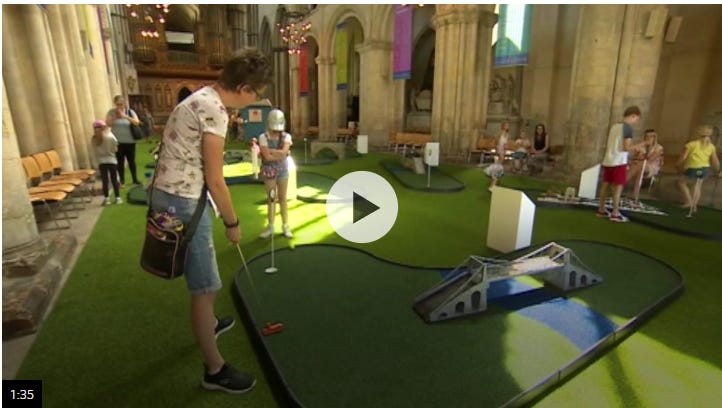
Change is when your bishop builds a mini-golf course inside the cathedral.
One clever journalist called it a “Fairway to Heaven.” [BBC.com, 2019-7-30]
Oh yes indeed, I know what change looks like. But the evolution of the Liturgy in the early centuries? That’s not what I mean by “change.”
The Changeless Core. When I say Orthodoxy is changeless, I mean that there is an inner core that persists across all nations and jurisdictions, across all centuries. It is a practical thing, a way to get closer to Christ. And that’s what I love about Orthodoxy, that it has brought me closer to him. (Fr. Doru asked “Why so much effervescence?” That’s why.) The Apostles must have known this deep-rooted longing, and it stretches from them to the present, through everyone who loves him, through all the ages.
Krouria Frederica’s blog post, Cradles, Converts, and Orthobros, is unusually long, and convincingly takes on some falsities in current media narratives about Orthodoxy.
I appreciate the narratives, perversely, as milestone of sorts. I entered the Church realizing how different it was, and that it was at least a tacit rebuke to modern Western Christianity (and culture). But almost nobody was attacking or critiquing it; we were too few, too “ethnic,” to be taken seriously. For an example, my Christian Reformed pastor, with whom I spoke about my interest in Orthodoxy, could only critique it as if it were Roman Catholicism.
So as I entered Orthodoxy, I braced myself for the day (for I had a gut feeling Orthodoxy was going to grow in America) when we were big enough to be attacked and critiqued more often.
So no, you can’t prove by me that there are any Orthobros in the Church (as opposed to internet noise or guys who show up with some twisted thinking but lose it in catechesis), but I appreciate that you’re taking us seriously enough now to concoct lurid narratives.
An aside: I notice on re-reading them, that the quotes above about real “change” all involve bishops. Khouria Frederica and her husband came to Orthodoxy from the Episcopal Church, ECUSA, which has long had notorious bishops (Bishop Pike being the first one I remember). So, much as I contrast Orthodoxy with Evangelicalism, she contrasts it, mostly, with Episcopalianism and progressive outposts in Roman Catholicism.
But don’t think that “lower” churches are exempt from baneful changes. Khouria Frederica, beginning with a section under the rubric “More masculine,” compared to what? writes about changes and distortions that, in my impression, mostly occur in Churches that try to avoid “liturgy” and denominational ties.
Back to the main subject, with a little stage-setting. I’m a Cantor in my parish. I have duties in my Parish that keep me from being a roving sociologist of Orthodoxy in America generally. I probably haven’t been in more than a dozen other parishes over my nearly thirty years in Orthodoxy, and I’ve only been in a handful of liturgies overseas during travels (and most of them were in monastic settings).
That my mental stage when I got to Khouria Frederica’s final thoughts, which opened new mental vistas for me (and made me suspect that my parish “vibe” is pretty typical of American Orthodoxy):
I tried to express this to Fr. Doru, but went overtime, and some of it was cut from the ending of the show. But here’s a summary of what I wanted to say, with some further thoughts that came to me, as I drove on into the night:
Penitence. I love Romanian Orthodoxy. I was blessed to have Fr. George Calciu, a survivor of Soviet torture, for my spiritual father. And I loved Fr Roman Braga, another survivor of the prisons. It was something Fr. Roman said that I’m thinking about now.
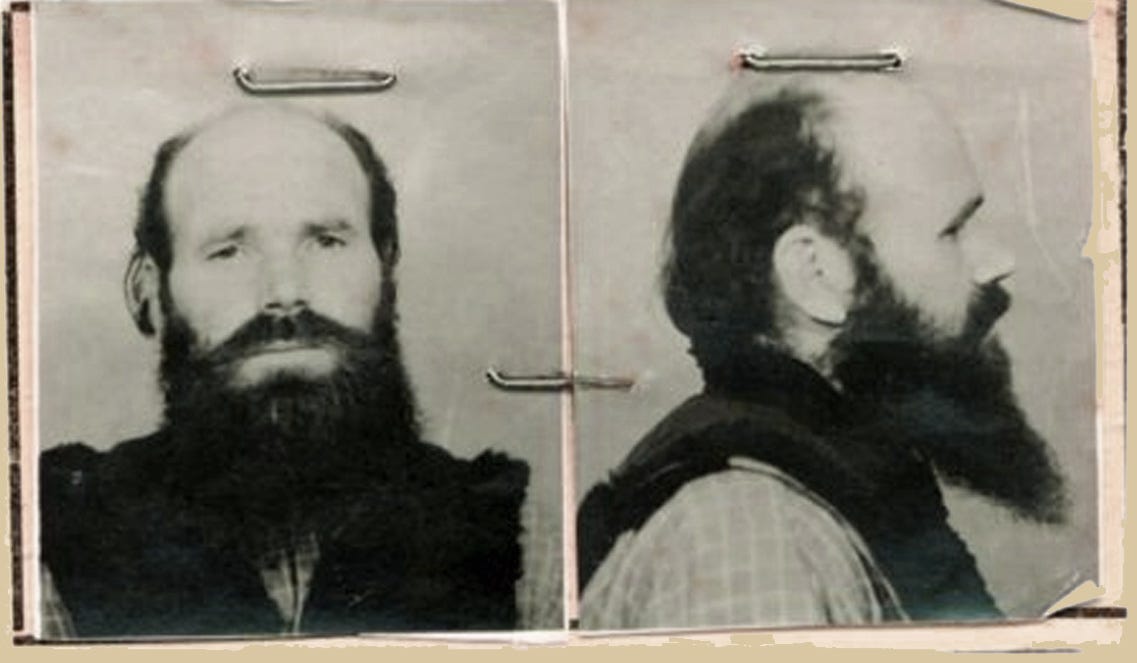
Fr. Roman Braga at his third arrest, 1958
Fr. Roman always said that every ethnic group has to work out its own kind of Orthodoxy. Americans will have to make an American Orthodoxy, and it won’t look like Romanian or Greek or any other kind. We will create our own American kind of Orthodoxy.
But I suspect that this American kind will be offensive, to some … We’re too loud, too bold, too informal. We smile too much … it’s just what Americans are like. We laugh, we’re loud, we’re expansive.
An example of the difference is that cradle Orthodox don’t want to have noisy children or babies in the church. People raised in Orthodoxy have a profound sense of awe about the temple, and treat the building itself with great respect. So they say, “Don’t bring a baby in the church! This is a holy temple, not a nursery!”
But Americans like having babies in church. They say, “If you can’t hear crying, the church is dying!” A church with wandering toddlers, and little boys gazing at a candle flame, and schoolgirls cuddling newborns—all that seems exactly right.
I know how beautiful Orthodoxy is, so I need to ask your forgiveness, because what Americans are going to do with it might look cheap to you. It might look like marketing. It might even look disrespectful. It won’t look like Romanian Orthodoxy. It will be the Orthodoxy that grows out of our distinctive American life. Forgive me, forgive us, for what we are nevertheless going to do, as we create this thing never seen before, American Orthodoxy.
It’s not just babies we welcome. It’s visitors, too. Come and see.
Apophatic
Orthodoxy theology defines only what is necessary and always leaves unspoken that which cannot be explained. This approach was part of the Christian faith from the beginning. But the Western phronema often suppresses, dismisses, minimizes, or ignores this stance. The Western mind is compelled to define and explain everything, since without a rational explanation a concept or fact cannot be considered true, or, conversely, all truth can be proven rationally.
Dr. Eugenia Scarvelis Constantinou, Thinking Orthodox.
I experienced this apophatic approach to theology, gradually over decades losing my tendency toward being the kind of person who today cataphatically thinks, oh, for instance, that he could create a computer administered questionnaire that would logically force people to confess the correct version of Christianity.*
Only then did I encounter neuroscientist and philosopher Iain McGilchrist. Getting to know McGilchrist confirms for me the deep wisdom of the Orthodox way, and I believe McGilchrist has been quoted as saying that if he became a Christian (in the narrow sense, not “culturally Christian”), he would be Orthodox.
In my mind, this is closely related to what I consider the Orthodox view of the Nicene Creed and the Ecumenical Councils more generally.
Ecumenical Councils are not summoned because Bishops need some way to spend their lavish expense accounts (as if!). They are called because of the perception that some rascally teacher or teaching is threatening the Church. A Council convenes, considers the matter, and declares the mind of the Church. At the Councils of Nicea and Constantinople, two of the earliest Councils, they considered the teachings of rascally Arius, condemned them, and set forth the Church’s mind in the form of the Nicene-Constantinopolitan Creed, typically shortened to “Nicene Creed.”
In Orthodoxy, we call the Creed “the Symbol of Faith,” which itself signals our view: the Creed is not, and was never intended to be, a precis of all mandatory parts of the faith.
As a consequence of this limited role of Councils, I view the Creed and the Canons to be markers of boundaries to keep the faithful safe — as if to say “this is a cliff; stay away!” or “here be dragons.” That leaves a whole lot of geography in which believers can and do move around fairly freely.
As in paradise, so many delights are allowed, so few forbidden — and even that for our good.
(* Actual delusion, but I was a Calvinist at the time.)
The cultural formations of western Christianity
Christianity as we see it in eighteenth-century Britain or twenty-first-century America is not Christianity as it has always been, and the more fundamental changes may not be those that the received history of religion narrates. The cultural formations of western Christianity, growing as they do in good part from binary, Protestant-Catholic debates, can be thrown into stark relief, for instance, when studied in comparison to that much neglected third term in Christendom: the Eastern Orthodox churches from which Rome severed itself nearly half a millennium before the Reformation, charting a course for Western Christianity wed to rationalism and enamored of individual authority, whether papal or personal.
Lori Branch, Conclusion: on the Religiousness of Criticism in her book Rituals of Spontaneity.
I just noticed, with much delight, Branch’s gimlet-eyed phrase “the Eastern Orthodox churches from which Rome severed itself” (italics added). This Great Schism is one of those fundamental changes that in received Church history in the West almost invariably inverts, by commentators Catholic, Protestant or unbelieving — who assume reflexively that four patriarchs in a pentarchy severed themselves from the fifth, which on the face of it is less plausible than the one severing from the four.
Something that sticks with me
Some decades ago, the late Richard John Neuhaus coined (so far as I know; I’d never heard it before) the term “ecclesial Christian.” He describe an ecclesial Christian as one for whom faith in Christ and faith in His Church is one act of faith, not two. (That may not be exact, but it’s how I’ve appropriated it for myself.)
I feel compelled to surface the term periodically to try popularizing it.
In the American fissiparous (there I go again!) nondenominational/megachurch/religiopreneur environment, the term is useful, and maybe even necessary, to demarcate the boundary between that sort chaos from a handful of Christian traditions in which the Church is central, not just more or less helpful to individual believers.
I was probably on the chaos side when I first encountered the term (I think it was the early ‘90s, the early days of First Things magazine) but it stuck with me, and I now, though firmly Orthodox, I feel a special kinship with ecclesial Christians outside my specific faith.
Christian America
Sociologists who look at American politics right now say that a major thing that’s driving our politics, maybe the major thing among white evangelicals, is that this is the group that has always assumed it should have the predominant role in American society. It’s the founding faith. It’s what the founders were.
No, the founders were not evangelicals, especially not in the contemporary devolved sense. That’s my story and I’m stickin’ to it. David Barton and his ilk have never persuaded me otherwise.
Far too good
The modern world is not evil; in some ways the modern world is far too good. It is full of wild and wasted virtues. When a religious scheme is shattered (as Christianity was shattered at the Reformation), it is not merely the vices that are let loose. The vices are, indeed, let loose, and they wander and do damage. But the virtues are let loose also; and the virtues wander more wildly, and the virtues do more terrible damage. The modern world is full of the old Christian virtues gone mad. The virtues have gone mad because they have been isolated from each other and are wandering alone. Thus some scientists care for truth; and their truth is pitiless. Thus some humanitarians only care for pity; and their pity (I am sorry to say) is often untruthful.
As a new convert, [St. Seraphim Rose] had some pretty strange views … Fr. Seraphim called it the “crazy convert” phase. But as he got older, more mature, he outgrew those views—as we hopefully do. And he helped his spiritual children to do the same. And that is what made him a saint.
He came to realize that what Orthodoxy had to offer isn’t a pure, unbroken tradition. It’s not a perfect adherence to the canons. It doesn’t make us better than everyone else. No! Fr. Seraphim said (and this is a quote):
The deepest and most attractive thing about Orthodoxy today is its message of love. The most discouraging thing about today’s world is that it has become so cold and heartless. In the Gospel of St. Matthew our Lord tells us that a leading characteristic of the last times will be that the love of many will grow cold. And the Apostle of love, St. John the Theologian, records our Lord as saying that the chief distinguishing mark of His disciples is the love they have one for another.
(…)
Being filled with the Gospel teaching and trying to live by it, we should have love and compassion for the miserable humanity of our days. Probably never have people been more unhappy than the people of our days, even with all the outward conveniences and gadgets our society provides us with. People are suffering and dying for the lack of God, and we can help give God to them. The love of many has truly grown cold in our days—but let us not be cold. As long as Christ sends us His grace and warms our hearts, we do not need to be cold.
Michael Warren Davis, on Monk-Priest Seraphim Rose, who reposed in 1982, and is now becoming officially recognized as an Orthodox Saint.
Today, my Parish receives a family of four, who came, saw, stayed, sought instruction, and finally is ready — nay, eager — to leave the Roman Catholic communion. Though we’ve been receiving many new members, I feel a special affinity for this family because the husband is the son a Reformed pastor, and my penultimate tradition was Reformed as well.
I’m always particularly gratified when the decision to become Orthodox appears cautious and deliberate, as this family’s has been.
We don’t have to flim-flam people. My impression is that most Orthodox Priests are telling serious inquirers “Slow down. Take your time. Get to know us. Let’s see what happens.”
A Distinctive
The Orthodox Church does not offer exact definitions and explanations for theological mysteries. The Orthodox Church has always preferred apophatic theology, that is, expressing what God is not, since God is beyond description.
Coming to Orthodoxy from a posture of know-it-all Calvinism, this was first unsettling, later liberating.
Learning how not to need to think
How do we become uncomplicated and unsophisticated? Can we simply unlearn all that we have learned?
No, we cannot, but what we can do is to separate ourselves from it in order to look at it with new eyes. For us Westerners to truly enter into the ancient Christian transmission and catch the essence of Christ’s teaching, it is necessary for us to crucify our rationalizing minds and arise above the level of thought and emotion. For a society founded on Descartes’ proposition “I think, therefore I am,” this of course means a kind of suicide; and it is to precisely such an ego-death that Christ calls us. Contemporary western Christianity trained us how to think and what to think; whereas Christ himself, as did Lao Tzu before Him, taught us how not to need to think.
Monk Damascene, Christ the Eternal Tao. If you think there’s something fishy about finding anticipations of Christianity in Lao Tsu, remember that this was a central theme of C.S. Lewis’s The Abolition of Man
Hell
How can I go out like this among a lot of people with real solid bodies? It’s far worse than going out with nothing on would have been on Earth. Have everyone staring through me.
C.S. Lewis, The Great Divorce. That was the reaction of one of Lewis’s day-trip visitors to heaven from hell.
No book by Lewis, including my favorites That Hideous Strength and The Abolition of Man, has affected me more profoundly than The Great Divorce. On second or third reading, roughly 27 years ago, a little light went on: what are you doing not to become the kind of self-absorbed person who’d get back on the bus instead of staying? And I found little to nothing in the Reformed tradition was receptive to such a question, because of the hated suggestion that what we do here and now might have something to do with our eternal happiness. That probably would have been dismissed as rank Pelagianism (though I was bound by my oath of office as an Elder not to discuss my doubts outside narrow channels, so I never found out).
Poet Dana Gioia glimpses a somewhat different alternative vision of hell that Lewis’s, but another in which God does not send people their against their wills:
…
V. Delegate, Delegate
“Watching the place unravel, Satan saw An opportunity beyond the chaos. What if he found a way to let the damned Punish themselves? They liked to make bad choices. Why not allow them to repeat their sins? Let Hell become a game they never win, A wheel that always hits on double zero.”
Our true telos
Each of us must become a saint to fulfill our human and Christian destiny.
C. S. Lewis anticipated this conciliar teaching when he noted that most of us, suddenly caught up to heaven, would probably feel a little uncomfortable. Why? Because we are not yet saints. And saints, Lewis suggested, are those who can live comfortably with God forever. How can the saints live that way? Because, in the Eastern Church Fathers’ striking image, they have been “deified.” So the entire point of the Christian “journey” is to cooperate with God’s grace so that we grow into the kind of people who will feel at home at the Wedding Feast of the Lamb: overflowing with gratitude for the invitation, and not feeling like party crashers.
I don’t remembers C.S. Lewis saying that in those words, but this is an extremely apt description of a conviction about my life (derived from my second or third reading of Lewis’ The Great Divorce) that lead me from Calvinistic Protestantism to the Orthodox Church — the permanent home of those Eastern Church Fathers.
Halfway conversions
There is no point in converting people to Christ if they do not convert their vision of the world and of life, since Christ then becomes merely a symbol for all that we love and want already – without Him. This kind of Christianity is more terrifying than agnosticism or hedonism.
Growing up evangelical, I was taught that your personal conscience is law …
…
True conscience is not a hyper-individual inner experience, but a knowing with others, a cleaving to the wisdom of God’s Word and the witness of the church.
This article was painful to read. My immediate reaction, to the opening paragraph (which also opens my block-quote), was “I grew up Evangelical and was never taught such pernicious nonsense.” (I was taught a slightly less pernicious nonsense, and by teachers who were acting in good faith to all appearances.)
But the interesting point emerged much later: if “true conscience” is as Noble says, a “knowing with others” (and he is etymologically correct), then “personal conscience” is an oxymoron, and those who claim to follow such a thing are crypto-antinomians.
There’s not much in the warm and fuzzy feelings department. No more than I would have those feeling for a swooping hawk, or a grizzly on the path, or a bush suddenly erupting into flame. What I can feel is awe.
Reading Job has cleared this up. I can’t mainline Baby Jesu cosy cosy when I’ve got God walloping thunderbolts about and waxing poetically about how bad ass the leviathan is. Job strengthens my back in its final section, I’m out of the psychological and completely into the mythological, my wonder-eye is OPEN.
And – as I said last time – this is where I think modern Christianity often goes awry. We could cater less for our psychological needs and attend more to our mythological longings.
Speaking of Martin, here’s a description of him I came across recently:
Martin is like the Lost Inkling, the one who wandered into the forest of Devon as a child, and grew up in Tom Bombadil’s cottage.
(Rod Dreher, The Martin Shaw Interview, Part I). When I first read that last November, I had no idea how spot-on it was. Now I understand, after following Martin for a while, why Malcolm Guite (or someone) said Martin would become Orthodox “because he’s too wild for anything else” or words to that effect. (Not that we’re wild, but we have room for wild ones: I have an icon of a Georgian wild man — a “fool for Christ” — hanging in my prayer corner.)
I alone have seen the light
Zwingli’s work also repudiated the entire patristic and medieval theology of the sacrament: “I can conclude nothing else but that all the doctors have greatly erred [vil geirret habend] from the time of the apostles…. Therefore we want to see what baptism actually is, at many points indeed taking a different path against that which ancient, more recent, and contemporary authors have taken, not according to our own whim [nitt mit unserem tandt] but rather according to God’s word.” Just like his Anabaptist opponents, Zwingli was following God’s word.
The multiplication of denominations, not to mention the countless non-denominational religious fiefdoms, was a major factor in my disenthrallment with sola scriptura Protestantism. (I provide the link because I discovered ~25 years ago that not all Protestants have even heard the historic term for what they claim to live by.)
Pick one: Modernity or Christendom
The West was Christian in the Middle Ages, but is so no longer; if anyone should reply that it may again become so, we will rejoinder that no one desires this more than we do, and may it come about sooner than all we see round about us would lead us to expect. But let no one delude himself on this point: if this should happen, the modern world will have lived its day.
René Guénon Guénon, The Crisis of the Modern World
If Indiana Jones were real, wouldn’t he be a Christian by now?
By the end of “Raiders of the Lost Ark,” archaeologist Indiana Jones had learned enough to know that he should close his eyes when facing the wrath of God.
Apparently, that kind of power can melt Nazis – without changing the hero’s soul.
“Why won’t Indiana Jones convert? We aren’t insisting that he convert to our faith or to his father’s faith or really to any faith in particular,” noted Jack Bennett, in a Popcorn Cathedral video marking the “Indiana Jones and the Dial of Destiny” release.
“What we want to know is why he is always back to square one at the start of every adventure – a skeptic, or even a scoffer. I mean, think about it: He has seen the Ark of the Covenant opened and the destroying angels pour out God’s vengeance on his enemies. He has seen the sacred Hindu stones come to life. …He has seen the true cup of Christ heal his own father from a fatal gunshot wound – on screen, with no ambiguity.”
[A]ny attempt to “modernise” liturgy in terms of making it more acceptable to modern society (i.e. “pastoral respectability”) should be undertaken with extreme caution; the warning of Charles Davis is paramount here:
My thesis is that there is no modern form of worship, because worship itself is outdated in the modern world and Christian Faith a state of deviancy from contemporary culture.
Bryan D. Spinks, “Christian Worship or Cultural Incantations?”, Studia Liturgical, vol. 12 (1977), 1, 12-13 (quoting Charles Davis, “Ghetto or Desert: Liturgy in a Cultural Dilemma” in Worship and Secularization (1970), pp. 10-27, p. 12).
Thanks to @letters on micro.blog who appears to read such things voraciously.
Wordplay
Blink
neglect, fail to acknowledge
John McWhorter on Justice Ketanji Brown Jackson’s usage of blink: “This contention blinks both history and reality in ways too numerous to count.”
Bombastic does not mean “overly emotional” or “excited” or anything like that: It refers to language that is artificially refined or formal, made high-sounding in an attempt to sound smart, “high-sounding but with little meaning,” as the Oxford people put it.
Williamson said most people use bombastic incorrectly. When I use it, which I don’t think is often, I’ve certainly been misusing it.
Toes
We don’t appreciate toes enough.
John Brady, commiserating with someone who injured a toe and is surprisingly debilitated thereby.
Bad Luck
You never know what worse luck your bad luck has saved you from.
Cormac McCarthy via the Economist
Barbie & Ken
Simply existing in America over the past few months meant having the bronzed images of Margot Robbie as Barbie and Ryan Gosling as Ken staring you down everywhere you turned, not unlike Mao Zedong’s portrait in Tiananmen Square.
This fellow said: “I am a free-born sovereign, sir, an American, sir, and I want everybody to know it!” He did not mention that he was a lineal descendant of Balaam’s ass, but everybody knew that without his telling it.
Mark Twain, The Innocents Abroad
Martin Shaw
Martin is like the Lost Inkling, the one who wandered into the forest of Devon as a child, and grew up in Tom Bombadil’s cottage.
The end of the world as we know it is not the end of the world.
You can read most of my more impromptu stuff here (cathartic venting) and here (the only social medium I frequent, because people there are quirky, pleasant and real). Both should work in your RSS aggregator, like Feedly or Reeder, should you want to make a habit of it. I’m even playing around a bit here, but uncertain whether I’ll persist.
The Eastern Orthodox Church might be called a little stingy in its acknowledging of anyone as a theologian. Strictly speaking, our church recognizes but three—just three saints whose names include that epithet. They are Saint John the Theologian (also called John the Evangelist), Saint Gregory the Theologian (also called Gregory of Nazianzus, and one of the Cappadocian Fathers), and Saint Symeon the New Theologian. As it happens, each of these men wrote their theologies in poetry, highlighting to some degree the rabbinic understanding that true theology is always parabolic, as the One of whom we speak extends beyond comprehension, irreducible.
…
One of the discoveries that led me finally to embrace the eastern church was its disposition toward biblical scripture. The church of my youth approached the scriptures as if they were both knowable and reducible to proposition; each verse was approached as a fixed utterance, dictated, word by word, by God to certain men; the scriptures were understood to be God’s words precisely, and they were understood to be the revelation, as such. On the other hand, Orthodoxy observes that what God revealed to these men was but a glimpse of himself, and that those men thereafter employed their own words to offer up what might be better understood as a witness to the revelation. That is to say, these writers beheld a mystical vision, and sought to share it by whatever means they could muster. What we make of their textual witness is, of course, another matter.
Follow me on Micro.blog, too, where I blog tweet-like shorter items and … well, it’s evolving. Or, if you prefer, those micro.blog items also appear now at microblog.intellectualoid.com.


 Tipsy Teetotaler ن