Orthodox Economics (with a shame-faced eucharistic postscript)

I’m unlikely for years, if ever, to compose a better introductionto Distributism for Orthodox Christians (or others) than this article from the Orthodox Peace Fellowship . All the following quotes, accordingly, are from it unless otherwise noted.

“Capitalism immediately appeals to Americans, who value freedom above just about everything,” the article acknowledges But don’t expect me to bite my tongue about what I see of  Emperor Capital’s new clothes. Continue reading “Orthodox Economics (with a shame-faced eucharistic postscript)”

On Christian Obedience

From Father Gregory Jensen at the Koinonia blog, a Homily on today’s Gospel (with a comment of my own at the end):

Romans 6:18-23 (Epistle)
Matthew 8:5-13 (Gospel)

Especially given the events of the 20th century, the rise of Communism, Fascism, world and regional wars and the persecution and slaughter or men, women and children because of religious or ideological differences, the virtue of obedience has–understandably–fallen into disrepute not only among non-Christians but Christians as well.  It is as if we have said, personally and collectively, “I have been betrayed by those in authority and so I will no longer trust anyone but myself.”  While not universally the case, many of us–again whether Christian or not–live not so much in willful disobedience but in helpless fear.  At its core our not wholly unreasonable suspicion of obedience reflects the scars left by love and trust abused.

The Gospel this morning, however, places obedience at the center of our attention. And it is not simply a generic obedience but the kind of obedience we have come as a culture to dread and fear I think more than any other.  It is a soldier’s obedience to his commander; a commander’s expectation of obedience from his troops.  “…I also am a man under authority, having soldiers under me. And I say to this one, ‘Go,’ and he goes; and to another, ‘Come,’ and he comes; and to my servant, ‘Do this,’ and he does it” (v. 9).

Hearing this, the Gospel says that Jesus, the Second Person of the Holy Trinity, He Who is God from All-Eternity become Man, the Creator become a Creature, “marvels.”  At this moment, it is not a man who stands in awe of God, but God Who stands in awe of a man. Jesus then turns to His disciples, to His friends and those to whom He is closest and says

Assuredly, I say to you, I have not found such great faith, not even in Israel! And I say to you that many will come from east and west, and sit down with Abraham, Isaac, and Jacob in the kingdom of heaven. But the sons of the kingdom will be cast out into outer darkness. There will be weeping and gnashing of teeth.” (vv. 10-12).

Neither the man’s race–he was a Gentile–nor his profession–he was a Roman solider and so responsible for enforcing the Emperor’s will–keeps him from being an exemplary, an icon if you will, of faith.  If anything, a life time of military service had taught him what it means to entrust not only his own life, but the lives of those he loved, to someone else.

When we think about obedience and its place in Christian life, we often unconsciously adopt the narrow and frankly deformed notion of obedience that is current in our culture.  As a Christian virtue, obedience is not mechanical, it does not deform or obscure what is unique in the person.  Much less does Christian obedience require that we sacrifice our freedom.

What it does require from me, however, is that I sacrifice my willful self-centeredness, my pretense, my myriad affectations and all the little ways in which I pursue the good opinions of others rather than the will of God.

So what do we mean, in a positive sense, by the Christian virtue of obedience?

First and foremost, before it is anything else, obedience is entrusting myself to the care of God.  We see this in the Gospel; the centurion has absolute confidence that Christ can heal his servant.  He say to Jesus, “only speak a word, and my servant will be healed” (v. 8).

We should linger momentarily on this verse because it contains a second characteristic of Christian obedience.  The centurion doesn’t simply trust Jesus in a general sense.  Nor is his trust limited to his own life.  No, the centurion trusts Jesus on behalf of his servant.

We see this again and again in the Gospels.  Jesus heals, for example, the paralytic let down through the roof not because of his faith, but in response to the faith of his friends (Matthew 9:1–8; Mark 2:1–12; Luke 5:17–26).  Or, to take another example (John 2:1-11), Jesus changes water into wine not at the request of the steward of the feast or of the bridegroom.  No what He does for them He does in response to the faith of His Mother the Most Holy Theotokos who is herself a model of obedience (see Luke 11:28).

Christian obedience to God is always an mutual obedience.  It isn’t simply your obedience or my obedience; it is rather always our obedience.  We are obedient to God together because Christian obedience is both a personal and a communal virtue.

Intuitively we know this.  Think how easily someone’s bad example can infect us.  My obedience is never simply mine alone.  It is dependent on yours, even as yours depends upon mine.

So what do we see?  While ultimately, obedience is always obedience to God, somewhat closer to our everyday life my obedience to God embraces the willingness of those around me to entrust themselves to God as well.  Again, we see this in the Gospel.

We also see something else in today’s Gospel and in the other passages to which I alluded.  The obedient Christian is sensitive not only to God’s will for his own life but also to the will of God for his neighbor.  Especially in an American context, this is one of the most neglected aspects of obedience.

Bishop Ignatius Brianchaninov’s  in The Arena (p. 45) we are reminded that it is only “Faith in the truth saves.”   But faith in what is untrue, faith “in a lie” is the fruit of “diabolic delusion” and “is ruinous, according to the teaching of the Apostle” (see, 2 Thessalonians 2:10-12). We need to be discerning about how we live out obedience on a day to day basis.  Precisely because obedience is always shared, we ought not to be obedient to those who do not demonstrate by their own lives that (1) they are themselves obedient to God and (2) that they are obedient to God’s will for our lives.

This is not meant to be a writ for self-will.  Rather it is to remind us that to “At the heart of leadership within the Church is the care of souls.”  For this reason, those to whom we are asked to be obedient must themselves be willing to be held “accountable for the lives and faith of those with whom [they have] been entrusted.”  A leader–a bishop, a priest, a spiritual father or a husband, a wife or parent–cannot expect obedience from others unless he or she unless “the model” of their “own life” is a clear example of “integrity of … faith and conduct” and their “oversight of others” gives to them an ever greater share of “responsibility to … fulfill” their own vocation (see, Metropolitan Jonah, “Episcopacy, Primacy, and the Mother Churches: A Monastic Perspective“).

While this is a lofty standard, it is not one alien to common sense.  We are free in Christ and real obedience in Christ is therefore freeing.  True obedience doesn’t cripple us, but liberates us from anxiety and worry and all the myriad little and great sins that hold us captive to sin and death.  But obedience is not magic but is the right exercise of my freedom in relationship to both God and my neighbor.  That I must grow in freedom, that my understanding and acceptance of freedom will (hopefully) grow and mature over time doesn’t change this.  If anything, it highlights that Christian obedience is only possible where divine grace and human freedom converge.

This brings us back, in a positive way I think, to our culture’s suspicion of obedience.  The recent history I outlined a moment ago, to say nothing our own own personal histories, provide us with ample evidence for while a mechanical and undiscerning submission to the will of another human being is unwise.  And this is just as true, maybe even more true, when the other person’s claims to speak for God.

Just as a solider must disobey an unlawful order, we must disobey those who counsel or command immorality or rebellion against God.  But, and again like the solider, when we do this we must also be willing to bear the consequences for our disobedience.  As I said a moment ago, authority and accountability travel together and I ought not to imagine that I can resist immorality without cost.

Thank God at least within the Church these situations are relatively rare (though even one instance is one too many).  In the main when conflict arises in the Church it does because we disagree on the practical, everyday details of life.  The first to realize when this happens is that honest disagreement is not the same as disobedience.  A difference of vision shouldn’t be equated with rebellion or a lack of faith.

All this being true, I think it is important that when I find myself in these kinds of practical conflicts I defer to authority.  Deference is I think the everyday form that Christian obedience takes.  In a funny way, it is easier for me to practice obedience in “big things.”  Much harder is deference in the little things of life.  And yet, what does Jesus tell us? “He who is faithful in what is least is faithful also in much; and he who is unjust in what is least is unjust also in much” (Luke 16:10).

What makes Christian obedience so difficult is that it almost always demands of me fidelity in what is least.  This is hard because what I want from God is the grand vision, the master plan.  And I want this because, to be honest, it makes me feel important.

But what I get from God is typically only the next step or two down the road.  My willingness to take that step or two is, in the final analysis, the true test of my obedience.

(I particularly like that characteristic Orthodox inversion: “At this moment, it is not a man who stands in awe of God, but God Who stands in awe of a man.”)

I suspect it’s not coincidental the the epistle today (see link above) invites us to “slavery” to righteousness — a virtue that ranks right down there with obedience, in the cellar of our modern values. But the stakes couldn’t be higher: the gift of eternal life.

For just as you presented your members as slaves of uncleanness, and of lawlessness leading to more lawlessness, so now present your members as slaves of righteousness for holiness.

… But now having been set free from sin, and having become slaves of God, you have your fruit to holiness, and the end, everlasting life. For the wages of sin is death, but the gift of God is eternal life in Christ Jesus our Lord.

I’m not sure I’m fit to sermonize even that much, so I’ll shut up now.

“Fervently Catholic, proudly gay, happily celibate”

A New York Times feature Saturday morning profiles Eve Tushnet, styled A Gay Catholic Voice Against Same-Sex Marriage. Eve Tushnet is a very intriguing and forthright thinker/writer who had dropped off my radar though I had admired her in the past.

I find her intriguing today because, on a general topic that remains contentious (which is why it merits careful discussion, again and again, until sanity reigns) and shrill (it often seems that the world is divided into “it’s an abomination” and “you’re a closet queen homophobe” camps), I find myself agreeing with her almost 100%. Her position lifestyle convictions — shared at least in general terms by Orthodox, Catholics, and at least a few others — are neither antinomian nor “phobic” about anything.

Read the profile and read Tushnet’s website a bit. (Here is the link to subscribe to her blog, offered because it was deucedly hard for me to locate.)

Although one might fault her for writing and talking so much about her own sexuality (there’s too little privacy about private things in our exhibitionist age), I believe I understand her decision. In a world where opinion on homosexuality is as polarized as I described, a still-recent convert to a humbler, more historic Christian tradition may be excused for saying repeatedly that “the Gospel is good news for everybody” (as Fr. Thomoas Hopko put it) and “I’ve got credibility because I’m joyously living what I say.” So she’s not hiding her little light under a bushel.

I claim no exalted expertise or credibility on homosexuality. I have watched, read and thought a lot about it as one of the contentious “culture wars” issues of the day, and I’ve pushed back against the gay rights cause where I thought it was going beyond a demand for human dignity and impinging on the rights of others (in general, see my discussion of Chai Feldblum here). When I pushed back, I regretted the wounded and uncomprehending looks from some “out” acquaintances and friends, and accordingly triple-checked and recalibrated my Golden Rule Empathyometer. (I wasn’t off by much if at all. Whew!)

Here’s where I may disagree with Tushnet:

  • “Fervently Catholic” — “She could do better than that,” says this still-recent Orthodox convert from Protestantism. ‘Nuff said about that. 😉
  • “Proudly gay” — these aren’t her words, and perhaps she wouldn’t use them. I simply don’t know what they mean. Pride about anything is dangerous. Pride about unchosen homosexuality seems as silly as being “proudly straight.” And “gay” is also problematic: I thought “gay” connoted non-celibacy; I’ve even had televised debates where my adversary scornfully dismissed the possibility of celibacy with some catty crack like “what do you think ‘gay’ means!?” “Matter-of-fact about her homosexual orientation” seems apt. “Convinced that sexual orientation cannot be changed” is plausible as well, as the falls of several high profile evangelical “reparative therapy” fans attest. But “proud.” Nah.
  • “She does not see herself as disordered” — this passing characterization, in case you’re unaware, represents a gentle repudiation of the Roman Catholic position that homosexual inclination is “objectively disordered.” I’m inclined, in contrast to Tushnet, to agree with that characterization — while quickly adding that there’s something(s) “objectively disordered” about a lot of things in this world. For that reason, I have not taken “objectively disordered” as a put-down, or particularly applied it to persons as opposed to inclinations and practices.
  • “Sin ‘means you have a chance to come back and repent and be saved,’ she says” — While it is true that “sin” doesn’t mean “you’re bad,” neither does it mean you have a chance to come back and repent and be saved. Sin (Greek amartia) means missing the mark (from which miss you indeed can repent etc.).

Somehow, though, it seems inadequate simply to say I agree with the rest of Tushnet’s “positions” in the profile. Instead, I especially appreciate her courage in advocating and modeling celibacy and passionate friendships, including same sex friendships, as the profile alludes to Tushnet’s “theology of friendship, as articulated in books like St. Aelred’s ‘On Spiritual Friendship.’”

I know some decent people who think that anything like “passionate friendships” are just too dangerous (or some such thing) for people with homosexual inclinations, but were there no other problems with that view, there is the very real danger in of any self-imposed, or socially-imposed, isolation. My attitude (to put it in terms of one of my own besetting sins) basically is “The world’s a dangerous place. I can’t stop eating just because I have an inclination to gluttony. I must eat – and risk loss of control – or die. And by analogy ….” I’ll bet you can fill in the rest (which presumes a universal human need for deep friendship). We’re “persons” only in relationship, and an isolated “individual” isn’t much to brag about.

Tushnet is refreshingly realistic about temptation, too: “‘It turns out I happen to be very good at sublimating,’ she says, while acknowledging that that is a lot to ask of others.” Perhaps a lot to ask especially of people trying to become fully human persons in close relation to others.

But in the world, as in the monastery, when a Christian falls, he/she gets back up. And if you fall again, you get up again. Maybe you ask yourself at some point “Am I exposing myself to too much temptation? Should I flee like Joseph from Potiphar’s wife?,” but that’s not my call to make for anyone other than myself.

Eve Tushnet: I’m putting you on my blogroll. Keep up the good work.

Finding salvation outside the monastery

St John of the Ladder writes (1:21):

Some people living carelessly in the world have asked me: “We have wives and are beset with social cares, and how can we lead the solitary life?” I replied to them: “Do all the good you can; do not speak evil of anyone; do not steal from anyone; do not hate anyone; do not be absent from the divine services; be compassionate to the needy; do not offend anyone; do not wreck another man’s domestic happiness, and be content with what you own wives can give you. If you behave in this way, you will not be far from the Kingdom of Heaven.’

HT: Felix Culpa.

Ascension Day

We observed Ascension Day “by anticipation” yesterday evening. (Our liturgical day begins at sunset, and we sometimes stretch it a bit, as an evening liturgy is better attended weekdays than a liturgy at, say, 6:30 a.m.)

My former Church, the Christian Reformed, took Ascension Day seriously, as did others in the Reformed tradition. That was on paper, at least. On the ground, the three Reformed Churches of generally Dutch background would typically pool resources, as not one of them could get a credible showing on its own for an Ascension Day service. (I assume it was otherwise a century or so ago.) That puzzles me now, more than ever.

I have noticed for decades the tendency of people to say things like “I grew up in X Church, but I never heard the gospel until my lovely wife Boopsie, then my fiancé, invited me to Y Church.” I may blog on that notion some day, because I have heard it said of the Orthodox Church — of which Church I know such a claim is false. The reason I know it is false is what may be worth blogging.

But as for Ascension, I can say that I grew up evangelical, then spent 2 decades in the Christian Reformed Church, but never apprehended until I was Orthodox that our Lord, God and Savior Jesus Christ not only sits at the right hand of the Father, from where he intercedes for us, but that He sits there in glorified human flesh!

The incarnation was no mere temporary expedient, so that the Son could take on crucifixion and death for us and thus placate the anger of the great sky bully (His Father) and get us (who actually deserved and were destined for such treatment) off the hook. That view of the Atonement is troubling on many levels.

But perhaps the most decisive proof of its inadequacy is that 40 days after the Resurrection, Christ did not go to the mountain and there shed his body, rising wraithlike to the Father before his disciples’ eyes. No, He rose in the body, taking it with Him.

So the Atonement — frequently broken down into separate word, “at one -ment”— has to do with reconciling humanity, flesh and blood as well as spirit, with the Holy Trinity.

This was the original plan. This was the eventuality of God’s little chats and walks with Adam and Eve in the Garden.  And this original plan is what our Blessed Second Adam has restored.

No wonder we have sacraments and relics as well as prayers and meditations. Salvation is for the whole person, and all persons. Reconciliation at all levels is so important that the Eternal Son, being fully God, humbled and emptied Himself and joined our race for eternity.

A Church that can’t spark interest in Ascension Day must be missing something huge about that.

Honk if you love irony

I started a month and a half ago to try to write a very trenchant post taking this music video as its point of departure.

Maybe someday I’ll get around to it, but to say what I wrote wasn’t ready for prime time would be a great understatement.

So just enjoy the video, chuckle at human folly, and then say a few “Lord have mercies” for us all.

Franklin Graham

There is a kerfuffle about Franklin Graham being excluded from some upcoming government-sponsored events because of his criticism of Islam as “evil” (not my scare quotes; I unequivocally believe in evil). For instance, testosterone-crazed Doug Giles rails here against the political correctness of it all.

I doubt not that Franklin Graham’s Samaritan’s Purse is a reputable enough charity, but the younger generation Graham, like the younger generation Frank Schaeffer, far surpasses his father in delusions that he has been given a prophet’s mantle, rather than the more modest platform of an evangelist. His mouth too frequently shoots off about matters of which he is ignorant.

He has, for instance, gently calumniated Orthodox Christianity, as in his 2007 Ukraine crusade, with charges of which it is entirely innocent. The gist was that the Orthodox Church, despite its antiquity and grandeur, doesn’t teach a personal relationship with Christ. (I believe, but cannot track down, that he has said much worse of Orthodoxy in the past.)

His comments about Islam are certainly undiplomatic. I’ll leave it to others to debate whether Islam is evil – the kinds of people who get suckered into other debates where the key terms are too equivocal to invite anything more than a shouting match. But on Orthodoxy, Graham is deeply wrong.  As is so often the case, Father Stephen Freeman says it better than I:

The salvation into which we are Baptized is a new life – no longer defined by the mere existence of myself as an individual – but rather by the radical freedom of love within the Body of Christ. To accept Christ as our “personal” savior, thus can be translated into its traditional Orthodox form: “Do you unite yourself to Christ?” And this question is more fully expounded when we understand that the Christ to whom we unite ourself is a many-membered body.

Read the whole article.

I don’t mind singing in an empty Church

Well, technically, I’m not sure the Church is ever really empty. There’s always that great cloud of witnesses.

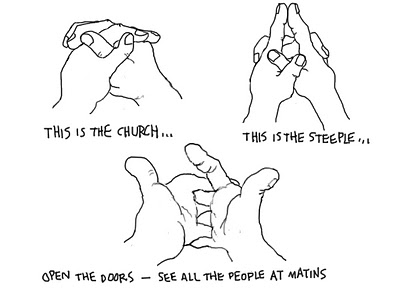
But apart from them, the Church is sometimes empty except for Priest and Cantor (me). We rarely have more than the “clergy” (Priest, Deacon, Cantor and maybe another Reader) at the very beginning  of Matins. Occasionally that will happen in a weekday service, too. Usually one or two will arrive soon after the start, though. The inspired doodle above is (from Steve Robinson at Pithless Thoughts, shall we say, reality-based.

But it doesn’t bother me, at least not in the sense of “why do I bother?” I may regret that many who could be present don’t bother, and miss out (missing out on what is the point of this posting – read on). But many really can’t come, and that’s okay. We’re a small Parish, with lots of young families with children. I’d think there was something seriously wrong if those families dragged their young ones to Matins, which combined with Liturgy routinely runs almost 3 hours. Others commute as much as an hour each way. So I don’t expect them to come.

But by coming and singing, I myself – hard of hearing and heart – steep in the teaching and mind of the Church. Slowly, I’m absorbing it. That counts for quite a lot since I’m serious about my faith but have nearly 5 decades of baggage from other Christian traditions, each misguided about many things, to unload.

One of those pieces of baggage is how to approach scripture. I had already begun to write this when Father Stephen posted on “the hearing of the word.” It illustrates beautifully how the Church approaches scripture:

I am convinced after years of preaching and listening to preaching that the bulk of Scripture has become lost to our ears. We hear it, but fail to “hear” it ….

Much of my conviction on this matter has come in the last 12 years or more and my immersion into the services of the Orthodox Church. These services, long and with ample “hymnography” that is but a poetic commentary on the Scriptures and doctrines that surround any particular feast, are probably the richest surviving engagement with the Word of God to be found in a 21st century Church. Here no Reformation has occurred and reduced all Scripture to a “riff” on Justification by Faith, or a subset of Calvin’s paradigms. Here no Enlightenment has shown with its darkness of doubt and obfuscation.

Instead, there is a constant wonderment at the Scriptures themselves, as if the hymnographer were discovering something for the first time or had found a rare gem to share to any willing to listen – and all in the form of praise and thanksgiving to God.

It is true to say that in Orthodoxy, “Theology sings.” ….

…In our modern context most people have either been shaped by fundamentalist literalism; by modernist historical criticism; or by nearly nothing at all. In each case the Scriptures will not sing – they will not yield up their treasures.

I was struck by a particular case this evening – at the Vigil for  Palm Sunday. The gospel account in question was the Matthean version of Christ’s entry into Jerusalem:

“And when they drew near to Jerusalem and came to Bethphage, to the Mount of Olives, then Jesus sent two disciples, saying to them, “Go into the village opposite you, and immediately you will find an ass tied, and a colt with her; untie them and bring them to me. If any one says anything to you, you shall say, `The Lord has need of them,’ and he will send them immediately.” This took place to fulfil what was spoken by the prophet, saying, “Tell the daughter of Zion, Behold, your king is coming to you, humble, and mounted on an ass, and on a colt, the foal of an ass.” The disciples went and did as Jesus had directed them; they brought the ass and the colt, and put their garments on them, and he sat thereon.”

Modern historical criticism hears in this only the “foolishness” of Matthew. Matthew has cited the prophecy in Zechariah that “your king is coming to you…mounted on an ass, and on a colt, the foal of an ass,” and has crafted his story in precisely that manner, placing Jesus astride two animals. The same critics will note that in other gospel accounts Christ is only on a “foal of an ass,” i.e., one animal. Historical Critics have a field day with such problems (I was first confronted with this “discrepancy” in my sophomore year of college – it was presented as if the professor had noticed something no one had ever seen before). Modern fundamentalists will rush to defend the integrity of the gospel accounts, “Two different eye-witnesses reported on the same thing and one emphasized one thing and the other emphasized another.”

Both explanations lack imagination and are precisely the sort of blindness that afflicts so much modern reading of Scripture. Listening to the hymnody for the Vigil of Palm Sunday, the hymnographer, without apology for the discrepancy, races to it and declares:

“O gracious Lord, who ridest upon the cherubim, who art praised by the seraphim, now Thou dost ride like David on the foal of an ass, The children sing hymns worthy of God, while the priests and scribes blaspheme against Thee. By riding an untamed colt, Thou hast prefigured the salvation of the Gentiles, those wild beasts, who will be brought from unbelief to faith! Glory to Thee, O merciful Christ. Our King and the Lover of man!”

the ancient hymnographer has come closer to the heart of Scripture than either the modern sceptic or the modern literalist will ever know.

… The writers of the New Testament believed that everything in the Old, when read rightly would yield insight into the Messiah and the mystery of our salvation. But their creative insight (again, I believe it is inspired) is far removed from the flat-footed nonsense that we hear out of modern fundamentalist “prophetic” scholars, whose reading of the Old Testament is almost as poorly constructed as the 19th century false prophecies of the book of Mormon! Neither bear any resemblance to the treatment of prophecy found in the New Testament.

And thus I return to my original point. We have become deaf. We listen with ears either hardened by modernist scepticism, or by a false literalism that has substituted Darbyite nonsense for the Apostolic faith, or reduced Scripture to delicate harmonizations. None of them have the boldness and audacity of the patristic hymnographers who stood in the proper line of succession, proclaiming the faith as it had been taught and received and continuing to expound its mysteries. Thank God that somewhere in this modern world, you can still stand and listen to the wonders of our salvation, sung and unraveled before the unbelieving heart of man. Glory to God who has so loved mankind!

So, whether there’s a single soul besides me in church, I’m singing theology. I’m singing poetry. I’m expounding the mysteries of the faith. I’m unraveling the wonders of our salvation before my own unbelieving heart, made dull by 48 years of desparate harmonizations – “flat-footed nonsense.”

[If this sampling from Father Stephen has whetted your appetite, probably the most target-rich zone of audacious expounding of the Old Testament is the Great Canon of St. Andrew of Crete, sung in segments during the first week of Lent and then sung in its entirety Thursday of the 5th week. Download and savor.]

And in a sense that I’m slowly and dimly beginning to apprehend, we are doing the reconciling work of God. This gets into a sacramental view of the world, which I am unqualified to address and would surely botch if I tried. Perhaps another day.

Although I’m occasionally bone-weary when I go to sing, it’s always a very great privilege, and I benefit as much as anyone.