Sunday before Nativity 2022

Antiquity envy

By Lingard’s day, the Church of England held the smug and self-affirming view that the old Anglo-Saxon Church—that is to say, Christianity in the British Isles prior to 1066—was in fact, proto-Protestant; concluding that Anglicanism was nothing more than English Christianity as it had always been before all those pesky Papists showed up and ruined things. From the actual historical record, to accomplish this, you must turn your head just right and squint at one isolated primary source, and then use 17th-century Protestant speculations as your guide for its interpretation. Lingard lays waste to such pretensions, but is always a slightly bemused gentleman in doing so.

Terry Cowan

Thus does Terry introduce the theme of what I’ll call “antiquity envy” in various 200-year-old sects. He even (blush!) gives me a shout-out as his favorite aggregator. What’s not to like?

Accommodating brute facts

In May 2021, a time when public gatherings in England were strictly limited because of the coronavirus pandemic, the British tabloids were caught off guard by a stealth celebrity wedding in London. Westminster Cathedral—the “mother church” of Roman Catholics in England and Wales—was abruptly closed on a Saturday afternoon. Soon the groom and bride arrived: Prime Minister Boris Johnson and Carrie Symonds, a Catholic and a former Conservative Party press officer with whom he had fathered a child the previous year. A priest duly presided over the marriage, despite the fact that the Catholic Church opposes divorce and sex outside marriage, and that Johnson had been married twice before and had taken up with Symonds before securing a divorce. It was an inadvertently vivid display of the Church’s efforts to accommodate its teachings to worldly circumstances.

Paul Elie, The Reinvention of the Catholic Church – The Atlantic (emphasis added)

I assume that accommodating Orthodoxy to worldly circumstances (which isn’t exactly changing its teachings, but may eventuate in that) is what Archbishop Elpidophoros of America was thinking at the ”First Greek Orthodox Baptism for Child of Gay Couple in Greece”

It is a fearful thing to be responsible for a multitude of human souls, as are priests and, a fortiori, Bishops, Archbishops and Patriarchs.

Deny baptism to the children “of” the gay couple and you’re mean or homophobic. Grant it and, among other problems, it is seen as “a sign of great progress in the Greek Orthodox Church in terms of acceptance of the LGBT community,” a not entirely salutary development. Do the wedding and you’re countenancing adultery and divorce; deny it and you’re promoting bastardy.

The only way I know of squaring the circle is that you consider stepping beyond the letter of the law only if you have reason to think that doing so will conduce to the salvation of one or more parties to the irregular circumstance, which in all the cases I can imagine will mean that there’s already some repentance for the circumstances they’ve created.

But then I’m not a Priest or a Bishop, am I?

Humble in theory, arrogant in fact

Over the last two centuries, an egalitarian culture has given rise to a diverse array of powerful religious leaders, whose humble origins and common touch seem strangely at odds with the authoritarian mantle that people allow them to assume.

Nathan Hatch, The Democratization of American Christianity

I cannot help but think of a law school classmate’s description of leaving the Protestantism of southern Indiana for the Roman Catholic Church: he gave up untutored and pompadoured tyrants who denied any authority beyond expounding the Bible in exchange for priests who claimed to be God’s authoritative presence but who let him live his own life.

We’re all liberals now

The late conservative philosopher Roger Scruton once referred to conservatism as ‘a hesitation within liberalism’ rather than an alternative to it, and Deneen too believes that while left and right might want to liberate different things, they are both onboard with the overall project:

What is bemoaned by the the right is not due to the left but to the consequences of its own deepest commitments, especially to liberal economics. And what is bemoaned by the left is not due to the right but to the consequences of its own deepest commitments, especially to the dissolution of social norms, particularly those regarding sexual behaviour and identity. The ‘wedding’ between global corporations and this sexual agenda is one of the most revealing yet widely ignored manifestations of this deeper synergy.

Paul Kingsnorth, In This Free World


[S]ubordinating truth to politics is a game which tyrants and bullies always win.

Jonathan Rauch, The Constitution of Knowledge

To believe that wealth is the only significant measure of the worth of an individual, a family, or a community is to reject the teaching of nearly every religion and wisdom tradition that ever was.

Mark Mitchell and Nathan Schlueter, The Humane Vision of Wendell Berry

The Orthodox “phronema” [roughly, mind-set] cannot be programmitized or reduced to shibboleths.

Fr. Jonathan Tobias

You can read most of my more impromptu stuff here (cathartic venting) and here (the only social medium I frequent, because people there are quirky, pleasant and real). Both should work in your RSS aggregator, like Feedly or Reeder, should you want to make a habit of it.


Sunday, 12/11/22

Big day today for the vocal chords. Church, then warmups, then a Chamber Singers concert.

Let my prayer arise …

Incense

Sermon on the Mount

Those Sermon on the Mount Virtues …

… just don’t work any more

Pastors have spoken to [Russell] Moore about getting blowback from their congregants for preaching biblical ideas about mercy, with people saying, “That doesn’t work anymore, in a culture as hostile as this.”

Michelle Goldberg.

So mercy (and other Sermon on the Mount virtues) are just some kind of jujitsu? A tactic rather than a principle?

Pathetic! Any pastor with integrity will recognize that it’s time to preach the whole Gospel until those who don’t like it repent or leave.

Worldview

Can a place be holy?

Rod Dreher is doing tons and tons of research and thinking for a forthcoming book on the re-enchantment of imagination (my version of his project, not his). Preparation includes visiting ancient Christian sites — presumably to try to recapture the context in which a more expansive view of reality than ours prevailed.

He’s been going back and forth with another American on the tour:

Pat and I got into another argument on the bus. I mentioned that the holiest place on earth for Christians is Jerusalem, especially inside the Church of the Holy Sepulchre, which takes in the spot where Jesus died, and the place where he rose from the dead. “You can’t say that,” said Pat. “I’m a Christian, and I don’t necessarily agree with you.” And then we were off. Pat’s view — a thoroughly nominalist one — is that when you say a place is “holy,” you are offering an opinion about the emotions it evokes within you. To Pat, there is no intrinsic holiness to a place, or an object. If the Prayer Tower at Oral Roberts University makes you feel closer to God than the Holy Sepulchre, well, then it is holier for you. Nobody can say that one place is more sacred than another.

You can imagine how I reacted to that line of argument. But again, I think it was important for me to hear it — I mean, to encounter someone who believes these things, and who thinks this way. Remember, Pat is not a liberal; in fact, Pat complained at one point on the trip about how the cultural climate in the city requires non-progressive Christians like him to be closeted. I never could really figure Pat out, to be honest, but he seems to sincerely believe that true Christianity can only be disembodied. He deflected every challenge from me with some form of, “That’s your perspective.” My guess is that he has only lived and dwelled among fellow Pentecostals, and assumes that Pentecostalism is normative. He had no awareness how very, very modern his take on Christianity is. I said to him at one point that if the early church had thought and lived as he does, it would not have survived. I got the sense that he regards me as a nut who worships Tradition, not God.

Again: it’s really useful for me to know as I write this book. Pat — who is a nice guy, actually — and I are at two extremes of the Christian spectrum, but I suspect that most contemporary American Christians are a lot closer to Pat’s end than mine.

Rod Dreher

So at which end, or where along the spectrum, do you stand? My reasoning as an ecclesial Christian puts me with Rod; my culture — and I cannot deny being its creature to a substantial extent — sides with Pat.

So I wouldn’t argue against Rod’s project, but my visceral reactions might not be consistently welcoming.

An older system of values

David French had a very powerful Sunday column last week, Remembering What Repentance Looks Like.

He leads with the story of Johnny Hunt, a big-name Southern Baptist pastor (and former national President) who in May, after finding that his lies about sexually assaulting another pastor’s wife weren’t fooling anybody, was forced out of ministry.

Now a self-appointed committee of four lackies/pastors declare that he’s ready to be restored — less than seven months after removal, and despite a recent SBC resolution (toothless, like all SBC resolutions, because each local church is entirely autonomous) that “any person who has committed sexual abuse is permanently disqualified from holding the office of pastor.”

Lots of juicy stuff in that story, including a cameo appearance by Herschel Walker, whose “repentance” looks more like intransigence. But I want to note two un-juicy things:

  1. Southern Baptist scripture-twisting. Johnny Hunt never confessed his sin to his congregation, citing Psalm 51:4, which states, “against You and You only have I sinned and done this evil in Your sight.” Further, one of the four lackeys justified his whitewashing of Hunt with the story of the Good Samaritan — which should have led him to run to the aid of the low-status victim pastor’s wife who’d been assaulted by Hunt, not to Hunt, the high-status perpetrator.
  2. The contrast with disgraced John Profumo, the backstory to which I personally recall: “the dignity, discretion, restraint, and repentance with which Profumo lived his life after his fall were the last gasp of an old system of values. His honorable conduct—continued for years, away from the blaze of publicity—would now be almost inconceivable among the political elite.”

We first of all need more men to keep their zippers up, but among those who fail, we need more John Profumos and fewer Johnny Hunts.

Freddie demolishes a straw man

For what it’s worth, I recognize almost nothing as authentically Christian in the straw man Freddie DeBoer attacked Monday.

I should say that Freddie almost certainly is not aware that he has set up a straw man. He’s a painfully honest man, who is describing the kind of Christianish stuff he’s seen on television or encounted beyond whatever church doors he has darkened.

The only thing he says about such Christianish stuff that belongs to authentic Christianity is his tacit acknowledgement that Christianity holds that Christ was more than a man and that his incarnation is salvific.

Curiously, on Friday, Freddie ranked the works of his favorite film director, Terrence Malick. Is there a more Christian director than Malick?

Modern syncretism

I’m very glad we live in a society that is more religiously tolerant. But this has also come at the cost of a greater indifference to the truths our various religions proclaim. Walking around these ancient once-pagan cities, thinking about how syncretic Greco-Roman polytheism was, it’s easy to grasp what a mortal threat monotheism combined with universalism was to the settled order. (The Jews were also monotheistic, but they did not proselytize, because their faith was not universalist.) How strange it is to think that Christianity in the contemporary West has become a lot like the syncretism of the ancient pagan world, in the sense that most Christians (myself included) don’t have a reflexive willingness to throw down to defend theological truths and police ecclesial borders. The Christians who lived in these Asia Minor cities were a threat to the settled social order precisely because they refused to worship the local gods. Had they just added Jesus into the mix, nobody would have bothered them. Had they kept their religion to themselves, as the Jews did, nobody would have bothered them.

In our time, the only Christians who get marked out for opprobrium are those who refuse to observe the dominant culture’s religious feasts (e.g., Pride Month), and who insist that all those who profess the faith they evangelize must also refuse. The Christians who assimilate easily to the idolatries of the day (“idolatry” is worshiping anything but the true God) have no problems. It’s helpful to think about if you were a Jesus believer in first-century Ephesus or Pergamum, if you would have been Christian enough to be persecuted.

Rod Dreher, pensive as he tours the Seven Churches of the Apocalypse in Asia Minor.

Disillusionment

Damon Linker, when he worked at First Things in 2003 and beyond, wrote an article on becoming a father, which produced many negative letters to the editor, most of them the equivalent of shit-posting comments on the web. Since First Things was a high-toned magazine, the contrast with its readers was revealing:

But reading all of those angry, sometimes vulgar, letters from First Things readers attacking me and the magazine, accusing us of abandoning the properly gendered outlook on the family, supposedly rooted in Scripture (but actually derived from pop-culture representations of 1950s middle-class white suburban family life), was significant, too. Doing so left me feeling deeply alienated from the place I worked. Not, again, in terms of the workplace. But in terms of the workplace’s telos—its end or goal. I was an editor for an opinion magazine. But who were its readers? What did its “base” believe about the world? How did I feel about devoting myself and my talents to serving this group of people and its prejudices, which I now began to wonder if I shared?

Damon Linker

What Linker writes there is part of what I felt when shifting from Evangelicalism, many long decades before Florida Man’s seduction of Evangelicalism, to the sober Calvinism of the Christian Reformed Church. Alienation. “These are not really my people.” That sort of thing, along with a more intellectual rationale that wasn’t entirely rationalization.

From what was I alienated?

  • Taboos that lacked even minimally plausible scriptural roots.
  • Altar calls in churches, irnoically without altars and without scriptural precedent.
  • Psychological manipulation in those altar calls: “I see that hand.” (There was no hand, but how was anyone to know with “every head bowed, every eye closed”? I guess I’ve outed myself.) “Is there another?”
  • Flagrant scripture-twisting.

There’s probably more.

Miscellany

Quality

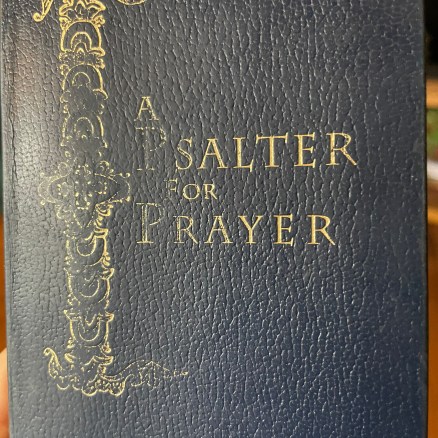
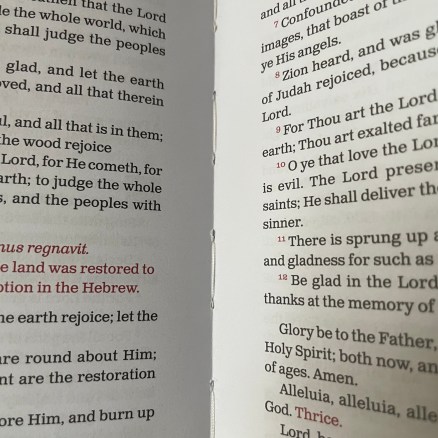
I don’t know much about book-binding, but it appears to me that my small Psalter’s cover letting will wear off before the binding shows any wear.

There’s even a sort of hinge so I can hold it open without straining the spine:

Essentials

American Gnostics

Be careful what you aim for


[S]ubordinating truth to politics is a game which tyrants and bullies always win.

Jonathan Rauch, The Constitution of Knowledge

To believe that wealth is the only significant measure of the worth of an individual, a family, or a community is to reject the teaching of nearly every religion and wisdom tradition that ever was.

Mark Mitchell and Nathan Schlueter, The Humane Vision of Wendell Berry

The Orthodox "phronema" [roughly, mind-set] cannot be programmitized or reduced to shibboleths.

Fr. Jonathan Tobias

You can read most of my more impromptu stuff here (cathartic venting) and here (the only social medium I frequent, because people there are quirky, pleasant and real). Both should work in your RSS aggregator, like Feedly or Reeder, should you want to make a habit of it.
Saturday, 12/10/22

Politics

Georgia Voters Call B*llsh*t on Existential Threatism

If you’ve spent any time in Republican circles since 2016, you’re familiar with a particular pattern of GOP political pressure. No, pressure is perhaps too mild of a word. The better word is bullying. 

The pattern works like this. Trumpist activists seize disproportionate power in the grassroots, work with the Trump team to nominate Trumpist candidates, and then browbeat every conservative who raises objections in the general election. They use negative polarization (with a helpful assist from Democratic extremism) to present voters with the “binary choice.” 

Are you pro-life? Then you can’t vote for the Democrat. Are you worried about the border? Then you can’t vote for the Democrat. Even if the Republican’s character is so deficient that you wouldn’t want your kid working for them if they managed the local McDonald’s, the MAGA movement will yell, “Still better than the Democrat!”

It turns out that people don’t want to be bullied into the ballot box. It turns out a significant enough number of Republicans and Republican-leaning voters will turn to their own party and say, “Do better.” They’ll call the Trumpist bluff and turn the challenge back to them—if these issues are so vital, why are you nominating obviously deficient candidates? Why aren’t you taking the high demands of public office seriously? 

But this point becomes truly powerful only combined with this last observation. MAGA losses combined with normie Republican wins shows there’s life left in conservatism yet. Here’s the tale of the tape in Georgia: Walker was the only Republican this year to lose a statewide race.

David French, Georgia Exposed the Trumpist Scam (Emphasis added)

Of course, a similar argument applies to Democrats: If Doug Mastriano was an existential threat to democracy, why did you spend money to get him elected in the primary?

Bad Omen

Any Republican that’s out there trying to work with [Democrats] is wrong.

Kevin McCarthy, quoted in the Economist

Culture

What subscriptions should I cancel next?

One of my most vital convictions is summed up in this post: “Wondering how to decide what to read? Here’s a simple but effective heuristic to cut down the choices significantly. Ask yourself one question: Does this writer make bank when we hate one another? And if the answer is yes, don’t read that writer.” Americans have these wildly distorted views of people whom they perceive to be their political enemies because so many journalists and talking heads enrich themselves through stoking hatred. Those people should be utterly shunned.

Alan Jacobs, via a reminder from John Brady.

I’ve looked ahead on my list of books to read and eliminated a few based on this wise heuristic.

But what of newspaper editorials that say “hateful rhetoric directed toward transgender people and the broader LGBTQ community” aired from “church pulpits” to “school board debates and libraries” causes people who’ve rarely or never darkened the door of any church open fire in gay bars and clubs? Aren’t those newspapers making bank on hatred?

Alan Jacobs at least is consistent. Last I knew, he read news once per week, on Friday, from The Economist, which doesn’t write such piffle.

Noble lies

The Matthew Shepard myth — that he was murdered by two redneck strangers because he was gay — is still widely believed, even though the hideous murder was far more complex and fundamentally about meth. The idea that the Pulse shooting was motivated by homophobia — not true — is routinely repeated …

This is not healthy. Noble lies are still lies. And lies always fail in the end.

“I sure hope Trump has some more brilliant ideas for can’t-miss Senate candidates. Omarosa maybe? Carrot Top? Ghislaine Maxwell?” – Ann Coulter on the Georgia runoff.

“Can’t believe Lindsey Graham’s pitch of ‘vote for the brain damaged guy to show you’re not racist’ fell short,” – Richard Hanania.

Andrew Sullivan

Wordplay, an occasional feature

When the right words won’t suffice

We are currently in a time, perhaps unprecedented, when talk about all kinds of sexual behavior is pervasive, even inescapable. And we Christians who value purity are very much on the outside, expressing beliefs that the culture can’t even understand. There’s little likelihood that, if we could only find the right way to say it, we’d win people over; I found that out with the pro-life issue. It’s the beliefs themselves that they reject, and changing the words won’t fool them.

Professor David Bradshaw, The Beauty of Chastity, a chapter in Healing Humanity

Words of the Year

For the first time in its history, the Oxford English Dictionary trusted the general public to vote on the word of the year instead of having its esteemed lexicographers make the choice.

Predictably, the general public immediately abused this trust by voting overwhelmingly for the slang term “goblin mode.”

The Morning Dispatch

… “goblin mode”. That means a state in which someone indulges their laziest or most self-indulgent habits—perhaps suitable as a symbol for the first proper post-lockdown year.

The Economist Daily Briefing for December 5

the stink of loserdom

The aura now surrounding Florida Man, per Ross Douthat


[S]ubordinating truth to politics is a game which tyrants and bullies always win.

Jonathan Rauch, The Constitution of Knowledge

To believe that wealth is the only significant measure of the worth of an individual, a family, or a community is to reject the teaching of nearly every religion and wisdom tradition that ever was.

Mark Mitchell and Nathan Schlueter, The Humane Vision of Wendell Berry

The Orthodox “phronema” [roughly, mind-set] cannot be programmitized or reduced to shibboleths.

Fr. Jonathan Tobias

You can read most of my more impromptu stuff here (cathartic venting) and here (the only social medium I frequent, because people there are quirky, pleasant and real). Both should work in your RSS aggregator, like Feedly or Reeder, should you want to make a habit of it.
Wednesday, 12/7/22

Today is my father’s 103rd birthday. I’m now officially past the "I wish he were still with us" stage (though he regularly appears in dreams), since he presumably would be pretty miserable if he were.

Yes, his 22nd birthday got quite a cloud over it.

Legalia

How long, O Lord?

How many times do Republican- and Trump-appointed federal judges have to totally smack down Team Trump arguments before the mainstream media stop insinuating that Republican judges uniquely cannot separate law and politics?

303 Creative

Cage Fighting comes to SCOTUS

I listened to about an hour of Supreme Court Oral Argument in Monday’s 303 Creative case.

I thought I was confused because I’m old and rusty, but two younger, un-rusty commentators, Sara Isgur and David French, flagged the argument as very low-caliber and peppered with lurid hypotheticals designed not to explore the the implications of each advocate’s position, but to make the advocates whose arguments they disfavored look monstrous.

In other words, it was more like a televised Senate hearing than an ordinary Oral Argument. (Pro tip: if you consistently defend free speech, you can be “hypoed” into defending really abhorrent speech. Get a backbone.)

I am relieved. I may be rusty, but it was a poor argument, courtesy of the Justices.

Look for very sharp dissents from the justices on the losing side, because both sides seemed pretty heavily-invested.

An academic frames the question

The question is whether civil rights protections properly include the suppression of speech that disagrees with legal norms, or compels speech that celebrates those norms. Alternatively: do artists (including web designers) have the freedom to depict what subjects they wish, and how—even if they take money for doing it, and even if their perspective is hurtful (to some people)?

Prof. Michael McConnell

Moore v. Harper

Prof. Akhil Amar’s oddly-compelling, low-tech podcast had a couple of podcasts (October 26 and followup episodes with Steven Calabresi) on the Independent State Legislature doctrine purportedly at issue in Wednesday’s Moore v. Harper SCOTUS oral argument.

For the first time, though, I’m now feeling misled by Prof. Amar. Wednesday’s Wall Street Journal features two pieces, one by the Editorial Board and one by lawyers, casting the controversy in terms that seem to make Prof. Amar’s argument peripheral if not irrelevant to the real issues.

Prof. Amar legitimately notes that each state legislature is created by that state’s constitution, and the boundaries of the “legislature” vary according to things like whether the governor has veto power, thus making him a part of the legislative process. This matters because elections are unusually entrusted not to the states generally, but specifically to their legislatures.

The Wall Street Journal pieces legitimately note that under no sane construal are state courts part of the legislative process. Thus, state courts have no role in overseeing federal elections, though federal courts may.

That is perhaps an over-simplification, but it struck me as a powerful point against the backdrop of state courts making up anti-gerrymander rules not found explicitly in their state constitutions, or overruling the legislature’s absentee ballot deadlines in favor of their own.

Maybe litigants took more extreme positions, justifying Prof. Amar’s characterization of ISL’s danger.

I expect SCOTUS, as I almost always do, to adopt narrow reasoning in Moore v. Harper — to deal with the case(s) at hand without sweeping pronouncements that they might regret later.

P.S.: I listened to a half-hour or so of arguments in the case Wednesday, and it seems that SCOTUS views the case more as does Wall Street Journal, less as does Akhil Reed Amar.

Trumpish

Snivelling cowards cool on Florida Man

He used us to win the White House. We had to close our mouths and eyes when he said things that horrified us.

Mike Evans, a former member of Trump’s evangelical advisory board, via Michelle Goldberg

You only had to close your mouth if you valued power and proximity over integrity. Don’t come snivelling to me now.

Pissing away Georgia — again

I’m gratified at the loss of Herschel Walker in the Georgia runoff for U.S. Senate.

I loved Walker as a football player. I probably could tolerate him as a former football player, bastard children and absentee fatherhood notwithstanding.

But his only claim to qualification for the U.S. Senate is that Florida Man endorsed him and encouraged him, despite patent unfitness intellectually. And when his sins found him out, his response was not that of a repentant Christian, but of someone with a sense of entitlement.

To drive a stake squarely through Florida Man’s heart, I only wish Walker had lost by more. He now has twice cost the GOP some national elective offices from Georgia that really should have been theirs:

All of this [context of Trump behavior] predictably helped make the runoff a fractal of the larger 2022 pattern: Under Trump’s influence, with Trump’s preferred candidates, the Republican Party first sacrificed a potential Senate majority and then sacrificed one more Senate seat for good measure.

Ross Douthat

Unrealistic, but instructive nonetheless

National Review’s Charlie Cooke would like a word with those arguing that, because Donald Trump’s call to suspend the Constitution won’t be heeded, it doesn’t really matter. “During the closing days of the 2020 election, I wrote repeatedly about the seriousness of Joe Biden’s refusal to reject his party’s growing demand to ‘pack’—i.e. destroy—the United States Supreme Court,” Cooke writes. “Not once did I receive an email from a Trump voter telling me that my alarm was misplaced on the grounds that, in all likelihood, Biden would not have the votes to do it. Back then—and rightly so—the mere fact that Biden was entertaining the idea was deemed instructive: ‘When people tell you what they want to do with power,’ my correspondents invariably opined, ‘you should believe them. Joe Biden cannot be trusted with power.’ Well, so it is with Donald Trump once again. … American patriots do not seek to overturn legitimate election results or recommend the suspension of the United States Constitution; they respect and defend both at all costs. Donald Trump is not a patriot. He is, in his heart of hearts, a tyrant. Take note, America.”

The Morning Dispatch


[S]ubordinating truth to politics is a game which tyrants and bullies always win.

Jonathan Rauch, The Constitution of Knowledge

To believe that wealth is the only significant measure of the worth of an individual, a family, or a community is to reject the teaching of nearly every religion and wisdom tradition that ever was.

Mark Mitchell and Nathan Schlueter, The Humane Vision of Wendell Berry

The Orthodox "phronema" [roughly, mind-set] cannot be programmitized or reduced to shibboleths.

Fr. Jonathan Tobias

You can read most of my more impromptu stuff here (cathartic venting) and here (the only social medium I frequent, because people there are quirky, pleasant and real). Both should work in your RSS aggregator, like Feedly or Reeder, should you want to make a habit of it.
Sunday, 12/4/22

What is Religion?

In the next few chapters, I am inevitably going to have to use some much debated terms, such as the Renaissance, the Enlightenment, and Romanticism. To the left hemisphere these look like categories that should be definable; to the right hemisphere they are the products of experience of loose constellations of phenomena, which have a family resemblance.

Iain McGillchrist, The Master and His Emissary, Chapter 9 (The Renaissance and the Reformation).

I remember a cartoon in a youth-oriented Christian magazine 50 years or so ago, wherein an “educated” person was claiming that “All religions are fundamentally alike under their superficial differences. I’ll show you: just name any two religions.” The response was “Micronesian frog worship and Christian Science.”

I have been, and remain, a bit skeptical of the term “religion,” but I suppose major religions might fall into the category of “loose constellations of phenomena, which have a family resemblance.”

There are even mutually exclusive Christianities

There is a Christianity that tells us God plans to save us from our sins: To heal our passions, conform our character to His, and make us capable of union with Him. And there is a Christianity that tells us God wants you to be happy in this life. These two Christianities are mutually exclusive.

There are certainly times of happiness for the disciple of Christ – and at least seeds of joy which can be brought to bloom through the practice of gratefulness, humility, and love. But in 21st-century America, perhaps Christianity’s most counter-cultural message is that God isn’t really interested in making you happy; the Gospel is about the Kingdom of God, not about you, and Christ unconditionally promises His people, “In this world you will have tribulation.” (Jn 16:33)

Fr Silouan Thompson, Your Best Life?. (H/T John Brady)

In our post-Christian Christendom, though, ghosts live on, not merely between salvation Christianity and happiness Christianity, but in how people prattle about Christianity.

A pet peeve example is people mis-identifying important peripheral matters as the core of Christianity. Phillip Rieff captures what’s wrong, and what’s almost right, about a major example:

Rightly ordered sexuality is not at the core of Christianity, but as Rieff saw, it’s so near to the center that to lose the Bible’s clear teaching on this matter is to risk losing the fundamental integrity of the faith.

Rod Dreher, The Benedict Option

It drives me batty when people prattle that sexuality (or variants thereof) are “the very core of Christianity” (or variants thereof). It tells me that the prattler is merely a culturally Christian conservative, or that he has a very tenuous connection between brain and the various organs of expression (mouth, fingertips, etc.).

But I had forgotten this quoted sentence, which I think is a much more accurate formulation, and gives the prattler’s at least a little bit of cover.

Cremation and Christianity

I went to a funeral home visitation of a friend recently, and what quickly struck me was that there was no casket, only an urn, presumably with the “cremains” of my friend.

Cremation hits me like a gut punch, and that reaction is getting worse. It wasn’t always so, even though I never, even in my giddiest infatuation was all things modern in my youth, thought I’d like cremation.

And it’s not just that Orthodox Christianity is dead-set against cremation. I know full well that not all Christians are Orthodox. But I’d like them actually to be Christian, and to have a Christian anthropology.

Part of my reaction to this most recent visitation, I’m pretty sure, was that everything about my friend’s obituary and visitation bespoke that she and her spouse had ceased observing any form of the Christian faith they professed when I first got to know them. They became nice, comfortable, and secular.

But earlier this year, I went to a visitation for another friend whose body likewise wasn’t present in his big-box, bare-black-wall warehouse church. So why did that bother me?

I mentioned my visceral reaction to my Protestant wife, whose parents also chose cremation. She repeated a fairly standard defense of cremation, though neither of us will be cremated: that God is capable of resurrecting a cremated body (fair enough; of course God can do that), and that cremation today is not an effort to defy God and avoid resurrected condemnation (probably true, but only because a lot of Christians believe in the resurrection of something than yucky old bodies).

Cremation says “Our bodies don’t matter, and maybe even are evil. (Insert prooftext, like maybe Romans 7:18.) We’re really spirits.” You can see that same attitude in the way moderns and postmoderns almost all speak about death as being a liberation from the body.

I do not believe that. Death indeed separates soul and body, but we’re not meant to be disembodied, and the resurrection restores the body-soul unity that God intends. The separation of soul and body is not a liberation, but a violent insult, wanting redress. When the resurrected Lord Jesus Christ ascended to His Father, he ascended in the body and His glorified, incarnate body is seated at His Father’s right hand. That should bring us up short if we discount our bodies.

For that reason, the dead body should be treated with respect, treated as part of the person who has died, not as an apartment they’ve vacated, and laid to rest intact — not because God cannot resurrect a body from ashes, but because cremation symbolically reinforces a sub-Christian doctrine of man, one that is rampant in our culture and even in many of our Churches. It’s as much for the living as from respect for the dead that we treat bodies with due respect, not as trash.

Maybe I’ll fret my way to a clearer articulation of a feeling that’s pre-verbal, but that can do for now.

Salvation? (Yawn!)

Salvation is constantly associated with palms, crowns, white robes, thrones, and splendour like the sun and stars. All this makes no immediate appeal to me at all, and in that respect I fancy I am a typical modern.

C.S. Lewis, The Weight of Glory

One reason for epistemic humility is that we are all, to some extent, creatures of our age, and our age will one day (here or hereafter) be recognized as full of errors.

The words of Judas

I grieve deeply when I hear the modern sentiment directed towards a beautiful Church “that money should have been given to the poor.” These are the words of Judas. And those who say such things rarely give anything themselves. Beauty is not a contradiction of generosity. The movement towards Beauty is a movement towards Goodness (which contains generosity at its core).

Fr. Stephen Freeman, The Erotic Language of Prayer

Barbarians capture Wheaton, but a few escape

The real problem at Wheaton College runs deeper than culture-war effervescence: Few students care about or even understand the mission of Christian intellectual formation. At Wheaton, when students pick up a book for a course, they usually ask only two questions: “Will this help me get a prestigious job?” and “Will this further my personal relationship with my savior?” Wheaton students tend to focus on practical career training and individual spirituality, giving little thought to how liberal learning can enhance one’s spiritual life or the importance of intellectual formation in the Christian tradition.

[E]ven humanities students get caught up in the careerist mindset, talking about their education as if it was merely one consumer preference among many. Though these students enjoy their studies, they do not see intrinsic value in learning and passing down Christian culture across the ages. The humanities can be an edifying hobby, but non-professional intellectual formation has no claim to any special, protected, or elevated status for many humanities students at Wheaton.

Wheaton’s culture of ahistoricism is even more pronounced than its careerism. On the surface, there seems to be little appetite for experiencing one’s faith as an inheritance transmitted through thousands of years of Christian civilization. But the fact that many evangelical students who enter Wheaton denominationally indifferent end up leaving as converts to Anglicanism, Catholicism, or Eastern Orthodoxy suggests that such an appetite is not whetted through the college. Its administration and trustees would do well to remember that the body of Christ isn’t merely alive in the present but transcends time and space. Full participation in the body of Christ requires knowledge of one’s place in that living chain.

James Diddams, The Real Problem at Wheaton College.

Of the many Wheaton students who leave as Anglicans, Catholics or Orthodox, I’d draw the opposite conclusion that Wheaton does, however inadvertently, however inadvertently, whet the appetite for what Richard John Neuhaus called “ecclesial Christianity,” defined as that Christianity in which faith in Christ and faith in Christ’s Church is one act of faith, not two.

The ephemeral pleasure of the in crowd

By the very act of admitting you it has lost its magic. Once the first novelty is worn off, the members of this circle will be no more interesting than your old friends. Why should they be? You were not looking for virtue or kindness or loyalty or humour or learning or wit or any of the things that can be really enjoyed. You merely wanted to be “in.”

C.S. Lewis, The Inner Ring, an essay in The Weight of Glory

Myth and epiphany

To the considerable extent that questions of value, of right and wrong, of justice and of beauty cannot be experimentally or rationally resolved, myth allows many individuals to share an epiphany, a vision of truth granting them a basis for accepting certain normative standards for which there are no clear or convincing proof … [M]yth assures mankind that certain values transcend reason to give human existence meaning within an unchanging frame of reference, while ensuring unity among the members of the community concerning these values. This unity of values is the hallmark of culture. Without this unity regarding the imponderables, civilized actions become impossible, and man is cast upon the shabby mythology of his own random dream-world and is at the mercy of state and natural religions.

David V. Hicks, Norms and Nobility

Conversion from paganism was a really big deal

When a gentile convert stood in the baptistery on Easter’s eve and, before descending naked into the waters, turned to the West to renounce the devil and the devil’s ministers, he was rejecting, and in fact reviling, the gods in bondage to whom he had languished all his life; and when he turned to the East to confess Christ, he was entrusting himself to the invincible hero who had plundered hell of its captives, overthrown death, subdued the powers of the air, and been raised the Lord of history. Life, for the early Church, was spiritual warfare; and no baptized Christian could doubt how great a transformation—of the self and the world—it was to consent to serve no other god than Him whom Christ revealed.

David Bentley Hart, Christ and Nothing, via Rod Dreher (emphasis added by Rod).

Dreher, touring Southeast Turkey, including ancient Ephesus, continues:

I had … prickly discussion with one of the members of our group, an American Christian who said he didn’t understand wars of religion, and religious conflict. He described religious difference as an unimportant matter of personal preference — and did this in a way that is very familiar in 21st century American life. He seemed to think that the pagans of Ephesus had no reason to fear the Christians, and were mean to them for no reason. I politely challenged him, but after a few barbed exchanges, we dropped the subject. For the early church in Ephesus, this wasn’t a potayto-potahto issue.

That other American could use a bit of epistemic humility, no?


[S]ubordinating truth to politics is a game which tyrants and bullies always win.

Jonathan Rauch, The Constitution of Knowledge

To believe that wealth is the only significant measure of the worth of an individual, a family, or a community is to reject the teaching of nearly every religion and wisdom tradition that ever was.

Mark Mitchell and Nathan Schlueter, The Humane Vision of Wendell Berry

The Orthodox "phronema" [roughly, mind-set] cannot be programmitized or reduced to shibboleths.

Fr. Jonathan Tobias

You can read most of my more impromptu stuff here (cathartic venting) and here (the only social medium I frequent, because people there are quirky, pleasant and real). Both should work in your RSS aggregator, like Feedly or Reeder, should you want to make a habit of it.

Tuesday, 11/29/22

Sam Bankman-Fried

I stopped reading Sam Bankman-Fried (“SBF” — hereafter, “the guy”) stories a week or two ago, and I really didn’t read many before that.

But I did listen to a somewhat penitent podcast, one of Malcolm Gladwell’s Pushkin podcast offerings, revisiting an insufficiently critical and probing prior podcast interview with the guy.

What struck me in the initial interview was how insouciantly reckless the guy was as a business strategy. Essentially, if a business takes $20 million to launch, has a 99% chance of failure, but has a 1% chance of becoming worth $2 billion or more, it’s an okay business plan.

If it might hit $20 billion, it’s a great business plan because the guy will get stinkin’ rich and can pour some of his riches into transformative (i.e. hubristic) charitable projects. And because he promises transformative charitable donations, we’re supposed to admire him. The initial podcast was pretty admiring. And because he was a top-tier Democrat Party donor, he’s got substantial political cover.

If he was playing entirely with his own money, I could ignore him, but because he gets investors, and may even go public, I consider his gambling, as most or all gambling-as-livelihood, contemptible. His investors surely are not told they’re buying into a 100-to-1 shot, where the guy keeps most of the loot if the long-shot bet pays off.

I do not think he is alone. If I understand his thinking, it sounds to me pretty close to some of Nassim Nicholas Taleb’s musings about unlikely but huge payoffs — only I don’t think Taleb has sucked investors into his risky, big-payoff plays.

That the guy’s plays are in crypto only raises my concerns exponentially, though it also tends to make me think of his investors as marks who were hoping to get something for nothing in an investment they don’t remotely understand.

“David Frenchism” Redux

It apparently is part of David French’s lot in life to become a walking, talking, breathing, living litmus test among “orthodox” Protestants: “What think ye of David French? Hath he sold out to secular elites?”

The latest entry (as of this writing and to the best of my knowledge) from a respectable source is Carl R. Trueman’s avid French and the Future of Orthodox Protestantism on the First Things website.

Trueman’s argument assumes, without discussing, the wrongness of French’s endorsement of the Senate version of the Respect for Marriage Act. As I have previously noted, French “showed his work,” walking any halfway attentive reader through the logic that led him to support the Act. Trueman, not a lawyer, does no such thing, but just assumes that French’s position is toxic because the Act accepts same-sex civil marriages, at least in the limited sense that he does not want to see existing same-sex headed families broken up should Obergefell be reversed.

Why would Trueman do such a thing? I have my suspicions, but do not want to add my ad hominem speculations to a discussion already too full of them. I invite you to critically read his piece and assess for yourself what it does, overall, besides slinging innuendo at French.

Related:

  • Matt Staver of Liberty Counsel pulls out all the stops, except for the “Thou Shalt Not Bear False Witness” stop, in his opposition to the Act. Staver was an instructor at the ADF National Litigation Academy I attended 20 years ago, and he’s a journeyman religious freedom litigator. That makes the misleading hyperbole more lamentable.
  • My current take on RFMA: proponents of Religious Freedom give up almost nothing but also get very little in exchange. I think we get more than we give up, but this Bill is not a hill I’m willing to die on. And it’s mostly moot as long as SCOTUS says same-sex marriage and fairly robust religious liberty are both the law of the land.

Encounters with unlikeness

I believe that any significant increase in personal density is largely achieved through encounters with un-likeness.

Alan Jacobs, Breaking Bread with the Dead

Localism, f/k/a Distributism

In 1910, G. K. Chesterton wrote a book called What’s Wrong with the World. In it is found one of his most famous lines: “The Christian ideal has not been tried and found wanting. It has been found difficult; and left untried.”

But what did he say was wrong with the world? Four things: big government, big business, feminism, and public education. The first two, which he nicknamed Hudge and Gudge, were in cahoots with each other, and largely drove the other two. The feminists, while imagining themselves to be achieving freedom and independence, had merely abandoned their positions of power and influence in the most fundamental unit of society – the family – and become wage slaves in factories and offices. As Chesterton quipped, “Ten thousand women marched through the streets shouting ‘We will not be dictated to!’ and went off and became stenographers.” Gudge was only too happy to grant them their “liberation” from the home and use them for cheap labor.

… [T]]he state had less power over a man when it could send him to be burned at the stake than it does now when it sends him to public school.

While flirting with socialism as a young man (as so many young men do, being aghast at the inequity of wealth and the crassness of a commercially driven culture), Chesterton soon realized that capitalism and socialism were remarkably similar. Both involve the majority of people working as wage-earners and not owning their own land or source of living. There is little difference between a clerk sitting at a desk in a tall corporate building and a bureaucrat sitting at a desk in a tall government building.

The opposite of employment,” argues Chesterton, “is not unemployment. It is independence.

… Localism faces two major hurdles at present. First, people are not always allowed to do things for themselves. And second, people are not accustomed to doing things for themselves.

Dale Ahlquist, Distributism Needs a New Name

D.L. Schindler, RIP

  • [T]he judgments embedded in liberalism are lies about the human person—primarily because liberalism does not conceive of humans first as persons who receive their being from God but as individuals who are separated from the various relationships that are constitutive of the person.
  • [C]ontemplation and silence are not matters of inactivity. It is not as though contemplation signals a contrast with creative action, such that these are at root two different kinds of acts meant at best to alternate with one another. On the contrary, contemplative letting be is the inmost form of creaturely activity as such. Patience is not the absence of activity but, in the words of T.S. Eliot, the still point of the turning world, where the dance begins, and is.

D.L. Schindler, who died November 16, quoted by Conor B. Dugan.

Better late than never: I confirmed that there is a relationship between D.L. and D.C. Schindler, that of father and son. The legacy, or at least a part of it, lives on.

Pronouns

Displaying pronouns signals: I am part of the tribe and I know the rules.

Luke Burgis, Why Everyone Wants the Same Things.

This is a good reason for me to never display “my pronouns.” If people thought I was a member of the tribe, they’d be all the more furious when I expressed non-tribal thoughts.


[S]ubordinating truth to politics is a game which tyrants and bullies always win.

Jonathan Rauch, The Constitution of Knowledge

To believe that wealth is the only significant measure of the worth of an individual, a family, or a community is to reject the teaching of nearly every religion and wisdom tradition that ever was.

Mark Mitchell and Nathan Schlueter, The Humane Vision of Wendell Berry

The Orthodox "phronema" [roughly, mind-set] cannot be programmitized or reduced to shibboleths.

Fr. Jonathan Tobias

You can read most of my more impromptu stuff here (cathartic venting) and here (the only social medium I frequent, because people there are quirky, pleasant and real). Both should work in your RSS aggregator, like Feedly or Reeder, should you want to make a habit of it.

Late Sunday fare

Bad Tipy! Bad bad Tipsy! I should have posted this about 10 hours ago.

Faith versus Ideology

She came from rough people but she had a natural love for poetry, history, and politics. She wasn’t ideological—ardent Catholics don’t need an ideology, they’ve already got the essential facts.

Peggy Noonan’s Thanksgiving Day reminiscence.

The tainting of Christian (perhaps others, too) faith with ideology seems to be a persistent risk, even if Peggy Noonan’s great-aunt escaped it. The relationship between religion and ideology is one I’ve been pondering for around 25 years now, and I’m not certain I’m any closer to an answer I can articulate. If only I were a fiction writer, maybe I could put it in a story! (I’ll bet others have.)

Not even half-converted

There is no point in converting people to Christ if they do not convert their vision of the world and of life, since Christ then becomes merely a symbol for all that we love and want already –without Him. This kind of Christianity is more terrifying than agnosticism or hedonism.

The Journals of Father Alexander Schmemann (quoted elsewhere).

This is more or less what I always thought St. Paul had in mind in Romans 12:1-2.

Amuse-bouche

A couple years ago, my daughters and I found an online recipe for a raspberry swirl pound cake. Wishing to surprise my wife, we decided to bake one for her. We failed miserably. The inedible monstrosity that emerged from the oven bore no resemblance whatsoever to the cake photographed on the recipe’s webpage. What went wrong? After all, I found a recipe that was profitable for instruction on how to bake the cake in order that I would be complete and thoroughly prepared for this good work.

As sufficient as the recipe was, I had very little experience with baking, and no one with the necessary experience was around to guide me so that I would be able to apply these instructions correctly.

Dr. Amir Azarvan, How to Test the Protestant Doctrine of Sola Scriptura

Reading a different critique of sola scriptura was an eye-opener on my unexpected journey to Orthodox Christianity a quarter-century ago. But I found in this short piece several more very good points — beyond this appetite-whetter — points that make it worth reading even though it is not very well-written.

On my wish list

His Grace has taken theology … out of the[] hands of sterile systematic dogmaticians, and returned it to its proper artistic home. And as Mr. Gleason noted about the music of his day, this also “has begged to be done for generations”. This book is a work of theological art.

By “art” I mean the work of those who see a vision of beauty, truth, and insight, who are filled with wonder at what they have experienced, and who strive to communicate it to others.

Father Lawrence Farley, on Wonder as the Beginning of Faith by Bishop Maxim Vasiljevic.

You better believe it’s on my wish-list.

“Let me keep my distance, always, from those
who think they have the answers.

Let me keep company always with those who say
"Look!" and laugh in astonishment,
and bow their heads.”

Mary Oliver

Wordplay

Thought and speech I used
as weapons.  My words are now
judges at my trial

To teach us union
and separation: this is
what bodies are for

Joshua Alen Sturgill, Eighteen Death Haiku


“The Hubriscene Age.” Substacker Caroline Ross’s characterization of our times.


We must believe in free will—we have no choice.

Isaac Singer via the Economist


[S]ubordinating truth to politics is a game which tyrants and bullies always win.

Jonathan Rauch, The Constitution of Knowledge

To believe that wealth is the only significant measure of the worth of an individual, a family, or a community is to reject the teaching of nearly every religion and wisdom tradition that ever was.

Mark Mitchell and Nathan Schlueter, The Humane Vision of Wendell Berry

The Orthodox "phronema" [roughly, mind-set] cannot be programmitized or reduced to shibboleths.

Fr. Jonathan Tobias

You can read most of my more impromptu stuff here (cathartic venting) and here (the only social medium I frequent, because people there are quirky, pleasant and real). Both should work in your RSS aggregator, like Feedly or Reeder, should you want to make a habit of it.

A Little Sunday Fare (11/20/22)

Salvation, east and west

Whereas many Western treatments of salvation major in “not going to hell,” theosis gives tangible content and a goal that is more than avoidance.

But what is theosis? How should we think of it? …

Fr. Stephen Freeman

Context is crucial

Granted that not all Orthodox are saints, even so, to the extent that one enters into the Orthodox way of life, chastity becomes realistic, because it is the natural concomitant of everything else that one does.

I emphasize this point because one of the reasons that people have turned against chastity is that they believe it to be impossible. Countless stories in our literature and pop culture, from The Scarlet Letter to Animal House, have taught us to think that anyone who aspires to sexual purity must be a fool or a hypocrite, or both. Perhaps such a perception was inevitable once chastity was removed from the way of life in which it is naturally at home. But the right response is not to despise it, but to seek to recover that fuller way of life.

Healing Humanity: Confronting our Moral Crisis (Multiple Authors)

Healing or punishment?

[In] Dante’s poem the appropriateness of the torment is related primarily to the processes of healing, not to those of punishment. The souls are being taught to unbind the chains they have made for themselves, “solvendo il nodo”, loosening the knot of their sin by appropriate counter-measures.

Eamon Duffy, The Stripping of the Altars

It didn’t start with Junior

[Jerry] Falwell often exercised what he considered his right as a preacher to tell stories that—to use Dean Acheson’s phrase—were truer than the truth. In 1980 he regularly claimed that The Old-Time Gospel Hour had 25 million viewers, and he made up an exchange with Jimmy Carter in which he asked the president why he had “practicing homosexuals” on the White House staff, and Carter replied that he had to represent the American people. When confronted by the fact that the exchange never occurred, Falwell said that the story was a “parable,” or “an allegory.” In other words, it ought to have happened, even if it did not.

Frances Fitzgerald, The Evangelicals

I read it. I highlighted it. I forgot it. Then Readwise reminded me: The sleaze didn’t start with Jerry Junior.

What fundamentalists and “higher critics” share

Both the fundamentalist and the higher critic assume that it is possible to understand the biblical text without training, without moral transformation, without the confession and forgiveness that come about within the church. Unconsciously, both means of interpretation try to make everyone religious (that is, able to understand and appropriate scripture) without everyone’s being a member of the community for which the Bible is Scripture.

Stanley Hauerwas, Resident Aliens


[S]ubordinating truth to politics is a game which tyrants and bullies always win.

Jonathan Rauch, The Constitution of Knowledge

The Orthodox "phronema" [roughly, mind-set] cannot be programmitized or reduced to shibboleths.

Fr. Jonathan Tobias

You can read most of my more impromptu stuff here (cathartic venting) and here (the only social medium I frequent, because people there are quirky, pleasant and real). Both should work in your RSS aggregator, like Feedly or Reeder, should you want to make a habit of it.

An Anniversary

November 16 is the 25th anniversary of my reception into Orthodox Christianity, from a background of Calvinism (proximate) and generic evangelicalism (20 years remote).

This post isn’t meant as an apologetic, though if it convicts someone that they should give Orthodoxy a look, I’d be glad. It’s also not intended to be a comprehensive story of why I didn’t, say, become Roman Catholic, or how all the little things, not just a few big things, pointed toward Orthodoxy. Something closer to a comprehensive story, or at least a complement to this post, is here.

I can’t give a neat connect-the-dots account of going from Christian Reformed Elder to Orthodox layman because I don’t remember everything I read or in what order I read them. But I tend to mention Peter Gilquist’s Becoming Orthodox: A Journey to the Ancient Christian Faith, The Orthodox Church: An Introduction to Eastern Christianity by Timothy Ware (later Metropolitan Kallistos Waare), and the monograph Sola Scriptura by then-Deacon, now Priest John Whiteford.

The first made conversion fairly “thinkable.” The second familiarized me with Orthodoxy at a basic level. The monograph disenthralled me of sola scriptura, the battle cry and foundation of the Protestant Reformation. When pondering why I remain Orthodox, I think of this monograph and say “there are some things you just can’t un-see.”

For some reason, I too rarely mention C.S. Lewis’s The Great Divorce, which played what feels like a very important (if idiosyncratic) role as well — perhaps because it was not a direct apologetic for Orthodoxy.

If you’re not familiar with The Great Divorce, you can fix that in one evening. Summarizing, many in Lewis’s tale of a day trip from hell to heaven, where they were given the option of staying, found that heaven was just a bit too real, or too little about them, or too inhospitable to their petty grudges, and so got back on the bus for hell.

Re-reading it a bit more than 25 years ago, I for the first time saw in myself hellion habits that could lead me back onto that bus, though I was offered heaven and had thought my salvation eternally secure. I asked myself: “What are you doing to become the kind of person who would stay in the hyper-real place, who wouldn’t get back on the bus to the grey city? Are you certain that some post-death miracle is going to eradicate a lifetime of cherished vices and self-regard? Shouldn’t you be starting a bit of self-mortification now?”

So what does that have to do with Orthodoxy? Orthodoxy is, so far as I know, uniquely urgent about the necessity of cooperating with God in our salvation (synergy). Most Protestant traditions I know seem utterly unable to distinguish cooperation with God from “earning salvation,” which they rightly believe is impossible. So they have nothing to offer one who wants to know how merely to cooperate.

It helps that Orthodox worship is distinctively “not about me” — if not uniquely, then at least counter-culturally. Decades before I found Orthodoxy, I was dissatisfied with most of the music we sang (in the whole succession of Churches I attended in my very mobile younger year), the gist of which was how God makes me feel — i.e., they weren’t really about God.

But “[w]e are homo adorans, creatures capable of self-transcendence through worship. Without this ability and capacity for worship, we are not fully human; even in our pomp we are like the beasts that perish (Psalm 49:20).” (Fr. Lawrence Farley)

Not even fully human without worship. That rings so very true to me! Whatever my faults, and they are many, inconstancy in Sunday church attendance has never been one of them. Because I need it — need to worship, and (I now recognize) need this stiff and willful stuff called “me” to be molded into a godlier likeness.

More than rejection of any particular Protestant doctrine, the awareness of the need — in this present life — to grow toward God, to become more Christlike, to work out my salvation with fear and trembling, has guided my past 25 years.

For some reason, I thought you might want to know that.

One more thing, not at all unrelated:

I believe the greatest heresy of all is the belief of some Christians that they are “saved.” If we believe we are categorically and without question already saved, it is a good sign that we have been dominated by demonic pride. St. Paul’s statement, “If you confess with your mouth the Lord Jesus and believe in your heart that God has raised Him from the dead, you will be saved” (Rom. 10:9), must be read in the context of Christ’s words: “Not everyone who says to me, ‘Lord, Lord,’ will enter the kingdom of heaven, but only the one who does the will of my Father who is in heaven.

Vassilios Papavasiliou, Thirty Steps to Heaven


You can read most of my more impromptu stuff here (cathartic venting) and here (the only social medium I frequent, because people there are quirky, pleasant and real). Both should work in your RSS aggregator, like Feedly or Reeder, should you want to make a habit of it.

Sunday fare, 11/13/22

Christians in Partisan Politics

I know of a man from Mississippi who was a conservative Republican and a traditional Presbyterian. He visited the Scottish Highlands and found the churches there as strict and as orthodox as he had hoped. No one so much as turned on a television on a Sunday. Everyone memorized catechisms and Scripture. But one day he discovered that the Scottish Christian friends he admired were (in his view) socialists. Their understanding of government economic policy and the state’s responsibilities was by his lights very left-wing, yet also grounded in their Christian convictions. He returned to the United States not more politically liberal but, in his words, “humbled and chastened.” He realized that thoughtful Christians, all trying to obey God’s call, could reasonably appear at different places on the political spectrum, with loyalties to different political strategies.

Another reason Christians these days cannot allow the church to be fully identified with any particular party is the problem of what the British ethicist James Mumford calls “package-deal ethics.” Increasingly, political parties insist that you cannot work on one issue with them if you don’t embrace all of their approved positions.

Tim Keller, 9/29/18.

Dreams, visions and curious converts

I began to have dreams. I dreamed I was a soldier in the First World War. I was a private, and was with my captain. I had broken my arm. It was all mangled. The captain looked at my arm – I hadn’t noticed it was broken – and he said, “Look at your arm. You’ve done such a good job trying to fix it yourself. I can fix it for you, but if I fix it for you, I’m going to have to break it.” I suddenly knew in the dream who I was in the presence of. I knew. I knew. And I gave him my broken arm. If it hurt, it only hurt for a second.

Mythologist Martin Shaw on his conversion to Christianity.

The whole story is very interesting and boundary-challenging. Martin Shaw learned a lot of truth about reality by sleeping in the Devonian wood and immersing in mythological tales. But Someone wanted him to have more.

My own conversion story is so black and white alongside Shaw’s technicolor!

Orthodoxy is getting some very interesting converts (yes, after searching for a Church, Martin Shaw found Orthodoxy and should be received in January).

But I do fear that we’re too often rushing famous-ish converts into the limelight and looking to them for more insight than they may possess. That’s good neither for us or for them.

Marriage as a natural institution — and more

Christian advocacy for a family-centered society has almost without exception focused on marriage as a natural institution. There have been good reasons of principle and of strategy for doing so. Marriage is a natural institution, and recognizing it as such is a necessary part of restoring the public understanding of the bond: As Pius XI affirmed in his encyclical letter on marriage, Casti connubii, the essential duties of marriage aren’t just applicable to “religious” marriages, but to all properly executed marital covenants.

In an era of secular states and secular politics, focusing on natural marriage has also made sense practically. Arguing that the truth about marriage is accessible and practicable by “public reasons,” to use the Rawlsian term, was essential to campaigns for state recognition of the truth about natural marriage. We’re all acclimated to the idea that only secular arguments are permissible in the public square, and so those are the arguments most Christian advocates make.

As a result, we’ve argued ourselves into assuming that strictly natural marriages—that is, marriages contracted without the benefit of the Sacrament of Matrimony—are sufficient to give society an enduring strength and structure. But this is a semi-Pelagian illusion, another lie of liberalism which only serves to obscure the essential role of divine grace and sacramentality in human life and the social order—one that also leads to the foreclosure of family solidarity to the bankrupt institution of secularism.

Scott Hahn, The Sacrament That Restores Nations

Hahn goes on to reach some illiberal conclusions that I think are unwarranted, but this transcribed address (or address manuscript) is worth your time.

Cowboy Church

The raison d’etre of the cowboy churches is their particular hobby, or fashion preference. In my mind, this has trivialized Christianity down to the point where it cannot go much further.

Two final points and I’ll stop beating this dead horse. American religious groups of all stripes have long adopted casual dress in worship. (I have no problem with this, up to a point, because what bothers me more than casualness is pretense.) I never heard of anyone being turned away from any Protestant church around here for showing up in boots and jeans. It just wasn’t an issue. So there was no real need for any separate churches. And I wonder what my reception would be at the All Around Cowboy Church if I showed up in khakis and loafers? It’s just the same old thing. Finally, the image of the cowboy in American culture is one of lonely, rugged, and individualistic self-reliance. While these traits may serve you well in taming the frontier, I don’t see a single one that should be a characteristic of Life in Christ.

Terry Cowan, Give Me That Rodeo Religion

Pre-Evangelism Today

So many well-meaning Christians believe that the best way for the Church to influence American culture is by imitating as much as possible whatever way of life happens to be fashionable and popular, in the hopes that people will like us and listen to us.

Ken Myers, All God’s Children and Blue Suede Shoes

Repentance today

Are Minnesota Lutherans and other denominations going to sell their church properties to give the money to black and Native Americans? No. Christian repentance, in their eyes, means lobbying the government to tax other people to fund reparations.

R.R. Reno

This is just another twist on an old charge against liberals by conservatives, but it persists for a reason.


[S]ubordinating truth to politics is a game which tyrants and bullies always win.

Jonathan Rauch, The Constitution of Knowledge

The Orthodox "phronema" [roughly, mind-set] cannot be programmitized or reduced to shibboleths.

Fr. Jonathan Tobias

You can read most of my more impromptu stuff here (cathartic venting) and here (the only social medium I frequent, because people there are quirky, pleasant and real). Both should work in your RSS aggregator, like Feedly or Reeder, should you want to make a habit of it.