Inviting Jesus into her heart

Today, both Latin (Roman Catholic) and Greek (Orthodox) Christians remember the falling asleep of the Mother of God.

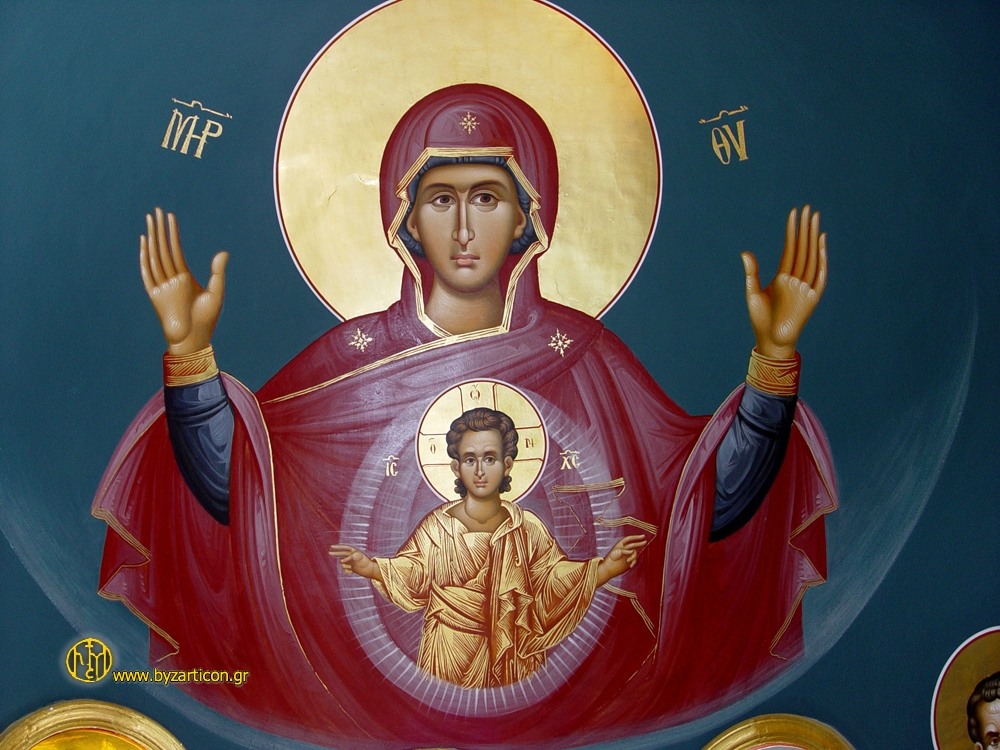
THE_PLATYTERA_DETAIL-web

Using some of the terminology from our revivalist friends, Mary became the very first to accept Jesus as her personal Lord and Savior, and invited Him thus into her heart (which is exactly what the Platytera Icon shows).

Fr. Jonathan Tobias.

You cannot get any more “lifework” than a young virgin saying, in the Latin version, fiat mihi secundum verbum tuum, in response to the Archangel’s invitation.

* * * * *

You can read most of my more impromptu stuff at here. It should work in your RSS aggregator, like Feedly, should you want to make a habit of it.

I highly recommend blot.im as a crazy-easy alternative to Twitter (if you’re just looking to get your stuff “out there” and not pick fights).

An open letter to Josh Harris, seeker

Dear Josh:

I hope I can call you Josh, though we’ve never met and I was way too old in the 90s to get caught up in “purity culture.” (Heck, even my son was a bit too old.)

What I have to offer, despite that, is the different way to practice Christian faith that you reportedly are looking for and most certainly need. I was discovering that different way when purity culture was turning into a big deal, and I’ve been following it for more than twenty years now.

I thought of your recent announcements as a kind of “apostasy,” though I hadn’t focused on what you actually said. Still, since I was no longer in the Evangelical world, I wasn’t threatened by it. I had no “horse in that race” so to speak. I’ve known for a long time now that “Christian” doesn’t have a very clear, agreed meaning in the U.S., and leaving some kinds of “Christianity” may be a very good move (especially if you move toward the right kind).

I felt kindly toward you for honesty: not reinterpreting scripture so you could go on being a megachurch pastor and Christian celebrity. From the way I see you telling your story now, that may not even have been existentially possible for you.

In fact, I’m dropping the label “apostasy.” “Rehab.” “Recovery from PTSD.” Those seem more apt.

Not all those who wander are lost, J.R.R. Tolkien observed. The corollary is that not all who lead know where they’re going. Both these statements are true of Joshua Harris, the former pastor and author of “I Kissed Dating Goodbye” (1997), who acknowledged on Instagram last week that “by all the measurements that I have for defining a Christian, I am not a Christian.”

[*I Kissed Dating Goodbye]’s message became “a big part of my identity, and almost my own sense of self-worth,” Mr. Harris told me last December. “So to even open the door to think that maybe it was, on the whole, unhelpful, and hurt people—it was just hard to go there.”

Jillian Kay Melchior, Wall Street Journal (emphasis added).

Apparently you did open the door and go there, and got an earful that would shake up any conscientious person. I’ve read some of them, and my godson is one of those who got poisoned (he’s recovering well).

Thus:

In July, Mr. Harris made two personal announcements on Instagram: He and his wife were separating, and he had “undergone a massive shift in regard to my faith in Jesus,” he wrote. “Many people tell me that there is a different way to practice faith and I want to remain open to this, but I’m not there now.

Many Christians responded with mourning, but I’m hopeful. Abandoning untrue beliefs is progress ….

(Emphasis added again)

I can whole-heartedly recommend “a different way to practice faith” than you’ve ever known, and of which you may even have no clue (having a clue and knowing something are not the same).

Ignore any “different way to practice faith” that baptizes the sexual revolution. Doing that would harm people as much or more than anything you’ve done before.

Ignore (I’m sure you will) any way that permanently anathematizes all who’ve ever sinned sexually. Ignore them if the first sexual sin gets you kicked out or branded with a scarlet letter of some sort.

Get thee to an Orthodox Church, with a capital-O, and just observe for a few months.

The Orthodox Church is probably a mystery to you because you grew up in the West, where the only visible claimant to the title The Church was Roman Catholicism. We Orthodox know that body well, because a thousand years ago, Roman Catholicism was Orthodox (and, to be fair, Orthodoxy more freely used the moniker “catholic”). We were one big family, with a few minor quarrels and personality differences. But then the Bishop of Rome, one of five Patriarchs of the Church, got too big for his britches (a crude shorthand, I know, but I’m not writing a theological treatise or Church history here) and eventually split — went into schism — from the other four Patriarchs and the Churches they represented.

That schism has never been healed. The Bishop of Rome increasingly took his church off the rails, adding doctrines that didn’t belong and tying down things that needed to remain freer.

The other four Patriarchs (Alexandria, Constantinople, Jerusalem and Antioch) never closed up shop, but they’ve been concentrated mostly east of Rome’s turf. They have preserved the ancient Christian faith without innovations and defining everything to death.

So Orthodoxy will probably look a lot like Roman Catholicism to you. (They’ve screwed up the Mass, bless their hearts, but it’s still recognizable.)

Like I say: Don’t commit. Just go and observe for a while. Russian, Greek, Romanian, Antiochian, even my own obscure Carpatho-Rusyn — Orthodox is Orthodox, and we’re working on shedding those ethnic labels in the U.S., since they don’t really belong.

That reminds me: If you stumble onto an Orthodox Church that doesn’t worship in English, keep moving. They’re not “wrong,” but you probably won’t get much out of it. There are plenty that use English now.

When you get there, open your heart and your mind. Those icons that may trouble you are stand-ins (and more) for the great cloud of witnesses in Hebrews.

Talk to the Priest with your questions. The people around you may be less knowledgeable, in a Protestant doctrinal sense, than you’re used to, because the center of the worship is Christ and His Eucharist, not the sermon. But the Priest almost certainly has formal education and has some idea where a Protestant inquirer is coming from. Odds are, he was once a Protestant, too, if you’re in the U.S.

Then settle in for the long haul. There will be some formal catechism and then a formal reception service if you decide to stay.  They may even conclude that you should be baptized again (though we don’t re-baptize if a prior baptism was done more or less as we baptize, as mine was, for instance).

Don’t count on being a leader again. Maybe, maybe not. But do expect that some well-meaning someone-or-other will make a big deal of it if you officially become Orthodox. We are in America, after all, and we’re sadly susceptible to celebrity culture. I wish it weren’t so. People can be destroyed by getting elevated too fast, as the Apostle Paul knew.

My advice: Say something like “I’m still healing from my past life and I don’t think it would be helpful for me to get into the limelight again.” Because that’s probably true, and I think you know it now.

Don’t let any elation about entering Orthodoxy make you think you’ve arrived. It means you’ve started in earnest. There’s going to be some serious interior remodeling, not just rearranging some furniture.

This is, after all, a really different way of practicing faith.

* * * * *

You can read most of my more impromptu stuff at here. It should work in your RSS aggregator, like Feedly, should you want to make a habit of it.

I highly recommend blot.im as a crazy-easy alternative to Twitter (if you’re just looking to get your stuff “out there” and not pick fights).

Sometimes, serendipity!

I blogged just yesterday, on the occasion of his death, about the odd metanarratives of “religion” Supreme Court Justice John Paul Stevens gratuitously spun in some of his religion clause opinions. I acknowledged (boasted?) that nobody else had noticed the falsity of his metanarrative.

And the response to yesterday’s blog seems to be that nobody noticed. Or they noticed and averted their eyes from my nakedness.

Today, in heat indices forecasted to reach 109° F and with a diagnosis of a torn ankle tendon requiring immobility, I decided to (among other things) catch up on some blogs I set aside because the author is always too substantive for a quick read.

And boy, was I ever rewarded! Sometimes, serendipity!

To appreciate why I was so delighted, you’ll need to go back to yesterday’s blog, painful though that may be, and see the parallels between what I wrote about what I called “integral Christianity” and what I found in The Struggle Against The Normal Life:

  • a better description of classical Christianity (I guess I was becoming a classical Christian long before I became one formally)
  • a contrast between it and modern Christianities (of the sort Justice Stevens had in mind),
  • acknowledgement that modern Christianities are ascendant, if facile and false, and
  • a call to the repentance and asceticism necessary to maintain classically Christian belief amid the hegemony of heterodoxy.

Excerpts (generous, but not exhaustive; this one needs to be read in full, then read again and again):

Within the Christianity of our time, the great spiritual conflict, unknown to almost all, is between a naturalistic/secular world of modernity and the sacramental world of classical Christianity. The first presumes that a literal take on the world is the most accurate. It tends to assume a closed system of cause and effect, ultimately explainable through science and manageable through technology. Modern Christians, quite innocently, accept this account of the world with the proviso that there is also a God who, on occasion, intervenes within this closed order. The naturalist unbeliever says, “Prove it.”

The sacramental world of classical Christianity speaks a wholly different language. It presumes that the world as we see it is an expression of a greater reality that is unseen. It presumes that everything is a continuing gift and a means of communion with the good God who created it. The meaning and purpose of things is found in that which is not seen, apart from which we can only reach false conclusions. The essential message of Christ, “The Kingdom of God is at hand,” is a proclamation of the primacy of this unseen world and its coming reign in the restoration of all things (apokatastasis, cf. Acts 3:21).

The assumptions of these two worldviews could hardly be more contradictory. The naturalistic/secular model has the advantage of sharing a worldview with contemporary culture. As such, it forms part of what most people would perceive as “common sense” and “normal.” Indeed, the larger portion of Christian believers within that model have no idea that any other Christian worldview exists.

The classical/sacramental worldview was the only Christian worldview for most of the centuries prior to the Reformation. Even then, that worldview was only displaced through revolution and state sponsorship. Nonetheless, the sacramental understanding continues within the life of the Orthodox Church, as well as many segments of Catholicism. Its abiding presence in the Scriptures guarantees that at least a suspicion of “something else” will haunt some modern Christian minds.

The classical model is, in fact, the teaching found in the Scriptures. It utterly rejects the notion of spiritual knowledge belonging to the same category as the naturalistic/secular world. It clearly understands that the truth of things is perceived only through the heart (nous) and that an inward change is required. It is impossible to encounter the truth and remain unchanged.

The classical model, particularly as found within Orthodoxy, demands repentance and asceticism as a normative part of the spiritual life. These actions do not earn a reward, but are an inherent part of the cleansing of the heart and the possibility of perceiving the truth.

The struggle between classical/sacramental Christianity and modernity (including its various Christianities) is not a battle over information. The heart of the struggle is for sacramental Christianity to simply remain faithful to what it is. That struggle is significant, simply for the fact that it takes place within a dominant culture that is largely its antithesis.

A complicating factor in this struggle is the fact that the dominant culture (naturalistic/secular) has taken up traditional Christian vocabulary and changed its meaning. This creates a situation in which classical Christianity is in constant need of defining and understanding its own language in contradistinction to the prevailing cultural mind. The most simple terms, “faith, belief, Baptism, Communion, icon, forgiveness, sin, repentance,” are among those things that have to be consistently re-defined. Every conversation outside a certain circle requires this effort, and, even within that circle, things are not always easy.

Such an effort might seem exhausting. The only position of relaxation within the culture is the effortless agreement with what the prevailing permutations tell us on any given day. Human instinct tends towards the effortless life – and the secular mentality constantly reassures us that only the effortless life is normal. Indeed, “normal, ordinary, common,” and such terms, are all words invented by modernity as a self-description. Such concepts are utterly absent from the world of Scripture. Oddly, no one lived a “normal” life until relatively recently.

That which is “normal” is nothing of the sort. It is the purblind self-assurance that all is well when nothing is well.

(Fr. Stephen Freeman, emphasis added)

So, among other (much more important) things, I should not be surprised that “the sacramental world of classical Christianity” was unknown to Justice Stevens, just as it is “unknown to almost all.”

This does nothing to relieve my concerns about his false metanarrative making its way into Supreme Court precedents. I can only hope that it’s seen as the obiter dicta that it is.

* * * * *

You can read most of my more impromptu stuff at here. It should work in your RSS aggregator, like Feedly, should you want to make a habit of it.

I highly recommend blot.im as a crazy-easy alternative to Twitter (if you’re just looking to get your stuff “out there” and not pick fights).

A soft answer?

We’ve reached a juncture where, I think, most people (even in my part of “flyover land”) know and have friendly relations with gays and lesbians who are remarkably normal. Involved in music and arts, I certainly do, and it has not, I think, “softened” my stance on the morality of same-sex erotic relationships.

At the same time, if you’re paying attention, you see at Pride Parades, on the left coasts at least, displays of extreme sexual perversity; and every “all we want is X” is followed by “all we want is Y” when the sexual revolutionaries get their X.

What is going on?

Rod Dreher has a generally conservative, very perceptive, same-sex-married reader who comments (not just in thin pseudonym, but anonymously to protect himself from feared professional consequences) as “Matt in VA.” Matt’s take seems very plausible to me:

I am not trying to say or claim that all or most gay men are peddlers of this suicidal and murderous sexual “ethic” — I am only saying that the most vocal and most committed and most will-to-power gays are. One of the drums I bang on constantly is that it doesn’t really matter so much what a “majority” believes or values deep in their hearts — the public square is shaped by those who are most committed to seeing their vision of society realized and made hegemonic. And of course the gay men with the most poisonous and toxic sexual priorities are the most committed and vocal — these are people who value their sexual practices and choices more, much more, than they value their own lives or the lives of their sexual partners.

If you read the well-documented accounts of Gaetan Dugas in And the Band Played On, or the stories about Foucault — this type of gay man may not be the majority, but it is not an exceedingly uncommon type, and it is the type that is committed to seeing its vision of what homosexuality means or should look like realized and affirmed (think of Foucault’s influence.) If others say it is false to declare these kinds of people murderers, that we are talking about consensual choices, then I would say at best they are the equivalent of heroin or fentanyl dealers, and gay male sexual communities are the equivalents of urban communities where hard-drug dealers and their “values” are aggressively and relentlessly normalized. These are failed communities.

… I am not talking about all nor even most gay men, here; but at the same time, I am talking about many of the most committed and loud and determined gay men, the ones who put great effort into normalizing and promoting their priorities and making the community into something that satisfies their desires as much as possible …

… to say “only within consenting adults” is to put up no guardrail whatsoever. Consenting adults are capable of “consenting” in the heat of the moment, or at certain points* over a lifetime of degraded and relentless mental and cultural grooming, to raping and being raped, to risking death to oneself or one’s sexual partners, to deliberately infecting others and/or deliberately, even fetishistically, exposing oneself to infection with anything and everything; to mutilating one’s body or somebody else’s body — to anything.

Matt in VA, via Rod Dreher.

I don’t know what to do about this. Smugly waiting for the backlash is a non-starter, but I’ve seen a possible model.

May 17 has somehow been designated the International Day Against Homophobia, Transphobia and Biphobia. The Republic of Georgia, in which I was traveling this May 17 past, is too tolerant to repress its observance, but too Orthodox Christian not to respond.

So the Orthodox Patriarch of Georgia declared (or persuaded the authorities to declare) May 17 “Family Sanctity Day“, an official holiday it appeared, which was celebrated with a parade, erection of a temporary massive stage at the open end of Sameba Cathedral Plaza, and displays of patriotism, traditional song and dance, and so forth.

I liked that tone and that substance.

[* This has obvious relevance to heterosexual “consenting adults” as well, as in Harvey Weinstein’s not entirely improbable claim that he never had non-“consensual” sex with {any aspiring starlet who he had the power to make or break}.]

* * * * *

You can read most of my more impromptu stuff at here. It should work in your RSS aggregator, like Feedly, should you want to make a habit of it.

I highly recommend blot.im as a crazy-easy alternative to Twitter (if you’re just looking to get your stuff “out there” and not pick fights).

An anniversary and a testimonial

Today is the 52nd anniversary of my high school graduation.

It might sound odd to remember that, but high school was formative for me because, almost impetuously, my parents and I agreed that I should go to a Christian (specifically Evangelical) boarding school. So off I went at age 14 (specifically, Labor Day 1963) to forge a life somewhat separate from my parents — an experience most of my contemporaries postponed for another four years. By that point in my life, living in dormitories was “old hat,” college “same old, same old.”

I should qualify the preceding paragraph by noting that only 40% of my school was boarding students. The other 60% was commuters from the nearby Evangelical Jerusalem: Wheaton, Illinois. I suspect that Wheaton Academy itself was “old hat” for my commuter classmates, many of whom had attended Wheaton Christian Grammar School, whereas I had attended public schools to that point in my life (with my parents requesting some exemptions to let me observe Evangelical taboos about, say, dancing — public schools were not yet required to teach fornication).

We Evangelicals, of course, were very focused on the Scriptures (which we received from the historic Church pretty much unacknowledged) because they, in theory, were our final authority. But those Scriptures are many (66 by Evangelical count, more than that historically) and varied. The inability to fully harmonize them, or to credibly discern the science of cosmic creation therein, leads some Evangelicals to the shipwreck of faith.

There is a different and much more historic way to approach Scripture, and it always amuses me when the New Atheists and their ilk presume that the Evangelical (shared closely with Fundamentalists) approach is the exclusively correct one — before using it to rip such Christian faith to shreds — a presumption betraying an ignorance so profound that they really should just shut up.

* * *

As I write, early in the morning, I’m still re-orienting from a very intense weekend wherein my Orthodox Christian parish Church was consecrated by our Bishop with the assistance of multiple priests and with me leading the singing of unfamiliar hymns proper to a consecration. My Christian pilgrimage has taken me there, deep into the historic roots of Christianity and thus a long way from Evangelicalism, for Evangelicalism is rooted mostly in the frontier revivalist vein of the Second Great Awakening of some 200 years ago.

Over my intense weekend, I made the acquaintance of a professional who joined his son, a recent Purdue graduate who was active in our parish, for the consecration and following Liturgy and banquet. His professional specialty is the same as one of my Wheaton Academy classmates, whose practice has grown large and, by what reputation I knew, very prominent.

I asked our guest if he knew of it, and it turned out he knew it, thought very highly of it, and almost joined it after interviewing with my classmate, his son and his daughter-in-law, all professionals in that field. He confirmed the practice’s excellence, and confirmed my impression that my classmate is still “very tightly wound” (my characterization) — adding some praise of the family’s Evangelical and charitable involvement as well, for it sounds as if the large practice is still owned and controlled largely or entirely by my classmate’s family and presumably has yielded considerable wealth.

Such thoughts of my classmate, and of my different Christian path, brought back to mind our different “life verses” (an ironically extrabiblical bit of Evangelical youth piety). Any time I say “life verse” from now on, you may gloss it as “important Bible verses favored by or associated with this person.”

My classmate’s life verse at the time seemed to be II Timothy 1:7: “For God hath not given us the spirit of fear; but of power, and of love, and of a sound mind.” That always seemed to me (though I don’t know my classmate’s mind) like the outward-looking verse of a doer, and my classmate has done a lot — enough that I felt like a slacker in comparison until I went back to school at age 30 for some graduate work of my own. He himself uttered that verse as a life verse (or close to it); the association isn’t my projection.

I’m pretty sure I never declared any “life verse,” but I believe I wrote by my signature in schoolmates’ yearbooks “Ephesians 3:17-19” which reads (in the King James Version):

That Christ may dwell in your hearts by faith; that ye, being rooted and grounded in love, May be able to comprehend with all saints what is the breadth, and length, and depth, and height; And to know the love of Christ, which passeth knowledge, that ye might be filled with all the fulness of God.

That always seemed to be to contrast with my classmate’s verse — in my favor, of course, or I could have changed.

I was also quite taken by Hebrews 5:12 – 6:3:

For when for the time ye ought to be teachers, ye have need that one teach you again which be the first principles of the oracles of God; and are become such as have need of milk, and not of strong meat. For every one that useth milk is unskilful in the word of righteousness: for he is a babe. But strong meat belongeth to them that are of full age, even those who by reason of use have their senses exercised to discern both good and evil.

Therefore leaving the principles of the doctrine of Christ, let us go on unto perfection; not laying again the foundation of repentance from dead works, and of faith toward God, Of the doctrine of baptisms, and of laying on of hands, and of resurrection of the dead, and of eternal judgment. And this will we do, if God permit.

This puzzled and challenged me, as “laying again (and again, and again, and again) the foundation of repentance from dead works, and of faith toward God” seemed rather the whole point of our revivalist (remember: Second Great Awakening) “altar calls,” and I thought “the doctrine of baptisms, and of laying on of hands, and of resurrection of the dead, and of eternal judgment” were very deep — meaty, not milky.

Finally, although it may (though I think not) have first obsessed me somewhat later than high school, Romans 12:2: “And be not conformed to this world: but be ye transformed by the renewing of your mind, that ye may prove what is that good, and acceptable, and perfect, will of God.” What makes me think it may have grabbed me later than high school is that I pretty much translated that to “thinking Christianly” (which “mind” justifies better than does the untranslatable Greek nous), and I think that “translation” came in college or even a bit later still.

All three of my passages/”life verses” seem to me introspective, or at least relatively so — “figuring stuff out” more than “doing,” and sinking roots more than (to use the modern barbarianism) “moving fast and breaking things.”

* * *

I don’t know if the best way to characterize our different verses, mine and my classmates, is as acorns, as in “mighty oaks from tiny acorns grow.” That metaphor seems like the idea that encouraged us Evangelical lads and lasses, very wet behind the ears, presumptuously to grasp the nettle by picking a life verse anyway.

I tend to think a better organic metaphor is “as the twig is bent, so grows the tree,” or even Immanuel Kant‘s “out of the crooked timber of humanity no straight thing was ever made.”

Scriptures are many and varied. There’s no scriptural reason why one should be guided primarily by II Timothy 1, another by Ephesians 3, Romans 12, and Hebrews 5 and 6. I suspect we latch onto verses because of how our twigs were bent by our DNA, our upbringing and such — even our our gut flora, as science seems to be finding. But I don’t think relativisticly that Evangelicalism is the “right” Christian tradition for my classmate, Orthodoxy for me, because of such things.

I believe there is a deeper human nature to which Orthodoxy responds fully and of which Evangelicalism at its rare best only dreams of. Orthodox Christianity is what I was dreaming of unawares as I dreamed of  being rooted and grounded in love, filled with all the fullness of God, going onto perfection, renewing my nous.

That’s my story and I’m stickin’ to it.

* * * * *

You can read most of my more impromptu stuff at here. It should work in your RSS aggregator, like Feedly, should you want to make a habit of it.

I highly recommend blot.im as a crazy-easy alternative to Twitter (if you’re just

* * * * *

You can read most of my more impromptu stuff at here. It should work in your RSS aggregator, like Feedly, should you want to make a habit of it.

I highly recommend blot.im as a crazy-easy alternative to Twitter (if you’re just looking to get your stuff “out there” and not pick fights).

Bridging, not widening

We Orthodox Christians hear again and again our our services that God is good and loves mankind.

But doesn’t every Christian group believe that? I very much doubt that they believe it in the same way — the way illustrated here, where an experienced Orthodox Priest describes how the rubber of sacramental confession meets the road of God’s love:

Among the more interesting experiences for a priest is the confession of children. The one thing I am certain to avoid is trying to teach children about sin when it is not part of their conscious existence. Convincing a child that there is an external parent (God) watching and judging their every thought and action is almost certain to create a certain distance from the soul itself. The question, “Am I ok?” is the language of shame, of broken communion, even communion with the soul. But, having done this now for 40 years, I can say that I see a gradual awakening in each child, an awareness of broken communion. The role of a confessor is not to widen that gap, but to help a child learn how it is bridged in Christ. I tell parents, “The only thing I want a child to know at first is the absolute certainty of God’s unchanging and unconditional love.” It is only in the context of such safety that, in time, an older adolescent can find the forgiveness and healing that they will inevitably need.

Fr. Stephen Freeman (emphasis added)

* * * * *

You can read most of my more impromptu stuff at here. It should work in your RSS aggregator, like Feedly, should you want to make a habit of it.

I highly recommend blot.im as a crazy-easy alternative to Twitter (if you’re just looking to get your stuff “out there” and not pick fights).

All about Christ

When I was in high school, street preachers told me: “The Bible is the word of God. Jesus is the Son of God. And if you accept him as your personal savior, your salvation is 100 percent assured.” It felt like an Amway pitch. I could get saved right on the sidewalk before sixth period—no long, boring catechumenate required.

This concept of an individual with a Bible who stands alone before God versus a person who needs a church and practices to help mediate God’s grace, represents a deep and real divide that has consequences for how evangelicals see themselves relative to more traditional groups …

Eighty percent of the congregation of Holy Theophany Orthodox Church, also in Colorado Springs, are converts from evangelical and Protestant backgrounds. Their priest, the Rev. Anthony Karbo, became a Christian through participation in Young Life, a national evangelical youth organization headquartered in Colorado Springs. He says, “As a Protestant I met Christ. In the Orthodox Church I met the rest of his family, including his mother.” Orthodoxy both challenges and appeals because its liturgy has not changed much since the fourth century and neither have its teachings. Unlike the Catholic Church, it has not tried to seem less pagan, less foreign, less strange. It has stayed weird.

Eric Jewett, a deacon in the Orthodox Church and a former Free Methodist youth pastor, says, “In the ancient church I encountered the fullness of the faith as it had been lived and preserved since the time of Christ and his apostles.”

Deacon Scionka, the former evangelical youth minister, describes falling in love with their style of worship: “My background is Bible-centered, which led me to think that liturgical worship was extra-biblical, but in reality it’s very biblical. The whole service is scriptural, and it centers on our unity in Christ. It floored me.” He tears up describing his first Christmas in the Orthodox Church.

“At the end of the Nativity Vigil, this long beautiful candlelight service, it hit me that this was the first time in my life that I had gone to church for Christmas and it was really celebrating the birth of Christ,” he said. “No big performances. No distractions. Just a dark, beautiful, candlelight service all about Christ.”

Anna Keating, Why Evangelical megachurches are embracing (some) Catholic traditions (emphasis added).

A few comments of my own.

First, the Orthodox Church is a minor part of Anna Keating’s medium-form article, but what she says is accurate and telling.

Second, although I consciously passed some specific doctrinal landmarks on my way from Protestant to Orthodoxy (rejecting the ironically extra-Biblical doctrine of sola scriptura and beginning to take seriously “one holy catholic and apostolic Church”), the further Protestantism fades into the rearview mirror, the more it’s Orthodoxy’s worship that I think really drew me, at the visceral level. I’d been a malcontent on Protestant worship in every church where I had a voice on the subject, pushing for more of the great Protestant hymns (there really are some) and eliminating (not just reducing) gospel songs in worship, since gospel songs are preachy or peppy adminitions to each other, not really worship at all.

I always lost. The trend was ever more vulgar, ever less exalted and Godworthy.

Third, Orthodoxy seems “pagan” only to modern and post-modern crypto-secularists, who have no idea what worship has meant through the Christian ages and are uncomfortable with actual acknowledgement of an actual triune deity who fully merits bows, kneelings and even prostrations, to name three “pagan” practices.

* * * * *

You can read most of my more impromptu stuff at here. It should work in your RSS aggregator, like Feedly, should you want to make a habit of it.

I highly recommend blot.im as a crazy-easy alternative to Twitter (if you’re just looking to get your stuff “out there” and not pick fights).

Betrayal, denial, cowardice

(This is Great and Holy Friday in the Orthodox Church.)

Betrayal, denial and cowardice were the hallmark of the Church on Good Friday. But from Christ we hear no blame – if only because He never thought us to be other than we are.

Now when he was in Jerusalem at the Passover feast, many believed in his name when they saw the signs which he did; but Jesus did not trust himself to them, because he knew all men and needed no one to bear witness of man; for he himself knew what was in man (John 2:23–25).

And if we are honest with ourselves and know what is in man, then we can only give thanks for the wondrous irony that, knowing all that, Christ gave Himself for us anyway. It is the very character of love.

Fr. Stephen Freeman, Irony and Belief

* * * * *

Follow me on Micro.blog Follow me on Micro.blog, too, where I blog tweet-like shorter items. That’s mirrored at microblog.intellectualoid.com.

The place for broken souls

Our Orthodox Faith defines sin as an illness that is in need of healing, not as a crime that requires punishment. The Church is a hospital for the soul whose therapists (priests) first sought therapy and then became the therapists. As a healing institution the Church is the place for broken souls.

We come before Christ as tarnished images, far from that which God intended. Yet this very Creator God is patient and loving, quick to forgive. Our God invites us to holiness, to be made whole. His grace is sufficient to lift us up out of our mire and into the heights of a joy and gladness that is meant to be eternal. We need only to humble ourselves and ask for help and the Kingdom is ours.

Heaven and hell are not about location, but about relationship. All that is needed is our responsive word, followed by action. We say yes to God’s invitation while seeking out the therapy that is ours within the life of the Church.

Wholeness (holiness) is ours through this relationship with Christ, Who’s redemptive act upon the Cross, together with His having conquered death by death, delivers us from the depths of estrangement. We are lifted up to God, having been made whole, and eternal communion with God is our destiny.

With love in Christ,
Abbot Tryphon

The Morning Offering, April 11, 2019

* * * * *

You can read most of my more impromptu stuff at here. It should work in your RSS aggregator, like Feedly, should you want to make a habit of it.

I highly recommend blot.im as a crazy-easy alternative to Twitter (if you’re just looking to get your stuff “out there” and not pick fights).

What Is It Like to Be a Monk?

A very respectful, even loving, account of a religiously ambiguous (Atheist? He says “not exactly”) philosopher’s brief visit to Mount Athos:

I have never seen a church seem so alive. At certain points in the Divine Liturgy on Sunday, it felt as if the whole church was glowing gold inside as the sunlight began to come up in the morning light. The physical discipline of the monks was hard to comprehend. They stood for hours on end without moving, twitching, fidgeting or biting their nails. No one drank anything or looked thirsty. At other times, all the candles were extinguished and there was a low droning chant in darkness. Toward the end of the five-hour vigil, around midnight, I noticed one or two stifled yawns, but nothing much. By this time, the monks had been awake for at least 24 hours. At the end, Ioanikios looked as fresh as a daisy. I was shattered, hungry and thirsty (I hadn’t eaten since the previous morning and had only a few hours’ sleep). But I felt such a lightness.

Simon Critchley, What Is It Like to Be a Monk?, New York Times

* * * * *

You can read most of my more impromptu stuff at here, but a bit here as well. Both should work in your RSS aggregator, like Feedly, should you want to make a habit of it.

I highly recommend blot.im as a crazy-easy alternative to Twitter (if you’re just looking to get your stuff “out there” and not pick fights).