Mikhail Kalashnikov and culpability

Mikhail Kalashnikov, Creator of the AK-47, has died at age 94. He had little formal education, describing himself as a tinkerer. But he was an engineer at heart.

How many – millions? tens of millions? – have died, pierced by projectiles from the tens of millions of his creations? How much moral culpability should we assign to engineering sorts for the consequences of their creations?

I suggest that in all but extraordinary cases, we (whose job it isn’t to assign moral culpability anyway) shouldn’t assign much.

The world’s fraught with unintended consequences. Russia had legitimate enemies. His creation arrived a bit too late to to contribute to the defeat of Hitler, the starring role in which defeat arguably was Russia’s, but defending themselves and their citizens is what governments do. And a citizen who creates so fine a work as the AK-47 is reported to be deserves a true patriot’s fame.

Not so someone who compliantly, say, designed a gas chamber cunningly disguised as a mass shower. That’s the extraordinary case I had in mind.

Robert Oppenheimer? Maybe we should go back to Kalashnakov.

Still, I can’t bring myself to a full-throated “Memory Eternal!”

* * * * *

“The remarks made in this essay do not represent scholarly research. They are intended as topical stimulations for conversation among intelligent and informed people.” (Gerhart Niemeyer)

Some succinct standing advice on recurring themes.

10 Commandments, 4 Loves

A story was told by a modern, North American Orthodox Priest, about a young man of his Parish who came to confession. Among the sins confessed was “I cheated on my girlfriend.” Unsure what was meant, the Priest sought clarification: “I had sex with another girl, Father.” Continue reading “10 Commandments, 4 Loves” →

Nelson Mandela and St. Nicholas

Certain portions of the right wing are exercised today about anybody having anything nice to say about Nelson Mandela. For instance:

Please STOP making comments about how wonderful Nelson Mandela was. He wasn’t the kind gentle old man the media, yes the media, makes him out to be. You might as well praise Osama bin Laden, Castro or Hitler. Please, read below on what this man did The hero of the anti-apartheid struggle was not the saint we want him to be.

The image of Nelson Mandela as a selfless, humble, freedom fighter turned cheerful, kindly old man, is well established in the West. If there is any international leader on whom we can universally heap praise it is surely he. But get past the halo we’ve placed on him without his permission, and Nelson Mandela had more than a few flaws which deserve attention.

He signed off on the deaths of innocent people, lots of them

(Punctuation or lack thereof in original) After initially calling “bullshit” (because a half-truth is a form of bullshit), I repaired to my treadmill, and as I walked, I thought.

Specifically, I thought about the notion that Nelson Mandela could not be a saint because he ordered the deaths of people. And I thought about who deserves death and who might mistakenly be thought to deserve death.

The forces against which Nelson Mandela fought – and frankly there is no sugar coating that he was a “militant activist” with all that implies – were white Calvinist proponents of apartheid. They were of Dutch ancestry.

In 1990, when Mandela was released from prison, I was a member of the church consisting largely of Dutch Calvinists. And in that era, if not in that exact moment (my memory of the sequence isn’t all that clear), we came under suspicion of harboring similar racist thoughts.

But as I pointed out at the time (and I was actually quoted on All Things Considered one evening, defending my Church in letter or e-mail), the Christian Reformed Church in North America had already condemned apartheid as a “heresy.” The Orthodox Church, which later allowed this sinner into its fold,  has condemned apartheid’s cousin, phyletism, as a heresy.

Coincidentally, today is the feast of St. Nicholas. St. Nicholas is remembered among other things for having opposed the proto-heretic Arius at the first ecumenical Council of Nicaea, from which we got the first draft of the Nicene Creed. Arius denied the divinity of Christ, a doctrine which was not invented at the Council of Nicaea but which was affirmed in the face of the threat posed to Christ’s church by the heretic Arius. At one point in the proceedings (although the story is probably apocryphal), Nicholas became so indignant that he struck Arius in the face.

For this, he was stripped of his rank as Bishop and actually was confined in prison, perhaps with the intention of releasing him after the conclusion of the Council. But as the hagiography has it, key people experienced visions about him, and he was released from prison and returned to the Council, restored to the office of bishop.

Did I mention that this violent opponent of heresy is universally recognized as a saint?

On the wall in my icon corner is an icon of a man with very dark skin and very curly hair. It is the icon of St. Moses the Ethiopian. St. Moses was a violent thief and criminal, and I believe that he was guilty of murder, probably many times over. But he was radically converted, and went on to live an exemplary life. I believe that the story of his life concludes, ironically, with him being killed by a band of violent thiefs and criminals who were attacking the monastery of which he was the Abbot, and whose monks he was trying to protect by interposing his unresisting body.

So, dear right-wing, stop telling half-truths about Nelson Mandela. There was fear of extreme violence, whipped up by him, upon his release from prison in 1990. But he did something much more radical than that: he forgave.

I have no opinion on whether Nelson Mandela is a saint. As I write, I cannot even recall whether he  professed the Christian faith.

But I do know that history is messy, repentance happens, and that Nelson Mandela is a historical figure remembered not for his “militant activism,” but for his role in truth, reconciliation – indeed, “Truth and Reconciliation” – and in moving his country forward dramatically during the last 23 years of his life.

May his memory be eternal!

* * * * *

“The remarks made in this essay do not represent scholarly research. They are intended as topical stimulations for conversation among intelligent and informed people.” (Gerhart Niemeyer)

Some succinct standing advice on recurring themes.
First Things (also 2nd through 6th)

I’m glad I re-subscribed to First Things. I can’t read it cover-to-cover, but it has some real gems.

  1. Polytechnic Utiliversity
  2. Liberalism then and now
  3. Our intolerant, oppressive and priceless patrimony
  4. “An oddly un-conservative way of thinking”
  5. History with an evil eye and an unequal hand
  6. The Donald

Continue reading “First Things (also 2nd through 6th)” →

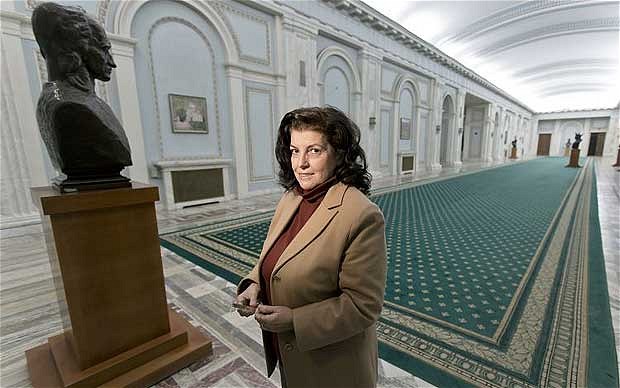
Anca Petrescu, B.I.H.

Anca-Petrescu_2721023b

Oh, my! The Telegraph has an obituary of Romanian Architect Anca Petrescu that might as well conclude “Burn in Hell, you brazen hussy”:

Anca Petrescu, who has died following a road accident aged 64, was an architect known as the “Albert Speer of Communism”, responsible for the Romanian dictator Nicolai Ceausescu’s “Palace of the People” in Bucharest — the world’s greatest monument to totalitarian kitsch.
…
In February 1982, at the age of 32, Anca Petrescu was appointed chief architect of a project whose raison d’être, in Ceausescu’s tautological phrase, was to be “a grandiose edifice that reflects the epoch of the time”.
…
When interviewed about her role in building the People’s Palace, Anca Petrescu tended to lapse into evasive, Soviet-style doublespeak, cutting off interviewers brusquely if they enquired about her relationship with Ceausescu. When asked by one western journalist how she justified the suffering Romanians went through as a result of her work, she retorted: “That is a question originating from someone who can only understand a system based on profit as motivation.” Her favourite novels, she revealed, were the “sick works of Dostoevsky and Tolstoy, because they fit my soul”.

The story brings back a bit of the horror of Ceausescu. I recall my then-Calvinist heart swelling with pride as I read about how he was toppled by a doughty band of Romanian Calvinists, who probably toppled him from calloused knees.

I forget the details (but the New York Times remembers) and you’ve probably never heard them since the story’s pretty implausible in retrospect when everyone knows Ronald Reagan toppled Communism on his feet.

And John Paul II.

Oh. Margaret Thatcher, too. And ordinary Polish Catholics. Led by Lech Walesa. Sound track by the late Lou Reed. With a cameo appearance by Plastic People of the Universe.

But oddly, apart from episodes like the capture of Hussein or the death of Bin Laden, I don’t hear anyone claiming the success someone or other pulled off in Iraq and Afghanistan.

* * * * *

“The remarks made in this essay do not represent scholarly research. They are intended as topical stimulations for conversation among intelligent and informed people.” (Gerhart Niemeyer)

Some succinct standing advice on recurring themes.

Church unity

This started as a “share” with an Orthodox group on Facebook, but outgrew it.

Frederica Mathewes-Green’s podcast thoughts on ecumenical Church unity, though gentle and irenic, amplify my own skepticism on the topic. Her primary focus is the desired unity between Roman Catholicism (the 800 pound gorilla) and Orthodoxy (America’s best-kept religious secret) — or at least the mutual recognition that disunity is a scandal.

So far, so good: disunity is a scandal; real unity would remove that scandal.

But the proposed terms of unity coming from Rome provoke not so much hostility – “Take this Olive branch and shove it!” – as indifference because Rome seems to desire a “unity” that’s strained, synthetic, and in many ways superficial compared to the unity of Orthodoxy.

Frederica nailed that one when she noted that we’re much more comfortable with the Oriental Orthodox than we are with Rome, which went into schism much more recently. The Oriental Orthodox could not agree with the Council of Chalcedon’s verbal formulation of how the two natures of Christ are united.

The Council of Chalcedon issued the ‘Chalcedonian Definition,’ which repudiated the notion of a single nature in Christ, and declared that he has two natures in one person and hypostasis; it also insisted on the completeness of his two natures: Godhead and manhood.
…
The Oriental Orthodox teach ‘one nature’ in Christ, “Jesus Christ, who is identical with the Son, is one person and one hypostasis in one nature: divine.”

(Wikipedia) But the Oriental Orthodox seem nonetheless to have “kept the same faith,” and I understand they feel the same toward us. It’s fair to say we long for a solution to the Chalcedonian conundrum.

Not so Rome. Their schism was more recent, but their drift after schism much greater. The Roman Catholic reflex seems to be that,

well, of course, being in communion with the Bishop of Rome is essential, and of course it must be on essentially Roman terms. After all, everyone knows you other guys are at fault. But we’re magnanimous, and we’ll let you keep your signature theological perspectives. That’s what “catholic” means: big tent.

That just leaves us cold. On the one hand, we don’t think we, the heirs of four of five pentarchs who remained in communion, are the schismatics. We think the fifth pentarch went into schism when, after we ignored his pretensions and affectation, he started getting too pushy to ignore.

Of course unity will bring us all into communion with one another, but it’s unlikely to happen on terms that signal even tacitly Orthodoxy’s admission of error on the filioque, universal direct jurisdiction of the Pope, infallibility and the other illicit dogmas of the West.

This is not for lack of considerable affection, at least on my own part. Rome has had a great run of Popes lately. John Paul II will be in my thoughts again today, as he was “dying on NPR” as we returned eastward across I74 from a visit to some friends Mrs. Tipsy and I are visiting again.

But even when John Paul II tried to reach out, he proved tone-deaf to a very fundamental matter, our different views of what salvation is:

The teaching of the Cappadocian Fathers on divinization passed into the tradition of all the Eastern Churches and is part of their common heritage. This can be summarized in the thought already expressed by Saint Irenaeus at the end of the second century: God passed into man so that man might pass over to God. This theology of divinization remains one of the achievements particularly dear to Eastern Christian thought.

(Orientale Lumen, italics added) That is a bad misquote, a demotion of the doctrine’s importance in the East, and as tone-deaf as a Protestant, courting Catholics or Orthodox, saying:

The teaching of the Early Fathers on communion passed into the tradition of all the “traditional” Churches as part of their common heritage. This can be summarized in the words of Jesus in the 6th chapter of the Gospel of John: “Verily, verily, I say unto you, Except ye eat bread symbolizing the flesh of the Son of man, and drink wine symbolizing his blood, ye have lowered your odds of having life in you.” This theology of transubstantiation remains one of the achievements particularly dear to “traditional” Christian thought.

The dogmatic differences are deep and perhaps intractable. But suppose we achieve agreement in principle. Having cleared away those stone cold deal killers, how would the rest of the deal look? It would be an awfully big tent that would accommodate the remaining, non-dogmatic differences.

But the Roman Catholic Church already looks to me (and I think to many other Orthodox) like multiple Christian traditions synthetically united though communion with the Pope.

Maybe I misunderstand “catholicity.” I mean that. I lived nearly 50 years where we didn’t give a hoot about that idea, and even now my view is colored by the seemingly intractable dogmatic differences. It’s hard to see clearly. Perhaps with the dogmatic differences out of the way, I could see a path to one big happy family.

But I’m not holding my breath.

* * * * *

“The remarks made in this essay do not represent scholarly research. They are intended as topical stimulations for conversation among intelligent and informed people.” (Gerhart Niemeyer)

Some succinct standing advice on recurring themes.