Saturday, 7/15/23

I forewent a provocative headline and lead paragraph.

You’re welcome.

Culture

Peter Coy brings the receipts

I haven’t harped about this because I didn’t have facts and figures. But the New York Times’ Peter Coy has now provided them (and it’s important enough that I’m giving you a link that pierces the paywall):

  • The amount of lithium, cobalt, manganese, nickel, graphite and other lithium-ion battery materials needed for one long-range electric vehicle would be enough for either six plug-in hybrids or 90 of the type of hybrid that recharges from deceleration and braking.
  • The overall carbon reduction of those 90 hybrids over their lifetimes is 37 times as much as a single battery electric vehicle.
  • The production of electric vehicles produces more greenhouse gases than the production of cars with combustion engines. So E.V.s have to travel between 28,000 and 68,000 miles before they have an emissions advantage over similarly sized and equipped internal-combustion mobiles.

All-electric vehicles are presently a gigantic flim-flam, and considering that third point, they’re going to remain a flim-flam for quite a long time. (Does an EV even get 68,000+ miles before those big honkin’ batteries need replaced?)

The plug-in hybrids have appealed to me, but I’ve got to get over that and to stop feeling like a criminal for (currently) not even driving a conventional hybrid, but a full-blown internal-combustion vehicle. (I’d have bought my second hybrid if they offered one on this model.)

EVs are a kind of social contagion, heavily subsidized by the federal government, which really needs to cut it out.

This is one reason I have almost as little respect for Elon Musk as I do for He Who Shall Not Be Named (another guy who got more-or-less rich dishonorably).

From the July 15 Economist
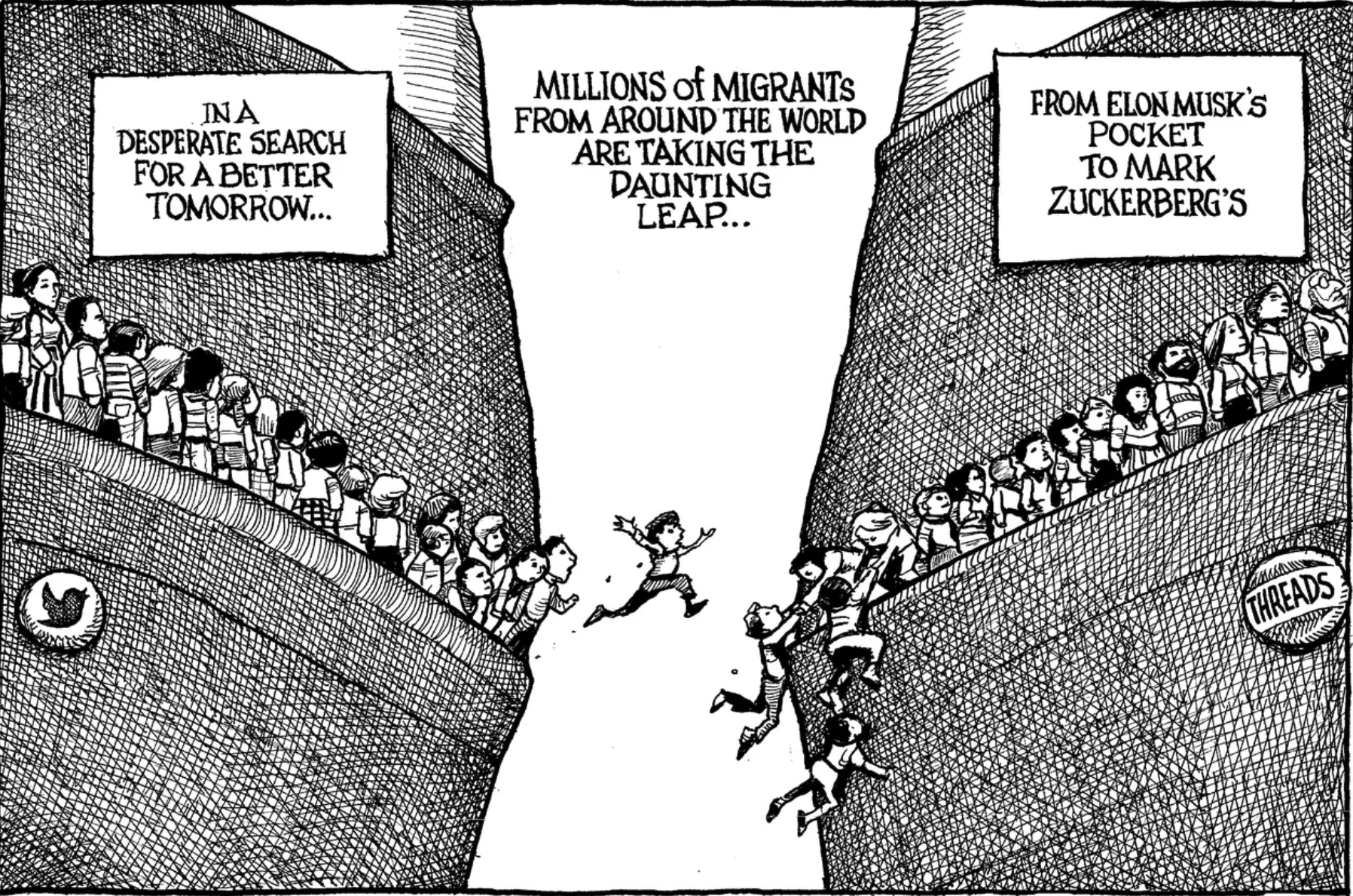
Pangloss makes the case for AI

Mark Andreesen, giving the Panglossian version of AI, lost me early on at the patently bullshitty “infinitely patient, infinitely compassionate, infinitely knowledgeable, and infinitely helpful.” He reminds me of George Burns: “Sincerity – if you can fake that, you’ve got it made.” Because all those AI virtues are fakes.

I was hoping for something better, because I think there’s a better case available. In fact, I know there’s a better case to be made because I heard it made on a podcast Tuesday on the Ezra Klein show.

Freedom

Aunt Concetta told me that she didn’t like life in America because we had no freedom. That comment baffled me because, like everyone else my age, I believed that America was the land of the free and the home of the brave. But she pulled me up short. “Your grandmother,” she said, “is afraid to walk down the main street at night.”

… That little conversation, more than anything I have read about political life, has put an indelible mark on my thinking about freedom. I have long rejected any view that reduces liberty to the results of a constitutional mechanism, or that identifies liberty with suffrage, or that defines liberty as a negative, as what the government may not tell you that you may not do.

… I think I can venture a suggestion as to gauging the degree of real freedom that a nation, or perhaps your town or your street, enjoys. It is the degree and the character of spontaneous, unencumbered, and undirected action on the street.

Anthony Esolen

I kinda sorta feel for Tommy Tuberville

Terms like “white nationalist” mean something: White nationalism is a form of white supremacy that advocates white dominance and white control. You don’t have to take my word for it, you can look it up. (On Tuesday, Tuberville admitted that white nationalists are racists.)

I don’t normally read Charles Blow, but this time, I read a little bit, including the block-quote, because The Morning Dispatch had called out Tuberville teasingly the day before:

It took him about two months and several botched attempts, but a hearty congratulations to GOP Sen. Tommy Tuberville of Alabama for finally saying these words in this order: “White nationalists are racists.”

I remember in law school insisting that I was a creationist. I said that because I believed that this stuff all around us, out to the furthest reaches of our telescopes, were the result of a divine creation, not an accident or the outworking of eternally-existent matter and energy. Someone pointed out that what I meant, though, was not what creationism had come to mean as a term of art. Creationism had come to mean divine creation roughly 6000 to 10,000 years ago, fixed species, etc.

“White Nationalist” has never been a term I’d apply to myself; first, because race is truly (if not exclusively, in our vexed history) a pigment of the imagination; second, because nationalism holds little to no appeal for me. But it appeared to me to mean “nationalism professed by a pale person,” and its journalistic use to be more epithet than description.

Maybe Tommy Tuberville thought as I did, and that’s why he pushed back so. But Blow cites Merriam-Webster for a term-of-art meaning that implies racist white supremacy.

I still stand by the epithet point, and believe that the term is not yet univocally racist. But sensible people, aware of its equivocal meaning, will steer clear of it.

Paris

Many people who love Paris love it because the first time they came they ate something better than they had ever eaten before, and kept coming back to eat it again.

Adam Gopnik, [The Table Comes First(https://www.amazon.com/Table-Comes-First-Family-Meaning-ebook/dp/B004KPM1EY/ref=sr_1_1)

I find that very plausible.

Legalia

FINALLY someone else says it (and better than I)

The nature of expressive, creative work is also such that consumers would not ordinarily wish to risk the quality of the product or service by conscripting a reluctant vendor to create messages that contradict the vendor’s sincere personal beliefs.

Abram Pafford, “You Couldn’t Pay Me to Say That”: 303 Creative and Compelled Commercial Speech.

303 Creative was a well-warranted pre-enforcement challenge based on the proposition that Colorado’s public accommodations law was unconstitutional as applied to plaintiff’s refusal of website design for same-sex weddings. Colorado never challenged the owner’s standing, and even stipulated the facts that eventually blew a little hole in the hull of its law (which remains resolutely afloat).

Even today, pre-enforcement challenges are pending to, notably, some of the new restrictive abortion laws some states have passed, and to state bans on transgender care for minors. The Left is happy as can be with decades of pre-enforcement challenges like these — of which the Left has been the primary beneficiary. I don’t recall Right-leaning pre-enforcement challenges, other than against college speech codes, until the Obama years.

Not until after Colorado had lost did its Attorney General start joining the ignorant “fake case” chorus.

But in a sense, 303 Creative was a “fake case” — or at least an “engineered case”: the sense that in the real world, untainted by polarization and the insatiable desire of LGBTetc folks for universal affirmation, as if their sexuality were constitutional high trump, such cases would not be brought because — well, see the block quote. That’s why I put it there.

What should happen now is clear enough to me: states should disavow application of their public accommodation laws to creative professionals’ rare refusals to aid in expressing an objectionable message — with the creative professional being the sole judge of “objectionable.”

And I’ll reiterate that the key here is the right of the service provider to be free of compulsion to express sentiments they in fact disapprove. It would apply as much to, say, a Jewish graphic designer declining to work on BDS advocacy as to conservative Christians (and others) declining work on same-sex weddings. I sincerely doubt that Colorado would punish that Jewish graphic designer; this is about forcing Christians to bend the knee to the new sexual orthodoxies.

(It’s surprising how easy it is to mis-state what’s at stake here. This little item took far more time than I expected. I probably should cut some slack to those who make a living minting hot takes on complex topics for siloed readerships and who get sloppy in the process.)

Non-partisan politics

Smoke-filled rooms

I miss smoke-filled rooms.

Not the literal ones, but the ones that brought forth sane and competitive candidates back in the day.

Today, primary voters — often the most extreme members of a party — deliver us unpalatable candidates, with the only gesture toward electability being “will he be perceived as less bad than the other party’s guy?”

Yes, I’m thinking specifically of the likely nomination of Donald Trump by the GOP. But I’m not thinking exclusively of that. Hillary in 2016 is also an example.

Our Unaccountable TechLords

At almost every gathering artificial intelligence came up. I’d say people are approaching AI with a free floating dread leavened by a pragmatic commitment to make the best of it, see what it can do to make life better. It can’t be stopped any more than you can stop the tide. There’s a sense of, “It may break cancer’s deepest codes,” combined with, “It may turn on us and get us nuked.”

My offered thought: AI’s founders, funders and promoters made a big recent show of asking Congress to help them fashion moral guardrails, but to my mind there was little comfort in it. I think they had three motives. First, to be seen as humble and morally serious—aware of the complexities of this awesome new power and asking for help in thinking them through. Second, they are certain government is too incompetent and stupid to slow them down or impede them in any meaningful way, so why not. Third, when something goes wrong they can say, “But we pleaded for your help!”

That unfriendly read is based on 30 years of observing our tech leaders. They have a sense of responsibility to their vision and to their own genius, but not to people at large or the American people in particular. They always claim they’re looking for better communication and greater joy between peoples when in the end it turns out they’re looking for money and power. And they only see the sunny side of their inventions because they were raised in a sunny age, and can’t imagine what darkness looks like, or that it comes.

Peggy Noonan

My skewed perspective

There are too many sensible people writing critically and even bitterly about the government’s Covid pandemic (or is “epidemic” sufficient?) response for me to assume it just partisan politics. But I confess that something about having retired before Covidtide seems to make me largely insensible to the outrage many feel about the government response.

I even joked that “I’m an introvert; social distancing is almost my default.”

So pardon me for not joining the chorus. If I’m consistent, though, I won’t join government’s defenders, either.

But I will make this observation: during the putative lockdowns, our lowest-paid, lowest-status workers had to go ahead and work in “meatspace,” risking infection. They are our truly indispensable workers, and many of them should be paid far better than they are.

Gaming the fat-cat system

The Republican National Committee has set a threshold of 40,000 individual donors, including 200 each in 20 states or territories, to qualify for primary debates. This is supposed to assure broad support and (they say) block candidates with mostly fat-cat donors.

So, how long did it take for candidates to game that system?

So how about using fat-cat donations to buy $20 gift cards for anyone who gives $1? You can buy a lot of $1 gifts if you’re offering an instant 1900% ROI.

(David A. Graham, We’re Entering a New Era of Shady Campaign Finance)


We are in the grip of a grim, despairing rebellion against reality that imagines itself to be the engine of moral progress.

R.R. Reno

The end of the world as we know it is not the end of the world.

You can read most of my more impromptu stuff here (cathartic venting) and here (the only social medium I frequent, because people there are quirky, pleasant and real). Both should work in your RSS aggregator, like Feedly or Reeder, should you want to make a habit of it. I’m even playing around a bit here, but uncertain whether I’ll persist.

St. Patrick’s Day 2023

I have nothing to say about St. Patrick beyond (a) he lived and ministered before Rome went into schism, and is therefore recognized by the Orthodox; (b) though Ireland is rich with spirituality that echoes the pre-schism church, we Orthodox don’t view him as a very major Saint, nor do we get drunk and rowdy on green beer to honor him.

Prissy Dissenter

I have long known that it’s important to guard my imagination. I have, for slightly less long, actually guarded my imagination — most of the time and more or less.

It’s not my place to boss others around, but some of the recommendations I get from fellow Christians for movies or (more importantly) TV shows and streaming clearly have not been run through a very fine “guard your imagination” filter.

For instance, David French raved about Ted Lasso, but I didn’t finish the first season because of all the f-bombs and sexual themes. I’m not opposed to sexual themes — or any other themes I can think of — in the abstract. That’s why I was never even tempted, let alone persuaded, by the earlyish evangelical and fundamentalist objections that Harry Potter books were “about witchcraft.”

But when non-marital sex is portrayed as perfectly wholesome, and when f-bombs are so ordinary that a major character keeps dropping them as a sports commentator, my prissy conscience says “no!” I could give more detailed examples of what was objectionable in Ted Lasso, but it wouldn’t be good for either of us.

I’m even beginning to wonder about British Mysteries. We subscribe to BritBox and watch on average nearly one British mystery per day. But I’ve noticed that not a single admirable character (other than Brother Cadfael) professes any form of Christian faith (and Cadfael is, probably realistically, surrounded by monastic brothers who fall far short of exemplary). Indeed, when religion comes up, the good guys basically say “Well, I was raised religious but I don’t believe it any more.”

The Overton Window, to put it differently, is open only from indifference to hostility.

I don’t think I’m in any danger of losing my faith over British Mysteries, but there may be subtler effects. I’m on guard.

UPDATE: I failed to mention Father Brown — probably because, as portrayed in the longest-running series of Father Brown mysteries — he was basically a detective who told the guilty party that they should repent — only this and nothing more.

Culture

Wandering as the birds of the air, then snared

[T]he key driver of Machine modernity, and the chief enemy of human freedom, has always been the state. It follows from this that escaping the reach of the state, and attempting to rebuild a moral economy, is the work – or the beginning of the work – of the reactionary radical.

British imperialist Sir Stamford Raffles spoke not only for his Empress, but for the mind of the colonial state across history, which is also the mind of the Machine, when he wrote:**

Here [Sumatra] I am the advocate of despotism. The strong arm of power is necessary to bring men together, and to concentrate them into societies … Sumatra is, in great measure, peopled by innumerable petty tribes, subject to no general government … At present people are wandering in their habits as the birds of the air, and until they are congregated and organised under something like authority, nothing can be done with them.

To read [James C.] Scott’s book is to be made to think hard about the conditions that a state needs to thrive, and thus the conditions that its cultural refuseniks might need to create in return. Based on Scott’s studies of Southeast Asia, we can begin to compile a basic list of necessities for state flourishing:

A reliable staple crop (in Asia, wet rice; in Europe, wheat; in South America, maize, etc)
An effective transportation system for people and goods
A settled population
Enforcement of law and order
An effective central government
A system of taxation and classification of population
A system of communication/propaganda
Slavery or forced labour

All of this applies today to the state in which I live, including the last one. The slavery and forced labour now takes place far from the core of modern Western states, in places like central Africa or China, where the poor mine our smartphone components or sew our cheap clothes in regimented workhouses, but that doesn’t make them any less necessary for the system to function.

Paul Kingsnorth, The Jellyfish Tribe, another of his essays that I’ve marked to revisit. It’s excellent. He’s a Substacker I’ll unequivocally recommend.

Kingsnorth’s very valuable essay also has a list of attributes that help make a people ungovernable. They’ll probably appear another day because I can’t get this essay off my mind.

Not the usual b*llsh*t about wokeness

Nick Cattogio almost instantly became a favorite pundit after he moved to the Dispatch and I began reaing him. He recently turned his critical eye on “wokeness”:

Trying to define “wokeness” is like trying to define “hardcore pornography.” You can do it, more or less, but you’re mostly just trying to articulate a gut feeling of transgression.

Damon Linker, a centrist, has written often lately about “wokeness” and offers another definition.

This is what I mean when I use the term “woke”: the effort by progressives to take ideological control of institutions within civil society and use those positions to mandate that their moral outlook (and accompanying empirical claims about race, American history, and human sexuality and gender) be adopted throughout the broader culture.

That’s how I think of “wokeness.” It’s not just a belief system, it’s a tactic.

Progressives have some very particular and controversial ideas about race, gender, oppression, and victimization that aren’t shared by much of the country, including members of the Democratic Party. But rather than concede that those subjects are matters of public controversy, in some cases they resort to social and professional sanctions to try to compel dissenters to accept their orthodoxy. (Adult dissenters, I mean. Schoolchildren can and will be indoctrinated into that orthodoxy.) Thomas Chatterton Williams cut to the heart of it when he made this point recently about the enforcement arm of “wokeness”: “Cancel culture is really about when someone is called out by a mob for transgressing a not-yet-agreed upon norm.”

The further you go toward the right-wing fringe, the more likely you are to find people who’ll insist … that lots of norms most of us take for granted haven’t truly been “agreed upon.”

I don’t think that’s fundamentally the game being played here, though. (Maybe a few people are playing it.) New York Times columnist Michelle Goldberg is closer to the mark in believing that anti-wokeness has simply become a placeholder ideology for a party that can’t agree on what it believes.

Not only is Michelle Goldberg close to the truth, but such manias as anti-CRT and anti-Woke are consciously manufactured placeholder ideologies for a party that has, literally, no platform:

It should elicit some sighs that I’m even bringing this up. [Christopher] Rufo has been open about his plan to play intentionally fast and loose with this term. Last year he gloated to James Lindsay: “We have successfully frozen their brand—‘critical race theory’—into the public conversation and are steadily driving up negative perceptions. We will eventually turn it toxic, as we put all of the various cultural insanities under that brand category.” It seems pretty clear that Rufo doesn’t care what is and isn’t critical race theory. He sees it as a usefully “toxic” brand under which he can lump “various cultural insanities,” whether or not they have anything to do with CRT per se.

Jesse Singal

Counter-anticulture

The building up of practices of care, patience, humility, reverence, respect, and modesty is also evident among people of no particular religious belief, homesteaders and “radical homemakers” who—like their religious counterparts—are seeking within households and local communities and marketplaces to rediscover old practices, and create new ones, that foster new forms of culture that liberalism otherwise seeks to eviscerate. Often called a counterculture, such efforts should better understand themselves as a counter-anticulture.

Patrick Deneen, Why Liberalism Failed

Prescient

Close but more tenuous relations exist between Russia and Georgia (overwhelmingly Orthodox) and Ukraine (in large part Orthodox); but both of which also have strong senses of national identity and past independence.

Samuel P. Huntington, The Clash of Civilizations and the Remaking of World Order

Politics

New class war

The influence of big donors in both parties further skews politics from the pragmatic concerns of America’s working-class majority. Wealthy donors, like primary voters, tend to be socially liberal and support free trade, immigration and cuts in government social spending more than the average voter. It’s not hyperbole to conclude that the United States is a nation of communitarians ruled by an oligarchy of libertarians.

Michael Lind, America’s new class war

Poor Mike Pence

Mike Pence has really been letting loose on Trump and January 6. Here’s Pence speaking to the white-tie Gridiron Dinner attendees this week: “President Trump was wrong. I had no right to overturn the election. And his reckless words endangered my family and everyone at the Capitol that day. And I know that history will hold Donald Trump accountable.”

Poor Mike Pence. He’s really in a bind. All he wanted was to be a good, happy evangelical conservative, closing down drag brunches and getting upset about Disney princesses showing their shoulders. But he had to ride to power on Trump, who never saw a Disney princess he didn’t want to see a little more shoulder from. So maybe Pence could find comfort on the left, along with the other Trump defectors? Maybe he can please the Gridiron Club folks? The trouble is, Mike Pence is a true believer. He can never pretend that, actually, he wants transgender turtles in the next Pixar movie. Now he’s teasing a presidential run, and we must all watch him suffer more. God, can you just take him to wherever you are storing Tim Kaine?

Nellie Bowles

Viva la difference!

The French battle against transgender activism has created some strange bedfellows:

Such is the extremity of transactivism, however, almost everyone who isn’t chronically underinformed or under 25 ends up on the other side of it eventually.

Kathleen Stock, Is France too sexy for the trans wars?

Cant

Diversity

“My kingdom for a moratorium on describing single individuals as ‘diverse,’” – Jill Filipovic, via Andrew Sullivan

Thinking outside the box

Sometimes I just love the irony that “think outside the box” has become a cliche.

ChrisJWilson on micro.blog

Silence

“Silence is golden.” (Tradition)
“Silence is violence.” (Today’s progressives)

Other wordplay

The secret of life

The whole secret of life is to be interested in one thing profoundly and a thousand other things well. (Hugh Walpole)

Via The Economist, The world in brief, 3/13/23

The Past

Except in the area of dental care, the Past is almost always better.

Terry Cowan, Spare Me


For all its piety and fervor, today’s United States needs to be recognized for what it really is: not a Christian country, but a nation of heretics.

Ross Douthat, Bad Religion

You can read most of my more impromptu stuff here (cathartic venting) and here (the only social medium I frequent, because people there are quirky, pleasant and real). Both should work in your RSS aggregator, like Feedly or Reeder, should you want to make a habit of it.

Valentines Hodge-Podge

Trigger Alert: This blog says nothing about any current front page political news. If you’re looking for a fix, you’re not going to get it here today.

What it does say is a hodge-podge of stuff collected since I last blogged here.


Rod Dreher, on a new Andrei Konchalovsky film Dear Comrades!:

At one point, after the evidence of the Party’s monstrousness nearly consumes her, she admits to the kindly KGB agent helping her search for her daughter that if Communism is false, then she has nothing to believe in. This is a universally human moment: so many of us are committed to a religion, a politics, an organization, a tribe, etc., that give us a sense of meaning and purpose. We dismiss evidence that discredits the thing we worship because we would not know what to do with ourselves if the thing is false … Lyuda is a diehard believer. Earlier in the film, we hear her chastising ordinary people, including her daughter, who complain about shortages and injustice in the system. For Lyuda, this is a kind of blasphemy.

What kept me awake for hours after finishing Dear Comrades! was reflecting on how damned difficult it is to live in truth — not only to have the courage to act on truth, but even more basically, to have the ability to see with clear eyes. What am I blind to? What injustices do I tolerate because to recognize them would mean slaying some sacred cows? How much evil and suffering continue in the world because people would rather live with a lie that comforts than with a truth that shatters?


Alasdair MacIntyre once called the New York Times “the parish magazine of self-congratulatory liberal Enlightenment.” Now, despite having some of the best columnists in America, the paper’s reporting side is just the Fox News of the semi-literate left.

Alan Jacobs


The only reason this kind of food mileage and disconnection can occur is because cheap energy masks the costs. If the true cost of fuel, including the cost of maintaining Middle Eastern stability, were actually added to transportation costs, food-miles would not look efficient. If energy were as dear as it was before the petroleum age, refrigerated warehouses, climate control, and shipping mesclun mix from California to Boston would be prohibitively expensive.

Joel Salatin, Folks, This Ain’t Normal: A Farmer’s Advice for Happier Hens, Healthier People, and a Better World


Fusionism, properly understood, is not a marriage of two groups. It’s a marriage of two value sets. A fusionist is someone who sees both liberty (in the classical sense of freedom from aggression, coercion, and fraud) and virtue (in the Judeo-Christian sense of submission to God’s commands) as important. Fusionism is therefore a distinct philosophical orientation unto itself. What’s more, it has historically been the dominant orientation on the American right.

Today’s post-liberal conservatives appear to think they’re distinguished by the belief that virtue matters. They behave as if their core disagreement with fusionists is about whether human beings have moral obligations that go beyond leaving others alone to do as they please. This could hardly be more wrong. Anyone who holds to the Judeo-Christian tradition—as fusionists by definition do—accepts that we have manifold duties to one another. The disagreement is about whether it’s the state’s job to enforce those moral obligations.

Stephanie Slade, Is There a Future for Fusionism? – Reason.com


Manent recognizes that face coverings are not neutral symbols. Their use is an “ongoing aggression against human sociability.” Like self-isolation and other methods of minimizing social contact, masks impede the face-to-face encounters that renew sociability and restore the baseline of trust that every civic order needs in order to sustain itself during times of stress and conflict.

R. R. Reno


Reparations politics is the humble-brag mirror image of white supremacy.

R. R. Reno


I urge readers to purchase print subscriptions. The censorship of recent months indicates that we could at any time be shut down on the internet and kicked off Amazon’s Kindle or Apple’s iPad. At this juncture, print journalism still has the protection of the United States Constitution. Unlike Big Tech, the U.S. Postal Service is not allowed to choose whose ideas and opinions it will deliver.

R. R. Reno, speaking of First Things

That seems a bit overwrought, but if I were running a orthodox Catholic neocon journal, and said snarky things about reparations like the preceding item, I’d probably be obliged to think about such things, too.


On Andrea Mitchell, Jennifer Rubin — the only two people in the world currently who can make Ted Cruz look good:

If you really were a person who reads and understands literature, you would know that — in the world of novels — a character who corrects other people curtly in that pedantic “No, that’s Faulkner” manner is an icky prig. I’ve read a lot of novels, and characters who talk like that are up to no good. That snootiness, even when there’s no mistake, marks a character toward whom you know instinctively you are not supposed to feel sympathetic. And let me just add that when the novelist makes a character utter words like “it says volumes about his lack of soul,” the competent reader knows immediately that it is the speaker of those words who lacks soul.

Ann Althouse, Andrea, Jennifer, and The 2 Williams


The Word of the LORD came unto me, saying:
O miserable cities of designing men,
O wretched generation of enlightened men,
Betrayed in the mazes of your ingenuities,
Sold by the proceeds of your proper inventions:
I have given you hands which you turn from worship,
I have given you speech, for endless palaver,
I have given you my Law, and you set up commissions,
I have given you lips, to express friendly sentiments,
I have given you hearts, for reciprocal distrust.
I have given you power of choice, and you only alternate
Between futile speculation and unconsidered action.
Many are engaged in writing books and printing them,
Many desire to see their names in print,
Many read nothing but the race reports.
Much is your reading, but not the Word of GOD,
Much is your building, but not the House of GOD.
Will you build me a house of plaster, with corrugated roofing,
To be filled with a litter of Sunday newspapers?

Poem: Choruses from ” The Rock ” by T. S. Eliot

I don’t know that I’d ever read this poem before. I’ve got to get more systematic.


“We are more sure to arise out of our graves than out of our beds. “ —Thomas Watson via Christopher P. Chelka on micro.blog.


You can read most of my more impromptu stuff at this little liteweight blog that’s sort of like Twitter without the toxicity from anyone other than me, or join me and others on micro.blog. You won’t find me on Facebook any more, and I don’t post on Twitter (though I do have an account for occasional gawking).