Emergencies seem to be all the rage these days, so I’m following suit by abandoning all my usual blogging practices and rushing this out with no second thoughts.
On Thursday, former FBI Director James Comey posted a picture on Instagram with the caption: “Cool shell formation on my beach walk.” The shells were arranged to spell out “8647.” This became an outrage on social media because, obviously, Comey was calling for Donald Trump (the 47th president) to be murdered.
Murdered? Yes. Murdered.
Donald Trump Jr. responded, “Just James Comey casually calling for my dad to be murdered.” Department of Homeland Secretary Kristi Noem leaped into action, tweeting, “Disgraced former FBI Director James Comey just called for the assassination of @POTUS Trump. DHS and Secret Service is investigating this threat and will respond appropriately.” Current FBI Director Kash Patel, no doubt poolside in Vegas, said he was monitoring the situation closely, but the Secret Service was taking the lead.
Not to be out done, Director of National Intelligence Tulsi Gabbard scrambled to deal with this emergency the way leaders in national security and intelligence have since the old OSS days: She ran to a camera to talk to Fox News’ Jesse Watters and told him, “The danger of this [Instagram photo of some shell-numbers] cannot be underestimated.”
Watters got to the real crux of the issue quickly. “Do you believe Comey should be in jail?”
“I do,” Gabbard replied …
I don’t want to belabor this, because you’re either embarrassed for the country by this unconstrained idiocy and asininity or you should probably be reading Gateway Pundit’s coverage of this very serious assassination plot. I don’t think Comey was calling for Trump’s assassination. Nor do I think there’s a person out there who would be motivated to assassinate the president by the numbers 8647, whether spelled in seashells, Cheetos, or the decapitated heads of Barbie dolls. But just for the record, even if the shells spelled out “Trump should be fed face first to bears,” Comey would be in no legal jeopardy.
I do love that the same crowd that bragged about restoring the First Amendment and vowed to end the era of weaponizing the justice system went straight to the claim that Comey’s obvious incitement of violence demands that he be put behind bars.
The past 24 hours have been something of a Rorschach Test for the Supreme Court. In the birthright citizenship case, the Court made clear that in emergencies, the judiciary must retain the power to enter universal injunctions, even if Article III does not otherwise permit such injunctions. And in A.A.R.P. v. Trump, the Court made clear that in emergencies, the court should certify a class without going through Rule 23, and grant an ex parte tro without considering any of the usual TRO factors.
What lesson should lower court judges take away? In cases of perceived emergencies, forget all the rules and make stuff up. When the executive branch takes such actions we call it an autocracy. When the courts do it, they call it the “rule of law.”
I will have much more to say about this order in due course.
Your enemies are not demonic, and they are not all-powerful and the right hasn’t always lost and the left hasn’t always won. But if you convince yourself of that, you give yourselves all sorts of permission to do a lot of stupid and terrible things under the rubric of “Do you know what time it is?”
I don’t do any of the major social media, but I have two sub-domains of the domain you’re currently reading: (a) You can read most of my reflexive stuff, especially political here. (b) I also post some things on the only social medium I frequent, because people there are quirky, pleasant and real.
America continues divided into two groups. One thinks, “He is something that happened to us.” The tone is shocked, still, and bewildered: Did I live in this country all this time and not understand it? The other thinks, “He is something we did.” The tone is pride and, still, surprise: I didn’t know we could seize things back.
I’ve now listened to twopodcasts in which journalist Batya Ungar-Sargon defends Trump.
I don’t think she really believes it. Some verbal tics when challenged suggest she doesn’t really believe it (notably, her repeated retreats into “I’m just a journalist explaining why people like him” when that’s plainly false). I suspect she has just found a niche (Center-Left Journalist Becomes Ardent Trump Defender!) that gets attention.
But whether or not she believes it, most of it is gibberish, nonsense-on-stilts — and it ignores Trump’s norm-breaking, due process and other constitutional violations, focusing on the (supposed) policy goals which (refrain) 80% of voters want, so they’re entitled to it immediately.
Well no, they’re not necessarily entitled to it at all, let alone immediately. The Constitution of the United States is deliberately counter-majoritarian in several of its structural provisions (e.g., the Electoral College and the Senate) and even more of the Bill of Rights.
Even the “right” policy, if executed unconstitutionally, is wrong.
I’m resolved not to inflict Batya Ungar-Sargon on myself again. She’s a vexation to my soul. But I’m still waiting for a coherent defense of Trump. Surely I’m missing something.
Conservative critics of Trumpism
Perhaps the most frustrating thing about being a conservative critic of Trumpism is that you often start by agreeing with Trumpworld about ends while disagreeing about means.
This pleases nobody. The left, broadly speaking, considers the ends as illegitimate as the means, and the pro-Trump right thinks that if you’re against the means you really don’t desire the ends. I’m against the abuse of power, even for my own “side.”
When Amazon reportedly considered displaying the added cost of tariffs on the price of items, Trump was furious. Here’s what an official anonymously told CNN: “Of course he was pissed. Why should a multibillion-dollar company pass off costs to consumers?” Fascinating. This is like when socialists, during the pandemic inflation, were talking about how greedy grocery store owners were to let prices go up. This is so phenomenally economically illiterate. Their argument is that Amazon should absorb the cost of the tariffs? What they really want is for Amazon not to point the tariffs out.
So Trump called Jeff Bezos, perhaps threatening to use the full weight of the U.S. government to make his life miserable (though Trump later described him as a “good guy” and said that Bezos “solved the problem very quickly.”). Amazon then told CNN “this was never approved and [was] not going to happen.” Right. . . so we’re in a gangster government now. The White House will personally target you if you don’t comply with their harebrained schemes. That’s a nice logistics and web services company you got there, Jeff, would be a real shame if the U.S. government went after it. Even Jeff Bezos—a man who is flying ladies to space for fun—caved. Our gangster government means conservative values are whatever Trumpo says they are, capisce? And Trumpo says it’s tariffs—or your other option is to buy $MELANIA coin, do you hear me? [Knee digs deeper into neck.] Am I not being clear, Jeff? Do I gotta enunciate more, Jeff?
Speaking of gangsters, a new private club for MAGA has launched in D.C. It’s called Executive Branch, and the membership fee is $500,000. Well, do you want your corporate merger approved or not?
Of Trump’s TweetedTruthed declaration Sunday, declaring that foreign flicks are a National Security threat and authorizing institution of “a 100% Tariff on any and all Movies coming into our Country that are produced in Foreign Lands.” (Since when do we tariff national security threats, by the way!?)
Hollywood and its foreign counterparts are “reeling” today from Sunday’s post, with studio executives reportedly convening emergency calls to plot a way forward financially. Billions of dollars and countless jobs here and abroad will turn on a random thought that the president had, one which he may or may not lift a finger to follow through on … We’re all living in a demented baby boomer’s endless nostalgia trip.
What you will not find in the [Secretary of Education Linda] McMahon letter [to Harvard] is any mention of the original justification for the Trump administration’s ongoing assault on elite universities: anti-Semitism. As a legal pretext for trying to financially hobble the Ivy League, anti-Semitism had some strategic merit. Many students and faculty justifiably feel that these schools failed to take harassment of Jews seriously enough during the protests that erupted after the October 7, 2023, terrorist attack on Israel by Hamas. By centering its critique on that issue, the administration was cannily appropriating for its own ends one of the progressive left’s highest priorities: protecting a minority from hostile acts.
Now, however, the mask is off. Aside from one oblique reference to congressional hearings about anti-Semitism (“the great work of Congresswoman Elise Stefanik”), the letter is silent on the subject. The administration is no longer pretending that it is standing up for Jewish students. The project has been revealed for what it is: an effort to punish liberal institutions for the crime of being liberal.
Were I not already leery of cryptocurrency as a scam, Trump’s creation of a même-coin on the cusp of his second term, and the way it’s being openly used to buy access to him (putting untold millions of actual U.S. dollars into his pockets), would have made me leery.
Another impeachable offense (foreign emoluments clause, for instance), but I’m pissing into the wind to note that.
Congress’ default
Congress is not doing its job, and the vacuum that its dereliction has created is encouraging presidential and judicial overreach. Congress’s weakness is our deepest constitutional problem, because it is not a function of one man’s whims and won’t pass with one administration’s term. It is an institutional dynamic that has disordered our politics for a generation. It results from choices that members of Congress have made, and only those members can improve the situation. It is hard to imagine any meaningful constitutional renewal in America unless they do.
…
[Newt] Gingrich advanced an almost-parliamentary model of the House of Representatives. He empowered the speaker and majority leader at the expense of the policy-focused committees, and set in motion a process that robbed most members of the opportunity for meaningful legislative work. His moves dramatically accelerated what was by then a 20-year trend toward the centralization of authority in the hands of congressional leaders. House leaders of both parties have pushed further in that direction in this century, and the Senate has largely followed suit. These efforts were intended to make Congress more effective, but in practice, they rendered most legislators almost irrelevant.
As a result, many ambitious members of Congress have concluded that their path to prominence must run not through policy expertise and bargaining in committees but through political performance art on social media and punditry on cable news. Our broader political culture has pushed in the same direction, encouraging performative partisanship. And the narrowing of congressional majorities has put a premium on party loyalty, further empowering leaders, and leaving many members wary of the cross-partisan bargaining that is the essence of legislative work.
…
In his first 100 days, Donald Trump signed only five bills into law—fewer than any other modern president. In a period rife with constitutional conflict in Washington, the first branch has done essentially nothing.
Since Levin wrote this, Congress has gotten on the stick by passing the vital bill to rename the Gulf of Mexico. Marjorie Taylor Greene led the charge. And if that’s not serious enough for you, you’re probably out of luck.
Excerpts from Sully
“The Trump admin was about to send a former POLICE OFFICER to be imprisoned in El Salvador without trial because an ICE officer looked at his social media and said his ‘hand gestures’ meant he was a gang member,” – Aaron Reichlin-Melnick.
“It is of interest to note that [the patient’s family] were all reassured to discover that George was not a homosexual. The diagnosis of ‘transexual’ provided an explanation for his feminine behavior and was, especially for the parents, psychologically relieving,” – a 1970 report on teen transition..
Sports stadiums, data servers, and other boondoggles
Writing in Reason, Marc Oestreich explores what data server farms and new sports stadiums have in common. “The recent announcement that Microsoft is investing over a billion dollars into a vast new data center campus in La Porte, [ Indiana], is expected to be transformational for the town of 22,000 people. Microsoft was given a 40-year tax abatement on equipment, a renewable state sales tax exemption through 2068, and just $2.5 million of payments in lieu of taxes (PILOT) over four years—roughly 30 percent of what it would normally owe. After that? Nothing. Local utilities would cover the infrastructure.” For Oestreich, this sounds familiar. “Just 60 miles up the toll road sits Soldier Field, home of the Chicago Bears. The stadium’s 2002 post-modern renovation cost $587 million, $387 million of which was shouldered by taxpayers. Two decades and two dozen quarterbacks later, Chicago only has $640 million (thanks to $256 million in interest) left to pay,” Oestreich writes. “Today’s stadium boondoggle is a server farm … The sales pitch is nearly identical to the stadium era: ‘It’ll create jobs. It’ll put us on the map. It’s worth the investment.’”
A friend drew my attention to a January 21, 2025 article in the New York Times. The topic was the Trump administration’s effort to limit the scope of birthright citizenship, the constitutional provision that accords citizenship to anyone born in the United States. The article’s title: “Undocumented Women Ask: Will My Unborn Child be a Citizen?” When the issue is abortion, the New York Times would never dream of referring to an “unborn child.” Apparently, that editorial discretion falls away when illegal immigration is under discussion.
We have seen some of the most grotesque costumes, along the line of the railroad, that can be imagined. I am glad that no possible combination of words could describe them, for I might then be foolish enough to attempt it.
Mark Twain, The Innocents Abroad
Your enemies are not demonic, and they are not all-powerful and the right hasn’t always lost and the left hasn’t always won. But if you convince yourself of that, you give yourselves all sorts of permission to do a lot of stupid and terrible things under the rubric of “Do you know what time it is?”
Regarding said “lot of stupid and terrible things,” my failure to call out anything about the current regime does not mean I approve. There’s just too much, and on some of the apparent illegalities I don’t want to abuse my credentials without thinking it through.
I don’t do any of the major social media, but I have two sub-domains of the domain you’re currently reading: (a) You can read most of my reflexive stuff, especially political here. (b) I also post some things on the only social medium I frequent, because people there are quirky, pleasant and real.
But in this case, to understand is not to be reassured. There is a dictatorial theory behind Trump’s assertion that “He who saves his country breaks no law,” and it is limited only if he gets tired of declaring bogus emergencies (from which to “save America”) or declines to defy the courts.
[Leo] Strauss sets out a timeless moral standard of what is “intrinsically good or right” in normal situations as the just allocation of benefits and burdens in a society. But there are also “extreme situations” — those in which “the very existence or independence of a society is at stake.” In such situations, the normally valid rules of “natural right” are revealed to be changeable, permitting officeholders to do whatever is required to defend citizens against “possibly an absolutely unscrupulous and savage enemy.”
Who gets to determine “extreme situations?” Strauss answers that it is “the most competent and most conscientious statesman” who decides. The statesman must also identify foreign enemies as well as “subversive elements” at home.
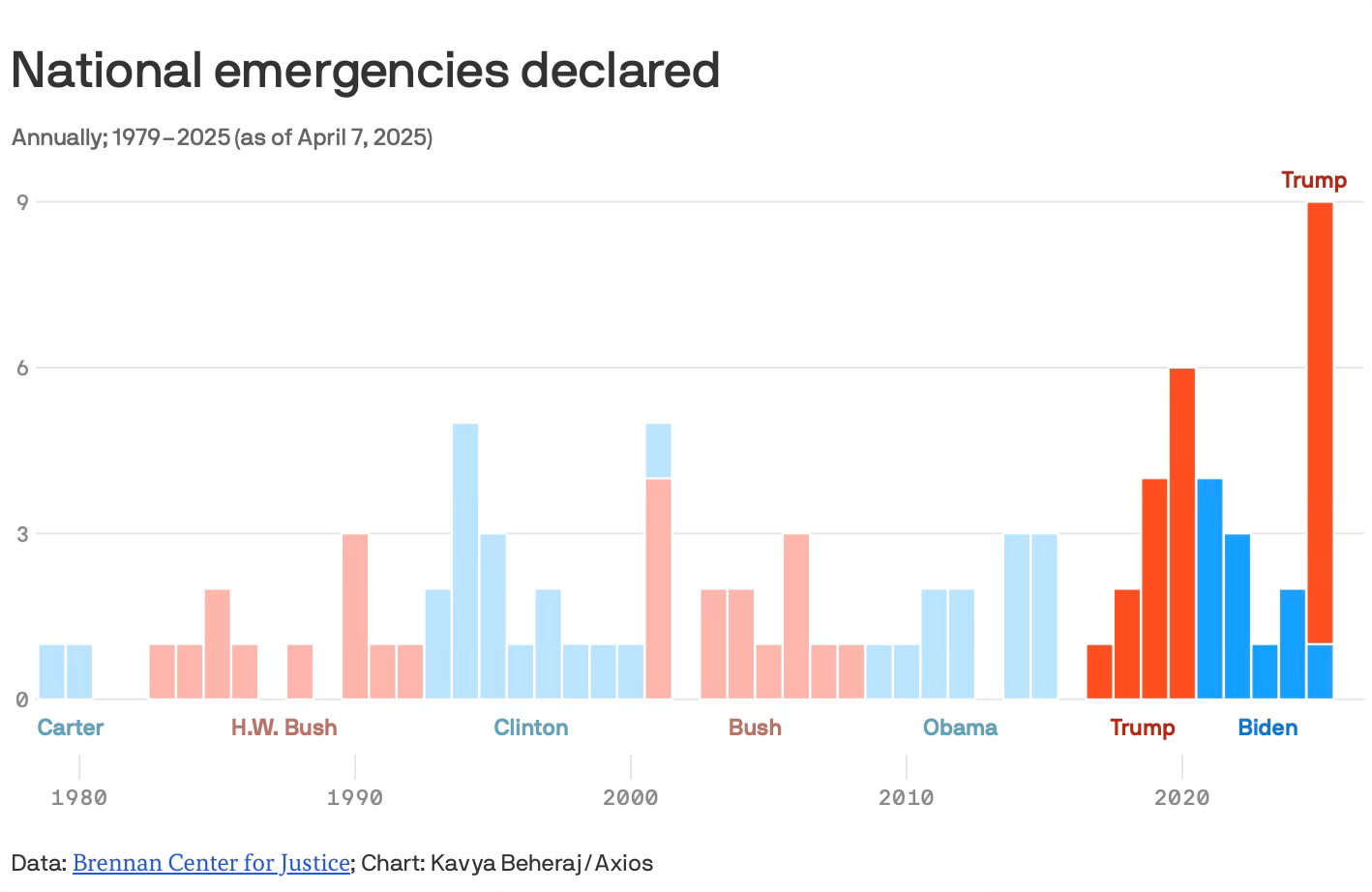
In recent decades, presidents of both parties have used emergency declarations to enhance their freedom of action. Barack Obama declared a dozen emergencies during his eight years in office. Mr. Trump declared 13 in his first presidency, while Joe Biden declared 11.
In only the first few months of his second term, Mr. Trump has declared eight ….
Coincidentally, Paul Dans, muse of Project 2025 (and a misogynist abuser and demeaner), defends Trump’s actions as absolutely necessary to “save America” in the Economist a few days ago. His argument eerily reflects what Linker has identified, but as ipse dixit rather than as the realization of intellectual theories that have been floating around a while.
The fit between Dans’ propaganda and Linker’s explanation adds to my assurance that Linker has nailed it.
One brief thing I want to add here that I don’t explicitly spell out in the op-ed: What’s typically called unitary executive theory is primarily about the president asserting power over the executive branch in a vertical way. Trump’s claim to possess the power to hire and fire executive branch employees as he sees fit, like his denial of their independence from presidential will, can be described as applications of that theory, which has been around since (at least) the Reagan administration.
But Trump has also been seeking to elevate the executive branch over the legislative and judicial branches of the federal government. He’s done this by refusing to enforce the law banning TikTok (which was passed by Congress, signed into law by Joe Biden, and deemed constitutional by a 9-0 Supreme Court decision), by claiming the power to impound congressionally appropriated funds, by defying judicial rules and expressing contempt for federal judges and courts, including when it comes to permitting due process to noncitizens marked for deportation. All of that can be described as a horizontal assertion of power that denies the doctrine of separate co-equal branches of government in favor of executive supremacy. (I’m relying here on a distinction drawn by Jack Goldsmith in his interview with Ross Douthat. I wrote about that interview in a post I published a couple of weeks ago.)
It’s primarily in the latter assertions of power that the tradition I’m writing about in today’s op-ed comes into play. The people I highlight genuinely believe that politics at its peak involves great statesmen looking out at the world, sizing up the situation (often deemed an emergency requiring decisive action), and making singular, unimpeded life-and-death decisions about what it will take to preserve the polity against an existential threat. That’s a justification for absolute executive governance.
I’ve been quoting Jonah Goldberg in my footer for a few months now, but never has it been more apt:
Your enemies are not demonic, and they are not all-powerful and the right hasn’t always lost and the left hasn’t always won. But if you convince yourself of that, you give yourselves all sorts of permission to do a lot of stupid and terrible things under the rubric of “Do you know what time it is?”
I don’t do any of the major social media, but I have two sub-domains of the domain you’re currently reading: (a) You can read most of my reflexive stuff, especially political here. (b) I also post some things on the only social medium I frequent, because people there are quirky, pleasant and real.
I don’t know about your Inbox, but mine tends to fill up especially on Friday. So I’m posting this now rather than in the wee hours tomorrow.
Trump 2.0
I haven’t been able to eliminate sharp criticism of Trump from today’s post because there are too many issues and I’ve read too much that isn’t just “same old same old.” As has become my habit, I’ve posted most of my anti-Trump stuff here.
United States law allows for a quite expedited process to remove people from the country, to deport them. You don’t get a big trial. You don’t get a jury trial. You are moved rapidly because the theory of the case is: First, you don’t have a right to immigrate to the United States, so you have not been deprived of your rights. And secondly, once you’re removed from the United States, you remain a free person. You are sent back to the place you came from or some other place to which you have some connection, and then you’re free to go about your business. You’re not sent to a prison—not sent to a prison for life.
But as I talk about this, the thing that has most gripped my mind with worry and anxiety is not only the effect on the individuals themselves, some of whom may be genuinely innocent, but the effect on those who are sending human beings to a prison without a hearing.
You know, the United States government is now building an apparatus of lawyers, of officials of all kinds, who plan and think every day, How can we apprehend people on American soil and bundle them to a prison without giving them any show of a hearing? They’re building skills and competencies at non-due-process forms of arrest and incarceration that are going to be very hard to limit.
… I remember when I was a Canadian citizen in the United States on a student visa, we were warned if you got into a bar fight, you could theoretically lose your student visa. Now, in those days, that meant that you’d have to go back to Canada and go to school in Canada, which is not the end of the world. In today’s America, that could mean you could lose your student visa and be accused of terrorism, and a bag put over your head and be put into a car and sent to a prison in El Salvador for the rest of your life.
Now, maybe that doesn’t happen in every case. Maybe that doesn’t happen in many cases. But there are people in the employ of the United States government, paid by taxpayers to think about how can we daily broaden the category of people who can be arrested and detained and imprisoned without any showing to any authority at all, without any opportunity to make themselves heard, without any evaluation by an independent fact finder—by any of the things we call due process.
David Frum, introducing a terrific conversation about The Crisis of Due Process with Peter Keisler. (bold added)
Do we really believe in free speech?
Trump 2.0 has been deporting foreign students and others for constitutionally protected speech, using as its current go-to bad-faith excuse that the speech is antisemitic.
The late British-American journalist Christopher Hitchens is a more recent testament to the long tolerance of America toward foreign dissent. Before becoming a U.S. citizen in 2007, Hitchens spent decades as a legal resident—and as one of America’s most acerbic public intellectuals. He accused Ronald Reagan of being “a liar and trickster,” called Israel America’s “chosen surrogate” for “dirty work” and “terrorism,” lambasted Bill Clinton as “almost psychopathically deceitful,” and accused the George W. Bush administration of torture and illegal surveillance. If a student can be deported for writing a campus op-ed critical of Israel, any of Hitchens’ views could have been used to justify deporting him.
This isn’t how our system is supposed to work. When a president does the kinds of things Donald Trump is doing, his popularity should sink so low that Congress will feel empowered to stand up to him. Ideally, they would impeach and remove him from office for attempting to govern like an absolute monarch. Short of that, Congress and the courts would be working in tandem to impose and enforce constraints on the wayward executive until the next election strengthens their hand against him.
But none of this is happening—because our system has broken down. The parties are ideologically sorted, with almost no remaining overlap. And Trump has transformed the GOP into a cult of personality more loyal to him personally than to the Republican Party, the other institutions of American democracy, the law, or the Constitution.
In a situation like this, the only thing preventing the president from transforming himself into a tyrant is his own willingness to do it. The courts can tell him to stop. But will he? If he does, democracy survives, at least for the time being. If he doesn’t, democracy is over, at least until it can be reconstituted at some point in the future.
One should never hope to live through a moment of great political precarity like our own. But one tiny compensation is that such moments bring clarity about certain fundamental matters. How has the United States managed to survive for nearly 250 years without evolving into a dictatorship? The answer really may be this simple: By never electing a man willing to do what it takes to effectuate the change.
It’s not clear that the courts will suffice, but the courts — having already, and deservedly, come to treat the Administration as bad-faith, untrustworthy actors — will provide partial deterrence and may help sway public opinion by the cogency (and sometimes, the tartness) of their reasoning.
[I]f you want a really extraordinary example of that, you would look at the order that the Court issued at 1 a.m. on Saturday morning this last weekend, because even though they had held that everybody has to be given meaningful notice before they could be removed in this way, there was credible evidence that the administration was loading people onto buses without giving them anything like the notice that was required. And the ACLU went to the Supreme Court and said, you know, Please, as you listen to the rest of this case and get briefing, stop this from happening.
And if the administration were a normal administration and had compiled a record so far of being a normal administration, the Court would’ve said, Well, I can be confident they’re not going to do this while we are hearing your petition, so let’s give the government a chance to respond. Let’s see what they say, and then we’ll decide what to do. Because, of course, the government wouldn’t spirit these people away while we are actually in the process of deciding whether it can do so on this emergency application you filed. But they knew that the government had done exactly that with the first 200 or so people they had sent away.
The case was before a district judge, and they rushed to secretly get the people out before he could issue an order. And they didn’t quite succeed on that, which is why you have these issues of contempt floating around now. But at 1 a.m., the Court by a 7–2 vote said, Don’t remove anybody in the class represented by these lawyers until you hear otherwise from us.
And that shows that there is a cost to the administration of acting the way it’s acting towards the courts, because if you squander the reputation that governments of both parties have had for credibility and fair dealing and honest brokering with the Court, then they’re going to treat you different because they know they can’t quite trust you.
The barstool right, which is a genuinely new constituency made up of hedonistic anti-woke libertarians that has replaced the Christian conservatives
The neo-conservative foreign policy hawks, who are the weakest member of the coalition, but can still get what they want on certain issues, as seen with the attacks on the Houthis as well as the saber rattling regarding Greenland
In other words, the Christian influence on actual Republican policy items and their political vision is going to be exceedingly negligible going forward. Sure, Vice President Vance will make an appearance at the March for Life. President Trump will show up to the National Prayer Breakfast. But even when he does acknowledge a Christian event, it often will come loaded with hatred and vile self-aggrandizement, as seen yesterday:
And ultimately when push comes to shove on the policy level, Christian concerns will always be backgrounded or eliminated relative to the priorities of the three above groups, as we have already seen on abortion, marriage, and PEPFAR.
I originally thought to post this on a Sunday, when my focus is narrower, but it didn’t fit there because I don’t value “religion” for its instrumental partisan-political value.
It was a very few years ago when I warned (as had others) “If you don’t like the Religious Right, just wait ‘till you see the irreligious Right.” Well you’ve been seeing them in power for three months now.
Beta-testing tyranny in the Sunshine State
Ron DeSantis walked so that Donald Trump could run. When the time came to formulate a policy response to the woke left, no one mattered more than the governor of Florida.
And through it all, DeSantis declared that Florida was the place where “woke goes to die.”
In his second term, Trump is a scaled-up version of DeSantis. Every element of the DeSantis model has been deployed against Trump’s ideological enemies …
…
At first I was optimistic about the anti-woke right. Their free speech argument resonated with me. I’d spent decades litigating free speech cases, after all, and I’d never really seen anything like a mass movement for free expression.
But my optimism quickly faded. In 2021, the anti-woke right embraced a series of state laws that were designed to ban critical race theory. Rather than meet critical race theorists in the marketplace of ideas, the right chose to try to suppress their expression.
By this time I was familiar with the right’s authoritarian turn — and getting very worried about it. In 2019, parts of the intellectual right were consumed with a fight over liberalism itself, with the new right arguing that liberal values — freedom of speech and free trade, for example — were hollowing out American culture, creating a nation of atomized individuals who were consumed with self-actualization (and consumption itself) at the expense of family and community.
Ironically, the left, now alarmed by the federal government’s intrusive reach [into, say, Harvard], bears direct responsibility for crafting the very legal weapons wielded against the universities it dominates. Almost four decades ago, progressive legislators demanded sweeping amendments to civil rights law, expanding federal oversight over higher education. The sequence of events reveals a cautionary tale of political hubris: progressive confidence that state power would reliably serve their ends overlooked the reality that governmental authority, once unleashed, recognizes no ideological master. Today’s circumstances starkly illustrate how expansive federal control over civil society, originally celebrated by progressives, returns to haunt its architects. The left’s outrage ought to focus not on this particular administration but on its own reckless empowerment of the state.
Yet for all its courage, Harvard’s response stopped short of making the argument that would best protect the values for which it was fighting. It defended the university’s independence without explaining why that independence deserves protection. It invoked values like “pluralism” and “inquiry,” but it did not fully explain why those values are essential to a liberal democratic society. The letter therefore missed an opportunity to articulate what a university is for — not just to students or donors, but to the country. And this matters, because Trump’s attack against this and other universities is not only about the balance of power between universities and the government. It is, at bottom, about the legitimacy of higher education as a public good.
The danger of being a professional exposer of the bogus is that, encountering it so often, one may come in time to cease to believe in the reality it counterfeits.
Your enemies are not demonic, and they are not all-powerful and the right hasn’t always lost and the left hasn’t always won. But if you convince yourself of that, you give yourselves all sorts of permission to do a lot of stupid and terrible things under the rubric of “Do you know what time it is?”
Regarding said “lot of stupid and terrible things,” my failure to call out anything about the current regime does not mean I approve. There’s just too much, and on some of the apparent illegalities I don’t want to abuse my credentials without thinking it through.
I don’t do any of the major social media, but I have two sub-domains of the domain you’re currently reading: (a) You can read most of my reflexive stuff, especially political here. (b) I also post some things on the only social medium I frequent, because people there are quirky, pleasant and real.
I can take a virtual tour of the Forbidden City in Beijing, or of the deepest underwater caverns, nearly as easily as I glance across the room. Every foreign wonder, hidden place, and obscure subculture is immediately available to my idle curiosity; they are lumped together into a uniform distancelessness that revolves around me. But where am I? There doesn’t seem to be any nonarbitrary basis on which I can draw a horizon around myself—a zone of relevance—by which I might take my bearings and get oriented. When the axis of closer-to-me and farther-from-me is collapsed, I can be anywhere, and find that I am rarely in any place in particular.
Matthew B. Crawford, The World Beyond Your Head
When I point at you, three fingers point back at me. Maybe this is why I so enjoy occasional travel, when devices and books stay home or in the hotel, and I go out on foot in some particular place.
Trump 2.0
I’m going to try to stop posting bilious attacks on Trump, however well-justified they may be — even in separate postings with trigger warnings. Apart from stopping the flood of illegal immigrants across the southern border and his impetuous pledge to end Daylight Savings Time (on which he has done nothing yet), you may take for granted that I detest all of his performative cruelty and protection-racket stunts.
But there are non-bilious things related to our current mess — typically context or gentler humor — that I’ll continue to share under the rubric “Trump 2.0.” If you don’t want to ready anything about it, although I think I curate some pretty good stuff, you can stop now because that’s all the rest of this post is about.
The due process situation
Due Process
Gessen: … For the record, while it’s very important to tell the stories of individuals subjected to injustice, it makes me uncomfortable when we focus on the man who had protected status, or the Venezuelan gay makeup artist, or the young barber, who were on those planes to El Salvador — when in fact every single man who was on those planes was put there without due process and is now confined to a prison, indefinitely …
French: I’m so glad Masha said that. Violations of due process are not unjust only when inflicted on the innocent. The Fifth and 14th Amendment due process protections apply to any “person” in the United States, not just to citizens or certainly not just to the innocent. Indeed, due process is how we try to discern guilt or innocence. Like Masha, I fear that by focusing on the terrible individual injustices, we might (perversely enough) send the message that a due process violation is only a problem when it inflicts harm on the innocent. Due process is a fundamental human right.
I’m not a violent man, but glibly dismissing due process because these are just a bunch of criminals and gang-bangers pushes many of the wrong buttons.
Rigorous vetting of Venezuelan gang members
“Here’s an example of the ‘rigorous vetting’ of gang membership that the Trump admin claims it’s doing: A woman admitted that her dead ex-husband, who she left 10 years ago, had been a TdA member. From that — and nothing more! — ICE declared she ‘is a senior member of the TDA,’” – Aaron Reichlin-Melnick.
“A friend of Neri Alvarado, currently rotting in a Salvadoran prison on Trump’s orders, shares a video of him volunteering to help neurodiverse children learn to swim. Neri was seemingly sent there after someone at ICE thought his autism awareness tattoo was a ‘gang tattoo,’” – Reichlin-Melnick.
“This is a terrible, terrible affidavit. If this were before me in a criminal case and you were asking to get a warrant issued on this, I’d throw you out of my chambers,” – Leonie Brinkema, a judge responding to ICE’s “evidence” of TdA membership.
Do not change the topic. Do not assume that Trump’s victims are all violent criminals.
The topic is the lack of due process. Absent due process, I won’t give Trump 2.0 the benefit of the doubt about how bad the desaparecidos are. Due process is how the government avoids jumping to conclusions, and how the public is persuaded that it didn’t. Absent due process, I will assume (as some have reported) that people are being grabbed off the street and sent to offshore hell-holes on less-than-flimsy “evidence” like ambiguous tattoos or wearing too-nice clothes.
This and the attacks on the rule of law by attacking law firms are my biggest concerns so far.
It makes me queasy to think that I have, in my extended family, individuals who have turned themselves into trolls over the last nine years and would defend this. (The defense would include name-dropping Laken Riley, of course. She’s barely even a genuine murder victim any more; her mere name is the snake oil that fortifies xenophobia.)
Be it remembered
Of course, the Department of Homeland Security, when it was created in the wake of 9/11, was meant to function in opaque ways and with broad authority; it was designed to be a secret-police force.
Not only was it so designed, there were a few voices loudly warning us.
Tariffs
Why tariffs will fail us (spoiler: an acrostic for the answer is “DJT”)
[R]ebuilding industry in America has two potential benefits even if it sacrifices some of the efficiencies offered by global trade. Factory jobs fill a particular socioeconomic niche that’s been filled instead by drugs, decline, despair. And having a real manufacturing base is essential if we’re going to be locked into great power competition for decades to come.
Under this theory, though, it would seem like tariffs would be most effectively deployed against China, countries in China’s immediate economic orbit, and developing countries that are natural zones for outsourcing. But the Trump administration has deployed them generally, against peer economies and allies. The policy seems much more sweeping than the goal, the potential damage to both growth and basic international comity too large to justify the upside.
With all due respect to Ross, the problem is deeper than mis-targeting:
Donald Trump had a plan. It was not a good plan, or even a plausible one. But it was, at least, a coherent plan: By imposing large trade barriers on the entire world, he would create an incentive for American business to manufacture and grow all the goods the country previously imported.
Whatever chance this plan had to succeed is already over.
The key to making it work was to convince businesses that the new arrangement is durable. Nobody is going to invest in building new factories in the United States to create goods that until last week could be imported more cheaply unless they’re certain that the tariffs making the domestic version more competitive will stay in place. (They’re probably not going to do it anyway, in part because they don’t know who will be president in four years, but the point is that confidence in durable tariffs is a necessary condition.)
Trump’s aides grasped this dynamic. “This is the great onshoring, the great reshoring of American jobs and wealth,” Stephen Miller, Trump’s deputy chief of staff, declared on “Liberation Day.” The White House accordingly circulated talking points instructing its surrogates not to call the tariffs a leverage play to make deals, but to instead describe them as a permanent new feature of the global economy.
But not everybody got the idea. Eric Trump tweeted, “I wouldn’t want to be the last country that tries to negotiate a trade deal with @realDonaldTrump. The first to negotiate will win – the last will absolutely lose.”
Eric’s father apparently didn’t get the memo either. Asked by reporters whether he planned to negotiate the tariff rates, the president said, “The tariffs give us great power to negotiate. They always have.”
Someone seems to have then told Trump that this stance would paralyze business investment, because he reversed course immediately, writing on Truth Social, “TO THE MANY INVESTORS COMING INTO THE UNITED STATES AND INVESTING MASSIVE AMOUNTS OF MONEY, MY POLICIES WILL NEVER CHANGE.”
However, there is a principle at work here called “No backsies.” Once you’ve said you might negotiate the tariffs, nobody is going to believe you when you change your mind and say you’ll never negotiate.
Jonathan Chait. It’s a long quote, but I don’t know that anyone could have made it so vivid in fewer words.
Miscellany
The Dispatch downside
The only thing I dislike about working for The Dispatch is that I’m forbidden from using profanity, and even that barely qualifies as a complaint. “No swearing” is the lightest of burdens for a writer.
But it’s getting heavier every day.
On Tuesday, a.k.a. “liberation” eve, the president addressed an upcoming vote in the Senate to block some of his tariffs on Canada. Don’t do it, he warned Republicans. Americans will die if you do. Fentanyl is being brought into the country across the northern border, after all, and one way to discourage people from using it is, and I quote, “by Tariffing the value of this horrible and deadly drug in order to make it more costly to distribute and buy.”
The guy who just touched off a global trade war appears to believe that drug smuggling is taxed. How do you do justice to that without cursing?
… If you’re not moved to curse a blue streak by the thought of Laura Loomer arguing with the national security adviser in the Oval Office over whether his intelligence deputies are sufficiently “loyal” to the president, you’re well and truly boiled.
So if I oppose the tariffs, I love fentanyl? (And probably hate Laken Riley to boot.)
The Pax American is dead. And Marco Rubio is cheering.
The most poignant comment I’ve seen about the president’s groin-punch to the U.S. economy came from his secretary of state. During a visit to NATO headquarters in Brussels on Friday, Marco Rubio told reporters, “We’re not the government of the world now.”
He said it triumphantly, I assume, which is part of what makes it poignant. In an alternate universe where ambition hasn’t rotted his brain, Sen. Marco Rubio is saying the same thing today, verbatim, about the first two-and-a-half months of Donald Trump’s second presidency. But his tone is entirely different.
Being the government of the world worked out okay for America, not to mention the world. Rubio circa 2016 would have been eloquent on that point. But he chose instead to be a cymbal-banging monkey for Trump, so now he’s required to say inane things about the nationalist virtues of immense wealth destruction.
America has always been at war with its darker nature, and sometimes that darker nature wins. We are living in a period of profound national regression.
I suspect historians will one day remember the Department of Government Efficiency the way we now remember lobotomies. It seemed, to some at the time, like a good idea.
I don’t do any of the major social media, but I have two sub-domains of the domain you’re currently reading: (a) You can read most of my reflexive stuff, especially political here. (b) I also post some things on the only social medium I frequent, because people there are quirky, pleasant and real.
“Fascist” slightly misses the mark. M. Gessen hits a bulls-eye:
Unmarked Vans. Secret Lists. Public Denunciations. Our Police State Has Arrived.
The 4chan White House Communications Office
Beyond the fact that this kind of shitposting is so obviously beneath the office, the posts are genuinely sinister. By adding a photo of an ICE arrest to a light-hearted viral trend, for instance, the White House account manages to perfectly capture the sociopathic, fascistic tone of ironic detachment and glee of the internet’s darkest corners and most malignant trolls. The official X account of the White House isn’t just full of low-rent 4chan musings, it’s an alarming signal of an administration that’s fluent in internet extremism and seemingly dedicated to pursuing its casual cruelty as a chief political export.
…
And the posters have goals. The first is to engage and supply their loyal audiences with constant memes and content. The second is perhaps more strategic. The account’s blatant humiliation of immigrants who it alleges have heinous criminal records is intentional. The goal is to goad their opponents into defending people accused of indefensible crimes. The primary accusation from the MAGA faithful toward people who are outraged about the White House’s Studio Ghibli post or the ASMR video is that the left is more concerned with defending fentanyl dealers and immigrants accused of rape and robbery than they are about the safety of the country. “Disappointing that folks are more upset about this meme than they are about the fentanyl crisis,” Dorr said in the same post that the White House pointed me to. But this is a false binary; in all cases, the chief objections are to the dehumanization and glee on display and the worrying lack of due process.
Aspiring Dominatrix-in-Chief Kristi Noem added a $50,000 Rolex to the dehumanization.
Feeling like Abraham
The America I’ve known for all my life is gone. I don’t think it will be back in my lifetime.
I’m not going to complain about God allowing this to happen; I suspect that something like it needed to happen and I trust that my morning prayer for the nation, “Let your judgment be merciful,” is somehow being answered.
But it may be that the merciful thing in the long-term feels very harsh in the moment (and that’s the perception of a citizen who’s relatively safe; imagine the immigrants among us!).
And part of the background thrum that makes the moment unnerving is my concern that the Democrats might do no better.
It feels like an Abraham moment: “Get thee up into a land I will show thee.” No map.
I suffer more from the humiliations inflicted by my country than from those inflicted on her.
I don’t do any of the major social media, but I have two sub-domains of the domain you’re currently reading: (a) You can read most of my reflexive stuff, especially political here. (b) I also post some things on the only social medium I frequent, because people there are quirky, pleasant and real.
Yes, it’s been a big beautiful opener from MAGA 2.0., hasn’t it?
In all fairness, let’s start with a real, substantive achievement. The Southern border is more secure than it has been in decades. Biden helped a lot with his belated executive orders, but reinstating Remain in Mexico and ending largely fraudulent asylum claims have been even more effective. In February 2024, Border Patrol picked up some 140,641 migrants between legal ports of entry; this February, it was 8,347. Huge success. And proof that previous administrations actively chose to keep the border open.
But the rest is chaos, malice, revenge, and failure, tinged with levels of indecency never before seen from the Oval Office.
…
The disaster this week with Mike Waltz’s astonishingly reckless Signal messaging brings it all together. This is a crew of bigots, sycophants, Fox News drunks and bimbos, Hollywood loonies, Claremont nutters, and uber-online edge-lords cosplaying as statesmen. But they aren’t even faintly serious — as Russia and China now fully understand. And their response to being found out was classic Trump: lie, lie, lie and call journalists scum. By any objective standard, this is a clown car.
“If I’m such a nefarious character, why am I in Mike Waltz’s phone?” – Jeff Goldberg.
“So President Trump is ‘using war authorities’ in the absence of a declared war when he deports Venezuelans, but it’s not ‘war plans’ (just ‘attack plans’) to bomb the Houthis because there is no declared war,” – Ed Whelan.
“This is dystopian. The government does not even allege this woman played a major role in the pro-Palestine protests, like Khalil did. And yet they’re trying to expel her to South Korea, where she hasn’t lived since she was 7. I don’t see how anyone can defend this. It’s un-American,” – Billy Binion on a 21-year-old college senior who’s had a green card since age 7.
Why are these firms being targeted, and what does Trump hope to get out of this campaign? In the Paul Weiss EO, the government alleges that “global law firms,” as Trump pejoratively calls them, have been involved in “the destruction of bedrock American principles.” They have played a large role in “undermining the judicial process” and engaging in “activities that make our communities less safe, increase burdens on local businesses, limit constitutional freedoms, and degrade the quality of American elections.”
But what’s really going on here, quite obviously, is that these firms have attempted to fight Trump and have represented clients Trump and his voters disapprove of. That is hardly a sin; representing an unpopular client is essential to any fair system. But Trump and his allies don’t want a fair system; they want a system reminiscent of China’s or Russia’s, that scares lawyers away from these clients and disables their opponents from bringing legal challenges against their efforts to rule by executive fiat. Already, some firms are receding from the fight against Trump, declining to represent those who oppose him.
…
Taken as a whole, this attack on law firms is nothing short of an assault on the very idea of an independent legal profession. For years, the profession has had a set of overarching principles that are thought to guide its members’ conduct. Among them: Clients should be able to hire whom they wish without worrying about government retribution, and lawyers should be free to zealously represent their clients without the threat of government retaliation. To say otherwise is to betray the fundamental value of fairness that undergirds our justice system. Trump’s actions are an attempt, bluntly speaking, to tilt the scales of justice by using the raw power of government coercion.
If you can’t get a lawyer to take a case against the administration, it doesn’t matter that the courts would have ruled for you.
DARVO
Standard protocol for the president and his minions when doing damage control is DARVO: Deny, Attack, Reverse Victim and Offender. That’s the playbook Hegseth used on Monday (see for yourself) when reporters confronted him about Goldberg’s story, and no wonder. He learned during his confirmation ordeal that the trick to getting Trump and Trumpists firmly on your side is to start throwing roundhouses at their enemies, irrespective of the facts.
If you elect a criminal who values loyalty above competence; if you confirm an unqualified nominee to lead the military because you’re too cowardly to oppose him; if you incentivize ruthlessness in your leaders by refusing to hold them accountable for failures, you’re handing public policy over to clowns.
The most interesting thing about the behavior here of Mike Waltz and Pete Hegseth is that they’re both smart, capable men. Waltz was a colonel in the special forces; Hegseth is an Ivy League grad who served honorably in the military. Removed from the circus culture in which they now operate, I suspect both would recognize instantly how reckless it is to conduct sensitive national security business in an insecure forum.
This failure isn’t a matter of stupidity, in other words, it’s a matter of corruption. Waltz and Hegseth knew that Trump wouldn’t care how securely or insecurely they behaved (I mean, really) and in a pseudo-autocratic operation like this one that’s the only relevant political consideration. Obviously, they would have thought differently if they knew Jeffrey Goldberg would end up on the thread, but that’s a question of getting caught, not a question of behaving responsibly. They assumed they had the president’s approval; that’s all that mattered.
That logic will bite us in worse ways than this before this presidency is done.
I don’t do any of the major social media, but I have two sub-domains of the domain you’re currently reading: (a) You can read most of my reflexive stuff, especially political here. (b) I also post some things on the only social medium I frequent, because people there are quirky, pleasant and real.
I won’t waste my time or yours weighing in on what has predictably been labeled “Signalgate” except to note that Trump, Gabbard and Hegseth are all trying to brazen it out with transparent lies.
Most chilling of all
The ochre emperor, having figured out that he cannot control life-tenured federal judges, has taken to kidnapping law firms, negotiating ransoms that include not taking any cases he doesn’t like.
Courts decide cases. They don’t inject themselves unbidden into the affairs of the Executive and Legislative branches. If Trump’s kidnappings work (and so far they have worked pretty well), don’t trust the courts to keep him in line because people won’t be able to get law firms to represent them against the Administration’s already-lawless behaviors.
Earlier this month, President Donald Trump delivered a speech in the Great Hall of the Justice Department. But he did not laud the impartial application of the law, as past presidents have done in the staid space. Instead, he took the opportunity to signal some score-settling against the lawyers involved in legal challenges against him.
“They spied on my campaign; launched one hoax and disinformation operation after another; broke the law on a colossal scale; persecuted my family, staff, and supporters; raided my home, Mar-a-Lago; and did everything within their power to prevent me from becoming the president of the United States,” Trump said, referencing his past campaigns and some of the criminal and civil cases brought against him. He went on to single out several lawyers allegedly involved in the scheme by name, including “radicals like Marc Elias, Mark Pomerantz” and “scum” like “Andrew Weissmann, deranged Jack Smith.”
As of Tuesday, each of those attorneys has something else in common: They all have current or former ties to law firms now in Trump’s crosshairs. Over the last month, Trump has threatened four law firms in what appears to be a broader campaign of intimidation directed at the legal profession. Coinciding with the administration’s recent attacks on judges, legal scholars fear the moves could represent a serious threat to the independence of the bar and the ability of individuals to effectively challenge the government in court.
You’d think that BigLaw could stand up and fight, but it’s a dog-eat-dog world out there, and Paul Weiss found the other dogs trying to poach their top lawyers and clients rather than offering help. That’s why they felt they had to pay Trump’s ransom demand.
Let me get this straight …
Donald Trump is, as he will tell you, the world’s greatest negotiator, and he feels the need to renegotiate the existing U.S.-Canada trade deal, which was negotiated by an utter incompetent: Donald Trump, whose administration oversaw the replacement of NAFTA by the (rather lightly modified) USMCA the last time he was president. And now Canadians have learned what banks, investors, vendors, small business partners, wives, ex-wives, and pornographic performers rapidly approaching their expiration dates have all learned over the years: If you think you have a deal with Donald Trump, you are a fool.
[T]he tone was a diatribe, the kind of ill-informed, red-meat rant Tucker Carlson honed throughout the first Trump administration every weeknight in prime time on Fox News: Come out of gate with guns blazing and never relent. Concede nothing to any less severe view of the topic. Reject any form of nuance. Illustrate the absolute truth of one’s position by giving a handful of outrageous-sounding anecdotes cherry-picked to demonstrate the absurdity of holding any other position.
On that day three years ago, it took Vance exactly 40 seconds to declare how important it was for conservatives like himself to “honestly and aggressively attack the universities in this country”—just as it took just a few weeks for the second Trump administration to follow through on precisely this agenda.
Damon Linker. I quote it because the bolded part is the Trump style, which he learned from the infamous Roy Cohn. That’s why you dare not rely on anything anyone in this administration says.
More:
I know enough about what goes on in the country’s universities to recognize that the right-wing thugs currently running the executive branch and taking a baseball bat to higher education are utterly full of shit. They are poised to do an immense amount of damage to something valuable and good. And much of the broader public appears not to care—in no small part because of the incendiary lies the ideological propagandists behind the MAGA movement have been propagating for years. I won’t say they must be stopped, because I don’t know if they can be stopped. Still, it’s important we recognize exactly what they’re doing and the price our country and our world are going to end up paying for their destructive zealotry.
Of course a narcissist would feel this way
I believe that CNN and MS-DNC, who literally write 97.6 percent bad about me, are political arms of the Democrat Party and in my opinion, they’re really corrupt and they’re illegal, what they do is illegal, … And it has to stop, it has to be illegal, it’s influencing judges and it’s really changing law, and it just cannot be legal. I don’t believe it’s legal, and they do it in total coordination with each other.
I don’t do any of the major social media, but I have two sub-domains of the domain you’re currently reading: (a) You can read most of my reflexive stuff, especially political here. (b) I also post some things on the only social medium I frequent, because people there are quirky, pleasant and real.
President Trump does not seem to notice or care that if you betray people, or jerk them around, they will revile you. Over the last few weeks, the Europeans have gone from shock to bewilderment to revulsion. This period was for them what 9/11 was for us — the stripping away of illusions, the exposure of an existential threat. The Europeans have realized that America, the nation they thought was their friend, is actually a rogue superpower.
In Canada and Mexico you now win popularity by treating America as your foe. Over the next few years, I predict, Trump will cut a deal with China, doing to Taiwan some version of what he has already done to Ukraine — betray the little guy to suck up to the big guy. Nations across Asia will come to the same conclusion the Europeans have already reached: America is a Judas.
This is not just a Trump problem; America’s whole reputation is shot. I don’t care if Abraham Lincoln himself walked into the White House in 2029, no foreign leader can responsibly trust a nation that is perpetually four years away from electing another authoritarian nihilist.
An anti-constitutional act is one that rejects the basic premises of constitutionalism. It rejects the premise that sovereignty lies with the people, that ours is a government of limited and enumerated powers and that the officers of that government are bound by law.
The new president has, in just the first two months of his second term, performed a number of illegal and unconstitutional acts. But the defining attribute of his administration thus far is its anti-constitutional orientation. Both of its most aggressive and far-reaching efforts — the impoundment of billions of dollars in congressionally authorized spending and the attempt to realize the president’s promise of mass deportation — rest on fundamentally anti-constitutional assertions of executive authority.
…
There is much to say about the administration’s decision to seemingly ignore a court order to halt or reroute deportation flights for these people and return them to United States. For now, let’s focus on the Justice Department’s initial defense of the president’s order, in which government lawyers argued the following: “Beyond the statute, the President’s inherent Article II authority is plainly violated by the district court’s order. As a function of his inherent Article II authority to protect the nation, the President may determine that [Tren de Aragua, a criminal gang] represents a significant risk to the United States … and that its members should be summarily removed from this country as part of that threat.”
In other words, according to the Justice Department, the president of the United States has an “inherent” power to summarily deport any accused member of Tren de Aragua (and presumably, any foreign national accused of membership in any gang) without so much as a hearing. What’s more, under this logic, the president can then direct his administration to send that person, without due process, to prison in a foreign country.
This is a claim of sovereign authority. This is a claim that the president has the power to declare a state of exception around a group of people and expel them from the nation — no questions asked. It is anti-constitutional — a negation of the right to be free, in Locke’s words, of “the inconstant, uncertain, unknown, arbitrary will of another man.”
There is nothing in this vision of presidential power that limits it to foreign nationals. Who is to say, under the logic of the Department of Justice, that the president could not do the same to a citizen?
If Congressional Republicans took their oaths of office seriously, they’d be impeaching Trump and removing him from office. He has already destroyed many of our most important international relationships (see David Brooks, above), and by “destroyed,” I mean that we face a long period of repair even if he were removed this afternoon.
Dems and Damon in the same headspace?
[M]y assumptions and style of analysis bring me back again and again to a feeling of fatalism rooted in the conviction that the time to stop Trump was in November 2016, in the immediate aftermath of the January 6 insurrection (via conviction in his second impeachment trial), or in November 2024. I don’t want to succumb to the feeling that it’s already too late to stop him. It’s just that I’m still trying to figure out how to break out of that cul-de-sac.
To collapse the structure of American justice and replace it with a proper banana republic, each pillar holding it up needs to be weakened.
The president spent most of his first two months in office focused on a single pillar: law enforcement. He purged officials at the Justice Department and FBI and replaced them with clownish toadies like Pam Bondi, Kash Patel, and Dan Bongino. That was a sensible way for an authoritarian to prioritize: Of the institutional players I’ve mentioned, corrupt cops and prosecutors can do the most damage. As long as the DOJ is willing to behave like a secret police force, Donald Trump doesn’t need to send Liz Cheney or Mark Milley to prison to make their lives miserable. Investigations are punishment enough.
His Castro-esque speech on Friday to Justice Department officials reflected his priorities. The president labeled political enemies like former special counsel Jack Smith “scum,” claimed that CNN and MSNBC are behaving “illegally” somehow, babbled about the supposedly rigged 2020 election, and insisted that the January 6 defendants he pardoned were “grossly mistreated.” The speech ended with the song “YMCA,” as you might hear at one of his political rallies.
Watching it felt like watching a dog mark his territory.
I may not have said this before: Trump’s shock and awe assault on norms, perceived enemies, constitutional limitations and the independence of “independent agencies” are so comprehensive, and so blur together in news coverage, that I couldn’t keep up, and couldn’t cogently predict which actions will ultimately be found unlawful, even if I tried.
And I’m trying not to try.
Oh, I still listen to legal podcasts, and they typically cover some of the cases brewing. If you get an opinion from me on a case, I’ll probably be regurgitating some of them, lightly post-processed.
I don’t feel responsible for Trump. He’s something I’m suffering along with everyone else — and my situation means I’m not personally suffering all that much except anxiety for my living descendants.
I don’t think Trump is the eventuality of true conservatism, though he may be the eventuality of the Moral Majority and other Religious Right activism starting in the 70s. I was never on board with them; I’m even less on board with them since becoming an Orthodox Christian; and I’m pleased to contemplate a knife fight between the New, Improved Religious Right (The New Apostolic Reformation! All you loved about the Moral Majority, but now with added Charismatic flakery!) and the Catholic Integralist “Common Good Constitutionalism.”
(Thoughts prompted by my deciding not to read a Wall Street Journal article on a Federal District court ruling against the demolition of USAID.)
Inflicting trauma
Russell Vought, a graduate of Wheaton College, now describes himself as a “Christian nationalist.” He also says:
“We want the bureaucrats to be traumatically affected,” he said. “When they wake up in the morning, we want them to not want to go to work because they are increasingly viewed as the villains. We want their funding to be shut down so that the EPA can’t do all of the rules against our energy industry because they have no bandwidth financially to do so.
“We want to put them in trauma.”
He may be a nationalist, but he puts his Christianity open to serious question by such hateful intentions. (Mark 8:36.) He’s rather unpopular at Wheaton, too, which is much to its credit.
Free speech lies
The president brags about ‘ending censorship’ while describing negative coverage about him as ‘illegal.’
I don’t do any of the major social media, but I have two sub-domains of the domain you’re currently reading: (a) You can read most of my reflexive stuff, especially political here. (b) I also post some things on the only social medium I frequent, because people there are quirky, pleasant and real.
[I] n The New Yorker, Ruth Marcus, who recently resigned from The Washington Post, explained that she and other columnists were confused by the Post owner Jeff Bezos’ new edict that the Opinions section write only in favor of “personal liberties and free markets”: “Without further clarification, we were like dogs that had been fitted with shock collars but had no clue where the invisible fence was.” (Susan Casey, Palm City, Fla.)
After a federal judge blocked the Trump administration’s effort to stop $2 billion in foreign-aid spending, Justice Amy Coney Barrett joined with Chief Justice John Roberts and all three Democratic-appointed justices to leave that order in place. The decision provoked a fiery and warranted dissent from Justice Samuel Alito, as well as some bitter complaints about Barrett from the right-leaning commentariat. It is understandable that conservatives might be nervous about the Supreme Court. For good reason, the names “Stevens,” “Souter,” “Kennedy,” and “O’Connor” echo eerily in the originalist mind. But while she was wrong in this particular case, there is no evidence that Barrett is at risk of joining their ranks. She concurred in Dobbs, the case that overturned Roe; in Students for Fair Admissions, Inc., the case that barred affirmative action; and in Bruen, the case that expanded the protections of the Second Amendment. More important than those outcomes is how she did so. Unlike the judicial nomads of the past, Barrett has a transparent and well-considered approach to the law that explains her actions even when she disappoints. In the case that prompted the criticisms, she was likely motivated by her mistrust of the shadow docket and her dislike of big cases built atop disputed facts. To conclude from this that Barrett was “a mistake”—or, worse, “a DEI hire”—is absurd. Judges are not supposed to play for a team.
National Review email for 3/14/25
Meritocracy is the death of noblesse oblige
In some ways, we’ve just reestablished the old hierarchy rooted in wealth and social status—only the new elites possess greater hubris, because they believe that their status has been won by hard work and talent rather than by birth. The sense that they “deserve” their success for having earned it can make them feel more entitled to the fruits of it, and less called to the spirit of noblesse oblige.
I’ve shunned Bitcoin as an investment because it’s useless other than for criming and speculation.
I’ve always shunned gold for similar reasons. Its industrial and jewelry uses are not the reason for it rising to more than $3,000 per troy ounce.
Regarding this Presidency
Trump censorship worse than cancel culture
I’ve been relegating most of my bile toward Trump and his goons to another blog, referenced in the footer below, but this is so patently un-American that it needs the widest exposure I can give it:
[T]his is not about protection from woke professors or ideologically captured deans. It’s protection from direct surveillance by the federal government. The Trump administration has launched a massive, all-of-government, AI-assisted program called “Catch and Revoke,” which will scan every social media comment and anything online they can use to flush out any noncitizen who might be seen as anti-Semitic or anti-Zionist or anti-Israel or indeed just getting on Marco Rubio’s wrong side.
Mahmoud Khalil, a green card holder, has not been accused of a crime. And that is the point. …
…
JD Vance — who lectured Europeans on free speech online, while his own administration was using AI to police the web for dissent! — said on Fox that a green card holder “doesn’t have an indefinite right to stay in America.”
In a Feb. 6 editorial, [Purdue] Exponent editors wrote: “And don’t get it twisted: When letters of visa revocation arrive in these students’ mailboxes and federal agents come to Purdue’s campus, no distinction will be made between ‘pro-jihadist’ and pro-Palestinian. Pro-ceasefire will continue to be conflated with ‘antisemitic.’ Anti-war can only now mean ‘pro-Hamas.’ Such twisting of language to be used as a weapon is contrary to the First Amendment, which gives the Exponent its right to exist just as much as it gives the right to students to protest as they see fit. It is the opinion of the Exponent that standing back while our website is potentially used to identify the state’s enemies would be directly against those principles.”
The statute cited by the Trump administration for expelling Khalil is very broad — and vague. I don’t think it will be struck down in its entirety, but surely permanent residents are entitled to know with some clarity what behaviors could get them kicked out of the country.
So I think the likeliest outcome is “unconstitutional as applied” to Khalil.
Living in fear
I spoke on Thursday to a university president who told me he was just advised to hire a bodyguard. He said he’d never seen so much fear in the world of higher education — that many college presidents are “scared to death” about the Trump administration cutting their funding, Elon Musk unleashing Twitter mobs on them, ICE agents coming on campus, angry email flooding their inboxes, student protests over Gaza and Israel, and worries about being targeted for violence. I was a higher education reporter two decades ago, when universities were widely admired in America, and so I asked this president — what went wrong?
He said presidents and professors had taken too many things for granted — they thought they’d always be seen as a “public good” benefiting society, but came to be seen as elitist and condescending toward regular Americans. And Americans hate a lot of things, but they really hate elites condescending to them. Now we are seeing a big reckoning for higher education — ideological, cultural, financial — driven by Donald Trump and the right.
Patrick Healy, introducing a conversation with M. Gessen, Tressie McMillan Cottom and Bret Stephens.
Just sayin’
Narcissism has a very high correlation with conspicuous consumption in an effort to boost social status and self-esteem. Narcissists are focused on the symbolic, rather than functional, importance of commodities, and the symbolism of the products they purchase is often used to compensate for fragile egos and fluctuating self-esteem.
As I have said any number of times, I have voted for the American Solidarity Party in each of the last three election cycles. But in the 2024 election, I was beginning to feel some sympathy for the people who thought Trump was less bad than Kamala Harris in the forced binary choice too many voters feel.
I no longer have any sympathy for that position, although I’m obviously working with the benefit of hindsight: Ready, Fire, Aim — over and over again ad infinitum. This is no way to run anything, quite apart from the autocracy.
I suffer more from the humiliations inflicted by my country than from those inflicted on her.
I don’t do any of the major social media, but I have two sub-domains of the domain you’re currently reading: (a) You can read most of my reflexive stuff, especially political here. (b) I also post some things on the only social medium I frequent, because people there are quirky, pleasant and real.


 Tipsy Teetotaler ن