Saturday, 11/29/25

As December impends, we have our first substantial snowfall of the year in my fair city. I am belatedly thankful for snow blowers.

Right Relativism

Jonah Goldberg, who I don’t read that often, grabbed my attention with the title of his Thanksgiving Day post: The Truth, the Whole Truth, Everything but the Truth. It was good enough for promotion to my lead item today.

Just one little snip:

It’s amazing to me how many people on the right can (rightly!) denounce the 1619 Project … but yawn at the … tendentious denunciations of the American regime by conservative intellectuals and various “influencers.” As shoddy as the 1619 Project was, it was vastly more serious and grounded in facts than “the Jews did Pearl Harbor” or the idea peddled on Carlson’s show that the Holocaust was an accident of poor planning by the Nazis.

When I was in university, Saul Alinsky didn’t come to my attention (neither did Foucault, Derrida and other figures now widely blamed for various ills). But some on the right, tired of losing and convinced that the Left’s tactics were giving them victories, have now embraced Alinsky for their own purposes. For instance:

We have successfully frozen their brand—”critical race theory”—into the public conversation and are steadily driving up negative perceptions. We will eventually turn it toxic, as we put all of the various cultural insanities under that brand category.

That’s “national conservative” Alinskyite Christopher Rufo, boasting in 2021. He’s my personal “Exhibit A” in indicting the Right. Compare Alinsky (via Goldberg):

“Pick the target, freeze it, personalize it, and polarize it,” and “Ridicule is man’s most potent weapon. It is almost impossible to counterattack ridicule. Also it infuriates the opposition, who then react to your advantage.”

I didn’t recognize the echo of Alinsky when I first read Rufo’s Tweet back in ’21, but I knew immediately that Rufo was being dishonest and thus was not my idea of a conservative. (Yeah, I guess I’m one of those “beautiful losers.”) He still isn’t my idea of a conservative, and remains one of my top two or three least favorite “respectable” conservatives. (I will grant that he’s “consequential”—my favorite way of damning with pseudo-praise.)

It may not be pas d’ennemis à droite, but I don’t recall any other conservatives condemning him. So I will: Lines must be drawn somewhere, and Rufo belongs on the same side of the respectability line as Tucker2025.

Rant over.

Goldberg (without citing Rufo, though I absolutely couldn’t help going there) explains some of the bad metaphysics of it. I recommend his piece to everyone, but I implore people who think of themselves as American conservatives (a habit I can’t shake) to read it carefully, because it hit bullseye after bullseye on the intellectual defeat of what passes for conservatism in the U.S. these days. Would that Rufo were one of his targets.

The American Right

Even apart from the widespread dishonesty on the American Right, I don’t hold out much hope for it to cohere rather than falling into civil war with one another.

Damon Linker made that point, outlining the multiple factions:

FactionPersonalitiesCore Beliefs
National ConservativesYoram Hazony, Josh Hammer, Christopher Rufo, Kevin Roberts, R.R. Reno, Viktor Orbán, JD Vance (honorary)Nationalism modeled on Israeli Zionism; view liberalism as imperialist and neo-Marxist; anti-wokeness; hawkish realism or restrained foreign policy.
PostliberalsSohrab Ahmari, Patrick Deneen, Adrian Vermeule, Gladden Pappin, JD VancePolitics oriented toward a theological “Highest Good”; critical of U.S. liberal founding; push for social conservatism combined with pro-family/worker policies; skeptical of foreign military aid.
ClaremonstersMichael Anton, Thomas Klingenstein, John Eastman, Charles Kesler, Larry Arnn, JD VanceStrongly defensive of a traditionalist interpretation of the American founding; view modern progressive changes as heretical; advocate aggressive opposition to “leftist” forces.
Hard Right UnderbellyCurtis Yarvin, Costin Alamariu (Bronze Age Pervert), Charles Cornish-Dale (Raw Egg Nationalist), Darren Beattie, Nick Fuentes, Steve Bannon, Tucker Carlson.Reactionary extremism; engage with fascist and anti-establishment conspiracy theories often ironically.
Silicon Valley Tech BrosPeter Thiel, Elon Musk, Marc AndreessenWealth-driven influence on right-wing politics; skepticism about democracy; interest in economic monopolies and authoritarian tendencies; cultural dynamism and natalism.
Foreign Policy RestrainersStaff of The American Conservative, Quincy Institute, Tucker Carlson (partially), JD Vance (occasionally)Oppose hawkish neoconservative foreign policy; skeptical of U.S. support for Ukraine and Israel in current conflicts.
Make America Healthy AgainRobert Kennedy Jr., writers linked to Tablet magazine and The Free Press, novelist Walter Kirn.Anti-vaccine skepticism; anti-establishment public health stance arising from pandemic distrust.
Zombie ReaganitesChristopher Long, Thomas Lynch (former ISI leaders)Opposition to federal government expansion since the New Deal; radical libertarian Old Right ideas

In addition to the inconsistent core beliefs, there are temperamental tendencies to further complicate things.

If you noticed one name over and over again, though, you’re right. JD Vance is enough of a chameleon (my characterization) that he might be capable of unifying most of the larger factions.

On avoiding information bubbles

I wrote some time previously (probably years ago) about my catholic reading habits, spanning a very wide spectrum of Left, Right and Center. I realized recently that I’ve narrowed my reading since then.

I haven’t narrowed my Overton Window—my conception of what opinions are admissible in a good society—but I’ve lost interest in reading some admissible opinions.

This narrowing is partly from a rather recent forsaking of political controversy. If I can barely be roused to rail against Donald Trump (from a truly conservative, not populist or progressive, promontory), then what else should rouse me?

But I think a bigger part is that I’m getting old and I have a fairly fixed vision of the world—a constrained vision, in the distinction made by Thomas Sowell.

For my reading habits, the constrained vision leaves me viewing writings from an unconstrained vision as at best tending toward delusion. For my politics, the constrained vision led me to repudiate my identification with the GOP when George W. Bush declared in his second inaugural an American goal of ending tyranny in the world, an unconstrained vision.

I’m just not interested any more in reading things that are incompatible with my vision of the world. Nothing has fundamentally shaken my vision during my long adult lifetime, and I don’t reasonably expect that anything ever will. I don’t (necessarily) hate opinions from a unconstrained vision, but I think there are better things to do with what time remains to me than to read them just to avoid the charge of living in an information bubble.

Call that “hydebound” if you must, but I prefer to think of it as stopping the search for the truth now that I think I’ve found that. C.S. Lewis and G.K. Chesterton would approve.

An Open Note to My Congressmen

To: Jim Baird, Todd Young, Jim Banks

I only joined AARP to get discounts on stuff. I’ll let you know when I really care about you supporting an AARP position. Don’t assume it.

Very truly yours,
Your cantakerous constituent
(who just got a letter asking him to lobby you along the AARP party line)

Shorts

  • As Bette Midler once said: “When it’s 3 o’clock in New York, it’s still 1938 in London.” (Keith McNally)
  • Silence, remember, is violence — perhaps the most profoundly anti-liberal slogan ever invented. (Andrew Sullivan)

Elsewhere in Tipsyworld


We are all gatekeepers now.

Peggy Noonan

Your enemies are not demonic, and they are not all-powerful and the right hasn’t always lost and the left hasn’t always won. But if you convince yourself of that, you give yourselves all sorts of permission to do a lot of stupid and terrible things under the rubric of “Do you know what time it is?”

Jonah Goldberg.

[A] critical mass of the American people … no longer want[s] to govern themselves, … are sick of this republic and no longer want to keep it if it means sharing power with those they despise.

Nick Catoggio

I don’t do any of the major social media, but I have two sub-domains of the domain you’re currently reading: (a) You can read most of my reflexive stuff, especially political here. (b) I also post some things on my favorite no-algorithm social medium.

Bright Thursday

I don’t know about your Inbox, but mine tends to fill up especially on Friday. So I’m posting this now rather than in the wee hours tomorrow.

Trump 2.0

I haven’t been able to eliminate sharp criticism of Trump from today’s post because there are too many issues and I’ve read too much that isn’t just “same old same old.” As has become my habit, I’ve posted most of my anti-Trump stuff here.

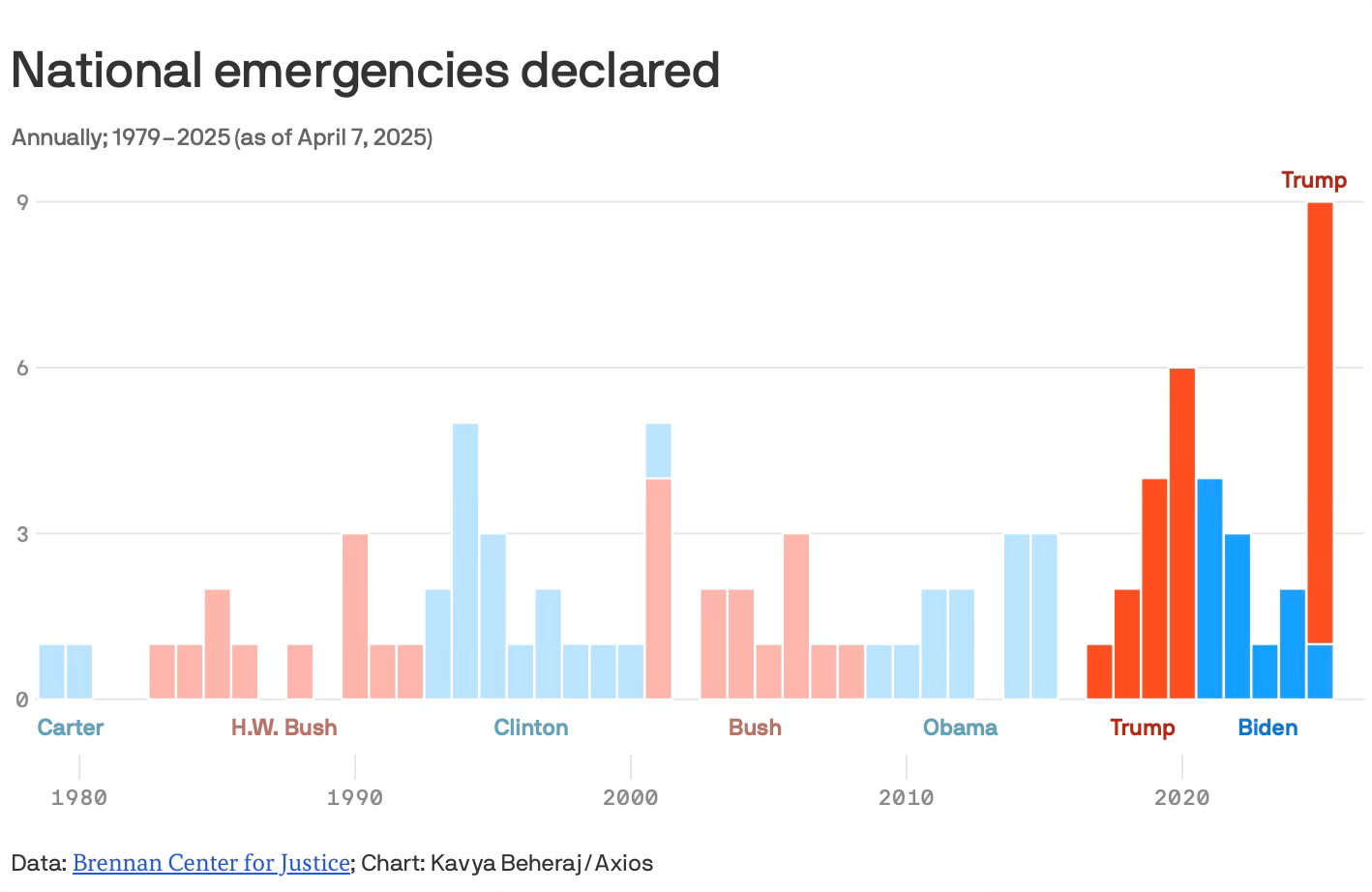
National “Emergencies”

Source: Andrew Sullivan

The Meta-Concern about summary deportation

United States law allows for a quite expedited process to remove people from the country, to deport them. You don’t get a big trial. You don’t get a jury trial. You are moved rapidly because the theory of the case is: First, you don’t have a right to immigrate to the United States, so you have not been deprived of your rights. And secondly, once you’re removed from the United States, you remain a free person. You are sent back to the place you came from or some other place to which you have some connection, and then you’re free to go about your business. You’re not sent to a prison—not sent to a prison for life.

But as I talk about this, the thing that has most gripped my mind with worry and anxiety is not only the effect on the individuals themselves, some of whom may be genuinely innocent, but the effect on those who are sending human beings to a prison without a hearing.

You know, the United States government is now building an apparatus of lawyers, of officials of all kinds, who plan and think every day, How can we apprehend people on American soil and bundle them to a prison without giving them any show of a hearing? They’re building skills and competencies at non-due-process forms of arrest and incarceration that are going to be very hard to limit.

… I remember when I was a Canadian citizen in the United States on a student visa, we were warned if you got into a bar fight, you could theoretically lose your student visa. Now, in those days, that meant that you’d have to go back to Canada and go to school in Canada, which is not the end of the world. In today’s America, that could mean you could lose your student visa and be accused of terrorism, and a bag put over your head and be put into a car and sent to a prison in El Salvador for the rest of your life.

Now, maybe that doesn’t happen in every case. Maybe that doesn’t happen in many cases. But there are people in the employ of the United States government, paid by taxpayers to think about how can we daily broaden the category of people who can be arrested and detained and imprisoned without any showing to any authority at all, without any opportunity to make themselves heard, without any evaluation by an independent fact finder—by any of the things we call due process.

David Frum, introducing a terrific conversation about The Crisis of Due Process with Peter Keisler. (bold added)

Do we really believe in free speech?

Trump 2.0 has been deporting foreign students and others for constitutionally protected speech, using as its current go-to bad-faith excuse that the speech is antisemitic.

The late British-American journalist Christopher Hitchens is a more recent testament to the long tolerance of America toward foreign dissent. Before becoming a U.S. citizen in 2007, Hitchens spent decades as a legal resident—and as one of America’s most acerbic public intellectuals. He accused Ronald Reagan of being “a liar and trickster,” called Israel America’s “chosen surrogate” for “dirty work” and “terrorism,” lambasted Bill Clinton as “almost psychopathically deceitful,” and accused the George W. Bush administration of torture and illegal surveillance. If a student can be deported for writing a campus op-ed critical of Israel, any of Hitchens’ views could have been used to justify deporting him.

Jacob Mchangama, A New McCarthyism

Law and its limits

This isn’t how our system is supposed to work. When a president does the kinds of things Donald Trump is doing, his popularity should sink so low that Congress will feel empowered to stand up to him. Ideally, they would impeach and remove him from office for attempting to govern like an absolute monarch. Short of that, Congress and the courts would be working in tandem to impose and enforce constraints on the wayward executive until the next election strengthens their hand against him.

But none of this is happening—because our system has broken down. The parties are ideologically sorted, with almost no remaining overlap. And Trump has transformed the GOP into a cult of personality more loyal to him personally than to the Republican Party, the other institutions of American democracy, the law, or the Constitution.

In a situation like this, the only thing preventing the president from transforming himself into a tyrant is his own willingness to do it. The courts can tell him to stop. But will he? If he does, democracy survives, at least for the time being. If he doesn’t, democracy is over, at least until it can be reconstituted at some point in the future.

One should never hope to live through a moment of great political precarity like our own. But one tiny compensation is that such moments bring clarity about certain fundamental matters. How has the United States managed to survive for nearly 250 years without evolving into a dictatorship? The answer really may be this simple: By never electing a man willing to do what it takes to effectuate the change.

Until now.

Damon Linker

It’s not clear that the courts will suffice, but the courts — having already, and deservedly, come to treat the Administration as bad-faith, untrustworthy actors — will provide partial deterrence and may help sway public opinion by the cogency (and sometimes, the tartness) of their reasoning.

[I]f you want a really extraordinary example of that, you would look at the order that the Court issued at 1 a.m. on Saturday morning this last weekend, because even though they had held that everybody has to be given meaningful notice before they could be removed in this way, there was credible evidence that the administration was loading people onto buses without giving them anything like the notice that was required. And the ACLU went to the Supreme Court and said, you know, Please, as you listen to the rest of this case and get briefing, stop this from happening.

And if the administration were a normal administration and had compiled a record so far of being a normal administration, the Court would’ve said, Well, I can be confident they’re not going to do this while we are hearing your petition, so let’s give the government a chance to respond. Let’s see what they say, and then we’ll decide what to do. Because, of course, the government wouldn’t spirit these people away while we are actually in the process of deciding whether it can do so on this emergency application you filed. But they knew that the government had done exactly that with the first 200 or so people they had sent away.

The case was before a district judge, and they rushed to secretly get the people out before he could issue an order. And they didn’t quite succeed on that, which is why you have these issues of contempt floating around now. But at 1 a.m., the Court by a 7–2 vote said, Don’t remove anybody in the class represented by these lawyers until you hear otherwise from us.

And that shows that there is a cost to the administration of acting the way it’s acting towards the courts, because if you squander the reputation that governments of both parties have had for credibility and fair dealing and honest brokering with the Court, then they’re going to treat you different because they know they can’t quite trust you.

Peter Keisler with David Frum

Miscellany

The new Republican coalition

Thus we have arrived at a new Republican coalition that looks like this:

  • The tech right, which is essentially a weirder and more evil upgrade of the pro-business libertarians
  • The barstool right, which is a genuinely new constituency made up of hedonistic anti-woke libertarians that has replaced the Christian conservatives
  • The neo-conservative foreign policy hawks, who are the weakest member of the coalition, but can still get what they want on certain issues, as seen with the attacks on the Houthis as well as the saber rattling regarding Greenland

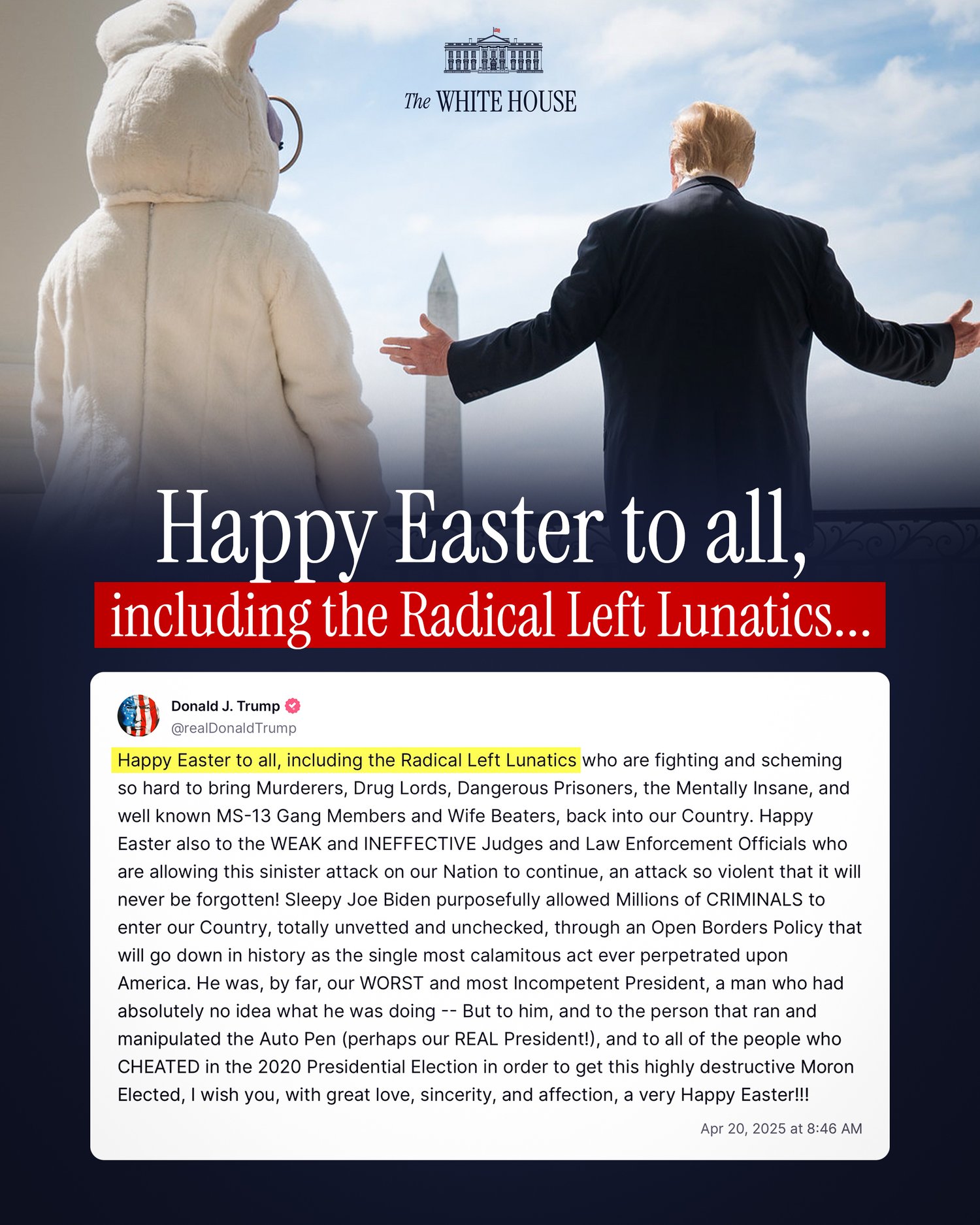
In other words, the Christian influence on actual Republican policy items and their political vision is going to be exceedingly negligible going forward. Sure, Vice President Vance will make an appearance at the March for Life. President Trump will show up to the National Prayer Breakfast. But even when he does acknowledge a Christian event, it often will come loaded with hatred and vile self-aggrandizement, as seen yesterday:

And ultimately when push comes to shove on the policy level, Christian concerns will always be backgrounded or eliminated relative to the priorities of the three above groups, as we have already seen on abortion, marriage, and PEPFAR.

Jake Meador

I originally thought to post this on a Sunday, when my focus is narrower, but it didn’t fit there because I don’t value “religion” for its instrumental partisan-political value.

It was a very few years ago when I warned (as had others) “If you don’t like the Religious Right, just wait ‘till you see the irreligious Right.” Well you’ve been seeing them in power for three months now.

Beta-testing tyranny in the Sunshine State

Ron DeSantis walked so that Donald Trump could run. When the time came to formulate a policy response to the woke left, no one mattered more than the governor of Florida.

He tried to ban critical race theory in education. He sharply limited discussion of gender and sexuality in public schools. He tried to limit the free speech of university professors. He retaliated against Disney when it had the audacity to exercise its freedom of speech to criticize the governor’s policies.

And through it all, DeSantis declared that Florida was the place where “woke goes to die.”

In his second term, Trump is a scaled-up version of DeSantis. Every element of the DeSantis model has been deployed against Trump’s ideological enemies …

At first I was optimistic about the anti-woke right. Their free speech argument resonated with me. I’d spent decades litigating free speech cases, after all, and I’d never really seen anything like a mass movement for free expression.

But my optimism quickly faded. In 2021, the anti-woke right embraced a series of state laws that were designed to ban critical race theory. Rather than meet critical race theorists in the marketplace of ideas, the right chose to try to suppress their expression.

A movement that had spent decades fighting speech codes on college campuses was now enacting speech codes of its own. States that once passed laws meant to protect free speech on campus were now passing laws suppressing the discussion of so-called divisive concepts about race.

By this time I was familiar with the right’s authoritarian turn — and getting very worried about it. In 2019, parts of the intellectual right were consumed with a fight over liberalism itself, with the new right arguing that liberal values — freedom of speech and free trade, for example — were hollowing out American culture, creating a nation of atomized individuals who were consumed with self-actualization (and consumption itself) at the expense of family and community.

David French, The Anti-Woke Right and the Free Speech Con

Context

Ironically, the left, now alarmed by the federal government’s intrusive reach [into, say, Harvard], bears direct responsibility for crafting the very legal weapons wielded against the universities it dominates. Almost four decades ago, progressive legislators demanded sweeping amendments to civil rights law, expanding federal oversight over higher education. The sequence of events reveals a cautionary tale of political hubris: progressive confidence that state power would reliably serve their ends overlooked the reality that governmental authority, once unleashed, recognizes no ideological master. Today’s circumstances starkly illustrate how expansive federal control over civil society, originally celebrated by progressives, returns to haunt its architects. The left’s outrage ought to focus not on this particular administration but on its own reckless empowerment of the state.

Yet for all its courage, Harvard’s response stopped short of making the argument that would best protect the values for which it was fighting. It defended the university’s independence without explaining why that independence deserves protection. It invoked values like “pluralism” and “inquiry,” but it did not fully explain why those values are essential to a liberal democratic society. The letter therefore missed an opportunity to articulate what a university is for — not just to students or donors, but to the country. And this matters, because Trump’s attack against this and other universities is not only about the balance of power between universities and the government. It is, at bottom, about the legitimacy of higher education as a public good.

Alan Jacobs, quoting, respectively, John O. McGinnis and Edward Frame

Dangers of debunking

The danger of being a professional exposer of the bogus is that, encountering it so often, one may come in time to cease to believe in the reality it counterfeits.

Alan Jacobs, The Year of Our Lord 1943


Your enemies are not demonic, and they are not all-powerful and the right hasn’t always lost and the left hasn’t always won. But if you convince yourself of that, you give yourselves all sorts of permission to do a lot of stupid and terrible things under the rubric of “Do you know what time it is?”

Jonah Goldberg.

Regarding said “lot of stupid and terrible things,” my failure to call out anything about the current regime does not mean I approve. There’s just too much, and on some of the apparent illegalities I don’t want to abuse my credentials without thinking it through.

I don’t do any of the major social media, but I have two sub-domains of the domain you’re currently reading: (a) You can read most of my reflexive stuff, especially political here. (b) I also post some things on the only social medium I frequent, because people there are quirky, pleasant and real.

CRT! (and some other stuff)

I’m trying out a new theme for the appearance of this blog. I often want to do quotes-within-quotes, and my current theme not only doesn’t do that (at least with Markdown files as the source), but makes the attempt look amateurish. I hope the new theme does better.

Mediocrities everywhere!

The 1984 film, Amadeus, tells the story of the child genius, Mozart. IMdB describes it in this manner:

The life, success and troubles of Wolfgang Amadeus Mozart, as told by Antonio Salieri, the contemporaneous composer who was insanely jealous of Mozart’s talent and claimed to have murdered him…

Mozart’s genius is so profound that it is little more than a toy in the hands of a very spoiled and immature boy/man. Salieri feels that, in Mozart’s existence, God is mocking him. He has dedicated his life to his work, even “to the glory of God,” and nothing he produces can be compared to the slightest trifle of Mozart’s irreverent gift. In the last scene of the film, Salieri, now confined to a mental institution (from where he is relating the tale) blesses the world:

“Mediocrities everywhere! I absolve you!”

Salieri implicates the whole of the world in his crime, describing himself as the “patron saint of mediocrities.” It is one of the most deeply affecting scenes I have ever encountered.

His crime is driven by envy. It is a story that brilliantly exposes the reality that envy is the product of shame and our inability, or unwillingness, to bear it …

[M]ost of the time throughout history, there is a slow and steadfast persistence of grace that, on the one hand, sustains us in our existence, and, on the other, constantly makes the fruit of our lives exceed the quality of our work. We offer him what is mediocre, at best, and He yields back to us thirty-fold, sixty-fold, a hundred. Indeed, we fail to understand that what some might judge to be “mediocre” is itself a work of grace.

… We are beloved mediocrities who have been commanded to become gods (by grace).

Fr. Stephen Freeman, ‌Mediocrity, Envy, and Grace

CRT! CRT! CRT!

CRT is far from the most important topic in this blog installment (see above for something far more important), but it seems to be click-baity.

Seriously, I’m trying for more than click-bait here. We have too much of that on this topic.

The “zero-sum” race mistake

Virulent racists and anti-racist activists would seem to have little in common, but in fact they tend to agree on one mistaken premise: Race relations are a zero-sum game. If whites are doing well, it’s at the expense of members of other races. If members of other races are doing well, it’s at the expense of whites.

On the racist (or “white nationalist”) side, this assumption means that members of other groups need to be subordinated so that whites can thrive. For anti-racists, this means that since whites have benefited at the expense of other groups, whites will now have to give up their “privilege” and reduce their own standard of living to allow other groups to thrive.

In fact, whites, as a group, don’t benefit from discrimination against, or oppression of, other groups, except perhaps psychologically if such discrimination and oppression make them feel superior and such feelings of superiority make them happy. But from a purely economic perspective, wealth comes from gains from trade, and the wealthier your trading partners, the more wealth you can accrue.

David Bernstein, Racists and (Many) Anti-Racists Make the Same “Zero Sum” Mistake – Reason.com

Stumbling over their own anti-CRT feet

I think my point is clear at this point. The defenses of anti-CRT laws are time and again running aground on the rocky shoals of … the actual anti-CRT laws. Welcome to the incredible difficulty of drafting speech codes. For decades, some of the smartest minds in higher education, Big Tech, and elsewhere have been trying hard to draft laws that ban the ideas they don’t like without sweeping too broadly or creating unintended consequences.

The allure is obvious. If we have the power to ban harmful speech, why not ban harmful speech? But the execution is always clumsy and dangerous if it’s broad, and narrow to the point of irrelevance if it’s precise. Another National Review pal, Ramesh Ponnuru, put things well in his own contribution to the debate in Bloomberg. “But regulation can be defensible in principle,” he says, “without a particular regulation being wise in practice. Some of the provisions in these bills are vague and sweeping.”

Yes, yes they are. But then Ramesh makes this vital point: “The more precisely these laws are written, though, the less they will proscribe and the easier they will be to evade.”

Yup. And that’s exactly why I circle back to my proposal—better curriculums and civil rights litigation. Thus you give teachers the confidence to teach something concrete and real without creating a fear that even their own course materials might suddenly be illegal …

David French, Even the Defenses of Anti-CRT Speech Codes Show the Problems With Anti-CRT Speech Codes

What’s really inflaming the CRT fights?

Again, I want to start with what the new progressivism is interested in changing. One change involves increasingly familiar terms like “structural” and “systemic” racism, and the attempt to teach about race in a way that emphasizes not just explicitly racist laws and attitudes, but also how America’s racist past still influences inequalities today.

In theory, this shift is supposed to enable debates that avoid using “racist” as a personal accusation — since the point is that a culture can sustain persistent racial inequalities even if most white people aren’t bigoted or biased.

… [T]he basic claim that structural racism exists has strong evidence behind it, and the idea that schools should teach about it in some way is probably a winning argument for progressives. (Almost half of college Republicans, in a recent poll, supported teaching about how “patterns of racism are ingrained in law and other institutions.”) Especially since not every application of the structural-racist diagnosis implies left-wing policy conclusions: The pro-life and school choice movements, for instance, regularly invoke the impact of past progressive racism on disproportionately high African-American abortion rates and underperforming public schools.

What’s really inflaming today’s fights, though, is that the structural-racist diagnosis isn’t being offered on its own. Instead it’s yoked to two sweeping theories about how to fight the problem it describes.

First, there is a novel theory of moral education, according to which the best way to deal with systemic inequality is to confront its white beneficiaries with their privileges and encourage them to wrestle with their sins.

Second, there is a Manichaean vision of public policy, in which all policymaking is either racist or antiracist, all racial disparities are the result of racism — and the measurement of any outcome short of perfect “equity” may be a form of structural racism itself.

The first idea is associated with Robin DiAngelo, the second with Ibram X. Kendi, and they converge in places like the work of Tema Okun, whose presentations train educators to see “white-supremacy culture” at work in traditional measures of academic attainment.

Ross Douthat, ‌The Excesses of Antiracist Education (bold added)

CRT dissent

I don’t even think the far left’s attempt to dismantle liberal democracy through critical race theory has been entirely a bad thing. It has revealed a consensus too: that we need to do better in telling the brutal truth about our white supremacist past. It’s been encouraging that even Republicans now agree that the Tulsa Massacre, one of the darkest moments in American history, should be taught without any attempt to disguise its evil. If this helps historians — and not critical race theorists — to uncover more of this shame, and to reckon with it, we will be a stronger country for it. It’s a real gain to have bipartisan support for a new federal holiday celebrating Juneteenth. And it’s also clear that the stealth campaign to indoctrinate children in the methods of CRT has begun to meet a real obstacle: parents of all races and backgrounds appalled by its racism.

Andrew Sullivan, Reasons To Be Cheerful, Part III. This one was near the top for me personally: Boring news cycle deals blow to partisan media – Axios

Angels on the head of a pin

A glib speaker in the Brains Trust once entertained his audience (and reduced the late Charles Williams to helpless rage) by asserting that in the Middle Ages it was a matter of faith to know how many archangels could dance on the point of a needle. I need not say, I hope, that it never was a “matter of faith”; it was simply a debating exercise, whose set subject was the nature of angelic substance: were angels material, and if so, did they occupy space?

Dorothy L. Sayers, The Lost Tools of Learning

Elusive expression

The humanists felt that literature was closer to life, that it provided a better lens onto the moral and spiritual life of man. In short, they elevated imagination to its rightful place alongside faith or reason as one of the fundamental faculties of human nature. Erasmus often vented his frustration when his comic and satirical works were attacked and misunderstood. Those “whose ears are only open to propositions, conclusions, and corollaries” are deaf to the more subtle literary techniques of irony and ambiguity.

Gregory Wolfe, Beauty Will Save the World

Propositional truth, once a hallmark of evangelicalism, is making way for more elusive means of expression, such as narrative, image, and symbol.

Hans Boersma, Heavenly Participation

Trump’s legacy

Wehner: What do you think is the most important legacy that Trump will leave?

Rauch: In the world I’m thinking and writing about, it’s that he has modeled for all time to come how to apply Russian-style disinformation in U.S. politics. And although he may have particular genius at doing that, this is an art that lots of people can practice. The KGB practiced it very successfully for a long time, not because they were geniuses, but because they had technicians who knew how to do it.

So it’s not just Trump anymore. I think he’s transformed the Republican Party into an institutionalized propaganda outlet; I think he’s had the same effect on conservative media, and that’s very hard to pull back in. Because once people start doing that, and they know it works, they continue to do it. And also the Republican base is in on it. They like it.

Disinformation is a participatory sport, not a spectator sport. It’s fun to tell yourselves narratives about how you really won; the other side cheated; you’re heroically taking back democracy; you’re in an existential fight against evil; you’re saving the country. This is way more fun than the boring truth. So the base now has picked up this style of spinning conspiracy tales, telling them to itself, acting on it; and the base is now leading the politicians. I don’t know how you put that genie back in the bottle. I think that’s maybe his most important contribution.

Peter Wehner, Jonathan Rauch on America’s Competing Totalistic Ideologies

Politics of loneliness

Work more often involves analysis of symbols (ideas and numbers) and takes place mostly within our own heads, mediated by technology, with remote work also becoming more common in recent years.

Damon Linker, ‌The politics of loneliness is totalitarian.

Linker lists several likely culprits for the surge of friendlessness over the past 30 years, but this one converged (I think) with other reading I’m currently doing.

Giving up on prohibition

Michael Pollan, whose writing about food I’ve admired, is turning to the “D” in FDA these days, advocating (with some nuance) for legalization of may currently illicit drugs. He’s especially fascinated by hallucinogenics, but hasn’t overlooked opioids:

Many people (myself included) are surprised to learn that the overwhelming majority of people who take hard drugs do so without becoming addicted. We think of addictiveness as a property of certain chemicals and addiction as a disease that people, in effect, catch from those chemicals, but there is good reason to believe otherwise. Addiction may be less a disease than a symptom — of trauma, social disconnection, depression or economic distress. As the geography of the opioid and meth crises suggests, one’s environment and economic prospects play a large role in the likelihood of becoming addicted; just look at where these deaths of despair tend to cluster or the places where addiction to crack cocaine proliferated.

Two findings underscore this point, both described in Johann Hari’s 2015 book on drug addiction, “Chasing the Scream.” Much of what we know, or believe we know, about drug addiction is based on experiments with rats. Put a rat in a cage with two levers, one giving it heroin or cocaine, the other sugar water, and the rat will reliably opt for the drug until it is addicted or dead. These classic experiments seemed to prove that addiction is the inevitable result of exposure to addictive drugs, a simple matter of biology. But something very different happens when that experimental rat is sprung from solitary confinement and moved to a larger, more pleasant cage outfitted with toys, good food and companions to play and have sex with. This is the so-called rat park experiment, devised by a Canadian psychologist named Bruce Alexander in the 1970s. He and his colleagues found that in this enriched environment, rats will sample the morphine on offer but will consume a small fraction of the amount consumed by rats living in isolation, in some cases five milligrams a day instead of 25. Dr. Alexander came to see that drug abuse isn’t a disease; it’s an adaptation to one’s environment and circumstance — to the condition of one’s cage.

The second phenomenon Mr. Hari recounts took place at the end of the Vietnam War. Some 20 percent of U.S. troops became addicted to heroin while in-country. With the war coming to an end, experts worried about tens of thousands of addicts flooding America’s streets. But something unexpected happened when the addicted service members got home: Ninety-five percent of them simply stopped using. It made no difference whether or not they received drug treatment. This is not to minimize the harm done by heroin to those who couldn’t quit; it is only to suggest that there is much more to addiction than exposure to an addictive drug

Michael Pollan, How Should We Do Drugs Now? (The New York Times)

I think Pollan is right that legalization of a lot of drugs is where the country is headed. I’m far from convinced that it’s a good trend, but am leaning toward “opposed but not distraught”.

Pollan:

We shouldn’t forget that two of the most destructive drugs in use today — alcohol and tobacco — have long been perfectly legal. Having wisely given up on prohibition, we’ve worked hard as a society to regulate their use, deploying both laws and customs. Recognizing the dangers of tobacco, we’ve desocialized its use over the past 50 years, devising rules and taboos about when and where one may smoke. Along with high taxes, these expressions of cultural disapproval have substantially reduced tobacco use …

There’s enough libertarian in me for that to sound pretty good, and that’s without getting into how enforcement of drug laws disparately affects some minority groups — part of the “systemic racism” that’s hard to deny.

New construct: “Luxury Surveillance”

I am not without sin when it comes to Luxury Surveillance, the willingness, if not eagerness, to adorn oneself and one’s life with tools of surveillance capitalism.

On the good side, I shut off the microphone on my Amazon Echo so Alexa can’t listen in on daily life. (A lot of people say Amazon started sending ads for things that had been discussed in Alexa’s hearing.) On the bad side, I was drooling over Apple Watch this week — an itch I ended up scratching with a $30 Casio dumb watch.

But really, read the article Luxury Surveillance and see if you want to play in this game. Or if you can’t change your life without getting furious, you can read ‌Delete Your Amazon Prime Account. Now..

Debriefing Covid

The last thing I would say is sort of a core failure is Zoom. I think many people think Zoom is what liberated us—were it not for Zoom, how bad would this pandemic have been? But my counterfactual is different. Zoom allowed a lot of upper-middle-class white-collar people the ability to work and make money and not lose their jobs, and to exclude themselves from society. That fundamentally changed the pandemic. If you went back 15 years ago, and you didn’t have Zoom, you would be facing unprecedented layoffs of wealthy, upper-middle-class people. I think a lot of businesses would have had staggered schedules and improved ventilation. Schools would have pushed to reopen. Amazon Prime and Zoom and all these things in our lives allowed a certain class of people to be spared the pains of COVID-19, taking them out of the game, and making them silent on many of the issues that affected other communities.

The closing of those schools doesn’t have a relationship to the spread of the virus, or the hospitalizations, or the deaths. It’s only really related to the political valence of the town, and the strength of the teachers union. Strong union towns that are left-leaning were far more likely to be closed than right-of-center places that have weaker unions. What sense does that make? That’s certainly not a virus driving that decision. It’s a policy decision. It’s playing politics with kids.

Vinay Prasad, associate professor in Epidemiology and Biostatistics at the University of California San Francisco, interviewed (along with others) by Emily Yoffe in ‌What We Got Wrong (and Right) About COVID-19

Orbital obliquity

SciTech Daily:

Planets which are tilted on their axis, like Earth, are more capable of evolving complex life. This finding will help scientists refine the search for more advanced life on exoplanets. […]

“The most interesting result came when we modeled ‘orbital obliquity’ — in other words how the planet tilts as it circles around its star,” explained Megan Barnett, a University of Chicago graduate student involved with the study. She continued, “Greater tilting increased photosynthetic oxygen production in the ocean in our model, in part by increasing the efficiency with which biological ingredients are recycled. The effect was similar to doubling the amount of nutrients that sustain life.”

“Orbital obliquity” is one of those scientific terms — like “persistence of vision” and “angle of repose” — that just cries out for metaphorical application.

All of the writers and thinkers I trust most are characterized by orbital obliquity. They are never quite perpendicular; they approach the world at a slight angle. As a result their minds evolve complex life.

(Alan Jacobs, orbital obliquity – Snakes and Ladders)

Weary of hearing what he has never heard

The worst judge of all is the man now most ready with his judgements; the ill-educated Christian turning gradually into the ill-tempered agnostic, entangled in the end of a feud of which he never understood the beginning, blighted with a sort of hereditary boredom with he knows not what, and already weary of hearing what he has never heard.

G.K. Chesterton, The Everlasting Man


You can read most of my more impromptu stuff at here. It should work in your RSS aggregator, like Feedly, should you want to make a habit of it.