
Conservative versus anti-left
Goldstein: Let me try to tempt you into armchair diagnosing another group of people: politician-critics of elite higher ed who are themselves products of elite higher ed — Ted Cruz, Josh Hawley, JD Vance, Ron DeSantis, Elise Stefanik.
Brooks: Stephen Miller.
Goldstein: That’s another one. Is there anything novel going on with these folks? Or is this the latest incarnation of an old story going back to at least Bill Buckley at Yale?
Brooks: What’s happening now is different than Buckley. He genuinely loved Yale, even while critiquing the professors. Let me tell the story this way. I graduated from Chicago in 1983, and at about the same time a group of people graduated from Dartmouth. We all moved to Washington about the same time. I knew them, and some of them have become famous, like Laura Ingraham and Dinesh D’Souza. I didn’t appreciate it at the time, but I came out of Chicago earnestly reading Edmund Burke and Adam Smith and all that, and my friends and I became pro-conservative. But the Dartmouth Review folks were not pro-conservative, they were anti-left. So in retrospect, I can see how big and vast a difference there was between people that I thought were part of the same movement. The sad news is that they now dominate conservatism and the Republican Party. Whereas my friends became Never Trumpers.
David Brooks and Evan Goldstein upon Brooks’ departure from the New York Times to, among other things, teach at Yale.
This sign, from the late Charlie Kirk’s Turning Point America and carried by a supporter of the Trump-backed challenger in the nationally-famous 3-vote-margin Indiana race, is not conservative:
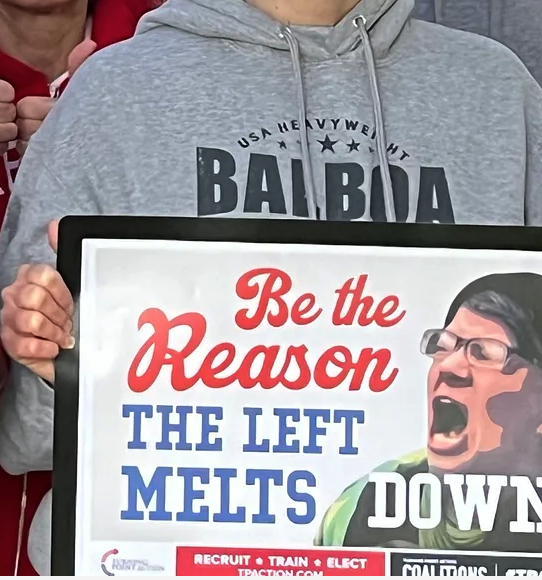
Note well: MAGA is not conservative. It is anti-left. Conservatives have been pretty much sidelined in our public life.
Courts
Having knowingly (we knew damn well beforehand) installed a snake in the Oval Office, and having reduced Congress to a bunch of internet trolls and “influencers,” Americans turn their attention to destroying the Courts, the Last Branch Standing between the present mess and the abyss.
The impetus toward postliberalism
The less capable our system is of producing outcomes that the losing side will see as “fair,” the greater that side’s appetite for postliberalism will be. If a process-oriented politics can’t deliver fair results, its frustrated subjects will conclude that a results-oriented system is the only alternative.
To many, a court overturning a vote of millions of Virginians that went in Democrats’ favor on a debatable procedural technicality will seem unfair. A second court dominated by Republican appointees choosing to end majority-minority redistricting coincidentally at the moment the GOP faces an electoral debacle will seem very unfair. The fact that Donald Trump and his party have broken norm after norm over the last 10 years, yet have plainly strengthened their hold on power over the same period, seems especially unfair, making traditional civic norms feel like a sucker’s game and a path to perpetual minority status.
Nick Catoggio, whose concern in The Road to Perdition is less the mid-decade gerrymander wars than the calls for court-packing. The boldest postliberal court-packing scheme I’ve seen is that of the Democrats in Virginia, which dials up to eleven the already outrageous mid-decade gerrymandering frenzy, which the Republicans started.
Suicide in the cause of process over results
The Virginia Court opinion invalidating the referendum-approved pro-Democrat gerrymander was, in my casual consideration, a by-the-book insistence on following the right process to get your desired result. Those who look closer at the opinion, or have deep insight into the Virginia judicial context, might differ.
But even if Virginia Democrats don’t nuke their courts, it will also be the end of the judicial career of the opinion’s author, as I noted elsewhere. You can’t blame the author of doing something that was cheap professionally.
A calming voice
As Justice Elena Kagan bemoaned in her dissent, a plaintiff objecting to district maps that kept Black voters from electing representatives of their choice would need to show that the maps were “motivated by a discriminatory purpose,” something that is “well-nigh impossible.” She thought the court need concern itself only with the racial effects, not racial purpose, as it had from 1986 until last week’s ruling.
But we seem less concerned about effects when other groups of people have limited ability to elect their favorite candidates. We do not think of the white Republican in San Francisco as meaningfully disenfranchised.
The question is whether present-day conditions justify classifying Black people as a special case.
…
W.E.B. DuBois in “The Souls of Black Folk” asked, “How does it feel to be a problem?” If Black voters can be meaningfully represented only by Black candidates, and some shifty Republican operators with their maps can really all but undo 60 years of electoral transformation, then Black Americans remain a problem.
I don’t think we are. There has been enough “good trouble,” as the great John Lewis used to put it, that I highly suspect that, to put it in the modern argot, We Got This.
There is no d*mn#d ceasefire!
I’ve seen so much abuse of language (and not just from Team Trump) that I was working on the assumption that “ceasefire” was broad enough to cover “we’re shooting at each other a little bit less now.” But we shouldn’t let “them” do that to us.
There is a real challenge for reporters and editors, opinion columnists, and [headline writers] when it comes to covering Donald Trump and his grim, grubby little band of slavering sycophants, which is that it is difficult to write about people who simply lie about everything all the time, from the minor to the major, changing their story from moment to moment, saying the first thing that comes into their minds or whatever it is they think will get them through the next two minutes. The difficulty is in striking a balance between implicitly adopting the assumptions of the people who are lying to you (who you know are lying to you, and who know that you know are lying to you, and you know that they know that you know, etc. ad literal nauseam) and writing as though you were always performing a real-time fact-check in the background of whatever reporting it is you are trying to do or whatever argument it is you are trying to make.
And so we end up with reporters writing about the possibility that a ceasefire that does not exist will cease to exist
…
But a lie is a lie is a lie is a lie is a lie.
That’s important for people in the journalism business, of course—if you can’t write or say that a lie is a lie, or if you feel compelled to treat an obvious lie as though it were something other than an obvious lie, then you really can’t do the work of journalism, whether you are an opinion-and-commentary guy or a straight-news reporter—but, more than that, it is important for us as free men and women in our roles as citizens in a self-governing republic. You can run a fiefdom on deceit, a kingdom on lies, and an empire on baloney, but you cannot long maintain a free society under the rule of law without a reasonably high baseline of honesty in the public conversation. Right now, we have a situation in which federal judges have decided that they can no longer assume that the lawyers serving the executive branch are not simply lying to the courts in their filings and statements. (The legal mumbo-jumbo for this is the “presumption of regularity.”) Once you lose that, you don’t get it back …
Trump is, of course, a pathological liar in his own right, but what is arguably worse is that he makes telling the most risible, shameful, and obvious lies a condition of serving in his administration ….
I didn’t even rush to print with this because I was pretty sure that any day this week (it’s Monday as I’m writing this item) it will still be true that there’s no ceasefire—and that the press will be talking and writing as if the sorta-kinda is.
Another nonsense that gets my nose out of joint is that Congress won’t impeach Trump, and remove him from office, for defying the War Powers Act’s 60-day time limit with the sophistry that “Epic Fury” is over and we’re into “Enduring Freedom” now.
Grrrrrr!
“Russia is safer” than the US
I follow the blog of an older American widower with a young Russian-American daughter, Marina. After his younger Russian wife’s death, they moved back to the U.S.
They’re now back in Russia, and the widower father explains why:
[W]hile I loved being back in the U.S., the political and social disintegration was clear. The economy seemed and still seems to be on the verge of collapse. The national debt is greater than the entire U.S. budget [sic – it’s bigger than the GNP]! I see absolutely no rhyme or reason to major political and military decisions made by Trump, e.g., the attack on Iran. The U.S. simply has to be in war or conflict somewhere …
I did not and do not want Marina raised in such a place. Russia is safer. Further, I sincerely believe she will get a better education in the public schools here, and I don’t have to wonder about any social agenda. For example, Putin has made it clear that the terms “mom” and “dad” will be used, not “parent 1” and “parent 2.”
Were I to become an expatriate, my heart would lead me to France, not Russia, but then I don’t have an impressionable child.
Apparition
I walked my fastest down the twilight street;Sometimes I ran a little, it was so late.At first the houses echoed back my feet,Then the path softened just before our gate.Even in the dusk I saw, even in my haste,Lawn-tracks and gravel-marks. “That’s where he plays;The scooter and the cart these lines have traced,And Baby wheels her doll here, sunny days.”Our door was open; on the porch still layUngathered toys; our hearth-light cut the gloam;Within, round table-candles, you — and they.And I called out, I shouted, “I am come home!”At first you heard not, then you raised your eyes,Watched me a moment — and showed no surprise.Such dreams we have had often, when we stoodThought-struck amid the merciful routine,And distance more than danger chilled the blood,When we looked back and saw what lay between;Like ghosts that have their portion of farewell,Yet will be looking in on life again,And see old faces, and have news to tell,But no one heeds them; they are phantom men.Now home indeed, and old loves greet us back.Yet — shall we say it? — something here we lack,Some reach and climax we have left behind.And something here is dead, that without soundMoves lips at us and beckons, shadow-bound,But what it means, we cannot call to mind.
John Erskine via Poems Ancient and Modern.
I cannot call to mind what this poem means, but I like it.
Shorts
- It says a lot about our current president that in response to the news that a giant gold statue of Donald Trump was dedicated this week, you have to ask, “Which one?” (Margaret Hartmann, Gold 22-Foot Trump Statue Definitely Isn’t a False Idol)
- The State Department will begin revoking the passports of about 2,700 individuals who owe more than $100,000 in child support. (The Morning Dispatch) That seems, at least superficially, like a good idea. Will they stop deporting individuals who owe more than $100,000 in child support?
- “We’re 9 weeks into a 4 week war we won 8 weeks ago,” – Ron Shillman via Andrew Sullivan
- “The Iran conflict has entered its metaphysical phase. Like Erwin Schrödinger’s famous thought experiment involving a cat that is simultaneously dead and alive, in the Strait of Hormuz there is both a war and a ceasefire,” – Eli Lake via Andrew Sullivan
- “Arrived in Palm Beach, drove by a gas staion [sic], $4.50 a gallon. Result of failed @BarackObama leadership,” – Donald Trump tweeting in April 2012 via Andrew Sullivan

