Everybody is talking these days about the decline of the West, and with good reason. Some people think that Christianity should have something to say about this: that as the faith was the rock on which the West was built, so the faith should rebuild it again, or defend it against its enemies. We need a Muscular Christianity! they insist in the comment sections. Bring on the Christian knights! they shout on YouTube. But I don’t think this is how it works. When the last empire collapsed, the Christians of Europe weren’t trying to build, let alone defend, some construction called “Christendom.” They didn’t plan for the dome of St. Peter’s or the Battle of Lepanto. They were just trying to do the humblest and the only thing: to worship the true God, and to strip away everything that interfered with that worship. They took to the deserts to follow Christ and to battle the Enemy. Their work was theosis. They had crucified themselves as instructed. What emerged as a result, and what it turned into—well, that wasn’t up to them.
In a time when the temptation is always toward culture war rather than inner war, I think we could learn something from our spiritual ancestors. What we might learn is not that the external battle is never necessary; sometimes it very much is. But a battle that is uninformed by inner transformation will soon eat itself, and those around it. Why, after all, were the cave Christians so sought after? Because they were not like other people. Something had been granted to them, something had been earned, in their long retreats from the world. They had touched the hem. After years in the tombs or the caverns or the woods, their very unworldliness became, paradoxically, just what the world needed.
The loss of Christendom gives us a joyous opportunity to reclaim the freedom to proclaim the gospel in a way in which we cannot when the main social task of the church is to serve as one among many helpful props for the state.
My favorite story about [St. Colman Mac duaghis, who lived in a cave as a hermit for seven years] concerns his wild companions. The saint, the legends tell us, somehow befriended a cockerel, a mouse, and a fly, and trained them to help him out. The cockerel’s job was to crow when he needed to get up in the morning to pray. The mouse’s role was to step in if Colman didn’t feel like getting out of bed: It would nibble his ear until he roused himself. As for the fly, Colman trained it to walk along the lines of his Bible in the dim light, so he could follow it as he read. A new stained glass church window in the nearby town of Gort portrays the saint with his three animal companions rather sweetly.
Nothing lasts, of course, especially the life of a fly. It wasn’t long before Colman’s companions died. He confided his sadness in a letter to another Irish saint of the time, Columba. His friend’s brief reply distilled the unworldly essence of desert spirituality: “You were too rich when you had them. That is why you are sad now. Trouble like that only comes where there are riches. Be rich no more.”
A new Terry Mattingly article for the Acton Institute, The Evolving Religion of Journalism reminds me to share some wise words from Alan Jacobs:
Wondering how to decide what to read? Here’s a simple but effective heuristic to cut down the choices significantly. Ask yourself one question: Does this writer make bank when we hate one another? And if the answer is yes, don’t read that writer.” Americans have these wildly distorted views of people whom they perceive to be their political enemies because so many journalists and talking heads enrich themselves through stoking hatred. Those people should be utterly shunned.
Avoiding them will do wonders for your blood pressure. More importantly, it’s a pre-condition for healing your soul.
Sometimes the application of the heuristic is awkward: I read Rod Dreher’s “diary” on Substack but stopped reading the bile he’s paid to produce for the American Conservative.
And I pray for him to unite his divided mind.
Clive the Convivial
Clarke and Lewis eventually met, perhaps around 1960, as Francis Spufford has narrated: “Clarke contacted Lewis and they arranged to meet in the Eastgate Tavern, Oxford. Clarke brought Val Cleaver as his second; Lewis brought along J. R. R. Tolkien. They saw the world so differently that even argument was scarcely possible. As Orwell said about something completely different, their beliefs were as impossible to compare as a sausage and a rose. Clarke and Cleaver could not see any darkness in technology, while Lewis and Tolkien could not see the ways in which a new tool genuinely transforms the possibilities of human awareness. For them, machines at very best were a purely instrumental source of pipe tobacco and transport to the Bodleian. So what could they do? They all got pissed. ‘I’m sure you are very wicked people,’ said Lewis cheerfully as he staggered away, ‘but how dull it would be if everyone was good.’ ”
On the flight over from Budapest, I almost finished Lewis’s novel That Hideous Strength, which is really terrific. I would have done, but the plane landed with two chapters to go. I’ve been saying for a while that the totalitarian dystopia we are living towards is much more like Huxley’s Brave New World than Orwell’s Nineteen Eighty-Four, but it’s really and truly like Lewis’s That Hideous Strength. I kept thinking, as I read along, how eerily on the nose Lewis was in 1945, when he published it, about how things are today in our creepy technocratic anti-human society. The technocratic conspiracy that runs the Britain of the novel manages to manipulate the media to manufacture consent and approval by the population, in ways that bring to mind the way the US Government manipulated social media outlets to control the Covid message. On the hopeful side, the brave little band of Christian warriors in That Hideous Strength are humble and frail, but heroic. One wants to be like them, when the time comes. One also wants a kindly bear called Mr. Bultitude.
So I did finish it, in London, and the conclusion was deeply moving, but not just at the emotional level. I felt like I had glimpsed a deeper truth — the kind of truth that moves the world. I won’t spoil it for you, don’t worry. I can say, though, that at the end, the “Director” — a sort of Gandalf figure directing the resistance to nation-destroying evil — explains to his seemingly feeble band of conspirators why despite appearances, the plain work they did vanquished great evil in an apocalyptic spiritual battle.
What is it that craves? It is your ego—your created sense of a permanent ‘self’—and it craves because it believes that if it can have what it craves it will stop suffering. This is the story of our civilization, and we are discovering the hard way that it doesn’t work.
Paul Kingsnorth, Savage Gods. This was written while Kingsnorth was a Pagan or a Buddhist or something — not yet Orthodox Christian — but he wasn’t wrong.
Our barbarism and superstition
Sometimes it is difficult to exaggerate how strange, barbaric, and superstitious an age ours really is.
I don’t much care for Hart these days, but I much enjoyed the essay he concludes thus.
Don’t think about this
Tradition is a bulwark against the power of commerce and the dissolving acid of money, and by removing these, all revolutions in the modern period have ended up accelerating the commercial and technological shift towards the Machine.
You can read most of my more impromptu stuff here (cathartic venting) and here (the only social medium I frequent, because people there are quirky, pleasant and real). Both should work in your RSS aggregator, like Feedly or Reeder, should you want to make a habit of it.
” How has it come about,” C. S. Lewis once asked, “that we use the highly emotive word ‘stagnation,’ with all its malodorous and malarial overtones, for what other ages would have called ‘permanence’?” It is, Lewis suggests, because the dominance of the machine in our culture altered our imagination. It gave us a “new archetypal image.”
There’s a reckoning coming for this — or so I hope. The alternative to a reckoning is people like assistant secretary for health Dr. Rachel Levine continuing to lie and cover up this scandal, and getting away with it.
Before I published, there were signs of a reckoning coming, from Senator Josh (“I used to be a conservative till I discovered the joy of demagoguery”) Hawley and the Missouri Attorney General.
Hold off on the funeral plans
Red states like Florida and Texas are growing at the expense of Blue states like New York and California. The main driver is said to be housing costs.
But beware jumping to a triumphalist conclusion, Red-staters:
Blue states aren’t doomed or dying. At any rate, high housing costs generally reflect very high demand from lots of people to live in a particular area; New York City isn’t some dystopian wasteland where no one can see their future. But even relatively small changes (minorities of workers working from home or moving away) can still lead to acute crises for cities ….
Stalinism made courage in thought especially dangerous, but the pressure to align one’s opinions with those of a favored group is universal. Solzhenitsyn detected this pressure even before the Revolution. Vorotyntsev, the hero of his novel November 1916, finds himself at a meeting of Kadets (the Russian liberal party). He listens as everyone voices the proper views they all already hold. He is struck that their confidence needs constant reinforcement and that those with progressive opinions regard it as “imperative . . . to meet and hear all over again what they collectively knew. They were all overpoweringly certain they were right, yet they needed these exchanges to reinforce their certainty.” An experienced colonel, Vorotyntsev knows that their opinions about common soldiers are absurd, but for a reason he cannot explain, he finds himself expressing agreement.
Age six, I once ruined Pass the Parcel at a schoolfriend’s birthday party, because I was distracted by a headline on a layer of discarded newspaper. MIND BOMBED BY THE MOONIES. I remember being intensely annoyed when it was taken off me before I could find out what that meant, and confused as to why all the adults thought my outrage was funny. It marked me out as one of those oddballs generally more interested in ideas than in who and what is immediately present. That trait has persisted: my mad professor streak is trying to friends and family, to this day.
I watched Harrington in a YouTube dialog, and her physical mannerisms were completely consistent with the “oddball” she describes.
They also reminded me of me.
IDW Alums
Interesting podcast about the Intellectual Dark Web (you remember that, don’t you?). It seems that if you put like-minded extremists in a room and close the door for a while (literally or by lumping them under a label like “IDW”), they emerge more extreme.
Still, I’m puzzled that so many of the IDW figures started on the Left but the whole thing now (apparently) codes Right.
Bingo
Now is not the time to discuss this is not an argument — it’s a derailing tactic.
You can say Mr. Biden fibbed, misled and exaggerated, and you wouldn’t be wrong, but in rope-a-doping Republicans on Medicare and Social Security he showed real mastery. “Some Republicans—some Republicans—want Medicare and Social Security to sunset. I’m not saying it’s the majority.” When they catcalled and booed he said he was glad to see it—“I enjoy conversion.”
I don’t care how planned that line was, it was good.
“So folks, as we all apparently agree, Social Security and Medicare is off the books now, right?” He meant off the table. “All right. We’ve got unanimity.”
The Republicans, as we all know, made a mistake in taking his bait. They should have laughed. Instead, when he painted them as dogs they barked and snarled. Much has been made of Marjorie Taylor Greene and her grimacing and jeering. In her flamboyant fur-collared jacket she was compared, on social media, with Cruella de Vil and late-stage Sharon Stone in “Casino.” That was unkind. She seemed to me more like the colorful Belle Watling, although without the kindness and dignity.
“I thought [Sarah Huckabee Sanders’] speech was terrible. If you’re going to give a counter speech, you’ve got to talk about important issues. Don’t get me wrong, the wokeism is very important. But it’s not quite the heart of the matter right now, right? It’s not the heart of the matter. Let’s be blunt,” – Steve Bannon, via Andrew Sullivan.
SOTU 3
Biden was triangulating hard. Stylistically, this was not-Trump at all. Substantively, it was Trump all the way. If Trump were not mentally ill, he’d sit back and bask in his legacy of reorienting US politics — including the Democrats — toward all the themes he stressed from 2015 on. He’d be happy to go down in history as populism’s bipartisan legitimizer. (But of course he’s out of his mind.)
My own belief is that the senior figures in the Trump administration—Donald Trump himself, Mike Pence, the various Cabinet secretaries and agency chiefs, etc.—should never again hold any position of public trust—or, if not never again, at least not in the foreseeable future … The same is true for those in Congress who voted against certifying the 2020 election results and those who were otherwise involved with the attempted coup d’etat of 2020-2021. Trumpworld lawyers such as John Eastman, Rudy Giuliani, and Cleta Mitchell should be disbarred.
…
I do not think that any of this should be done in a spirit of vengeance, nor do I believe that we should work to socially ostracize these people or go out of our way to ruin them financially, though, of course, their employment prospects would be narrowed in some cases. Rather, I think that we should think of them the way Marcus Aurelius thought about his hypothetical sparring partner: We have had a bad experience with them, and we should take such steps as are necessary to avoid repeating that experience. Once is enough.
Put another way: The point of keeping Trump administration veterans out of positions of public trust is not to punish them—it is to keep them out of positions of public trust.
…
I am not saying that Nikki Haley and other veterans of the Trump administration are necessarily villains or dishonorable people or anything like that. I am saying that they are an avoidable risk—and we should avoid them.
I shall do my part.
Russia, Ukraine, U.S.
Beyond a certain point, the United States is no longer “helping” or “advising” or “supplying” the Ukrainians, the way it did, say, the Afghan mujahedeen during the Cold War. It is replacing Ukraine as Russia’s main battlefield adversary. It is hard to say when that point will be reached or whether it has been already. With whom is Russia at war — Ukraine or the United States? Russia started the war between Russia and Ukraine. Who started the war between Russia and the United States?
…
In an age of smart devices, robotics and remote control, the United States’ involvement in the war has always been greater than it appeared. The computer-guided rocket artillery that Ukraine has received from the United States may seem analogous to the horses and rifles that a government might have sent to back an insurgency in the old days. They look at first like traditional weapons, albeit advanced ones.
But there is an important difference. Most of the new weapons’ destructive power comes from their being bound into an American information network, a package of services that keeps working independently of the warrior and will not be fully shared with the warrior. So the United States is participating in these military operations at the moment they happen. It is fighting.
…
Russians say the war is about preventing the installation of an enemy military stronghold on the Black Sea, strong enough to close off what has for centuries been Russia’s main access to the outside world. Without Ukraine, Russia can be turned into a vassal state. That NATO intends to bring about the subjugation, breakup or even extinction of Russia may be true or false — but it will not sound implausible to a Russian.
…
We should not forget that, whatever values each side may bring to it, this war is not at heart a clash of values. It is a classic interstate war over territory and power, occurring at a border between empires. In this confrontation Mr. Putin and his Russia have fewer good options for backing down than American policymakers seem to realize, and more incentives to follow the United States all the way up the ladder of escalation.
Donald Trump’s detractors—including yours truly—would often make the mistake of downplaying his political effectiveness simply because we were utterly immune to his (alleged) charms.
I’m in that camp with Goldberg: utterly immune. I struggled to figure out his effectiveness even intellectually, but I’ve eventually settled on something like these:
When you tell a large chunk of the country that their voices are not worth hearing, they are going to react badly—and they have. (David Brooks, How the Bobos Broke America)
Telling parents they’re bigots or are unenlightened for not embracing the latest faddish orthodoxy is not a winning message. (Pamela Paul, What Liberals Can Learn From Ron DeSantis)
Prudential calculation
[T]he classical statesman permits errors and vices, not because he believes in tolerance for its own sake, but because state action would, in his estimation, harm the common good of the polity more than the vices or errors do.
This very much was why I opposed criminal laws against sodomy 50+ years ago — not because I thought that vice was a virtue or even neutral.
It seems quaint even to mention that now, but my position remains substantially the same today.
Tradition is a bulwark against the power of commerce and the dissolving acid of money, and by removing these, all revolutions in the modern period have ended up accelerating the commercial and technological shift towards the Machine.
You can read most of my more impromptu stuff here (cathartic venting) and here (the only social medium I frequent, because people there are quirky, pleasant and real). Both should work in your RSS aggregator, like Feedly or Reeder, should you want to make a habit of it.
This battle was lost even before I entered it, so I rarely mention it. Here goes anyway.
Where the reasons for infertility are known, we are free to develop treatments to cure them. But even if we intervene in an individual’s body to restore its reproductive function, conception still might not occur. Therapeutic interventions of this sort, which are certainly admissible for a Christian who seeks to be a parent, do not seek the conception of a child. They aim to remove known obstacles so that the couple may try to conceive a child. This may seem like a small difference, but it is not. A medical treatment of this sort seeks to enable a man and a woman to conceive. It does not seek to replace their roles in conception.
Matthew Lee Anderson, The Biblical Case Against IVF. Not surprisingly, there’s much more than this to Anderson’s argument.
I agree with Anderson’s conclusion against IVF, but not necessarily for the reasons he adduces. I particularly hesitate at the label “Biblical” in the title, as I don’t think one Christian in a thousand would reason his or her way to Anderson’s conclusion given only the Bible.
What I really agree with is thinking carefully and critically about new technologies presented to us.
We’re not going to take this any more
At various times before the nineteenth century, Byzantines, Arabs, Chinese, Ottomans, Moguls, and Russians were highly confident of their strength and achievements compared to those of the West. At these times they also were contemptuous of the cultural inferiority, institutional backwardness, corruption, and decadence of the West. As the success of the West fades relatively, such attitudes reappear. People feel “they don’t have to take it anymore.”
I wish I’d read this book decades ago. A mind-extender.
Knowing how little we know
A world of radicals needs incrementalists to make real change, Greg German and Aubrey Fox argue in Persuasion. “Gradualists know how little they know,” they write. “Anyone trying to understand a given problem these days is necessarily missing crucial information because there is simply too much information to process effectively. Gradualists acknowledge that, inevitably, errors happen. Building on this insight, an iterative, incremental process allows for each successive generation of reformers to learn from, and improve upon, their predecessors’ efforts.” Make no mistake, they continue: “We still need dreamers and visionaries and rabble-rousers who want to pursue moon-shot goals like curing cancer and ending hunger. But our default setting should be to admit the obvious: Our problems are big and our brains are small. Incrementalism is nothing less than the endless, ongoing effort to alleviate injustices. It is a way of greeting the world in a spirit of optimism even in the face of the daily conflicts, disappointments, and tragedies that life throws at all of us.”
Jefferson observed at one time that it would be better to have newspapers and lack a government than to have a government and be without newspapers. Yet we find him in his seventieth year writing to John Adams: “I have given up newspapers in exchange for Tacitus and Thucydides, for Newton and Euclid, and I find myself much the happier.”
Department of horrible ideas: State Democrats in Massachusetts want to offer prisoners reduced sentences for donating organs. Yes, I’m serious. In the new bill: If you, a prisoner, go under the knife to give up a kidney or some bone marrow, you could get up to a year of your prison sentence reduced. The lawmakers say the bill would “restore bodily autonomy.“
What in the free-market hell is this?
…
President of Heritage calling to cut military spending? What world am I in? This week, Kevin Roberts, the president of the conservative Heritage Foundation, wrote about how America needs to cut defense spending. “For too long, Republicans considered it a victory to increase defense and non-defense spending by equal dollar amounts, without cutting a dime from the deficit.” And: “Congress needs to put away its kid gloves and put the Department of Defense and other agencies alike under the knife to excise wasteful spending.”
Getting riled up about military budgets is an age-old progressive hobby, and I still get mad looking at charts that compare U.S. military spending to every other country in the world. That Republican Heritage Foundation leaders are now saying we need to cut defense spending—and Democrats are pushing for more military spending—is amazing. The military and Big Pharma are somehow becoming pet projects of the left. Soon they’ll be advocating on behalf of Big Corn.
[T]his week, the former executive editor, Len Downie, a near-icon of the old school, published a report on journalism and found a broad consensus among his colleagues that, in the words of one editor-in-chief, “Objectivity has got to go!” So every story now assumes “white supremacy” as the core truth of the world.
So what happens when stories arrive which, on the face of it, seem to refute that entirely? Take three recent events: two mass killings of Asian-Americans within two days in California by an Asian-American (in Monterey Park) and a Chinese national (in Half Moon Bay); five black police officers in a majority-black police force with a black police chief all but lynched and murdered an innocent black man; and a trans woman was convicted of the rape of two other women with the use of her penis.
How on earth do these fit into the pre-arranged “white supremacy” template?
I must travel in weird circles. I’ve never seen racist or homophobic or transphobic violence with my own eyes.
But considering how the media gaslight us on so much else (e.g., Russiagate, Hunter Biden’s laptop — I could go on, but these are the iconic gaslightings of recent years), why should I believe the press that white supremacy is everywhere when that defies my personal experience?
The US media has the lowest credibility — 26 percent — of 46 nations, according to a 2022 study by the Reuters Institute for the Study of Journalism. And “moral clarity” journalists seem intent on driving it even lower.
(Andrew Sullivan again)
(I am aware of structural racism. Here’s a video for you if you aren’t. or think it isn’t real. If you want to call that “white supremacy,” you’ll need to come up with some stronger term for things like the KKK and the Charlottesville “Jews will not replace us!” jackasses.)
You can’t make this stuff up
But what I find even more bizarre is this critique from the Buzzfeed piece:
Another huge problem: MrBeast’s video seems to regard disability as something that needs to be solved. He doesn’t say in the video or in any of his subsequent public statements whether he consulted with the video’s subjects about how they felt to have their disability treated as a problem. That’s something that’s been argued over in the days since the video was uploaded.
Really? I suspect the fact that these blind people signed up to be cured of their blindness is a really strong indicator that they thought being blind was a problem. Talk about denying the humanity and agency of the disabled; you fools should have been proud of your blindness.
Call me retrograde and bigoted all you like, but I think that curing blindness is good. I don’t think it’s so good that we should drag blind people into hospitals and operate on them against their will. But, again, short of something like that … shut up.
All I can say for the Buzzfeed take is that Jesus did once ask a lame or blind person (I don’t recall which) “Do you want to be healed?”
Yes, you can!
We can’t help but notice you haven’t read our emails in a while.
National Review email to me in the early morning hours of February 5.
Yes you can help notice: don’t put trackers in them.
You’re welcome.
Politics
What is “National Conservatism”?
National conservatism is a baggy term—for some it means traditional conservatism with a particular concern for the American nation-state; for others it signifies collectivist social policies combined with social conservatism.
The Covid emergency ends when the Supreme Court says it ends.
President Joe Biden.
I shouldn’t have to tell you how perversely wrong that it, but it certainly captures a bit of how Congress and the President reflexively defer to SCOTUS for any heavy lifting.
It’s particularly baffling in this case, though, since Amtrak Joe has announced that the Covid emergency will end in May — not that he’ll petition the Court for that.
Hold them all accountable
There is something deeply, cosmically unfair about a group of elites force-feeding voters a lie about a stolen election, bilking them out of their money, demanding with the most overheated rhetoric that they “fight” to save the country—and then avoiding all responsibility while those people are hauled off to jail for doing what they’d been asked to do.
Haul them off anyway. If we can’t stop demagogues, we can deter the rubes who believe them.
Whatever self-advancement requires
Writing in the National Review, Jack Butler lamented Daniels’ decision in a piece that included this passage: “I cannot begrudge a man his choices, particularly when made with his characteristic thoughtfulness. However, I can’t help but to think that, even if he himself won’t regret bowing out, the country will. While the Mitch Danielses of the world will seriously reflect on whether to enter politics and decide against it, the opportunists in public life will make no such considerations. They will instead do or say or think whatever is necessary for their own self-advancement. This paradoxical asymmetry will benefit some — indeed, it already has — but will continue to make us all worse off. The ranks of the shameless in our politics will grow while the reserves of the honest will diminish. That is not a promising trajectory if it continues unabated.” For the full piece, here it is: “Mitch Daniels Declines to Run for Senate. That’s Bad News for Our Politics.”
That the American right would eventually tire of [progressive control of schools] and take steps to combat it through acting directly on the public schools themselves should not be surprising to anyone. And if this unhappy tale in American public life is to end with anything other than tragedy, it will require significant steps to deescalate, steps that must begin with an attempt to sincerely understand the opposite side’s concerns. The catechetical agendas of both right and left will need to expand themselves to accommodate questions of peaceful coexistence and principled pluralism amidst our deep differences. Should we fail to do this or if this turns out to be impossible, as it may well be, then reason offers little hope for any happy outcome to these current controversies.
In the 1960s, the liberal-progressive establishment successfully managed black anger, which became explosive in major cities, by accommodating demands for civil rights and allocating vast sums for economic uplift while preserving America’s existing hierarchies of wealth and power.
R.R. Reno. Reno’s title, Anger-Politics on the Right, suggests an updated application for this political placebo.
Bad Apples?
In 2022, no institution (aside from the presidency) reflected a greater partisan trust gap than the police. A full 67 percent of Republicans expressed confidence in the police, versus only 28 percent of Democrats.
David French, ‘Bad Apples’ or Systemic Issues?. I believe this was French’s debut as a full-time Opinion Writer for the New York Times.
Republicans under the gestalt-a-scope
The Republicans—where to start? They’re riven by policy disagreements, some of which stem from philosophical disagreements regarding what conservatism is and must be in the 21st century. Weirdly, since politics is a word business, their Washington leadership can’t find the words to talk about this. They don’t know how to talk about public policy. In the debt-ceiling debate, if that’s the right word, they’re allowing themselves to be tagged as the Axe the Entitlements party, or at least as people who’d secretly like to do it but can’t admit it, but when they’re in power they’ll try.
If they do that they will never win national power, or at least presidential power, again. Which they kind of know. But they do it anyway. Because they haven’t decided if they’re a “limited government” party or a party that accepts, as it should, that the federal government will never be small in our lifetimes, and being mature means seeing that and turning the party’s focus toward the pursuit of more conservative ends, such as . . . helping families? Police the government, don’t spend like nuts, aim for growth, encourage dynamism, think long term.
In any case they should stop saying “limited” government. People think the federal government is already limited, as in slow and stupid. They’d like it to be able and efficient. Maybe lean into a government that doesn’t push us around, demanding more than it’s due. Everybody wants that.
Tradition is a bulwark against the power of commerce and the dissolving acid of money, and by removing these, all revolutions in the modern period have ended up accelerating the commercial and technological shift towards the Machine.
You can read most of my more impromptu stuff here (cathartic venting) and here (the only social medium I frequent, because people there are quirky, pleasant and real). Both should work in your RSS aggregator, like Feedly or Reeder, should you want to make a habit of it.
In both of the spiritual traditions in which I have immersed myself over the last decade – Buddhism and Orthodox Christianity – this spirit of necessary detachment, this sense that to tie yourself too closely to the churning affairs of the world is to invite destruction, is the precursor to the work. To a Buddhist, the ongoing effort to ‘detach’ yourself from created things is the only way to sidestep the first of the Buddha’s Four Noble Truths: that ‘to live is to suffer.’ From an Orthodox perspective, to live after the Fall is also to suffer. The work of the Christian who wants to find the way home again is to ‘die to the world’: to rid himself of the ‘passions’ of worldly attachment as the essential prelude to walking the narrow path which leads to theosis: union with God.
The theologies of Zen, Orthodoxy, Mark Anthony and Robinson Jeffers differ wildly, and yet they alight, all of them, on this same reality. So does every other religious tradition I know of. To watch the great fall, to say goodbye to Alexandria, to accept that nothing gold can stay: this is the task of people who find themselves living through the falling years. It is the prelude to doing anything useful with our time. If we spend that time lamenting the fall, or trying to prevent it, or stewing in bitterness at those we believe responsible, we will find ourselves cast into darkness. If we ‘degrade ourselves with empty hopes’ of some form of technological or political salvation yet to come, the darkness will be just as deep.
No: the only way out is through. To dance with the way things are moving. To watch the great fall, accept its reality, and then get on with our work. What that work might be, in the age of the Total system, will differ for each one of us. Rebellion, restoration, protection, the building of new structures: I’m going to explore each of these in coming essays. But before anything can happen, we have first to get our inner house in order.
The loss of Christendom gives us a joyous opportunity to reclaim the freedom to proclaim the gospel in a way in which we cannot when the main social task of the church is to serve as one among many helpful props for the state.
Stanley Hauerwas, Resident Aliens
“Religion”
Hindus who used words such as religion, or secular, or Hinduism were not merely displaying their fluency in English. They were also adopting a new and alien perspective on their country and turning it to their advantage.
It’s astonishing how differently Knight and the Intelligent Design proponents treat Darwin. Knight:
The question of how miracles are to be understood becomes a very different one than that usually assumed if we abandon the notions of the “supernatural” that are now prevalent in discussions about miracles … [M]iraculous events represent, not the “supernatural” action of of an outside agent, but an anticipation of the character of the “world to come.” The state that these events unveil is above nature only in the sense that it is above the subnatural state in which, because of the fall, we now find ourselves. Miracles represent the true nature of the world intended by God in his creation of it.
…
[O]ur scientific picture of evolution through natural selection arose originally from Charles Darwin’s observations of differences between closely related species and subspecies. It was later reinforced and refined, however, both by fossil evidence and by genetic insights quite unknown to Darwin himself. These genetic insights were themselves later underpinned by biochemical insights that arose through the work that followed the discovery of the structure of DNA, and by technical advances that now enable us to look in detail at the genetic makeup of all living things.
…
The robustness of the present scientific consensus means that those Christians who insist that their faith is incompatible with that consensus often present an enormous barrier to those who are scientifically literate but who might be willing to explore the Christian view of the world.
…
Though Darwin’s achievement was a magnificent one, it was only later, through the integration of genetic insights unknown to Darwin himself, that his evolutionary theory could be regarded as robust from a scientific perspective.
In contrast, the ID guys (who I can’t directly quote because it was a podcast, and I wasn’t interested enough to try to write down quotes) all spoke as if accumulating evidence against Darwin is growing more irrefutable every day.
I have no need of that hypothesis.
AI
My attitude is that there is no AI. What is called AI is a mystification, behind which there is the reality of a new kind of social collaboration facilitated by computers. A new way to mash up our writing and art.
…
I frequently found myself trying to dissuade people from buying NFTs in 2022. They were often working folks without a lot of money to spare. When I would try to explain that only a very few, very early people made those fortunes you hear about, that by now there’s no one left to buy your NFT for more than you paid; when I said those things they looked back at me like cult members, eyes full of hope. Sure, people have been falling for get-rich-quick schemes forever, but this was something more. There was also religion. NFTs were a cross between a lottery and the prosperity gospel, which holds that wealth and godliness are the same thing. When I tried to save people from getting ripped off it was as if I was attacking their religion. They weren’t angry; they pitied me.
Tradition is a bulwark against the power of commerce and the dissolving acid of money, and by removing these, all revolutions in the modern period have ended up accelerating the commercial and technological shift towards the Machine.
You can read most of my more impromptu stuff here (cathartic venting) and here (the only social medium I frequent, because people there are quirky, pleasant and real). Both should work in your RSS aggregator, like Feedly or Reeder, should you want to make a habit of it.
Whenever I read about someone who sees a technological route to immortality I think about this “ravenous desire for personal immortality” combined with “a total indifference to all that could, on a sane view, make immortality desirable.” So you want a digital imitation of yourself to live on after you die. But why?
A few people have asked me to write more about recent AI endeavors, but here’s the problem: I can’t summon the interest to become sufficiently well-informed. I wrote a bit about the responses of some writers to the opportunity (as they see it) to outsource their work, but I haven’t used ChatGPT or LaMDA or DALL·E or Stable Diffusion or any other recent AI project — and I haven’t used them because the very idea bores me stiff. It’s as simple as that. I just can’t think of a reason to be interested. So instead I’ll do the things that I am interested in. It’s a good policy, I find.
Is Jeff Bezos trying to sellThe Washington Post? It sure looks like the Bezos team is planting stories that the Post is for sale, because his favored publications are saying, well, it’s for sale. Bezos denies these reports. But when I see something inThe Daily Mail, I know someone, somewhere, is scheming. (The Daily Mail also seems like the go-to publication for Bezos’ girlfriend Lauren Sanchez, who it frequently describes as stylish and rocking.) If you owned _The Washington Post—_a place with a few great reporters, and then hundreds of screaming activists who hate journalism, hate each other, and hate you—wouldn’t you want to get the hell out? Meanwhile this week, the Postannounced layoffs.
I am determined to retire in order to spend what little remains of my life, now more than half run out … consecrated to my freedom, tranquillity, and leisure.
“I’m very skeptical of books,” he expands. “I don’t want to say no book is ever worth reading, but I actually do believe something pretty close to that. I think, if you wrote a book, you f***ed up, and it should have been a six-paragraph blog post.”
I have read books that (slight hyperbole) could and should have been 6-paragraph blogs. The authors, however, were paid quite well. Those books make me feel cheated.
I have read books that (slight hyperbole) could have been 6-paragraph blogs, but would have been opaque or misunderstood without unpacking those six tight paragraphs. Once that was worthwhile, usually not.
I have read books that never could have been 6-paragraph blogs because they just keep on delivering good stuff and they trust the reader think through most of the ramifications. Those books are hardest to read, but the most rewarding.
Civilizational conflicts, Ideological conflicts
European governments and publics have largely supported and rarely criticized actions the United States has taken against its Muslim opponents, in striking contrast to the strenuous opposition they often expressed to American actions against the Soviet Union and communism during the Cold War. In civilizational conflicts, unlike ideological ones, kin stand by their kin.
As [Patrick Deneen’s Why Liberalism Failed] tells it, what happened when the wall fell was not the triumph of freedom over oppression so much as the defeat of one Western ideology by another. The one that came through was the oldest, subtlest and longest-lasting, one which disguised itself so well that we didn’t know it was an ideology at all: liberalism.
To be resolutely ‘anti-modern’ is not to be in any way ‘anti-Western’; on the contrary, it only means making an effort to save the West from its own confusion.
René Guénon Guénon, The Crisis of the Modern World
Politics
Bermuda Triangle Party
The G.O.P. should be renamed B.T.P., for Bermuda Triangle Party. Enter it, weird stuff happens, and you go straight to the bottom … George Santos is what you inevitably get once you’ve already normalized Donald Trump, Roy Moore, Lauren Boebert and “Space Laser” Greene.
We’re in a dark place if Donald J. Trump is no longer crazy enough to win a Republican primary without help from someone crazier, but, well, we are in a dark place. The Dispatch wouldn’t exist if we weren’t.
…
The core of hardcore partisanship is the belief that the worst member of your party is preferable to whatever the other party is offering. Trump/Greene would test that faith like few other things could. If you can tolerate helping those two to power, you can tolerate anything in the name of brainless Team Red loyalty.
When Everything Is Classified, Nothing is Classified
“Everything’s secret,” Michael Hayden, former CIA and NSA director, once said. “I mean, I got an email saying, ‘Merry Christmas.’ It carried a Top Secret NSA classification marking.”
Tradition is a bulwark against the power of commerce and the dissolving acid of money, and by removing these, all revolutions in the modern period have ended up accelerating the commercial and technological shift towards the Machine.
You can read most of my more impromptu stuff here (cathartic venting) and here (the only social medium I frequent, because people there are quirky, pleasant and real). Both should work in your RSS aggregator, like Feedly or Reeder, should you want to make a habit of it.
Rod Dreher was recently interviewed on Andrew Sullivan’s podcast, and when pressed by Sullivan could not give much defense of why traditional Christian sexual morality is good. To Sullivan (and even to me), Rod’s standards sounded like sheer legalism.
Rod realized the inadequacy of his defense, and has been mulling over why he was so dumbstruck. Sunday’s Rod Dreher’s Diary is partly some longish thoughts about the Sullivan podcast débâcle:
Once I surrendered entirely to Christ, in the tradition, the entire question of sex and sexuality became one of: how do you live out this truth? I have not spent much time thinking about why it’s good; I believe that for most Christians who struggle with this, the truth is to be found not in propositional logic, but in their unwilling hearts … the kind of questions that preoccupy the minds of Christians like Andrew Sullivan simply don’t occur to me, and haven’t for a long time. I accept the authority of Scripture and Tradition.
Two years ago, in Hungary on my first fellowship, I became friends with a fellow with whom I shared, after a while, my own struggles in a failed marriage. He is not a Christian, and encouraged me to find a girlfriend. I told him that is out of the question, because I’m a believer, and that I am going to be faithful to my wife, because in so doing, I am being faithful to Christ. That ended that conversation. Thinking about it later, I realized that I had fallen back on spiritual training within Orthodoxy, which teaches us to swat thoughts like that down as soon as they present themselves. The paracosm in which I lived, and do live, has no space for that kind of speculative thought (“I wonder if God would mind so much if I got a girlfriend…”). That would begin the road to rationalization, because it is very, very easy — especially if you are me! — to talk yourself into something you secretly want to do, but know you shouldn’t.
…
To be clear, I’m certainly not saying that one should not explore difficult moral and religious questions! I’m saying that we have to know whether it is right for us — me, or you — to do so, given our own particularities. Nobody faults a reformed alcoholic for not dwelling on when it is permissible to consume booze. Nobody faults an ex-smoker for choosing to stay away from places where she may be tempted to smoke …
Contemporary culture makes it extremely hard to master our thoughts, not only by fragmenting our attention, but also by construing desire as constitutive of the authentic person. Why should it be the case that a man with same-sex attraction who watches gay porn, and then goes out to find an anonymous partner in a bar, is a more authentic human than a man with same-sex attraction who refuses his desire to do so, and instead prays the rosary then goes over to watch Star Wars movies with friends? Doesn’t it make more sense, even from a strictly secular perspective, that the man who can choose to say no to his desires is more authentic, because he is in greater control of his consciousness?
…
[T]he philosophical writer Matthew Crawford points to neuroscience studies showing that when people are compelled to confront a wide variety of choices in daily life, it wears them down mentally and physically. And that wearing-down makes it harder for them to pay attention. Crawford said that in the past, we had “cultural jigs” that made it easier to focus. A “cultural jig,” in his definition, is a constraint imposed by the culture or tradition into which we are embedded, that gives us a pattern to which to conform, for the sake of focusing our attention. A cultural jig is one or a group of ideas and practices that we take on without thinking about them, but that shape our thought and behavior. These are structures of ideas and incentives that form desires and behavior. They can be good or bad, but when they are good, they make it easier for us to choose to be good. The cultural jig closes certain doors to make it easier to move through the open doors that we need to pass through on our pilgrimage.
I’m so glad to see Rod emerging from the torture of his last year. I’m starting to think I might, once again, buy a forthcoming book even though he has pawed it over in advance in his blog(s).
I’ve been blindsided in debate by a tack I should have foreseen; Rod’s lapse was extra understandable for the reasons he states and because he was going in for a chat with an old friend (whose sexuality comes up a lot, granted).
Tradition is a bulwark against the power of commerce and the dissolving acid of money, and by removing these, all revolutions in the modern period have ended up accelerating the commercial and technological shift towards the Machine.
You can read most of my more impromptu stuff here (cathartic venting) and here (the only social medium I frequent, because people there are quirky, pleasant and real). Both should work in your RSS aggregator, like Feedly or Reeder, should you want to make a habit of it.
We know Lent is coming when Zacchaeus Sunday arrives. It has arrived.
Unions
Every sacrament of the Church is about union with Christ, or union with another human being (marriage). It is predicated on the possibility of true communion and participation.
The claim that this is true and possible distinguishes Orthodox Christianity from virtually every form of contemporary Christian believing. It is the foundation of the sacramental world of the Church.
It’s one thing to yell at the culture, “Get back to church!” It’s another thing entirely to make sure your religious community is worth coming back to.
I enjoy David French on the law quite a lot, but there’s a wide gap between his Reformed Christianity (in which I’d have been quite at home 30 years ago) and Orthodox Christianity. Hence the parenthetical in the title.
Science and the Christian Faith
After a 25-year hiatus, I am reading again about Science and the Christian Faith. What drew me back was that this book is by an Orthodox Christian — a priest and astrophysicist. Apparently there have been others, but this was the first to come to my attention.
The difference from other Christian treatments is material, as I fully expected it would be. I may have more to say later — or I may not. Some of it’s getting pretty deep.
Rule-following
Observing Orthodox practices is no more a guarantee of salvation than abiding by all the decisions of the pope and the magisterium, or speaking in tongues, or saying the “sinner’s prayer” and acknowledging Jesus Christ as your personal Lord and Savior.
Adhering to Orthodox practices to the letter is legalism, and legalism distorts the entire spiritual life. True Orthodoxy is devoid of a spirit of legalism.
I can think of a very prominent person, widely judged to be evil, who knows and practices much Orthodox choreography.
Evangelical guru lightened up in Italy
Italy was where they proved themselves to be so much more than their fundamentalist beliefs. It was as if they wanted me to somehow grow past the constricted world they had fallen into.
Frank Schaeffer, of his parents Francis and Elizabeth Schaeffer, in Crazy for God.
I quote this with my usual caveat: Frank Schaeffer was an angry Protestant/Evangelical/Fundamentalist and now he’s an angry Orthodox Christian. I don’t like or trust anger, even if I tend toward it myself.
That said, this is an uncommonly gracious observation, almost out of context in the overall book.
A pairing
Ultimately, theology is not a set of definitions or theories. Theology is mystery since it transcends the rational mind and attempts to express the inexpressible. In schools of theology and seminaries, theology is indeed an academic subject and, as such, it requires accuracy and embraces a certain “intellectual rigour,” as Met. Kallistos remarks. This does not conflict with Orthodoxy, since “we do not serve the Kingdom of God through vagueness, muddle and lazy thinking.”28 But he also notes that in other sciences or areas of investigation, the personal sanctity of the scientist or inquirer is irrelevant. This is not the case with theology, which requires metanoia (repentance), catharsis (purification), and askesis (spiritual struggle).
Both the fundamentalist and the higher critic assume that it is possible to understand the biblical text without training, without moral transformation, without the confession and forgiveness that come about within the church. Unconsciously, both means of interpretation try to make everyone religious (that is, able to understand and appropriate scripture) without everyone’s being a member of the community for which the Bible is Scripture.
Stanley Hauerwas, Resident Aliens
Tradition is a bulwark against the power of commerce and the dissolving acid of money, and by removing these, all revolutions in the modern period have ended up accelerating the commercial and technological shift towards the Machine.
You can read most of my more impromptu stuff here (cathartic venting) and here (the only social medium I frequent, because people there are quirky, pleasant and real). Both should work in your RSS aggregator, like Feedly or Reeder, should you want to make a habit of it.
I find transhumanism repugnant, and I believe in the wisdom of repugnance because I believe that some truths are not susceptible of distillation to catchy slogans for the ADHD World we live in, and perhaps not possible to articulate directly at all.
But I was unaware that there was more to it than billionaire nerds asking “wouldn’t it be cool if we could upload our brains and live forever?” No, there’s another case, superficially more plausible:
If humanity’s technological progress can be compared to climbing a mountain, then the Anthropocene finds us perched on a crumbling ledge, uncertain how long we have until it collapses. The most obvious way out is to turn back and retrace our steps to an earlier stage of civilization, with fewer people using fewer resources. This would mean acknowledging that humanity is unequal to the task of shaping the world, that we can thrive only by living within the limits set by nature.
But this kind of voluntary turning back might be so contrary to our nature that it can never happen. It is far more plausible that the human journey was fated to end up in this dangerous spot ever since we first began to change the ecosystem with farming and fire. Such a view forms the basis of antihumanism, a system of thought that removes humans from their pedestal and contends that, given our penchant for destruction—not only of ourselves but also all other species—we are less deserving of existence than are animals, plants, rocks, water, or air. For antihumanists, the only way off the precipice is a fall, with the survivors left to pick up the pieces. And if there are no survivors, that wouldn’t be a tragedy; there will always be beings in the world, even if there are no human beings.
Australian philosopher Toby Ord uses the image of the crumbling ledge in his book The Precipice: Existential Risk and the Future of Humanity (2020). “Fueled by technological progress, our power has grown so great that for the first time in humanity’s long history, we have the capacity to destroy ourselves,” Ord writes. He believes that the odds of this happening in the next 100 years are about one in six, the same as in a game of Russian roulette. “Humanity lacks the maturity, coordination and foresight necessary to avoid making mistakes from which we could never recover,” he concludes.
Ord is not an antihumanist but rather a transhumanist, a research fellow at the world’s leading center for transhumanist thought, Oxford University’s Future of Humanity Institute, which looks to scientific and technological advances as the only path forward. Transhumanists agree with antihumanists that human nature is morally and physically circumscribed in ways that make it impossible for us to get past the precipice. They likewise agree that Homo sapiens is doomed to disappear. But for transhumanists, this is a wonderful prospect because we will disappear by climbing instead of falling. As Ord writes, “Rising to our full potential for flourishing would likely involve us being transformed into something beyond the humanity of today.” That something will no longer be “us” in the strictest sense, but our posthuman successors will preserve what is best and most important about us. “I love humanity, not because we are Homo sapiens, but because of our capacity to flourish,” Ord writes.
The appeal of that comes from its familiarity: We’ve been making problems with technology, then solving them with more technology, for a fairly long time now. Unless you stop to think about it, that seems normal.
(H/T Alan Jacobs)
Humanity without limits seems at best inhumane to me. Nonetheless, I recommend the American Scholar article, which pairs well with C.S. Lewis, That Hideous Strength
White nationalism
The constant accusations of “white nationalism” remind me of preachers and other polemicists calling Playboy “hard-core pornography” 50 years or so ago. People are going to catch on fairly quickly when they see something white nationalist/hard-core and there’s no term left on the rhetorical spectrum to describe it.
Haute Couture
I don’t recall ever seeing a piece of haute couture that so vividly captures the intersection of aburdity and misogyny:
Perhaps because of some new movie or something, Justice Brett Kavanaugh seems to be back in the news, and it set me thinking about his confirmation hearings again.
When I was becoming a lawyer, I had to sit for a personal interview with another lawyer (or two). One of the questions was “Have you ever broken the law?” My answer was that, starting around age 19, I had two alcoholic beverages, one on each of two occasions, contrary to law. He/They were amused at my candor.
Back to Justice Kavanaugh: the thing that bothered me most about his nomination was his long history of drinking to drunkenness, beginning in high school and continuing, apparently, nonstop to present. I supported him before I knew of this, waffling afterward (I’m a bad member of any tribe).
I expect greater respect for the law from highly-placed Judges. I am obviously not squeaky-clean in the underage drinking department, but I’m close, I admit that I broke the law, and I admit that I was wrong. Kavanaugh lied and tap-danced about his drinking.
“But are you serious that ‘the thing that bothered me most about his nomination was his long history of drinking to drunkenness’? Two women accused him of sexual assaults!”
Yes, I am serious. I was not convinced by those two female accusers. But the history of drinking made both charges more plausible than they would have been without that history. Drunken sexual encounters, voluntary, involuntary and borderline, are the bane of every major university, and both accusations fit fairly well into the “drunken frat boy/drink until you’re irresistible” pattern.
Had I been a Senator, I think I’d have voted to reject the nomination, not because I found those accusations likelier true than not, but because I don’t want an unrepentant, somewhat sanctimonious, drunk on the Supreme Court — a man against whom the accusations had some sting.
Politics
Red-pilling for power
Damon Linker does a pretty good job in The Red-Pill Pusher of explaining and rebutting Curtis Yarvin, a “neo-reactionary” (Linker’s term, but I doubt Yarvin would reject it), of whom I had heard, and probably could have placed as Right rather than Left figure. Beyond that, I was essentially ignorant of Yarvin’s particular spin on things — or how much influence it has built in formerly-reputable conservative circles like Ohio Senator J.D. Vance, whose Hillbilly Elegy marked him as someone with a background and a mind possibly suited to high office.
Yarvin gets a lot of facts right, a few more plausible. Yet my reaction against his conclusions is different than what Linker articulated (which probably was less than what he could have articulated).
Here’s my problem with Yarvin. He is hungry for power, and his obsession with power has already corrupted him. He has made it clear that among his first exercises of power would be sweeping, radical firings that would cripple government (and cause much misery to the newly-unemployed). Then he and his mostly-unnamed pals would amateurishly assume most or all of the vacated offices and try to impose their will on a country that’s about 50% of a different mind. It would make the Trump years a model of decorum and competence in comparison. I think it highly likely that there would be much bloodshed.
I have no reason to trust that their program would make the country better or make its citizens freer.
No thanks.
Signs of hope
I recently (like within the past half hour as I type) heard a preacher say that he has only seen one encouraging sign in public so far this year: a bunch of NFL players kneeling and praying around a teammate felled on the field by a heart attack.
It’s a tempting narrative: world; hell; handbasket. You can fill in the blanks.
Yet I see other signs — contemporaneous if not distinctly 2023.
I found it encouraging that a high proportion of the worst emerging Republican jackasses were handed their heads by voters last November.
I find it encouraging that honest liberals, and even one Marxist, keep saying things that get them labeled — oh, I don’t know; “white nationalists,” probably. Examples here and here.
I find it almost as encouraging that most honest conservatives have no use for Donald Trump and say to in terms that gives aid and comfort to liberals. (A bold claim I know, but I can always fall back on the No True Scotsman fallacy if you find a counter-example.)
Indeed, I find it encouraging to be reminded that center-left and center-right have an awful lot in common when compared to the alternatives.
The Quaker’s Mule Who Wouldn’t Plow
One of my favorite stories is about the Quaker whose mule refused to plow.
The Quaker tried to coax him every way he knew. Finally, he stepped around in front of the mule, took him gently by the ears, and stared into his eyes.
“Brother mule, thou knowest that I am a Quaker. Thou knowest I cannot beat thee. Thou knowest I cannot curse thee.
“With thou knowest not is is that I can sell thee to the Baptist down the road, and he can beat the living daylights out of thee.” 
Mitch Daniels, though Presbyterian rather than Quaker, ran no negative ads in his two successful runs for governor of Indiana, yet he won re-election in a year when Barack Obama memorably took Indiana’s electors in the presidential race. As President of Purdue (recently retired), he froze tuition for ten years.
It does my soul goodcheers my sinful heart, then, to see that Mitch has supporters who are willing to respond to barbarians who are trying to keep him from running for the Senate seat Mike Braun will vacate next year to run for governor:
Then with a toxic blast of political rectal gas, [Representative Jim] Banks signaled he would enter the brewing 2024 U.S. Senate race. Teaming up with Club for Growth President David McIntosh, the pair did something we’ve never seen before: Running a preemptive TV ad designed to keep a rival — Mitch Daniels — out of the race.
… [I]n the eyes of Club for Growth, a PAC of billionaires, it said in the TV ad, “After 50 years in big government, big pharma and big academia, Mitch Daniels forgot how to fight. An old guard Republican clinging to the old ways of the bad old days.”
Long-time GOP operative Mark Lubbers responded to the Club for Growth TV ad, telling me, “These are the same people who cost us Republican control of the Senate. Sad to see that Banks has thrown in with them.”
…
Donald J. Trump Jr. then tweeted on Jan. 13: “The establishment is trying to recruit weak RINO Mitch Daniels to run for U.S. Senate in Indiana. The same Mitch Daniels who agreed with Joe Biden that millions of MAGA Republicans are supposedly a danger to the country & trying to ‘subvert democracy.’ He would be Mitt Romney 2.0.”
This was the first time anyone had described Daniels as a “weak RINO.”
Lubbers responded to Trump the younger: “You think the progressive left needs to be fought; we think it needs to be BEATEN. That requires optimistic positive conservatism that builds majorities, wins elections & makes policy. Not just foaming at the mouth, counting tweets, and grifting contributions. Hit the road.”
When you think politically, … think of the most privileged person you have ever seen, and ask if your next act will be of any threat to him. I call this the Rich Uncle Pennybags test, after the guy from Monopoly. The question is, does your next proposed political action hurt Rich Uncle Pennybags? … I am saying that a left-wing movement that devotes most of its time, effort, and attention to actions that fail the test risks no longer being a left-wing movement at all. I’m saying that a left wing that constantly fails the Rich Uncle Pennybags test is precisely the kind of left-wing movement that establishment power would prefer to face – a movement about symbolism over substance, about the individual rather than the masses, about elevating minorities in the ranks of a corrupt system rather than ending that corruption, about personal antipathy rather than structural reality.
…
[P]olitics is about mass action at scale, and the ability of politics properly understood to address interpersonal bigotries is limited. What’s not limited is our ability to reduce economic and social inequalities between identity groups, if we engage in politics in the right spirit and with a healthy understanding of the need to achieve structural change instead of personal critique – the kind of structural change that Rich Uncle Pennybags can’t ignore.
That’s a really good understanding of politics, even if you’re on Uncle Pennybag’s side. But the best parts were (1) examples of pseudo-progressive obsessions that fail the test and may even strengthen Uncle Moneybags, and (2) things I read between the lines.
F’rinstance, Uncle Moneybags doesn’t mind DEI training. It may even help him. He probably doesn’t mind the rich kids of Antifa.
And just as the Right is full of people whose whole purpose in public life seems to be trolling and triggering the Left, so the Left is full of people whose whole purpose in public life, objectively, seems to be trolling and triggering the Right. They fail the Uncle Moneybags test and, along with their equally self-indulgent Right-wing co-conspirators, debase our visible political discourse and waste time that could be spent on consequential, not clickworthy, things.
A Pleasant Surprise
The Justice Department announced Tuesday two Florida residents had been indicted for allegedly vandalizing at least three pro-life pregnancy centers in Florida, spray-painting threats like “if abortions aren’t safe than niether [sic] are you,” “WE’RE COMING for U,” and “YOUR TIME IS UP!!” on the sides of the buildings. If convicted of the charges—which also included violations of the Freedom of Access to Clinic Entrances (FACE) Act—each defendant could face a maximum of 12 years in prison and fines up to $350,000. A number of crisis pregnancy centers around the country faced threats or violent attacks in the months leading up to and following last year’s Dobbs decision.
If forced to wager, I’d have wagered that Biden’s DOJ would never ferret out and prosecute the perpetrators of any attacks on pro-life pregnancy centers. Since I didn’t wager, I’m pleased to have my mild bias disproven.
Nonconformists
Transgender woman with Mike Tyson face tattoo GUILTY of raping two vulnerable mums with “her penis”
Most of the press went along with the defendant’s post-arrest change from man to woman, as did the judge, calling him “she” throughout the trial.” The Sun, god bless ‘em, did not.
Tradition is a bulwark against the power of commerce and the dissolving acid of money, and by removing these, all revolutions in the modern period have ended up accelerating the commercial and technological shift towards the Machine.
You can read most of my more impromptu stuff here (cathartic venting) and here (the only social medium I frequent, because people there are quirky, pleasant and real). Both should work in your RSS aggregator, like Feedly or Reeder, should you want to make a habit of it.
I am well aware that over my almost 13 years of blogging, I’ve more or less exhausted many of my ideas, and have become something of an aggregator or curator instead of someone expressing his own thoughts.
So I’ve begun — tentatively, at least — going back to my early blogging days for inspiration. In so doing, I found this from March of 2010. The title was I Don’t Mind Singing in an Empty Church. It still holds true:
Well, technically, I’m not sure the Church is ever really empty. There’s always that great cloud of witnesses.
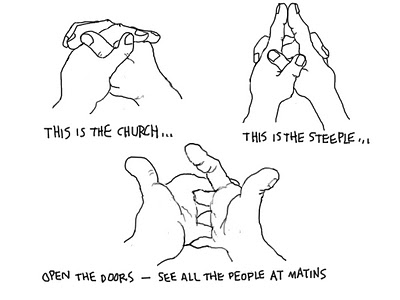
But apart from them, the Church is sometimes empty except for Priest and Cantor (me). We rarely have more than the “clergy” (Priest, Deacon, Cantor and maybe another Reader) at the very beginning of Matins. Occasionally that will happen in a weekday service, too. Usually one or two will arrive soon after the start, though. The inspired doodle above is (from Steve Robinson at Pithless Thoughts, shall we say, reality-based.
But it doesn’t bother me, at least not in the sense of “why do I bother?” I may regret that many who could be present don’t bother, and miss out (missing out on what is the point of this posting – read on). But many really can’t come, and that’s okay. We’re a small Parish, with lots of young families with children. I’d think there was something seriously wrong if those families dragged their young ones to Matins, which combined with Liturgy routinely runs almost 3 hours. Others commute as much as an hour each way. So I don’t expect them to come.
But by coming and singing, I myself – hard of hearing and heart – steep in the teaching and mind of the Church. Slowly, I’m absorbing it. That counts for quite a lot since I’m serious about my faith but have nearly 5 decades of baggage from other Christian traditions, each misguided about many things, to unload.
One of those pieces of baggage is how to approach scripture. I had already begun to write this when Father Stephen posted on “the hearing of the word.” It illustrates beautifully how the Church approaches scripture:
I am convinced after years of preaching and listening to preaching that the bulk of Scripture has become lost to our ears. We hear it, but fail to “hear” it ….
Much of my conviction on this matter has come in the last 12 years or more and my immersion into the services of the Orthodox Church. These services, long and with ample “hymnography” that is but a poetic commentary on the Scriptures and doctrines that surround any particular feast, are probably the richest surviving engagement with the Word of God to be found in a 21st century Church. Here no Reformation has occurred and reduced all Scripture to a “riff” on Justification by Faith, or a subset of Calvin’s paradigms. Here no Enlightenment has shown with its darkness of doubt and obfuscation.
Instead, there is a constant wonderment at the Scriptures themselves, as if the hymnographer were discovering something for the first time or had found a rare gem to share to any willing to listen – and all in the form of praise and thanksgiving to God.
It is true to say that in Orthodoxy, “Theology sings.” ….
…In our modern context most people have either been shaped by fundamentalist literalism; by modernist historical criticism; or by nearly nothing at all. In each case the Scriptures will not sing – they will not yield up their treasures.
I was struck by a particular case this evening – at the Vigil for Palm Sunday. The gospel account in question was the Matthean version of Christ’s entry into Jerusalem:
“And when they drew near to Jerusalem and came to Bethphage, to the Mount of Olives, then Jesus sent two disciples, saying to them, “Go into the village opposite you, and immediately you will find an ass tied, and a colt with her; untie them and bring them to me. If any one says anything to you, you shall say, `The Lord has need of them,’ and he will send them immediately.” This took place to fulfil what was spoken by the prophet, saying, “Tell the daughter of Zion, Behold, your king is coming to you, humble, and mounted on an ass, and on a colt, the foal of an ass.” The disciples went and did as Jesus had directed them; they brought the ass and the colt, and put their garments on them, and he sat thereon.”
Modern historical criticism hears in this only the “foolishness” of Matthew. Matthew has cited the prophecy in Zechariah that “your king is coming to you…mounted on an ass, and on a colt, the foal of an ass,” and has crafted his story in precisely that manner, placing Jesus astride two animals. The same critics will note that in other gospel accounts Christ is only on a “foal of an ass,” i.e., one animal. Historical Critics have a field day with such problems (I was first confronted with this “discrepancy” in my sophomore year of college – it was presented as if the professor had noticed something no one had ever seen before). Modern fundamentalists will rush to defend the integrity of the gospel accounts, “Two different eye-witnesses reported on the same thing and one emphasized one thing and the other emphasized another.”
Both explanations lack imagination and are precisely the sort of blindness that afflicts so much modern reading of Scripture. Listening to the hymnody for the Vigil of Palm Sunday, the hymnographer, without apology for the discrepancy, races to it and declares:
“O gracious Lord, who ridest upon the cherubim, who art praised by the seraphim, now Thou dost ride like David on the foal of an ass, The children sing hymns worthy of God, while the priests and scribes blaspheme against Thee. By riding an untamed colt, Thou hast prefigured the salvation of the Gentiles, those wild beasts, who will be brought from unbelief to faith! Glory to Thee, O merciful Christ. Our King and the Lover of man!”
… the ancient hymnographer has come closer to the heart of Scripture than either the modern sceptic or the modern literalist will ever know.
… The writers of the New Testament believed that everything in the Old, when read rightly would yield insight into the Messiah and the mystery of our salvation. But their creative insight (again, I believe it is inspired) is far removed from the flat-footed nonsense that we hear out of modern fundamentalist “prophetic” scholars, whose reading of the Old Testament is almost as poorly constructed as the 19th century false prophecies of the book of Mormon! Neither bear any resemblance to the treatment of prophecy found in the New Testament.
And thus I return to my original point. We have become deaf. We listen with ears either hardened by modernist scepticism, or by a false literalism that has substituted Darbyite nonsense for the Apostolic faith, or reduced Scripture to delicate harmonizations. None of them have the boldness and audacity of the patristic hymnographers who stood in the proper line of succession, proclaiming the faith as it had been taught and received and continuing to expound its mysteries. Thank God that somewhere in this modern world, you can still stand and listen to the wonders of our salvation, sung and unraveled before the unbelieving heart of man. Glory to God who has so loved mankind!
So, whether there’s a single soul besides me in church, I’m singing theology. I’m singing poetry. I’m expounding the mysteries of the faith. I’m unraveling the wonders of our salvation before my own unbelieving heart, made dull by 48 years of desperate harmonizations – “flat-footed nonsense.”
[If this sampling from Father Stephen has whetted your appetite, probably the most target-rich zone of audacious expounding of the Old Testament is the Great Canon of St. Andrew of Crete, sung in segments during the first week of Lent and then sung in its entirety Thursday of the 5th week. Download and savor.]
And in a sense that I’m slowly and dimly beginning to apprehend, we are doing the reconciling work of God. This gets into a sacramental view of the world, which I am unqualified to address and would surely botch if I tried. Perhaps another day.
Although I’m occasionally bone-weary when I go to sing, it’s always a very great privilege, and I benefit as much as anyone.
This recent post from Father Stephen expands on why I benefit from singing even in an empty church, particularly when I wrote that I “steep in the teaching and mind of the Church”:
What is often experienced at first as “boredom” (the sameness of the liturgy or the interminable character of the Psalms or Canon in some services) is nothing more than a description of something that exists for the nurture of the nous rather than the emotions and reasoning. Imagine walking with someone through a Redwood forest, or along a quiet beach and being told, “I’m bored.” In truth, the forest and the beach are quite common examples of noetic experiences that have yet to be eradicated or destroyed by our culture. It is not surprising that many people report an awareness of God in such settings.
I really should at least provide a hyperlink for nous, which is more than the first person plural French pronoun.
The Desire of the Nations
It is a strange yet incontrovertible fact that, when God did take flesh, He in many ways (though certainly not all) revealed himself to be closer in spirit to the Tao of Lao Tzu then to God as conceived by the Hebrews at that time, even though the Hebrews had the revelation of Moses. This might be difficult to accept by those who are accustomed to thinking of Christ as the fulfillment of the expectation specifically of the Hebrews. Ancient Christian tradition, however, holds that Christ satisfied the longing of all the nations.
Alasdair MacIntyre famously suggested that modernity is like the late Roman Empire, living on fragments of old ideas and practices that made sense only within a context that is now largely lost. Christian institutions, such as parishes, schools, hospitals, and aged-care and welfare agencies, might seem quite healthy. But they can easily lose their souls and become Christian “zombies” indistinguishable from secular NGOs.
…
As a young man, backpacking around Europe while deciding my vocation, I spent a fortnight in Florence. Two young guys from Seattle arrived at my youth hostel with only a day for Florence and asked me whether there was much to see! Though no expert, I offered to take them around. Engraved in my memory is an incident in the Uffizi Gallery. One of them turned to me and asked, “Who is the woman with the baby in so many of the pictures?”
[I]t came as something of a surprise that the Anglican bishops voted this week to stand firm on gay marriage. The result is somewhat qualified—the bishops also voted to permit blessings and prayers for same-sex civil partnerships and to issue a forthcoming apology about past sins against LGBTQ+ people. Archbishop of Canterbury Justin Welby, however, is apparently delighted:
This response reflects the diversity of views in the Church of England on questions of sexuality, relationships and marriage. I rejoice in that diversity and I welcome this way of reflecting it in the life of our church. I hope it can offer a way for the Church of England, publicly and unequivocally, to say to all Christians and especially LGBTQI+ people, that you are welcome and a valued and precious part of the body of Christ.
Or, to put it more concisely in the words of Neville Chamberlain, “Peace in our time.”
There is no point in converting people to Christ if they do not convert their vision of the world and of life, since Christ then becomes merely a symbol for all that we love and want already – without Him. This kind of Christianity is more terrifying than agnosticism or hedonism.
Rod Dreher, Schmemann and Social Justice. I suspect that Dreher was quoting or closely paraphrasing Fr. Schmemann, a towering figure in American Orthodoxy.
I don’t want my Sunday posts to turn political, but it seems to me that this may be relevant to the Donald Trump supporters who began calling themselves “Evangelical” without darkening the door of even the Trumpiest “church.”
Steve Robinson returns!
To my delight, I stumbled onto one of my favorite sporadic podcasters and doodlers, who apparently disappeared partly because of cancer, but it now back with the Pithless Thoughts II.
It appears that “sporadic” no longer fits, which is a good thing if I’m going to pay-to-read.
Do not subscribe expecting any political commentary.
More from Steve:
The internet gives us an omniscience about, and a platform to address the world in ways that were previously available only to God.
…
The problem is, we are not equipped to be God. Adam and Eve had one thing to control and could not deal with the temptation attached to it. They failed as “gods” in a near-perfect world in which only one thing in their world demanded a consequential choice. One thing. In one small place. With one clear instruction. No other people. No “big picture”. No big deal. Their world was as limited as their humanity. And yet they failed to be even as human as they could have been.
I don’t know if the world is bigger and more complicated because of the Fall, or if we have just not been able to keep up with it because of the Fall. Either way, we are not created with the capacity to deal with omniscience. Our finite humanness is created to obey God and let God be God and judge and control all things (to not “be God”). It is not created to “be God” and judge, control and respond to the entire world’s issues. Because we are not God and we live in a fallen world, we can only take in so much pain, evil and dissolution (on top of what is already in our own hearts and lives) before we break.
…
I’ve watched the internet for over 20 years now and I see the same thing happening. We are in a cultural and personal “psychotic break”.
The “break” is this: We are overwhelmed with an ungodly amount of information, we are tempted and called on to be “gods”, but we, by nature, incapable of omniscience. The world is big, out of control, gray and complex. We, on the other hand are small, relatively powerless and simple. At the intersection of the vast world and our limited humanity is the potential for “psychosis”. And it is ultimately a spiritual issue.
…
The hardest spiritual discipline, from the beginning, is to “stay in our human lane” and not fall for the First Temptation to “be like God, knowing good from evil”. All the evils in the world were brought about by that simple appeal to our human ego and the news of the world, no matter how intimate or global that news is, has tempted humanity since.