Making it up on our own

Over the Christmas holiday 1969-70, I attended Inter-Varsity Christian Fellowship’s “Urbana 70” Missionary Conference, along with, as I recall, 10,000 or so other young people.

Two episodes at the conference stood out in my memory these 50 years later. One is irrelevant for present purpose.

The other was an epiphanic episode wherein it was first announced that communion would be served to conferees at the University of Illinois Assembly Hall in a New Years Eve service. It made me feel all warm and comfy inside.

Then some spoilsport posed a question that conference organizers felt they must answer: By what authority was a parachurch organization enacting a sacrament of Christ’s Church? The question stunned this low Protestant boy, who had no answer, yet somehow felt that the proposed service was meet and right.

Organizers farmed the question out for answering to the late John R.W. Stott, low church only by the standards of high-church Anglicanism, who invented, live and in front of mostly smart and pious kids, a completely unpersuasive (and thus unmemorable) answer.

The show went on, but I was left pondering a conundrum, whenever that memory came back, until events decades later cut the Gordian knot: The questioner was right: IVCF had no authority to administer sacraments and should not have.

Inter-Varsity Christian Fellowship was tacitly Inter-Varsity Low Protestant Fellowship when the rubber met the road, just as Christian Legal Society was really Low Protestant Legal Society. It’s an error it’s easy to make in America, where even the public schools in my childhood were tacitly Protestant.

That episode in my life came back to me as I read the following in a paean to the late Rachel Held Evans:

At every conference she hosted, Communion was served, and the table was always open. She knew how important its tangible reminders were, especially for those told they had no business imbibing the bread and wine.

I crave your forgiveness if it seems too proximate to her death to say anything, but I didn’t go looking for this; RHE’s own friends brought it up to eulogize her, and I’m loathe to let it pass.

I don’t doubt that this felt right to her, and that she meant as well as she knew how to mean. But at this point in my life, it shocks me, as something analogous apparently shocked someone 50 years ago at Urbana 70.

My shock today has little or nothing to do with her table being open, with all that implies in the context of her life, because surely all that was on the open table was “bread and wine,” not the body and blood of Christ. My shock has to do with the scotoma of “sacrament” without church. (Learning the meaning of “one holy catholic and apostolic Church” was part of what cut that Gordian IVCF knot for me.)

Some critical analysis in a long-form piece from 30 months ago, which I just discovered, is highly relevant: Alastair Roberts, The Social Crisis of Distrust and Untruth in America and Evangelicalism. It surprised and delighted me with its insight into how we get anti-vaxxers, President Donald Trump, autodidact super-peers — and, by implication, your Uncle Harry the climate denier (who has “done a lot of research on this hoax”) and churchless sacraments. It’s longish, but joins a very select club of clipped articles I’ve tagged as “important.”

Let he who has ears to hear, hear: This is not about Rachel Held Evans; it is about Church, about rightful authority, about the erosion of trust in rightful authority, and about the unreliability of most of those who, uncredentialed, fill the resultant void.

* * * * *

You can read most of my more impromptu stuff at here. It should work in your RSS aggregator, like Feedly, should you want to make a habit of it.

I highly recommend blot.im as a crazy-easy alternative to Twitter (if you’re just looking to get your stuff “out there” and not pick fights).
Potpourri 2/22/19

1

“We’re in a cage match,” said Rob Renfroe, a conservative pastor in Texas who believes the denomination should break up. “The loser can’t get up off the mat. The winner is beaten up, bloody, battered.”

Frank Schaefer, a Methodist pastor who was defrocked and then reinstated after officiating his son’s same-sex wedding, is in full agreement. “It’s better for our LGBTQ community if we split,” he said.

… [M]any congregations object to allowing such differences on an issue they consider central to their faith, and are preparing for divorce—and for the disputes over church property that will inevitably follow.

“All of this comes down to money,” said Mandy McDow, the pastor of Los Angeles First United Methodist Church and a supporter of LGBT rights. “If people wanted to leave, they would have left a long time ago, but they would have had to give up their buildings and their pensions.”

Ms. McDow said she would be in St. Louis to see “the great divorce of my denomination. It’s going to be awful.”

Ian Lovett for the Wall Street Journal on United Methodists.

It boggles my mind, and should serve as a cautionary tale about Moralistic Therapeutic Deism, that both sides think the deep integrity of the Christian faith is at stake — especially when one side is thus tacitly condemning 20 centuries of its spirtual ancestors to the status of inferior pseudo-Christians.

But I agree with Mandy McDow. I’ve seen quite a few clergy who waited until retirement to follow their changed convictions into different Christian traditions, and had personal communication with one who was frank about the financial straits earlier “conversion” would put on his family.

I’m thankful that I did not have direct financial ties to the Christian Reformed Church (of course, one tends to do business with people one knows from Church) when, unbidden, my investigation into the falsity of a new Orthodox Church in town persuaded me of Orthodoxy’s truth.

2

Mr. Smollett deserves to be punished for his hoax to deter others. The media’s punishment will be its continuing loss of public credibility.

Wall Street Journal Editorial Board

Yes, but what of us putatively innocent bystanders, who’d like reliable news? Are we deluded about what we really want? Or have the appetites of our countrymen for sensational confirmation of their biases driven legitimate news out of the market?

I caught a few minutes of the CBS national news last night and quickly caught them eliding legitimate issues to fit complex stories into their narrative and their time-per-story constraints.

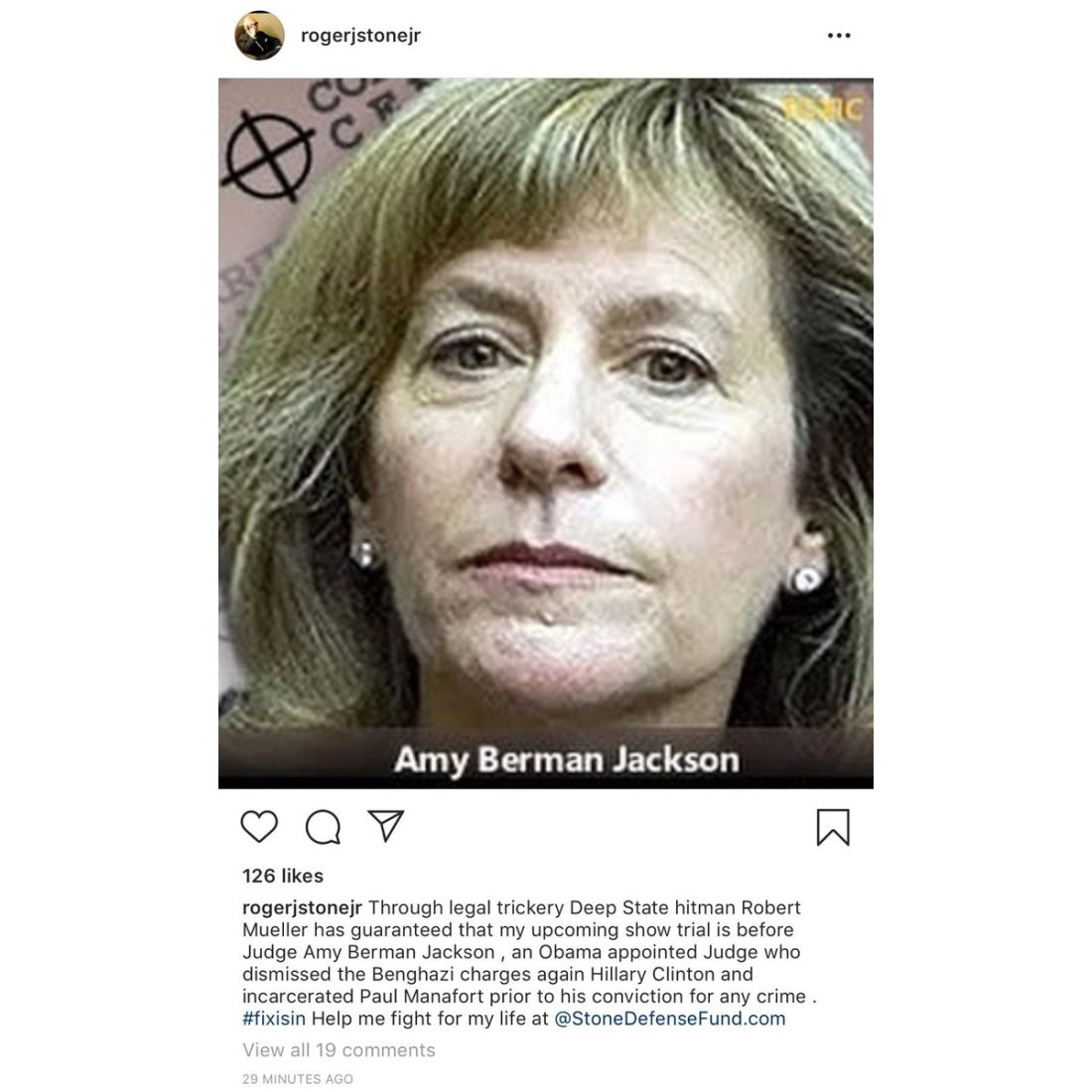
For instance, they tried to make sure that viewers would “see” a rifle’s crosshairs, oddly placed in the corner of a picture motormouth Roger Stone posted of Judge Amy Berman Jackson, when the lines were way too thick and too long, the placement was certifiably weird if a threat was intended, and the accompanying tweet was a plea for defense funds:

DzthWx-VAAAaYtR

Had I not listened to a legal podcast, All The President’s Lawyers, I probably would have fallen for that spin, for spin it was, becoming one of the semi- and mis-informed with a cartoonish notion of what’s going on, and who the good guys and the bad guys are.

And that’s probably what I am.

It’s impossible to read/view/hear and evaluate all world news at length. The sweet spot is knowing what matters, and that’s probably mostly local news, even as local media sink into insolvency that not even sensationalism can fix.

It may become necessary for local news to get its funding from patrons, not just from readers and advertisers, perhaps on the public radio model. We’re on terra incognita.

3

Should corporations, especially big, megarich ones, be given tax benefits for locating in a city or state? No, actually. They should come in simply as grateful and eager new citizens, especially in a place like New York, since there’s nothing like us. But that is not the world in which we live. In this world politicians are desperate to expand the tax base and brag about creating jobs. Companies can and do press every advantage.

Here is the truth: New York’s progressives weren’t tough, they were weak. They don’t know how to play this game.

You want to be tough and mean, get what you want, and keep those jobs for your constituents? Here was the play:

You don’t unleash the furies and hold hearings where crowds jeer, hiss and chant “GTFO, Amazon has got to go.” You don’t put stickers on every lamp pole saying “Amazon crime.” You don’t insult and belittle their representatives. You don’t become Tweeting Trotsky.

You quietly vote yes, go to the groundbreaking, and welcome our new partner in prosperity. Then you wait. And as soon as the new headquarters is fully built and staffed, you shake them down like a boss.

Peggy Noonan

4

A tax preparer in Russiaville, Indiana declined to do a repeat customer’s return when she showed up with her new “spouse,” also a “she.”

My first thought was that the culprit drew a dubious line. But then I thought back to the days after the Supreme Court littered same-sex marriage onto the nation’s legal landscape. I believe there were pledges circulating to “never recognize same-sex marriage in any way,” which was a tempting bit of proposed civil disobedience and which might fit doing a joint tax return.

The pair was able to get it’s “married filing jointly” return done elsewhere, of course.

In Indiana, there’s no law against what he tax preparer did.

Because her beliefs warrant respect, too, I’m content with Indiana’s status quo, the only argument against which is that it’s vitally important to Corporate America (and some United Methodists, but I digress) that sex trump all countervailing considerations and that we’ll be on its “naughty list” until our laws say so.

* * * * *

I left Twitter and I’m leaving Facebook, but you can read other stuff at Micro.blog (mirrored at microblog.intellectualoid.com) and, as of February 20, 2019, at blot.im, at both of which I blog shorter items. Both should work in your RSS aggregator, like Feedly.

Potpourri 1/16/19


1

When I’m looking for guidance in my life I always turn to a Dow 30 company … P&G (Gillette) for my relationship with women. Goldman Sachs for child rearing. Chevron for a mid-life crisis. Walgreen’s for spiritual insights.

A snarky Wall Street Journal reader on odd new Gillette ads. Suffice that I’m stickin’ with Harry’s.

2

[C]onsider what Sean Hannity had to say about taxing the rich. What’s that? You say that Hannity isn’t a member of the Trump administration? But surely he is in every sense that matters. In fact, Fox News isn’t just state TV, its hosts clearly have better access to the president, more input into his decisions, than any of the so-called experts at places like the State Department or the Department of Defense.

Anyway, Hannity declared that raising taxes on the wealthy would damage the economy, because “rich people won’t be buying boats that they like recreationally,” and “they’re not going to be taking expensive vacations anymore.”

Paul Krugman, Donald Trump and His Team of Morons. Now that is an epic Freudian Slip.

3

In their criticism of King, you get the sense that Republicans are actually relieved to be in the position of attacking racism for a change, instead of being forced to defend it from the president. They seem to be signaling that they are not really the bigots they appear to be. Republicans seem desperate to explain that they are normal and moral — despite all the evidence. Attacking King reveals some sense of shame at what they have become.

Yet, in the end, Republican critics of King manage to look worse rather than better. If racism is the problem, then President Trump is a worse offender. And the GOP’s relative silence on Trump is a sign of hypocrisy and weakness.

By any standard, Trump says things that are reckless, wrong, abhorrent, offensive and racist. Until Republicans can state this reality with the same clarity and intensity that they now criticize King, they will be cowards in a time crying for bravery.

Michael Gerson

This is a perfectly defensible opinion, and it is opinion that Gerson writes for the Washington Poast. The NYT crossed the traditional line by putting the equivalent sentiment it in news:

House Republican leaders removed Representative Steve King of Iowa from the Judiciary and Agriculture Committees on Monday night as party officials scrambled to appear tough on racism and contain damage from comments Mr. King made to The New York Times questioning why white supremacy is considered offensive.

Trip Gabriel, Jonathan Martin and Nicholas Fandos (emphasis added). But that traditional line has been pretty well obliterated by advocacy journalism, I fear, and editorializing within news stories is likely here to stay.

Now for my opinion: by uttering his most notorious sentence (“White nationalist, white supremacist, Western civilization — how did that language become offensive?”), Rep. King brought Western civilization into disrepute, and should be tarred, feathered, and rode back to Iowa on a rail. Censure is too mild.

4

Having announced a Presidential run, Rep. Tulsi Gabbard puts some distance between herself and the Democrat voices that keep telling me I’d better not vote for them if I value first-class citizenship:

Article 6 of the U.S. Constitution clearly states that there “shall be no religious test” for any seeking to serve in public office.

No American should be told that his or her public service is unwelcome because “the dogma lives loudly within you” as Sen. Dianne Feinstein (D-Calif.) said to Amy Coney Barrett during her confirmation hearings in 2017 to serve as U.S. Circuit Court judge in the 7th Circuit.

While I absolutely believe in the separation of church and state as a necessity to the health of our nation, no American should be asked to renounce his or her faith or membership in a faith-based, service organization in order to hold public office.

The party that worked so hard to convince people that Catholics and Knights of Columbus like Al Smith and John F. Kennedy could be both good Catholics and good public servants shows an alarming disregard of its own history in making such attacks today.

We must call this out for what it is – religious bigotry. This is true not just when such prejudice is anti-Catholic, but also when it is anti-Semitic, anti-Muslim, anti-Hindu, or anti-Protestant, or any other religion.

(Emphasis added)

5

The guy who called out Emily is named Herbert. He told “Invisibilia” that calling her out gave him a rush of pleasure, like an orgasm. He was asked if he cared about the pain Emily endured. “No, I don’t care,” he replied. “I don’t care because it’s obviously something you deserve, and it’s something that’s been coming. … I literally do not care about what happens to you after the situation. I don’t care if she’s dead, alive, whatever.”

But the “Invisibilia” episode implicitly suggests that call-outs are how humanity moves forward. Society enforces norms by murdering the bullies who break them. When systems are broken, vigilante justice may be rough justice, but it gets the job done. Prominent anthropologist Richard Wrangham says this is the only way civilization advances that he’s witnessed.

Really? Do we really think cycles of cruelty do more to advance civilization than cycles of wisdom and empathy? I’d say civilization moves forward when we embrace rule of law, not when we abandon it. I’d say we no longer gather in coliseums to watch people get eaten by lions because clergy members, philosophers and artists have made us less tolerant of cruelty, not more tolerant.

The problem with the pseudo-realism of the call-out culture is that it is so naïve. Once you adopt binary thinking in which people are categorized as good or evil, once you give random people the power to destroy lives without any process, you have taken a step toward the Rwandan genocide.

Even the quest for justice can turn into barbarism if it is not infused with a quality of mercy, an awareness of human frailty and a path to redemption. The crust of civilization is thinner than you think.

David Brooks, The Cruelty of Call-Out Culture.

This one caused me a bit of introspection, as I have on several occasions committed pre-internet acts of calling out, about which acts I’ll not go into detail. Let’s just say there can be a fine line between wanton cruelty and condoning by silence, and I may have landed on the wrong side of that line.

6

Without culture and its attendant explanation through story and ritual, what is left instead is “the quest for well-being,” where intellectuals “serve the public not in order to elevate it but to satisfy the need for novelty.” One need only look at the current adulation of TED talks or Silicon Valley to see confirmation of his prediction.

Gerald Russello, The Nonconformist, a review of Augusto Del Noce’s The Age of Secularization.

7

Wisdom requires us to ignore most provocations.

David Warren, The Wisdom of Sheep

* * * * *

Follow me on Micro.blog Follow me on Micro.blog, too, where I blog tweet-like shorter items and … well, it’s evolving. Or, if you prefer, those micro.blog items also appear now at microblog.intellectualoid.com.

Clippings, 1/4/19

1

A reminder that not all “Evangelical” Trump supporters are merely self-described Evangelicals who do not actually go to church:

You and other white evangelical leaders have strongly supported President Trump. What about him exemplifies Christianity and earns him your support?

What earns him my support is his business acumen. Our country was so deep in debt and so mismanaged by career politicians that we needed someone who was not a career politician, but someone who’d been successful in business to run the country like a business. That’s the reason I supported him.

Is there anything President Trump could do that would endanger that support from you or other evangelical leaders?

No.

That’s the shortest answer we’ve had so far.

Only because I know that he only wants what’s best for this country, and I know anything he does, it may not be ideologically “conservative,” but it’s going to be what’s best for this country, and I can’t imagine him doing anything that’s not good for the country.

Washington Post interview with Jerry Fallwell Jr..

Don’t lose sight of the credulity amidst that idolatry. Jerry Fallwell Jr. actually believes that Trump is a successful businessman, not conman and tax fraudster who played a successful businessman on Reality TV.

I bow deeply to young, über-progressive Godbeat reporter Elizabeth Breunig for her synopsis:

Jerry Falwell Jr. is once again spreading his uniquely modern, American version of a business philosophy roughly based on the religion known as Christianity.

He seems … to have been reasoning backward, trying to explain in Christian terms why he holds the conclusions he does, rather than beginning from the religion and following it to its own conclusions ….

Breunig is not doing the usual cherry picking of progressive or secularist “clobber passages.” She reminds me instead of the conservative American Christian who went to Europe, found people who shared his religious convictions, but was stunned to find that they considered themselves socialists.

2

[T]he problem is the emergence, over the course of a century, of a fourth branch of government neither conceived by nor desired by the framers of the Constitution: a network of administrative agencies that combine legislative, executive and judicial powers and therefore threaten the integrity of the constitutional framework and the basic rights of the American people …

But conservatives often misdiagnose the process by which the administrative state has arisen. We emphasize the hyperactivity of the executive and judicial branches, and these are certainly part of the problem. But hiding in plain sight is a deeper cause: the willful underactivity of the legislative branch. In an effort to avoid hard choices and shirk responsibility, Congress enacts vague statutes that express broad goals, empower executive agencies to fill in the practical details, and leave courts to clean up the ensuing mess. The result can look like executive overreach and judicial activism, but the root of the problem is legislative dereliction.

Yuval Levin, reviewing Judicial Fortitude by Peter Wallison.

Exactly. Thank you.

More:

[A] certain kind of judicial activism is actually a necessary precondition to judicial restraint and to any form of originalism: Judges must make sure that each branch of government does no more but also no less than the job the Constitution assigns it. “If Congress were permitted to delegate its exclusive legislative authority to the administrative agencies in the executive branch,” he writes, “the separation of powers would be a nullity and the dangers to liberty envisioned by the Framers could become a reality.” To avoid that, judges must insist that Congress engage in actual legislating by preventing it from handing over its power to regulatory agencies.

I very much like this idea. I’m tempted to buy the book to see how Wallison elaborates on “statutes that express broad goals, [and] empower executive agencies to fill in the practical details.” Is it just laziness, or is it fear of dark money ads ominously saying that “Congressman Schmoe voted against the Apple Pie, Motherhood and the Flag Act.”

3

I haven’t kept a scorecard, but I’ve been watching Kamala Harris since her days as California Attorney General, and she is toxic and hostile to people like me. Her treatment of Catholic judicial nominee Brian Buescher is not an uncharacteristic break in a record of tolerance, but just another mark of her progressive totalitarianism, her intent to use the levers of government to silence religious conservatives.

She is a very dangerous woman. And she’s generating a lot of buzz as the 2020 Democrat Presidential nominee.

* * * * *

Follow me on Micro.blog Follow me on Micro.blog, too, where I blog tweet-like shorter items and … well, it’s evolving. Or, if you prefer, those micro.blog items also appear now at microblog.intellectualoid.com.

“Paul, what do you mean???”

In the course of my opinionated life, I have from time to time disappointed people who thought I was their ally by exhibiting—I don’t what else to call it—sanity.

It probably was in the early 90s, for instance, when some of our local Religious Right leaders (who had some reasons to think I was their ally) went on the warpath against our local newspaper with the comic strips (of all things) as the focus.

Specifically, they objected that my beloved “For Better or Worse” (one of the most insightful and humane comic strips in my lifetime) had introduced a gay middle school boy into the strip’s cast of bit players. That was an outrage per se, whatever the lad did or didn’t do or say, and howsoever rarely he appeared at all.

In their war against it, they represented, as I recall, that X-thousand newspapers had decided not to run it, implying that they were dropping it because of the Great Subversion Of All That Is Right And Decent in Amurica (which wasn’t true; the count included all newspapers not running it, including those who never had).

As I say, I loved that strip, as did Mrs. Tipsy, so I responded in a letter to the editor that (a) they were effectively lying about the statistics with their half-truth about newspapers not running it, and (b) it’s just a comic strip, fer cryin’ out loud.

I think it was for that betrayal I got hit with an anonymous call wishing me an eternity in hell along with my 30 pieces of silver—a wish and an anonymity later rescinded, I must admit, though the experience was a wake-up call that left me unwilling to ally with them again.

[UPDATE: It was not for that betrayal. It was for my joining the call for resignation of a not-ready-for-primetime Christianish elected official, who kept stirring up controversy and recently had shot off an objectively anti-semitic email to a Jewish critic.]

That ole Religious Right spirit is alive and well today, but has been taken up by social justice warriors of the Left, who want Baby, It’s Cold Outside banished because she says “no” several times (he not getting her hat and coat at the first “no” is a per se distillation of All That Is Wrong And Rotten in Amerika) and speculates about what is in her drink.

They’re enjoying some success in their little crusade, and as someone who wants to put Mass back in Christmas, I would be churlish to deny them even an iota of grudging gratitude for reducing the rotation frequency of a seduction song during Advent.

And let it not be said that they’re without a sense of humor, albeit a grim one. One of them produced a Funny Or Die video of the song, choreographed as they (the dirty-minded neo-Puritans) see it.

I tip my hat to the New York Times for its story on the controversy, for the video link (with others, too, including one with Ricardo Montalban and another with Red Skelton) and for highlighting this comment to the story:

The “controversy” over this song is just plain silly. I remember Jerry Seinfeld was performing his comedy at a WH function. Paul McCartney was there and Jerry mentioned the song “I Saw Her Standing There.” Jerry quoted the lyrics “Well she was just seventeen….you know what I mean…” and Jerry looked at Paul and said “Paul, what do you mean???” Everyone including Paul laughed. I wonder if the radio stations will eventually ban “I Saw Her Standing There.”

I also thank the grim-jawed and humor-impaired SJWs for reminding us that sometimes a naughty song is, in the end, just a song and not a condensed symbol of ultimate evil.

(Baby, It’s Cold Outside, by the way, was the “party song” of the composers, at a time when, in their social set, you didn’t go to a party without some act ready to perform.)

* * * * *

Follow me on Micro.blog Follow me on Micro.blog, too, where I blog tweet-like shorter items and … well, it’s evolving. Or, if you prefer, those micro.blog items also appear now at microblog.intellectualoid.com.

Clippings, 12/12/18

1

Many in the pro-life movement, of which I am passionately a part, will consider the Harvard Law-educated intellectual [Ben Shapiro] a huge get. Not me. Despite Shapiro’s star power and stature, I consider his appearance a serious mistake for the March, one that will move us even further from being understood as the broad-based human rights movement we need to embody in order to go from fringe to mainstream.

Shapiro’s appearance is an especially ominous sign after last year’s appearance via satellite TV of President Trump — the absolute nemesis of more left-leaning pro-lifers like myself.

It was bad enough to have the movement associated with Trump. On his year’s stage, will Shapiro read his show’s regular advertisements for the U.S. Conceal-Carry Association? How will the crowd react when he does his daily promotion of his “Leftist Tears: Hot or Cold” tumbler?

The set of all pro-lifers is huge, politically diverse, and, as I have argued in these pages, more representative of the views of people of color than of white people — especially white liberals.

Unfortunately, while the March features the occasional Democratic politician or openly liberal pro-life activist, the speakers’ list and political tone in recent years have become overwhelmingly Republican and conservative. Increasingly, and especially with Trump speaking last year, those who identity with a different political ideology have been alienated from the most important pro-life march in the country — as well as the most important annual pro-life strategic meetings that surround the March.

This alienation is among the factors pushing non-conservative pro-life organizations such as New Wave Feminists, Rehumanize International, Secular Pro-Life, Democrats for Life, Consistent Life, among others, to hold alternative events at the March. This is a disaster for a number of reasons, among them that the pro-life movement will never meet our goals unless we can be understood as a broad-based human rights movement — and not merely as a Republican or conservative constituency.

Charles Camosy.

2

PETA is all in on Twitter’s hate speech policy:

Calling someone a “pig” or a “dog,” PETA observed, is “supremacist and speciesist.” Additionally, using such language may have the effect of “normalizing violence against animals and desensitizing people to their suffering.” …

On December 4, PETA posted a tweet against using anti-animal language, using its new tagline “Bringing Home the Bagels Since 1980”! Bagels? That was in lieu of the more readily recognizable bacon, which PETA wants to help us remove from our language (“bring home the bacon”), along with all other animal products from our diets and lives as a whole.

PETA also wants us to change our language because, as the tweet stated, “Words matter, and as our understanding of social justice evolves, our language evolves along with it. Here’s how to remove speciesism from your daily conversations.” To help us “Stop Using Anti-Animal Language,” PETA offered other substitutions …

The Twitterverse erupted in mockery and ridicule, at least according to the mainstream media. The next day USA Today ran the headline, “PETA ridiculed, criticized for comparing ‘speciesism’ with racism, homophobia and ableism.” The Washington Post said, “the Internet thinks they’re feeding a fed horse,” a poke at one of PETA’s suggested replacement phrases.

Mercatornet

3

[P]erhaps instead of secularization it makes sense to talk about the fragmentation and personalization of Christianity — to describe America as a nation of Christian heretics, if you will, in which traditional churches have been supplanted by self-help gurus and spiritual-political entrepreneurs. These figures cobble together pieces of the old orthodoxies, take out the inconvenient bits and pitch them to mass audiences that want part of the old-time religion but nothing too unsettling or challenging or ascetic. The result is a nation where Protestant awakenings have given way to post-Protestant wokeness, where Reinhold Niebuhr and Fulton Sheen have ceded pulpits to Joel Osteen and Oprah Winfrey, where the prosperity gospel and Christian nationalism rule the right and a social gospel denuded of theological content rules the left.

Ross Douthat

4

Those people keep having kids and being happy and ignoring us. Don’t they read? They do read, but the wrong things! Why don’t they read what we suggest? Don’t credentials matter to them?

Smugness is most uncomfortable facing jolly fecundity.

John Mark Reynolds, quoting Salutation.

5

Talk about a twist: He sought the presidency, as so many others surely did, because it’s the ultimate validation. But it has given him his bitterest taste yet of rejection.

Frank Bruni

* * * * *

Follow me on Micro.blog Follow me on Micro.blog, too, where I blog tweet-like shorter items and … well, it’s evolving. Or, if you prefer, those micro.blog items also appear now at microblog.intellectualoid.com.

Two clips, 12/11/18

1

Recently billboards have appeared along major U.S. freeways depicting Trump’s face and the quote from John 1 “And the Word became flesh.” Another saying on the billboards is “Make the gospel great again.” Predictably these billboards have raised concerns and questions. The Christians who sponsor the billboards have defended them, claiming that they do not equate Trump with Jesus Christ. But the billboards are what they are. Whatever the sponsor’s thoughts and intentions may be, the billboards scream out that Trump is “up there with Jesus” in terms of messiahship, saviorhood, worthiness of ultimate loyalty.

Again, whatever the billboards’ sponsors say, the billboards communicate a dangerous message and even the most die-hard Trump supporters must speak out against that message. I am not charging the billboards’ creators and sponsors with heresy, apostasy, blasphemy, or idolatry, but I will say the billboards’ message constitutes those. No amount of denial or defense can undo the message; the message is what it is.

Roger W. Olson

I hope that the sponsor, Make the Gospel Great Again, is a false flag operation (they’re not being campy about it—apart from the billboard itself), but the idolatrous echoes of 80 years ago, noted by Olson, prevent me being blasé about it.

2

A French reader e-mails Rod Dreher:

I told you in a previous email that after three centuries of an anomalous absence, anti-clericalism had finally arrived to America. Jenny Nagel proves me right and if things are going by the French textbook it’s only the beginning and Christians can expect the worse in years to come, without any possibility to answer in kind as the most vicious attacks will come from “protected minorities”. Being rubbished by despicable people is something French Catholics have had to live for two centuries, and American Christians will have to live it until either they regain control of the culture (unlikely at this stage) or stop being nice guys (and girls) and fight back. I know, that’s unlikely too – it hasn’t happened yet in France either.


* * * * *

Follow me on Micro.blog Follow me on Micro.blog, too, where I blog tweet-like shorter items and … well, it’s evolving. Or, if you prefer, those micro.blog items also appear now at microblog.intellectualoid.com.

Potpourri, 12/5/18

1

There is nothing NSFW about the thread — it’s just screenshots of these users’ profiles. Such as:

You get the idea. Twitter is kicking off anyone who “deadnames” or “misgenders” a trans person, but allows stuff like this.

Rod Dreher.

That was the last straw. I have deactivated my Twitter account.


2

When my conservative evangelical parents and I left the theater [after watching Boy, Erased, they said to me, “That was so powerful.” My dad observed, “Some movies seem to drag and lose your attention. Not this one.” My mom said, “It’s all just so sad — and cultish.” Evangelical Christians still tempted to embrace the conversion therapy framework should ponder why it is that two people who (unwittingly) reared a gay son while looking to James Dobson for parenting advice had that reaction to this film.

Not only has conversion therapy heaped false guilt on the shoulders of parents, it has left many of its participants unable to distinguish between true Christian holiness and the straitjacket of mid-twentieth century gender norms. It’s high time we left it behind and joined its victims in lamenting its sad legacy.

Wesley Hill.

Reading this reminds me that I once considered Joseph Nicolosi and NARTH “experts” on how homosexuality happens and how to “cure” it. I wasn’t deeply into it because I had no gayness to cure, but they guided my half-baked attitudes. It had not occurred to me that the parents of gay kids suffered false guilt because of those theories.

My attitudes may still be half-baked, but Wesley Hill and other abstinent gay Christians are who I listen to now.


3

Bryan Behar did something unconscionable.

He praised George H.W. Bush.

The former president had just died. In Behar’s view, it was a moment to recognize any merit in the man and his legacy.

Many of his followers disagreed. They depended on Behar for righteous liberal passion, which left no room for such Bush-flattering adjectives and phrases as “good,” “decent” and “a life of dignity.” How dare Behar lavish them on a man who leaned on the despicable Willie Horton ad, who nominated Clarence Thomas to the Supreme Court, who did too little in the face of AIDS, whose privilege often blinded him to need.

They lashed out at Behar. They unfollowed him. And they demonstrated the transcendent curse of these tribal times: Americans’ diminishing ability to hold two thoughts at once.

We like our villains without redemption and our heroes without blemish ….

Frank Bruni, who’s nearly as good as Ross Douthat this Wednesday morning. They’re both behind the New York Times’ metered paywall, so choose Douthat first; it’s a column for the ages — I highlighted almost every word in my “keeper” copy. His thesis is we’re pining for WASP aristocrats like 41, because the meritocrats (starting with 42) are such a sorry lot in comparison.


4

From Douglas Murray’s The Strange Death of Europe:

In October 2015 the Hungarian Prime Minister, Viktor Orban, criticised Soros publicly as one of a circle of activists who “support anything that weakens nation states.” Soros responded publicly to confirm that the numerous groups he was funding were indeed working for the ends described by Orban. In an email to Bloomberg, Soros said that it was his foundation which was seeking to “uphold European values,” while he accused Orban of trying to “undermine those values.” Soros went on to say of Orban: “His plan treats the protection of national borders as the objective and the refugees as an obstacle. Our plan treats the protection of refugees as the objective and national borders as the obstacle.” The dialogues ceased before anyone could ask Soros how long those European values might last once Europe could be walked into by people from all over the world.

… Orban leads a tiny and relatively poor Central European country of fewer than 10 million people, is desperately attempting to prevent that country from committing cultural suicide like the rest of Europe. It is hard for Americans to understand what the world looks like from the perspective of a country like that …

… Orban considers Soros’s university to be an agent of real corruption in the heart of his embattled nation. Consider something as petty as the gender studies program at the university. That’s a garbage discipline that promotes an ideology that destroys marriage and family …

Rod Dreher.

One may, I suppose, view Soros’ project as benign or even admirable, but I am sympathetic to Orban (and suspicious—cui bono?)—that billionaire Soros’ “Open Society” is designed in part to clear the path, for him and his kindred, to more billions.


5

A few years ago, I first encountered members of a fundamentalist church who believed that fiction is wrong. They taught that reading about characters and events which are not literally real violates the ninth commandment because it involves sentences which, out of context, convey falsehoods. “Once upon a time there lived a princess named Snow White” is a lie, according to this thinking, because there technically never was such a person.

When I asked these Christians to explain Jesus’ parables (which are stories), they insisted that there really must have been a Prodigal Son, a Good Samaritan, and a man who built his house on the sand! They couldn’t prove this claim, of course, except by begging their first principle that all technical non-facts are lies. I pointed out that this was circular. That was more or less the end of the discussion. I think we moved on to debating whether C. S. Lewis was a warlock.

Is Santa Claus a lie?


6

Even for a hit piece the article feels incredibly forced, ham-fisted and desperate. Reading it gives you the feeling as if [name omitted] is leaning way into your personal space, pressing his face against your ear, and saying “You are not to believe the things that horrible man says about what is happening in your world. I will tell you what you are to believe about those controversial events. Big Brother is your friend. You love Big Brother.”

Caitlyn Johnstone

Johnstone embeds a video without (that I noticed) saying why, but it’s an interview of Noam Chomsky by journalist Andrew Marr, with a typical click-baity description. Excerpts:

Chomsky: … Unpopular ideas can be silenced without any force.
Marr: How?
Chomsky: He [Orwell] gives a two-sentence reponse … “Two reasons: The press is owned by wealthy men who have every interest in having certain things not appear; but, second, the whole education system from the beginning on through, gets you to understand that there are certain things you just do not say ….”
Marr: This is what I don’t get. It suggests that [unintelligle] are self-censoring …
Chomsky: Not self-censoring. There’s a filtering system that starts in kindergarten and goes all the way through … It selects for obedience and subordination. And especially …
Marr: So stroppy people won’t make it …
Chomsky: … behavior problems. If you read applications to graduate school, you’ll see that people will tell you “he’s not good, doesn’t get along too well with his colleagues,” and you know how to interpret those things.

Marr: How can you know that I’m self-censoring?
Chomsky: I’m not saying you’re self-censoring. I’m sure you believe everything you’re saying. But what I’m saying is that if you believed something different, you wouldn’t be sitting there.

Chomsky speaks softly and confidently, but this is a perverse example of Bulverism.

The inverview video is just a clip of a longer video, so maybe Chomsky gets into how Marr is wrong, and not just why (i.e., he’s been carefully groomed and filtered and deemed worthy to front for The Man). But that Johnstone might think the clip profound does not speak all that well of Johnstone, who always writes colorfully and entertainingly, but also, too often, flippantly, in the sense of assuming that the joke on her target has already been made, and that it’s time for ritual mockery.


7

“Deplorables” was bad, but the most insulting thing anyone said about Trump supporters in 2016 was said by Trump himself: “I could stand in the middle of Fifth Avenue and shoot somebody and I wouldn’t lose any voters.”

Can you live down to that, Trump fans?


8

Rudy makes a fool of himself. Details. Summary:

Giuliani spent 16 years as a security consultant and was originally brought on to the Trump team as a cybersecurity adviser. Be terrified. https://t.co/OTK6KERlyT

— Alex Laird (@alexdlaird) December 5, 2018

All because he can’t type, accidentally creating the URL G-20.in, and then tried to blame a Twitter conspiracy against him.


* * * * *

Follow me on Micro.blog Follow me on Micro.blog, too, where I blog tweet-like shorter items and … well, it’s evolving. Or, if you prefer, those micro.blog items also appear now at microblog.intellectualoid.com.

Jonathan Chau

There’s a fair amount of buzz about the death of American Jonathan Chau at the hands of Sentinelese islanders near India. Here’s the New York Times, for instance.

A secularist blogger at Patheos seized the opportunity to mock and vilify Christians, some (perhaps many) of whom are calling Chau a “martyr.” One group even wants the Sentinelese killers prosecuted. (That group is laser-focused on persecution of Christian around the world, so it has an incentive to see every Christian’s violent death as a persecution.)

Here’s my own initial and limited take.

There is no inconsistency between (1) recognizing the illegality and foolhardiness of Chau’s effort and (2) acknowledging him as a martyr because he was trying to preach the Gospel.

But I personally do not call Chau a Christian martyr because he is in almost every way not worthy of emulation:

  1. He was not in communion with the Orthodox Church, but rather with a group multiple schisms removed from it — a group I might even think heretical if I knew more about it than the debased label “Christian.” That he graduated from Oral Roberts University is no reassurance.
  2. He was deliberately violating a reasonable law that was not enacted to prevent evangelization of the Sentinelese. (That’s setting aside any question about what it was intended to do.)
  3. He was, from what I’ve read, totally unprepared actually to evangelize the Sentinelese; he didn’t know their language and he had no training to master languages from scratch. I’m not even sure that he was any kind of commissioned missionary (versus an enthusiastic world traveler).
  4. He was, frankly, grandstanding. Whatever else he was doing, he was doing that. (I might be dissuaded on this point.)
  5. The Sentinelese killed him for his invasion of their island, not for his faith.

In short, I see his letters home as a sort of “hold my beer (and don’t call the Coast Guard) while I go through the motions of declaring Jesus to these folks who won’t understand me and who I can’t understand. And tell Mom I love her.”

God is merciful and loves mankind, so I still can hope for a blessed repose for this foolish and willful young man.

UPDATE 11/29/18: I have just learned that Chau did have some preparation, including linguistic training, vaccinations and quarantine, and was commissioned as a missionary. I need to acknowledge that in light of my third and fourth points and my snarky summary—all based on what I knew or had reason to know at the time I wrote them.

If you want to understand what might motivate a young man to take a very high risk with his life (and his freedom if caught by legal authorities), Ed Stetzer’s “Acts of Faith” item in the Washington Post would be good to read.

UPDATE 2 (reaching this group was a long obsession of Chao, and the missionary agency boot camp was oriented to that, making the mission agency complicit in the illegality).

* * * * *

Follow me on Micro.blog Follow me on Micro.blog, too, where I blog tweet-like shorter items and … well, it’s evolving. Or, if you prefer, those micro.blog items also appear now at microblog.intellectualoid.com.

Alan Jacobs on Evangelicalism

Some very sharp observations by Alan Jacobs in a Los Angeles Review of Books interview. I’ll not highlight as you should read it all (if at all) and let Jacobs himself guide you:

I felt that [Marilynne] Robinson was, in many cases, using her entry to the liberal intelligentsia — she can always be published in the NYRB or wherever else — to be very critical of her fellow Christians, and I just wished that went the other way around. I wished she would use her opening with the liberal intelligentsia to be more critical of them.

But, I’ve got to say, there’s been a bit of a change in my thinking that can be deeply identified with the 80 percent rate at which white evangelicals — or people who call themselves evangelicals — voted for Trump. When that happened, I thought, maybe Marilynne Robinson is more right about my fellow evangelicals than I was, you know? At that point, I thought maybe I should just drop my criticism of her, she may have been right after all.

That was a very distressing moment for me. I knew there would be a lot of support for Trump simply because he was the Republican candidate. I didn’t expect it to be that high. What I expected was more of a nose-holding posture — like, I don’t like this guy, I don’t approve of his personal life, I don’t approve of many things about him, but he’s the lesser of two evils. What we got instead was a great many Christians refusing to acknowledge that there’s anything evil here at all — he’s great, he’s wonderful, he speaks for us. And I will have to admit that I was taken aback, not so much by the willingness of evangelicals to vote for him, but by the enthusiasm with which they voted for him.

And then I started looking into things a little more, because I was curious about this phenomenon. And I came to realize that a lot of people who are willing to claim the name “evangelical” are actually people who don’t go to church and couldn’t sum up what evangelical belief is. They just don’t know.

And while some see that as good news, that the people who voted for Trump aren’t really evangelicals, that’s not the lesson I took from it. The lesson I took from it is: How many of us are there? We used to think there are a lot of evangelicals in America. Maybe there aren’t very many people who are sufficiently formed in the Christian faith to be able to say what it is.

So, what does “evangelical” mean?

Right now, I have no freaking idea. [Laughs.] I couldn’t begin to tell you.

What is it supposed to mean?

So, the most classic definition is one that was coined by Scottish historian David Bebbington (you can Google the term “Bebbington quadrilateral”), and it consists of these four things: evangelicals are people who believe in a conversion experience; they believe in the authority of scripture; they have a theology centered on the cross, and Jesus’s atoning work on the cross; and, as Bebbington puts it, they engage in a theologically informed activism, they get out there and preach the gospel and try to win people over. Some have suggested revisions to that, but that’s the general thing.

And what we’re looking at now is that many of the people who call themselves “evangelical” in polls are people who actually could not in any meaningful way affirm any of those four things. But that’s not encouraging to me, because what that suggests is that there are all these people who have some kind of tribal association with the word “evangelical.” And that means that evangelical churches have allowed themselves to degenerate into a kind of tribalism, rather than theologically informed, compassionate activism.

* * * * *

Follow me on Micro.blog Follow me on Micro.blog, too, where I blog tweet-like shorter items and … well, it’s evolving. Or, if you prefer, those micro.blog items also appear now at microblog.intellectualoid.com.