I was familiar with all the intellectuals named except Jordan Hall, and they all seem to fit Brad East’s year-old Conversions, Protestantism, and a new mainline commenting on the rarity of intellectual conversions to Protestantism as opposed to catholic traditions. Add to Brad East’s exploratory hypotheses about that phenomenon those of Fergus McCullough, Why don’t intellectuals convert to Protestantism?.
Not too long ago, I was telling Ezra Klein that I had noticed a relatively new development in classical liberalism. If a meet an intellectual non-Leftist, increasingly they are Nietzschean, compared to days of yore. But if they are classical liberal instead, typically they are religious as well. That could be Catholic or Jewish or LDS or Eastern Orthodox, with some Protestant thrown into the mix, but Protestants coming in last.
As an Orthodox Christian, I take no offense at intellectual converts gravitating in a catholic direction, but for a number of reasons, I’m not doing an end-zone dance about it, either, unlike one (Roman) Catholic bishop in Texas:
Catholicism will be nihilism’s last competitor on the dance floor of history, and Catholicism will see it drop from exhaustion as the orchestra plays on. The music itself will testify.
Bishop Daniel E. Flores of Brownsville, Texas
But so what?
Men are apt to prefer prosperous error to an afflicted truth.
Those evangelicals of intellectual bent should be wrestling with this question, though.
Carefully Rehearsed Spontaneity
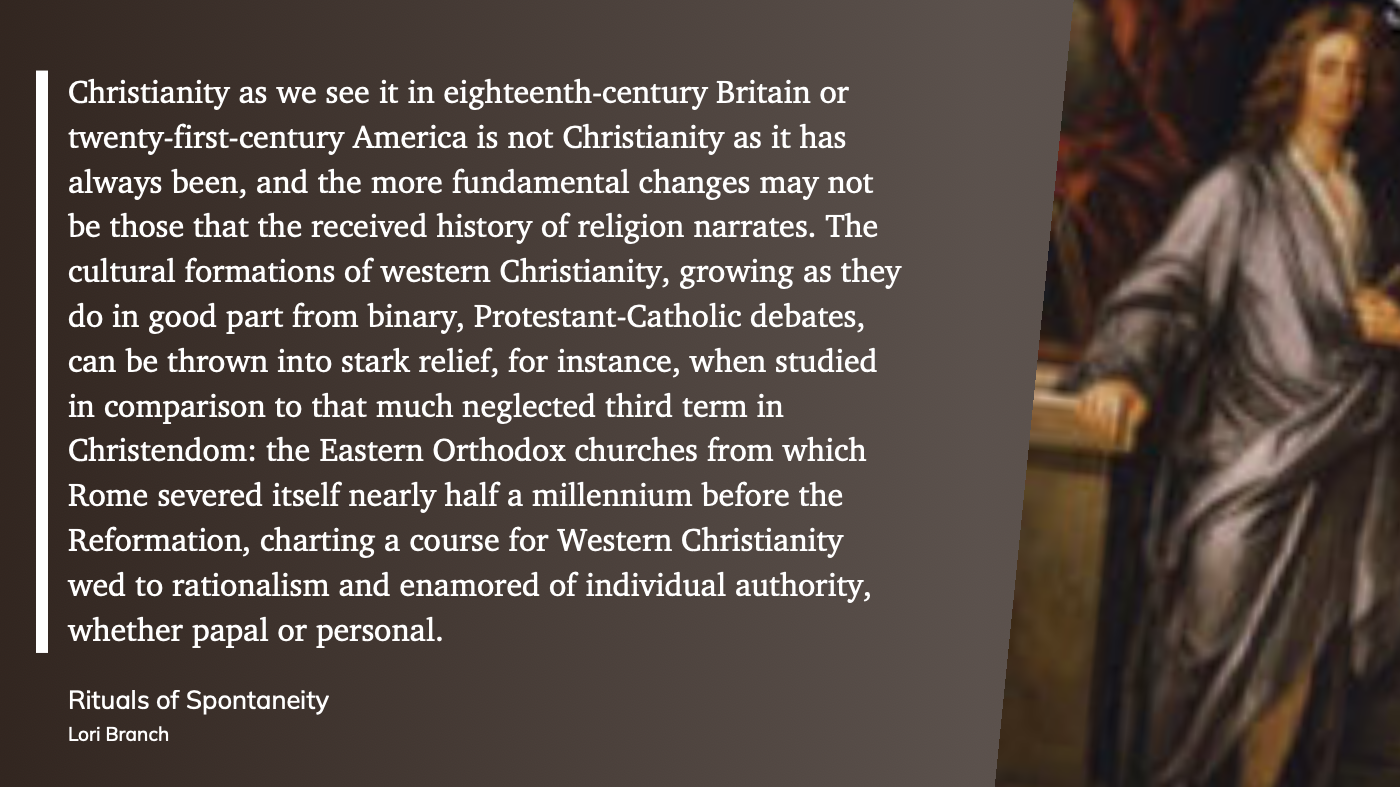
The framers of the Directory [for the Publique Worship of God] were not unaware of its paradoxical stance vis-à-vis ritual, either. Its preface obliquely acknowledged the oddity of institutionalizing a prescribed means of praying when Puritan teaching held that converted people would pray aright by the Spirit, but offered it as “some help and furniture” to the minister, so that he might “furnish his heart and tongue with Materials of Prayer and Exhortation, as shall be needful” (7-8). The careful, italicized language of the Directory, meant to be paraphrased but not displaced altogether, embodies a sort of anxious, secret checking of spontaneity that is in fact part and parcel of its logic. In spite of the selection of a man who appeared a trustworthy minister of God’s word, not only might his prayers stray from sound doctrine, but more than that, they might not flow freely, spontaneously, and affectively at all. In referring to the guide as “help and furniture,” the Directory portrays what it believes should be a modern, rational, self-transparent, and spontaneous self, operating under what it figures as deformities, weaknesses, and handicaps: seeking to authenticate its goodness and wholeness, yet perennially afraid of its inner divisions, the demand of its repeated performance, and perhaps most of all of its silences.
In this way, the Directory also looks toward the spiraling anxiety. That is one of the enduring legacies of Protestant and English dissenting spirituality in the restoration and enlightenment. More paradoxically than the writers of the Directory, Dissenters later wrote a vast literature to instruct those within their camp in the art of praying spontaneously. This literature too begs the question of why free prayer needed coaching, a query many dealt with directly. But it also sets forth as its most common recommendation for achieving true prayer the collection of lists of phrases, usually from Scripture, which once memorized would roll off the tongue and be easily assembled into prayer on the spur of the moment. Where the Directory‘s very form expresses the implicit knowledge that spontaneity is no real guarantor of (doctrinal or spiritual) truth, these free-prayer guides murmur with the fear that spontaneity may not come at all. While they seek to fill the mind with scriptural phrases, constructing, in Matthew Henry’s words, a “Storehouse of Materials for Prayer,” they also speak another truth. Besides being furnished with nonorthodox materials, the self that flees performativity and ritual, looking inward for authentic substance, finds itself fluctuating and, in the face of the demands of performance and empirical, experimental repetition, often silent and empty.
…
[Matthew] Henry’s Method culminates with his most fascinating phrase-collection of all, “A Paraphrase on the Lord’s Prayer, in Scripture Expressions.” Christ’s own form of prayer given to his disciples had long been a thorn in Puritans’ sides, to be plucked out by being understood as only a general guideline. Henry’s strategy is to neutralize the prayer’s form in a similar method; he provides, for instance, and amazing two and a half pages of verses elaborating on the one phrase “Our Father, who art Heaven” (MP, 163-65), a general topos, he says, from which prayer begins. Many editions of the Method were printed as Henry intended, interleaved with one blank page between each printed one, to enable the reader to pen in his own collection of phrases to supplement Henry’s own. Like Bunyan’s demand for scrupulous sincerity, Henry’s lists and blank pages, figures of accumulation and abstraction, combine literally to efface the Lord’s Prayer and erase it from Dissenting practice.
…
The more individualized these spiritual practices became, like the personalized collections of scriptural phrases, the more readily their constructedness-their nonspontaneity-was apparent, opening the believer to a sense of isolation and perpetual, nearly neurotic self-critique …
This fake spontaneity persists in verbal tics like “Father God, we just” this, that, or the other thing. It’s like refrigerator magnet poetry only less creative.
The sober prayers of the Book of Common Prayer always secretly guided me when, as a Calvinist Elder, I was to lead congregational prayer, and those of the Orthodox Prayer books had an outsized influence on my eventual embrace of Orthodoxy.
Watch what they do, not what they say
Paradoxically, therefore, the structures necessary for the Reformers to extend the sacred into all of life included a whole constellation of structures and practices that they undermined. For if everything is sacred, then in another sense, nothing is sacred. This struck me in a particularly visceral way one Sunday morning at the Calvinist church in Idaho. After the service, I went to use the restroom and found leftovers of Communion bread in the bathroom garbage. The clergy routinely gave leftover bread and wine to the children to consume as a snack, which the children could then take wherever they wished.
You can read most of my more impromptu stuff here and here (both of them cathartic venting, especially political) and here (the only social medium I frequent, because people there are quirky, pleasant and real). All should work in your RSS aggregator, like Feedly or Reeder, should you want to make a habit of it.
I have long admired David Brooks, and a few years ago I heard fairly detailed rumors about his embrace of Christian faith — without ceasing to identify as Jewish.
When I was an agnostic, I thought faith was primarily about belief. Being religious was about having a settled conviction that God existed and knowing that the stories in the Bible were true. I looked for books and arguments that would convince me that God was either real or not real.
Some people are spiritual but not religious; during that time, you could say I was religious but not spiritual.
…
When faith finally tiptoed into my life it didn’t come through information or persuasion but, at least at first, through numinous experiences …
…
Sometimes people hear about my religious journey and ask me about my “conversion,” but that word is a relic from the rationalist mentality — as if I traded one belief system for another. The process felt more like an inspiration, like someone had breathed life into those old biblical stories so that they now appeared true.
Today, I feel more Jewish than ever, but as I once told some friends, I can’t unread Matthew. For me, the Beatitudes are the part of the Bible where the celestial grandeur most dazzlingly shines through. So these days I’m enchanted by both Judaism and Christianity. I assent to the whole shebang. My Jewish friends, who have been universally generous and forbearing, point out that when you believe in both the Old and New Testaments, you’ve crossed over to Team Christian, which is a fair point.
…
We religious people talk about virtue so much you’d think we’d behave better than nonreligious people. But that’s not been my experience. Over the past decade, especially in the American church, I’ve seen religious people behaving more viciously, more dishonestly and, in some ways, more tolerant of sexual abuse. I sometimes joke that entering the church in 2013 was like investing in the stock market in 1929. My timing could have been better.
Still, I’ve been grateful to live in an enchanted world, to live toward someone I can seek and serve. I’ve been grateful to have to learn and relearn yet another startling truth, that faith is about yearning but it’s not about striving. You can’t earn God’s love with good behavior and lofty thoughts, because he’s already given it to you as the lavish gift that you don’t deserve. “I prayed for wonders instead of happiness, Lord,” Abraham Joshua Heschel wrote, “and you gave them to me.”
Three decades ago, I might have snorted and said “this guy is no Christian!” Or maybe I wouldn’t have. It’s hard to remember all of my past attitudes, and tempting to caricature them. But I’m confident that I would at least have felt that this account was alien and challenging to my then-understanding of Christian faith. Today, I find his account quite sympathetic, as, I think, the late Bishop Kallistos Ware would have as well:
Faith is not the supposition that something might be true, but the assurance that someone is there.
And I have it on reasonably good authority that most uses of “faith” in English-language Bibles would better be rendered as “faithfulness,” which is especially salient this morning as the gospel reading (on the Orthodox “new calendar”) is much of Hebrews chapter 11.
Chistianities: thin, sharp, thick
Jonathan Rauch, in conversation with David French (unlocked), divides Christianity in the US into thin, sharp, and thick versions. It’s of concern to him — gay, atheist and Jewish — because he has come to see that Christianity is congruent with liberal democracy and our liberal democracy may need it for survival.
I’ve rejected untold times the idea that Christianity is only important in publicly instrumental ways, but that doesn’t mean it isn’t important in those ways. And I thought Rauch’s descriptions of thin and sharp Christianities are pretty well on target.
It seems to me, though, that Rauch’s example of what constitutes thick (i.e., useful) Christianity is off-base:
This is what’s been missing. Christians have a teaching about how individuals should relate to the world around them. If there’s a hurricane in Asheville, the stories of what the church is doing are fantastic. But they don’t have a teaching about how to engage politics as Christians. And that leads me to realize what the Church of Jesus Christ of Latter-day Saints is actually modeling is a whole civic theology, and that’s what Christianity needs more of: teachings about how would Jesus approach politics.
I think my concern arises because Rauch is seeing Christianity largely in instrumental terms. Or maybe it’s because I’m having trouble figuring out how a Church stays thick while diverting attention to thinning civics (“teaching about how to engage politics as Christians”). Or maybe I recoil at the thought that anything good could come out of Salt Lake City.
The inevitability of ritual
In England, the two kinds of churches I do still see filling appear rather different. In a local baptist church the pews are crammed with young families having powerful, intimate encounters with their faith. Something immediate is being accommodated. I remember seeing a guy fresh from a building site, dusty with a high viz jacket. Family with him, arms outstretched, tears on his cheeks. It would bring a lump to your throat.
Then I see my own parish, hushed and seemingly antique, but with more young people than ever before. In both I see people who look spiritually fed. Then out there in the wider audit of emptying churches there seems often to be a sense of weariness, or simple lack of oomph. There will be exceptions to this last sentence, I have no sneer in writing it. I sometimes go sit in those congregations simply out of love for the yards they’ve put in as parishioners. Solidarity, a hand held across the fence to a fellow worker bee.
It seems, from a distance, the two churches are very different, and I am well aware of the theological wrestles that create distance. What I don’t go along with is the notion that one is completely improvisational and unencumbered by tradition, and the other set-and-only-set in a kind of endless, ancient theatre or lifeless ceremony. Dame Mary Douglas, a cultural anthropologist, encapsulates something she calls the ‘anti-ritualist’ approach:
The confirmed anti-ritualist mistrusts external expression. He values a man’s inner convictions. Spontaneous speech that flows from the heart, unpremeditated, irregular in form, even somewhat incoherent, is good because it bears witness to the speaker’s real intentions.
I think actually, ritual is inevitable, even when tacit. We are ceremony people, no matter how spontaneous we think we may be. There will be a loved formula, a linguistic groove long established, a shared initiatory language in common for any community that lasts. It’s about the dynamic counterpoints of tradition and innovation. We may have done away with the candles, offerings and holy smoke, but simply to feel safe repetition will always have value.
It is noteworthy that no institutional form of religious persecution was ever introduced in the Christian East. Because of Western historiographical ignorance of the Orthodox Church, however, the inquisition would come to represent, for secular intellectuals in modern times, the illegitimacy of any civilization grounded in Christianity, whether Western or Eastern.
John Strickland, The Age of Division
Fully God, fully man
And from this we draw a refutation of Eutyches: since Christ is declared to be the fruit of the womb. And all fruit is of the same nature as the parent plant: so it follows that the Virgin also was of the same nature as the Second Adam, Who takes away the sins of the world. And let those be ashamed at the true child-bearing of the Mother of God, who have invented some fantastic notion concerning Christ’s Body; for the fruit proceeds from the very substance of the tree. And what of those who say that Christ passed through Mary as water through a channel? Let them hearken to the words of Elizabeth, who was filled with the Holy Ghost; saying that Christ was the fruit of the womb.
Severus (of Antioch) via Jonah (of micro.blog). Emphasis added because I heard somebody on WMBI say exactly that (actually, she said “pipe” rather than “channel”).
If Christ passed through Mary as water through a pipe, where did He get His humanity, which all Christians now confess? How do you get to “fully God and fully man” if Mary was just a pipe?
Denying Christ’s humanity is a pretty high price to pay for dodging her whose “fiat mihi secundum verbum tuum” is a crucial element in the story of our salvation.
A terrible choice
Christians in Germany will face the terrible alternative of either willing the defeat of their nation in order that Christian civilization may survive, or willing the victory of their nation and thereby destroying our civilization.
Dietrich Bonhoeffer
Sometimes this whole 2000-year-old faith seems like a living koan. Chew on this until you are enlightened. Keep walking.
You can read most of my more impromptu stuff here and here (both of them cathartic venting, especially political) and here (the only social medium I frequent, because people there are quirky, pleasant and real). All should work in your RSS aggregator, like Feedly or Reeder, should you want to make a habit of it.
The Puritans quickly developed a phobia about ritual, going so far as to resist “rote” recitation of the Lord’s Prayer:
Henry’s Method culminates with his most fascinating phrase-collection of all, “A Paraphrase on the Lord’s Prayer, in Scripture Expressions.” Christ’s own form of prayer given to his disciples had long been a thorn in Puritans’ sides, to be plucked out by being understood as only a general guideline. Henry’s strategy is to neutralize the prayer’s form in a pages of verses elaborating on the one phrase “Our Father, who art in similar method; he provides, for instance, an amazing two and a half Heaven” (MP, 163-65), a general topos, he says, from which begins. Many editions of the Method were printed as Henry intended, interleaved with one blank page between each printed one, to enable the reader to pen in his own collection of phrases to supplement Henry’s own. Like Bunyan’s demand for scrupulous sincerity, Henry’s lists and blank pages, figures of accumulation and abstraction, combine literally to efface the Lord’s Prayer and erase it from Dissenting practice.
Between the ledgerlike pages of Henry’s collected phrases and the blank sheets for scribbled lists of readers’ personal prayer phrases, one senses of variety of fears: that without this careful accounting, the business might go bankrupt, that in the copious, nervous quoting from God’s word to talk and talk and talk to God, God might not listen or respond at all.
Moreover, Reformation scholars tend analytically and in their division of labor to hive off the magisterial Reformation-Lutheranism, Reformed Protestantism, and the Church of England-from the radical Reformation. Consequently, whether oriented primarily toward theology or toward social history, they have overlooked the significance of the principle of sola scripture for contemporary hyperpluralism.
When I first opened A Severe Mercy nearly 20 years ago I had needed a vision of Christian faith that was unapologetically devoted to Christian doctrine without being materialistic, more American than Christian, and completely uprooted from history. Up to that point, the expressions of Christianity I had encountered were simply different forms of sectarian faith—a vapid progressivism or a parochial and narrow fundamentalism. Vanauken gave me catholicity ….
In practical terms, the Reformed commitment to the theological significance of everyday life led to the development of something like Protestant metaphysics, Protestant epistemology, Protestant science, Protestant politics, Protestant social and economic theory, Protestant art, and Protestant poetics. The development of these Reformed spheres of intellectual and cultural activity never occurred without substantial influence from sources not specifically religious. In Switzerland, the southern German regions, Hungary, Holland, and the British Isles, the Reformed perspective could be used to mask economic or political aggression. More commonly, it emerged from a complicated mix of sacred and secular motives. Yet wherever sufficient Reformed strength existed, the assumption also existed that biblical Christianity had something fairly definite to say about everything.
Some of us have been glued to the BBC on a Sunday evening this autumn watching Mark Rylance return mesmerically as Thomas Cromwell in the second series of Wolf Hall. This all takes place in the era of the Reformation, and a particular scene has stayed with me. Surrounded by crosses lifted from churches, Cromwell says the following:
The English will discover God in daylight, not hidden in a cloud of incense. They will hear his word in their own language from a minister who faces them, not turning his back and muttering in some obscure, foreign tongue…no one will ever believe the poor once bowed and scraped to stocks of wood, and prayed to lumps of plaster.
I have such a mixed response to this brilliant bit of writing.
I went to such a daylight church and could not find God there. I didn’t find him in a cloud of incense either. I found him in a moonlit, midnight forest. I found him in a place with almost no human imprint. That was where he suddenly said NOW.
And I suppose I have become someone who ‘bows and scrapes’ to icons and prays to ‘lumps of plaster’. But, of course, to reduce them as Cromwell does is to misunderstand their function, what they do to the spirit and heart of the faithful. It’s not to the wood or plasterness of them I am praying. It’s just that I am not entirely just a brain on legs fed by sermons. These scorned ‘lumps’ of Cromwell become luminous by attention and repetition, by their physicality, by their evocation of tradition, what exudes through them. They gather and focus devotion, taking it from a lyric (entirely personal) into an epic (collective) encounter with the divine. Their materials are not the thing.
I have sympathies with all that want to hear gospel in their own language, and I’m glad that happened. Surely we all, really, want a profound sense of both tradition and innovation?
Maybe we long for a God of daylight and moonlight, of lyric and epic, of straight talking and unknowable mystery. I’d find it hard to imagine someone who didn’t. We stand on the Mount of Olives with our teacher and surely all is possible. Surely anything less than this is just silly.
But human history is human history and we make our choices. They are rarely ideal, but we chew, we rail, then we decide.
I have three lists of Maxims or such that I review regularly. This one, which I think was originally embedded in a longer blog post by Father Stephen Freeman, seems more precious (in the good sense, not the snarky sense) every time I read it:
First, live as though in the coming of Jesus Christ, the Kingdom of God has been inaugurated into the world and the outcome of history has already been determined. (Quit worrying)
Second, love people as the very image of God and resist the temptation to improve them.
Third, refuse to make economics the basis of your life. Your job is not even of secondary importance.
Fourth, quit arguing about politics as though the political realm were the answer to the world’s problems. It gives it power that is not legitimate and enables a project that is anti-God.
Fifth, learn to love your enemies. God did not place them in the world for us to fix or eliminate. If possible, refrain from violence.
Sixth, raise the taking of human life to a matter of prime importance and refuse to accept violence as a means to peace. Every single life is a vast and irreplaceable treasure.
Seventh, cultivate contentment rather than pleasure. It will help you consume less and free you from slavery to your economic masters.
Eighth, as much as possible, think small. You are not in charge of the world. Love what is local, at hand, personal, intimate, unique, and natural. It’s a preference that matters.
Ninth, learn another language. Very few things are better at teaching you about who you are not.
Tenth, be thankful for everything, remembering that the world we live in and everything in it belongs to God.
Sometimes this whole 2000-year-old faith seems like a living koan. Chew on this until you are enlightened. Keep walking.
You can read most of my more impromptu stuff here and here (both of them cathartic venting, especially political) and here (the only social medium I frequent, because people there are quirky, pleasant and real). All should work in your RSS aggregator, like Feedly or Reeder, should you want to make a habit of it.
Yesterday was the 27th anniversary of my formal entry into the Orthodox Christian Faith. Unlike my departure from frank evangelicalism for Calvinism two decades earlier, this felt like a conversion, not an incidental change of denomination.
Part of that feeling may have been that the evangelical-to-Calvinist transition was largely invisible to observers: I didn’t quit our Baptist church and go to the tiny PCA startup in town; instead I moved across the country to go back to school, so of course I had to find a new church; I graduated, moved, and began practicing law in my hometown, so again I had to find a new church.
That each of those steps was away from evangelicalism and toward Calvinism would have been apparent only to someone for whom the permeability of denominational walls in Protestantism seems odd, and I think there most Protestants who take that permeability for granted (if they even think about “denominations” in an age of tens of thousands of crypto-baptist nondenominational pastoral fiefdoms). Indeed, during this transition, I published a law journal note titled Church Property Disputes in an Age of Common-Core Protestantism, based on the premise that someone who became a Presbyterian or Methodist or Episcopalian was unlikely to be buying into denominational ownership or control of the local church’s temporalities that he (or she) now donated to maintaining.
But another part of the “conversion” sensation certainly was that I had to be catechized to enter Orthodoxy. Its walls are not permeable. I became an “ecclesial Christian” as Richard John Neuhaus described it: one for whom faith in Christ and faith in His Church is one act of faith, not two. I finally believed that the one holy, catholic and apostolic church is visible and distinct, not invisible and amorphous.
Today, I’m more interested in a question one could phrase in an article title as Church Discipline in an Age of Permeable-Wall Protestantism. Others have doubtless gone deeper into the topic of how there can be effective church discipline, how can flagrant sinners be brought to repentance, when they can just move to another church before the heat melts their hearts? Maybe he can even start and pastor his own church (or get nominated as Attorney General). In a largely Protestant nation, it’s hard for an ecclesial Christian convert not to at least dabble in other people’s business.
A bold claim
I’ve been reading Fr. Stephen De Young’s book St. Paul the Pharisee, which I hoped would focus on this bold claim:
Mostly it doesn’t, or it doesn’t do so explicitly except for that quote.
But Fr. Stephen’s “interpretive translation” of Paul’s epistles subtly undermines the tendency to view them as theological treatises rather than pastoral guidance.
Instrumentalist faith
In the last few years, there has been no shortage of political commentary—much of which I agree with—that has argued that Christianity is needed for Western civilization and its guiding principles to survive. Famously, the essay in which the writer and activist Ayaan Hirsi Ali spoke about her conversion—the authenticity of which I do not doubt —focused on the role that Christianity plays in Western civilization. But one should be clear-eyed about this matter. If the point of Christianity is the survival of the West, then Christianity may be treated as a useful fiction or a necessary evil alongside things like police forces and the military. The place of Jesus in such a Christianity is clear: he is a mascot, a long-dead victim of Roman imperialism and religious zealotry whom we invoke when we need a symbol, so that we may display him for all to see, pinned to the cross by our highest values and current political aspirations.
The outcome is not a secret. The churches that live as though Jesus is optional have been, despite their best verbal efforts, saying effectively and forcefully to their members and to the world that what the church uniquely has to offer is not needed, and that the church is here to serve those realities which already exist beyond the church’s baptismal boundaries.
…
I have become convinced that one of the primary challenges for Christians today is to come to terms with the overwhelming success of secularized Christianity. It is a great comfort to a Christian to say to himself or herself that secularized faith doesn’t actually work: it is how we tell ourselves that secularism will collapse under its own weight and that we’ll be here waiting when it happens, ready to welcome the world back into our arms. But of course, this is a fantasy about our own relevance. We are the secular culture’s ex-girlfriend, and telling ourselves that the new girlfriend isn’t pretty and that the culture will eventually see that it needs us is a pathetic expression of our need, not the world’s.
I honestly don’t think I’ve heard any Orthodox Christian talking about the importance of the Orthodox Church in secular instrumental terms. But to be honest, I sometimes think of the Catholic and Protestant churches as important to the survival of western civilization — and for some of its peculiarities.
Enculturation
Sometimes I have the unsettling sense that everyone possesses a spiritual secret but me. Other students speak of God as an intimate friend. They seem perfectly content studying the Bible all day, and unquestioningly accept whatever the professors say. More often, I conclude there is no secret, just a learned pattern of conformity, of mimicking others’ behavior and parroting the right words.
Philip Yancey, Where the Light Fell
Of this “learned pattern of conformity, of mimicking others’ behavior and parroting the right words,” I recently heard the sympathetic observation that people can believe absurd things, even contradictory things, because of where they are enculturated.
For anyone who thinks he (or she) has found the truth, and who can’t understand why others cannot see it, this is helpful to remember — in both directions. I don’t mean there’s no truth, only enculturation, but something about empathy and humility.
The American Hermeneutic
The problem with race and the Bible was far more profound than the interpretation of any one text. It was a problem brought about by the intuitive character of the reigning American hermeneutic. This hermeneutic merged three positions: (1) The Bible was a plain book whose meanings could be reliably ascertained through the exercise of an ordinary person’s intelligence; (2) a main reason for trusting the Bible as true was an intuitive sense, sealed by the Holy Spirit; (3) the same intelligence that through ordinary means and intuitions could trust the Bible as true also gained much additional truth about the world through intuitive processes that were also deliverances of universal common sense. The first position was a traditional Protestant teaching intensified by the American environment; the second was historically Protestant and Reformed; the third was simply a function of the American hermeneutic.
Mark A. Noll, America’s God
Of Nietzsche
Ironically, the fallen antichrist spent his long years of decline in the same female company that he claimed to have detested as a boy. He ended his life as the charge of his sister, but for many years after his collapse he was cared for by his mother. We know almost nothing about this quiet, pious woman, the widow of a Lutheran minister. But her act of taking the invalid into her home and enduring his catatonic silence, marked by occasional screaming fits, could only have been motivated by maternal love and Christian pity, two of the most debilitating values in what the philosopher had called the “slave morality.”
John Strickland, The Age of Nihilism
The flight into nondenominationalism
I’ve noticed Churches changing names to drop denominational identifiers. The Church I grew up in is considering dropping “Evangelical” from its name, not because it identifies the denomination but because of the debasement of the term into a political category.
Mites and motes
People who want to bring heaven upon earth have turned the earth into hell and made rivers run red with blood, because the first thing they must do is the one thing they cannot do, which is to cure themselves.
The spectacle of [John] Lennon imagining a world without possessions while sitting in a huge mansion did nothing to put off his admirers. As Nietzsche spun furiously in his grave, ‘Imagine’ became the anthem of atheism.
Tom Holland, Dominion
Command performance
The logic of those prayers, if one was reading between the lines, was something like this:
“Dear Heavenly Father, in Your Word You say that when two or three are gathered together, You will be in the midst of them. Well, we’re gathered here, so do what we’re telling You to do because we have You over a barrel and can quote Your own book back at you! And in case You’re thinking of weaseling out of this deal, we claim Your promises, and because You can’t break any of those since You wrote it all in the Bible, You’ll do what we say, and You’ll do it NOW! Amen!”
The early Church had no Scripture of its own, and the Jews had no defined canon of Scripture; therefore, sola scriptura as the foundation for what Christians believed was absolutely impossible.
Dr. Eugenia Scarvelis Constantinou, Thinking Orthodox
Religious ideas have the fate of melodies, which, once set afloat in the world, are taken up by all sorts of instruments, some woefully coarse, feeble, or out of tune, until people are in danger of crying out that the melody itself is detestable.
George Elliot, Janet’s Repentance, via Alan Jacobs
You can read most of my more impromptu stuff here and here (both of them cathartic venting, especially political) and here (the only social medium I frequent, because people there are quirky, pleasant and real). All should work in your RSS aggregator, like Feedly or Reeder, should you want to make a habit of it.
The beginning is context, analogy; just wait for the provocative “aside.”
Fr. Stephen: … [R]eligions that are separate things … didn’t exist in the ancient world. What it meant to be a Greek was not just to have grown up in Hellas or to have your people be from there for many generations; what it meant to be a Greek was also to worship the Greek gods and to participate in the ritual life of Greece that surrounded the gods, the public festivals, all of those things. That’s what it meant to be Greek.
So what does it mean to be a Greek Christian? Now we take that for granted, but for St. Paul that wasn’t something you could take for granted. And so you can understand why, in the early Church, you get the opponents of St. Paul in Galatians who were saying, “Well, okay, you can’t be pagans any more. So why don’t, uh, you be Jews? You can’t be a Greek any more. You have to have some culture. You have to be something. So you need to get circumcised, you need to keep Torah, you need to do all these things. You need to be Jewish. You can’t be Greeks any more, because being Greek is being a pagan.” And St. Paul is saying, “No! You’re not to become Jews, because you’re not Jews. You’re going to remain Greeks, but what it means to be Greek is going to change.” So a Greek Christian identity is forged, and that takes a couple centuries. St. Paul starts it, but you read all the problems he’s having, for example, in 1 and 2 Corinthians that we already referred to. This is a difficult process.
Fr. Andrew: And even while the concept and the way of life gets worked out, the terminology largely isn’t kept even, early on. By the time you get to the Cappadocians and so forth, “Greek” in terms of something other than language, “Greek” is used to refer to pagans. If you’re Christian, you’re a “Roman.”
Fr. Stephen: Right. Greeks are the ones still following that way of life.
Fr. Andrew: Right. I mean, the word “Greek” in various ways gets revived again in the 18th, 19th century for other reasons, but, yeah, that identification of “Greek” with “pagan” holds on for a long time, even while they’re kind of developing a Greek Christian life, just calling it something different
Fr. Stephen: Yeah. And so St. Paul is going to affirm… So he’s got those folks on the one side who want people to become Jewish; on the other side, he’s got the Jewish zealot tradition that wants to overthrow societal structures within Roman life. And St. Paul is going to want to keep those social structures. That’s the part of the Gentile identity that he can keep, sort of, you know: families! Marriage in general! We don’t need to get rid of marriage in general. All of these relationships, all of these structures we can keep, but they need to be re-infused. Paganism needs to be drawn out; they need to be re-infused with Christ. So that’s part of this transformation.
And as a kind of aside, when folks… One of many things I’m a pessimist about is there being an American Orthodox Church any time soon. The big reason is that we still have to do precisely this. Not figure out what it means to be American and Christian, because there’s an American Christianity, and the more American it gets, the less it looks like Christianity, frankly. But figuring out what it means to be American and Orthodox Christian: we can’t just take for granted that that’s just an easy sub.
In fact, the fact that America is deeply steeped in another form of Christianity—a sort of Puritan, Calvinist, Protestant Christianity—sometimes makes it harder for us to make the distinctions that we need to make in order to form an American Orthodox identity. If America was a Muslim country or a Hindu country, when we looked at cultural institutions, it would be a little easier for us to spot, in the Hinduism case, the paganism, in the Muslim case, the Islamic parts, but when it’s another form of Christianity, the distinctions get more subtle and more tricky, and that identity can be a little harder to form.
(Underlining added)
When an American Orthodox Christian steps to either side of the safe corridor cleared by the Church, she’s likely to hit a Puritan land mine or a Calvinist IED. When an American Orthodox Christian feels we’re missing out on something good in the larger society, what he wants us to import may well be a Puritan version of a Trojan Horse.
About that American brand of Christianity
William Craig Brownlee “contrasted the genuine religion that flourished in America with ‘the mixed Christianity that began its career at an early period in the history of the church’”.
Paul J. Gutacker, The Old Faith in a New Nation: American Protestants and the Christian Past.
To these Orthodox Christian eyes, that reads as perversely the opposite of reality. The religion that flourished in America, and of which we are still heirs, is the later, entropic version.
The starting point of Christian faith
To be Christian, to believe in Christ, means and has always meant this: to know in a transrational and yet absolutely certain way called faith, that Christ is the Life of all life, that He is Life itself and, therefore, my life. “In him was life; and the life was the light of men.” All Christian doctrines—those of the incarnation, redemption, atonement—are explanations, consequences, but not the “cause” of that faith. Only when we believe in Christ do all these affirmations become “valid” and “consistent.” But faith itself is the acceptance not of this or that “proposition” about Christ, but of Christ Himself as the Life and the light of life. “For the life was manifested and we have seen it, and bear witness, and show unto you that eternal life, which was with the Father, and was manifested unto us” (1 Jn. 1:2). In this sense Christian faith is radically different from “religious belief.” Its starting point is not “belief” but love.
Alexander Schmemann, For the Life of the World
When will they ever learn?
Only slightly tempered by a sense of their own limitations, these reformers espoused private judgment as the sure route to coherence and harmony. Unfortunately, the more confidently they attacked the traditional order and espoused individual autonomy, the more confusing their limitless world became. In one of the early republic’s severest ironies, the determination to quiet theological wrangling resulted in a proliferation of voices.
Nathan O. Hatch, The Democratization of American Christianity
Iconoclasm
God was understood to have physical form, but that form was to be described only verbally, not represented iconographically.
William T. Cavanaugh, The Uses of Idolatry
Purging
I am greatly looking forward to reading St. Paul the Pharisee by Fr. Stephen De Young. An ex-Calvinist Orthodox Priest with deep knowledge should be perfect for purging my involuntarily-retained Calvinist readings of St. Paul.
Mute
It is very difficult to make our contemporaries see that there are things which by their very nature cannot be discussed.
René Guénon Guénon, The Crisis of the Modern World
Religious ideas have the fate of melodies, which, once set afloat in the world, are taken up by all sorts of instruments, some woefully coarse, feeble, or out of tune, until people are in danger of crying out that the melody itself is detestable.
George Elliot, Janet’s Repentance, via Alan Jacobs
You can read most of my more impromptu stuff here and here (both of them cathartic venting, especially political) and here (the only social medium I frequent, because people there are quirky, pleasant and real). All should work in your RSS aggregator, like Feedly or Reeder, should you want to make a habit of it.
This was only one of many ironies in the debates over slavery, which saw Catholics ignoring or reinterpreting papal decrees, Episcopalians celebrating early American Puritans, Presbyterians defending medieval society while criticizing the Reformation, Baptists treating patristic exegesis as authoritative, and anticlerical abolitionists praising the pope. Not all of this irony was lost on contemporaries. As has been discussed, African American historians, in particular, took pleasure in pointing out the hypocrisy of proslavery authors who cited North African church fathers in their arguments for white supremacy.
Paul J. Gutacker, The Old Faith in a New Nation
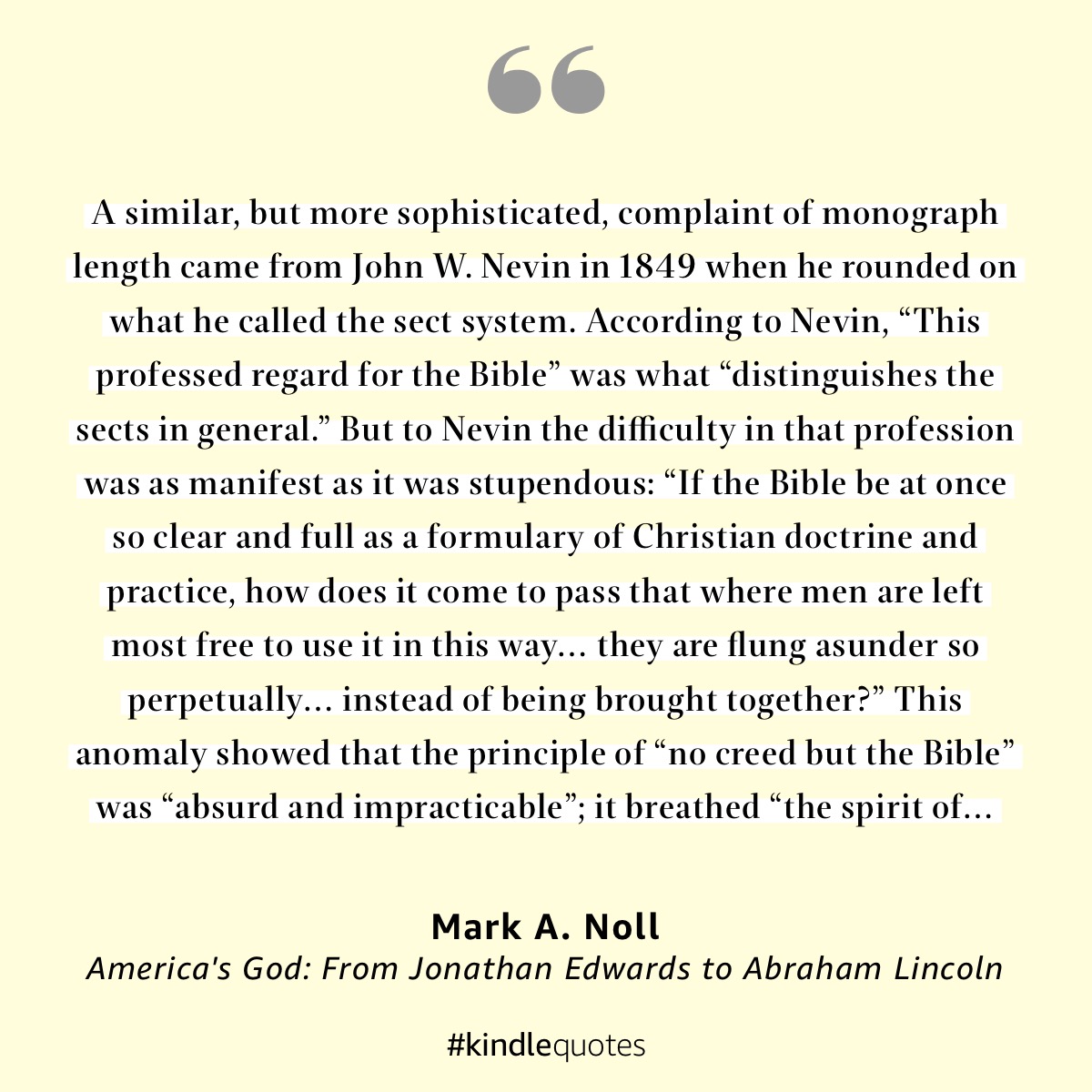
No creed but the Bible?
Orthodoxy in America
Whatever else Orthodoxy in America is, it’s not bourgeois. It’s too weird for that. At the same time, bourgeois people like me come to it. The point is to be converted by it, to learn by the fasts, the prayers, and the way of Orthodox life to train our hearts to want what Christ says we should want.
I fear that I’m like the little girl in Flannery O’Connor’s short story, who was sure she could never be a saint, but thought she might could be a martyr if they killed her quick.
Religious ideas have the fate of melodies, which, once set afloat in the world, are taken up by all sorts of instruments, some woefully coarse, feeble, or out of tune, until people are in danger of crying out that the melody itself is detestable.
George Elliot, Janet’s Repentance, via Alan Jacobs
You can read most of my more impromptu stuff here and here (both of them cathartic venting, especially political) and here (the only social medium I frequent, because people there are quirky, pleasant and real). All should work in your RSS aggregator, like Feedly or Reeder, should you want to make a habit of it.
Predictably, secular authorities convinced by the reformers’ truth claims liked the distinction drawn between the necessity of obedience to them and of disobedience to Rome. They liked hearing “the Gospel” accompanied by such “good news”—it would allow them, for starters, to appropriate for themselves all ecclesiastical property, including the many buildings and lands that belonged to religious orders, and to use it or the money from its sale in whatever ways they saw fit. In two stages during the late 1530s, seizing for himself the vast holdings of all the hundreds of English monasteries and friaries, Henry VIII would demonstrate how thoroughly a ruler could learn this lesson without even having to accept Lutheran or Reformed Protestant doctrines about grace, faith, salvation, or worship.
Repentance is everything you do to get sin, those inborn passions, out of you. It’s reading, thinking, praying, weeding out disruptive influences in your life, sharing time with fellow Christians, following the guidance of the saints. Repentance is the renunciation of what harms us and the acquisition of what is beneficial to us, writes a holy counselor.
The prayer of penitence leads us to reflect critically on our own lives. If it is uttered sincerely, it leads us to repent in humility, not just of particular wrongs we have done, but of our whole shameful and degraded state of being. The paradox is that, far from leading to lethargy or despair, such penitence brings a new kind of strength. Sexual sin is never merely sexual, but always has motives that are rooted in the passions—whether the need to be loved, or the lust for domination, or the desire to prove oneself attractive, or any of a dozen other motives that come readily to mind.
… to believe that wealth is the only significant measure of the worth of an individual, a family, or a community is to reject the teaching of nearly every religion and wisdom tradition that ever was.
[T]he move from taking God for granted to disputing God’s existence is a move from naïve to reflective, from a position where one set of options is precluded to a position where that set of options is fully available. Underlying that move, however, is the move from porous to buffered selves, and that is a move from naïve to naïve. It is, in other words, a move from a position where one set of options is precluded to a position where another set of options is precluded.
Caveat: This touches on American electoral politics.
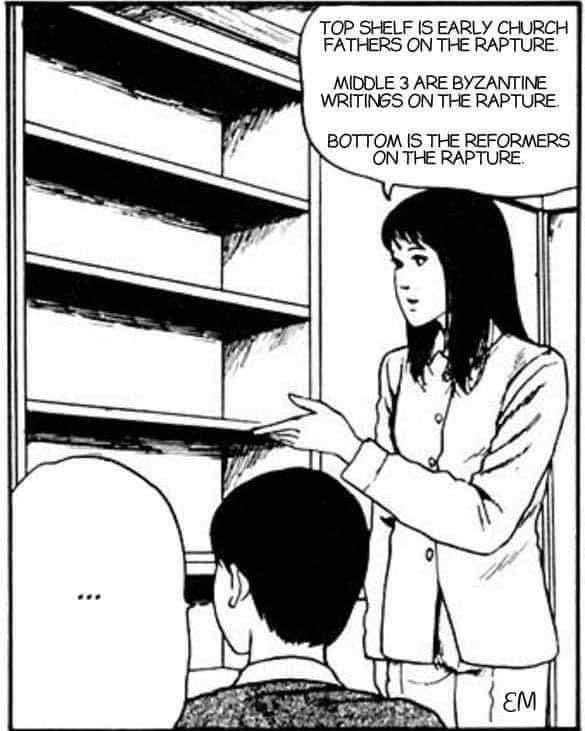
Historical views of the Rapture
Do you want to be like Tim?
If you are a writer or pastor who wants to preach like [the late Tim] Keller, you won’t get there if your strategy is “listen to Keller and copy him.” Keller himself would tell you that that’s a terrible idea.
Instead, do what Tim did: Go to seminary. After seminary, read everything George Whitefield wrote. Read Calvin’s Institutes and his sermons. Read The Lord of the Rings over and over and over. Read everything C. S. Lewis ever wrote. Read every Puritan paperback from Banner of Truth. Read sociology. Read social theory. Read Bavinck. Read current events books and a steady line up of journalists. Do all of that within the context of a family alongside your spouse and while talking to people facing ordinary life problems who are in need of counsel and aid and think about how to explain what you’re learning to them in ways that are sensible to them. Lewis had a rule that if he couldn’t say something in a way an ordinary British person could understand it meant that he wasn’t ready to say that thing yet. Follow that rule.
Heh, heh, heh! You had me going there for a minute, Jake. What’s the quick way to preaching like Tim Keller? I don’t want to be faithful for decades and decades with no assurance that I’ll ever become famous; I want a surefire to fame by next year.
East versus West
The thing is the cultural habit of rationalizing and abstracting has also made serious inroads into Catholic life and practice in the West. The crisis, Kingsnorth concluded, is not so much one of Catholic versus Protestant as it is of Eastern Christianity versus Western Christianity. It is a conclusion I arrived at not long after I left Catholicism for Orthodoxy in 2006, the result of a great spiritual trauma. I had thought of Catholicism as a mystic-friendly form of Christianity—which it is, but only by comparison to Protestantism. When seen from the East, both Catholicism and Protestantism—in the West, at least—are marooned primarily in the head and are futilely trying to think their way out of the civilizational shipwreck of the modern West.
Though Orthodoxy shares with Catholicism a fundamentally sacramental metaphysics, in practice Orthodoxy is far more mystical, emphasizing that the conversion of the heart must precede the conversion of the intellect. It does not deny the intellect, only orders it within an anthropological hierarchy.
One aspect of Orthodoxy that particularly appealed to Kingsnorth is its panentheism—the principle that God is, as the Orthodox prayer says, “everywhere present and filling all things.” It’s not the same as pantheism, which says that the material universe is God. Orthodoxy teaches that God is separate from his creation but also interpenetrates it with his energies, or his force. Consider how the warmth and pleasant glow of an English hillside on an August afternoon occur because the faraway sun penetrates the grass, the flowers, and the earth with its energies. The hillside is not the sun, but it testifies to the presence of the sun in its material being.
“The earth is not God, but God is there, present in nature, not in some far-off heaven,” Kingsnorth says. He goes on: “He’s deeply entwined in everything. Creation is the book of God, as Augustine said, I think. That is explicitly recognized in Orthodoxy. So what I was finding, weirdly enough, was a sort of ancestral Christianity that my ancestors in England would have had access to, and that the early Celtic saints certainly had access to. When I became Orthodox, a lot of people said to me, ‘Welcome home,’ and, strangely, it did feel like I was coming home. It felt like there’s something here that we had, that we lost.”
I’ve been a fan of most of Rod Dreher’s books since Crunchy Cons. I want to distinguish his books from his columns, which I have frequently disagreed with. I also concede that one of his books was too raw, too transparent, too kiss-and-tell for my tastes.
Rod has been through a lot — openly for the last two years or so, quietly for a decade before that. Oh, heck: he’s been through a lot his whole life, much at the hands of family who lived in Louisiana at an extreme end of insularity. It’s hard to imagine a family that felt no pride in a member making it fairly big in New York City publishing because he dared to leave home, a family that affirmatively poisoned the minds of the next generation with refrains that Uncle Rod was uppity and no damn good.
I think he’s coming out of it, but he thought he had come out of it when he wrote How Dante Can Save Your Life.He’s voting for Donald Trump because Trump is the enemy of his enemies.. I cannot. I’m more with Miles Smith: “don’t tell me it is anything other than tragic that either of the two leading candidates for the presidency will eventually govern the American republic.”
Rod has a new book coming out tomorrow. It may be his most important; I’ve had it on pre-order for months.
This rave review struck me as capturing what’s special about Rod:
Dreher has an uncanny ability to articulate how religious conservatives feel, even to pre-empt it. Previous books gave us the Crunchy Cons (2006), whose eponymous conservatives want to turn the clock back; The Benedict Option (2017), which meant opting out of liberal culture; and Live Not By Lies (2020), which drew a line between “Marxist” and “woke”.
I can attest, spending much time among devout Christians, that Dreher has done it again, capturing our present mood: we’re trapped between wanting to throw ourselves into movement politics to defeat The Beast, or looking inwards in the hopes of becoming the change one wants to see in the world. Many of us are asking whether the best service we could do to Christianity is simply to become better Christians.
(Boldface added.) If you doubt that he has pre-empted conversations, ask yourself how often you’ve encountered the term “the Benedict Option,” which is literally his coinage.
These are a few of my favorite things
[N]one of the things that I care about most have ever proven susceptible to systematic exposition.
“My people have been oppressed for nearly 2000 years. For 1200 years they endured Dhimmitude, a system of oppression made for the sole purpose of humiliating & breaking them. Today they face persecution in their homeland. And yet I don’t know of a single Coptic terrorist. Do you?”
If you hide the gifts you have been given in order to appear humble, then you are very proud indeed. Wishing to appear humble is the worst form of pride.
Religious ideas have the fate of melodies, which, once set afloat in the world, are taken up by all sorts of instruments, some woefully coarse, feeble, or out of tune, until people are in danger of crying out that the melody itself is detestable.
George Elliot, Janet’s Repentance, via Alan Jacobs
You can read most of my more impromptu stuff here and here (both of them cathartic venting, especially political) and here (the only social medium I frequent, because people there are quirky, pleasant and real). All should work in your RSS aggregator, like Feedly or Reeder, should you want to make a habit of it.
Sundays are joyful days, but there’s a little cloud on this one: 26 years ago, my father died, quite unexpectedly.
His was a quick and apparently painless death — what we think of as a good death these days. But I’m not so sure. Meeting God face-to-face is a serious business. I’m inclined to think a slow and painful death, with lots of time to face the reality and to set aright things that are our of kilter, has its own advantages.
We brought nothing into this world
Modernity equates liberty with the freedom to decide and choose, to define ourselves and the world around us. In the words of Justice Anthony Kennedy (Planned Parenthood vs. Casey, 1992):
At the heart of liberty is the right to define one’s own concept of existence, of meaning, of the universe, and of the mystery of human life.
We relish this concept of unfettered freedom. But, of course, it is absurd, even for a secularist. For whether we choose to admit it or not, we “brought nothing into this world” (1 Tim. 6:7). Everything in our lives is derived and gifted. We are not the inventors of the world nor of our lives. And though we struggle to understand and even master our own DNA, it remains a primary component of our destiny, a genetic memory of the history of our coming into being across the ages. To be told that we have some portion of DNA contributed by Neanderthals reminds us that even such obscure ancestors are “selves we have received” through our genetically traditioned existence.
Without defining Christianity, Renn says the world used to be positive toward it. You can read Renn for yourself, and Jacobs, too (and you really should read Jacobs if you think Renn is onto something important), but here’s the gist (via Jacobs) of why there was never a “positive world” for thoroughgoing Christianity:
Professing Christianity is what Renn calls a “status-enhancer” when and only when the Christianity one professes is in step with what your society already and without reference to Christian teaching describes as “being an upstanding citizen.” If you don’t believe me, try getting up on stage in an evangelical megachurch and reckoning seriously with Jesus’s teaching on wealth and poverty. Even a sermon on loving your enemies, like Ruby Bridges, and blessing those who curse you, can be a hard sell — as many pastors since 2016 have discovered. News flash: if you make a point of never saying anything that would make people doubt your commitment to their preferred social order, they’ll probably think you an upstanding citizen. (Who knew?)
There are pretty much always some elements of Christian teaching that you can get away with publicly affirming; but you can never get away with affirming them all. If American Christians sixty years ago felt fully at home in their social world, that’s because they quietly set aside, or simply managed to avoid thinking about, all the biblical commandments that would render them no longer at ease in the American dispensation. Any Christians who have ever felt completely comfortable in their culture have already edited out of their lives the elements of Christianity that would generate social friction. And no culture that exists, or has ever existed, or ever will exist, is receptive to the whole Gospel.
Renn is Evangelical or Evangelical-adjacent (PCA Presbyterian). I was once very friendly toward the PCA, so I think I can say that it’s not a church that rocked the social order (at least until Orgasms for All! became the unofficially established religion of the USA).
The bloom is entirely off my Renn Rose. I deeply discount articles that take his “three worlds” model as their premise.
A Christian Is An Outlaw
Apropos of “negative world”:
It would be honour in modernity for a Christian to be called such an outlaw, for surely they do not conform to the laws of this world.
There’s a brilliant episode of King of the Hill where Bobby, the thirteen-year-old boy, gets really into Christian rock. At the end of the episode his dad, Hank, shows him a box where he keeps tokens from all the different phases he has gone through. There’s a Beanie Baby, a Tamagotchi, a Teenage Mutant Ninja Turtle… Bobby cringes—and that’s the point. “I know you think the stuff you’re doing now is cool,” says Hank to his son, “but in a few years, you’re going to think it’s lame. And I don’t want the Lord to end up in this box.”
This Orthodox novice’s section on prayer (“Play to your weakness”) was also very good.
Sufficiently Rawlsian?
I might appeal to the second chapter of Genesis when speaking about the fundamental importance of male–female complementarity. But I do so because the biblical witness so succinctly and powerful states a fundamental truth that every civilization has honored.
Even as they claimed to rely on the Bible alone, antebellum Protestants frequently turned to Christian saints, exegetical traditions, the practices of Christians past, and official church teachings, employing these sources to complement or clarify what they took the Bible to mean. Perhaps this betrays a deeper sense that the Bible was not as self-interpreting as many Protestants hoped. At the very least, it shows the inescapability of tradition. American Protestants never read, or argued over, the Bible alone.
Paul J. Gutacker, The Old Faith in a New Nation
What the heck is a Carpatho-Rusyn?
In the last decades of the nineteenth century, Byzantine Rite Christians from the Carpathian mountain region began to arrive in America. It is difficult to label these people: they came from an area that today is divided among Poland, Slovakia, Hungary, Moldova, Belarus, and Ukraine, and they were known by a great variety of names, including Carpatho-Russians, Rusyns, Ruthenians, Galicians, and others. Their ancestors were originally Orthodox Christians, but in the sixteenth and seventeenth centuries they submitted to the pope of Rome through a series of “unions,” which is why they have long been known to the Orthodox as “Uniates.” Despite their subordination to the pope, they retained most of the external forms of Orthodox worship and practice, including allowing married men to become priests.
These people are the historic core of my diocese. And my parish’s Patron Saint, Alexis Toth, led multitudes back to the Orthodox faith, after he was spurned by Archbishop John Ireland.
Religious ideas have the fate of melodies, which, once set afloat in the world, are taken up by all sorts of instruments, some woefully coarse, feeble, or out of tune, until people are in danger of crying out that the melody itself is detestable.
George Elliot, Janet’s Repentance, via Alan Jacobs
You can read most of my more impromptu stuff here and here (both of them cathartic venting, especially political) and here (the only social medium I frequent, because people there are quirky, pleasant and real). All should work in your RSS aggregator, like Feedly or Reeder, should you want to make a habit of it.
I’m on vacation, so I’m not going to take the time to sort these into topics.
Also, it’s a major Feast day in the Eastern Church. The Orthodox Church at my vacation destination appears to be postponing observance to tomorrow — an Orthodox oddity in my limited experience.
Selling hoi polloi a delusion
Those with a material interest in doing so have learned to speak autonomy talk, and to tap into the deep psychology of autonomy in ways that lead to its opposite.
Matthew Crawford, The World Beyond Your Head
Purposeful to a fault
Himmler quite aptly defined the SS member as the new type of man who under no circumstances will ever do “a thing for its own sake.”
Hannah Arendt, The Origins of Totalitarianism
Sit quietly with that one for a minute. Then consider Josef Pieper, Leisure, The Basis of Culture.
“Televangelists”
Fugitive Televangelist Wanted by F.B.I. Is Caught in the Philippines Weeks of tense standoff in the Philippines have ended in the capture of a pastor accused of leading an international ring of sex abuse and trafficking of young women and girls.
I don’t believe it would be fair to saddle any Christian tradition or denomination with this guy. From what the Times says about the idolatrous adulation he cultivated, he was plainly some kind of one-off cultist.
But I have no idea how many one-off cultists are abroad in the world, when this admonition currently being featured at the end of my Sunday blog posts:
Religious ideas have the fate of melodies, which, once set afloat in the world, are taken up by all sorts of instruments, some woefully coarse, feeble, or out of tune, until people are in danger of crying out that the melody itself is detestable.
George Elliot, Janet’s Repentance, via Alan Jacobs
Huge (if true)
Donald Trump runs no risk of going to prison in the middle of his campaign, thanks to Judge Juan Merchan’s decision Friday to postpone sentencing until Nov. 26. The delay gives his lawyers more time to prepare an appeal. Fortunately for Mr. Trump, his trial was overwhelmingly flawed, and a well-constructed appeal would ensure its ultimate reversal.
A central problem for the prosecution and Judge Merchan lies in Article VI of the U.S. Constitution, which makes federal law the “supreme law of the land.” That pre-empts state law when it conflicts with federal law, including by asserting jurisdiction over areas in which the federal government has exclusive authority.
Mr. Trump’s conviction violates this principle because it hinges on alleged violations of state election law governing campaign spending and contributions. The Federal Election Campaign Act pre-empts these laws as applied to federal campaigns. If it didn’t, there would be chaos. Partisan state and local prosecutors could interfere in federal elections by entangling candidates in litigation, devouring precious time and resources.
That hasn’t happened except in the Trump case, because the Justice Department has always guarded its exclusive jurisdiction even when states have pushed back, as has happened in recent decades over immigration enforcement.
The normal approach would have been for the Justice Department to inform District Attorney Alvin Bragg, who was contemplating charges against Mr. Trump, of the FECA pre-emption issue. If Mr. Bragg didn’t follow the department’s guidance, it would have intervened at the start of the case to have it dismissed. Instead the department allowed a state prosecutor to interfere with the electoral prospects of the chief political rival of President Biden, the attorney general’s boss.
In the summer of 2015, back when he was still talking to traitorous reporters like me, I spent extended stretches with Donald Trump. He was in the early phase of his first campaign for president, though he had quickly made himself the inescapable figure of that race—as he would in pretty much every Republican contest since. We would hop around his various clubs, buildings, holding rooms, limos, planes, golf carts, and mob scenes, Trump disgorging his usual bluster, slander, flattery, and obvious lies. The diatribes were exhausting and disjointed.
But I was struck by one theme that Trump kept pounding on over and over: that he was used to dealing with “brutal, vicious killers”—by which he meant his fellow ruthless operators in showbiz, real estate, casinos, and other big-boy industries. In contrast, he told me, politicians are saps and weaklings.
“I will roll over them,” he boasted, referring to the flaccid field of Republican challengers he was about to debate at the Ronald Reagan Presidential Library that September. They were “puppets,” “not strong people.” He welcomed their contempt, he told me, because that would make his turning them into supplicants all the more humiliating.
“They might speak badly about me now, but they won’t later,” Trump said. They like to say they are “public servants,” he added, his voice dripping with derision at the word servant. But they would eventually submit to him and fear him. They would “evolve,” as they say in politics. “It will be very easy; I can make them evolve,” Trump told me. “They will evolve.”
Like most people who’d been around politics for a while, I was dubious. And wrong. They evolved.
The eighteenth-century Humean slave of the passions is thus indistinguishable from the liberated, twentieth-century Sartrean individual living authentically.
Brad S. Gregory, The Unintended Reformation
All that matters is strength
Part of the reason Trump is less constrained on [the abortion] issue than his predecessors is that he’s transformed the Christian right just as he has the broader conservative movement, dethroning serious-seeming figures while promoting those once regarded as flamboyant cranks. In Republican politics, Steve Bannon and Alex Jones now have far more influence than erstwhile conservative stalwarts like Paul Ryan and Dick Cheney. Similarly, in the religious realm, the ex-president has elevated a class of faith healers, prosperity gospel preachers and roadshow revivalists over the kind of respectable evangelicals who clustered around George W. Bush. “Independent charismatic leaders, who 20 years ago would have been mocked by mainstream religious right leaders, are now frontline captains in the American culture wars,” writes the scholar Matthew D. Taylor in his fascinating new book, “The Violent Take It by Force: The Christian Movement That Is Threatening Our Democracy.”
The churches Taylor is writing about exist outside the structures and doctrines of denominations like the Southern Baptists. They’re led by flashy spiritual entrepreneurs who fashion themselves as modern apostles and prophets with supernatural spiritual gifts, and they represent one of the fastest-growing movements in American Christianity. Among many of these churches, Trump remains the anointed one, chosen by God to restore Christian rule to the United States. These Christians care a great deal about abortion, but they appear to care at least as much about Trump. Many of them see him as a modern-day version of the Persian emperor Cyrus, a heathen who, in the sixth century B.C.E., rescued God’s chosen people from Babylonian captivity. In this framework, Trump’s piety is irrelevant; all that matters is his strength.
I think Goldberg, no Christian, is right. And that means that it’s hard to say that MAGA and I share the Christian tradition; their religion seems from a darker source.
Ted Cruz is no dummie
Liz Cheney famously endorsed Kamala Harris over Donald Trump, and less famously endorsed Democratic U.S. Representative Colin Allred over Ted Cruz for Cruz’s Texas Senate seat.
So has she abandoned the GOP?
I can’t speak for Cheney, but I can tell you why I’m voting for Allred over Cruz—and it has nothing to do with policy or burning anything down.
Since January 6, the threshold question I ask when considering whether to vote for a Republican is how that candidate responded to Trump’s coup attempt. There’s a spectrum of behavior on that point, with Cheney and Kinzinger on one end, Trump himself on the other, and the mass of congressional Republicans somewhere in between.
At the two extremes of the spectrum, policy doesn’t matter to me. Policy debates are things you get to have when everyone agrees on the rules of the game. Rewarding those who defended democratic norms and punishing those who undermined them is more important.
I would vote for Cheney and every other Republican who voted to impeach or convict Trump following the insurrection in hopes that their victories would embolden others in the party to resist his power grabs in a second term. And I would vote against Trump and all of his co-conspirators for the opposite reason, in hopes that their defeats would convince others that civic crime, like trying to overturn an election on false pretenses, doesn’t pay.
Ted Cruz was Trump’s chief co-conspirator in the Senate after the 2020 election, initially agreeing to argue before the Supreme Court that the electoral votes of swing states won by Joe Biden should be thrown out. When the court declined to hear that case, Cruz switched to Plan B and ring-led a scheme on January 6 to stop Congress from certifying Biden’s victory by objecting to those swing-state electoral votes. Had he gotten his way, some sort of chaotic ad hoc election “commission” would have been thrown together before Inauguration Day to decide who the next president should be.
He did all of this knowing full well that Trump was and is a loon and that egging on Americans to doubt the fairness of their own elections will destabilize the country long-term. But he was willing to pay that price because he thought making himself useful to the coup would give him a leg up with Trump’s base when he runs for president again someday.
You don’t need to agree with Colin Allred on a single policy issue to grasp that a person like Ted Cruz cannot be trusted to defend the constitutional order. He was tested and failed grievously. If you believe that a second Trump presidency would create a “unique threat” to American government, as Liz Cheney and I do, it’s urgent that Trump’s most unethical enablers in Congress be replaced by people who won’t rubber-stamp anything he does.
Republicans in Texas had their chance to replace Cruz with a candidate like that in this year’s primary, just as Republicans nationally had their chance to replace Trump. They made their choice. Cheney and I have made ours.
It’s frankly amazing to me that so many conservatives have been left struggling to understand Cheney’s endorsement of Allred. To a certain sort of partisan, it seems, Trump is the only elected Republican who bears meaningful responsibility for the attempt to overturn the 2020 election. Ted Cruz, Mike Lee, the scores of House GOPers who voted to object on January 6—they’re all off the hook because, well, there are just too many of them to punish. Beating them at the polls would wipe out the party, and partisans won’t tolerate that. Even for just one election cycle, to teach their representatives a hard lesson about authoritarian bootlicking.
If you feel obliged to excuse Ted Cruz for his role in a coup plot because that’s what hating Democrats requires of you, you do you. But let’s please stop memory-holing his part in it by feigning confusion as to why Liz Cheney might want to drive him from politics. It’s pathetic.
Ted Cruz is no dummie. He’s whip-smart and cunning. He also is a contemptible human being with no core. His mentor, Princeton’s Robert P. George, must be deeply grieved.
Shanghaied
Few cities in Asia match Shanghai’s level of economic development. In the fanciest shopping streets in the city center you can go miles without leaving the realm of luxury stores, with a Hermes outlet abutting a Louis Vuitton outlet, which in turn abuts a Rolex outlet. At times, the city reminded me of an acquaintance’s semi-humorous observation that, in a hundred years, luxury brands may be all that remains of Europe’s once enormous influence on the world.
In Postwar, Tony Judt argues that in the 1960s, the restive mood of Europe’s young was in part fueled by the ugliness of the homes in which they had been raised and the new universities in which they were being educated. Comparisons between Europe sixty years ago and China today are certain to be wrong for any number of reasons, but my mind kept going back to Judt’s observation every time I drove past another island of identical, unadorned housing blocks.
Preferences about the next American president seem to be nearly as divided among Chinese intellectuals as they are among the American electorate. A senior scholar of international relations told me that Donald Trump would likely be more willing to cut deals with China but that he preferred Kamala Harris because of her greater predictability on the international stage. A senior economist told me that Kamala Harris might prove softer on tariffs but that she would prefer Donald Trump because of his greater predictability on economic policy. The only consistent refrain was the preference for perceived predictability: Chinese elites seem as discombobulated by the sense that it’s impossible to predict what Washington might do as they are by any specific action the next president might take.
The chief petty officers aboard the USS Manchester (LCS-14) were caught illicitly placing and using a Starlink satellite-internet antenna while the ship was under way. The conspiracy, involving all senior enlisted sailors attached to the littoral combat ship, came to light after months of use, when a civilian contractor came aboard and stumbled upon the bootleg setup. The ship’s command senior chief and ringleader of the operation was convicted at court-martial and reduced in rank from E-8 to E-7: an outrageously light penalty considering her repeated lies to her commanding officer, her background in Navy IT that ensures she was absolutely aware of her transgression, and the cover-up campaign that involved the intimidation and silencing of those below her. This betrayal of the ship’s whereabouts in service to movie-streaming, texting, and other forms of personal entertainment is especially egregious because of the role that chiefs have in preserving good order and discipline among the ranks while upholding Navy traditions. A bad chief is the ruin of a ship and its crew, and the legal equivalent of keelhauling the only correct recourse.
National Review’s The Week Friday email. See also the Navy Times.
Donald Trump after the debate
The Hill: Trump Floats Punishment For ABC After Debate
I mean, to be honest, they’re a news organization. They have to be licensed to do it. They ought to take away their license for the way they did that.
This response is fractally wrong. ABC doesn’t need a license to be a news organization (thank God and the First Amendment).
If they did have a license, it would be dictatorial to revoke it for displeasing the President or anyone else.
Trump once again exhibits his anti-democratic impulses, though once again it probably will deter no fans.
Lesser evils
“Sending migrants away, not allowing them to grow, not letting them have life is something wrong; it is cruelty,” Francis said in a news conference on the plane as he returned to Rome after his long trip to Southeast Asia and Oceania. “Sending a child away from the womb of the mother is murder because there is life. And we must speak clearly about these things.”
…
But when asked whether it would be morally admissible to vote for someone who favored the right to abortion, he responded: “One must vote. And one must choose the lesser evil. Which is the lesser evil? That lady or that gentleman? I don’t know. Each person must think and decide according to his or her own conscience.”
Donald Trump seemingly is Teflon-coated, but explicit Papal permission to vote for the (more) pro-abortion candidate could logically be a factor in this election.
Even WSJ is appalled
Ms. Loomer is usually described in the press as “far right,” but that’s unfair to the fever swamps. On Sunday she posted on X that if Ms. Harris wins the election, “the White House will smell like curry,” a gibe against Ms. Harris’s Indian heritage.
She added that Ms. Harris’s speeches “will be facilitated via a call center.” U.S. companies often farm out their information lines to Indian firms, get it? We wonder if JD Vance’s Indian-American wife thinks that’s funny.
In 2018 Ms. Loomer chained herself to Twitter’s New York headquarters after the platform banned her. She suggested that Casey DeSantis, the wife of Florida Gov. Ron DeSantis, might have lied about having breast cancer: “I’ve never seen the medical records.” This week she smeared Sen. Lindsey Graham after he criticized her association with Mr. Trump.
All of this would be ignorable, except that others close to Mr. Trump say he is listening to Ms. Loomer’s advice. People in the Trump campaign are trying to get her out of the former President’s entourage, to no avail. Even Rep. Marjorie Taylor Greene thinks Ms. Loomer is damaging the former President’s election chances.
As North Carolina Sen. Thom Tillis put it on Friday: “Laura Loomer is a crazy conspiracy theorist who regularly utters disgusting garbage intended to divide Republicans. A DNC plant couldn’t do a better job than she is doing to hurt President Trump’s chances of winning re-election. Enough.”
If anyone is looking for facts to support a vote for Trump despite loony Loomer (and everything else), these two graphs may be just the ticket. The Biden administration has not covered itself in glory on illegal immigration.
The yellow bar is illegal immigrants and those awaiting adjudication of asylum claims or other claims to remain.
Delta wants to know what I thought of my flight. Honda wants to know what I thought of my oil change. The company that inspects my HVAC system twice yearly wants to know what I thought of … the air filter replacements? The technician’s demeanor? I’m not sure because I’ve read only the subject lines of the emails, which keep coming, imploring me to reflect on the experience and charting some strange new territory where customer service and stalking overlap. It may be time for a restraining order. Or, minimally, a different kind of filter, the one that consigns certain senders’ electronic missives to the Spam or Trash folders.
I don’t do any of the major social media, but I have two sub-domains of the domain you’re currently reading: (a) You can read most of my reflexive stuff, especially political here. (b) I also post some things on the only social medium I frequent, because people there are quirky, pleasant and real.
The Russian philosopher Vladimir Solovyov expressed the non sequitur at the heart of Western civilization with a deliciously sarcastic aphorism: “Man descended from apes, therefore we must love one another.”
You can spend forty years teaching people to be awake to the fact of mystery and then some fellow with no more theological sense than a jackrabbit gets himself a radio ministry and all your work is forgotten. I don’t know where it will end.
Rev. John Ames via @dswanson and @KyleEssary on micro.blog.
I follow @dswanson and @KyleEssary on micro.blog. They seem like very nice guys and pretty well-educated and sensible (I wouldn’t follow them otherwise; if I want outrage, I can visit my disused X account or rejoin Facebook).
But I gotta say (the preface to many a gratuitous and unnecessary comment) that Orthodox Christianity often has a similar gripe against Protestantism, and its incorrigible devotion to novel doctrines that kept it from returning to Orthodox Christianity as it failed to reform schismatic Latin Christianity.
Orthodox, Catholic, Protestant
In my experience, really committed Protestants tend to think of themselves as “saved” because they have accepted Jesus; Roman Catholics, on the other hand, see themselves as “sinners” in need of weekly absolution. Orthodox just think themselves lucky.
Peter France, A Place of Healing for the Soul
Inquisition
In 1184, bishops who previously might have been content to let sleeping heretics lie had been instructed actively to sniff them out. Then, in 1215, at the great Lateran Council presided over by Innocent III, sanctions explicitly targeting heresy had provided the Church with an entire machinery of persecution.
Tom Holland, Dominion
Ethics
[T]he recent (as in, since the nineteenth century) evangelical Protestant practice of building ethics on proof texts is remarkably limited in our day and age. Proof texts work when the moral intuitions of the culture track with the broad shape of biblical teaching. That is no longer the case. Further, advances in technology now raise all kinds of questions about what it even means to be human—which in turn raises questions not only about fertility, but about other issues, from end-of-life care to the use of AI. The broader biblical account of human nature, not isolated proof texts, must now factor into Christian discussions of the most pressing ethical issues that we face.
Fr. Andrew: The human identity, as we were made to be, is something that is always in the future. Because we, being finite, will never arrive at being God.
Fr. Stephen: Right, our identity is always in the future, my existence is what I am today … There’s this gap, there’s this lack between me and it … even when we’re in the life of the world to come, we are not going to be in a static state.
Fr. Andrew: Right, which also implies that if our progress is always this point in the future—future for us—which is the fullness of the stature of Christ, to use St. Paul’s language, then that means that this modern thing that we see now, identitarianism, where people take these labels and apply them to themselves and that becomes the end-all … of how they conceive of themselves, looking for their identity either in something in the past or something at this moment … [i]t’s really an anti-Christian philosophy, and it’s really kind of an unhopeful philosophy, because it means I’ve arrived, I am this thing, and this is what I am and who I am, period. The becoming is not on the plate, on the table. It’s a distortion, really.
Fr. Stephen: Right, and one way, one devastatingly destructive way in which we are faithful to something other than Christ is when we’re faithful to some version of ourselves. We have this idea that we’re not allowed to break character, that whoever I was yesterday I have to be someone consistent with that today, even if who I was yesterday was wretched and miserable.
Fr. Andrew: [Laughter] “This is just who I am!” No, you can be better!
Fr. Stephen: Right, “I can’t make a break…” And this is something I say to people over and over and over again in confession, is that the devil doesn’t spend his time trying to get us to sin; we do that on our own. The devil spends his time, when we fall, telling us not to get up, telling us that this is where we belong, this is who we are, don’t bother trying to do better, to be better, to make any progress …
Fr. Andrew: I can’t remember—didn’t one of the saints say something to the effect of the demons always whisper two lies? One is: “You’re doing great!” And the other is: “There’s no hope for you!” And, I mean, those are the roots of… I don’t know, I’ve heard confessions for well over a decade and a half now; I’m pretty sure those are the roots of basically most sins.
The four Gospels are not a software user license — do not skip to the end and click “I agree.”
Read them. Realize the implications. Count the cost. Commit to live this life under the laws of this Kingdom, and set your feet on the road of repentance.
If more people wrestled with the difficult commands and expectations of Christ, then there might be fewer people called Christians — but they would be more ready for life in Christ.
Religious ideas have the fate of melodies, which, once set afloat in the world, are taken up by all sorts of instruments, some woefully coarse, feeble, or out of tune, until people are in danger of crying out that the melody itself is detestable.
George Elliot, Janet’s Repentance, via Alan Jacobs
You can read most of my more impromptu stuff here and here (both of them cathartic venting, especially political) and here (the only social medium I frequent, because people there are quirky, pleasant and real). All should work in your RSS aggregator, like Feedly or Reeder, should you want to make a habit of it.