We’ve Been Lucky Day

We’ve Been Lucky Day

What we are experiencing isn’t truly thankfulness, but only something like delight over good fortune. In this case, I wonder why we even call it thankfulness. Perhaps we should be celebrating a Gee We’ve Been Lucky Day, or, if times have been hard, maybe an It Could Have Been Worse Day. If a shorter name is needed, we could call it Okayness Day. I guess it would be something like Happy Hour.

J Budziszewski, wrested from context (i.e., this is not his position)

Eulogy — Mike Gerson

It’s nice to read Peter Wehner writing a eulogy instead of invective, however deserved.

Excerpts:

Mike [Gerson] was appalled at those who disfigured Jesus and used their faith for the purposes of dehumanization. It is one of the reasons why he was so thankful to publish an extraordinary essay in the Post before his death, lamenting Christians whose view of politics “is closer to ‘Game of Thrones’ than to the Beatitudes.”

Very few people knew the full scope of the health challenges Mike faced. He suffered a heart attack in 2004, when he was 40. Kidney cancer in 2013. Debilitating leg pain, probably the result of surgical nerve damage. The kidney cancer spread to his lungs. Then Parkinson’s disease and metastatic adrenal cancer. And finally, metastatic bone cancer in multiple locations, intensely painful. At one point he told me he was on 20 different medications. Mike and I joked that of all the figures in the Bible he could model himself after, he chose Job.

I am among those who had no idea of Gerson’s health problems. I admired his opinion pieces, but not quite enough to keep my Washington Post digital subscription.

Buying off the bloodhounds

[Y]ou don’t have to have a granular understanding of blockchain to understand [Sam Bankman-Fried] was a fraud. I think there are a lot of reasons he got away with it for as long as he did. Buying political cover from politicians with donations (Bankman-Fried was the Dems’ second biggest donor in the last cycle) and purchasing political cover from the media with woke gobbledygook about philanthropy is not a bad strategy. Also, hiding your malfeasance in the squid ink of technical jargon few people understand is pretty savvy as well.

But I think he had something else going for him. Democrats and the left love having billionaires in their corner. It’s a great way to blunt charges of “Marxism” and whatnot, and it’s also a fun way to advance the argument that there’s no real tension between progressive policies and profit. Having token billionaires is even better when those billionaires seem like they’ve broken the old paradigms of heavy industry and are on the cutting edge of innovation. Having dinosaurs who made their money the old-fashioned way—especially the ones who made their money from liquified dinosaurs—can trigger psychological or ideological second thoughts. Peddling ones-and-zeros just sounds so cutting edge.

One lesson from this is that new ideas and new technologies—not to mention getting rich off them—can blind you to the importance of due diligence. Say what you will about old-fashioned accountants and lawyers from prestigious firms—they at least have a vested interest in protecting their reputations and brands. Thinking that the rules of the past don’t apply to you is a great way to give yourself permission to break rules that definitely do apply to you.

Jonah Goldberg

I’d rather drink muddy water

My least-favorite series in the New York Times travel section is “36 Hours in [major city].” I would not enjoy dashing around and bar-hopping at night as they invariably describe.

Let me settle into a city for a bit, and give me time to catch my breath without liquor.

Is Orbán a Cosplayer?

There has always been a whiff of the fake about Mr. Orbán’s war on Brussels. That he never proposed the obvious solution to this impasse—Hungary’s exit from the European Union—exposed the limit of his gamesmanship. More fool the American conservatives who didn’t notice this sooner.

Joseph C. Sternberg, Orbán and the Collapse of the Trump Intellectuals

I don’t fully agree with Sternberg, but I welcome his pushback against Orbán if only because it doesn’t follow the usual script of name-calling and “everybody knows.”

Epistemic humility

Appealing to a higher, theological standard of judgment above politics can, in theory, act as a moderating influence that inspires humility, restraint, and even wisdom. But it often does the opposite—inspiring imprudent acts and judgments …

Of course, the religiously devout aren’t the only people who are prone to act in a way that fails to exemplify the spirit of liberality or civic generosity …

Liberalism is better off when these tendencies are tamed. The best way to accomplish that goal is to rely on civic education that instills lessons in epistemic humility and mutual respect for fellow citizens. But of course, such education will only receive political support if our fellow Americans already want to produce humble and respectful citizens in the first place.

Damon Linker, The Endless Skirmish Between Liberalism and Religion

I have a nit-picky disagreement with Linker. I doubt that we can maintain liberalism at all without the epistemic humility he commends, not just that “liberalism is better off when these tendencies are tamed.” Indeed, liberalism almost seems definitionally a polity of epistemic humility, a recognition that the other guy just might be right, and therefore can be worth close attention.

Florida Man and the Pro-life cause

The ethos of the Trumpist-dominated G.O.P. is fundamentally incompatible with the ethos of a healthy pro-life movement. The reason is simple: Trumpism is centered around animosity. The pro-life movement has to be centered around love, including love for its most bitter political opponents.

David French, The Pro-Life Movement Has to Break With Trumpism

An honest, full-cost accounting

[W]e need to replace fanciful dreams of endless energy from renewables with full-cost accounting, which an increasing number of experts are taking seriously. There are destructive environmental and social consequences to constructing the infrastructure for that energy production.

Wes Jackson and Robert Jensen, No Easy Answers: Facing Ecological Crises Honestly

I often post controversial or negative things with no comment. Not this time. I believe that Jackson and Jensen are right.

If wishes were horses …

[M]y friends at National Review plead[] with Republican hopefuls to clear the field for a Trump-DeSantis showdown.

That’s the right strategy if you’re a conservative whose goal is to maximize the GOP’s chances of nominating a superior candidate, but it’s eye-roll material if you’re an ambitious Republican politician who looks in the mirror and sees a president staring back.

That’s a great irony of the next cycle, incidentally. As selfish as Trump is in routinely placing his own interests above the GOP’s, the Chris Christies and Nikki Haleys who’ll end up piling into the 2024 field and splintering the anti-Trump vote will be guilty of having done the same.

Nick Cattogio, Trump Is About to Wreck His Legacy

Respect for Marriage Act

Yet the gains here are not negligible, either, and what is lost is—well, the answer to that depends on how realistic it is to think that Obergefell will be overturned within the next 10 years.

Matthew Lee Anderson, regarding the Respect for Marriage Act, quoted at The Dispatch (italics added)

I don’t think there’s a significant chance that Obergefell gets overruled for a long time. (Eventually, it probably will be overruled because it’s contrary to the nature of marriage and came about through an ideological mania. We’ll come to our senses eventually.) So, we (those concerned to preserve religious liberty) are getting something for essentially nothing.

Sounds like a presumptively good deal. Tell me how I’m wrong.

David French endorses RFMA, and has caught a lot of crap for it. Even Kristen Waggoner has misrepresented RFMA, but she’s now head of ADF, which may explain her factual flexibility.

Have I mentioned lately that my pen always totally dries up if I think of writing a check to ADF, but always works just fine for checks to Becket Fund?


[S]ubordinating truth to politics is a game which tyrants and bullies always win.

Jonathan Rauch, The Constitution of Knowledge

The Orthodox "phronema" [roughly, mind-set] cannot be programmitized or reduced to shibboleths.

Fr. Jonathan Tobias

You can read most of my more impromptu stuff here (cathartic venting) and here (the only social medium I frequent, because people there are quirky, pleasant and real). Both should work in your RSS aggregator, like Feedly or Reeder, should you want to make a habit of it.

A Little Sunday Fare (11/20/22)

Salvation, east and west

Whereas many Western treatments of salvation major in “not going to hell,” theosis gives tangible content and a goal that is more than avoidance.

But what is theosis? How should we think of it? …

Fr. Stephen Freeman

Context is crucial

Granted that not all Orthodox are saints, even so, to the extent that one enters into the Orthodox way of life, chastity becomes realistic, because it is the natural concomitant of everything else that one does.

I emphasize this point because one of the reasons that people have turned against chastity is that they believe it to be impossible. Countless stories in our literature and pop culture, from The Scarlet Letter to Animal House, have taught us to think that anyone who aspires to sexual purity must be a fool or a hypocrite, or both. Perhaps such a perception was inevitable once chastity was removed from the way of life in which it is naturally at home. But the right response is not to despise it, but to seek to recover that fuller way of life.

Healing Humanity: Confronting our Moral Crisis (Multiple Authors)

Healing or punishment?

[In] Dante’s poem the appropriateness of the torment is related primarily to the processes of healing, not to those of punishment. The souls are being taught to unbind the chains they have made for themselves, “solvendo il nodo”, loosening the knot of their sin by appropriate counter-measures.

Eamon Duffy, The Stripping of the Altars

It didn’t start with Junior

[Jerry] Falwell often exercised what he considered his right as a preacher to tell stories that—to use Dean Acheson’s phrase—were truer than the truth. In 1980 he regularly claimed that The Old-Time Gospel Hour had 25 million viewers, and he made up an exchange with Jimmy Carter in which he asked the president why he had “practicing homosexuals” on the White House staff, and Carter replied that he had to represent the American people. When confronted by the fact that the exchange never occurred, Falwell said that the story was a “parable,” or “an allegory.” In other words, it ought to have happened, even if it did not.

Frances Fitzgerald, The Evangelicals

I read it. I highlighted it. I forgot it. Then Readwise reminded me: The sleaze didn’t start with Jerry Junior.

What fundamentalists and “higher critics” share

Both the fundamentalist and the higher critic assume that it is possible to understand the biblical text without training, without moral transformation, without the confession and forgiveness that come about within the church. Unconsciously, both means of interpretation try to make everyone religious (that is, able to understand and appropriate scripture) without everyone’s being a member of the community for which the Bible is Scripture.

Stanley Hauerwas, Resident Aliens


[S]ubordinating truth to politics is a game which tyrants and bullies always win.

Jonathan Rauch, The Constitution of Knowledge

The Orthodox "phronema" [roughly, mind-set] cannot be programmitized or reduced to shibboleths.

Fr. Jonathan Tobias

You can read most of my more impromptu stuff here (cathartic venting) and here (the only social medium I frequent, because people there are quirky, pleasant and real). Both should work in your RSS aggregator, like Feedly or Reeder, should you want to make a habit of it.
Public Affairs, 11/19/22

I’ve been on a bit of a roll lately, blogging daily. That’s not a goal, but I’ve just stumbled into it.

I’m going to try to separate any blogging about Florida Man into separate posts. If we are lucky, he’ll continue fading from memory and relevance anyway. Today is not a day when I write about him.

My (Other) Man Mitch

I’ve long been an admirer of outgoing Purdue President Mitch Daniels, who adopted Dubya’s praise of “my man Mitch” and made it his own when he ran for Governor of Indiana.

But I also respect the heck out of Mitch McConnell, and am pleased that Senate Republicans spared no time re-electing him as their leader over a Trumpier challenger.

McConnell is shrewd, stable, and flexible. He cooperated with Trump a lot without becoming a sycophant. He also criticized Trump without becoming an unhinged never-Trumper, and that even in the face of Trump’s racist attacks on his asian wife. He carefully assesses electability when parsing out dollars to candidates from funds he effectively controls, and I have little doubt that the Republicans would have a majority in the Senate come January if primary voters had picked his preferred candidates over Trump’s parade of grotesques.

In other words, he’s a grown-up in a city of petulant, limelight-seeking adolescent Republicans and soccer-flopping progressives.

Democrats like to demonize McConnell as Republicans demonize Nancy Pelosi and Chuck Schumer, but we’d put an end to the “do-nothing Congress” if we had more Senators and Representatives of his temperament and experience.

What does he know, anyway?

Reacting to an uncommonly silly pronouncement from Peter Thiel:

Wait. What? The three options for the liberal democracies of Western Europe are Sharia law, “Chinese communist AI,” and some kind of green energy state? And there are “no other doors?” The only thing that separates that comment from a light-night, weed-infused dorm room bull session is his few billion dollars. That’s the person who should reshape the GOP? 

I’ve come to your inbox less to condemn the gurus (though people who commit fraud should pay the price), but to ask a different question. Why do we fall for them time and again?

I’m not someone who tells celebrities to “shut up and sing” or athletes to “shut up and dribble.” And I’d never tell Elon Musk to “shut up and get to Mars” or tell Peter Thiel, “shut up and facilitate cashless transactions.” I like the marketplace of ideas. I’m open to interesting thoughts from unlikely sources. 

But I object to the presumption of insight from famous or successful people. I object to the hero worship (or greed) I’ve seen with my own eyes, where sycophants and fans won’t tell the wealthy and famous obvious truths because they hope to bask in their reflected glory or benefit from their largesse.

David French, America, Can We Talk About Our Guru Problem?

It used to be stars and starlots on whose every oracular word we waited. Now it’s billionaires, more than one of whose bubbles could turn them into mere millionaires by tomorrow.

Blake Masters

Speaking of Peter Thiel, the George Soros of the Right (and neither of those two is as dumb or evil as their detractors think), one of his boys, Blake Masters, lost in Arizona.

I don’t need to have, and don’t have, an overall impression of Masters. But I’ve got some litmus tests and one of them is “if a candidate quotes the late Sam Francis without caveats, don’t vote for him.”

Francis was brilliant, atheist, and deeply racist. I appreciated his brilliance until his racism became undeniable, and it is why he should be “consigned to the dustbin of history.”

Federalist Society at a Crossroad

Peter Cannelos thinks the Federalist Society was all about reversing Roe v. Wade and is adrift now. (“You get your white whale and what do you do? What’s the next thing?”)

“Not so fast,” say David French and Sarah Isgur on Thursday’s Advisory Opinions podcast. That was never the purpose of the Society and its actual purpose remains vital. The real question is whether the Society will stand by its principles when populist Republicans, not liberals or progressives, are the ones trampling on the Constitution, as the Society has become closely identified with the GOP and the GOP has become performatively populist at the state level in particular.

David and Sarah seem to think FedSoc will stand by its principles initially, but that losing its “conservative” friends when it does so will intensify long-term pressure to forsake principle for politics. It’s the nature of those long-term pressures that make Cannelos’s piece worth reading. And he’s not necessarily wrong that abortion is what FedSoc was about in public impression.

Begin listening at 46:33.

EA

Although SBF and the collapse of FTX have cast a pall over EA, that’s unwarranted.

(If you find the prior paragraph undecipherable, congratulations: you’re more immune to ephemera than I am.)

We really should think about how much our charitable giving actually helps, not about how virtuous it makes us feel. That doesn’t mean we all should suddenly start giving only to deploy mosquito nets against malaria, but:

Aw, heck! I wrote most of the preceding before Ross Douthat weighed in. He touched on some of the same themes but added other good stuff. This link is supposed to get you through the New York Times paywall to read his take.

Michael Gerson, RIP

Still, Gerson deserves high marks for his criticism of Donald Trump and, above all, for his readiness to call out fellow evangelicals for their abject obeisance. The day after the assault on the Capitol, he wrote a column holding them more responsible than anyone else for “unleashing insurrectionists and domestic terrorists.”

I come back to this group repeatedly, not only because I share an evangelical background and resent those who dishonor it, but because the overwhelming support of evangelicals is the single largest reason that Trump possesses power in the first place. It was their malignant approach to politics that forced our country into its current nightmare. As white nationalists, conspiracy theorists, misogynists, anarchists, criminals and terrorists took hold of the Republican Party, many evangelicals blessed it under the banner “Jesus Saves.”

Nor did he hesitate to name names: Franklin Graham, Jerry Falwell Jr., Robert Jeffress, Ralph Reed, Penny Nance.

Mark Silk, Two cheers for Michael Gerson

Gerson’s reasons for coming back to evangelicals in the Trumposene were closely akin to my reasons.

For what it’s worth, I don’t share Silk’s condemnation of him for his role in selling the Iraq war. I voted for Bush’s “humbler foreign policy” in 2000, but I understood on 9/11 that the pressure for a strong military response against someone-or-other was going to prevail, and better people than I backed it at the time. I don’t think I ever supported the war (God forgive me if I did), but relentless resistance was futile.

Remembering our collective sins

He asked me if I had been to Auschwitz, in Poland. I hadn’t. “Don’t go there,” he said, shaking his head. “People are all with their phones. It should be prevented. And they go”—he raised his hand a few feet from his face and looked at his palm, emulating someone taking a selfie—“ ‘Me in front of the crematorium.’ ‘Me in front of the ramp.’ I mean, it’s so obscene.”

In the United States there are 41 million Black people; we make up 12.5 percent of the population. In Germany, there are approximately 120,000 Jewish people, out of a population of more than 80 million. They represent less than a quarter of 1 percent of the population. More Jewish people live in Boston than in all of Germany. (Today, many Jews in Germany are immigrants from the former Soviet Union and their descendants.) Lots of Germans do not personally know a Jewish person.

This is part of the reason, Steiner believes, that Germany is able to make Holocaust remembrance a prominent part of national life; Jewish people are a historical abstraction more than they are actual people. In the United States, there are still millions of Black people. You cannot simply build some monuments, lay down some wreaths each year, and apologize for what happened without seeing the manifestation of those past actions in the inequality between Black and white people all around you.

Steiner also believes that the small number of Jewish people who do reside in Germany exist in the collective imagination less as people, and more as empty canvases upon which Germans can paint their repentance.

Clint Smith, How Germany Remembers the Holocaust

The story was so long that I almost didn’t read it, despite some trusted person’s recommendation. I’m glad I did. It brought tears to my eyes in places.

The explicit challenge is “how will America remember its sins?”, but that feels like an afterthought, to add a touch of “relevance,” and few answers are suggested.

Superwoman

“I would just like to announce that I am in my third trimester and I am an absolute powerhouse that can create human life. I can do ANYTHING … except sit or stand or lie down or recline,” – Mary Katharine Ham. (Via Andrew Sullivan).

New Category!

Today, I’m introducing a new category, “soccer-flopping.” All honor to David French for introducing me to the metaphor. The bad news is that “grievance mongering” may fall into disuse


[S]ubordinating truth to politics is a game which tyrants and bullies always win.

Jonathan Rauch, The Constitution of Knowledge

The Orthodox “phronema” [roughly, mind-set] cannot be programmitized or reduced to shibboleths.

Fr. Jonathan Tobias

You can read most of my more impromptu stuff here (cathartic venting) and here (the only social medium I frequent, because people there are quirky, pleasant and real). Both should work in your RSS aggregator, like Feedly or Reeder, should you want to make a habit of it.

Florida Man Rundown

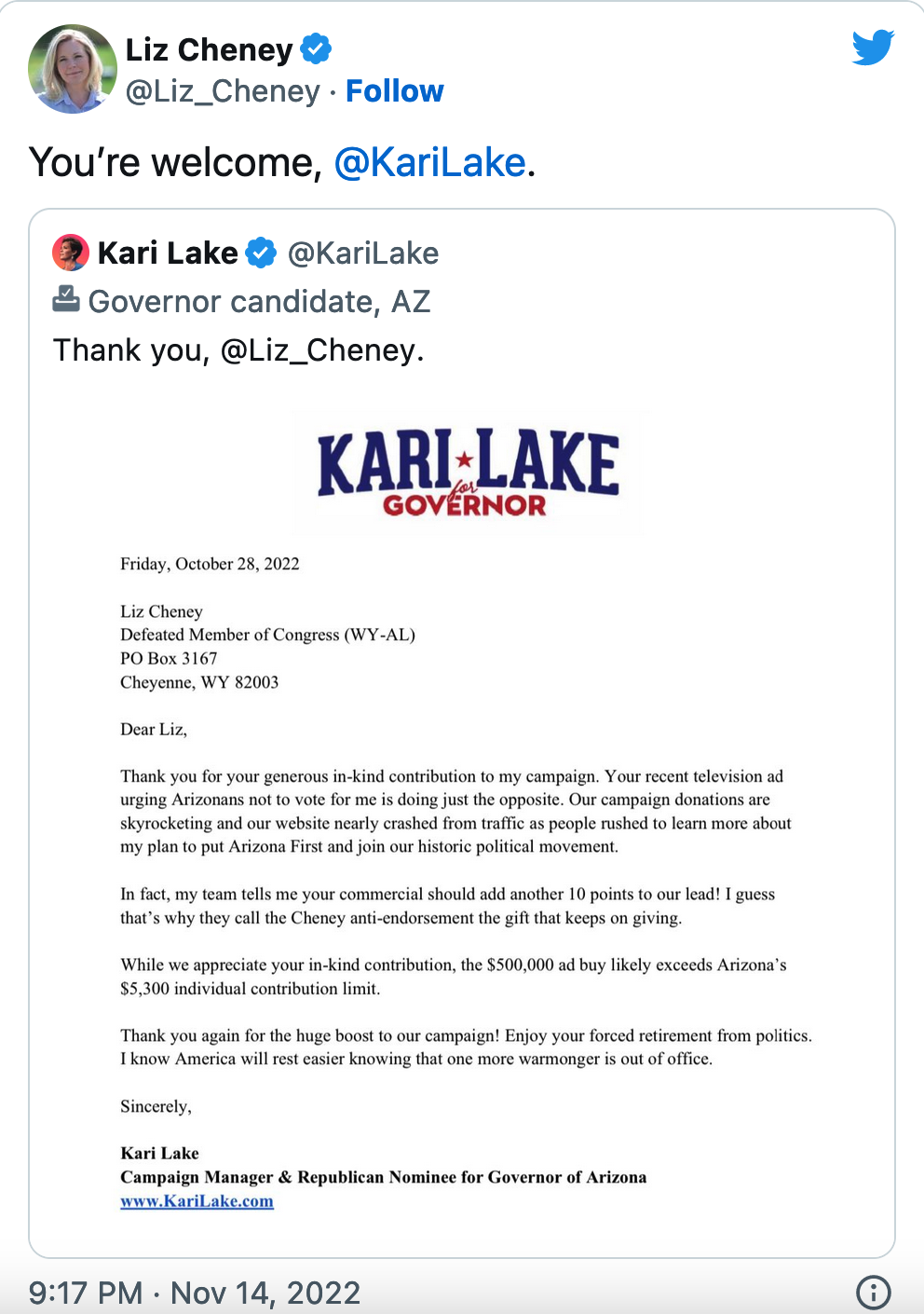
Florida Man Makes Announcement, Wyoming Woman Does Endzone Dance

I love this

… and this

I’ll try to remember “Florida Man” as the perfect way to Voldemort/circumlocute him.

[O]f the Democrats who received Cheney’s endorsement this year, all won tight races.

Nick Catoggio, Liz Cheney’s Revenge?

Will a populist GOP without [Florida Man] be a big enough tent to accommodate disaffected Republicans like Cheney, or will they become Independents (or even, rarely, Democrats)?

Yes, but what about Paula White?

As [Florida Man] launches new presidential bid, will former faith advisers back him?

There’s always a danger of cherry-picking in ventures like this, but the answer appears to be “no.” (I note, too, how undistinguished this list of former supporters appears to me — even without prosperity gospel heretic Paula White on the list).

Too toxic for present company

Bret Stephens thinks Florida Man is Toast:

[Florida Man] is finally being abandoned by many of his usually unflagging apologists and enablers in right-wing media, whose influence will be felt downstream.

That includes Fox News’s Laura Ingraham: “If the voters conclude that you’re putting your own ego or your own grudges ahead of what’s good for the country, they’re going to look elsewhere.” It includes Townhall’s Kurt Schlichter: “[Florida Man] presents problems and we need to face them,” he admitted. “We owe [Florida Man] nothing. He’s a politician.” It includes Victor Davis Hanson: “Will an unapologetic [Florida Man] instead now escalate his slurs, bray at the moon, play out his current angry Ajax role to the bitter end, and thus himself end up a tragic hero — appreciated for past service but deemed too toxic for present company?”

They just don’t care

It’s not just that [Florida Man] doesn’t care about what’s good for the party (if it’s not also good for him), it’s that he wants the GOP to embrace strategies and messages that affirmatively hurt Republican candidates. [Florida Man] has infected the right with a suite of self-destructive habits—among them, defending the January 6 attack on the U.S. Capitol, spreading the election fraud myths, rejecting early voting as somehow illegitimate, and thinking that being obnoxious is good politics.

This has long been obvious. If Senate Minority Leader Mitch McConnell had picked Senate candidates for the 2022 midterms, without interference from [Florida Man], the GOP would have picked up several seats it lost.

The problem is that members of the [Florida Man’s] faction of the party don’t care. They’d rather be the leaders of a new minority party than risk that status in pursuing the power of the majority. That’s why they’re trying to scapegoat McConnell, even though McConnell-aligned PACs spent almost $250 million trying to salvage various MAGA races, while [Florida Man] mostly sat on his dragon’s hoard, refusing to help his hand-picked candidates.

Rachael Larimore, The Double Standard Driving GOP Dysfunction

Florida Bonaparte

There was also something decidedly Bonapartist in the attitude of [Florida Man]’s early partisans, who seized upon his rhetoric about “American carnage” with the same eagerness that supporters of Bonaparte welcomed an end to the chaos of the immediate post-revolutionary era. [Florida Man]’s avowal of socially conservative causes seemed to carry roughly as much conviction as Bonaparte’s rapprochement with the Catholic Church, but in both cases doctrinal purity was not the point. The consolidation of power was.

On this understanding, [Florida Man]’s defeat in 2020 was merely a kind of exile, with Mar-a-Lago as his Elba. Spied on by the federal government before the 2016 election, declared “illegitimate” as president by prominent members of the opposition party even before his inauguration, subject to a special counsel investigation (based on a patently absurd theory of Russian “collusion”) and two impeachments, announced as a loser in an election in which he won 11 million more votes than he had in 2016 (despite state-level rule changes that benefited his rival), [Florida Man] found himself assailed by a domestic counterrevolution that he could not overcome. “Stop the steal” was not a precise theory about voter fraud but an existential affirmation of [Florida Man]’s thwarted prerogative. Vive L’Empereur!

What [Florida Maniacs] have intuited is an essentially illiberal understanding of authority, one based not upon the deliberative processes of electoral majorities but upon a romantic conception of a leader who embodies the essence of a nation. They believe that he should be restored to his office because it belongs to him, regardless of who currently occupies 1600 Pennsylvania Avenue. His right to rule is not diminished by temporary abeyance because it is derived not from the Electoral College or the written Constitution but from something like history itself. [Florida Man] the emperor was the world-soul descending the escalator, the instrument of the Absolute who realized the unconscious aspirations of his age.

This, I think, is why for [Florida Man]’s most enthusiastic partisans, his faults are not merely excusable but appear beneath discussion or even notice. Those features most commonly derided by his opponents — his economical relationship with facts, his disregard for procedural norms, his ambivalent attitude toward the separation of powers, his rhetorical fixation on the supposed perfidy of his opponents — confirm that he is the man of destiny whose conduct cannot be evaluated by ordinary standards.

Matthew Walther, The Real Case for [Florida Man] Is About Justice

If you don’t know who the patsy is, you’re the patsy

One of the things the [Florida Man]-aligned Republican populists are going to have to account for before they can move on from the midterm fiasco: They got took.

[Florida Man] epigones such as Steve Bannon and his acolytes think of themselves as hard-headed, cynical, scheming Machiavellians—you’ve heard all the stuff about “12-D chess” and thinking five moves ahead—but they are, almost to a man, suckers. And, like suckers everywhere, they always get took.

The Democrats rolled the dice in a big and bold way in the midterms, putting more than $40 million into the campaigns of the nuttiest nut-cutlets contesting the Republican primaries, hoping to advance the worst of the crackpots, coup-plotters, and conspiracy kooks to the general election …

The best kind of mark for a con artist is a dumb person who thinks he is smart—or a smart person who isn’t quite as smart as he thinks he is. The right-wing populists who got behind these Democrat-funded candidates knew what they were doing—it wasn’t a secret who was controlling the money that was deciding those primary races. But they went along with the con, turning out in the primaries to elect the people the Democrats spent tens of millions of dollars trying to support. That’s because they believe their own bull: that they are super-clever grandmasters of 12-D chess who can see five steps ahead of the Democrats’ gambit and then counter it to win.

And they got took.

Kevin D. Williamson


[S]ubordinating truth to politics is a game which tyrants and bullies always win.

Jonathan Rauch, The Constitution of Knowledge

The Orthodox "phronema" [roughly, mind-set] cannot be programmitized or reduced to shibboleths.

Fr. Jonathan Tobias

You can read most of my more impromptu stuff here (cathartic venting) and here (the only social medium I frequent, because people there are quirky, pleasant and real). Both should work in your RSS aggregator, like Feedly or Reeder, should you want to make a habit of it.

Thursday, 11/17/22

Embodied Perception

To emphasize the role that our bodies play in determining how we inhabit and therefore perceive the world, and to entertain the notion of cognitive extension, is to put oneself on a collision course with the central tenets of the official anthropology of the West. As we have already noted, embodied perception poses a direct challenge to the idea that representation is the fundamental mental process by which we apprehend the world.

Matthew Crawford, The World Beyond Your Head

I think Crawford calls this “the official anthropology of the West” because of our fetish that everyone must go to college to encounter more representations of the world, less actual world.

Long-term readers may justly suspect that, in my behavior, I am slave to this official anthropology. I tend to prefer reading to getting up and going for a walk or making something with my hands.

An opportunity, not a death knell

Let’s start with what the pro-life pessimists get right. Tuesday’s results confirm the anti-abortion movement’s fundamental disadvantages: While Americans are conflicted about abortion, a majority is more pro-choice than pro-life, the pro-choice side owns almost all the important cultural megaphones, and voters generally dislike sudden unsettlements of social issues.

You can strategize around these problems to some extent, contrasting incremental protections for the unborn with the left’s pro-choice absolutism. But when you’re the side seeking a change in settled arrangements, voters may still choose the absolutism they know over the uncertainty of where pro-life zeal might take them.

However, when abortion wasn’t directly on the ballot, many of those same voters showed no inclination to punish politicians who backed abortion restrictions. Any pro-choice swing to the Democrats was probably a matter of a couple of points in the overall vote for the House of Representatives; meanwhile, Republican governors who signed “heartbeat” legislation in Texas, Georgia and Ohio easily won re-election, and there was no dramatic backlash in red states that now restrict abortion.

In other words, Republicans in 2022 traded a larger margin in the House and maybe a Senate seat or two for a generational goal, the end of Roe v. Wade. And more than that, they demonstrated that many voters who might vote pro-choice on an up-down ballot will also accept, for the time being, pro-life legislation in their states.

For a movement that’s clearly a moral minority, that’s an opportunity, not a death knell ….

Ross Douthat

FTX

I have generally avoided getting into discussions about cryptocurrencies, because I am a perennial late-adopter who never understands how the big new thing is supposed to work or why anyone would even be interested in it. Aware of that bias, the fact that crypto always struck me as an elaborate Ponzi scheme wasn’t quite enough for me to be sure that it was an elaborate Ponzi scheme. Besides, even if I was sure, that wouldn’t be reason enough to confidently predict collapse; flim-flam operations sometimes get bought by companies with real businesses—or may even monetize their hype into real currency that they use to buy real companies—and thereby achieve something like an enduring presence in the business landscape that they might not have been able to achieve on their own merits.

So what interests me primarily about the collapse of FTX is this business could ever have been idealized. The premise behind FTX is that, even though nobody is totally sure what crypto is ultimately good for, people love to trade it, and to concoct ever more elaborate schemes for leveraging waves of investor enthusiasm.

Noah Millman

Priorities

My wife and I had a conversation one day with a pleasant couple who were much younger, and much more prosperous, than we were.  Husband and wife were both high-dollar attorneys.  She expressed strong frustration because the kids were in day care, but she wanted to stay with them herself.  “Why don’t you?” we asked.  They answered that they had expenses.  “Like what?” we asked.  Well, they had to keep up the payments on their big, expensive boat and their big, expensive house on the lake.

The difference between her facial expression and his were intriguing.  She became nervous.  He became alarmed.  There was some history here, and he didn’t want his wife going down this road.  She didn’t want to displease him.  We changed the subject.

To one degree or another, almost all husbands and wives divide labor, and they are generally happier doing so.  Obviously, not all women desire an exclusively domestic life, and there is nothing wrong with that.  But there is a great deal wrong with the fact that we force women to act against their domestic inclinations for reasons that have nothing to do with their fulfillment.  We call it being liberated, but it is really about serving the interests of men — and economic managers.

J Budziszewski I have seen another variation on this: high-earners who “can’t afford” to pay the tuition they agreed for private Christian education.

Letting the cat out of the bag

It is important that we start on time. We are training our children for the work force.

Remark from the school on a first-grader’s report card, via Jonathan Malesic, When Work and Meaning Part Ways

There’s another cat in the bag, too. We’re training our children in a second role of consumers. A hyperbolic account:

[S]trange to think that even in Our Ford’s day most games were played without more apparatus than a ball or two and a few sticks and perhaps a bit of netting. Imagine the folly of allowing people to play elaborate games which do nothing whatever to increase consumption. It’s madness. Nowadays the Controllers won’t approve of any new game unless it can be shown that it requires at least as much apparatus as the most complicated of existing games.

Aldous Huxley, Brave New World.

This is one of the reasons I think Huxley far surpasses Orwell as a prophet of dystopia (although I’m pretty sure I had no opinion either way before the year 1984.)

Things they told you that weren’t, now that you think about it, true.

On a note related to the preceding item, this:

The transformation of work into a spiritual enterprise, the site of our highest aspirations—to transcend ourselves, to encounter a higher reality, to serve others—is the work ethic’s cruelest unfulfilled promise.

Jonathan Malesic, When Work and Meaning Part Ways

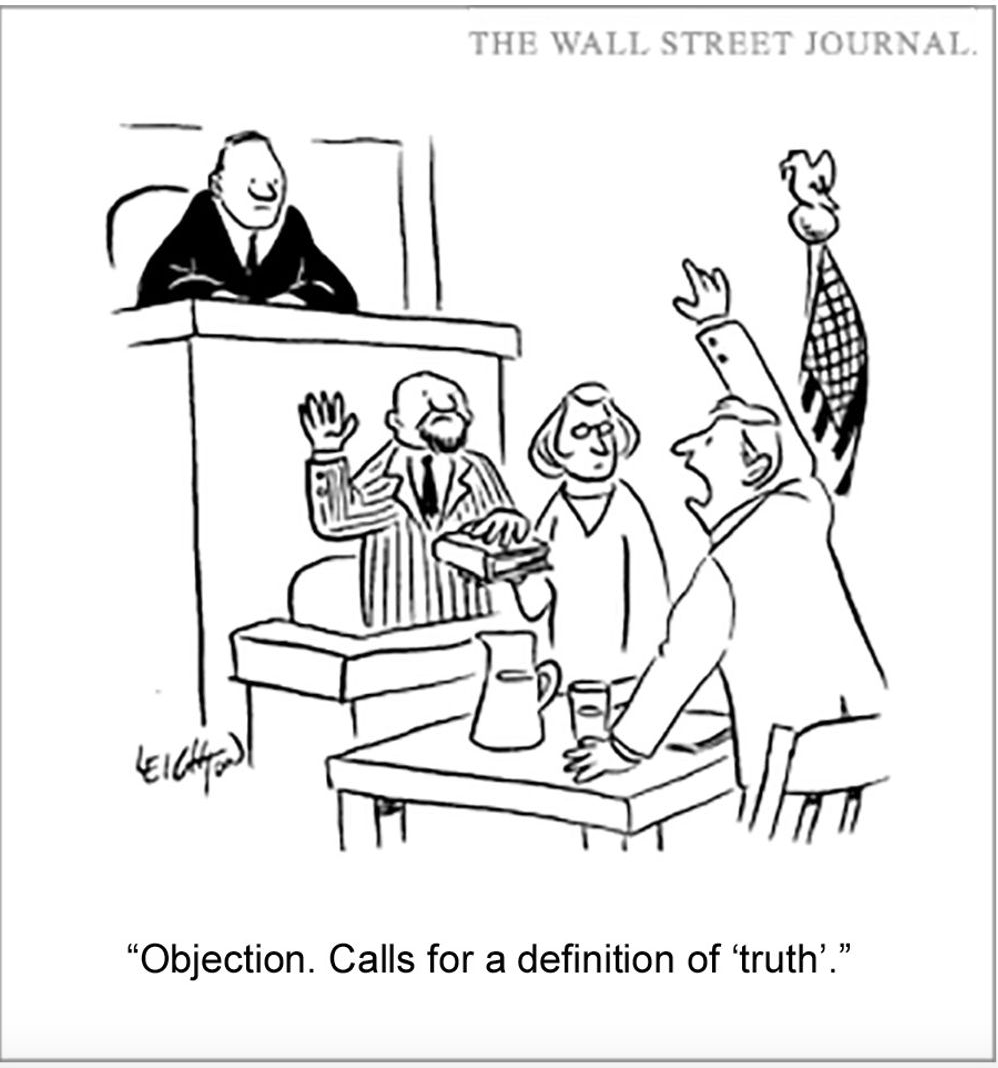
Speaking of truth, the Wall Street Journal’s Pepper & Salt cartoon is one of few cartoons I view regularly. Wednesday’s gave me a rueful chuckle:

Guilty and unashamed

Caffeine is so widely used and normalised that we don’t think of it as a drug or notice how it alters our minds. Research into its effects is often hampered by the difficulty of finding people who aren’t already dependent on it.

Sophie McBain, The psychoactive plants that change our consciousness, reviewing Michael Pollan, This is Your Mind on Plants.

A Hoosier teetotaler on the Isle of Islay

I opened my first-ever bottle of Laphroaig, “the most richly flavoured of all Scotch whiskies,” Monday night, as nightcap and to usher in the Nativity Fast that began Tuesday (a sort of personal “fat Monday”).

Wow! Now I think I know what Cutty Sark was trying to do when it produced a liquor that tasted like Listerine. In fact, that’s what the smell of Laphroaig reminded me of. Mercifully, the taste is not Cutty Sark.

Laphroaig is to every other scotch I’ve had as Dogfish Head 120 minute IPA is to Bud Light. It’s more — much more — but not just more. It’s different, too. From the label, that difference may be peat and smoke, but I’m forever hearing scotch afficianados talk about “peatiness,” so maybe I’m way off base. My palate and liquor vocabulary reflect my teetotaler roots.

Truth be told, I’m not sure how well I really like it. I’m not exactly alone. It was a shock. But I’ll know by the end of the bottle in a few months.

My last two items are about someone I hate even to name. Skip them if you like.

Trumpism without Trump?

Trumpism can survive without Mr. Trump.

Peter Wehner, Never-Trumper from the early days.

Isolating this phrase, I could hope that we get “Trumpism without Trump,” but that totally depends what one means by that phrase.

I could, and probably would, endorse the GOP continuing toward making itself the party of working-class middle-Americans of all races. Highlighting their plight is one of the (few, but consequential) good things Trump did.

Wehner, though, means by “Trumpism without Trump” a GOP that is malicious, dishonest and destructive. No thanks.


[S]ubordinating truth to politics is a game which tyrants and bullies always win.

Jonathan Rauch, The Constitution of Knowledge

The Orthodox "phronema" [roughly, mind-set] cannot be programmitized or reduced to shibboleths.

Fr. Jonathan Tobias

You can read most of my more impromptu stuff here (cathartic venting) and here (the only social medium I frequent, because people there are quirky, pleasant and real). Both should work in your RSS aggregator, like Feedly or Reeder, should you want to make a habit of it.

It’s about time

Jonathan H. Adler, Trump Lawyers Sanctioned for Frivolous Lawsuit Against Political Opponents

There’s apparently no deterring Trump, but maybe his legal prostitutes (that’s what I consider lawyers who file frivolous lawsuits just because a client is willing to pay them to do so) can be deterred.

An Anniversary

November 16 is the 25th anniversary of my reception into Orthodox Christianity, from a background of Calvinism (proximate) and generic evangelicalism (20 years remote).

This post isn’t meant as an apologetic, though if it convicts someone that they should give Orthodoxy a look, I’d be glad. It’s also not intended to be a comprehensive story of why I didn’t, say, become Roman Catholic, or how all the little things, not just a few big things, pointed toward Orthodoxy. Something closer to a comprehensive story, or at least a complement to this post, is here.

I can’t give a neat connect-the-dots account of going from Christian Reformed Elder to Orthodox layman because I don’t remember everything I read or in what order I read them. But I tend to mention Peter Gilquist’s Becoming Orthodox: A Journey to the Ancient Christian Faith, The Orthodox Church: An Introduction to Eastern Christianity by Timothy Ware (later Metropolitan Kallistos Waare), and the monograph Sola Scriptura by then-Deacon, now Priest John Whiteford.

The first made conversion fairly “thinkable.” The second familiarized me with Orthodoxy at a basic level. The monograph disenthralled me of sola scriptura, the battle cry and foundation of the Protestant Reformation. When pondering why I remain Orthodox, I think of this monograph and say “there are some things you just can’t un-see.”

For some reason, I too rarely mention C.S. Lewis’s The Great Divorce, which played what feels like a very important (if idiosyncratic) role as well — perhaps because it was not a direct apologetic for Orthodoxy.

If you’re not familiar with The Great Divorce, you can fix that in one evening. Summarizing, many in Lewis’s tale of a day trip from hell to heaven, where they were given the option of staying, found that heaven was just a bit too real, or too little about them, or too inhospitable to their petty grudges, and so got back on the bus for hell.

Re-reading it a bit more than 25 years ago, I for the first time saw in myself hellion habits that could lead me back onto that bus, though I was offered heaven and had thought my salvation eternally secure. I asked myself: “What are you doing to become the kind of person who would stay in the hyper-real place, who wouldn’t get back on the bus to the grey city? Are you certain that some post-death miracle is going to eradicate a lifetime of cherished vices and self-regard? Shouldn’t you be starting a bit of self-mortification now?”

So what does that have to do with Orthodoxy? Orthodoxy is, so far as I know, uniquely urgent about the necessity of cooperating with God in our salvation (synergy). Most Protestant traditions I know seem utterly unable to distinguish cooperation with God from “earning salvation,” which they rightly believe is impossible. So they have nothing to offer one who wants to know how merely to cooperate.

It helps that Orthodox worship is distinctively “not about me” — if not uniquely, then at least counter-culturally. Decades before I found Orthodoxy, I was dissatisfied with most of the music we sang (in the whole succession of Churches I attended in my very mobile younger year), the gist of which was how God makes me feel — i.e., they weren’t really about God.

But “[w]e are homo adorans, creatures capable of self-transcendence through worship. Without this ability and capacity for worship, we are not fully human; even in our pomp we are like the beasts that perish (Psalm 49:20).” (Fr. Lawrence Farley)

Not even fully human without worship. That rings so very true to me! Whatever my faults, and they are many, inconstancy in Sunday church attendance has never been one of them. Because I need it — need to worship, and (I now recognize) need this stiff and willful stuff called “me” to be molded into a godlier likeness.

More than rejection of any particular Protestant doctrine, the awareness of the need — in this present life — to grow toward God, to become more Christlike, to work out my salvation with fear and trembling, has guided my past 25 years.

For some reason, I thought you might want to know that.

One more thing, not at all unrelated:

I believe the greatest heresy of all is the belief of some Christians that they are “saved.” If we believe we are categorically and without question already saved, it is a good sign that we have been dominated by demonic pride. St. Paul’s statement, “If you confess with your mouth the Lord Jesus and believe in your heart that God has raised Him from the dead, you will be saved” (Rom. 10:9), must be read in the context of Christ’s words: “Not everyone who says to me, ‘Lord, Lord,’ will enter the kingdom of heaven, but only the one who does the will of my Father who is in heaven.

Vassilios Papavasiliou, Thirty Steps to Heaven


You can read most of my more impromptu stuff here (cathartic venting) and here (the only social medium I frequent, because people there are quirky, pleasant and real). Both should work in your RSS aggregator, like Feedly or Reeder, should you want to make a habit of it.

Sunday fare, 11/13/22

Christians in Partisan Politics

I know of a man from Mississippi who was a conservative Republican and a traditional Presbyterian. He visited the Scottish Highlands and found the churches there as strict and as orthodox as he had hoped. No one so much as turned on a television on a Sunday. Everyone memorized catechisms and Scripture. But one day he discovered that the Scottish Christian friends he admired were (in his view) socialists. Their understanding of government economic policy and the state’s responsibilities was by his lights very left-wing, yet also grounded in their Christian convictions. He returned to the United States not more politically liberal but, in his words, “humbled and chastened.” He realized that thoughtful Christians, all trying to obey God’s call, could reasonably appear at different places on the political spectrum, with loyalties to different political strategies.

Another reason Christians these days cannot allow the church to be fully identified with any particular party is the problem of what the British ethicist James Mumford calls “package-deal ethics.” Increasingly, political parties insist that you cannot work on one issue with them if you don’t embrace all of their approved positions.

Tim Keller, 9/29/18.

Dreams, visions and curious converts

I began to have dreams. I dreamed I was a soldier in the First World War. I was a private, and was with my captain. I had broken my arm. It was all mangled. The captain looked at my arm – I hadn’t noticed it was broken – and he said, “Look at your arm. You’ve done such a good job trying to fix it yourself. I can fix it for you, but if I fix it for you, I’m going to have to break it.” I suddenly knew in the dream who I was in the presence of. I knew. I knew. And I gave him my broken arm. If it hurt, it only hurt for a second.

Mythologist Martin Shaw on his conversion to Christianity.

The whole story is very interesting and boundary-challenging. Martin Shaw learned a lot of truth about reality by sleeping in the Devonian wood and immersing in mythological tales. But Someone wanted him to have more.

My own conversion story is so black and white alongside Shaw’s technicolor!

Orthodoxy is getting some very interesting converts (yes, after searching for a Church, Martin Shaw found Orthodoxy and should be received in January).

But I do fear that we’re too often rushing famous-ish converts into the limelight and looking to them for more insight than they may possess. That’s good neither for us or for them.

Marriage as a natural institution — and more

Christian advocacy for a family-centered society has almost without exception focused on marriage as a natural institution. There have been good reasons of principle and of strategy for doing so. Marriage is a natural institution, and recognizing it as such is a necessary part of restoring the public understanding of the bond: As Pius XI affirmed in his encyclical letter on marriage, Casti connubii, the essential duties of marriage aren’t just applicable to “religious” marriages, but to all properly executed marital covenants.

In an era of secular states and secular politics, focusing on natural marriage has also made sense practically. Arguing that the truth about marriage is accessible and practicable by “public reasons,” to use the Rawlsian term, was essential to campaigns for state recognition of the truth about natural marriage. We’re all acclimated to the idea that only secular arguments are permissible in the public square, and so those are the arguments most Christian advocates make.

As a result, we’ve argued ourselves into assuming that strictly natural marriages—that is, marriages contracted without the benefit of the Sacrament of Matrimony—are sufficient to give society an enduring strength and structure. But this is a semi-Pelagian illusion, another lie of liberalism which only serves to obscure the essential role of divine grace and sacramentality in human life and the social order—one that also leads to the foreclosure of family solidarity to the bankrupt institution of secularism.

Scott Hahn, The Sacrament That Restores Nations

Hahn goes on to reach some illiberal conclusions that I think are unwarranted, but this transcribed address (or address manuscript) is worth your time.

Cowboy Church

The raison d’etre of the cowboy churches is their particular hobby, or fashion preference. In my mind, this has trivialized Christianity down to the point where it cannot go much further.

Two final points and I’ll stop beating this dead horse. American religious groups of all stripes have long adopted casual dress in worship. (I have no problem with this, up to a point, because what bothers me more than casualness is pretense.) I never heard of anyone being turned away from any Protestant church around here for showing up in boots and jeans. It just wasn’t an issue. So there was no real need for any separate churches. And I wonder what my reception would be at the All Around Cowboy Church if I showed up in khakis and loafers? It’s just the same old thing. Finally, the image of the cowboy in American culture is one of lonely, rugged, and individualistic self-reliance. While these traits may serve you well in taming the frontier, I don’t see a single one that should be a characteristic of Life in Christ.

Terry Cowan, Give Me That Rodeo Religion

Pre-Evangelism Today

So many well-meaning Christians believe that the best way for the Church to influence American culture is by imitating as much as possible whatever way of life happens to be fashionable and popular, in the hopes that people will like us and listen to us.

Ken Myers, All God’s Children and Blue Suede Shoes

Repentance today

Are Minnesota Lutherans and other denominations going to sell their church properties to give the money to black and Native Americans? No. Christian repentance, in their eyes, means lobbying the government to tax other people to fund reparations.

R.R. Reno

This is just another twist on an old charge against liberals by conservatives, but it persists for a reason.


[S]ubordinating truth to politics is a game which tyrants and bullies always win.

Jonathan Rauch, The Constitution of Knowledge

The Orthodox "phronema" [roughly, mind-set] cannot be programmitized or reduced to shibboleths.

Fr. Jonathan Tobias

You can read most of my more impromptu stuff here (cathartic venting) and here (the only social medium I frequent, because people there are quirky, pleasant and real). Both should work in your RSS aggregator, like Feedly or Reeder, should you want to make a habit of it.

Happy Birthday to Me

Social Media, Crypto, and such

Trump, Musk, Ye

When Jaron Lanier writes, I read:

I encountered Donald Trump a few times in the pre-social-media era, and he struck me as someone who was in on his own joke. He no longer does. Elon Musk used to be a serious person more concerned with engineering and building businesses than with petty name-calling. He didn’t seem like the kind of person to amplify a preposterous, sordid story about Paul Pelosi. Kanye West was once a thoughtful artist. Now known as Ye, he radiates antisemitism on top of his earlier slavery denialism.

I have observed a change, or really a narrowing, in the public behavior of people who use Twitter or other social media a lot. (“Other social media” sometimes coming into play after ejection from Twitter.) When I compare Mr. Musk, Mr. Trump and Ye, I see a convergence of personalities that were once distinct. The garish celebrity playboy, the obsessive engineer and the young artist, as different from one another as they could be, have all veered not in the direction of becoming grumpy old men, but into being bratty little boys on a schoolyard. Maybe we should look at what social media has done to these men.

I believe “Twitter poisoning” is a real thing. It is a side effect that appears when people are acting under an algorithmic system that is designed to engage them to the max. It’s a symptom of being part of a behavior-modification scheme.

The same could be said about any number of other figures, including on the left. Examples are found in the excesses of cancel culture and joyless orthodoxies in fandom, in vain attention competitions and senseless online bullying.

Twitter poisoning is a little like alcoholism or gambling addiction, in that the afflicted lose all sense of proportion about their own powers. They can come to believe they have almost supernatural abilities. Little boys fantasize about energy beams shooting from their fingertips.

Jaron Lanier in the New York Times.

Tulip mania

I started to read a story on Sam Bankman-Fried and the collapse of FTX, his cryptocurrency venture. But I stopped when aI realized that I still don’t understand crypto, which I accordingly never trusted, and that I was reading the story mostly for the schadenfreude.

That I mention this, and allude to tulip mania, shows that I, a sinner, still take pleasure in being vindicated.

… an endless stream of content

Instead of facilitating the modest use of existing connections—largely for offline life (to organize a birthday party, say)—social software turned those connections into a latent broadcast channel. All at once, billions of people saw themselves as celebrities, pundits, and tastemakers. A global broadcast network where anyone can say anything to anyone else as often as possible, and where such people have come to think they deserve such a capacity, or even that withholding it amounts to censorship or suppression—that’s just a terrible idea from the outset. And it’s a terrible idea that is entirely and completely bound up with the concept of social media itself: systems erected and used exclusively to deliver an endless stream of content.

Ian Bogost via The Morning Dispatch

What a waste!

The best minds of my generation are thinking about how to make people click ads. That sucks.

Data scientist Jeff Hammerbacher via Nellie Bowles

Please, God, let Twitter live!

The best argument I’ve heard for praying fervently that Twitter survives is this:

Just FYI if Twitter dies, TGIF goes with it. (Nellie Bowles)

Election 2022

The Democrats’ greatest electoral asset

What will Democrats do when Donald Trump isn’t around to lose elections? We have to wonder because on Tuesday Democrats succeeded again in making the former President a central campaign issue, and Mr. Trump helped them do it.

Trumpy Republican candidates failed at the ballot box in states that were clearly winnable …

Since his unlikely victory in 2016 against the widely disliked Hillary Clinton, Mr. Trump has a perfect record of electoral defeat. The GOP was pounded in the 2018 midterms owing to his low approval rating. Mr. Trump himself lost in 2020. He then sabotaged Georgia’s 2021 runoffs by blaming party leaders for not somehow overturning his defeat. That gave Democrats control of the Senate …

Now Mr. Trump has botched the 2022 elections, and it could hand Democrats the Senate for two more years. Mr. Trump had policy successes as President, including tax cuts and deregulation, but he has led Republicans into one political fiasco after another.

Wall Street Journal Editorial Board, Trump Is the Republican Party’s Biggest Loser

Smartest political money of 2022

The smartest money spent in this whole election was the tens of millions the Democratic party spent to help ensure Republicans picked the craziest candidates in nine different state primaries. It was a risky, cynical move for Dems to boost the most radical Republicans—and it paid off. The most effective (i.e.: dangerous) Republican candidate is someone reasonable like Virginia governor Glenn Youngkin. Trumpist Republicans reject these types as RINOs, and Dems were only too happy to help. 

Americans also rejected the #resistance stars. Georgia gubernatorial candidate Stacey Abrams lost again. And Texas’s Beto O’Rourke lost, again again. Not that it will deter either of them from running for President (certainly not from fundraising at least). TGIF looks forward to the Abrams-O’Rourke ticket in 2024.

Nellie Bowles

Look for the Republicans to copy “back the Dems’ craziest primary candidates” to their own playbook.

A Teachable Moment

An esteemed Tory political figure summed it up succinctly in London in August: “Donald Trump ruined the Republican Party’s brand.”

It will now stick with him or not. It will live free or die.

If, in 2024, Republicans aren’t serious about policy—about what they claim to stand for—they will pick him as their nominee. And warm themselves in the glow of the fire as he goes down in flames. If they’re serious about the things they claim to care about—crime, wokeness, etc.—they’ll choose someone else and likely win.

[Of a Trump rally in Ohio:] What I am seeing is the end of something. I am seeing yesterday. This is a busted jalopy that runs on yesteryear’s resentments. A second term of this would be catastrophic, with him more bitter, less competent, surrounded by collapsed guardrails. He and his people once tried to stop the constitutionally mandated electoral vote certification by violently overrunning the U.S. Capitol. If America lets him back, he will do worse. And America knows.

… All About Me is a losing game, because politics is all about us …

The old saying is there’s no education in the second kick of a mule. This is the third kick, after 2018 and 2020. Maybe they will learn now.

Peggy Noonan

The weakness of our major parties

The election of 2022 marked the moment when America began to put performative populism behind us. Though the results are partial, and Trump acolytes could still help Republicans control Congress, this election we saw the emergence of an anti-Trump majority.

According to a national exit poll, nearly 60 percent of voters said they had an unfavorable view of Trump. Almost half of the voters who said they “somewhat disapprove” of Biden as president still voted for Democrats, presumably because they were not going to vote for Trumpianism.

The telling election results were at the secretary of state level. The America First Secretary of State Coalition features candidates who rejected the 2020 election results and who would have been a threat to election integrity if they had won Tuesday. Most either lost or seem on their way to losing. Meanwhile, Brad Raffensperger, the secretary of state of Georgia who stood up to Trump’s bullying, won by a wide margin.

There are two large truths I’ll leave you with. The first is that both parties are fundamentally weak. The Democrats are weak because they have become the party of the educated elite. The Republicans are weak because of Trump. The Republican weakness is easier to expunge. If Republicans get rid of Trump, they could become the dominant party in America. If they don’t, they will decline.

Second, the battle to preserve the liberal world order is fully underway. While populist authoritarianism remains a powerful force worldwide, people, from Kyiv to Kalamazoo, have risen up to push us toward a world in which rules matter, practicality matters, stability and character matter.

David Brooks

This is one of Brooks’ best in a while.

Why Biden should announce his 2024 retirement

By saying he would not run again, Mr Biden would not surrender political leverage so much as enhance his chance to reach at least some deals. And he would make any Republican investigations of him and his family seem like malicious irrelevancies.

Joe Biden should not seek re-election | The Economist

Freddie’s not-so-grand conclusions

  • Trumpism continues to define American politics in many ways. Trumpian candidates appeared to do not great – JD Vance won, but he has a relationship to Trump that’s more complicated than Oedipus’s with Jocasta – but every single Republican Senate candidate had to define him- (or her-, but really him-) self in relationship to Trump. He wasn’t on the ballot, but our country’s political gravity sucks toward him at all times. What’s scary about him is knowing that, for him, nothing else matters – I don’t think he gives a single merciful shit about passing a conservative agenda, so long as people are talking about him. Including – especially – the haters!
  • I think people continue to underestimate the downsides of Trump’s influence on American politics. Yes, he served as president for a term, and just about everyone in politics (if speaking honestly) would say that electing your guy to the presidency is worth any cost. But Trump’s benefits are in some tension – he famously refused to put Social Security or Medicare in harm’s way, defying Paul Ryan’s previous stewardship of the GOP; he made just enough substance-free waves at economic populism and trade protectionism to let some people look past the fact that he’s a lunatic who says wild shit about whatever he wants and appears to barely be holding it together, cognitively. That’s one set of advantages. The other advantage is that he’s a lunatic who says wild shit about whatever he wants and appears to barely be holding it together, cognitively. A lot of Republican primary voters loved him because he would say absolutely whatever it took to most insult his enemies.
  • Finally, I continue to think that the outlook can’t look too rosy for Democrats given a basic question: what happens if an actually-competent populist Republican rises out of the morass of the party? What happens if someone takes Trump’s refusal to threaten SS and Medicare, takes his populist feints, and keeps a little bit of the performative rudeness, but isn’t, you know, absolutely fucking nuts? What if we get a Trump that hasn’t admitted to sexual misconduct on video? What if we get a Trump who doesn’t mock disabled reporters? What if we get a Trump who doesn’t have a mountain of oppos sitting out in the open for any reporter to get a hold of? What happens if, instead, we get a Reaganite figure who preaches a small government gospel while being smart enough to leave entitlements for the elderly alone, can give a speech without telling a thousand lies, and who doesn’t appear seriously cognitively compromised? Hypothetically, that figure could win 40 states. I truly believe that.

Freddie deBoer’s modest post-election analysis. Oddly, Freddie doubts that Ron DeSantis is the hypothetical candidate in his third-quoted excerpt.

Attempted extortion

Ron DeSantis, a Republican, won re-election as governor of Florida by a whopping margin. He is now well placed to run for the presidency in 2024. Donald Trump warned “Mr DeSanctimonious” to stay out of that race, hinting that he might dish up dirt on him if he challenges Mr Trump for the Republican nomination.

True Leadership

The voters have spoken, and they’ve said that they want a different leader. And a true leader understands when they have become a liability.

Virginia Lt. Gov. Winsome Sears on why she will not support 45 if he tries to become 47.

Groveling businesses

In the Holy Land and Jordan in late-October, I encountered the occasional pay toilet (usually, an attendant outside).

Considering the direction of American business, and even my big-clinic doctor, I’m almost surprised I haven’t gotten texts asking me to “Rate you experience breaking wind in our loo” — with a followup robocall if I don’t take the original bait.


[S]ubordinating truth to politics is a game which tyrants and bullies always win.

Jonathan Rauch, The Constitution of Knowledge

The Orthodox “phronema” [roughly, mind-set] cannot be programmitized or reduced to shibboleths.

Fr. Jonathan Tobias

You can read most of my more impromptu stuff here (cathartic venting) and here (the only social medium I frequent, because people there are quirky, pleasant and real). Both should work in your RSS aggregator, like Feedly or Reeder, should you want to make a habit of it.

Thursday, 11/10/22

Election 2022

With a little help from their foes

[M]uch of the conversation about the modern Republican Party assumes … that Republican politicians are impossibly bound to the needs and desires of their coalition and unable to resist its demands. Many — too many — political observers speak as if Republican leaders and officials had no choice but to accept Donald Trump into the fold, no choice but to apologize for his every transgression, no choice but to humor his attempt to overturn the result of the 2020 presidential election and now no choice but to embrace election-denying candidates around the country.

But that’s nonsense. For all the pressures of the base, for all the fear of Trump and his gift for ridicule, for all the demands of the donor class, it is also true that at every turn, Republicans in Washington and elsewhere have made an active and affirmative choice to embrace the worst elements of their party — and jettison the norms and values that make democracy work.

Jamelle Bouie, No One Forced Republicans to Do Any of These Things

Nobody forced them, but a sleazy and dangerous Democrat tactic worked:

Democrats’ cynical decisions to boost more extreme Republican primary candidates seem to have paid off last night, as Price reports, with all six of the boosted primary winners losing to Democratic candidates. That’s likely to encourage future Democratic meddling—but operatives say it should also be a wake up call for Republicans supporting extreme candidates.

The Morning Dispatch

Some of these MAGA candidates were so thinly-funded — apart from the boost the Dems cynically gave them — that they were unlikely to win. And in the end (the general election), they didn’t.

For more, see Price St. Clair, Primary Meddling Pays Off for Democrats. Excerpt:

The Democrats meddling in Michigan’s 3rd District generated the most controversy. Incumbent Peter Meijer was one of only 10 Republican House members to vote to impeach Trump in the aftermath of January 6—but he lost his primary to Trump-aligned candidate John Gibbs after the Democratic Congressional Campaign Committee spent $425,000 boosting Gibbs. Pre-election forecasts suggested that the race was likely to end up being the closest of the six “MAGA meddling” races. On Tuesday, Gibbs lost by 8 points to his Democratic opponent Hillary Scholten, who had run an explicitly moderate campaign.

Lashed to the Orange mast as the ship overturns

Mastriano and Lake, meanwhile, successfully navigated their respective primaries by lashing themselves to the former president in essentially every respect. That meant throwing themselves behind stolen-election conspiracy theories, but it also meant disdaining the notion that they had to care about uniting the party. It was their job to wave the MAGA flag, and everyone else’s job to get in line.

This produced bizarre spectacles, like when Lake went out of her way to attack, not just the late Sen. John McCain, but any of her own potential voters who might have liked him. “We don’t have any McCain Republicans in here, do we?” Lake said at a campaign event. “Get the hell out!”

In a wave election, that sort of behavior might pay off as a triumphal assertion of who is in charge around here. With a loss, it ends up as a remarkable display of political hubris.

Andrew Egger, The End of ‘Stop the Steal’?

Voldemorting 45

“What every Republican leader knows, but few dare say out loud, is that 2022 would mark the third consecutive year that Republicans not named or tainted by Trump had a good election,” Jonathan Martin writes for Politico. “For all the affection Trump enjoys from his base, there’s a reason why it’s Democrats who are the most eager to make him the face of the GOP.”

The Morning Dispatch

Dissent

While others suggest this election was a defeat for Trump, Trumpism, and the Big Steal bullshit, the New York Times narrative makes it about America’s love of abortion together with a defense of democracy against its enemies.

I know I’m nowhere near the mainstream in many ways, and I was sufficiently inattentive to the campaign that I unwittingly early-voted for an Indiana candidate who, I learned on Election Day, is under a dark cloud. But despite the success of a few abortion-permissive post-Dobbs referenda, I’m not buying the Times narrative. It’s not absurd, but I don’t find it persuasive, either.

Politics more broadly

The GOP’s Urban failures

Young, educated urbanites in Texas are a lot like their counterparts anywhere else in the country. Imagine yourself as a high-achieving young Texan who wants to attend an elite university, graduate, move to Austin, and work at Apple. What does the Republican Party stand for that makes you feel that you belong there? Parker, the Fort Worth mayor, looks like precisely the kind of voter Republicans have an increasingly hard time reaching: a millennial woman with an elite university education, a graduate degree, and an address in a major city in what will soon be the nation’s third-largest metropolitan area.

There is good evidence that conservatives can get good things done in big cities. But, for the most part, big-city voters are not interested in Republicans.

“We’re the old man saying, ‘Get off my lawn!’” says Kevin Robnett of Fort Worth, a businessman, veteran, and longtime Republican activist. “We as a party have become anti-intellectual, and we have become anti-institution,” he continues. This has made it more difficult to connect with college-educated professionals in the cities and suburbs. “Our message is: ‘Something has been broken and you have been robbed, and things were better in the past.’ That’s our mantra now, and it is a losing vision for the entire millennial generation. They want to suck the marrow out of life. That’s why you don’t see them in offices, and they’re hard to employ. But one of the things about that generation that I really like—that we are not appealing to—is the sense that we can fix our problems, that our best days are ahead. I have an optimistic view of that generation, but our party does not.”

Worse than merely failing to sympathize with the values and aspirations of these voters, Republicans often sneer at them, denouncing the cities and the mode of life lived there as corrupt, dismissing the colleges and universities that prepare students for professional life as dens of inequity, and, increasingly, treating those at the commanding heights of business as cultural traitors. “You don’t tell a woman she’s ugly and should have made better choices and then try to get her to go out with you,” Robnett says.

Kevin D. Williamson

It can’t happen here

I didn’t read past this, but I’m inclined to agree with the top-level summary:

A MAGA America Would Be Ugly
Forget Orban’s Hungary. We’d be worse. By Paul Krugman

I’m still on the fence about whether Viktor Orban’s “illiberal democracy” is per se anathema (currently reading Karl Popper’s Open Society and Its Enemies), but I don’t think that today’s dramatis personnae on the American Right could pull it off here — with the possible exception of Ron DeSantis, who is far smarter and more thoughtful than his street-brawler looks suggest.

Culture

Good science not (necessarily) welcome here

Students are often happy to hear that there are genes for sexual orientation, but if you teach that most human personality traits, and even school achievement, have a heritable component, they start to squirm …

[I]t has become taboo in the classroom to note any disparities between groups that are not explained as the result of systemic bias.

Some grants focus almost exclusively on identity, as federal agencies, such as the National Science Foundation, now offer a surplus of grants with the purpose of “broadening the participation of members of groups that are . . . currently underrepresented”—instead of funding research to answer scientific questions.

But the field that is most directly affected is research related to humans, especially those dealing with evolution of populations.

As an example: The NIH now puts barriers to access to the important database of “Genotypes and Phenotypes (dbGaP).” The database is an amazing tool that combines genomes (the unique genetic makeup of each individual) and phenotypes (the observable characteristics of each individual) of millions of people. These phenotypes include education, occupation, health and income and, because the dataset connects genetics with phenotype at an individual level, it is essential for scientists who want to understand genes and genetic pathways that are behind those phenotypes.

The NIH now denies scientists access to this data and other related datasets. Researchers report getting permits denied on the grounds that studying their genetic basis is “stigmatizing.” According to one researcher, this happens even if the research has nothing to do with race or sex, but focuses on genetics and education.

Luana Maroja, An Existential Threat to Doing Good Science

Not with a bang but a whimper

Jeffrey Epstein accuser Virginia Giuffre, her lawyer David Boies and the disgraced financier’s former attorney Alan Dershowitz said Tuesday that they have dropped their defamation lawsuits against one another, ending a yearslong feud involving two of the nation’s best-known attorneys.

In announcing the resolution of the lawsuits, Ms. Giuffre said in a statement that she now recognizes that she might have made a mistake in identifying Mr. Dershowitz as one of her alleged abusers.

Mr. Dershowitz said in a statement Tuesday that he never had sex with Ms. Giuffre.

“I have nevertheless come to believe that at the time she accused me she believed what she said,” Mr. Dershowitz said. He added that he now believed that he was mistaken in accusing Mr. Boies of engaging in misconduct and extortion.

Defamation Lawsuits Dropped in Jeffrey Epstein Saga

Well, I’m glad that’s all — well, “cleared up” seems a bit strong.

Pro tip from someone who practiced law for 37 years and heard many jury verdicts announced: very seldom does either side feel fully vindicated and satisfied after the jury comes back.

Too typical

This is a humiliating moment. Or at least it should have been. The Daily Wire’s Matt Walsh went on Joe Rogan’s podcast and asserted that “millions” of kids have been on hormone blockers. That’s laughably absurd. There has been a spike in students identifying as genderqueer or non-binary, but millions of kids on puberty blockers?

Rogan’s team fact-checked Walsh in real time, and found that the true number of children placed on puberty blockers was less than 1,000 kids per year, out of the more than 70 million children in the United States.

[Embedded Tweet omitted]

I want to be crystal clear on where I stand. I don’t believe minor children should receive “gender-affirming” surgery or be placed on puberty blockers. States have the constitutional authority to block such treatments, and they should.

At the same time, one of the reasons why our politics has become so hysterical is constant exaggeration. Critical race theory is everywhere! Drag queens are overrunning our schools! Millions of kids are on puberty blockers!

Take something that’s bad (there are, in fact, harmful anti-racist training modules, drag shows for children are absurd, and no child should be given life-altering “gender-affirming” medical treatment) and then hype the threat. Make it pervasive. Frighten people. It’s a formula for ratings and clicks, but it’s also a formula for reactionary politics and constitutional violations. It’s a formula that heightens American polarization and contributes to pervasive anger and despair.

Walsh has cast himself as an expert on these matters. He created a documentary attacking radical gender ideology. He should know better.

David French

I am sick to death of implausible, if not outright innumerate, hyperbole from people I basically agree with.

(For what it’s worth, contra French, I’m uneasy with outright bans on “gender-affirming care” of adolescents because, even if “trans” is a social contagion, and there has been profiteering and ideological blinders at gender clinics, I’m not prepared to say that no adolescent needs such a band-aid, if only to cover the deep wound of genuine, persistent and extreme gender dysphoria.)


[S]ubordinating truth to politics is a game which tyrants and bullies always win.

Jonathan Rauch, The Constitution of Knowledge

The Orthodox "phronema" [roughly, mind-set] cannot be programmitized or reduced to shibboleths.

Fr. Jonathan Tobias

You can read most of my more impromptu stuff here (cathartic venting) and here (the only social medium I frequent, because people there are quirky, pleasant and real). Both should work in your RSS aggregator, like Feedly or Reeder, should you want to make a habit of it.

Election Day 2022

I’m going to post this Monday evening though some of it is Tuesday-oriented and some (I am included) have already voted, because much if it is relevant to the impending election.

Election 2022

Worrisome

I’m old enough to remember the Beatles appearing on “The Ed Sullivan Show” and I can’t remember an election in which so many political newcomers had a serious shot at taking out established politicians of the opposite party.

Here’s the short list among the Senate races: J.D. Vance in Ohio, Herschel Walker in Georgia, Mehmet Oz in Pennsylvania, Blake Masters in Arizona, Don Bolduc in New Hampshire, Joe O’Dea in Colorado and Tiffany Smiley in Washington. They are, respectively, a venture capitalist/author, an ex-football star, a doctor/television celebrity, another venture capitalist, a retired Army general, a construction company CEO and a nurse. They’re all complete outsiders with no political experience. Their Democratic opponents, except for Pennsylvania’s John Fetterman, on the other hand are all incumbent senators or representatives. Even so, Mr. Fetterman is no rookie, having served as a small-town mayor before becoming lieutenant governor.

Gregg Opelka, GOP Outsiders Dominate the 2022 Midterms

Not just difference, but menace.

Americans are sorting themselves out by education into two roughly equal camps. As people without a college degree have flocked to the G.O.P., people with one have flocked to the Democrats.

“If Democrats can’t win in Nevada,” one Democratic pollster told Politico, “we can complain about the white working class all you want, but we’re really confronting a much broader working-class problem.” Even Black voters without a college degree seem to be shifting away from the Democrats, to some degree.

Back in those days I didn’t find a lot of class-war consciousness in my trips through red America. I compared the country to a high school cafeteria. Jocks over here, nerds over there, punks somewhere else. Live and let live.

Now people don’t just see difference, they see menace. People have put up barricades and perceive the other class as a threat to what is beautiful, true and good. I don’t completely understand why this animosity has risen over the past couple of decades, but it makes it very hard to shift the ever more entrenched socio-economic-cultural-political coalitions.

Historians used to believe that while European societies were burdened by ferocious class antagonisms, Americans had relatively little class consciousness. That has changed.

David Brooks, Why Aren’t the Democrats Trouncing the Republicans?.

I find myself in the odd position of fitting the Democrat college-educated, sushi-eating, jazz-listening, foreign-traveling profile, but rejecting both major parties ideologically. This goes back to 2005, as I’ve said before.

What has changed for me since the 2016 election is that I think I’ve apprehended the new Republican zeitgeist, so that the 2016 election of Trump no longer baffles me nearly so much.

This doesn’t mean that all is normal, all is well. The press won’t let us forget that a great many 2022 Republican candidates are unqualified and/or conscious liars about the 2020 election, but the Democrats have a good share of odd-balls, too.

It’s a very unhealthy polarization, elimination of which I’m inclined to effectuate through ranked-choice voting until I hear a better idea.

Is Democracy on the Ballot?

Sure, Americans like to complain about democracy, but they don’t want to get rid of it. Indeed, besides a handful of fringe dorks and radical fantasists, there is literally no significant constituency on the American right or left for getting rid of democracy. There are significant constituencies for bending the rules, working the refs, even rigging the system, and these constituencies should be fought relentlessly. But while often in error, most of these people believe they are on the side of democracy. The people who wildly exaggerate both voter suppression and voter fraud believe what they’re saying. They’re just wrong.

I take a backseat to no one in my contempt for both the grifters and sincere hysterics on the right who take things like Dinesh D’Souza’s 2000 Mules seriously. But even Dinesh’s carefully crafted crackpottery works on the assumption that democracy is good. Even putsch-peddlers like Michael Flynn argued for rerunning the election, because in America we believe that elections confer legitimacy for elected positions.

For all of Donald Trump’s lies about the election being stolen, his mendacious vice pays tribute to the virtue of democracy. He wants people to believe he actually won. His whole bogus pitch is premised on the idea that democracy should be restored.

Now, I should be clear. I don’t think Donald Trump gives a damn about democracy, but he knows deep in his condo salesman brain that the American people do. His attitude toward democracy is indistinguishable from his attitude toward golf and business—he sees nothing wrong with cheating, but he also wants people to believe he won fair and square.

Cheating is terrible. But there’s a difference between stealing a couple bills from the bank when playing Monopoly and saying, “Screw this game, it’s corrupt. I choose Stratego!”

Jonah Goldberg

The GOP as hostage crisis

The conservative world is, right now, largely split between two camps: the Republican establishment and the MAGA populists. Traditional Republicans still understand the importance of character, at least to some extent. Indeed many of them were proud of a perceived contrast between the Bill Clinton–led Democratic Party and a Republican Party that (once) remembered when character was king.

But now, as my Dispatch colleague Nick Catoggio writes, “The modern Republican Party is essentially a hostage crisis in which each wing could kill the party by bolting the coalition but only one wing is willing to do it and both sides know it.” The MAGA wing will stay home if its demands aren’t met. The establishment, by contrast, dutifully marches to the polls, no matter who has the “R” by their name.

David French

Politics generally

Equivalencies can be true

I find that often the equivalence is not quite as false as individuals like to think that it is. For example, we hear claims that Republicans do not support democratic norms. If someone mentions Abrams as a counter-example then one would be hit with the false equivalency charge. But a recent poll shows that resistance to democratic norms among Democrats is not less common than it is for Republicans …

Many commenters on the left state that politically inspired violence is a problem on the right. Pointing out the attack on Scalise only gets you an accusation of false equivalency. Yet this same poll tells a different story. Democrats are more supportive of politically inspired protesting without a permit (36.6% to 31.6%), vandalism (8.1% to 3.6%), assault (3.5% to 1.1%) arson (2.1% to .9%), assault with a deadly weapon (2.1% to .8%) and murder (1.6% to .1%) than Republicans. It is easy to make the case that attitudes supportive of political violence are much more of a problem on the left than on the right.

But let’s admit that there are times when conservatives are more in the wrong than progressives. Is that still justification to run behind a false equivalency argument to ignore the sins on the left? It is not. A society where men are allowed to hit their wives is better than a society where men are allowed to kill their wives. However, they should not hide behind arguments of false equivalency to avoid the obvious problem that they should not be hitting their wives.

George Yancey, The Problem with False Equivalency Claims

The de-Baathification of the GOP

[H]ere’s the thing for Democrats: There will be no de-Baathification of the Republican Party.

The “reckoning” for which many Democrats and some Republicans have yearned for years—the one in which Trump is ruined and all of the toadies who drooled on his golf shoes will either also be ruined or forced to come begging for forgiveness—is not to be. That’s not to say that Trump might not one day be ruined or that many who once sported red hats with pride will quietly abjure their MAGA membership. It’s just that these things don’t happen all at once.

Almost half of the Republicans in the Senate voted against censuring Sen. Joe McCarthy in 1954 after the Wisconsin red baiter drove one of his fellow senators to suicide with blackmail over the senator’s son’s homosexuality. Out of 206 Democrats in the House in 1998, only five could bring themselves to vote to impeach Bill Clinton for lying and obstructing justice to conceal his assignations with a 21-year-old White House intern, offenses he had obviously committed. It took decades in both cases for the parties to come to terms with what partisanship had blinded them to.

If the GOP ever comes back to being interested in governing again, it will come a little bit at a time.

Chris Stirewalt, Dems Face a Test After Tuesday

The wrongness of Roe

If Dobbs has shown us anything, it is the limited usefulness of constitutional theory to the pro-life movement. The future of the cause will require sustained engagement with the questions of biology and metaphysics upon which the anti-abortion position has always depended, questions that lie outside politics in the conventional sense of the word. Legal thinking is by nature unsuited for such efforts — and perhaps even corrosive to them.

Matthew Walther in the New York Times

As an attorney (albeit retired), I will not apologize for long considering the reversal of Roe v. Wade a good to be sought in and of itself, regardless of what state legislatures subsequently would do on the topic of abortion. In this, I’m not so much arguing with Walther as pointing out that there is more than one perspective on the wrongness of Roe.

Claremont Institute’s diagnosis

I listened recently to an episode of the podcast Know Your Enemy, a couple of articulate young lefties putting American conservatism under the microscope, and I think they helped me figure out what the heck has gone wrong with the Claremont Institute.

The Claremont Institute is broadly “Straussian,” but its “West Coast Straussianism” differs from “East Coast Straussianism.” One way it differs is its valorization of Thumos. That may at least partially explain grotesqueries like Michael Anton’s 2016 Flight 93 Election and Claremont’s continuing favorable orientation toward Orange Man.

Twitter

This is Marx on Twitter. Any questions?

Twitter used to be owned by someone from a particular economic class, and should [Elon] Musk get tired of his new toy he’ll sell it to people from that same class. What I’m complaining about in the essay is not that Musk is being criticized but rather that the criticism leaves off the hook the rest of the ownership class that previously owned Twitter, such as the Saudis. (That is, an autocratic theocracy that beheads people for being gay.) The basic contention of the essay is that Marxist class analysis teaches us that the ownership class as a class is our enemy, and that moralizing about individual members of that ownership class is not a Marxist project. That he is the world’s wealthiest person does little to distinguish himself from the rest of the ownership class, and nothing to change the basic class analysis; he’s no better but not particularly any worse.

Freddie deBoer

On leaving Twitter

While a denizen of Twitter, I prided myself on never having retweeted that picture of the shark swimming down the street during a hurricane, or, for the most part, any of its text equivalents. I don’t think my own mind ever got poisoned, in other words, but I did see minds poisoned. (‘Who goes redpill?’ is an article I would like to read someday.) The thing is that on Twitter there’s always a hurricane, and a shark is always swimming toward you through its chum-filled waters. Repeatedly batting it on the nose takes effort, and is that how you want to spend your one and only life?

Caleb Crain via Alan Jacobs

Culture

How we think

[P]erceptual and pictorial shapes are not only translations of thought products but the very flesh and blood of thinking itself.

Rudolf Arnheim, Visual Thinking, via Iain McGilchrist, The Master and His Emissary

The delusions delivered by ideologies

[A]ll ideologies seek to do the impossible. Which is to contain the uncontainable cosmos in rational, propositional thought in order to fix it …

The theoretical models we create can never—will never— actually match the unspeakable and unsayable fullness of reality, no matter how powerful our computers become, or thorough our thinking. The map can never be the territory—it is as simple as that. This is even more true with those aspects of reality that actually matter, that actually means something to us, e.g., Love, Meaning, Beauty, God, etc. Instead, this impulse focuses on simple systems it can somewhat model and reduces everything to that. Yet this simple-minded approach is what humans have been trying to do for some 500 years or more. It has in some ways worked wonders, but in those wonders, it has created disasters—disasters both psychological, political, and ecological.

This habit of control is built into the way we have been taught to think, be and move into the institutions that are supposedly charged with our well-being. As this becomes clearer, however murky, we try to hide from it2. Since this reductive/abstracted way of relating to the world is what we know because it is what we have been taught, the more we seek to swerve from the catastrophe the more we steer into. We are trying to solve the problem by the same means that got us into it in the first place. Even those who see the problem most clearly are hardly immune from this blindness. To engage with reality differently is now a struggle against ourselves, given the current state of affairs. We need to start from a very different kind of beginning.

Jack Leahy, Where Two or Three are Gathered: On the 12-Steps and Forming Anarcho-Contemplative Community

Or more succinctly:

Let me keep my distance, always, from those
who think they have the answers.

Let me keep company always with those who say
“Look!” and laugh in astonishment,
and bow their heads.

Mary Oliver, Evidence: Poems


[S]ubordinating truth to politics is a game which tyrants and bullies always win.

Jonathan Rauch, The Constitution of Knowledge

The Orthodox “phronema” [roughly, mind-set] cannot be programmitized or reduced to shibboleths.

Fr. Jonathan Tobias

You can read most of my more impromptu stuff here (cathartic venting) and here (the only social medium I frequent, because people there are quirky, pleasant and real). Both should work in your RSS aggregator, like Feedly or Reeder, should you want to make a habit of it.