Sunday potpourri

Western Civ

The Russian philosopher Vladimir Solovyov expressed the non sequitur at the heart of Western civilization with a deliciously sarcastic aphorism: “Man descended from apes, therefore we must love one another.”

Andrew Wilson, Remaking The World

Irony

You can spend forty years teaching people to be awake to the fact of mystery and then some fellow with no more theological sense than a jackrabbit gets himself a radio ministry and all your work is forgotten. I don’t know where it will end.

Rev. John Ames via @dswanson and @KyleEssary on micro.blog.

I follow @dswanson and @KyleEssary on micro.blog. They seem like very nice guys and pretty well-educated and sensible (I wouldn’t follow them otherwise; if I want outrage, I can visit my disused X account or rejoin Facebook).

But I gotta say (the preface to many a gratuitous and unnecessary comment) that Orthodox Christianity often has a similar gripe against Protestantism, and its incorrigible devotion to novel doctrines that kept it from returning to Orthodox Christianity as it failed to reform schismatic Latin Christianity.

Orthodox, Catholic, Protestant

In my experience, really committed Protestants tend to think of themselves as “saved” because they have accepted Jesus; Roman Catholics, on the other hand, see themselves as “sinners” in need of weekly absolution. Orthodox just think themselves lucky.

Peter France, A Place of Healing for the Soul

Inquisition

In 1184, bishops who previously might have been content to let sleeping heretics lie had been instructed actively to sniff them out. Then, in 1215, at the great Lateran Council presided over by Innocent III, sanctions explicitly targeting heresy had provided the Church with an entire machinery of persecution.

Tom Holland, Dominion

Ethics

[T]he recent (as in, since the nineteenth century) evangelical Protestant practice of building ethics on proof texts is remarkably limited in our day and age. Proof texts work when the moral intuitions of the culture track with the broad shape of biblical teaching. That is no longer the case. Further, advances in technology now raise all kinds of questions about what it even means to be human—which in turn raises questions not only about fertility, but about other issues, from end-of-life care to the use of AI. The broader biblical account of human nature, not isolated proof texts, must now factor into Christian discussions of the most pressing ethical issues that we face.

Carl R. Trueman, We Need Good Protestant Ethicists

Identitarianism is anti-Christian

Fr. Andrew: The human identity, as we were made to be, is something that is always in the future. Because we, being finite, will never arrive at being God.

Fr. Stephen: Right, our identity is always in the future, my existence is what I am today … There’s this gap, there’s this lack between me and it … even when we’re in the life of the world to come, we are not going to be in a static state.

Fr. Andrew: Right, which also implies that if our progress is always this point in the future—future for us—which is the fullness of the stature of Christ, to use St. Paul’s language, then that means that this modern thing that we see now, identitarianism, where people take these labels and apply them to themselves and that becomes the end-all … of how they conceive of themselves, looking for their identity either in something in the past or something at this moment … [i]t’s really an anti-Christian philosophy, and it’s really kind of an unhopeful philosophy, because it means I’ve arrived, I am this thing, and this is what I am and who I am, period. The becoming is not on the plate, on the table. It’s a distortion, really.

Fr. Stephen: Right, and one way, one devastatingly destructive way in which we are faithful to something other than Christ is when we’re faithful to some version of ourselves. We have this idea that we’re not allowed to break character, that whoever I was yesterday I have to be someone consistent with that today, even if who I was yesterday was wretched and miserable.

Fr. Andrew: [Laughter] “This is just who I am!” No, you can be better!

Fr. Stephen: Right, “I can’t make a break…” And this is something I say to people over and over and over again in confession, is that the devil doesn’t spend his time trying to get us to sin; we do that on our own. The devil spends his time, when we fall, telling us not to get up, telling us that this is where we belong, this is who we are, don’t bother trying to do better, to be better, to make any progress …

Fr. Andrew: I can’t remember—didn’t one of the saints say something to the effect of the demons always whisper two lies? One is: “You’re doing great!” And the other is: “There’s no hope for you!” And, I mean, those are the roots of… I don’t know, I’ve heard confessions for well over a decade and a half now; I’m pretty sure those are the roots of basically most sins.

Fall of Man Part 1: Garments of Skin | Ancient Faith Ministries

The Gospels are not a software license

The four Gospels are not a software user license — do not skip to the end and click “I agree.”

Read them. Realize the implications. Count the cost. Commit to live this life under the laws of this Kingdom, and set your feet on the road of repentance.

If more people wrestled with the difficult commands and expectations of Christ, then there might be fewer people called Christians — but they would be more ready for life in Christ.

Fr. Silouan Thompson


Religious ideas have the fate of melodies, which, once set afloat in the world, are taken up by all sorts of instruments, some woefully coarse, feeble, or out of tune, until people are in danger of crying out that the melody itself is detestable.

George Elliot, Janet’s Repentance, via Alan Jacobs

You can read most of my more impromptu stuff here and here (both of them cathartic venting, especially political) and here (the only social medium I frequent, because people there are quirky, pleasant and real). All should work in your RSS aggregator, like Feedly or Reeder, should you want to make a habit of it.

Saturday, 9/7/24

Revisionist History

Tucker Carlson’s interview with some doofus named Darryl Cooper has gone viral in the world of Carlson-skepticism, which world I now whole-heartedly join, no looking back:

Some on the right found Carlson’s turn toward Holocaust skepticism surprising. “Didn’t expect Tucker Carlson to become an outlet for Nazi apologetics, but here we are,” Erick Erickson, the conservative radio host, wrote on X. But Carlson’s trajectory was entirely predictable. Nazi sympathy is the natural endpoint of a politics based on glib contrarianism, right-wing transgression and ethnic grievance.

There are few better trolls, after all, than Holocaust deniers, who love to pose as heterodox truth-seekers oppressed by Orwellian elites …

Obviously, not every red-pilled conservative ends up arguing, as Owens did, that Hitler gets a bad rap. But the weakening of the intellectual quarantine around Nazism — and the MAGA right’s fetish for ideas their enemies see as dangerous — makes it easier for influential conservatives to surrender to fascist impulses …

Ultimately, Holocaust denial isn’t really about history at all, but about what’s permissible in the present and imaginable in the future. If Hitler is no longer widely understood as the negation of our deepest values, America will be softened up for Donald Trump’s most authoritarian plans, including imprisoning masses of undocumented immigrants in vast detention camps.

Toward the end of their conversation, Carlson and Cooper discussed how the “postwar European order” has enabled mass immigration, which has, in Carlson’s telling, destroyed Western Europe. “So why not have a Nuremberg trial for the people who did that?” asked Carlson. “I don’t understand. I mean, that’s such a crime.”

“Well,” Cooper responded, “we have to win first.”

Michelle Goldberg, who rarely writes things I want to pass along.

Tucker Carlson—who spoke prominently at the Republican National Convention, advises Trump’s campaign, and is scheduled to appear on stage with J. D. Vance later this month—has made himself famous in recent years for “just asking questions.” Carlson hosted revisionist-history podcaster Darryl Cooper on his interview show on Twitter/X, saying he “may be the best and most honest popular historian” in America. Cooper went on to expound his view that Winston Churchill was the “chief villain” of the Second World War, primarily on the basis of the fact that Churchill rejected Adolf Hitler’s peace feelers and kept Britain fighting the Nazi tyranny even after the fall of France. And Churchill, wouldn’t you know, was motivated to fight Germany not to protect British liberty but because he was a “psychopath” and perhaps even bought off by Zionist financiers. After an uproar, Cooper doubled down in a long, rambling tweet storm in which he insisted that Hitler had only wanted peace with Britain and “an acceptable solution to the Jewish problem.” The interview has rocketed Cooper’s formerly obscure podcast to the top of the charts. Is Carlson off his rocker, seeking the viewership of those who are, or both? Just asking.

National Review’s weekly news summary email

Free speech update

→ Iranian writer sentenced to prison over dot: Hossein Shanbehzadeh, an Iranian writer and activist, has been sentenced to 12 years in prison by the Tehran Revolutionary Court after he tweeted a period at the Supreme Leader. Officially, NPR reports, “Shanbehzadeh was sentenced to five years for alleged pro-Israel propaganda activity, four years for insulting Islamic sanctities, two years for spreading lies online and an additional year for anti-regime propaganda.” Suspicious. . . this was my exact penalty in college for attending Shabbat services. 

Shanbehzadeh’s one-character tweet, which was in response to a photo posted by Ayatollah Ali Khamenei of himself with the national volleyball team, received more likes than the Ayatollah’s post. He basically got 12 years for ratioing. Which, if that’s a crime, I guess I’ll be going in for twenty to life any day now. 

Now, maybe you’re telling yourself: This could never happen in the U.S. Thank Allah and the Founding Fathers for the First Amendment! And you’re probably right: Tweeting a period at President Harris and/or Trump is unlikely to get you thrown in jail, and American citizens enjoy more speech protections than probably any other people on Earth. But don’t let your Bill of Rights throw pillow woo you into complacency. I mean, we’re not some tyrannical shit hole like the UK, where people are being charged for mean tweets, but government censorship does exist here. The last few years has seen huge surges in book banning and protest crackdowns, and just last week, Mark Zuckerberg admitted that Meta caved to Biden administration pressure to censor content posted by users on Facebook. 

This week, Reason reported on the case of a “citizen journalist” who goes by the name Lagordiloca, or “the fat, crazy lady” (catchy), who was arrested by police in Laredo, Texas, after she broke stories obtained by a confidential source from within that same department. And vice presidential hopeful Tim Walz said in a recently resurfaced interview that misinformation and hate speech aren’t protected by the First Amendment. Now, he’s wrong about that, which you’d think a former high school social studies teacher would know (you actually are allowed to be a prick and a liar in America, thank God), but it’s a troubling statement from someone who could soon occupy the little closet down the hall from the Oval Office where they stow the VP.

Katie Herzog, filling in for Nellie Bowles.

Oh, Texas!

Speaking of things that could never happen here, in the US of A, Texas Attorney General Ken Paxton keeps making a liar of me for my “calm down, that will never happen” assurances about what conservatives want.

Possibilities, two of which carry the “No True Scotsman” gene:

  1. He’s not really a conservative.
  2. I’m not really a conservative.
  3. Conservatives are frightfully heterogenous.

Mike Gallagher …

… is the kind of politician the Republican Party, or any party, should prize: bright, earnest, conscientious, etc. For seven years, he served as an intelligence officer in the Marine Corps. He was twice deployed to Iraq. A conservative Republican from Wisconsin, he served four terms in the U.S. House, or just short of that. He resigned in April. He had been the chairman of the Committee on the Chinese Communist Party, a committee devoted to an extremely important subject. He stayed in Congress just long enough to vote for aid to Ukraine, Israel, and Taiwan. He bowed out at age 39. Why? Gallagher has talked to David Ignatius of the Washington Post, in a series of interviews. The long and the short of it: the threat of violence—against him and his family—from people angered at his deviations from a Trump line. There is a sickness in our politics, one that the decisions to depart of Gallagher and his like will only worsen.

National Review’s weekly news summary email.

That MAGA is shading into extortion is yet another reason to vote against Trump.

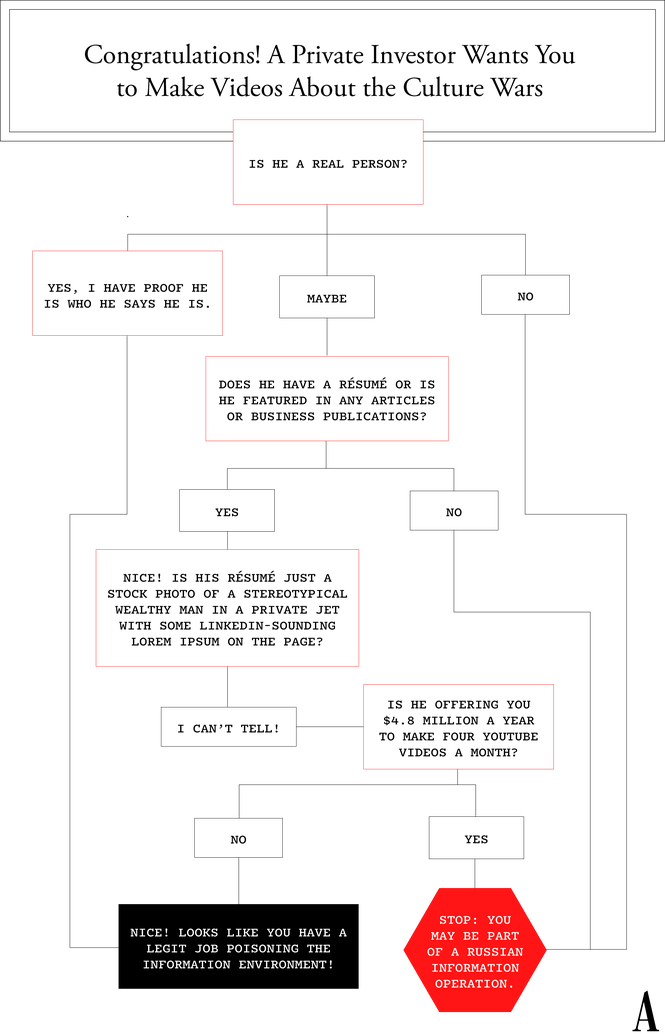
Oh, Russia!

A humorous flow chart

(Charlie Warzel)

Holding two adverse opinions at once

As I continue to parse Kamala Harris’ contradictions, and rhetorical blather, and refusal to explain all her sudden alleged policy switches from four years ago, I don’t mean to elide the fact that her opponent is out of his mind.

Some are incensed that after (much delayed) scrutiny of Biden’s mental deterioration, Trump still gets a pass for what in anyone else would be regarded as utter derangement. The trouble with this argument — see Jim Fallows’ Twitter feed for the full huff-and-puff — is that Biden was clearly declining fast because of incipient dementia and physical frailty, which is a story; and Trump has always been nuts, is not appreciably nuttier than he ever was, and, in stark contrast with Biden, seems physically robust.

This deranged con-man was president for four years — with of all this plain to see — and is still the likeliest winner of this election. Half the country takes him seriously, and they think — despite overwhelming evidence to the contrary — that he is mentally fit to perform the most powerful job in the world.

It’s merely our job, as citizens and voters, to note that we have one mentally ill candidate in this race and one mediocre but sane one. And to vote accordingly.

Andrew Sullivan, The Sane-Washing of Donald Trump

Sullivan also shared (embedded, but I won’t) a video of some impressive and even baffling ping-pong.


I suffer more from the humiliations inflicted by my country than from those inflicted on her.

Simone Weil, from a letter to Georges Bernanos.

I don’t do any of the major social media, but I have two sub-domains of the domain you’re currently reading: (a) You can read most of my reflexive stuff, especially political here. (b) I also post some things on the only social medium I frequent, because people there are quirky, pleasant and real.

Thursday, 9/5/24

Culture

A key moment in modernity

One of the key moments in the creation of modernity occurs when production moves outside the household. So long as productive work occurs within the structure of households, it is easy and right to understand that work as part of the sustaining of the community of the household and of those wider forms of community which the household in turn sustains. As, and to the extent that, work moves outside the household and is put to the service of impersonal capital, the realm of work tends to become separated from everything but the service of biological survival and the reproduction of the labor force, on the one hand, and that of institutionalized acquisitiveness, on the other. Pleonexia, a vice in the Aristotelian scheme, is now the driving force of modern productive work.

Alasdair MacIntyre, After Virtue

Why essays?

Of all the literary genres, I am fondest of the essay, with its meandering course that (we hope) faithfully represents the meanderings of the human mind … certain images in advance and people will recur throughout this book, returning perhaps when you think we’re done with them. I write this way because none of the things that I care about most have ever proven susceptible to systematic exposition.

Alan Jacobs, Breaking Bread with the Dead (emphasis added)

Interrogating “Self-expression”

[A]lthough everything we do is self-expression, we normally describe an action as self-expression only to say “this is good.” Used that way, the term is powerful. For example, foul pictures and language weren’t formerly counted as free speech because they didn’t communicate ideas and arguments. Today, though, they are counted as free speech, just because we say they “express” the “self.” And of course, logically, they do. If I spout a stream of profanities, I may be expressing nothing more of myself than an urge to blow off steam. But I may also be divulging my desire for attention, my craving to sound tough, my enjoyment of filthiness, or even my inability to express a cogent argument.

But why should the term “self-expression” have such power to connect itself with our approval? Probably for at least two reasons. The first is that the idea of expressing ourselves validates our narcissism. The second is that it shields us from criticism.

J Budziszewski

Modern finance is a shell-game

John Lanchester:

Lending money where it’s needed is what the modern form of finance, for the most part, does not do. What modern finance does, for the most part, is gamble. It speculates on the movements of prices and makes bets on their direction. Here’s a way to think about it: you live in a community that is entirely self-sufficient but produces one cash crop a year, consisting of a hundred crates of mangoes. In advance of the harvest, because it’s helpful for you to get the money now and not later, you sell the future ownership of the mango crop to a broker, for a dollar a crate. The broker immediately sells the rights to the crop to a dealer who’s heard a rumour that thanks to bad weather mangoes are going to be scarce and therefore extra valuable, so he pays $1.10 a crate. A speculator on international commodity markets hears about the rumour and buys the future crop from him for $1.20. A specialist ‘momentum trader’, who picks up trends in markets and bets on their continuation (yes, they do exist), comes in and buys the mangoes for $1.30. A specialist contrarian trader (they exist too) picks up on the trend in prices, concludes that it’s unsustainable and short-sells the mangoes for $1.20. Other market participants pick up on the short-selling and bid the prices back down to $1.10 and then to $1. A further speculator hears that the weather this growing season is now predicted to be very favourable for mangoes, so the crop will be particularly abundant, and further shorts the price to 90 cents, at which point the original broker re-enters the market and buys back the mangoes, which causes their price to return to $1. At which point the mangoes are harvested and shipped off the island and sold on the retail market, where an actual customer buys the mangoes, say for $1.10 a crate.

Notice that the final transaction is the only one in which a real exchange takes place. You grew the mangoes and the customer bought them. Everything else was finance – speculation on the movement of prices. In between the time when they were your mangoes and the time when they became the customer’s mangoes, there were nine transactions. All of them amounted to a zero-sum activity. Some people made money and some lost it, and all of that cancelled out. No value was created in the process.

That’s finance. The total value of all the economic activity in the world is estimated at $105 trillion. That’s the mangoes. The value of the financial derivatives which arise from this activity – that’s the subsequent trading – is $667 trillion. That makes it the biggest business in the world. And in terms of the things it produces, that business is useless. (Source: lrb.co.uk)

John Ellis News Items

Word-of-the-day

Word of the day: coprophagia

Definition: gobbling up Tucker Carlson other than for a detailed exposé. (Note that there are three hyperlinks in the preceding sentence.)

I don’t think Carlson has lost his mind, or at least no more so than anyone who’s been politically radicalized has. He’s been engaged in a coherent, if despicable, ideological project for years. As far back as 2017, he was airing segments in Fox News prime time on the gypsy infiltration of America. He surrounded himself at the network with white-nationalist chuds. He’s become a committed postliberal. It was inevitable that he’d start pulling his chin one day about the supposed moral complexity of World War II.

There’s nothing unusual about populists Nazi-pilling themselves with historical revisionism in search of their next contrarian high. What’s unusual about Tucker is that he’s maintained a degree of national popularity and even mainstream acceptance as he goes about trying to make the world unsafe for democracy. 

How? He’s taking advantage of a leadership vacuum on the right.

Creeping fascism on the right has been a-creepin’ since at least 2016. If you’re shocked, shocked to find that there’s gambling going on in here in 2024, it can only be because you went out of your way for tribal reasons not to notice.

Nick Catoggio

Covering what others don’t

If there is a criticism I’ve gotten over the past several years it’s that I pay too much attention—and apply too much scrutiny—to the excesses of the illiberal left at the expense of the illiberal right. Wasn’t I ignoring the elephant and allowing myself to get distracted by the gnat?

My response to that is twofold.

The first is that there is no shortage of writers, reporters, and outlets focusing on the dangers of the far right. I saw the far left as conspicuously overlooked by people who otherwise take a great interest in political extremism. And I understand why they were averting their gaze: The social cost of noticing this subject is very high. Given that the job description of a journalist is to observe the world, uncover things in the public interest, and then tell the plain truth about it, choosing topics where others fall silent seems wise to me. It still does.

The second is that I have been concerned for years now that the illiberal ideology that has become increasingly mainstream on the political left—one that makes war on our common history, our common identity as Americans, and fundamentally, on the goodness of the American project—would inspire the mirror ideology on the right. 

And that is exactly where we find ourselves, with an illiberal left that defaces Churchill statues—and an illiberal right that defaces Churchill’s legacy. With a left that insists 1619 was the year of the true founding of America—and a right that suggests the Greatest Generation was something closer to genociders. With a left that sympathizes with modern-day Nazis in the form of Hamas—and a right that sympathizes with the original ones.

Bari Weiss

Public affairs

Military valor

[Adam] Kinzinger’s political stance—his willingness to criticize the most popular and feared figure in his party, when the overwhelming majority of his colleagues have either gone silent or defended the ex-president’s indefensible actions—can’t be understood apart from his military service.

“Because we ask [service members] to die for the country, we have to be willing to do the same thing. But”—here he turned incredulous—“we’re too scared to vote for impeachment, because we’re going to lose our job? Like, seriously?”

For most of Kinzinger’s colleagues, the answer is: Yes, seriously. When I asked Kinzinger how many Republican votes there would have been in favor of impeachment if it had been a secret ballot, he told me 150. Instead, there were only 10.

The Man Who Refused to Bow

Richard Lugar

Tuesday, a bronze statue of Richard Lugar was unveiled in Indianapolis, with considerable ceremony including a speech by, appropriately, Condoleeza Rice.

I recall when I first was awed by Lugar. At our County’s Lincoln Day dinner (the closest I ever got to being a partisan activist) around 1982 or 1983, he was the featured speaker. He spoke for a very long time, without notes, mostly about his trip to the Phillipines, which had just ended. He shot straight, eschewing the B.S. about Ferdinand Marcos. One of the “conservative” talking points of the day was that Marcos’ only opponents were communists. “Don’t you believe it,” Lugar essentially said. “His only supporters are the oligarchs of the country. Small business, the Chamber of Commerce types, oppose him strongly.”

It all seemed to cohere. I couldn’t give such a speech even with notes. That he’d been a Rhodes Scholar showed.

Lugar was the kind of statesman who’d have voted to convict Trump on the Articles of Impeachment. If more Republicans had his balls, Trump would be behind us by now.

Understudy to Russia’s role as whipping boy

Yesterday Politico dropped a story about how “former GOP officials are sounding the alarm over Trump’s Orban embrace.” Gosh, where would we be without Former GOP Officials, eh? The story attempts to demonize anyone who has anything to do with the Hungarian prime minister. Excerpt:

The Conservative Partnership Institute, a nerve center for incubating policies for a second Trump administration, co-sponsored a discussion in October 2022 about how to bring “peace in Ukraine” featuring Hungarian Minister of Foreign Affairs Peter Szijjarto.

Audience members included conservative policy and national security officials and GOP strategists, according to a person familiar with the meeting. Once seated, they were given pamphlets pushing unabashedly pro-Russia talking points.

“Russia has the will, strength, and patience to continue war,” warned the document, which was given to POLITICO by a participant. “U.S aid to Ukraine must be severely constricted and Ukrainian President Zelensky should be encouraged by U.S. leadership to seek armistice and concede Ukraine as a neutral country.”

“If the U.S. continues to enable war, it will result in the destruction of Ukraine and provoke further Russian aggression toward the West, with the potential for nuclear conflict,” it said.

You see what Politico is doing here? We are not supposed to evaluate these claims; we are supposed to reject them out of hand as “pro-Russian talking points.”

This is the same kind of manipulation the Blob used to manufacture consent of the American people to support the Iraq War. What, you think Arabs don’t deserve democracy? You want Iraq to create a mushroom cloud over an American city? You want the terrorists to win?!

The Orban government might be wrong in its analysis of the Ukraine war, but characterizing it as nothing more than “pro-Russian talking points” does a profound disservice to democratic publics in the US and Europe, who are financing NATO’s participation in this war. If Orban’s government is wrong, then explain how they’re wrong. Don’t talk to people like we’re morons.

Rod Dreher (who you can safely ignore because he just channels pro-Russian talking points).

The Best fall outcome, in the long-term, for the GOP

For the GOP, might the ingredient for long-term success be its defeat in the 2024 election? “The best possible outcome in November for the future of the Republican Party is for former President Donald Trump to lose and lose soundly,” Jonathan Martin wrote for Politico. “Trump will never concede defeat, no matter how thorough his loss. Yet the more decisively Vice President Kamala Harris wins the popular vote and electoral college the less political oxygen he’ll have to reprise his 2020 antics; and, importantly, the faster Republicans can begin building a post-Trump party,” Martin continued. “For most Republicans who’ve not converted to the Church of MAGA, this scenario is barely even provocative. In fact, asking around with Republicans last week, the most fervent private debate I came across in the party was how best to accelerate Trump’s exit to the 19th Hole. … Yes, moving past Trump in the aftermath of another defeat will hardly be easy. But it’s essential if Republicans want to become a viable national party once more.”

The Morning Dispatch

Politics more narrowly

Kamala Harris is an enemy of free speech

In 2019, well before the January 6 riot that ultimately led to President Trump’s Twitter ban, then–Senator Harris publicly and repeatedly called on Twitter to ban him. On October 1, 2019, in a letter to Dorsey, Senator Harris called Trump’s tweets “blatant threats,” and claimed that other users “have had their accounts suspended for less offensive behavior.” She tweeted at Twitter’s then-CEO Jack Dorsey, pleading with him “to do something about this.”

Apparently surprised by Harris’s casual use of her pulpit to call for Twitter to ban a sitting president, CNN’s Jake Tapper asked Harris in an interview: “How is that not a violation of free speech? The president has the same rights that you have, that I have. How would that not be a slippery slope to ban half the people on Twitter?” 

Harris doubled down: “I’ve heard that argument, but here’s the thing, Jake. A corporation—which is what Twitter is—has obligations and in this case, they have terms of use policy. Their terms of use dictate who receives the privilege of speaking on that platform and who does not. And Donald Trump has clearly violated the terms of use, and there should be a consequence for that,” she said [emphasis mine]. “Not to mention the fact that he has used his platform, being the president of the United States, in a way that has been about inciting fear and potentially inciting harm against a witness to what might be a crime against our country and our democracy.”  

In case Twitter had somehow failed to notice the directive, then–Senator Harris said: “And I am asking that Twitter does what it has done on previous occasions, which is revoke someone’s privilege because they have not lived up to the advantages of the privilege.”

Two weeks after the Tapper interview, at the Democratic primary debate on October 15, 2019, Harris repeated her call for Twitter to ban President Donald Trump from its platform. Harris claimed that the mass shooter at an El Paso Walmart had been “informed by how Donald Trump uses that platform.” She several times urged Elizabeth Warren, “Join me in saying his Twitter account should be shut down.” Even

Even Elizabeth Warren seemed appalled. She refused with a simple “No.” She is a law professor, after all. 

After that debate, Harris told Tapper flatly:  “The bottom line is you can’t say you have one rule for Facebook and another rule for Twitter. The same rule has to apply which is that there has to be a responsibility placed on social media sites to understand their power. They are directly speaking to millions of people without any level of oversight or regulation and that has to stop.” [empahsis mine]

Did you get that? It’s worth watching: Harris said social media sites should not be able to communicate information directly with the public without government oversight.

Abigail Shrier, Elon Musk, Mark Zuckerberg, and Our Government Censors

This item via Bari Weiss’s Free Press, as she does indeed cover what others don’t. (See above.)

Swing states

I don’t believe we have the luxury of writing in candidates’ names, particularly in swing states … As a conservative, as someone who believes in and cares about the Constitution, I have thought deeply about this and because of the danger that Donald Trump poses, not only am I not voting for Donald Trump, but I will be voting for Kamala Harris.

Liz Cheney

I have just one question: Is Wyoming really a swing state?

Trump’s off his game

I get the sense that the assassination attempt spooked him more than he’s willing to admit and also slowed him down. And yes, there are those niggling details about him being a nut, a narcissist, a boor, a bigot, a blowhard, a tornado of baloney — a man who, to borrow from an old joke, could commit suicide by leaping from his ego to his I.Q.

Bret Stephens


I suffer more from the humiliations inflicted by my country than from those inflicted on her.

Simone Weil, from a letter to Georges Bernanos.

I don’t do any of the major social media, but I have two sub-domains of the domain you’re currently reading: (a) You can read most of my reflexive stuff, my primal screams, here. (b) I also post some things on the only social medium I frequent, because people there are quirky, pleasant and real.

Indiction 2024

This is the Eastern Church’s Indiction, the beginning of the liturgical year.

[I]n the day-to day trenches of adult life, there is actually no such thing as atheism. There is no such thing as not worshipping. Everybody worships. The only choice we get is what to worship. And the compelling reason for maybe choosing some sort of god or spiritual-type thing to worship . . . is that pretty much anything else you worship will eat you alive.

David Foster Wallace, quoted as the epigraph to the Introduction of William T. Cavanaugh’s new The Uses of Idolatry. It seemed a fitting epigraph for this post as well.

From incarnate God to Baby Jesus

Historian John Strickland rues

that moment in history when the incarnate God gives way to “Baby Jesus,” a departure from tradition so great that it represents the transition between a paradisiacal art and a utopian one. To a member of the old Christendom, it bordered on blasphemy. In an effort to celebrate human life in a spiritually untransformed world, the artist of the new Christendom now emasculates the image of the Godman and by doing so diminishes His divinity. … the only clue that the painting represented the Madonna was that it conformed in content to the standard iconography of the Theotokos inherited from and still normative in the East. … Jesus Christ had become an adorable baby whose passivity incites a desire to pinch him on the cheek and poke him in the belly like some fourteenth-century Pillsbury Doughboy.

From the chapter The End of Iconography in The Age of Utopia.

Christian schools as an effective alternatives to secular schools

Christian schools will be effective alternatives to secular schools only to the extent that students at those schools are formed in a sacramental imagination that sees the cosmos as “charged with the grandeur of God.” Too often, Christian educators formed by the secular academy have unwittingly adopted modes of teaching and attention that impart a reductive, materialist understanding of reality.

Their materialist assumptions are often disguised by a veneer of prayer that is equal parts domesticated, distant, and safe. It’s easy to see why. While a handful of faithful families might reject a school that adopts the lens of the world, many more—hungry for their children to fit into mainstream American culture—will line up, especially if the school has a proven track record of finding places for their graduates at elite colleges and universities, which are still seen by far too many parents as the only path to a good life.

As families begin to see the dangers that secular and secular-adjacent institutions of higher education pose to their children over the next decade, and as alternative career paths in the trades become increasingly commonplace, it’s essential for educators at Christian schools to begin discerning a new path forward. Is there a different way to educate young men and women that avoids the college prep vortex?

Randy Aust, Sacramental Ontology in a Christian School

What follows this quote are four suggested steps to inculcate a sacramental ontology.

As a Board Member of two different Christian schools in my lifetime, these opening paragraphs really ring true — especially the tacit point that it’s hard to maintain a school with just “a handful of faithful families” who set their sites higher than hunger for their children to fit into mainstream American culture with a little Baby Jesus thrown in for good measure.

Not my circus, not my monkeys inquisitors

It is noteworthy that no institutional form of religious persecution was ever introduced in the Christian East. Because of Western historiographical ignorance of the Orthodox Church, however, the inquisition would come to represent, for secular intellectuals in modern times, the illegitimacy of any civilization grounded in Christianity, whether Western or Eastern.

John Strickland, The Age of Division

Lazarus

IT IS WELL KNOWN AMONG Cypriots, not to mention a matter of national pride, that St. Lazarus lived on the island of Cyprus after the Lord’s Resurrection. Saint John’s Gospel tells us that the Jewish leaders had resolved to kill both Jesus and Lazarus. They considered it necessary to kill Lazarus because belief in Jesus as the Messiah increased after he raised Lazarus to life when he had been dead for four days (John 12:9–11). Lazarus was literally living proof of this extraordinary miracle. The New Testament itself does not tell us that Lazarus went to Cyprus later, but this was known in the tradition of the Church of Cyprus. The gospel message came to Cyprus very early, and the Church was established there even before St. Paul became a missionary (Acts 11:19–21).

My husband, Fr. Costas, was born and lived on the island of Cyprus when it was still a British colony. He related to me that the Cypriots would boast about St. Lazarus to the British there. But the British would often scoff at this claim, saying there was no proof that Lazarus had ever come to Cyprus.

A very old church dedicated to St. Lazarus, dating back to the 800s, is located in Larnaca, Cyprus. In 1972 a fire caused serious damage to the church building. The subsequent renovation required digging beneath the church to support the structure during reconstruction. In the process of digging, workers uncovered the relics of St. Lazarus located directly below the altar in a marble sarcophagus engraved with the words “Lazarus, the four-day dead and friend of Christ.”

Dr. Eugenia Scarvelis Constantinou, Thinking Orthodox

Rubes

The Presbyterian David Rice described these impulses at work among people in Kentucky: “They were then prepared to imbibe every new notion, advanced by a popular warm preacher, which he said was agreeable to Scripture. They were like a parcel of boys suddenly tumbled out of a boat, who had been unaccustomed to swim, and knew not the way to shore. Some fixed upon one error, and some upon another.”

Nathan O. Hatch, The Democratization of American Religion

Something in common

As a historical and empirical reality between the early Reformation and the present, “Protestantism” is an umbrella designation of groups, churches, movements, and individuals whose only common feature is a rejection of the authority of the Roman Catholic Church.

Brad S. Gregory, The Unintended Reformation

How we got critical theory

Convinced that capitalism must be abolished before the promises of humanism could be realized, they considered liberal democracy a functional dystopia. Contrary to the promises of Marx, the proletariat did not choose to overthrow the bourgeoisie when given the opportunity. In fact, it came to embrace the values of the oppressors. This was astonishing to Marxist intellectuals. The Frankfurt School developed an entirely new method of understanding the calamity, something they called “critical theory.”

John Strickland, The Age of Nihilism

Authentic embrace of the struggle

One of the first things most young men do who authentically embrace the struggle is get rid of their video games. The same with drugs. If the young man is to succeed, the marijuana has got to go as well.

From the chapter An Approach to Healing in Frederica Mathewes-Green & Rod Dreher, Healing Humanity


Religious ideas have the fate of melodies, which, once set afloat in the world, are taken up by all sorts of instruments, some woefully coarse, feeble, or out of tune, until people are in danger of crying out that the melody itself is detestable.

George Elliot, Janet’s Repentance, via Alan Jacobs

You can read most of my more impromptu stuff here and here (both of them cathartic venting, especially political) and here (the only social medium I frequent, because people there are quirky, pleasant and real). All should work in your RSS aggregator, like Feedly or Reeder, should you want to make a habit of it.