Thursday, 6/8/23

Politics of one sort or another

Plus ça change

Metapolitics

I’m a pluralist. I don’t just mean in the sense that I think modern societies are too highly differentiated for them to be oriented toward a single highest good in the way some on the right (the so-called Integralists) like to imagine they were in the supposedly good old days of unified Catholic Europe during the medieval period. I am that kind of pluralist, but I’m also a pluralist in another and deeper sense, one that traces its lineage to the work of Isaiah Berlin, who deployed the term to describe the character of moral reality itself, regardless of the composition of any specific society.

Individual freedom from external constraint or coercion is an important human good. But what about other senses of liberty? Or fairness (proportional justice)? Or solidarity? Or loyalty? Or excellence? Or authority? Or creativity? Or sanctity? Or piety? There are many human goods, each worthy of pursuit. Devoting one’s life to one at the exclusion of others will undoubtedly have value, but it will also require the sacrifice of those other goods. That doesn’t mean we must embrace, affirm, and pursue all values equally. (Equality is itself a good the pursuit of which requires the sacrifice of other goods.) But it does mean that we should make our choices in full awareness of the sacrifices involved, and not deny the reality of the losses.

So the love of liberty has its place. The problem is that libertarianism overemphasizes it to the exclusion of other values, and often denies there is any important loss or tradeoff involved in doing so. (Yes, that’s a little ironic for thinkers who usually like to emphasize the need for tradeoffs in the context of fashioning government policy.)

Damon Linker

Sorta Politics

After the way he abased himself to secure the Speakership, I never would have thought Keven McCarthy would be able to get anything done:

Among the various reassessments of Kevin McCarthy following his successful debt ceiling negotiations, the one with the widest implications belongs to Matthew Continetti, who writes in The Washington Free Beacon that “McCarthy’s superpower is his desire to be speaker. He likes and wants his job.”

[P]art of what’s gone wrong with American institutions lately is the failure of important figures to regard their positions as ends unto themselves. Congress, especially, has been overtaken by what Yuval Levin of the American Enterprise Institute describes as a “platform” mentality, where ambitious House members and senators treat their offices as places to stand and be seen — as talking heads, movement leaders, future presidents — rather than as roles to inhabit and opportunities to serve.

On the Republican side, this tendency has taken several forms, from Newt Gingrich’s yearning to be a Great Man of History, to Ted Cruz’s ambitious grandstanding in the Obama years, to the emergence of Trump-era performance artists like Marjorie Taylor Greene. And the party’s congressional institutionalists, from dealmakers like John Boehner to policy mavens like Paul Ryan, have often been miserable-seeming prisoners of the talking heads, celebrity brands and would-be presidents.

[T]he most notable populist Republican elected in 2022, J.D. Vance, has been busy looking for deals with populist Democrats on issues like railroad safety and bank-executive compensation, or adding a constructive amendment to the debt-ceiling bill even though he voted against it — as though he, no less than McCarthy, actually likes and wants his current job.

Ross Douthat, Can Kevin McCarthy and Joe Biden Fix Washington?.

Bare-knuckle politics

The former governor, whose affiliated PAC calls itself “Tell It Like It Is,” didn’t pull any punches during his roughly two-hour town hall last night against the man he’s convinced gave him COVID-19, calling the former president “lonely, self-absorbed, and self-serving.”

“I’m going after Trump for two reasons,” he said in response to an audience question. “Because he deserves it, and because it’s the way to win.”

Christie, a former federal prosecutor, likely views his punch-Trump-in-the-mouth approach as killing three birds with one stone. Not only does it put Trump on the defensive, but picking fights will also earn Christie time on cable news, which amounts to free advertising for the campaign. Plus, it helps him paint himself as a fighter. “He knows how to brawl and we like that in our candidates,” Merrill said of New Hampshire GOP voters.

TMD, The GOP Field Takes Shape

Delusional politics

A Toyota memo to auto dealers in April explained the challenges to full electrification. For instance, “most public chargers can take anywhere from 8-30 hours to charge. To meet the federal [zero-emissions vehicle] sales targets, 1.2M public chargers are needed by 2030. That amounts to approximately 400 new chargers per day.” The U.S. isn’t close to meeting that goal.

Toyota also noted that “more than 300 new lithium, cobalt, nickel and graphite mines are needed to meet the expected battery demand by 2035,” and they could take decades to develop. “The amount of raw materials in one long-range battery electric vehicle could instead be used to make 6 plug-in hybrid electric vehicles or 90 hybrid electric vehicles.”

And here’s an even more striking statistic: “The overall carbon reduction of those 90 hybrids over their lifetimes is 37 times as much as a single battery electric vehicle.” These inconvenient truths undermine the climate religion and government mandates.

Wall Street Journals Editorial

Culture

The Machine chooses its pronoun: “I”

Gaslit by machinery that calls itself a person :: Writing Slowly

Phone-free schools?

“Once upon a time, teachers smoked in classrooms.” There’s no reason we can’t get to a place where sneaking a look at a smartphone would be like sneaking a smoke at school—shameful for adults, a disciplinary offense for students.

Mark Oppenheimer, quoting David Sax.

Swell article, along with this. Dare I suggest, though, that Apple Watch complicates phone-free school strategies?

Wordplay

the ‘woke’ tribe

a curious agglomeration of international capital and elite progressive opinion posing as an uprising from below. (Paul Kingsnorth, The West Must Die)


It is the greatest of all mistakes to do nothing because you can only do little.

Sydney Smith (via The Economist)


zoonosis

Any disease or infection that is naturally transmissible from vertebrate animals to humans. See also Factory farming will kill us all. I think I’ll keep up buying pastured meat on the theory that — well, see the Sydney Smith quote above.

Apologies to Monbiot? I don’t think so.


The view from nowhere came from somewhere.

Subtitle of an Atlantic Article on the idea of objectivity.


Diffident

The thought crossed my mind that this has become an apt description of me. Looking up definitions, it does seem to fit. I “put a lot of stuff out there,” but have few hills I’m willing to die on. This may be a knock-on effect of a major religious epiphany after almost 50 years of excessive confidence in things I now see as sorely lacking.


A “true” story, in the older understanding, is a story that tells a truth, even if the facts are not true.

Rod Dreher, reporting on a gathering in Dublin that he and I both consider significant.

I may have said this before, but I was still, at age 18, struggling with the idea that something non-factual could be true, and I was suspicious of a young teacher who seemed to believe that it could. No doubt, that was connected to the putative literalism my (then) religious tradition of 1950s and ‘60s Wheaton-College-oriented evangelicalism. But I hesitate to try to unpack it further because the first sentence of this paragraph says all I can really remember of my hangup, which is virtually incomprehensible to me now.


To me, the Vision Pro doesn’t look like something to use, it looks like something to be sentenced to – by an especially cruel judge.

Alan Jacobs (link added, in case you’re not yet caught up in the hype)


Phubbing: contraction of “phone snubbing.” Phubbing is breaking away from a conversation to look at one’s phone screen.

##############################

For all its piety and fervor, today’s United States needs to be recognized for what it really is: not a Christian country, but a nation of heretics.

Ross Douthat, Bad Religion

We are in the grip of a grim, despairing rebellion against reality that imagines itself to be the engine of moral progress.

R.R. Reno

The end of the world as we know it is not the end of the world.

You can read most of my more impromptu stuff here (cathartic venting) and here (the only social medium I frequent, because people there are quirky, pleasant and real). Both should work in your RSS aggregator, like Feedly or Reeder, should you want to make a habit of it.
Thursday, 11/17/22

Embodied Perception

To emphasize the role that our bodies play in determining how we inhabit and therefore perceive the world, and to entertain the notion of cognitive extension, is to put oneself on a collision course with the central tenets of the official anthropology of the West. As we have already noted, embodied perception poses a direct challenge to the idea that representation is the fundamental mental process by which we apprehend the world.

Matthew Crawford, The World Beyond Your Head

I think Crawford calls this “the official anthropology of the West” because of our fetish that everyone must go to college to encounter more representations of the world, less actual world.

Long-term readers may justly suspect that, in my behavior, I am slave to this official anthropology. I tend to prefer reading to getting up and going for a walk or making something with my hands.

An opportunity, not a death knell

Let’s start with what the pro-life pessimists get right. Tuesday’s results confirm the anti-abortion movement’s fundamental disadvantages: While Americans are conflicted about abortion, a majority is more pro-choice than pro-life, the pro-choice side owns almost all the important cultural megaphones, and voters generally dislike sudden unsettlements of social issues.

You can strategize around these problems to some extent, contrasting incremental protections for the unborn with the left’s pro-choice absolutism. But when you’re the side seeking a change in settled arrangements, voters may still choose the absolutism they know over the uncertainty of where pro-life zeal might take them.

However, when abortion wasn’t directly on the ballot, many of those same voters showed no inclination to punish politicians who backed abortion restrictions. Any pro-choice swing to the Democrats was probably a matter of a couple of points in the overall vote for the House of Representatives; meanwhile, Republican governors who signed “heartbeat” legislation in Texas, Georgia and Ohio easily won re-election, and there was no dramatic backlash in red states that now restrict abortion.

In other words, Republicans in 2022 traded a larger margin in the House and maybe a Senate seat or two for a generational goal, the end of Roe v. Wade. And more than that, they demonstrated that many voters who might vote pro-choice on an up-down ballot will also accept, for the time being, pro-life legislation in their states.

For a movement that’s clearly a moral minority, that’s an opportunity, not a death knell ….

Ross Douthat

FTX

I have generally avoided getting into discussions about cryptocurrencies, because I am a perennial late-adopter who never understands how the big new thing is supposed to work or why anyone would even be interested in it. Aware of that bias, the fact that crypto always struck me as an elaborate Ponzi scheme wasn’t quite enough for me to be sure that it was an elaborate Ponzi scheme. Besides, even if I was sure, that wouldn’t be reason enough to confidently predict collapse; flim-flam operations sometimes get bought by companies with real businesses—or may even monetize their hype into real currency that they use to buy real companies—and thereby achieve something like an enduring presence in the business landscape that they might not have been able to achieve on their own merits.

So what interests me primarily about the collapse of FTX is this business could ever have been idealized. The premise behind FTX is that, even though nobody is totally sure what crypto is ultimately good for, people love to trade it, and to concoct ever more elaborate schemes for leveraging waves of investor enthusiasm.

Noah Millman

Priorities

My wife and I had a conversation one day with a pleasant couple who were much younger, and much more prosperous, than we were.  Husband and wife were both high-dollar attorneys.  She expressed strong frustration because the kids were in day care, but she wanted to stay with them herself.  “Why don’t you?” we asked.  They answered that they had expenses.  “Like what?” we asked.  Well, they had to keep up the payments on their big, expensive boat and their big, expensive house on the lake.

The difference between her facial expression and his were intriguing.  She became nervous.  He became alarmed.  There was some history here, and he didn’t want his wife going down this road.  She didn’t want to displease him.  We changed the subject.

To one degree or another, almost all husbands and wives divide labor, and they are generally happier doing so.  Obviously, not all women desire an exclusively domestic life, and there is nothing wrong with that.  But there is a great deal wrong with the fact that we force women to act against their domestic inclinations for reasons that have nothing to do with their fulfillment.  We call it being liberated, but it is really about serving the interests of men — and economic managers.

J Budziszewski I have seen another variation on this: high-earners who “can’t afford” to pay the tuition they agreed for private Christian education.

Letting the cat out of the bag

It is important that we start on time. We are training our children for the work force.

Remark from the school on a first-grader’s report card, via Jonathan Malesic, When Work and Meaning Part Ways

There’s another cat in the bag, too. We’re training our children in a second role of consumers. A hyperbolic account:

[S]trange to think that even in Our Ford’s day most games were played without more apparatus than a ball or two and a few sticks and perhaps a bit of netting. Imagine the folly of allowing people to play elaborate games which do nothing whatever to increase consumption. It’s madness. Nowadays the Controllers won’t approve of any new game unless it can be shown that it requires at least as much apparatus as the most complicated of existing games.

Aldous Huxley, Brave New World.

This is one of the reasons I think Huxley far surpasses Orwell as a prophet of dystopia (although I’m pretty sure I had no opinion either way before the year 1984.)

Things they told you that weren’t, now that you think about it, true.

On a note related to the preceding item, this:

The transformation of work into a spiritual enterprise, the site of our highest aspirations—to transcend ourselves, to encounter a higher reality, to serve others—is the work ethic’s cruelest unfulfilled promise.

Jonathan Malesic, When Work and Meaning Part Ways

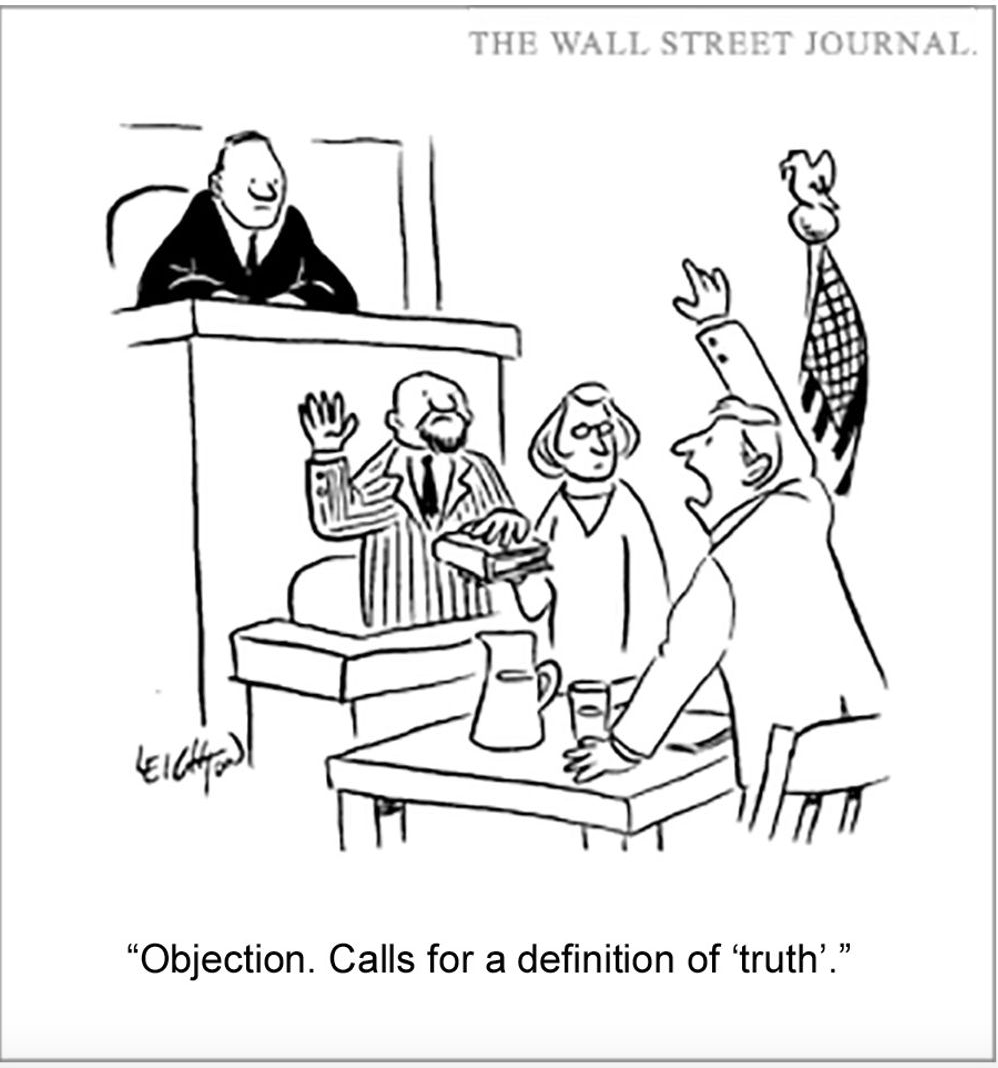
Speaking of truth, the Wall Street Journal’s Pepper & Salt cartoon is one of few cartoons I view regularly. Wednesday’s gave me a rueful chuckle:

Guilty and unashamed

Caffeine is so widely used and normalised that we don’t think of it as a drug or notice how it alters our minds. Research into its effects is often hampered by the difficulty of finding people who aren’t already dependent on it.

Sophie McBain, The psychoactive plants that change our consciousness, reviewing Michael Pollan, This is Your Mind on Plants.

A Hoosier teetotaler on the Isle of Islay

I opened my first-ever bottle of Laphroaig, “the most richly flavoured of all Scotch whiskies,” Monday night, as nightcap and to usher in the Nativity Fast that began Tuesday (a sort of personal “fat Monday”).

Wow! Now I think I know what Cutty Sark was trying to do when it produced a liquor that tasted like Listerine. In fact, that’s what the smell of Laphroaig reminded me of. Mercifully, the taste is not Cutty Sark.

Laphroaig is to every other scotch I’ve had as Dogfish Head 120 minute IPA is to Bud Light. It’s more — much more — but not just more. It’s different, too. From the label, that difference may be peat and smoke, but I’m forever hearing scotch afficianados talk about “peatiness,” so maybe I’m way off base. My palate and liquor vocabulary reflect my teetotaler roots.

Truth be told, I’m not sure how well I really like it. I’m not exactly alone. It was a shock. But I’ll know by the end of the bottle in a few months.

My last two items are about someone I hate even to name. Skip them if you like.

Trumpism without Trump?

Trumpism can survive without Mr. Trump.

Peter Wehner, Never-Trumper from the early days.

Isolating this phrase, I could hope that we get “Trumpism without Trump,” but that totally depends what one means by that phrase.

I could, and probably would, endorse the GOP continuing toward making itself the party of working-class middle-Americans of all races. Highlighting their plight is one of the (few, but consequential) good things Trump did.

Wehner, though, means by “Trumpism without Trump” a GOP that is malicious, dishonest and destructive. No thanks.


[S]ubordinating truth to politics is a game which tyrants and bullies always win.

Jonathan Rauch, The Constitution of Knowledge

The Orthodox "phronema" [roughly, mind-set] cannot be programmitized or reduced to shibboleths.

Fr. Jonathan Tobias

You can read most of my more impromptu stuff here (cathartic venting) and here (the only social medium I frequent, because people there are quirky, pleasant and real). Both should work in your RSS aggregator, like Feedly or Reeder, should you want to make a habit of it.

It’s about time

Jonathan H. Adler, Trump Lawyers Sanctioned for Frivolous Lawsuit Against Political Opponents

There’s apparently no deterring Trump, but maybe his legal prostitutes (that’s what I consider lawyers who file frivolous lawsuits just because a client is willing to pay them to do so) can be deterred.

Wednesday, 7/27/22

The WEIRD West

In one analysis involving similar samples from fifty countries, the top twenty countries scoring highest on the individualism index included all the Western countries except Portugal plus Israel.

Samuel P. Huntington, The Clash of Civilizations

Timely perspective

While it is true that the prenatal child should not be punished for the horrific behavior of her biological father, it is not clear that a woman who has been raped has the same obligation to aid a fetus as someone who has had consensual sex. That this question has not been given more thoughtful consideration within the public leadership of many “pro-life” communities is just the latest example of our culture’s refusing to take sexual violence against women seriously. Not least because nearly one in five women can expect to be victims of some kind of sexual violence during their lifetimes, we must be willing to have new and difficult conversations about abortion in these cases.

Charles C. Camosy, Beyond the Abortion Wars

We can know more than we can tell

Polanyi recognized how disastrous this view of knowledge really is. He already had an inchoate–or, tacit–sense that this was wrong by 1916. He had published a paper called “Absorption of Gases by a Solid Non-Volatile Absorbent,” which would become his dissertation. He submitted it to a chemist at the University of Budapest. The exchange between the two of them provides a clue.

Polanyi remembers that the professor studied his work and then asked him to explain a curious point in the paper. Polanyi’s result seemed to be correct, but the way he arrived at his result was faulty. Polanyi writes, “Admitting my mistake I said that surely one first draws one’s conclusions and then puts their derivations right. The professor just stared at me.”

There is a hint here of what would become Polanyi’s most famous phrase: “We can know more than we can tell.”

Perhaps it is becoming clear now how the modernist default setting for how knowledge works is incompatible with the way we actually know and live. If real knowledge is only factoids that we can put into sentences, then how do we ever really begin to know? How can this explain the way we operate productively in the world around us?

Finally, if Polanyi is right, then the idea of a neutral, unbiased, objective, a-religious public square needs to be discarded.

Michael Polanyi: Epistemological Therapist for a Secular Age

Republican dreams, Sugar Daddy investments

Until about five minutes ago, Mick McGuire was The Republican Dream, and, in the pre-Trump era, it would have been him versus Brnovich, the party man, and, this being Arizona, McGuire probably would have won.

But McGuire is polling in the single digits. In the early July poll, he was 19 points behind [Blake] Masters.

McGuire will tell you it’s all about the moolah. “The whole game has become a money game,” he told me. “The media is for sale, endorsements are for sale.” But, really, it was because McGuire hadn’t tapped into the Republican zeitgeist right now. He wasn’t a good investment. If he were, another billionaire sugar daddy would have materialized.

Crisp, full of snappy bullet points, Masters came across as a little studied, which he was. And he wore a jacket and tie, which made him look like he wanted the job too much. He wasn’t a man of the people as much as a man applying to be a man of the people.

Peter Savodnik, Blake Masters Wants to Be Trump 2.0


“The Frenchman works until he can play. The American works until he can’t play; and then thanks the devil, his master, that he is donkey enough to die in harness ….” (G.K. Chesterton)

You can read most of my more impromptu stuff here (cathartic venting) and here (the only social medium I frequent, because people there are quirky, pleasant and real). Both should work in your RSS aggregator, like Feedly or Reeder, should you want to make a habit of it.

Sunday, 7/10/22

Knowing God

“Let’s assume that we wish to investigate a natural phenomenon. As you very well know, in order to do so we need to employ the appropriate scientific methods … Everything must be explored through a method appropriate to the subject under investigation. If we, therefore, wish to explore and get to know God, it would be a gross error to do so through our senses or with telescopes, seeking Him out in outer space. That would be utterly naïve, don’t you think?”

“Yes, if you put it this way,” I replied. “Can we then conclude that for modern, rational human being, metaphysical philosophy like that of Plato and Aristotle or rational theology is the appropriate method?” As I raised the question I thought I knew what father Maximos’s answer would be.

“It would be equally foolish and naïve to seek God with our logic and intellect. But we have talked about this before, have we not?”

“… We can and must study God, and we can reach God and get to know him.”

“But how?” I persisted.

Father Maximos paused for a few seconds. “Christ himself revealed to us the method. He told us that not only are we capable of exploring God but we can also live with Him, become one with Him. And the organ by which we can achieve that is neither are senses nor logic but our hearts.”

… “This is the meaning, feather Maximos argued, of Christ’s beatitude, ‘Blessed be the pure in heart for they shall see God.’”

Then in the more serious tone I asked: “are we to assume that the philosophical quest for God, one of the central passions of the western mind from Plato to Immanuel Kant and the great philosophers of the nineteenth and twentieth centuries has in reality been off its mark?”

“Yes. Completely.”

Kiriakos C. Markides, The Mountain of Silence

Verites chretiennes devenues folles

It is indeed one of the grave errors of religious anti-secularism that it does not see that secularism is made up of verites chretiennes devenues folles, of Christian truths that “went mad,” and that in simply rejecting secularism, it in fact rejects with it certain fundamentally Christian aspirations and hopes.

Fr. Alexander Schmemann, For the Life of the World

Quite a bit of time has passed since Fr. Alexander wrote this. What are today’s "Christian truths gone mad"?

Mennonites

More than a year ago, this writer reviewed an excellent defense of opposite-sex only monogamy by a pastor in the Mennonite Church U.S.A., Darrin W. Synder Belousek, who offered a Biblical defense of opposite-sex only monogamy independent of the Biblical condemnations of homosexuality. Synder Belousek was concerned about the drift of his denomination toward the acceptance of same-sex marriage. Earlier the denomination’s largest conference, the Lancaster Mennonite Conference, had left the denomination, concerned about the increasing acceptance of homosexuality.

Late this spring, as was reported at the beginning of last month, the Mennonite Church U.S.A. formally accepted same-sex marriage, and signaled an utter rejection of Christian sexual morality in effectively apologizing for its previous Biblical standard, calling for repentance from it. Typical of the current homosexual/transgender apologetic, it effectively claims that the pain and humiliation Biblical morality causes is sufficient to establish that it is oppressive, setting aside God’s absolute authority, and Jesus’ call to accept the painful, narrow gate to life.

Scott Morgan, Evangelical Denominations Act on Biblical Morality and Their Future.

The Mennonites apparently want to be the left bookend of evangelicalism, whereas Christian Reformed and Presbyterian Church in America resolutions this summer are the right bookends. (All three might question the label "evangelical;" I don’t know any more.)

I wonder how Myron Augsberger, the Mennonite with whom I had most contact (and who I’m surprised to see is still living at age 92), received this news?

Dogs don’t understand pointing

I have tried to stress throughout the inevitableness of the error made about every transposition by one who approaches it from the lower medium only. The strength of such a critic lies in the words “merely” or “nothing but.” He sees all the facts but not the meaning. Quite truly, therefore, he claims to have seen all the facts. There is nothing else there; except the meaning. He is therefore, as regards the matter in hand, in the position of an animal. You will have noticed that most dogs cannot understand pointing. You point to a bit of food on the floor; the dog, instead of looking at the floor, sniffs at your finger. A finger is a finger to him, and that is all.

C.S. Lewis, Transposition, an essay from The Weight of Glory

Irreducible

“Constancy is the form of a whole human life.”

Stanley Hauerwas, via the To the Shire


If people have always said it, it is probably true; it is the distilled wisdom of the ages. If people have not always said it, but everybody is saying it now, it is probably a lie; it is the concentrated madness of the moment.

Anthony Esolen, Out of the Ashes

You can read most of my more impromptu stuff here (cathartic venting) and here (the only social medium I frequent, because people there are quirky, pleasant and real). Both should work in your RSS aggregator, like Feedly or Reeder, should you want to make a habit of it.

Polanyi on Knowledge

And if this is what knowledge is, then of course all knowledge is propositional. It can easily be put into words and sentences. It’s explicit.

Michael Polanyi: Epistemological Therapist for a Secular Age. Polanyi here states a position he rejects; he does not believe that all, or even most, knowledge is propositional.

“Propositional truth” — insistence that God’s truth was adequately communicable in words and sentences — was, I’m almost positive, an obsession of the late Francis Schaeffer, mentor to intellectualoid evangelical kids (including me) in the late 60s and throughout the 70s.

It was an obsession in the wrong way, if Polanyi is right. Everything I’ve come to know in the last two decades tells me that Schaeffer was wrong about this, Polanyi right, and that Schaeffer’s wrongness manifested his fundamentalist roots (though his self-presentation was much softer and cerebral than any other fundamentalist I can think of).

I’ve read an awful lot about Polanyi over the years, and I intend to hit some primary sources soon. Meanwhile, from the source cited above:

Let me gesture towards some possible areas where Polanyi might have something to say. Perhaps these areas can serve as catalysts for discussion.

A. Religion in the Public Square
[I]f Polanyi is right, then the idea of a neutral, unbiased, objective, a-religioius public square needs to be discarded.

If all knowledge is on the same epistemic footing, then should we be accrediting moral and spiritual knowledge in the public square?

If you prioritize a certain type of knowledge in a society (i.e., scientific knowledge), then you arguably end up privileging certain cultures and people with training who speak those ways.

Is this vision for knowledge necessary for any truly democratic public square?

B. Apologetics and the Imagination
Modern evidentialist apologetics attempts to prove with certainty such propositions as, “God exists,” or “Jesus was raised from the dead,” or “The Bible is infallible.”

Lesslie Newbigin writes, “The assumption often underlying [modern apologetics] is that the gospel can be made acceptable by showing that it does not contravene the requirements of reason…This is a mistaken policy…To look outside the gospel for a starting point for the demonstration of the reasonableness of the gospel is itself a contradiction of the gospel, for it implies that we look for the logos elsewhere than in Jesus.”

Perhaps what apologetics needs is an appeal to the imagination. Beauty through art, story, and practices. Art is usually seen as an extra or superfluous thing. But if Polanyi is right, then the arts are about a type of knowledge in the same way that chemistry is.

This gets at Charles Taylor’s notion of the “social imaginary.” Apologetics should work toward the conversion of the social imaginary.

C. Liturgy
Polanyi himself pointed to the possible role of liturgy to Christian belief and knowledge.

He writes that Christian liturgies serve as “frameworks of clues which are apt to induce a passionate search for God.”

I suggest that we think of the liturgy in Polanyi’s “from-to” structure of knowledge: subsidiary-focal integration. Can we discern clues and patterns in our liturgies (scripture readings, creedal confessions, sermons, hymns, corporate prayers, the Eucharist) and can these be indwelt by the skillful practitioner in order to see their meaning?

Perhaps we can reason from the liturgy to an intimate knowledge of God Himself.

D. Scripture and Tradition
What about the Scripture vs. tradition debate?

If we get rid of the two thousand years of church tradition with a (naive) desire to interpret Scripture apart from how the tradition (i.e., Creeds and “masters of the craft”) has in the past, what you will end up with is not the cold hard facts of what St. Paul really said–as the historical-critical method would have you believe. Rather, much like an unlearned and unskilled apprentice in a workshop, you will most likely put yourself and those around you in danger somehow.

After all, Scripture refers to itself as a sword. And swordsmanship is certainly a skill that requires practice and submission to a master swordsmanship.

Polanyi might suggest to us that there is no divide between Scripture and tradition if we understand it rightly. It is within Scripture that we come before the face of God. And it is there that we find that the face Scripture reveals is Christ’s. In order to attend to the deeper meaning of Scripture, which is Christ, we indwell them by the “tool” of the church’s great tradition. We submit to tradition and let it teach us how to read the Bible.

Michael Polanyi: Epistemological Therapist for a Secular Age (italics added).


“Where is the Life we have lost in living?
Where is the wisdom we have lost in knowledge?
Where is the knowledge we have lost in information?
The cycles of Heaven in twenty centuries
Bring us farther from GOD and nearer to the Dust.”

The Word of the LORD came unto me, saying:
O miserable cities of designing men,
O wretched generation of enlightened men,
Betrayed in the mazes of your ingenuities,
Sold by the proceeds of your proper inventions:
I have given you hands which you turn from worship,
I have given you speech, for endless palaver,
I have given you my Law, and you set up commissions,
I have given you lips, to express friendly sentiments,
I have given you hearts, for reciprocal distrust.
I have given you power of choice, and you only alternate
Between futile speculation and unconsidered action.
Many are engaged in writing books and printing them,
Many desire to see their names in print,
Many read nothing but the race reports.
Much is your reading, but not the Word of GOD,
Much is your building, but not the House of GOD.
Will you build me a house of plaster, with corrugated roofing,
To be filled with a litter of Sunday newspapers?

When the Stranger says: ” What is the meaning of this city?
Do you huddle close together because you love each other?”
What will you answer? ” We all dwell together
To make money from each other”? or ” This is a community”?
And the Stranger will depart and return to the desert.
O my soul, be prepared for the coming of the Stranger,
Be prepared for him who knows how to ask questions.

It is hard for those who have never known persecution,
And who have never known a Christian,
To believe these tales of Christian persecution.
It is hard for those who live near a Bank
To doubt the security of their money.
It is hard for those who live near a Police Station
To believe in the triumph of violence.
Do you think that the Faith has conquered the World
And that lions no longer need keepers?
Do you need to be told that whatever has been, can still be?
Do you need to be told that even such modest attainments
As you can boast in the way of polite society
Will hardly survive the Faith to which they owe their significance?

(T.S. Eliot, Choruses From ‘The Rock’)


From 1906 to 1910 he was a Liberal Party Member of Parliament for Salford South. During one campaign speech he was asked by a heckler if he was a “papist.” Retrieving his rosary from his pocket he responded, “Sir, so far as possible I hear Mass each day and I go to my knees and tell these beads each night. If that offends you, then I pray God may spare me the indignity of representing you in Parliament.” The crowd cheered and Belloc won the election.

Hilaire Belloc – Wikipedia

Compare Ben Sasse, Message to Nebraska GOP State Central Committee. Sasse is a guy who can speak the truth because — unlike most of his colleagues — he has no apparent ego-need to be a U.S. Senator.


Conservatives Sit Down For A Relaxing Evening Of Being Insulted By Every Major Corporation In America | The Babylon Bee