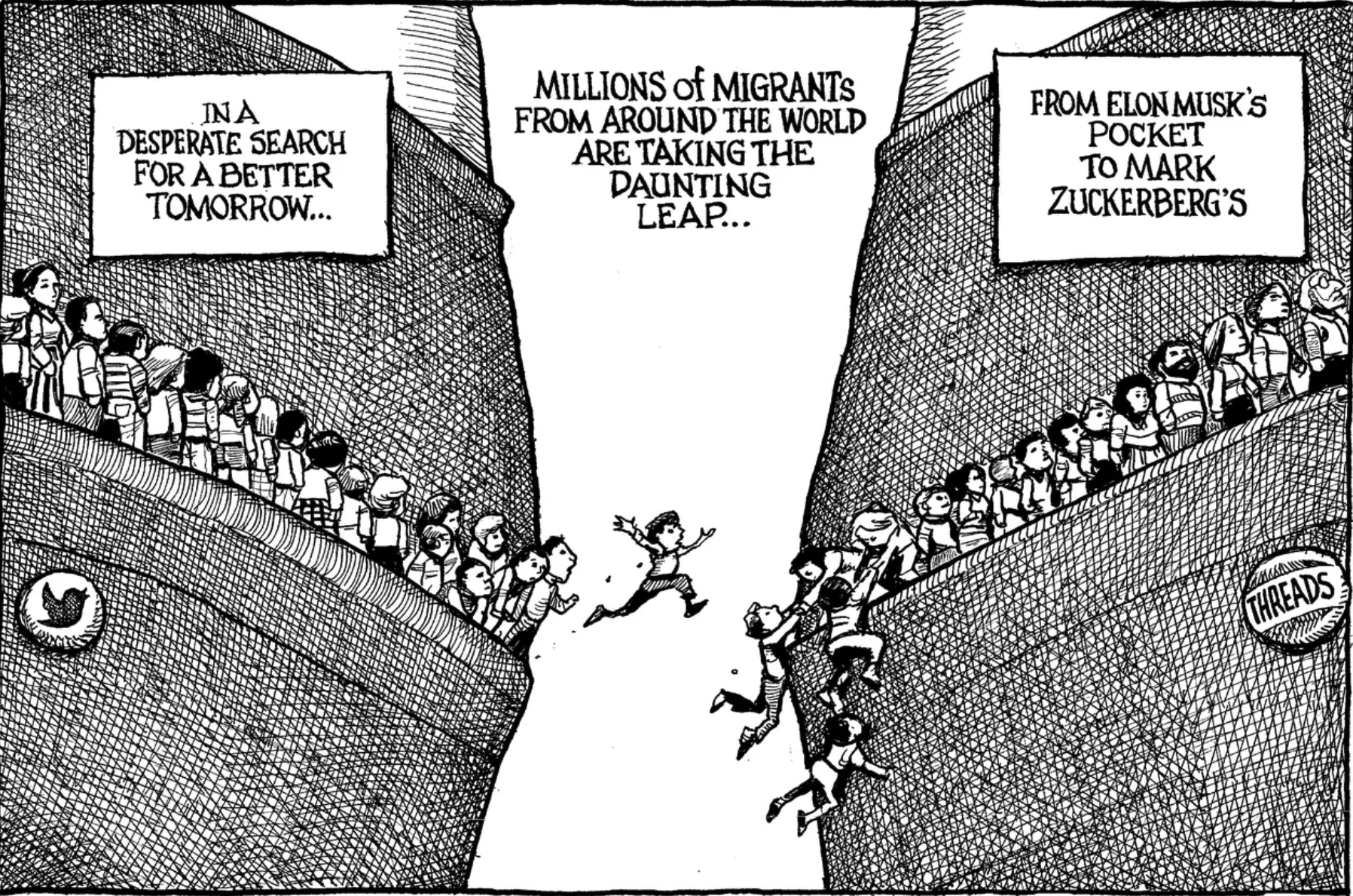
Wednesday, 3/12/25

Trump-related

As is my wavering intent, I have moved my more vitriolic criticisms of Trump 2.0 to another blog. What remains is relatively temperate.

As the twig is bent …

“Dennis Burnham, who lived next door, was a toddler when his mother briefly put him in a playpen in their garden. She returned a few minutes later to find the current U.S. president, then aged five or six, standing at his fence throwing rocks at the little boy. Another neighbor, Steven Nachtigall, now a 66-year-old doctor, said he never forgot Trump … once jumping off his bike and beating up another boy: ‘It was so unusual and terrifying at that age,’” – Trump Revealed.

“When I look at myself in the first grade and I look at myself now, I’m basically the same,” – Donald J Trump.

Andrew Sullivan

Tripping over a very low bar

It doesn’t take much to persuade me that some new development in this Administration is really bad. But it takes more than this:

Defense Secretary Pete Hegseth’s appointment today of his personal lawyer, Timothy Parlatore, as a Navy commander in the Judge Advocate General’s Corps reflects not just the norm-breaking approach that Hegseth is bringing to the job, but an odious philosophy of warfare. Like his new boss at the Pentagon, Parlatore has a pattern of providing support to soldiers accused of grave misconduct, even war crimes. He notably represented Eddie Gallagher, a Navy SEAL court-martialed on charges including the murder of a captured fighter (though he was found guilty only of one, lesser charge), along with a second SEAL accused of serious sexual offenses. Elevating a lawyer with this record does not bode well for the armed services Hegseth hopes to build.

Jason Dempsey at the Atlantic.

If we really believe that every criminal defendant deserves competent legal counsel, we must stop insinuating that lawyers who have represented criminals are complicit in their crime and therefore evil. But we’ve done so (albeit selectively, sorted by tribe) all my adult life, and it has always bugged me — even before I was a lawyer.

Dare I think this nasty habit reflects what we really believe:

  1. We should have kangaroo courts or even summary executions without trial — except for members of our respective tribes.
  2. Anyone who facilitates real courts and frustrates summary executions is a money-grubbing lowlife.

For my friends, anything; for my enemies, the law

For all of Trump’s talk about rooting out “anti-Christian bias” from the United States, one of his administration’s first executive actions violated the free speech and religious freedom rights of several Christian congregations. It turns out that Trump wants to protect only his Christian allies from government reprisals. Dissenting believers will face his wrath, and the wrath of the state.

David French, who has the receipts.

This is one of the reasons I don’t buy Aaron Renn’s positive world/neutral world/negative world chronology of Christianity’s status in the US. True and consistent Christianity has never been viewed positively, and the negativity has come from the right as well as the left, albeit for different reasons.

The Plight of the Never-Trump Pundit

I woke up excited to write about the day’s most important political news—before remembering that I said most of what I wanted to say on the subject a few weeks ago.

Never Trumpers who work in media will face that problem every day for the next four years. Good luck finding something new and interesting to say as the president vindicates your arguments against him again and again and again.

Nick Catoggio

The Trumposcene is a great time not to be a professional pundit. Yes, I opine, but I don’t have to do it on a schedule, whether or not I’m feelin’ it.

And I mostly borrow.

Not Trump-related

Resurrecting de Gaulle

[T]he American right should consciously support a stronger France. It should encourage a special relationship between the two republics, support French primacy on the continent, treat Paris rather than Brussels as the European capital and the French military as the keystone of Europe’s security.

In effect, we should revisit Charles de Gaulle’s bid to maintain more French independence within the Western alliance, which made him a thorn in the American side during the Cold War, and recognize that he was right. It was not actually in America’s long-term interests to make Europe our full dependent, because vassaldom encourages weakness, and weakness reduces the value of the alliance in a world that America can no longer simply bestride alone.

The French military is limited but still “indisputably the most capable in Western Europe,” as Michael Shurkin noted in a 2023 analysis for War on the Rocks, with a resilient capacity for expeditionary action. Its nuclear-energy strategy has granted it a degree of energy independence that contrasts sharply with the reckless folly of German “green” de-industralization. Its pro-natal policies have given it a sustained demographic advantage; it is aging, but its fertility isn’t collapsing in the style of Italy, Spain or now Poland.

Then, psychologically, France lacks the crippling sense of historical guilt that still pervades Germany, and the junior-partner complex that has made Britain an unsuccessful adjunct of recent American foreign policy mistakes. It embodies two distinct forms of universalism, Roman Catholic and republican, that have more historical appeal across Europe than the Anglo-American style of empire. And the rapid renovation of Notre-Dame de Paris joined to the recent “gentle revival” of Catholic practice amid secularized conditions suggest stronger possibilities for spiritual renewal as well.

This last point is crucial for American conservatives. The current European establishment, secular and socially liberal even in its “conservative” forms, often feels like a natural ally not of the United States in full but of American progressivism alone. So the American right should wish to see a more substantial European conservatism re-emerge — more ambitious than today’s populist factions, and capable, as the right-wing Frenchman Pascal-Emmanuel Gobry put it this week, of affirming Europe’s “Greco-Roman and Judeo-Christian” roots in contrast to Anglo-American progressivism.

Ross Douthat

ACB

After Justice Amy Coney Barrett voted against the Administration on one of the many Trump 2.0 “Emergency Docket” cases, she has been attacked I’m told, by the kinds of trolls who trot out canards like “DEI hire” in place of “treacherous bitch.” (I’m not referring to Prof. Josh Blackman, who criticizes the decision on more defensible grounds.)

Kevin D. Williamson is having none of it:

Supreme Court Justice Amy Coney Barrett, who joined with the chief justice to rule against Trump in the matter of his attempt to unilaterally freeze certain federal spending, is a great loyalist—but not the kind of loyalist Donald Trump’s ghastly little sycophants demand that she be. Justice Barrett is loyal to her oath of office, to the law, to the Constitution, to certain principles governing her view of the judge’s role in American life—all of which amounts to approximately squat in the Trumpist mind, which demands only—exclusively—that she be loyal to Trump, and that she practice that loyalty by giving him what he wants in court, the statute books—and the Constitution—be damned. 

The usual dopes demand that she give Trump what he wants because he is “the man who put her on the Supreme Court.” Mike Davis of the Article III Project (not the author of Late Victorian Holocausts; his organization works to recruit Trump-friendly judges) sneers that the justice is “weak and timid” and, because he is a right-wing public intellectual in 2025, that “she is a rattled law professor with her head up her ass.” Davis, a former clerk for Justice Neil Gorsuch, presumably is not as titanically stupid as he sounds, but there is a reason Justice Barrett is on the Supreme Court and he is a right-wing media gadfly who describes his job as “punching back at the left’s attacks.”

There is a word for men such as Davis et al.: subjects.

Kevin D. Williamson

Debasing education

Even though I am certainly angry at those students who choose to cheat, the fact is that I also care about them and feel a certain degree of compassion for them. I don’t want them to miss out on the opportunity to become educated, not even as the result of their own poor choices. It’s a bit of a Catch-22. How can we expect them to make good choices, about their studies or anything else, if they have not yet been given the tools to think critically? How can we expect them to grasp what education means when we, as educators, haven’t begun to undo the years of cognitive and spiritual damage inflicted by a society that treats schooling as a means to a high-paying job, maybe some social status, but nothing more? Or, worse, to see it as bearing no value at all, as if it were a kind of confidence trick, an elaborate sham?

Troy Jollimore via Alan Jacobs

Moral clarity

A devil is no less a devil if the lie he tells flatters you and stands to help you defeat your enemies and achieve power.

Rod Dreher, Something Demonic Is In The Air, 1/13/2021

I don’t think Rod’s vision is as clear now as it was then.


I suffer more from the humiliations inflicted by my country than from those inflicted on her.

Simone Weil, from a letter to Georges Bernanos.

[N]one of the things that I care about most have ever proven susceptible to systematic exposition.

Alan Jacobs, Breaking Bread With the Dead

I don’t do any of the major social media, but I have two sub-domains of the domain you’re currently reading: (a) You can read most of my reflexive stuff, especially political here. (b) I also post some things on the only social medium I frequent, because people there are quirky, pleasant and real.

Saturday, 7/15/23

I forewent a provocative headline and lead paragraph.

You’re welcome.

Culture

Peter Coy brings the receipts

I haven’t harped about this because I didn’t have facts and figures. But the New York Times’ Peter Coy has now provided them (and it’s important enough that I’m giving you a link that pierces the paywall):

  • The amount of lithium, cobalt, manganese, nickel, graphite and other lithium-ion battery materials needed for one long-range electric vehicle would be enough for either six plug-in hybrids or 90 of the type of hybrid that recharges from deceleration and braking.
  • The overall carbon reduction of those 90 hybrids over their lifetimes is 37 times as much as a single battery electric vehicle.
  • The production of electric vehicles produces more greenhouse gases than the production of cars with combustion engines. So E.V.s have to travel between 28,000 and 68,000 miles before they have an emissions advantage over similarly sized and equipped internal-combustion mobiles.

All-electric vehicles are presently a gigantic flim-flam, and considering that third point, they’re going to remain a flim-flam for quite a long time. (Does an EV even get 68,000+ miles before those big honkin’ batteries need replaced?)

The plug-in hybrids have appealed to me, but I’ve got to get over that and to stop feeling like a criminal for (currently) not even driving a conventional hybrid, but a full-blown internal-combustion vehicle. (I’d have bought my second hybrid if they offered one on this model.)

EVs are a kind of social contagion, heavily subsidized by the federal government, which really needs to cut it out.

This is one reason I have almost as little respect for Elon Musk as I do for He Who Shall Not Be Named (another guy who got more-or-less rich dishonorably).

From the July 15 Economist

Pangloss makes the case for AI

Mark Andreesen, giving the Panglossian version of AI, lost me early on at the patently bullshitty “infinitely patient, infinitely compassionate, infinitely knowledgeable, and infinitely helpful.” He reminds me of George Burns: “Sincerity – if you can fake that, you’ve got it made.” Because all those AI virtues are fakes.

I was hoping for something better, because I think there’s a better case available. In fact, I know there’s a better case to be made because I heard it made on a podcast Tuesday on the Ezra Klein show.

Freedom

Aunt Concetta told me that she didn’t like life in America because we had no freedom. That comment baffled me because, like everyone else my age, I believed that America was the land of the free and the home of the brave. But she pulled me up short. “Your grandmother,” she said, “is afraid to walk down the main street at night.”

… That little conversation, more than anything I have read about political life, has put an indelible mark on my thinking about freedom. I have long rejected any view that reduces liberty to the results of a constitutional mechanism, or that identifies liberty with suffrage, or that defines liberty as a negative, as what the government may not tell you that you may not do.

… I think I can venture a suggestion as to gauging the degree of real freedom that a nation, or perhaps your town or your street, enjoys. It is the degree and the character of spontaneous, unencumbered, and undirected action on the street.

Anthony Esolen

I kinda sorta feel for Tommy Tuberville

Terms like “white nationalist” mean something: White nationalism is a form of white supremacy that advocates white dominance and white control. You don’t have to take my word for it, you can look it up. (On Tuesday, Tuberville admitted that white nationalists are racists.)

I don’t normally read Charles Blow, but this time, I read a little bit, including the block-quote, because The Morning Dispatch had called out Tuberville teasingly the day before:

It took him about two months and several botched attempts, but a hearty congratulations to GOP Sen. Tommy Tuberville of Alabama for finally saying these words in this order: “White nationalists are racists.”

I remember in law school insisting that I was a creationist. I said that because I believed that this stuff all around us, out to the furthest reaches of our telescopes, were the result of a divine creation, not an accident or the outworking of eternally-existent matter and energy. Someone pointed out that what I meant, though, was not what creationism had come to mean as a term of art. Creationism had come to mean divine creation roughly 6000 to 10,000 years ago, fixed species, etc.

“White Nationalist” has never been a term I’d apply to myself; first, because race is truly (if not exclusively, in our vexed history) a pigment of the imagination; second, because nationalism holds little to no appeal for me. But it appeared to me to mean “nationalism professed by a pale person,” and its journalistic use to be more epithet than description.

Maybe Tommy Tuberville thought as I did, and that’s why he pushed back so. But Blow cites Merriam-Webster for a term-of-art meaning that implies racist white supremacy.

I still stand by the epithet point, and believe that the term is not yet univocally racist. But sensible people, aware of its equivocal meaning, will steer clear of it.

Paris

Many people who love Paris love it because the first time they came they ate something better than they had ever eaten before, and kept coming back to eat it again.

Adam Gopnik, [The Table Comes First(https://www.amazon.com/Table-Comes-First-Family-Meaning-ebook/dp/B004KPM1EY/ref=sr_1_1)

I find that very plausible.

Legalia

FINALLY someone else says it (and better than I)

The nature of expressive, creative work is also such that consumers would not ordinarily wish to risk the quality of the product or service by conscripting a reluctant vendor to create messages that contradict the vendor’s sincere personal beliefs.

Abram Pafford, “You Couldn’t Pay Me to Say That”: 303 Creative and Compelled Commercial Speech.

303 Creative was a well-warranted pre-enforcement challenge based on the proposition that Colorado’s public accommodations law was unconstitutional as applied to plaintiff’s refusal of website design for same-sex weddings. Colorado never challenged the owner’s standing, and even stipulated the facts that eventually blew a little hole in the hull of its law (which remains resolutely afloat).

Even today, pre-enforcement challenges are pending to, notably, some of the new restrictive abortion laws some states have passed, and to state bans on transgender care for minors. The Left is happy as can be with decades of pre-enforcement challenges like these — of which the Left has been the primary beneficiary. I don’t recall Right-leaning pre-enforcement challenges, other than against college speech codes, until the Obama years.

Not until after Colorado had lost did its Attorney General start joining the ignorant “fake case” chorus.

But in a sense, 303 Creative was a “fake case” — or at least an “engineered case”: the sense that in the real world, untainted by polarization and the insatiable desire of LGBTetc folks for universal affirmation, as if their sexuality were constitutional high trump, such cases would not be brought because — well, see the block quote. That’s why I put it there.

What should happen now is clear enough to me: states should disavow application of their public accommodation laws to creative professionals’ rare refusals to aid in expressing an objectionable message — with the creative professional being the sole judge of “objectionable.”

And I’ll reiterate that the key here is the right of the service provider to be free of compulsion to express sentiments they in fact disapprove. It would apply as much to, say, a Jewish graphic designer declining to work on BDS advocacy as to conservative Christians (and others) declining work on same-sex weddings. I sincerely doubt that Colorado would punish that Jewish graphic designer; this is about forcing Christians to bend the knee to the new sexual orthodoxies.

(It’s surprising how easy it is to mis-state what’s at stake here. This little item took far more time than I expected. I probably should cut some slack to those who make a living minting hot takes on complex topics for siloed readerships and who get sloppy in the process.)

Non-partisan politics

Smoke-filled rooms

I miss smoke-filled rooms.

Not the literal ones, but the ones that brought forth sane and competitive candidates back in the day.

Today, primary voters — often the most extreme members of a party — deliver us unpalatable candidates, with the only gesture toward electability being “will he be perceived as less bad than the other party’s guy?”

Yes, I’m thinking specifically of the likely nomination of Donald Trump by the GOP. But I’m not thinking exclusively of that. Hillary in 2016 is also an example.

Our Unaccountable TechLords

At almost every gathering artificial intelligence came up. I’d say people are approaching AI with a free floating dread leavened by a pragmatic commitment to make the best of it, see what it can do to make life better. It can’t be stopped any more than you can stop the tide. There’s a sense of, “It may break cancer’s deepest codes,” combined with, “It may turn on us and get us nuked.”

My offered thought: AI’s founders, funders and promoters made a big recent show of asking Congress to help them fashion moral guardrails, but to my mind there was little comfort in it. I think they had three motives. First, to be seen as humble and morally serious—aware of the complexities of this awesome new power and asking for help in thinking them through. Second, they are certain government is too incompetent and stupid to slow them down or impede them in any meaningful way, so why not. Third, when something goes wrong they can say, “But we pleaded for your help!”

That unfriendly read is based on 30 years of observing our tech leaders. They have a sense of responsibility to their vision and to their own genius, but not to people at large or the American people in particular. They always claim they’re looking for better communication and greater joy between peoples when in the end it turns out they’re looking for money and power. And they only see the sunny side of their inventions because they were raised in a sunny age, and can’t imagine what darkness looks like, or that it comes.

Peggy Noonan

My skewed perspective

There are too many sensible people writing critically and even bitterly about the government’s Covid pandemic (or is “epidemic” sufficient?) response for me to assume it just partisan politics. But I confess that something about having retired before Covidtide seems to make me largely insensible to the outrage many feel about the government response.

I even joked that “I’m an introvert; social distancing is almost my default.”

So pardon me for not joining the chorus. If I’m consistent, though, I won’t join government’s defenders, either.

But I will make this observation: during the putative lockdowns, our lowest-paid, lowest-status workers had to go ahead and work in “meatspace,” risking infection. They are our truly indispensable workers, and many of them should be paid far better than they are.

Gaming the fat-cat system

The Republican National Committee has set a threshold of 40,000 individual donors, including 200 each in 20 states or territories, to qualify for primary debates. This is supposed to assure broad support and (they say) block candidates with mostly fat-cat donors.

So, how long did it take for candidates to game that system?

So how about using fat-cat donations to buy $20 gift cards for anyone who gives $1? You can buy a lot of $1 gifts if you’re offering an instant 1900% ROI.

(David A. Graham, We’re Entering a New Era of Shady Campaign Finance)


We are in the grip of a grim, despairing rebellion against reality that imagines itself to be the engine of moral progress.

R.R. Reno

The end of the world as we know it is not the end of the world.

You can read most of my more impromptu stuff here (cathartic venting) and here (the only social medium I frequent, because people there are quirky, pleasant and real). Both should work in your RSS aggregator, like Feedly or Reeder, should you want to make a habit of it. I’m even playing around a bit here, but uncertain whether I’ll persist.

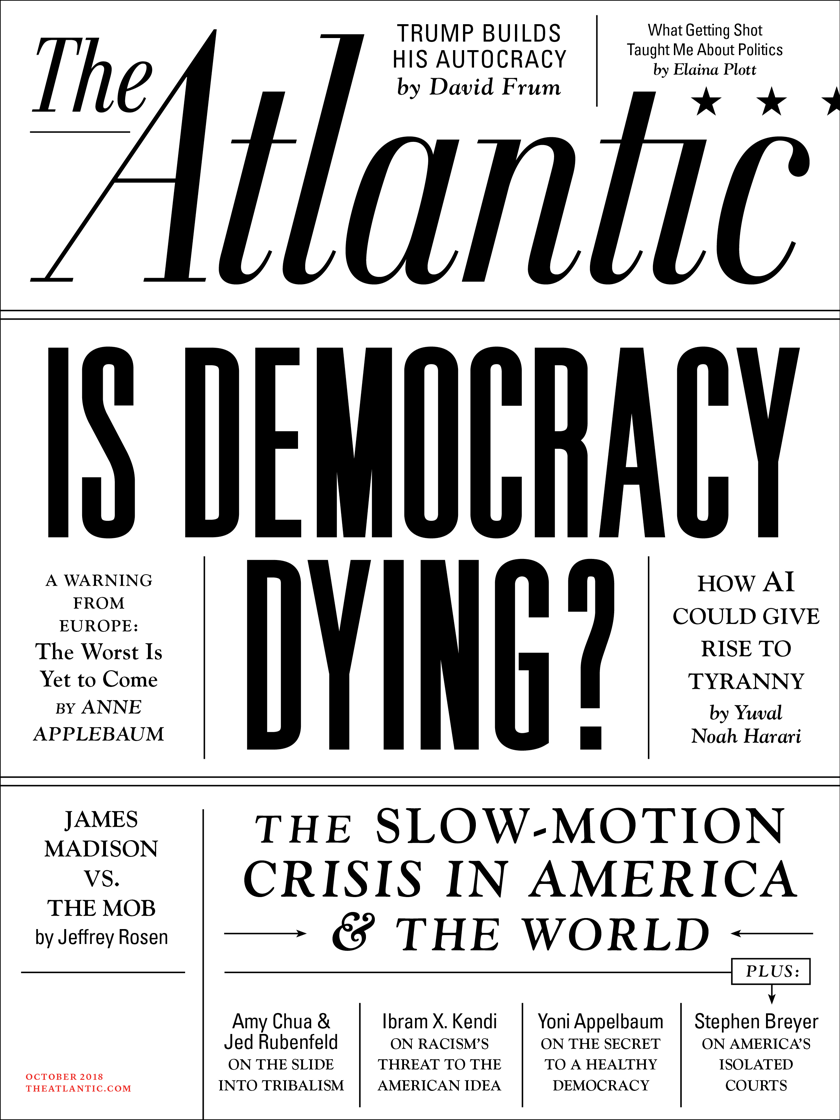
Is (Liberal) Democracy Dying?

The Atlantic for October is a theme issue:

840

I can’t provide URLs because it’s still subscriber-only, but you get get to your favorite bookstore and pick up a copy. All of the following are from that issue, as was Anne Applebaum, A Warning From Europe: The Worst Is Yet to Come, about which I blogged earlier.

1

It is much harder to struggle against irrelevance than against exploitation.

Yuval Noah Harari, Why Technology Favors Tyranny.

And a stunning microcosm:

On December 6, 2017, another crucial milestone was reached when Google’s AlphaZero program defeated the Stockfish 8 program. Stockfish 8 had won a world computer chess championship in 2016. It had access to centuries of accumulated human experience in chess, as well as decades of computer experience. By contrast, AlphaZero had not been taught any chess strategies by its human creators — not even standard openings. Rather, it used the latest machine-learning principles to teach itself chess by playing against itself. Nevertheless, out of 100 games that the novice AlphaZero played against Stockfish 8, AlphaZero won 28 and tied 72 — it didn’t lose once. Since AlphaZero had learned nothing from any human, many of its winning moves and strategies seemed unconventional to the human eye. They could be described as creative, if not downright genius.

Can you guess how long AlphaZero spent learning chess from scratch, preparing for the match against Stockfish 8, and developing its genius instincts? Four hours.

(Emphasis added)

2

Many progressives, particularly young ones, have turned against what were once sacrosanct American principles. Freedom of speech is an instrument of the dehumanization of women and minorities. Religious liberty is an engine of discrimination. Property rights are a shield for structural injustice and white supremacy. In a recent poll, two-thirds of college-age Democrats said that “a diverse and inclusive society” is more important than “protecting free speech rights.” Only 30 percent of Americans born in the 1980s believe that living in a democracy is “essential,” compared with 72 percent of Americans born in the 1930s.

… One of our students told us: “I don’t know any lefty people my age who aren’t seriously questioning whether the First Amendment is still on balance a good thing.”

Amy Chua and Jed Rubenfeld, The Threat of Tribalism.

But wait! There’s more! It’s not tribalist without at least two tribes!

In a 2017 survey by the Pew Research Center, less than half of Republicans said that the freedom of the press “to criticize politicians” was “very important” to maintaining a strong democracy in the United States. In other 2017 surveys, more than half of Trump supporters said the president “should be able to overturn decisions by judges that he disagrees with,” and more than half of Republicans said they would support postponing the 2020 presidential election if Trump proposed delaying it “until the country can make sure that only eligible American citizens can vote.”

I can’t pick which side is worse. Can you?

3

Jeffrey Rosen incited in me kindly feelings toward California:

Voters in several states are experimenting with alternative primary systems that might elect more moderate representatives. California and Washington State have adopted a “top two” system, in which candidates from both parties compete in a nonpartisan primary, and the two candidates who get the most votes run against each other in the general election — even if they’re from the same party. States, which Louis Brandeis called “laboratories of democracy,” are proving to be the most effective way to encourage deliberation at a time when Congress acts only along party lines.

Madison and the Mob.

4

This author was shot, randomly, with a 22:

Knee-jerk calls for gun control didn’t resonate with me. Yet a reverence toward guns no longer felt right either.

I found my ambivalence unsettling. Everyone else seemed so sure about how to feel about guns—people on campus, on the internet, back home. Unlike most of them, I had made intimate acquaintance with gun violence. I should have had some special insight. If what had happened to me wasn’t fodder for clarity, I feared nothing ever would be.

As we drove, he asked me to remind him what I was writing about. I said some- thing lazy, offhanded: “What it was like getting shot in a place that loves guns.”

“It’s not love,” he said. We pulled into the parking lot of his store, which sits high on a hill. You can see almost all of Tuscaloosa from there. “It’s about necessity.” He mentioned rattlesnakes and coyotes. For people in rural areas — that’s more than 40 percent of Alabamians — guns are still a day-to-day defense against such animals. Yes, there is ample love for guns in Alabama. But to forget that they’re tools is to miss an important point.

Elaina Plott, The Bullet in My Arm.

Perhaps, but they’re not the kind of tools Our People use now, are they dear?

5

A 2018 U.S. Magazine asking whether democracy is dying might be suspected of a hit on 45, but it really was not. He did get more than passing mention in David Frum’s contribution, though:

[A] Donald Trump with impulse control would not be Donald Trump …

When Trump refers to “my” generals or “my” intelligence agencies, he is teaching his supporters to rethink how the presidency should function. We are a long way from Ronald Reagan’s remark that he and his wife were but “the latest tenants in the People’s House.”

In 2016, Trump supporters openly brandished firearms near polling places. Since then, they’ve learned to rationalize clandestine election assistance from a hostile foreign government. The president pardoned former Sheriff Joe Arpaio, convicted of contempt of court for violating civil rights in Maricopa County, Arizona, and Dinesh D’Souza, convicted of violating election-finance laws—sending an unmistakable message of support for attacks on the legal order. Where President Trump has led, millions of people who regard themselves as loyal Americans, believers in the Constitution, have ominously followed.

Building an Autocracy.

6

To stop the rot afflicting American government, Americans are going to have to get back in the habit of democracy.

[In the 19th Century] From churches to mutual insurers to fraternities to volunteer fire companies, America’s civic institutions were run not by aristocratic elites who inherited their offices, nor by centrally appointed administrators, but by democratically elected representatives.

Civic participation was thus the norm, not the exception.

Democracy had become the shared civic religion of a people who otherwise had little in common.

But the United States is no longer a nation of joiners. As the political scientist Robert Putnam famously demonstrated in Bowling Alone, participation in civic groups and organizations of all kinds declined precipitously in the last decades of the 20th century.

Trump turned the long-standing veneration of civic procedure on its head. He proclaimed that America is “rigged”; that “the insiders wrote the rules of the game to keep themselves in power and in the money.” The norms and practices of democratic governance, he insisted, had allowed elites to entrench themselves.

Trump secured the Republican nomination by speaking directly to those voters who had the least experience with democratic institutions. In April 2016, when the Republican field had narrowed from 17 candidates to three, a PRRI/The Atlantic survey found Trump enjoying a narrow lead over second-place Ted Cruz among Republican-leaning voters, 37 to 31 percent. But among those who seldom or never participated in community activities such as sports teams, book clubs, parent-teacher associations, or neighborhood associations, Trump led 50 to 24 percent. In fact, such civically disengaged voters accounted for a majority of his support.

Yoni Applebaum, Americans Aren’t Practicing Democracy Any More.

7

And finally:

The cardinal fact always is the loss of contact with objective information. Public as well as private reason depends upon it. Not what somebody says, not what somebody wishes were true, but what is so beyond all our opining, constitutes the touchstone of our sanity. And a society which lives at second-hand will commit incredible follies and countenance inconceivable brutalities if that contact is intermittent and untrustworthy. Demagoguery is a parasite that flourishes where discrimination fails, and only those who are at grips with things themselves are impervious to it. For … the demagogue, whether of the Right or the Left, is, consciously or unconsciously an undetected liar.

Walter Lippman, November 1919 (before my father was born), quoted in a side-bar.

I’m venturing a guess that nobody born since 1970 will understand his use of “discrimination” unless they have a liberal arts college education.

* * * * *

Follow me on Micro.blog Follow me on Micro.blog, too, where I blog tweet-like shorter items and … well, it’s evolving. Or, if you prefer, those micro.blog items also appear now at microblog.intellectualoid.com.