15th Anniversary

15 years ago today, I posted my first post on my “big” WordPress blog, titled Okay: You can stop holding your breath now.


I suffer more from the humiliations inflicted by my country than from those inflicted on her.

Simone Weil, from a letter to Georges Bernanos.

[N]one of the things that I care about most have ever proven susceptible to systematic exposition.

Alan Jacobs, Breaking Bread With the Dead

I don’t do any of the major social media, but I have two sub-domains of the domain you’re currently reading: (a) You can read most of my reflexive stuff, especially political here. (b) I also post some things on the only social medium I frequent, because people there are quirky, pleasant and real.

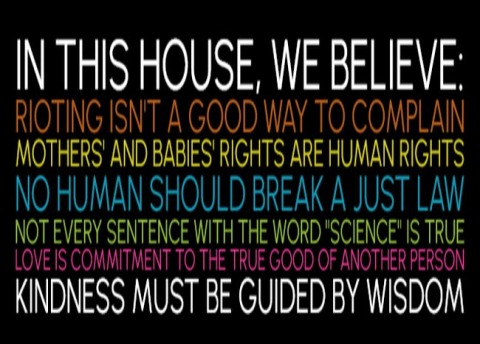
Keeping up with the chaos

I excelled in the study of Constitutional Law, which excellence helped little if any in my subsequent practice of law, but helped a lot in my blogging.

The current firehose of constitutional indignities, though, defies my analysis. It’s too much, too fast — just as they intended.

I have thoughts on a few, but we’re into the structural parts of the Constitution now, the reconciliation of Articles I through III, and there are norms as well as laws. I suspect that the Trump team’s legal justifications will be rejected by the Courts as crackpottery, but even if I’m right, that’s not the end of it. Trump is no fan of norms.

Inversion in the Anglicansphere

These days, I tend very strongly to find “Anglicans” more simpatico than “Episcopalians.” But not this time, between Calvin Robinson and John Taylor:

Intemperate and Imprudent

Sorry trolls, it’s a Nazi salute: After Father Calvin Robinson threw out a “Roman salute,” also known as a Nazi salute, the Anglican Catholic Church ousted him. They wrote beautifully about why, and it’s a great articulation of the values that seem so distant, just a few weeks later.

Priests are certainly called to support the Church’s teaching on the sanctity of life and on a range of other doctrinal issues; but they are not called to provoke, to troll, or to behave uncharitably toward their opponents. They are called to minister to, to persuade, to forgive, to be gentle, and to be kind even to their foes. Robinson demonstrated repeatedly that he lacks the temperament and prudence needed in a parish priest.

After Steve Bannon threw up a Nazi salute last Friday, French far-right leader Jordan Bardella canceled his CPAC speech, calling it “a provocation. . . a gesture referring to Nazi ideology.” So lame, Jordan, you’re totally misunderstanding this. Nothing says light-hearted youthful hijinks like a Nazi salute, Jordan. It’s a meme thing, Jordan!

It’s always in jest, they say, always a reference, never the one you’re thinking of. I’m showing my cards too much, but these salutes make me nauseous, and you better believe I’m in therapy like: I just don’t get why Nazis are back and Do I need to listen to Martyr Made’s new revisionist WWII podcast and Is there lots of evidence that Brigitte Macron is a man and I’m just totally missing it? So weird that my therapist keeps canceling our sessions when I am simply emailing photos of Brigitte’s shoulders and asking if they look wide.

Nellie Bowles

Art anticipates life

Seeing Putin’s boys bully a besieged freedom fighter in the Oval Office was humiliating for every American. Since there is no presidential precedent for the public brutalizing of an ally, we reach for fiction and Mayor Carmine DePasto, from the comedy “Animal House,” and his summit with the dean of Faber College. “If you want this year’s homecoming parade in my town,” he says, “you have to pay.” When the dean accuses him of extortion, the mayor replies, “Look, these parades are very expensive. You’re using my police, my sanitation people, my three Oldsmobiles. So if you mention extortion again, I’ll have your legs broken.”

Making our way through the shadow of disgrace Trump casts requires us to think carefully and humbly. Notwithstanding the heretical teachings of Christian nationalists and apostolic reformists, God doesn’t love us more than other people. We’re not chosen or anointed. We’ve had moments of glory and deep disgrace.

If the U.S. ever needs its friends again, no one will answer the phone. We’ll be as lonely as Trump when he turns out the lights.

John Taylor, Bishop of the Episcopal Diocese of Los Angeles, via David Post at the Volokh Conspiracy.

I don’t want to reflexively both-sides things, but Ross Douthat steel-mans Trump’s foreign policy (shared link). Even if he’s 100% right, it’s very sobering.

ElonAI refutes Elon

I asked @grok (Elon Musk’s AI company) to analyze the last 1,000 posts from Elon Musk for truth and veracity. More than half of what Elon posts on X is false or misleading, while most of the “true” posts are simply updates about his companies. (Source: x.com)

Isaac Saul via John Ellis

Oscars

[I]he Oscars have become less about the movies and more about politics. Winners feel the need to turn their acceptance speeches into sermons about feminism, or immigration, or Donald Trump. But the average American doesn’t want political advice from jesters in $10,000 evening gowns. In fact, there was a time when actors would be booed for using the podium as a pulpit. … [I]t was a better time.

The Free Press


I suffer more from the humiliations inflicted by my country than from those inflicted on her.

Simone Weil, from a letter to Georges Bernanos.

[N]one of the things that I care about most have ever proven susceptible to systematic exposition.

Alan Jacobs, Breaking Bread With the Dead

I don’t do any of the major social media, but I have two sub-domains of the domain you’re currently reading: (a) You can read most of my reflexive stuff, especially political here. (b) I also post some things on the only social medium I frequent, because people there are quirky, pleasant and real.

Cheesefare 2025

Gymnasiums

The gym where God retrains our hearts

Worship is the arena in which God recalibrates our hearts, reforms our desires, and rehabituates our loves. Worship isn’t just something we do; it is where God does something to us. Worship is the heart of discipleship because it is the gymnasium in which God retrains our hearts.

James K.A. Smith, You Are What You Love

And that, my friend, is why I [still] don’t mind singing in an empty Church.

Smith gets a lot of things right.

The gym where amnesiacs stultify our hearts

[T]he practices and prayers set out for God’s people in the prayer book have been amongst the most formative in western and, indeed, global Christianity. But to American evangelicals in the 2020s, living after nearly 50 years in which our corporate liturgy and prayer life has soaked in the corrosive acid of seeker sensitive church life, the practices and even the language of the prayer book can feel strange and foreign and even a bit frightening, I think. We have become accustomed to three songs and a TED talk, to spectacle, and to spontaneity. And while I think there are a great many of us who are quite tired of such things, it is not easy for those on the far side of a great forgetting to regain what previous generations misplaced—unless they have help ….

Jake Meador.

Jake is a young man, so it’s understandable that he thinks the great forgetting began with seeker-sensitivity. I think it started earlier, perhaps more than a century earlier. But I’m neither a historian nor an eyewitness.

Miscellany

Out of my yawns, a grabber

Ross Douthat was being interviewed by Andrew Sullivan about his forthcoming book, Believe. For the most part, I am uninterested in this book (which gives all kinds of rational, scientific arguments for the reasonableness of belief and some kind of God) simply because I think God‘s existence per se is not very interesting.

However, there was one argument of a sort that I had not heard before, and that caught my attention: Why is mankind so gifted with intelligence and curiosity that he penetrates many of the secrets of the universe? Why was our intelligence not limited to that degree that, for instance, would allow us to be subsistence, farmers or herders? If we merely evolved, why didn’t evolution stop there? Might it be that we are given much greater intelligence than that in order that we could both discover facts about the universe and commune more fully with God?

(I’m not sure where Douthat ends and I begin in the prior paragraph.)

Some day, a story

I’m fatigued by politics at the moment – I have to be careful with attempting punditry in this state – as Gary Snyder said, “Don’t be a slave to your lesser talents”. But at some point a story rather than a polemic will appear that speaks to the moment we are in and I will proceed from there. Nobody needs more clever arguments. I miss the woods, the sea, the swooping buzzard, I don’t miss any more retina-blitzing bit of adrenal-wrecking rhetoric.

Martin Shaw, 2/23/25

Correctness < Theology

Nothing is as difficult as true theology. Simply saying something correct is beside the point. Correctness does not rise to the level of theology. Theology, rightly done, is a path towards union with God. It is absolutely more than an academic exercise. Theology is not the recitation of correct facts, it is the apprehension and statement of Beauty.

It is this aspect of liturgical life that makes it truly theological. It is also the failure of most contemporary Christian worship efforts. Gimmicks, emotional manipulation and a musical culture that barely rises above kitsch reveal nothing of God – and embarrassingly much about us.

Fr. Stephen Freeman

Catholic or Orthodox?

It happened one afternoon last autumn. I was praying before an icon of the Holy Family. “What should I do? Should I stay Catholic or become Orthodox? Please give me some sign.”

A tear rolled down Mary’s face. I wiped it away. My fingers were wet. I burst into the living room and called to my wife. “The icon is weeping,” I told her. She looked incredulous. “Call Father T.,” she said.

Father T. was the priest of our Eastern-Catholic parish. He retired from the local police force as a homicide detective before taking holy orders. I told him what happened. “I’m an old cop,” he said, “so I assume there are natural causes before I start looking for supernatural ones.” As we were talking, I watched a tear form in Joseph’s eye and roll down his face.

“It’s happening again,” I said.

Father T. was silent for a moment. “Oh.”

We hung up. I was staring at the icon when another tear formed in Mary’s eye. This time I brought it to my wife. “Do you see this?” I asked her. She wiped the tear from the icon and tasted it. “It’s sweet.”

A few hours later I called Father T. back. He said that, in his opinion, the weeping icon was a sign to remain Catholic. Surely, Mary and Joseph were crying because I was thinking about leaving the Church. Also, icons of the Holy Family are definitely “Western-style.” (Mrs. Davis and I bought the icon shortly after we were married, at a conference hosted by the Society of St. Pius X.) Isn’t that significant? Besides, in the East, miraculous icons usually stream myrrh all over, like a glass of ice water sweating in the hot sun. Ours wept tears from its eyes, more like the miraculous statues one finds in the West. This was a “hybrid” miracle: no doubt a sign to remain Eastern Catholic. All of which are perfectly good arguments.

Afterwards I called Father A., an old Russian priest in whom I’d been confiding. Father A. also happens to be a master iconographer. I asked him, “Is this a sign to become Orthodox?” To my surprise, he demurred. Weeping icons are not like Ouija boards, he said. They don’t give yes-or-no answers to the questions we ask God in prayer. First and foremost, they are gifts. They remind us of God’s presence in our lives, and of His love for us. Secondly, they call us to repentance—to enter more deeply into a life of prayer and fasting.

Father A. told me that, of course, he would love for us to become Orthodox. He felt that our fasting and prayer would, in time, lead us to the Orthodox Church. But God is not like you and me, he said. His gifts are never purely utilitarian.

Michael Warren Davis

It may well be that “Father T” opined badly by the standards of his own Church and that Orthodox Priests exist who, unlike Father A, would play the same game. But I’m pretty sure Father A is in the Orthodox mainstream.

Lazarus on Cyprus

It is well-known among Cypriots, not to mention a matter of national pride, that St. Lazarus lived on the island of Cyprus after the Lord’s Resurrection. Saint John’s Gospel tells us that the Jewish leaders had resolved to kill both Jesus and Lazarus. They considered it necessary to kill Lazarus because belief in Jesus as the Messiah increased after he raised Lazarus to life when he had been dead for four days (John 12:9–11). Lazarus was literally living proof of this extraordinary miracle. The New Testament itself does not tell us that Lazarus went to Cyprus later, but this was known in the tradition of the Church of Cyprus. The gospel message came to Cyprus very early, and the Church was established there even before St. Paul became a missionary (Acts 11:19–21).

My husband, Fr. Costas, was born and lived on the island of Cyprus when it was still a British colony. He related to me that the Cypriots would boast about St. Lazarus to the British there. But the British would often scoff at this claim, saying there was no proof that Lazarus had ever come to Cyprus.

A very old church dedicated to St. Lazarus, dating back to the 800s, is located in Larnaca, Cyprus. In 1972 a fire caused serious damage to the church building. The subsequent renovation required digging beneath the church to support the structure during reconstruction. In the process of digging, workers uncovered the relics of St. Lazarus located directly below the altar in a marble sarcophagus engraved with the words “Lazarus, the four-day dead and friend of Christ.”

Dr. Eugenia Scarvelis Constantinou, Thinking Orthodox

Why do we find it implausible that Lazarus lived somewhere after Christ raised him, and that it/he was important enough that people there preserved the memory?


Religious ideas have the fate of melodies, which, once set afloat in the world, are taken up by all sorts of instruments, some woefully coarse, feeble, or out of tune, until people are in danger of crying out that the melody itself is detestable.

George Elliot, Janet’s Repentance, via Alan Jacobs

[N]one of the things that I care about most have ever proven susceptible to systematic exposition.

Alan Jacobs, Breaking Bread With the Dead

You can read most of my more impromptu stuff here and here (both of them cathartic venting, especially political) and here (the only social medium I frequent, because people there are quirky, pleasant and real). All should work in your RSS aggregator, like Feedly or Reeder, should you want to make a habit of it.

Friday, 2/28/25

Welcome to the post-Christian right

The Trump administration is pushing Romania to lift travel restrictions on Andrew Tate, who is a pimp being prosecuted for human trafficking, sexual misconduct, money laundering, and starting an organized crime group. But he’s also a hero of the new right and has a huge online following despite efforts to censor the hell out of him, and obviously someone in the Trump administration is a Tate fanboy and wants to help him out. There is a guy who works in the State Department who is on his eighth Jake Paul energy drink and taking a victory lap through Discord right now.

But wait, how did a European pimp become a conservative hero? Welcome to the post-Christian right. The Moral Majority is out. Ned Flanders is out. In, instead, is paganism. In is strength, sun, and harems. Basically that movie The Northman is the new vibe of all your favorite conservatives.

Nellie Bowles, 2/21/25.

So much “winning”

Andrew and Tristan Tate left Romania for America on a private jet after prosecutors lifted a travel ban. Andrew, a social influencer, is popular in alt-right online spaces. The pair are under investigation for human trafficking and money laundering, charges they deny. Romanian prosecutors say the case remains open. They also face sexual misconduct allegations in Britain, which they deny.

Economist World in Brief, 2/27/25. See also WSJ and NYT.

Tribalismn

I can’t think of a single institution in which I really believe — that is, that I consider to have the common good and the best interests of the American people in mind. The System is collapsing? Good. It’s about time. David Brooks, at ARC, said that conservatives are supposed to conserve, not destroy. He’s right — which is why Shadi Hamid is correct to say the Democratic Party has become the conservative party, the party of the System.

Maybe it’s better to think of myself and people like me not as conservatives — I sure as hell don’t want to conserve most of what the ruling class and its conquered institutions have done to America — but as right-wing antagonists to the System. Donald Trump is very far from my ideal president, but you know what? He’s not One Of Them. More power to him. I say that with great trepidation, because history shows that revolution against a corrupt ancien régime can produce worse. Still.

The future is not fated. We can change. Maybe that’s what’s happening in Washington now. I hope so. But I know this: it could not go on as it had been doing. The old paradigm is over, because at least half the country has lost faith in it. Maybe what’s being born now will be worse, I dunno. We’ll see. But bring it on. I’ve had it.

Thus (emphasis added to show that he is without excuse) does my longtime fellow-traveler, Rod Dreher, take a nihilistic fork in the road that I refuse to take.

Let me quote Rod to Rod:

A second major factor present in pre-totalitarian societies is loss of faith in institutions.

Living in Wonder, October 2024.

The kind of trolling yard sign I’d consider

Mike drop

To a certain kind of guy, Donald Trump epitomizes masculine cool. He’s ostentatiously wealthy. He’s married to his third model wife. He gets prime seats at UFC fights, goes on popular podcasts, and does more or less whatever he wants without consequences.

That certain kind of guy who sees Trump as a masculine ideal? That guy is a teenage boy.

Jill Filipovic, The Adolescent Style in American Politics

The problem with those two paragraphs is that they’re too perfect. I didn’t want to risk spoiling them by reading the rest of the article.


I suffer more from the humiliations inflicted by my country than from those inflicted on her.

Simone Weil, from a letter to Georges Bernanos.

[N]one of the things that I care about most have ever proven susceptible to systematic exposition.

Alan Jacobs, Breaking Bread With the Dead

I don’t do any of the major social media, but I have two sub-domains of the domain you’re currently reading: (a) You can read most of my reflexive stuff, especially political here. (b) I also post some things on the only social medium I frequent, because people there are quirky, pleasant and real.
An auspicious birthday

Today is my son’s 49th birthday. Such a thing is impossible. I can’t have a son that old.

I recall watching M.A.S.H. in my wife’s room as she labored into the evening. The next day, I ran into my ex-fianceés husband at a Pizza Hut, I being 70 miles from home (a town of 4,000 with no OB/GYNs, and it was a tricky pregnancy) and he being several hundred miles from home leading a high school band in something-or-other.

The rest of it’s kind of a blur.

The rest of this post is pretty political. Summary: I’m unhappy with our course, but I’d have been unhappy with the alternative, too.

We need friends in the world

After the Cold War Ukraine agreed to relinquish the nuclear weapons housed there for a promise the U.S. would always have its back. They trusted us. Must American presidents honor the honestly made vows of their predecessors? In this case surely yes, at pain of announcing to every friend we have, “You’re on your own, Uncle Sam has left the building.” Trump supporters think they want that message sent. It is a careless and destructive one.

The future will be a hard place. All the unfortunate aspects of man’s nature will be sped up and made more fateful by technology such as artificial intelligence. In that world we will need old friends. There is a speech by St. Thomas More in “A Man for All Seasons”: “Oh? And when the last law was down, and the Devil turned round on you—where would you hide, Roper, the laws all being flat? This country’s planted thick with laws . . . and if you cut them down—and you’re just the man to do it—d’you really think you could stand upright in the winds that would blow then?” Replace “law” with “friend.”

Peggy Noonan

Less uncomprehending

The book’s emotional climax is Mr. Rauch’s endorsement of Joe Biden’s characterization of Mr. Trump as “semifascist.” Mr. Rauch generously concedes that MAGA partisans aren’t sending their opponents to death camps, but he insists there are similarities between Mr. Trump and Hitler. “Rejection of elections? Check. Contempt for law? Check. Corrupt use of government power? Check.” And so on for two pages. The possibility that these criticisms might apply as much to Mr. Trump’s opponents, or more so, doesn’t occur to Mr. Rauch.

Barton Swaim, Wall Street Journal (emphasis added), reviewing Jonathan Rauch’s latest book.

I haven’t voted for a Democrat for President since 1972, and I haven’t voted for a Republican for President since 2012.

Swaim’s last sentence alludes, though, to the bipartisan rot that made me less uncomprehending of Trump voters late in the 2024 election season than I had been in 2016 and 2020.

So we elected Trump and Babylon USA is now falling in a Trumpian manner than a Democrat manner.

History rhyming again

The politics of the backcountry consisted mainly of charismatic leaders and personal followings, cemented by strong and forceful acts such as Jackson’s behavior at Jonesboro. The rhetoric that these leaders used sometimes sounded democratic, but it was easily misunderstood by those who were not part of this folk culture. The Jacksonian movement was a case in point. To easterners, Andrew Jackson looked and sounded like a Democrat. But in his own culture, his rhetoric had a very different function. Historian Thomas Abernethy observes that Andrew Jackson never championed the cause of the people; he merely invited the people to champion him. This was a style of politics which placed a heavy premium upon personal loyalty. In the American backcountry, as on the British borders, loyalty was the most powerful cement of political relationships. Disloyalty was the primary political sin.

David Hackett Fischer, Albion’s Seed

I really have been astonished at the Jackson/Trump parallels Fischer brings out implicitly (because the book came out in 1989 — long before Mafia Don descended the golden escalator).

Liberation — for satyrs

…men have created the social structures that determine how our culture dispenses money and creates fame. For women, this is almost always tied to the sexual exploitation of their bodies — most often to make corporations lots and lots of money.

Charles C. Camosy, Beyond the Abortion Wars

Ubiquitous terms that tell us almost nothing

Far right [is]one of those labels around whose use we could do with having some hygiene. I’ve only ever been called ‘far-right’ by Islamists and far-leftists who want to try to stigmatize me like I’m a totally unreasonable head-banger. It is a smear, designed to shut down debate.

Douglas Murray

Pudwhacking throne-sniffers

The so-called Department of Government Efficiency is not a department, it is really only quasi-government at most, and its aim is not efficiency. It is the right-wing mirror image of those “diversity” offices whose aim is the enforcement of homogeneity and conformity. George Orwell (I hope he is pleasantly surprised by his position in the afterlife) is somewhere laughing his immortal ass off.

It is obvious that Musk and his disreputable little gaggle of pudwhacking throne-sniffers simply do not know what they are doing: For example, they ordered the dismissal of a bunch of federal employees who were “on probation” because they seem to have thought that this probationary condition was disciplinary rather than a formality related to those employees being new hires. Employees with stellar evaluations were fired in emails that cited their supposed performance problems.

Kevin D. Williamson.

Loving “disreputable little gaggle of pudwhacking throne-sniffers” so much probably makes me a bad person. But it’s closer to the literal truth than mass firings of probationary employees for “performance problems.”


I suffer more from the humiliations inflicted by my country than from those inflicted on her.

Simone Weil, from a letter to Georges Bernanos.

[N]one of the things that I care about most have ever proven susceptible to systematic exposition.

Alan Jacobs, Breaking Bread With the Dead

I don’t do any of the major social media, but I have two sub-domains of the domain you’re currently reading: (a) You can read most of my reflexive stuff, especially political here. (b) I also post some things on the only social medium I frequent, because people there are quirky, pleasant and real.
Sunday of the Last Judgment

No, that’s not a prediction. That’s the formal name of this last pre-Lenten Sunday in Orthodox Christianity. It’s also known as “meatfare,” because tomorrow we begin abstaining from meat until Pascha, April 20 this year.

State of the Union, February 23

A lot of people are trying to find precedents for what’s going on with the USA over the last 34 days. May I suggest that this is a fall of Babylon?

The US as Babylon was first suggested to me by a schismatic (when I was unwittingly schismatic) almost 60 years ago. I’ve never quite shaken it, and I think that there was a seed of truth there that’s compatible with Orthodoxy. One important divergence in my application is that I absolutely wouldn’t say “When the Bible says ‘Babylon,’ it means the USA.” Rather, I think Babylon is a typology, and that the USA fits it to a “T” today. In a few hundred years (“if the Lord tarries,” as they say), it could be China.

On the other hand, we don’t read Revelation liturgically, and I’ve never heard an Orthodox Priest or academic suggest this directly. I can’t rule out that the thought is just a bit of mental baggage from my past. It hasn’t caught on in white American Evangelicalism because — well, read the passage. It’s not holding up a flattering mirror.

In all this, friends, remember that God’s judgments are true and righteous, that He is gracious and loves mankind, and that the end of a world isn’t the end of the world.

Atheism in the Church

Last week, I quoted the ever-provocative Stanley Hauerwas

Atheism slips into the church where God really does not matter, as we go about building bigger and better congregations (church administration), confirming people’s self-esteem (worship), enabling people to adjust to their anxieties brought on by their materialism (pastoral care), and making Christ a worthy subject for poetic reflection (preaching). At every turn the church must ask itself, Does it really make any difference, in our life together, in what we do, that in Jesus Christ God is reconciling the world to himself?

Might this be profitably expanded to include political mobilization? …

The Atheist Liturgical Calendar

… Or our “liturgical calendars”?

Fr. Stephen: Right, and so … what any calendar does, because any calendar you use is going to be cyclical, is going to be a series of weeks that make up a series of months that make up a series of years, and that cycle is going to repeat. There’s going to be a May 23 every year. It loops back around.

Even if you want to talk about— Let’s talk about the most secular calendar I can think of, which is the American consumer calendar, meaning it’s structured around holidays that are built to sell things. So we just had Memorial Day: sell barbecue supplies and flags. We’re going to have—now, Juneteenth has been added to the list; I think that’s also going to be a lot of barbecuing for most people. Fourth of July, sell fireworks, sell flags. Mother’s Day, Father’s Day is in there: buy gifts for Dad, get the tie cake from Carvel. Valentine’s Day. St. Patrick’s Day: sell a lot of beer and green stuff, etc. So this is the most— about as secular as you can get of a calendar; even though some of those dates are still named after saints, it’s pretty secular.

That calendar, if you follow it, will shape the rhythm of your life. And that’s what it’s designed for! … Retail establishments want that to shape the rhythm of your life. That “seasonal” section at your local Walmart, where they have the stuff for whatever the next one of these holidays that aren’t really holy days per se in most cases— They’re counting on that cycle. They want that to shape your life. “Oh, now I go and buy and consume this. Now I go and buy and consume that.” They’ll shape your life; it’ll form you.

This, to me, is one of the worst backlashes of particularly the Puritan movements that come out of the Protestant Reformation. Bear with me here, Protestant friends. Really think about this. They had such an antipathy for [things] like saints’ days… Some of those Puritan movements— Well, most of those Puritan movements wouldn’t celebrate Christmas, the birth of Christ. Some of them won’t even celebrate Easter, Pascha. But definitely we don’t want a lot of, you know, feast days. I think it’s in the Westminster Standards that says you must guard against the proliferation of saints’ days.

Fr. Andrew: Nice! [Laughter]

Fr. Stephen: Protect everyone from this, right? So all of this stuff from the Christian liturgical calendar gets removed. And most American Christianity, American Evangelicalism really comes out of those Puritan movements, just historically. But then what do you end up centering even your church life around? You’ve got Mother’s Day sermons, Father’s Day sermons.

Fr. Andrew: You’re going to have a liturgical calendar one way or another.

Fr. Stephen: Yeah! Fourth of July sermons when you sing patriotic songs in a church!

Fr. Andrew: I know.

Fr. Stephen: All of these things. It’s the same thing! You’ve just chosen the most secular possible version!

Fr. Andrew: What I want to know is—and I’m pretty sure the answer to this question is yes; I just haven’t encountered it yet because I haven’t googled it up yet— Are there Amazon Prime Day sermons?

Fr. Stephen: Oh, I’m sure. I know there are Black Friday sermons.

Fr. Andrew: Oh, absolutely. Yeah, of course!

Fr. Stephen: [Sigh] Right? Just pause and think about it for a minute. What’s better: to base and structure your liturgical life on the life of Christ and the stories about Christ recounted in the Bible, or to base the cycles of your church life on random national holidays that often don’t even have any particular religious significance? I mean, the answer to that seems so obvious to me. I think the Puritans would be horrified by Fourth of July sermons and Mother’s Day and Father’s Day sermons! So think about that. But this is why, again, the calendar is so important.

Fr. Andrew Stephen Damick and (mostly) Fr. Stephen De Young

Science and religion

Just as colonial officials and missionaries, traveling to India, had imposed the concept of ‘religion’ on the societies they found there, so did agnostics colonize the past in similar manner. The ancient Egyptians, and Babylonians, and Romans: all were assumed to have had a ‘religion’. Some peoples—most notably the Greeks—were also assumed to have had ‘science’. It was this that had enabled their civilization to serve as the wellspring of progress. Philosophers had been the prototypes of scientists. The library of Alexandria had been ‘the birthplace of modern science’. Only Christians, with their fanatical hatred of reason and their determination to eradicate pagan learning, had prevented the ancient world from being set on a path towards steam engines and cotton mills.

Tom Holland, Dominion (spelling Americanized)

History Rhymes

Most Church leaders—conscious that to condemn Nazis for blasphemous kitsch might prove risky—opted to bite their tongues. Some, though, actively lent it their imprimatur. In 1933, the year that Hitler was appointed chancellor, Protestant churches across Germany marked the annual celebration of the Reformation by singing Wessel’s battle hymn. In Berlin Cathedral, a pastor shamelessly aped Goebbels. Wessel, he preached, had died just as Jesus had died. Then, just for good measure, he added that Hitler was ‘a man sent by God’.

Tom Holland, Dominion

Naked suffering

My grandparents did not have a car, but they hired one to go in to the hospital, when the end finally came. I went with them in the car, but was not allowed to enter the hospital. Perhaps it was just as well. What would have been the good of my being plunged into a lot of naked suffering and emotional crisis without any prayer, any Sacrament to stabilize and order it, and make some kind of meaning out of it? In that sense, Mother was right. Death, under those circumstances, was nothing but ugliness, and if it could not possibly have any ultimate meaning, why burden a child’s mind with the sight of it?

Thomas Merton, The Seven-Story Mountain


Religious ideas have the fate of melodies, which, once set afloat in the world, are taken up by all sorts of instruments, some woefully coarse, feeble, or out of tune, until people are in danger of crying out that the melody itself is detestable.

George Elliot, Janet’s Repentance, via Alan Jacobs

[N]one of the things that I care about most have ever proven susceptible to systematic exposition.

Alan Jacobs, Breaking Bread With the Dead

You can read most of my more impromptu stuff here and here (both of them cathartic venting, especially political) and here (the only social medium I frequent, because people there are quirky, pleasant and real). All should work in your RSS aggregator, like Feedly or Reeder, should you want to make a habit of it.

Rank punditry 2/22/25

I’ve taken my rankest politics elsewhere. If you like rank politics, here’s my recent ones.

You’re welcome.


I suffer more from the humiliations inflicted by my country than from those inflicted on her.

Simone Weil, from a letter to Georges Bernanos.

I don’t do any of the major social media, but I have two sub-domains of the domain you’re currently reading: (a) You can read most of my reflexive stuff, especially political here. (b) I also post some things on the only social medium I frequent, because people there are quirky, pleasant and real.

Musings, 2/21/25

Can there be a lawful order to act unethically?

I’m struggling with the agreement between Sarah Isgur and David French on the Advisory Opinions podcast that the orders from the Trump Department of Justice to dismiss the charges against New York City Mayor Eric Adams was a lawful order, even if compliance by federal prosecutors would have been unethical. I’d like to think that an order to a professional to do something unethical is ipso facto not a lawful order.

If nothing else, this confirms the wisdom of not allowing non-lawyers to own a law firm (e.g., Model Rules of Professional Conduct 1.17(b)) lest this kind of thing pervade the legal profession rather than remaining an application of the unitary executive theory to the Department of Justice.

This is why we can’t have nice things

Speaking of unitary executive theory, I have more or less been persuaded to become a “soft unitarian.” But the test case that Donald Trump has set up by firing the head of the Special Counsel’s office is straining my recently-acquired conviction.

Mafia Don has fired Hampton Dellinger, current head of the Office of Special Counsel, without invoking “inefficiency, neglect of duty, or malfeasance in office” as required by statute. A federal District Court has ordered that he be reinstated. A federal Court of Appeals has rejected Trump’s appeal on technical grounds (the District Court decision is only preliminary, not final). He now seeks review by the US Supreme Court.

I shudder because unitary executive theory makes the substance of his appeal plausible.

So here’s the deal on the Constitutional issues.

The Constitution establishes three branches of the federal government: Congress (Article I), the Executive (Article II), and the Judiciary (Article III). The opening words of Article II are “The executive Power shall be vested in a President of the United States of America.“

So what is the status of supposedly “independent” agencies, created by Congress, like the Office of Special Council? Are they a fourth branch of government, hiding in the shadows of the constitution, or are they simply unconstitutional because all executive power is vested in the presidency? If the latter (which is substantially the position of President after President since the Office was created, but nobody before The Don cared so little about chaos to provoke a fight over it), then what checks the power of the Presidency? Are we doomed to live under a kakistocracy if the President goes haywire?

The conventional answer is that Congress’s impeachment power checks the power of the presidency. If you are satisfied that this Congress has the cojones to impeach this president, you are living in a different reality than I am.

As I sit here in my easy chair, six years retired and 43 years out of law school, the best response I can come up with for SCOTUS is (1) refuse to hear the case because the District Court decision is only preliminary or (2) take the case and rule that independent agencies are not exercising executive power, but rather are serving as a check on executive power, and thus really are “hiding in the shadows” of the Constitution.

I think this would be a satisfactory ground to uphold the District Court. But I remember how conservatives derided Justice Harry Blackmun’s finding a right to abortion in the “emanations of the penumbrae” of the constitution?

The electorate having decided that Mafia Don was the lesser evil (a perception I gradually came to find defensible within the 5 or 6 months preceding January 20) has thrust us into the Constitutional crisis of an utterly corrupt President who will never be impeached because not only can he suborn and fund primary candidates against those who would impeach him, but he can with winks, nods, and stochastically violent rhetoric unleash fanatics that make Congressmen literally fear for their families if they cross him.

A decision either way from the Supreme Court will deepen the crisis.

First, they came for the radical liberal communists …

Pundit tribalism

That issue—how intellectuals are supposed to comport themselves in their political engagements—is one that matters a lot to me. On top of the policy disagreements, what drove me away from the intellectual right two decades ago was the expectation, as an editor for First Things magazine, that I defend a political line in public. I wasn’t allowed to write a conservative case for not invading Iraq, for example, because that would risk making myself and the magazine appear “unreliable.” There was simply too much at stake, my boss told me, to risk a dissent from the conservative movement and its presidential champion. The War on Terror had to be won—and even more fundamentally, George W. Bush needed to have a successful presidency. We couldn’t risk contributing to its failure by directing criticisms its way.

Damon Linker

I’m very sympathetic to Linker about this kind of tribalism.

Our local rag used to have a very lively letters to the editor section (they don’t even have an opinion page anymore). When my religious Right co-belligerents expressed particularly idiotic opinions or called for perverse boycotts (example omitted because it was so idiotic you wouldn’t believe me), I tended to refute them vigorously, and at least once received an anonymous phone call implying that I was a Judas (no threat, just bile).

Why can’t the world be unanimously sane and moderate, just like Damon Linker and me?

Our four-party system

I enjoyed Ezra Klein’s little essay the other day as a partial explanation of how polarization got worse:

The two-party system of the 20th century was really a four-party system. The Democrats were split between the liberals we know today and the Dixiecrats, whose primary goal was upholding segregation. The Republicans were split between conservatives and Northern liberals. It is astonishing from our vantage point, but it was true for much of the 20th century: To say you were a Republican or a Democrat didn’t reveal whether you were a liberal or a conservative. As a senator, Joe Biden opposed the Roe v. Wade decision in 1973. President Richard Nixon proposed a universal health care bill and created the Environmental Protection Agency. George Wallace started out as a Democrat. Politics was different then.

Parties that contained so many different places and ideologies could not act in lock step, and so bipartisanship was common. The Civil Rights Act of 1964 was pushed by a Democratic president, but congressional Republicans were crucial to its passage. When Watergate began coming to light, Congress acted as a collective. Only four House Republicans voted against opening the impeachment inquiry into Nixon, and a delegation of congressional Republicans ultimately persuaded him to resign.

And it wasn’t just impeachment. When Nixon refused to spend the money Congress had appropriated — a policy known as impoundment — Congress acted to protect its power: The Congressional Budget and Impoundment Control Act of 1974 passed the House with only six “no” votes; it passed the Senate without a single vote in opposition.

(Emphasis added) I remember guys like Scoop Jackson, Dick Gephart, Mark Hatfield, Nelson Rockefeller, John Lindsey. Joe Manchin proves there’s no room for that kind any more. There’s just two tribes, each controlled from the wings, not the center.

Clamoring aboard the ARC

A Jordan Peterson-adjacent, Christian-coded “Alliance for Responsible Citizenship” recently convened. Two Orthodox Christian friends have diverging thoughts:

As I wrote yesterday, it is strange that it has taken a non-believing clown like Donald Trump to be the Great Disrupter. We do not have to agree with everything he does …, but I believe people like me can work with people like him in ways we simply could not do with those who were in power before.

Rod Dreher, whose “responsible citizen” culture-warring is a bone of contention between him and his friend Kingsnorth:

Jesus didn’t come to Earth to teach us how to be ‘responsible citizens’, of any political stripe. Responsible citizens don’t leave their own fathers unburied. They don’t hate their own mother and father, or give away all of their wealth, or compare the religious authorities to whitewashed tombs full of rotting flesh. And they don’t usually end up being crucified.

Paul Kingsnorth commenting in advance.

My sympathies lie almost completely with Kingsnorth, but I understand Dreher’s point — though I would rephrase it as “Unlike the Democrats, Trump is not actively and operationally hostile toward America’s motley array of ‘conservative’ Christians.”

Back in the days when I blogged longer-form original material more than curating other folks’ stuff, I declared myself a “Conscientious Objector to the Culture Wars” (a status that’s hard to maintain consistently) in a long-form blog that holds up well as a description of why I disengaged. This was about 80% Kingsnorthian a decade before I’d heard of the guy. It’s a posture that has spared me the ignominy of ever hallucinating that “we can work with” Trump 2.0 toward any truly edifying end.

(By the way: my shift from longer-form original material toward curation is, I think, a recognition that I’ve blogged most of my idées fixes in long-form and to my personal satisfaction; there’s no need to inflict them on others constantly, though I’m toying with a blogroll of my landmark posts.)

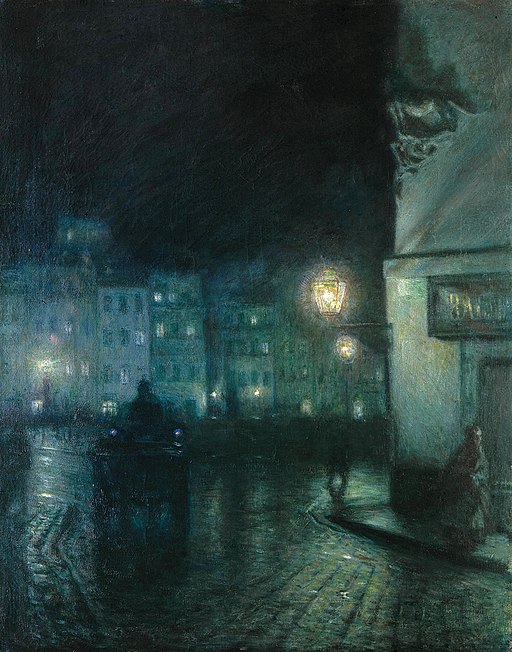
Just because …

… I thought this image was beautiful.

Jozef Pankiewicz, Market Square of Warsaw by Night, 1892 (Wikimedia Commons)


O Lord of hosts be with us, for we have none other help in times of sorrow but Thee. O Lord of hosts, have mercy on us.

I don’t do any of the major social media, but I have two sub-domains of the domain you’re currently reading: (a) You can read most of my reflexive stuff, especially political here. (b) I also post some things on the only social medium I frequent, because people there are quirky, pleasant and real.

Sunday of the Prodigal Son

What if …?

What happens when a biblicist church (non-creedal, non-liturgical, congregationalist) becomes biblically illiterate? Brad East (Biblicist Churches that Don’t Read the Bible) thinks it’s happening, and that:

there is nothing left; at least, not if you remain, on the surface or even beneath the skin, biblicist-primitivist-congregationalist in polity, doctrine, and practice. The rug has been pulled out beneath your feet, the branch you were sitting on has been sawed off, the pillars have all been thrown down: there is nothing left.

Besides, that is, the Zeitgeist. But discerning the spirits is no longer possible when the word of the Lord in Holy Scripture is no longer known, cherished, prized, read. Where else is there to turn? Either to tradition or to the culture. I see no third option.

As he has defined the problem, the only third option probably is, as he “Updated,” “the singular authority of a charismatic, entrepreneurial, popular pastor.”

But as a former member of biblicist, non-creedal, notionally non-liturgical, congregational churches, I’d suggest thinking outside that box: creed, liturgy, hierarchy. That means admitting you’ve been wrong, but I ate that humble pie 27-plus years ago, and it was awfully good.

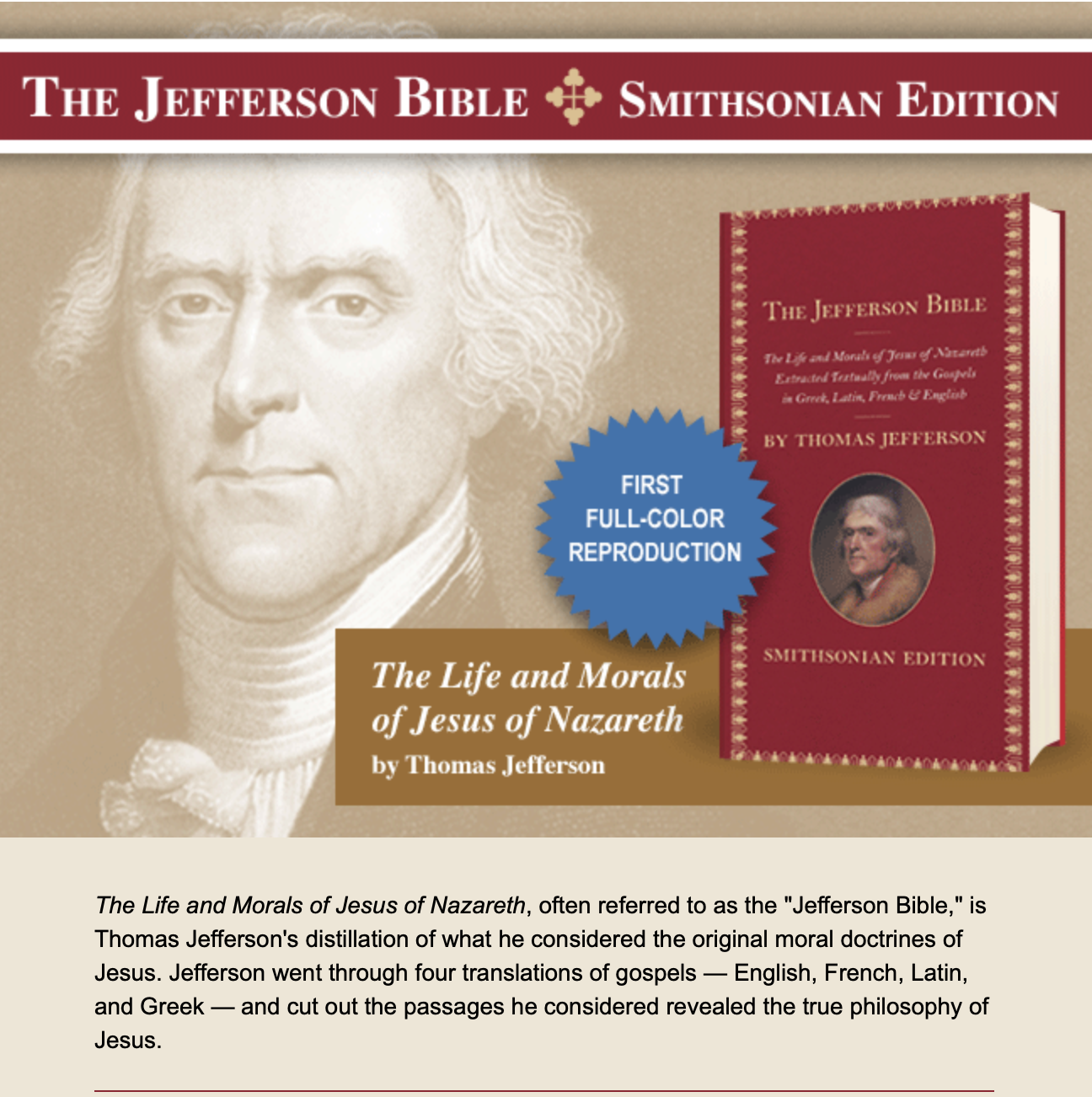
The Jefferson Bible

What was that again you were saying about our Christian Founding Fathers?

Practical Atheism in the Church

Atheism slips into the church where God really does not matter, as we go about building bigger and better congregations (church administration), confirming people’s self-esteem (worship), enabling people to adjust to their anxieties brought on by their materialism (pastoral care), and making Christ a worthy subject for poetic reflection (preaching). At every turn the church must ask itself, Does it really make any difference, in our life together, in what we do, that in Jesus Christ God is reconciling the world to himself?

Stanley Hauerwas, Resident Aliens

The Grand Myth

That grand myth which I asked you to admire a few minutes ago is not for me a hostile novelty breaking in on my traditional beliefs. On the contrary, that cosmology is what I started from. Deepening distrust and final abandonment of it long preceded my conversion to Christianity. Long before I believed Theology to be true I had already decided that the popular scientific picture at any rate was false.

C.S. Lewis, The Weight of Glory


Religious ideas have the fate of melodies, which, once set afloat in the world, are taken up by all sorts of instruments, some woefully coarse, feeble, or out of tune, until people are in danger of crying out that the melody itself is detestable.

George Elliot, Janet’s Repentance, via Alan Jacobs

[N]one of the things that I care about most have ever proven susceptible to systematic exposition.

Alan Jacobs, Breaking Bread With the Dead

You can read most of my more impromptu stuff here and here (both of them cathartic venting, especially political) and here (the only social medium I frequent, because people there are quirky, pleasant and real). All should work in your RSS aggregator, like Feedly or Reeder, should you want to make a habit of it.

Saturday, 2/15/25

Conservatives versus Nihilists

Trump really seems not to give a crap about the working class. Trump is not a populist. He campaigns as a populist, but once he has power, he is the betrayer of populism.

What’s going on here is not a working-class revolt against the elites. All I see is one section of the educated elite going after another section of the educated elite. This is like a civil war in a fancy prep school in which the sleazy kids are going after the pretentious kids.

Conservatives believe in constant and incremental change. Nihilists believe in sudden and chaotic disruption. Conservatism came into being opposing the arrogant radicalism of the French Revolution. The Trump people are basically the French revolutionaries in red hats — there are the same crude distinctions between good and evil, the same contempt for existing arrangements, the same descent into fanaticism, the same tendency to let the revolution devour its own.

David Brooks (emphasis added; unlocked).

The evils of revolutions almost invariably outweigh the goods. We’re getting what we voted for good and hard.

What’s radical about Trump?

[Trump]’s simply not as radical a departure from his predecessors’ worst policy instincts as we’d like to believe. But he is a radical departure in cultivating fear as a tool of leverage, right out in the open. And not just fear of political repercussions either.

In his earliest days as a Republican candidate for president, he half-joked with fans that he’d pay their legal bills if they punched protesters at his rallies. As he moved toward the GOP nomination in 2016, he warned there’d be riots if conservatives tried to block him at the convention. … It flatters his ego to know that his fans might be willing to kill for him and it pleases him to have an extra lever most politicians lack to pressure others into giving him what he wants. His amoral willingness and charismatic ability to intimidate is the molten core of his strongman persona.

January 6 is the supreme illustration … More than one Republican member of Congress has claimed that fear of rabid Trump supporters harming their families led some of their GOP colleagues to oppose his impeachment and removal after the insurrection. 

Encouraging unrest if he doesn’t get his way isn’t the only tool he uses to intimidate opponents, though.

He yanked federal protection details from John Bolton, Mike Pompeo, Mark Milley, and Anthony Fauci, placing them in danger for no better reason than that they criticized him in the past.

If you cross the president, you should expect your career, your finances, or even your life to be imperiled if it’s within his power to facilitate that. And rather than obscure that horrifying fact, Trump seems eager to advertise it: Freeing the thugs who broke into the Capitol on January 6 hoping to hang Mike Pence was his way of showing opponents that there’s no sin he won’t countenance if it’s committed in service to him.

Nick Catoggio (emphasis added)

Trump will never forgive Ukraine

Trump is no friend of Ukraine. Earlier this week he dipped into his stream of consciousness to pronounce that Ukraine “might be Russian someday” as J.D. Vance, the poor man’s Tucker Carlson, prepared to meet with Ukrainian leader Volodymyr Zelensky. He is surrounded by people who derive some weird kind of jollies from smearing and vilifying the Ukrainians—the vice president and other so-called nationalists who are all too happy to see a nationality exterminated if that pleases Vladimir Putin—as well as by people such as Kash Patel, the Kremlin stooge (on the cheap, no less) whom Trump has nominated to run the FBI. Trump will simply never forgive Ukraine for its government’s failure to help him manufacture a phony scandal (entirely superfluous, given the real ones) involving corrupt business practices and the Biden family.

Kevin D. Williamson

Softening, a little, on Trump

[Howard] Kurtz: It’s been reported, and feel free to push back on this, that when Trump won in 2016, you were at The Wall Street Journal and you were sobbing at your desk. . . . Has your view of him evolved since then?

[Bari] Weiss: It’s a good question. I mean, look, I’m the first to admit that I was a sufferer of what conservatives at the time would have called TDS, Trump Derangement Syndrome. . . . I’m someone that believes, call me old-fashioned, that everything is sort of downstream of character. And the kinds of things that he had said, and the way that he talked, and the way I felt he would coarsen our public discourse, those are all real. . . .

There were two things, I think, that I didn’t know in that moment when I was crying at my desk. One would be the sort of overzealous, out-of-touch, hysterical reaction to him, and the kind of illiberalism that was born out of the reaction to him that calls itself democratic, that calls itself progressive, but is actually extraordinarily authoritarian and totalitarian in its impulses. . . .

The other thing that I didn’t see was that Trump was going to do a lot of policies that I agreed with. I thought the Abraham Accords were historic and excellent. I thought his policy vis-à-vis Iran was excellent. The economy was better.

Howard Kurtz interviewing Bari Weiss of the Free Press on Fox News Channel’s “Media Buzz,” Feb. 9, via Wall Street Journal.

That’s a fair summary of longer comments, which you can view in less than 5 minutes via the “interviewing” link. The character issue remains.

J.D. Vance

A Trump presidency would have been completely unbelievable to me when I wrote my book about the G.O.P. and younger voters, so I approach political prediction with humility. Republicans do not have a robust modern record of vice presidents becoming their party’s presidential nominee — just ask Dan Quayle, Dick Cheney and Mike Pence. And those working under Mr. Trump do not always emerge from the experience unscathed. Four years is an eternity in politics, and if America ultimately concludes that the Trump-Vance administration was a failure, the Republican Party could look to turn the page.

But so far a good many voters like the direction this administration is going in, and Mr. Vance is finding his own moments, as at the A.I. conference, to show how he’s different from our recent generation of presidents. Mr. Trump may think it’s too soon to anoint successors, but he finds himself with a vice president who is better aligned with the spirit of what he is trying to achieve than virtually any other Republican.

Kristen Soltis Anderson. a Republican pollster

Clarity achieved

Imagine what they might have done. Trump could have announced that Musk and his minions were going in to audit the federal government. Within a few months, they’d bring a report, outlining every insane piece of waste or DEI excess or fraud they could find. Trump would then urge Congress to vote on these reforms. Win, win, win. It’s a great idea to shake up the joint with an outsider! But nah. They are busy ensuring that any cuts they make are brutal, dumb, and destined to expire.

Last year, a ton of readers who agreed with me on immigration, DEI, the transing of children, and the need for a more restrained foreign policy asked, in frustration, why I still couldn’t endorse Trump.

I hope that’s clearer now.

Andrew Sullivan.

I fear that for tribalist Trump-supporters, anything that owns the libs is just fine; they will not see more clearly now.

I shoulda listened

A binary system dictates binary choices. The Democrats were out for me. Donald Trump was the alternative.

Hunter Baker, When Pragmatic Politics Goes Bad: An Apology to the Never-Trumpers

Unlike Andrew Sullivan, Baker did vote for Trump and regrets it.

Ordo Amoris

I’m not personally going to enter into the little debate that has been going on about J.D. Vance’s characterization of Ordo Amoris, the ordering of loves, in Christian ethics. Here’s where the debate seems to stand:

Last month in a Fox News interview Vice President JD Vance articulated a … vision of a Catholic doctrine, ordo amoris. He said, “You love your family, and then you love your neighbor, and then you love your community, and then you love your fellow citizens in your own country. And then after that, you can focus and prioritize the rest of the world.”

While there were Catholics who agreed with Vance and defended his argument, Pope Francis was not among them.

On Tuesday the pope published a letter attacking Trump’s policy of mass deportations that appeared to directly address Vance’s argument. “Christian love is not a concentric expansion of interests that little by little extend to other persons and groups,” Francis wrote.

“The true ordo amoris that must be promoted,” he said, is “love that builds a fraternity open to all, without exception.”

David French

Make of that what you will, but don’t make too much of it because it’s a red herring:

Even if you agree with Vance’s formulation of ordo amoris, it strains credulity to argue that the United States isn’t prioritizing its own citizens when it spends such a small fraction of its budget on foreign aid — and when that aid provides concrete strategic benefits to the United States.

It’s also just bizarre to argue that describing the consequences of a policy is somehow emotionally manipulative when avoiding those consequences was the purpose of the program that’s being frozen or cut.

So, yes, you say that children might die without a certain program when the very purpose of the program is to prevent children from dying. That’s not manipulation. It’s confronting individuals with facts. It’s making them understand exactly what they are choosing to do.

There are few things more symbolic of the decline of the Republican Party than this radical turn against humanitarian aid ….

David French again (bold added).

I got a real punch-in-the-face reminder just days ago of how out of touch I am on today’s Evangelicalism. So all I’ll say on French’s perception that “Trump is influencing the evangelical church more than the church is influencing him” is that:

  1. It’s plausible: American evangelicalism has always been “plastic” (H/T Mark Noll, America’s God).
  2. I appreciate French’s tacit acknowledgement that there’s more to the Church than its distorted-but-prominent evangelical presentation.

The waning of family

“Like the waning of Christianity, the waning of the traditional family means that all of us in the modern West lead lives our ancestors could not have imagined. We are less fettered than they in innumerable ways; we are perhaps the freest people in the history of all humanity. At the same time, we are also more deprived of the consolations of tight bonds of family and faith known to most of the men and women coming before us—and this fact, it will be argued, has had wider repercussions than have yet been understood.”

Mary Eberstadt, How the West Really Lost God (Disclaimer: This book has long been in my queue because of quotes like this, but I have not read it.)

Colluding on the narrative

When, on a single day in 2018, more than 300 newspapers ran synchronized editorials against the president’s claim that the news media were the enemy of the American people, they sent a message about journalism’s independence.

Jonathan Rauch, The Constitution of Knowledge

I like Jonathan Rauch, but it seems to me that the message was that the media collude to set the narrative.

Most of the time, it’s not so patent.

A new form of ideological aggression

Dugin is extremely critical of modern Western society, and has written that “the entirety of Russian history is a dialectical argument with the West and against Western culture, the struggle for upholding our own (often only intuitively grasped) Russian truth.” But he also says: I am not anti-Western. I am anti-liberal. In fact, I love the West.… … I simply cannot accept the West in its current condition, at the end of modernity.… … He complains that “spiritually, globalization is the creation of a grand parody, the kingdom of the Antichrist.… American values pretend to be ‘universal’ ones. In reality, they are a new form of ideological aggression against the multiplicity of cultures and traditions still existing in the rest of the world.”

Paul Robinson, Russian Conservatism

This is one respect in which Trump may well be better than the Democrats.


I suffer more from the humiliations inflicted by my country than from those inflicted on her.

Simone Weil, from a letter to Georges Bernanos.

[N]one of the things that I care about most have ever proven susceptible to systematic exposition.

Alan Jacobs, Breaking Bread With the Dead

I don’t do any of the major social media, but I have two sub-domains of the domain you’re currently reading: (a) You can read most of my reflexive stuff, especially political here. (b) I also post some things on the only social medium I frequent, because people there are quirky, pleasant and real.