Disrupting Goëbbels’ lunch

I was a bystander to an internet conversation that Alan Jacobs opened thus:

A word to the people whose political views I despise: I don’t want you to lose your job, and I do want you to be able to enjoy a meal at a restaurant in peace. I just hope you change your mind about a few things — a few extremely important things.

To my surprise at least, others jumped in to disagree, or perhaps I should be more explicit: they disagreed that, e.g., Sarah Sanders should be able to dine out unmolested (because she’s “simply lying to the American People – each and every day”).

One of them brought me up short on my reflexive support of Jacobs with an argument that I’d characterize as “this is ‘literally Hitler’ in the 20s and 30s” and which I found pretty plausible. (If that kind of argument never gives you a “Niemöller moment,” if you always blow it off as “Godwin’s law,” there’s something wrong with you.)

I’m deliberately providing no hyperlinks. The ethos of the platform where the discussion occurred seems to run counter to intense controversy, so I try (not always successfully) to take my obnoxious stuff elsewhere, and Jacobs, too, seems to have dropped out and posted this instead:

Now, a question for people who support confronting and challenging politicians at restaurants and other public places. What is your goal? Is it simply punitive, or do you believe that by doing that kind of thing you can change a politician’s mind? …

And no sooner had I read that from my RSS feed than I tabbed over to this from Caitlin Johnstone, also in my RSS feed, who probably is further to the Left than Jacobs is to the Right:

A radical change in human behavior away from its patterns … will necessarily involve a drastic transformation in humanity’s relationship with thought. I’ve been saying this over and over again in different ways for a long time now, and yet I still get criticisms saying that I have useful insights but I don’t provide any plan of action.

The transformation in human consciousness is the plan of action. I really don’t know how to say it any clearer than that. And I will go so far as to say that that it is the only plan of action which will pull us out of our destructive patterns and into a healthy state of collaboration with each other …

I understand the criticism, though. When people read about [big, entrenched problems] … they don’t want to hear a bunch of stuff about mass ego death and spiritual enlightenment, they want to hear about nationwide demonstrations or organizing the working class or forming a new political party or cryptocurrencies or ending the Federal Reserve, or something along those lines depending on where they believe the problem is localized. In general, they want a fairy tale about people coming together to effect drastic, sweeping changes and turn the status quo on its head, which they will do because something something reasons, cough cough.

Seriously, why do people think revolution happens? Why do they believe their ideas have a chance of winning out over the existing paradigm? …

It doesn’t seem like many proponents of revolution and change have really thought about this very much. They have a good idea, and they can envision a world in which that idea is implemented, but getting from the idea to its manifestation seems like it’s often a jumbled mess in a lot of dissidents’ minds, not unlike the “Phase 1: Collect underpants / Phase 2: ??? / Phase 3: Profit” model of the Underpants Gnomes from South Park. Most dissident voices I see are primarily interested in Phase 1, and to a much lesser extent in Phase 3. Phase 2 is what I’m interested in, and in my opinion it necessarily involves a drastic shift in human consciousness. …

She might disagree, but her “transformation in humanity’s relationship with thought” and mocking of “turn the status quo on its head, which they will do because something something reasons, cough cough” seems clearly to amount to “we need to change people’s minds first.”

That’s utterly congruent with Jacobs and seems like a refreshingly conservative way of being progressive.

We should all, whatever our political discontents, try to focus on Phase 2.

And, focusing on Phase 2, the objection “this is ‘literally Hitler’ in the 20s and 30s” proves too much, because if we are absolutely convinced of that, we should be doing something more than fecklessly disrupting Goëbbels’ lunch.

* * * * *

Our lives were meant to be written in code, indecipherable to onlookers except through the cipher of Jesus.

Greg Coles.

Follow me on Micro.blog Follow me on Micro.blog, too, where I blog tweet-like shorter items and … well, it’s evolving. Or, if you prefer, those micro.blog items also appear now at microblog.intellectualoid.com.
Spiking the ball


* * *


* * *

(I have not yet reached “broken glass” phase, but this débâcle has made me likelier to vote for candidates of my former party. Both parties deserve to lose, but the Republicans don’t affirmatively hate people like me and mine. That’s not nothing.)


* * *

You might want to click the link to see what she was trolling.


* * *


* * *


* * *


* * *


* * *

If there is one thin, bright light in all this, it is that the Kavanaugh vote will be bipartisan. Only in the narrowest possible sense, with one Republican senator — Lisa Murkowski of Alaska — likely to vote no, and a lone Democrat voting to confirm. But a straight party-line vote would have been even worse and, these days, we have to count the smallest blessings.

Megan McArdle

* * * * * * * * *

Follow me on Micro.blog Follow me on Micro.blog, too, where I blog tweet-like shorter items and … well, it’s evolving. Or, if you prefer, those micro.blog items also appear now at microblog.intellectualoid.com.

Tangential Miscellany

1

Riveted by the proceedings, I felt at times I should have looked away rather than play voyeur to the humiliation of two fine people — stripped of dignity and emotionally exposed before the world.

Kathleen Parker.

This was a predictable response of decent people. Unlike political pundits, I had no obligation to watch, so I didn’t. That limits how much I can comment with integrity.

* * *

I didn’t watch Thursday’s hearing because I didn’t expect to come any closer to warranted belief by watching (and I expected to be slimed — see above). I think I called that right. Except that most Kavanaugh backers found Ford a powerful witness, Thursday seemed to function as Rorschach Test.

* * *

I’m pretty disgusted with both the Wall Street Journal and the New York Times coverage. The Times is more blatantly partisan, dishing up wave upon wave of shockingly tendentious commentary and “news,” but I also have trouble crediting most of the Journal’s arguments for Kavanaugh.

* * *

Lindsey Graham’s display of rage seems a bit amnesiac. Despicable power grabs in confirmation context started with the proto-Borking, but the penultimate power grab was the GOP’s grab and tabling of Merrick Garland’s confirmation hearing. The GOP brought a pen knife, the Democrats brought an AK-47, but it’s the same street fight.

2

Regarding Presidential politics more generally:

I just don’t understand it. Why aren’t parents more concerned about what their children are hearing about the President’s behavior? … I am left to conclude from these opinions that our greatest problem is not in the Oval Office. It is with the people of this land! We have lost our ability to discern the difference between right and wrong.

As it turns out, character DOES matter. You can’t run a family, let alone a country, without it. How foolish to believe that a person who lacks honesty and moral integrity is qualified to lead a nation and the world! Nevertheless, our people continue to say that the President is doing a good job even if they don’t respect him personally. Those two positions are fundamentally incompatible. In the Book of James the question is posed, “Can both fresh water and salt water flow from the same spring” (James 3:11 NIV). The answer is no.

… Nothing short of a spiritual renewal will save us.

Dr. James Dobson.

Those words are as true now as they were when Dr. Dobson first wrote them — about Bill Clinton, of course. Surely you didn’t think that an Evangelical® would say such a thing about Donald Trump, God’s anointed!

3

When you strip away the blind, fawning hero worship of his supporters and the shrieking, garment-rending hysteria of his opponents, instead examining the actual behavior of this administration, the sitting president looks an awful lot like a fairly conventional Republican scumbag with about as many differences from Obama as Obama had from Bush.

And, to be clear, that is a bad thing. Both Trump supporters and Trump haters get upset whenever I say that this president is not significantly different from his predecessors in any meaningful way outside of rhetoric and narrative, Trump supporters because they believe he is a populist hero and Democrats because I’m disputing the narrative that he’s Literally Hitler. But I don’t say this because I like upsetting everyone, I say it because it’s extremely important to be absolutely clear about what is happening here if we ever want to turn things around for the fate of our species. Trump’s election did not represent the arrival of a new Hitler-like monster, the monster was already here. The call is coming from inside the house..

I’m getting used to Caitlin Johnstone, and trying to figure out the (seeming) conspiracy theory she believes — as I think she’s also doing. Sometimes, Donald Trump appears as one of the plutocrats who’s controlling this all; other times, he’s beholden to those plutocrats.

But she does rack up a lot of points as she careens about the pinball table.

4

If journalism is the first draft of history, history editors have pretty good job security well into the future — assuming we have a future and that people there will want to read history instead of just consulting their feelings.

5

Today is the 20th anniversary of my Father’s repose in the Lord. He was one of the most level-headed people I know, or at least he created that impression by not blathering.

That obviously is a recessive trait, or perhaps one acquired on mine sweepers in the South Pacific and not hereditable.

* * * * *

Follow me on Micro.blog Follow me on Micro.blog, too, where I blog tweet-like shorter items and … well, it’s evolving. Or, if you prefer, those micro.blog items also appear now at microblog.intellectualoid.com.

Bearing reality

I anticipated reading in Monday’s newspapers some analysis of how Dr. Christine Blasey Ford’s potential corroborating witnesses (those she said were at the party where Brett Kavanaugh allegedly assaulted her) have all failed to corroborate anything about the party, including its existence, and that some even volunteered defenses of Kavanaugh.

That’s all true, and I wondered how the crypto-Resistant press would handle it.

But it was not to be. (Trigger warning for sexual assault):

Judge Kavanaugh’s prospects were further clouded on Sunday when The New Yorker reported on a new allegation of sexual impropriety: A woman who went to Yale with Judge Kavanaugh said that, during a drunken dormitory party their freshman year, he exposed himself to her, thrust his penis into her face and caused her to touch it without her consent.

In a statement, Judge Kavanaugh denied the allegation from the woman, Deborah Ramirez, and called it “a smear, plain and simple.” The New Yorker did not confirm with other eyewitnesses that Judge Kavanaugh was at the party.

The Times had interviewed several dozen people over the past week in an attempt to corroborate her story, and could find no one with firsthand knowledge. Ms. Ramirez herself contacted former Yale classmates asking if they recalled the incident and told some of them that she could not be certain Mr. Kavanaugh was the one who exposed himself.

New York Times. The New Yorker, though, makes the new allegation sound a bit more plausible.

I’ve had two simmering reactions to the whole picture, new allegation aside, lasting for a few days now, that I at first thought unsuitable for public consumption. They went in my personal journal today for that reason.

Standing alone, I suppose they are unfit for public consumption, in addition to or as a function of being cryptic, but I’m not going to let them stand alone:

  1. My oatmeal’s cold! I want the FBI to investigate!
  2. Hey, boys and girls! Aren’t drunken parties fun!?

* * *

It’s my understanding that FBI investigations of nominees are focused on whether the nominee is a national security threat. It certainly is not the role of the FBI to investigate the truth or falsity of allegations of decades-old violations of state law just because partisans want to know more for purposes of a political fight. (Such skeletons presumably might come out in response to the question “Any skeletons in his closet?” as the FBI interviews old acquaintances.)

When politicians demand an FBI investigation in circumstances like those now present, they’re just buying time. That’s why the calls are all coming from Democrats currently. They are performing so strongly in election polls that they just might re-take both House and Senate in January and force Trump to nominate, say, Merrick Garland (that is, someone sufficiently moderate that he won’t plausibly be cast as the vehicle for a nefarious agenda, and who will allow both POTUS and the Senate avoid the onus of leaving a seat vacant for years).

The echoed calls of others, not in politics, for FBI investigations are, it seems to me, at least one of at least two things (that’s not a typo; it’s an acknowledgement that beyond that, imagination currently fails me):

  1. Partisan efforts to buy time, just like the Senate Democrats.
  2. Tacit admissions that all the unfounded he-said-she-said accusations flying around are disorienting, and we want some putative neutral expert to tell us what to believe.

The first point requires no elaboration beyond that such calls come from Democrats or progressives even if they’re not personally involved in politics because they’re savvy enough to know the strategy.

As for the second point, I’ve known for decades that we turn inappropriately to “experts” to resolve our vexing problems. I first noticed it when physicians were asked about “quality of life” in the context of medical treatment, nutrition and hydration for gravely ill or injured people — typically, survivors of drug overdoses, traumatic head injuries or dementia.

But quality of life is not a medical question, something about which physicians by experience and training have special knowledge. It’s existential (for the person being evaluated), philosophical for the rest of us. Vexing, yes, but not in the doctor’s bailiwick. (I believe that a few curmudgeonly or pro-life lawyers successfully excluded such testimony on the basis that physicians have no expert qualifications on the subject.)

Another approach to those same tragic situations was to let a proxy decisionmaker, typically a close family member, make the non-treatment decision in the name of patient autonomy. (Yes, the desired decision was non-treatment; if the proxy chose treatment, the search for another proxy who wasn’t an “extremist” or “vitalist” would continue.)

But “autonomy by proxy” is a blatant oxymoron.

The main virtue of letting doctors opine on “quality of life” or letting proxy decisionmakers exercise a patient’s autonomy to refuse further treatment, food or water, was that it spared the rest of us the wrestling with such issues and permitted us to evade what was really going on.

A final example of the phenomenon is conducting capital punishment covertly, so the rest of us can pretend it’s somehow quick and humane. Lethal injection even made it clinical (and we know how expert doctors are about everything).

Similarly, the main virtue of letting the FBI investigate decades-old questions, beyond delay for delay’s sake, is the hope that it will come up with a plausible declaration that the accusation is clearly true or clearly false.

That a professional law enforcement agency is not designed to do, but if they did, we’d be back close to square one asking “so now what?” If true, is it disqualifying?

* * *

My second reaction (“Aren’t drunken parties fun!?”) is aimed at a social problem from which we’ve averted our gaze in a different way.

Instead of delegating amelioration or elimination of adolescent drinking to putative experts, we’ve just decided to ignore it. “Boys will be boys.” “When I was young and foolish, I was young and foolish.” “Harmless fun so long as they don’t drive.”

Or as long as it doesn’t get sexy somehow without full and informed consent. (Or whatever next decade’s #MeToo Moment will be focused on.)

Dare I suggest that a history of binge drinking is itself a problem, or at least a big ole warning flag of problems?

For a change, I’m suggesting something without the need to say “Yes, I did so myself, but have repented.” I never have binge-drunk. When they asked me in my character and fitness examination (for admission to practice law) about past law-breaking, I confessed two occasions where I had one alcoholic beverage where I was not of legal age. The examiner, a cop-turned-lawyer, laughed out loud. At least I’m pretty sure. My memory is fuzzy. That may be my sole qualification for high office.

We know that kids drink, if for no other reason, to lower their inhibitions. In some cases, to lower them specifically to facilitate hooking up, an unchivalrous and predatory act by men and an unnatural act by women.

Are we really shocked by what those inhibitions were holding back? Truly, humankind cannnot bear very much reality.

* * *

Here endeth my meditation, because I have no more expertise than your doctor to tell you what to think about all this. I’m mostly just cynical about our odds of resolving the factual questions.

For what it’s worth, I’m starting to think that Drunk Brett was or is different than Sober Brett, and that the difference may be revelatory. Your mileage may vary, as may your assessment of how that should affect confirmation.

My closest approach to a personal resolution for this whole saga came from reading this, published before the second accusation, which suggests a course of action for Sober Brett.

* * * * *

Follow me on Micro.blog Follow me on Micro.blog, too, where I blog tweet-like shorter items and … well, it’s evolving. Or, if you prefer, those micro.blog items also appear now at microblog.intellectualoid.com.

My blog overfloweth

Oh dear! So much that’s shareable today!

The Clergy Sexual Abuse Scandal

1

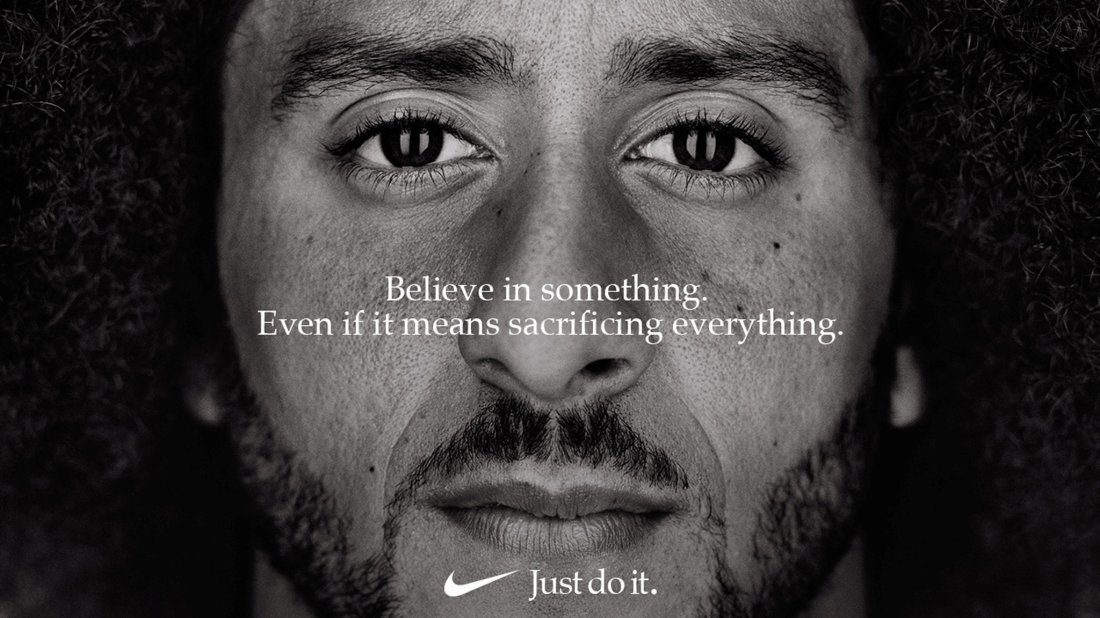
Nike reportedly is facing a boycott for an ad featuring Colin Kaepernick, who famously “took the knee” during the NFL’s repulsive and gratuitous pre-game patriotic frenzies.

Kaepernick

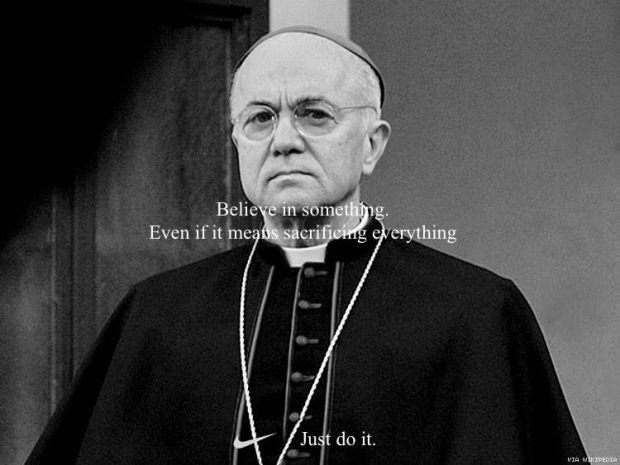
We’ll see if Nike actually believes in something, “even if it means sacrificing everything.” Nike has set itself up nicely to illustrate how “courage” no less than “patriotism” can be insincerely weaponized for commercial purposes.

Contrast:

Viganò

2

Ross Douthat … in a twitter thread which noted, among other things,

One of the striking things about the Hebrew Bible is that it’s the record of a people that makes extraordinary claims for itself — that their tribal god is the Only God, that they are His chosen people, that all nations will eventually worship him, etc.

And they buttress those claims with an extensive history in which they are … terrible. Morally terrible, politically impotent, constantly apostasizing, ignoring their prophets, the works.

Basically the Hebrew Bible says: “Hi, we’re the true chosen people of God, and to prove it let us tell a long series of stories about how our patriarchs were sinners, our kings were even worse, and we failed God completely time and time again.”

The best king of Israel, the awesome all-conquering one, is a philanderer and murderer. The second-best one, the temple-builder, becomes an idol-worshiper. And about the rest, the less said the better.

Pace certain evangelicals-for-Trump and certain RC churchmen, this is not an argument for tolerating ugliness in service of some higher good. God and His prophet deal very harshly w/David when he kills Uriah, and the attitude of the prophets throughout is horror at Israel’s sins.

But for all their horror the prophets never doubt that Israel is the elect, the chosen people, God’s intended bride. And if the Old Testament is supposed to be a revelation with big implications for the new covenant, for the Christian church, that part is important.

Eve Tushnet quoting, obviously, Ross Douthat.

Trump & the Vichy Republicans

3

News:

Two long running, Obama era, investigations of two very popular Republican Congressmen were brought to a well publicized charge, just ahead of the Mid-Terms, by the Jeff Sessions Justice Department. Two easy wins now in doubt because there is not enough time. Good job Jeff.

(Another damned Tweet by our Tweeter-in-Chief, who thinks an Attorney General is a wingman.)

News analysis by Peter Baker and Nicholas Fandos:

  • His tweet over the holiday weekend chastising Jeff Sessions, the attorney general, for the Justice Department’s recent indictments of two Republican congressmen because it could cost the party seats in November crossed lines that even he had not yet breached, asserting that specific continuing criminal prosecutions should be decided on the basis of partisan advantage.
  • “I think it was appalling,” Senator Susan Collins of Maine, another Republican, told reporters asking on Tuesday about the tweet. “It’s unbelievable. It’s unbelievable.”
  • Over nearly 20 months in office, Mr. Trump has repeatedly castigated the Justice Department and the F.B.I. for investigating his associates and not investigating his enemies. He has threatened time and again to fire Mr. Sessions because his recusal from the Russia investigation meant that he could not protect the president from the inquiry.
  • Mr. Trump’s suggestion would have been a major scandal under any other president, veterans of past administrations said. “His interference in an ongoing criminal investigation may be the single most shocking thing he’s done as president,” said Walter E. Dellinger, a former acting solicitor general under President Bill Clinton.
  • Senator Jeff Flake of Arizona, a Republican who has been among the president’s most outspoken critics in his own party, had the same reaction. “Those who study this kind of thing say it’s a lot more evidence for abuse of power or obstruction,” he said. “I just know it’s not healthy for the institutions of government to have the president want to use the Department of Justice that way.”
  • Senator Lisa Murkowski, Republican of Alaska, likewise criticized the president’s comments. “I’m looking at them just as you are looking at them,” she told reporters. “I thought that yesterday’s comments were not appropriate and they upset me.”

I agree with Walter Dellinger. If Trump is impeached, I hope his browbeating of law enforcement people for doing their jobs is prominent among the charges.

4

Ross Douthat imagines the defense theme of the Vichy Republicans in the court of public opinion:

Yes, they would say, the president is erratic, dangerous, unfit and bigoted. But notwithstanding certain columnist fantasies you can’t impeach somebody for all that — or for pretending to be a dictator on Twitter, for that matter. And by the standards of any normal presidency we still have him contained.

Sure, the trade wars are bad, but every president launches at least one dumb trade war. We stopped the child migrant business, his other immigration moves are just stepped-up enforcement of the law, we’ve stepped back from the brink (however bizarrely) with the North Koreans, we’re still sanctioning the Russians.

Meanwhile he’s nominated the most establishment Republican jurist possible to the Supreme Court, and we won’t even let him fire his own attorney general, let alone Bob Mueller.

Look, we’re not enabling an American Putin here. We’re just babysitting the most impotent chief executive we’ll ever see, and locking in some good judges before the Democrats sweep us out.

5

I have given my qualified approval to President Trump’s defense of religious freedom. The qualification is that he hasn’t shown any solicitude for the religious freedom of anyone other than Evangelical Protestants (though we other Christians collect crumbs from their State Dinner Table).

Here’s someone else’s expression of one instance of where Trump has been bad on religious freedom.

Kavanaugh Confirmation Hearings

6

Ben Sasse Conducts a Two-Minute Master Class in American Civics

7

Democrats Open Contentious Hearings With Attack on ‘Partisan’ Kavanaugh

When the New York Times puts in scare-quotes “partisan” as a description of a Republican Supreme Court nominee, I think it’s a sign that the Democrats beslimed themselves pretty good yesterday.

Is Steve Bannon fit for polite company?

8

A Venn diagram showing New Yorker readers and Trump fans would contain two circles miles apart. The folks in the New Yorker circle are far more likely to believe that Trump is a nascent despot than to believe that he is anything like a normal president. Nor are they likely to change their minds simply by spending an hour in the physical presence of Bannon.

Left-leaning cultural arbiters became too skillful with their weapon of choice, mastering those institutions so completely that certain kinds of progressivism became not merely normal, but mandatory. But by leaving less and less room for dissenters, the hegemons created a counter-tribe of outsiders who reject their authority as vehemently as they exert it. And thus, for the same reasons that the beliefs of New Yorker readers are in no danger from Steve Bannon, the views of Trump fans are entirely safe from David Remnick.

What’s left is a kind of ceremonial cleansing of the sacred city, a mighty labor to make sure that the two circles on the Venn diagram never, ever come into contact. There’s something admirable about uncompromising ethical purity, but also something rather dangerous. For it means that outside your circle, there’s an entirely different normal. And if you abdicate any influence over that alternate normality, while rigorously expelling your own heretics, you may one day awake to find that your impeccably maintained ring of truth has been swamped by that other normal, now grown entirely beyond your control.

Megan McArdle

9

I agree with those who think that he should never have been invited. Steve Bannon keeps failing in his various projects to overthrow the establishment or create a political mass movement. Were it not for the lavish media attention he still gets, he’d be a classic coffee-house revolutionary, regaling strangers about how he came “this close” to ruling and how, with a little help from you, he can get the revolution restarted. But because he provides relatively good quotes and calls back journalists, the mainstream media have an investment in keeping him more relevant that he really is. He was fired by Trump, defenestrated by Breitbart and the Mercers, and lives on largely as a useful prop for the media he claims to despise.

Jonah Goldberg

10

New Yorker, editor David Remnick, explaining why he had extended, and then quickly rescinded, an invitation to former presidential adviser Stephen K. Bannon to be interviewed on a public stage.

[I]t’s worth considering what Remnick’s disinvitation has actually achieved. Here’s my list:

It has kept Bannon’s name prominently in the news, no doubt to his considerable delight. It has turned a nativist bigot into a victim of liberal censorship. It has lent credence to the belief that journalists are, as Bannon said of Remnick, “gutless.” It has corroborated the view that the news media is a collection of left-wing group thinkers who, if they aren’t quite peddling “fake news,” are mainly interested in advancing only their own truths. It has kept readers of The New Yorker locked in their usual echo chamber. It has strengthened the belief that vulnerable institutions can be hounded into submitting to the irascible (and unappeasable) demands of social media mobs. Above all, it has foreclosed an opportunity to submit Bannon to the kind of probing examination that Remnick had initially promised, and that is journalism at its best.

The next time we journalists demand “courage” of the politicians, let’s first take care to prove that we know what the word means, and to exhibit some courage ourselves.

Bret Stephens

As Rod Dreher points out, The Economist did it better.

Miscellany

11

John McCain, well aware of his impending death, orchestrated a Resistance Funeral.

It’s currently obligatory to overlook his flaws as well as to remember his virtues, and I’ll not breach my obligation just yet. Indeed, I expect canonization forthwith.

But what I didn’t expect is hectoring pundits posing “WWJMD” criticisms every time Republicans do something deemed insufficiently bipartisan.

12

If you consider yourself a sane conservative, I’d suggest you bookmark the US edition of the Spectator. It’s pretty lively, with some voices other than the usual suspects.

It was there, for instance, that I learned that:

The Pussy Church of Modern Witchcraft (PCMW) in Maryland has just been afforded Tax Exempt Status by the IRS, which recognised it as a legitimate place of worship, or rather a ‘place of lesbian faith’. Serving a lesbian-feminist congregation, the PCMW is described on its website as, ‘a congregation of female-born, lesbian-led Women devoted to the liberation of Women and Girls from the oppression we face based on our sex.’


* * * * *

Follow me on Micro.blog Follow me on Micro.blog, too, where I blog tweet-like shorter items and … well, it’s evolving. Or, if you prefer, those micro.blog items also appear now at microblog.intellectualoid.com.

Google bias

The reality is that progressives and left-leaning news outfits tend to build better sites. They do more customization and put more thought and energy into unique sites. They use less tracking and scripts.

So progressive sites play better in Google.

And this is largely a result of the progressive donor class versus the conservative donor class. A progressive donor does not want to make a profit on a left leaning news or activist site. That donor wants a return in public policy or politics.

Too many conservative donors want an actual return on investment in the form of monetary profit or they want a 501(c)(3) to give to so they can take a tax write off. A major progressive donor will gladly cut a $200,000.00 check to a for profit progressive news site knowing they’ll be funding the cause. It is hard to find those donors on the right.

Erick Erickson. I sort of suspected something like this. My WordPress site with free theme won’t rise high in Google — which is fine by me.

* * * * *

Follow me on Micro.blog Follow me on Micro.blog, too, where I blog tweet-like shorter items and … well, it’s evolving. Or, if you prefer, those micro.blog items also appear now at microblog.intellectualoid.com.

Sunday Tidbits 8/26/18

1

Michael Brendan Dougherty at National Review takes seriously two kinds of critics of “liberalism”:

  • That political liberalism makes false promises, holding out the possibility of liberty and pluralism but ultimately demanding conformism.
  • That it’s past time to give up arguing for our claims under natural law. Instead, we should make our claims unabashedly for the social kingship of Christ.

(Paraphrased)

But he “gently suggest[s] that the integralist critics of liberalism may be focusing too much on the theory of liberalism and not enough on the condition of their Church.”

And what’s that condition?

See how the Reverend John I. Jenkins, the president of Notre Dame University, took several contradictory positions on the contraception mandate. His school became a plaintiff, arguing against it, as an infringement of religious liberty, in the highest courts in America. But, faced with dissension among professors, he reversed himself.

This level of dissension on matters of moral doctrine is everywhere in Catholic institutions, not just in universities but on the boards of Catholic health-care and charitable organizations and in diocesan secondary and primary schools. Such dissension characterizes the whole Church in America, a country where the second-largest reported religious affiliation is “ex-Catholic.” Catholic birth and divorce rates have, respectively, moved toward Protestant norms. In their catechisms, many Protestant denominations have accepted abortion and homosexuality as moral goods. And many prominent Catholic personalities — even those with imprimaturs of Catholic bishops — are urging Catholics to do likewise.

Dougherty, too, should be taken seriously.

2

Gallagher is implicitly rehashing here the old saw that “postmodernism brings a level playing field,” when in fact it relieves the rulers of the obligation to level that field. Under the ancien regime of liberalism people needed to come up with reasons for dismissing religious positions, and typically did so, even when the reasons were very badly formed indeed; now the reasons are unnecessary. “You’re a bigot” does the job just fine. As I once heard Richard Rorty say, “The theists can talk, but we don’t have to listen.” There may be, and indeed I think there are, good reasons to abandon fusionism, but the idea that in our current order integralist and other post-fusionism arguments will have greater purchase than fusionism did is, I fear, a fantasy.

There is no reason whatsoever to think that Catholic particularism will have any more “credibility” to the society at large than Catholic fusionism did. “The Catholic tradition must be prepared to speak in its own voice” not because that will be more credible or effective but because it is the Catholic tradition’s own voice. Calculations of political effectiveness are misplaced in a social environment where all substantive (and hence exclusive) religious stances are indistinguishable from the grossest bigotry. The dogma living loudly within you won’t win many friends or influence many people. But it ought to live loudly within you anyway.

Alan Jacobs, After Catholic Fusioisn, What? (hyperlink added).

3

In the gospels it was the devils who first recognized Christ and the evangelists didn’t censor this information. They apparently thought it was pretty good witness. It scandalizes us when we see the same thing in modern dress only because we have this defensive attitude toward the faith. (1963)

Flannery O’Connor via Eric Mador, Flannery O’Connor’s Christian Realism.

4

It is not homophobia in the least to point out that a heterosexual man will not have multiple sexual relationships with adult males and also pursue boys sexually when there are plenty of women around ….

Erin Manning

5

A new micro.blog acquaintance makes his own case, and cites another, for prayer using historic prayer books (in his case, the Episcopal Book of Common Prayer).

6

Hello [Tipsy],

You’ve now completed at least six hours each night on sleep therapy for 21 out of the last 30 days.

Well done. You’ve earned yourself the GOLD badge!

If you log in to myAir now you can see your progress, and you might want to share your accomplishment with family and friends on Facebook and Twitter.

Sleep well!

The myAir Team

Next to my Notary Certificate, this myAir “GOLD badge!” is one of my great accomplishments in life.

* * * * *

Our lives were meant to be written in code, indecipherable to onlookers except through the cipher of Jesus.

Greg Coles.

Follow me on Micro.blog Follow me on Micro.blog, too, where I blog tweet-like shorter items and … well, it’s evolving. Or, if you prefer, those micro.blog items also appear now at microblog.intellectualoid.com.

Thursday Potpourri, 8/23/18

1

An interesting and unexpected twist on St. Clive the New Academic:

When C.S. Lewis converted to Christianity in 1931, he admitted that he did so in large part because Christianity answered the pagan longings he had experienced in his love of mythology and of all things northern …

Epigram to a Brad Birzer article on C.S. Lewis, C.S. Lewis: Man of Faith or Warmed-Over Pagan?. After some tart words about Evangelical and fundamentalist worship of Lewis, and his own frustration with Lewis at times, this:

[S]uch Pagan lingerings should not really surprise the modern reader. When Lewis converted to Christianity in late 1931, he admitted that he did so in large part because Christianity answered the pagan longings he had experienced in his love of mythology and of all things northern. Christianity, he claimed, then and later, did not overturn the past; it baptized it. Christianity did not kill the magic, it sanctified it, making it holy and good. In ways Lewis could not understand but knew to be true, dryads remained, but they could no longer wield their power in the way they had before the coming of Christ. Further, Lewis wrote openly about the Pagan powers as real and tangible, such as when Venus, the goddess (or angelic power) of love, descends upon the wedding cottage of Jane and Mark Studduck in the finale of That Hideous Strength. And, if this is not enough proof, one need only read (or reread) what many regard to be his greatest work, Till We Have Faces, a novel so openly pagan at times as to shock.

Yet, within many Evangelical and Protestant Christian circles, Tolkien remains suspect as a pagan because of his stories of wizards, magic, necromancers, orcs, and elves.

To be sure, these are double standards. What Lewis and Tolkien each understand—and with piety and intelligence—is that the world God created still holds profound mysteries that are at once sacramental and perilous, open to the deepest longings and imaginings of the soul.

The next time you hear a bustle under the hedgerow, pause, wonder, and move on.

As someone who experienced major changes in my Christian tradition twice in life, and who recognizes (1) that my rationales may not have exhausted my reasons and (2) that I have “baggage,” acknowledged and undiscerned, I sympathize with Lewis and appreciate Birzer’s perceptive comments.

Now I think I understand why, deficient as I am in knowledge of mythology, I never could finish Till We Have Faces. But I’m not dead yet. I may give it another try, without looking for the hidden Gospel in it this time.

2

The Left is wrong, the Right is wrong, but there’s still legitimate asymmetry between sides of any racial divide:

For the left, their perspective is that historical injustice has created such a degree of unfairness that it is not right to treat oppressed groups exactly the same as privileged groups. For the right, their perspective is that we have to ignore the past and treat everyone the same.

We should be clear about the content of some of [Sarah] Jeong’s tweets. She tweeted about the joy of being cruel to old white men, that whites should become extinct and compared whites to dogs. A reasonable person does not respond to specific trolls with such dehumanizing comments about groups of individuals. It is wrong plain and simple …

Not only are such comments wrong, but they also coarsen our discourse and make it harder for us to find solutions that we can all accept. How do we expect whites to react to such comments? Do we really think that they will have some type of Kumbaya moment and realize their privileged position? Or is it most likely that those who already do not experience white guilt will merely harden their resistance to any suggestion by people of color since they will link those suggestions to anti-white bigotry? I think to ask these questions is to answer them.

I know that some progressives will say that we should not care what white people think. They are the oppressors right? We merely need to impose whatever “woke” solution of the day is out there as a matter of justice. Makes sense to me. Telling whites that their opinions do not matter has worked wonders in achieving an awareness of racial privilege. In fact, it has worked so well that we now have President Trump. Truly insanity is doing the same thing over and over again and expecting a different result.

George Yancey, Lessons from the Sarah Jeong affair. There’s quite a bit more.

3

Then what about some of the traits among those in TDW [Theological Dark Web]? If you go back to the sorts of things you might hear around IDWers, you might arrive at certain theological equivalents:

There are fundamental biological differences between men and women.

There are fundamental differences between evangelicalism and Protestantism of the Reformation.

Free speech is under siege.

Having theological disagreements is mean.

Identity politics is a toxic ideology that is tearing American society apart.

Dietrich Bonhoffer and Martin Luther King, Jr. may not have been the most orthodox of theologians.

Then if you want an analogous set of principles, it might look like this:

Willingness to disagree ferociously, but talk civilly, about nearly every meaningful subject: religion, abortion, immigration, the nature of consciousness.

Willingness to disagree about baptism, the Lord’s Supper, ordination, limited atonement, small group Bible studies and small group prayer.

Determination to resist parroting what’s politically convenient.

Determination to resist what’s popular on the conference circuit.

Purged from institutions that have become increasingly hostile to unorthodox thought — and have found receptive audiences elsewhere.

Working outside moderate evangelical institutions and finding receptive audiences in Presbyterian, Lutheran, and Anglican settings.

In fact, what may identify TDW more than anything else is an identification with a communion or denomination first, with parachurch institutions functioning on the periphery.

I think it’s time for a Theological Dark Web.

D. G. Hart 

4

Bobby Jindal, the former promising policy wonk, now a failed former governor, is back to wonkery, and makes one very good point: the GOP could end up inadvertently spurring single-payer.

5

This may deserve more prominent mention, but I’m not yet ready for abject “mea culpas: From down under comes word of moderate success in “sexual orientation change efforts,” with few reported ill-effects, for “men who have a religious motivation to change.”

As implied, I pass it on because I’ve expressed skepticism about sexual orientation change efforts (though not about the possibility of chastity).

* * * * *

Our lives were meant to be written in code, indecipherable to onlookers except through the cipher of Jesus.

Greg Coles.

Follow me on Micro.blog Follow me on Micro.blog, too, where I blog tweet-like shorter items and … well, it’s evolving. Or, if you prefer, those micro.blog items also appear now at microblog.intellectualoid.com.

The n-word

I understand Omarosa, a con woman, playing around with an allegation that Donald Trump used the n-word and she has a recording to prove it. It keeps her in the limelight and sells books. But I have no idea how Trump used it which, heaven help me, seems relevant even when the user is Donald Trump.

I couldn’t recall any account of how “Papa John” of pizza fame used it, so I Googled it and found this report, in which the journalist won’t spell out the word (but which reveals a use for which firing, return of millions of dollars of charitable donations, and erasure of the donor’s name from endowed buildings seems a bit hysterical — but admittedly the broader context of the narrower context is missing).

A black sociologist argues that “the n-word” is more toxic than “honky,” but he won’t spell out “the n-word” as he discusses it (and the legitimate reasons why sauce for the goose isn’t sauce for the gander when it comes to hateful language hurled across racial lines).

I “get it” that it is uniquely toxic as an epithet directed at another human being, especially when a pale (or orange) person hurls it at a dark person, in person or even in absentia. (Heck, it’s even worse than “dog“!)

But not all uses are epithets. Some people use it as a negative example, to criticize it and forbid its use as epithet. It seems to me that journalists could legitimately use it in the context of reporting on a controversy over its use as an epithet.

Should a law ever be written to criminalize it, describing it as “the n-word” would be, I think, an independent, void-for-vagueness constitutional infirmity.

But no. Not done. Can’t go there. Can’t go anywhere.

I’m half expecting some playwright or novelist to go coy on us in dialog.

It’s as if the very mention of it, howsoever legitimate and non-epithetic, threatens (social) death.

I may be a little bit Aspie, but I just don’t get it.

If it’s just a crazy fad, I have a suggestion for a much more sensible fad. The metaphorical use of “impact” and its derivatives as verbs by any journalist or other professional shall result in immediate termination for malpractice and, where applicable, license revocation. “Impactful” shall be a capital offense.

One may, however, use those words in drafting appropriate legislation or advocating its passage.

UPDATE: I deleted a rambling introduction, venting about something happening to a friend of mine that, in cool light of day, looked terribly out of place.

* * * * *

Our lives were meant to be written in code, indecipherable to onlookers except through the cipher of Jesus.

Greg Coles.

Follow me on Micro.blog Follow me on Micro.blog, too, where I blog tweet-like shorter items and … well, it’s evolving. Or, if you prefer, those micro.blog items also appear now at microblog.intellectualoid.com.

Potpourri

I’m starting to realize that my new favorite platform, micro.blog, makes makes some of my shorter blogs a poor fit — either literally (their platform is weighted toward 280-character bursts) or in terms of ethos (I’m more focused on political affairs than the vast majority there).

So I’m going to try aggregating here again observations and encounters that don’t quite feel right there, or that exceed the 280-character-weighted format over there. Quotation does not necessarily imply agreement.

If you’re interested in my other shorts, they’re probably going to continue cross-posting here.

1

Status issues function as vehicles through which a non-economic group has deference conferred upon it or degradation imposed upon it. Victory in issues of status is the symbolic conferral of respect upon the norms of the victor and disrespect upon the norms of the vanquished.

Phillip Jenkins quoting Joseph Gusfield on Symbolic Crusades.

It strikes me that we’re in the very odd position now of having the former political majority symbolically disrespected through laws that say, in effect, “we’re in control now, and to hell with what has been heretofore the universal conviction in Christendom (or even throughout the whole world).”

2

Begin with those much-touted checks and balances. Their health depends — as my colleagues Norman Ornstein, Thomas Mann and I argued in our book, “One Nation After Trump” — on the willingness of those in the legislative and judicial branches to put their institutional loyalties and their stewardship of the system as a whole above their partisan loyalties.

The opposite is happening in the GOP-led Congress. With the exception of a few Republican elected officials at the periphery, Congress has worked to enable Trump’s abuses (witness the behavior of California Republican Rep. Devin Nunes to undercut special counsel Robert S. Mueller III’s investigation) and to minimize the outrageousness of his conduct.

E.J. Dionne.

This is why I’m inclined to vote against most or all Vichy Republicans in November.

3

I have never talked with such soul-less, self-vindicatingly sincere liars as I have with sexual abusers — who almost always believed that the victim somehow led them into sexual acting out; that it was somehow “not bad” for the victim; that it was their “right” as an abuser; that they were only doing this out of their “depression” and history of “victimization.”

As I looked into their pale eyes, I couldn’t say “go to hell” as I wanted because in fact, they were already there. And loving it.

Fr. Jonathan Tobias

4

The mood in America is arguably as dark as it has ever been in the modern era. The birthrate is at a record low, and the suicide rate is at a 30-year high; mass shootings and opioid overdoses are ubiquitous.

It would be easy to blame the national mood all on Donald J. Trump, but that would be underrating its severity and overrating Trump’s role in creating it (as opposed to exacerbating it). Trump’s genius has been to exploit and weaponize ….

Frank Rich.

5

How much of a role did homosexuality play in all this? There is of course a vital distinction to be made here between sexual orientation and sexual abuse [that’s not the distinction that comes to my mind], and between being gay and being a pedophile, hebephile, or ephebophile [it’s hard for me to imagine being gay and not having ephebophilic yearnings, reasoning from analogy to being straight and gazing upon certain post-pubescent girls]. Many gay priests are fine and honorable servants. It horrifies me they are tarred by association, by some of the more reactionary voices in the church. It’s also true that one reason young men and boys were targeted was that they were far more readily available to priests than girls [what is he trying to say? That homosexual priests would gladly abuse girls if they were available? That straight priests abuse boys because girls aren’t available?].

But it remains true that the overwhelming majority of Catholic abuse cases are between men and boys, or men and men, not men and girls, or men with women (although that happened too). And the way in which homosexuality has been treated by Catholicism — the only option for all gays is a life of celibacy and emotional repression [conflation unwarranted] — is not likely to lead to healthy homosexual lives, let alone priests.

Homophobia may also have increased the proportion of priests over the centuries who have been gay, because the priesthood has always been a reliable cover for not dating women. And these closeted, fucked-up gays are the ones who may well have internalized many of the slurs against gays in the past, hated themselves, never come to terms with themselves, and seen no real difference between sexual abuse and sex. So gay priests may well have covered this stuff up for aeons, or formed cliques that perpetuated it, or developed personae that could create some campy subculture to make the awful contradictions and cruelties of sexual repression and self-loathing bearable. When no form of sex is allowed, all forms of sex can seem equally immoral. And if your celibacy has ever slipped, you sure don’t want to snitch on someone else, do you?

It’s a vicious, destructive, evil circle. Which is why, it seems to me, that the clerical closet has to end. Secrecy and shame abet sexual dysfunction. Openness and self-respect are the cure [openness about orientation, perhaps; openly sexually active, no — never]. If a priest is celibate and openly gay, he is in no way disqualified for the priesthood — the church teaches that being gay is in itself no sin — so why can’t he be out? [Fair question, but is the premise true? Is it forbidden for a priest to acknowledge that were he sexually active, he would prefer men?] The stricture against this kind of honesty and transparency has only compounded the fucked-upness of it all. Allowing married people and women to be priests is also a no-brainer [well, that nonsequitur was sure glib!]. We have long discovered that secretive, hierarchical cabals of single men are usually trouble in any context and I have a feeling that a female priest would not react to the news of an abused child with concern for the abuser. The church’s moral credibility is now close to zero. All the more reason to throw open the doors and let the light in.

Andrew Sullivan.

Sullivan sort of got on a roll with his ecclesial pet peeves.

This unusually muddled thinking, by a man who tries to be faithfully Catholic while disregarding its stated sexual standards, tends to reinforce the idea that men with “deep-seated homosexual tendencies” should not be ordained because they’ll not teach the faith faithfully, but rather will subvert it on matters of sexuality.

6

Austin Ruse says

Rod [Dreher] was right and I was wrong, and now I say this to Rod: Pedal to the metal. Tell it all. Tell it loud. Tell it long. Let the chips and even the prelates fall where they may.”


* * * * *

Some succinct standing advice on recurring themes.

Where I glean stuff.