Plus ça change, plus c’est la même

Plus ça change, plus c’est la même. There’s no doubt in my mind that the Catholic Church gets extra scrutiny because it’s not 100% cool with modern prejudices and vices.

The Orthodox Church will get the same treatment as we grow and become better known. Orthodoxen: get used to it.

Yes, I just “compared” today’s sexual revolutionaries — i.e., about 90% now (or so it seems sometimes) — to Nazis, if you’re looking for merde to throw. No, I don’t think sexual revolution is Nazi or Nazi-inspired.

Metaphors of the Atonement.

Father Stephen Freeman, whose thought and spirit I greatly appreciate, has this evening posted on Metaphors of the Atonement. I commend it to Orthodox readers especially, but it may be of interest to western Christians (Roman Catholics and Protestants) to see how their characteristic “forensic” understanding differs from the unfamiliar Orthodox view – which I have come to cherish.

This is not some arcane theological backwater, by the way. The differing views of Christ’s atonement and “descent into hades” are quite fundamental differences that ramify extensively through the churches – and individual Christians – who hold them — not just in express doctrinal propositions, but in how the two sides of the Great Schism have come to perceive the world and the place of people in it.

A second difference, not touched on by Father Stephen in this post, is what Wikipedia not unreasonably calls Experience of God (Theoria) vs Scholasticism. Theoria is the Orthodox emphasis; Scholasticism (a term of art, not to be confused with intelligence or intellectual bent) was a post-schism development largely of Thomas Aquinas and his fellow schoolmen in the pre-Reformation Roman Catholic Church, and which influence Protestant thought as well.

Both are deep differences, which make Orthodoxy worth a look by folks burnt out on the western Church(es) they’ve known, but haunted by Christ.

Greetings, Masson’s Blog followers

There’s no explanation for the traffic spike today besides Doug Masson’s kind words at his blog. Welcome to you all.

I’ll see if I can come up with something new to say, but meanwhile those of you converging from the left coasts should like “Places not worth caring about” from last night. James Howard Kunstler posits, among other things, that if we keep building places not worth caring about, we’ll soon have a Country not worth caring about – a point on which there should be ample ground between thoughtful liberals and conservatives, I’d think. We’re embodied creatures, after all, and the space we inhabit affects us powerfully.

Like a lot of young men, I once thought I’d be an architect. I quickly learned that I did not have what it took, so I thought I’d be a homebuilder. I abandoned that for different reasons – heck, it was the 60s and early 70s and everything was unsettled – and eventually landed in the disreputable profession of law, having tired of making an honest living. [Note to self: locate smiley-face icon. Or winky-face.]

Doug described me as a true conservative, which I’ll take as high praise. Religiously, I went off the scale 13 years ago, embracing Eastern Orthodox Christianity – which it’s critics fault for not changing with the times. To that, I say, “Damn straight!” That’s as conservative as it gets religiously, though you’ll find some Obama bumper stickers in our parking lot on Sunday. Religious and political conservatism are not, except for perhaps a few issues, a package deal.

Back to places worth caring about. I’m Chairman of my Church Building Committee as we plan a new building that we intend to be very much worth caring about. Here’s a few thoughts I shared along with two key renderings. [Note to self: incorporate PayPal button for friendly Church Building Fund donations.]

We’ve hired a Charleston, SC designer to lead in the design of an Orthodox temple and site to cherish for centuries. His sensibility is New Urbanist, but we’ll be building at 43N and 225 just west of Battle Ground, on 8 acres currently supporting corn or soybeans.

As important as the temple itself – which will even have real plaster walls to receive iconography in the future – is the site plan, creating a fitting sense of both invitation and separation, with a courtyard that will serve a fairly important purpose at “Orthodox Easter.” The idea is not alien to the points Kunstler is making about urban spaces in “Places not worth caring about.”

Again: welcome, visitors/newcomers.

To Change the (Barbarian) World

(This posting may be of limited interest to non-Orthodox readers.)

I just discovered a new Orthodox blog that looks somewhat promising, Koinonia. The owner/host has completed a very manageable 3-part series, Barbarians at the Gate, where he takes to task not the barbarians (he just identifies them fairly trenchantly), but the indifference or capitulation of the Orthodox Church to those barbarians. Part of his solution is that we cease and desist from bashing Western Culture and get down to the work of transforming it.

Our alliance with barbarism has happened because we have rejected the Christian roots of Western culture in a misguided effort to (1) keep the Church Greek (or Russian, or Arab, or Serbian) or (2) to distinguish “True Orthodoxy” from “false Catholicism” or (3) because, like Frank Schaeffer, we are simply cultural-despisers who have found that the Orthodox tradition is a convenient cudgel with which to continue waging our political or cultural battles. Whatever the reason, this amounts to a refusal to engage in any meaningful way with the cultural marketplace of ideas. As a result, it leaves the public square utterly naked – even as we moan and complain about it privately. Worse, it makes us the tools by which Nietzsche could proclaim that God was a non-factor (“dead”) in modern life. Itputs us in a position where we not only fail America – to be salt and light for our neighbor and our country – but also Christ and ourselves.

…

The spiritual genius of the Orthodox Church has always been the ability of the Church to take on and transform the dominate culture. This means that just as Jesus was the authentic Jew among Jews, the Church has been – in turn – authentically Greek among the Greeks, and authentically Russian among the Russians, so too we must be authentically American among the Americans. While have rarely done this perfectly, we have largely done this without sacrificing the Gospel or the communion of the various local or ethnic churches.

Is there any reason, other than sloth or despair, why we think we cannot do this in America as well?

It hit a nerve. My posts in the short life of this blog have been relatively heavy on culture-bashing. I bash because I really do care – like an inarticulate father who doesn’t know what to do with a sick child except to yell.

Part of the challenge in Barbarians at the Gate is that there are people outside the Church with whom we can and must make common cause. He suggests, among a handrul, the Catholic Church.

I suggest that James Davidson Hunter, author (coiner?) of the influential Culture Wars in the 90s, is also one with whom we can make common cause. I highly commend this paper he gave at Trinity Forum 8 years ago. That “briefing” finally has grown to a book of the same title. I am greatly looking forward to reading it (if I can moderate my blogging long enough to fit it in).

Davidson’s main points from the briefing eight years ago:

  1. Culture is a resource, and as such, a form of power.
  2. Culture is produced.
  3. Culture production is stratified into a rigid structure of “center” and “periphery.”
  4. Culture changes from the top down; rarely if ever from the bottom up.
  5. World-changing is most intense when the networks of elits and the institutions they  lead overlap.

Another with whom we can make common cause is Ken Myers at Mars Hill Audio Journal, who has been inspiring me for several decades now. I think we have some examples to emulate as well from the folks at Front Porch Republic.

The work at hand is not revolution, but the slow permeation of salt and the absorption of light. We need to be about it sooner rather than later.

The Gospel Reading for Pascha

The passion narratives having been read during the week, we come on the Day of Resurrection to read … not an explicit Resurrection narrative, but  John 1: 1-17.

The choice of John 1 (“In the beginning was the Word, and the Word was with God and the Word was God ….”) might seem an odd one, but:

In Him was life, and the life was the light of men. And the light shines in the darkness, and the darkness did not comprehend it.

Given the Orthodox emphasis on the Resurrection as Christ’s conquering of death (not – or not exclusively – a vindication of his “His message” or even of the deity of “His person,” as if to say “See? I’m God. I can do anything? Got that, dummies?”), the inability of light to “comprehend” the light takes on added power.

Another reason, however, may be the tradition of receiving Catechumens on Great and Holy Saturday. In other words, their formal catechesis having been completed, adults are received into the Church. We had no litany for Catchumens in the Liturgy today.

But what has that to do with why we read from John today? When I was a Protestant, we passed out the Gospel of John, separately printed, as a veritable evangelistic tract because of what we considered its warmth and accessibility. I believe it’s still the case that Wycliffe Bible Translators will translate and publish the Gospel of John in a new (to Wycliffe) language before any other Scriptures.

But it was not so in the early Church. The early Church actually withheld the Gospel of John from Catechumens, having them learn the facts of Christ’s life from the synoptic gospels. The Gospel of John was considered too theological for a novice. That’s right: the superficially warm and fuzzy Gospel of John is heavy theology!

Therein, no doubt, lies a rather large tale about how historic Christianity and Evangelicalism even conceive theology. Obviously, we’re seeing something more in John than its heart-warmingness. Something, even, that might be missed or misappropriated if John is read to early in a spiritual pilgrimage.

So – or so it seems to me – the Gospel for today from John may be appointed not just for its evocative power, but to continue the instruction of the “Newly Illumined” who were received the day before – and are now “ready for meat” in more than one sense. I wish I were equipped to flesh out this little epiphany better than this, but there it is.

Can these bones live?

I sometimes have trouble focusing. My mind careens around like a pinball. I see connections between X and Y and my mind races off to how Y connects to Z and so forth. Or it can be as simple as “what’s the next thing to sing in this long Good Friday service?” So I sometimes miss things.

I have it on pretty good authority that I’m not alone in this, by the way, and that single-mindedness is part of that toward which our salvation – our spiritual healing and restoration – tends.

But last night, my mind stopped racing for a moment. John nearby was chanting Ezekiel chapter 37 – “the Spirit of the Lord … set me in the midst of the plain, which was full of human bones ….”

I thought that was a prophecy of the restoration of Israel! What’s it doing in a Good Friday service!?

The Fathers taught that it prophesies the Final Resurrection:

Great is the lovingkindness of the Lord, that the prophet is taken as a witness of the future resurrection, that we, too might see it with his eyes … We notice here how the operations of the Spirit of life are again resumed; we know after what manner the dead are raised from the opening tombs … And finally, he who has believed that the dead shall rise again ‘in a moment, in the twinkling of an eye, at the last trump (for the trumpet shall sound) … shall be caught up among the first in the clouds to meet Christ in the air’; he who has not believed shall be left, and subject himself to the sentence by his own unbelief.

(Ambrose of Milan via the Orthodox Study Bible.)

Again, this except from the daily Dynamis devotional:

Ezekiel 37:1-14    (4/3-4/16)     Prophecy at Lamentations Orthros of Great &Holy Saturday

The Mystery of Resurrection: Ezekiel  37:1-14 SAAS, especially vs. 3: “Then He said to me, ‘Son of man, can these bones live?’ So I answered, ‘O Lord, You know this.’” God speaks through His Prophet Ezekiel to show us “…a great multitude of bones on the face of the plain.  They were very dry” (Ezek. 37:1,2). We confront bleak death. Can it be undone?

…

Archpriest Georges Florovsky faces the vast plain of dry death, and he adds a notable disclaimer: “Human death did not belong to the Divine order of Creation.  It was not normal or natural for man to die.”  Death is not according to the will of God.  It is alien, an enemy in league with the father of lies, the purveyor of death.  Father Florovsky recalls that in Scripture death is “the wages of sin” (Rom. 6:23).  Therefore, he stoutly refuses the conception of death “…as a release of an immortal soul out of the bondage of the body.”  Rather, he counters with the great truth that “…death is not a release, it is a catastrophe,” following the world-view of Scripture.

By bringing us into the valley of dead, dry bones, God sets a mystery before us:  “Can these bones live?” (Ezek. 37:3).  Cancer, heart attacks, tsunamis, suicide bombers, earthquakes, and the graves of our war dead press us to say, “Unlikely!”  But the Prophet does not answer this way.  He defers to the power, mercy, and boundless love of God.  “O Lord, You know this” (vs.3).  Yes, death defies us and the image of God within us.  We cry out, “What of death, O Lord?”  Is the end just weathered bones on the valley floor of hades?

But, the word of the Lord stops the mind to arrest our attention: “Thus says the Lord to these bones: ‘Behold, I will bring the Spirit of life upon you. I will put muscles on you and bring flesh upon you.  I will cover you with skin and put my Spirit into you.  Then you shall live and know that I am the Lord’”(vss. 4-6).  The Prophet Ezekiel was a deported slave. The life of Israel was virtually ended by conquest and deportation.  Still, God promised, “Thus says the Lord: Behold, I will open your tombs, bring you up from your graves, and bring you into the land of Israel” (vs. 12).

God’s promise was no less incredible for the disciples scattered at the arrest and  crucifixion of the Lord Jesus.  He died on the cross.  He crossed into the plain of dry bones. Where was God with His promise?  Learn from Ezekiel.  The Prophet obeyed God: “So I prophesied as He commanded me, and the Spirit entered into them and they lived and stood upon their feet, and exceeding great assembly” (vs. 10).  Likewise, the Lord Jesus kept His promise as well: “They will scourge Him and kill Him.  And the third day He will rise again” (Lk. 18:33).  “Christ is risen from the dead, and has become the first fruits of those who have fallen asleep….even so in Christ all shall be made alive” ( 1 Cor. 15:20,22).  Ezekiel discloses the way. The Lord Jesus’ Resurrection is just the beginning.  And many shall follow!

The gates of Hades didst Thou shatter, O Lord, and by Thy death Thou didst destroy death.  And Thou didst free the race of man, granting life and great mercy to the world.

Jason Peters on the Krustian sell-a-bration of Eester

Item 983 on my growing list of reasons I’m blessed to have stumbled onto Orthodox Christianity.

This kind of stuff, I’m afraid, is the entropic eventuality of Protestantism. We experienced it as “Worship Wars” in my Protestant church before I left, eventually giving one group reluctant leave to “plant” a new church to its tastes. “Church planting” was the lipstick we put on the pig of splitting up.

I look back now and think neither side knew what real worship looked like, but one was more clueless than the other.

I hesitate to use the term “entropy” with Roman Catholicism, which has endured for a rather long time now. But they’ve got some boundary-setting to do, as in this (I shudder to use the term) Liturgy in Los Angeles:

I don’t mind singing in an empty Church

Well, technically, I’m not sure the Church is ever really empty. There’s always that great cloud of witnesses.

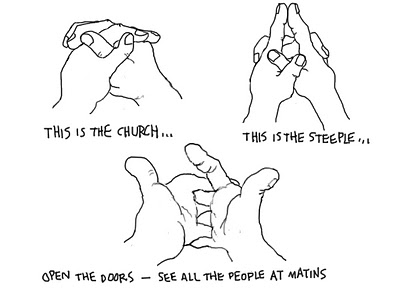
But apart from them, the Church is sometimes empty except for Priest and Cantor (me). We rarely have more than the “clergy” (Priest, Deacon, Cantor and maybe another Reader) at the very beginning  of Matins. Occasionally that will happen in a weekday service, too. Usually one or two will arrive soon after the start, though. The inspired doodle above is (from Steve Robinson at Pithless Thoughts, shall we say, reality-based.

But it doesn’t bother me, at least not in the sense of “why do I bother?” I may regret that many who could be present don’t bother, and miss out (missing out on what is the point of this posting – read on). But many really can’t come, and that’s okay. We’re a small Parish, with lots of young families with children. I’d think there was something seriously wrong if those families dragged their young ones to Matins, which combined with Liturgy routinely runs almost 3 hours. Others commute as much as an hour each way. So I don’t expect them to come.

But by coming and singing, I myself – hard of hearing and heart – steep in the teaching and mind of the Church. Slowly, I’m absorbing it. That counts for quite a lot since I’m serious about my faith but have nearly 5 decades of baggage from other Christian traditions, each misguided about many things, to unload.

One of those pieces of baggage is how to approach scripture. I had already begun to write this when Father Stephen posted on “the hearing of the word.” It illustrates beautifully how the Church approaches scripture:

I am convinced after years of preaching and listening to preaching that the bulk of Scripture has become lost to our ears. We hear it, but fail to “hear” it ….

Much of my conviction on this matter has come in the last 12 years or more and my immersion into the services of the Orthodox Church. These services, long and with ample “hymnography” that is but a poetic commentary on the Scriptures and doctrines that surround any particular feast, are probably the richest surviving engagement with the Word of God to be found in a 21st century Church. Here no Reformation has occurred and reduced all Scripture to a “riff” on Justification by Faith, or a subset of Calvin’s paradigms. Here no Enlightenment has shown with its darkness of doubt and obfuscation.

Instead, there is a constant wonderment at the Scriptures themselves, as if the hymnographer were discovering something for the first time or had found a rare gem to share to any willing to listen – and all in the form of praise and thanksgiving to God.

It is true to say that in Orthodoxy, “Theology sings.” ….

…In our modern context most people have either been shaped by fundamentalist literalism; by modernist historical criticism; or by nearly nothing at all. In each case the Scriptures will not sing – they will not yield up their treasures.

I was struck by a particular case this evening – at the Vigil for  Palm Sunday. The gospel account in question was the Matthean version of Christ’s entry into Jerusalem:

“And when they drew near to Jerusalem and came to Bethphage, to the Mount of Olives, then Jesus sent two disciples, saying to them, “Go into the village opposite you, and immediately you will find an ass tied, and a colt with her; untie them and bring them to me. If any one says anything to you, you shall say, `The Lord has need of them,’ and he will send them immediately.” This took place to fulfil what was spoken by the prophet, saying, “Tell the daughter of Zion, Behold, your king is coming to you, humble, and mounted on an ass, and on a colt, the foal of an ass.” The disciples went and did as Jesus had directed them; they brought the ass and the colt, and put their garments on them, and he sat thereon.”

Modern historical criticism hears in this only the “foolishness” of Matthew. Matthew has cited the prophecy in Zechariah that “your king is coming to you…mounted on an ass, and on a colt, the foal of an ass,” and has crafted his story in precisely that manner, placing Jesus astride two animals. The same critics will note that in other gospel accounts Christ is only on a “foal of an ass,” i.e., one animal. Historical Critics have a field day with such problems (I was first confronted with this “discrepancy” in my sophomore year of college – it was presented as if the professor had noticed something no one had ever seen before). Modern fundamentalists will rush to defend the integrity of the gospel accounts, “Two different eye-witnesses reported on the same thing and one emphasized one thing and the other emphasized another.”

Both explanations lack imagination and are precisely the sort of blindness that afflicts so much modern reading of Scripture. Listening to the hymnody for the Vigil of Palm Sunday, the hymnographer, without apology for the discrepancy, races to it and declares:

“O gracious Lord, who ridest upon the cherubim, who art praised by the seraphim, now Thou dost ride like David on the foal of an ass, The children sing hymns worthy of God, while the priests and scribes blaspheme against Thee. By riding an untamed colt, Thou hast prefigured the salvation of the Gentiles, those wild beasts, who will be brought from unbelief to faith! Glory to Thee, O merciful Christ. Our King and the Lover of man!”

… the ancient hymnographer has come closer to the heart of Scripture than either the modern sceptic or the modern literalist will ever know.

… The writers of the New Testament believed that everything in the Old, when read rightly would yield insight into the Messiah and the mystery of our salvation. But their creative insight (again, I believe it is inspired) is far removed from the flat-footed nonsense that we hear out of modern fundamentalist “prophetic” scholars, whose reading of the Old Testament is almost as poorly constructed as the 19th century false prophecies of the book of Mormon! Neither bear any resemblance to the treatment of prophecy found in the New Testament.

And thus I return to my original point. We have become deaf. We listen with ears either hardened by modernist scepticism, or by a false literalism that has substituted Darbyite nonsense for the Apostolic faith, or reduced Scripture to delicate harmonizations. None of them have the boldness and audacity of the patristic hymnographers who stood in the proper line of succession, proclaiming the faith as it had been taught and received and continuing to expound its mysteries. Thank God that somewhere in this modern world, you can still stand and listen to the wonders of our salvation, sung and unraveled before the unbelieving heart of man. Glory to God who has so loved mankind!

So, whether there’s a single soul besides me in church, I’m singing theology. I’m singing poetry. I’m expounding the mysteries of the faith. I’m unraveling the wonders of our salvation before my own unbelieving heart, made dull by 48 years of desparate harmonizations – “flat-footed nonsense.”

[If this sampling from Father Stephen has whetted your appetite, probably the most target-rich zone of audacious expounding of the Old Testament is the Great Canon of St. Andrew of Crete, sung in segments during the first week of Lent and then sung in its entirety Thursday of the 5th week. Download and savor.]

And in a sense that I’m slowly and dimly beginning to apprehend, we are doing the reconciling work of God. This gets into a sacramental view of the world, which I am unqualified to address and would surely botch if I tried. Perhaps another day.

Although I’m occasionally bone-weary when I go to sing, it’s always a very great privilege, and I benefit as much as anyone.

Culture war update

My posting that used my spiritual doppelganger Frank Schaeffer as a launching pad was in the works for several days, but coincidentally, the AOI blog featured Schaeffer’s odd behavior as its centerpiece just a day later.

I underestimated the depth of the problem, having only sampled what Schaeffer offers to wallow in. There’s something seriously wrong when an Orthodox Christian of Schaeffer’s reported status can write this generally and this in particular:

The [Manhattan] declaration was the brainchild of a far right Reconstructionist extremist, Roman Catholic scholar, Robert P. George. George is a Princeton University professor of jurisprudence and probably the most influential Reconstructionist thinker to try to derail our democracy … Of course George would disavow being called a Reconstructionist. Rather he would claim he’s an advocate of the so-called Natural Law school of Roman Catholic theology.

Well, yes, Frank: George would deny being a Reconstructionist. Because he isn’t one. And he’d claim the Natural Law mantle. Because it fits.

And if you don’t know that, I’ve got bad news for you: you’re an idiot. (Shall I write that slower? You. Are. An. Idiot.)

Or as George put it:

I remember meeting him [Schaeffer] only once. Admittedly, it was a memorable experience. We were on a panel together at Princeton discussing contemporary politics in the midst of the 2008 presidential election. I knew nothing about the man, but he immediately struck me as an odd and, frankly, somewhat creepily emotive character who, as they say, “had issues.” He seemed pathetically desperate to be important or, at least, to be regarded as important in elite intellectual circles. I’ll leave it to the psychiatrists to decide whether this had to do with his being reared by fundamentalist Christian parents, a fact which, for some reason, he insisted on making a very big deal out of in his remarks. His speech was an emotional tirade that was perhaps the most self-referential piece of oratory I’ve ever heard. It was, you see, all about . . . him! We were supposed to be talking about the election, but what the audience got from Frank Schaeffer was autobiography—an account of the life and deeds of Frank Schaeffer. (Evidently, he was once himself connected to those dreadful right-wing fundamentlists until he “realized just how anti-American they are,” which led him to forums like the the Rachel Maddow Show and the Huffington Post where he warns the Enlightened about the nefarious plans of his former comrades in arms “to derail democracy.”)  It was so painfully embarrassing that even people on his side (that would be the pro-Obama side) were rolling their eyes to make clear to the rest of us that they found his behavior as peculiar and embarrassing as we did.

Schaeffer once said Orthodoxy was his last stop in Christianity – as if he’d apostatize entirely if Orthodoxy didn’t suit him. So as a litany in the St. Ambrose Prayer Book has it:

On those who at this moment are in danger of losing Thee forever, Lord have mercy!