Sunday, November 2

The final blow

A campaign led by the kings of France and England to recapture it had failed. A second expedition, launched in 1202 in obedience to Innocent’s own summons, had been diverted to Constantinople. In 1204 it had stormed and sacked the city. A stronghold that for long centuries had withstood the envy of pagan warlords had fallen at last—to a Christian army. Its captors justified their storming of the city by charging that its inhabitants were rebels against the papacy: for the churches of Rome and Constantinople, ever since the age of Gregory VII, had been divided by an ever-widening schism. Innocent, however, appalled by the despoliation of Christendom’s bulwark, lamented the fall of Constantinople as a work of hell.

Tom Holland, Dominion.

The Great Schism between the papacy and Eastern Christian patriarchs is conventionally dated 1054, and not without reason. But those who dig deeper (or, like me, who read those who have dug deeper) tend to think that the 1054 schism was curable until this sacking of Constantinople by Crusaders.

A quintessential American heresy

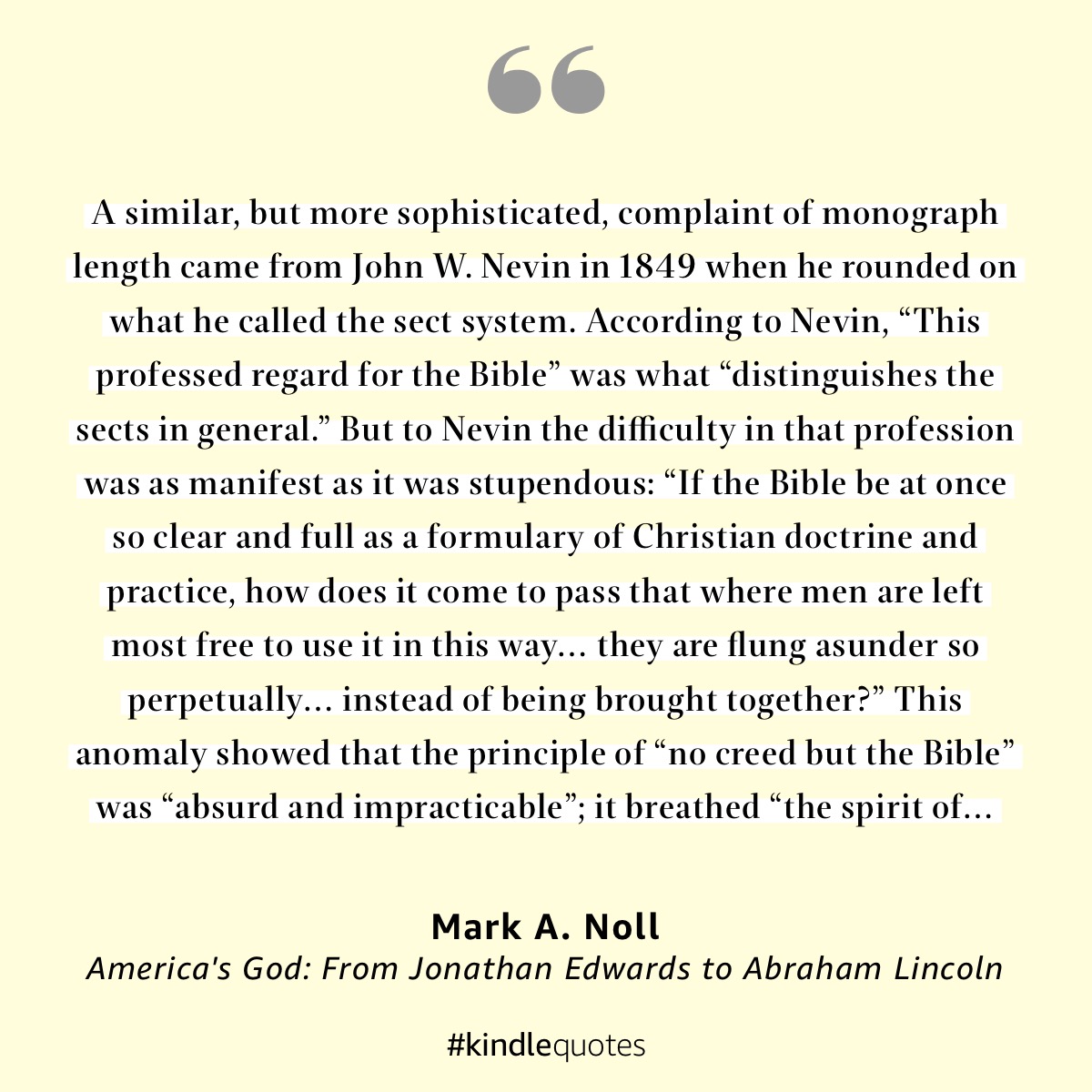
[L]iving by no rule but the Bible turned out to be a defense against virtually the same list of enemies as living up to the standards of republicanism: “Many are republicans as to government, and are yet half republicans, being in matters of religion still bent to a Catechism, creed, covenant, or a superstitious priest. Venture to be as independent in things of religion as in those which respect the government in which you live.” Few Protestants expressed themselves as flamboyantly as [Elias] Smith in the early republic, but most followed where he led.

Mark A. Noll, America’s God.

I was reminded this week of a distinction that’s relevant here. I believe I learned it from the late Richard John Neuhaus, who I followed closely starting sometime in the 1980s. I won’t give a name (other than “quintessential American heresy”) to the view expressed so flamboyantly by Elias Smith, a view which I once effectively held, but I’m now in the camp of “ecclesial Christians”: those for whom faith in Christ and faith in His Church is one act of faith, not two.

I decidedly do not venture to be independent in things of religion, but very consciously submitted to the tradition of the Church particularly about Mary, the Mother of God-in-the-flesh, who was a stumbling-block to me as she has been to other Protestants (who in our generation call her “blessed” only sullenly, bound by scripture to do so).

The worst of the worst

Church management is a tricky and complicated business. I am glad that it is not my job. But I do know this much: The church is there for Gyp the Blood and Humpty Jackson, for Charlie Whitman and John Wilkes Booth and me. If there is no room for the worst of the worst in your church, then you do not have a church: You have a crappy book club.

Kevin D. Williamson (hyperlinks added).

Work and play

But there is the question. What, precisely, is “the business of life”? We can get onto an endless carousel if we try to decide which is the serious stuff of life, work or play. It is possible to take either view: either we toil away our eight hours so that we can get down to the real stuff—pleasure and love and recreation—or we enjoy periodic intervals of escape from the real stuff, the work.

Thomas Howard, Chance or the Dance? I would not have retired had I thought the real stuff was work; that’s just livelihood, not life.

What evangelism can obscure

With the clergy focused on the task of evangelism, their doctrines received so little scrutiny that laypeople took them for granted: the Bible was an infallible guide in every situation, and the church taught what was written in it. Coming into contact with people who read the Bible differently, southerners, unconscious of their own scrim of interpretation, concluded that those others were not Christians.

Frances Fitzgerald, The Evangelicals.

Fallen hero

Jérôme Lejeune was a hero of the National Right to Life Committee for his stance against aborting unborn children with Down syndrome.

He also was a thief—a stealer of glory that belonged to others.

It was apparently how the game was played back then. (Gift Link) That may not have changed much.

There’s probably a better moral to this little story than I can write: convention is no assurance of morality.

Upright life, sound doctrine

Over and over again he insisted that in electing an abbot upright life and soundness of doctrine were to be the prime considerations, not rank or family influence. ’I tell you in all sincerity,’ he said, ‘that as a choice of evils I would far rather have this whole place where I have built the monastery revert forever, should God so decide, to the wilderness it once was, rather than have my brother in the flesh, who has not entered upon the way of truth, succeed me as abbot. Take the greatest care, brothers, never to appoint a man as father over you because of his birth; and always appoint from among yourselves, never from outside the monastery.

Bede et al, Bede


Religious ideas have the fate of melodies, which, once set afloat in the world, are taken up by all sorts of instruments, some woefully coarse, feeble, or out of tune, until people are in danger of crying out that the melody itself is detestable.

George Elliot, Janet’s Repentance, via Alan Jacobs

[N]one of the things that I care about most have ever proven susceptible to systematic exposition.

Alan Jacobs, Breaking Bread With the Dead

You can read most of my more impromptu stuff here and here (both of them cathartic venting, especially political) and here (the only social medium I frequent, because people there are quirky, pleasant and real and it has no-algorithms). All should work in your RSS aggregator, like Feedly or Reeder, should you want to make a habit of it.

Great and Holy Race Day

I’m situated geographically in a place so sports- and Indy500-obsessed that in my former Church, men would disappear en masse on “Race Day.” Granted, I lived away from here 20-ish years, but it’s still a point of sinful pride that I’ve never been. Not to the race, not to the trials, not to carburation day.

(I apologize for some funky formatting today. After all these years, I still have trouble dealing with numbered or bulleted lists within block quotes.)

Filioque

As a protestant, I had no idea that the filioque (the words “and from the Son” in the Nicean Creed concerning the procession of the Holy Spirit) was added to the Creed hundreds of years later, nor that it was rejected from the beginning by Christians outside the jurisdiction of the Roman Patriarch, nor even (very distinctly at least) that there were catholic Christians outside the jurisdiction of the Roman Patriarch.

Since becoming Orthodox, I have taken it as a matter of high importance to reject the filioque, but I don’t recall previously seeing all of these reasons for the rejection:

Eastern Europe was converted to Christianity by Byzantine missionaries, the most prominent of whom are Saint Cyril and Saint Methodius. These bonds of religion created a deep sympathy between Bulgar to Byzantine. The Franks attempted to sever these bonds by sending missionaries into Eastern Europe, claiming that the Byzantines had taught them a heterodox version of Christianity and encouraging them to use the filioque.

I know Catholics are tired of Orthodox apologists going on about the Franks. But this really is an important test-case, for the following reasons:

  1. The threat of Arianism was resolved 300 years before the Schism. So, adding the filioque served no pastoral function. On the contrary, it was deeply divisive.  
 2. The underlying theology of the filioque was hotly disputed, especially by the Eastern patriarchs. So, adding the filioque did not express the mind of the universal Church.  
 3. The original Creed had been drafted in Council for a reason: it was supposed to express the *consent* and *concensus* of the orthodox, catholic bishops. So, adding the filioque defeated the whole purpose of the Creed.  
 4. For about six hundred years, Popes had taught the dangers of inserting the filioque into the Creed. So, adding the filioque violated even Rome’s local customs.  
 5. The Ecumenical Councils had ruled that the Creed should not be modified. So, adding the filiioque violated the Holy Canons.  
 6. Rome was advancing the *filioque* for worldly reasons only. So, adding the filioque would have allowed a single bishop to advance his own political and economic interests at the whole Church’s expense.  

The Eastern Patriarchs had every reason to reject the insertion of the filioque, and no reason to accept it—none except, “The pope said so, and we have to do whatever the pope says.”

Michael Warren Davis, ‘Papal Minimalism’ Is Eastern Orthodoxy

Worship

To anyone who has had, be it only once, the true experience of worship, all this is revealed immediately as the ersatz it is. He knows that the secularist’s worship of relevance is simply incompatible with the true relevance of worship. And it is here, in this miserable liturgical failure, whose appalling results we are only beginning to see, that secularism reveals its ultimate religious emptiness and, I will not hesitate to say, its utterly anti-Christian essence.

Alexander Schmemann, For the Life of the World

Protestant, Catholic, Non-Denom

As my readers know, I’ve been an Orthodox Christian ever since I began blogging. The more attentive readers may know that before that I was Reformed (i.e., Calvinist, and specifically Christian Reformed) and before that, I was a generic Wheaton-College type evangelical.

Or maybe I should say “a generic Wheaton-College type evangelical as evangelicalism was configured in the 1950s through the mid-1970s.” Because it has come to my attention more forcefully, and in a way that more painfully implicates and pronounces doom on the kinds of Christian I once was, that things are changing. The evangelicalism I knew is not as powerful as it once was; evangelical denominations are shrinking and dying. So are Calvinist denominations. The Protestantism I knew most closely is increasingly nondenominational, and doesn’t care much about doctrine or sacraments, and increasingly doesn’t even want to be called “evangelical” or even “Protestant.”

This affects me closely because my wife remains Christian Reformed, and I consider it a pretty good penultimate tradition for an Orthodox Christian. And there is a very strong trend toward those denominational Churches dying out in favor of non-denoms.

And it worries me because those nondenominational Churches tend far too much to be personality cults and hotbeds of rampant sexual and other clergy abuse. And God only knows what they’re teaching, insofar as they’re teaching anything other than a mooshy-gooshy relationship with Jesus and a firm commitment to the GOP as a way of gaining power.

Yeah, this means I’ve gained some fresh respect even for the progressive Protestant denominations (which are also dying, even faster than the conservatives). At least there’s some accountability to hierarchies less likely than local parishioners to be mesmerized by Mr. Charisma. And some of them retain a liturgy that will expose worshippers to more scripture and doctrine than Joel Osteen can even imagine.

In any event, I say all that to introduce you to four of the thought-provoking articles (presented in the order in which I encountered them) that brought to my attention how much things are changing in my former haunts. A common thread is that denominational Protestantism is in deep, deep trouble; one goes so far as to suggest that nondenominational Churches are not really Protestant, but a whole new tradition:

  1. Goldilocks Protestantism – First Things
  2. LONG FORM: Does Traditional Protestantism Have a Future?
  3. How ‘Christian’ Overtook the ‘Protestant’ Label – Christianity Today
  4. Low Church in High Places: The Fate and Future of American Protestantism – Public Discourse

Religious ideas have the fate of melodies, which, once set afloat in the world, are taken up by all sorts of instruments, some woefully coarse, feeble, or out of tune, until people are in danger of crying out that the melody itself is detestable.

George Elliot, Janet’s Repentance, via Alan Jacobs

[N]one of the things that I care about most have ever proven susceptible to systematic exposition.

Alan Jacobs, Breaking Bread With the Dead

You can read most of my more impromptu stuff here and here (both of them cathartic venting, especially political) and here (the only social medium I frequent, because people there are quirky, pleasant and real). All should work in your RSS aggregator, like Feedly or Reeder, should you want to make a habit of it.
Pascha 2025

I put the final touches on this as I waited for our Paschal/Easter Vigil. When it posts, I should be fat, happy — and sound asleep in a “meat coma.”

Fr. Stephen Freeman says “I can think of at least two times in my life that the failures of Church, or its hierarchy, drove me from the ranks of the Church, or what passed for Church at the time.” I can think of only one, but heightened apprehension of the Resurrection kept me from leaving what passed for Church at the time. So it seems personally fitting that this is Orthodoxy’s “Feast of Feasts,” surpassing even Christ’s Nativity (which seems more prominent in the West — forgive me if I err).

All around the world tonight and tomorrow, Orthodox priests will be spared writing an “Easter Sermon” because it’s customary to read this one from a master preacher. We even do a bit of call and response, shouting “It was embittered!”

Christ is Risen!

One more Easter thought

[Saint John] Chrysostom commented on this reality: I, for instance, feel differently about these subjects than an unbeliever. I hear, “Christ was crucified” and immediately I admire His loving-kindness to men. The other hears and esteems it as weakness. I hear, “He became a servant” and I wonder at his care for us. The other hears and counts it as dishonor. I hear, “He died” and I am astonished at His might, that He was not held in death, but even broke the bands of death. The other hears and surmises it to be helplessness. He, on hearing of the resurrection, says the thing is a legend. I, aware of the facts which demonstrate it, fall down and worship the dispensation of God. . . . For not by the sight do I judge the things that appear, but by the eyes of the mind. I hear of the “Body of Christ.” In one sense I understand the expression, in another sense the unbeliever.

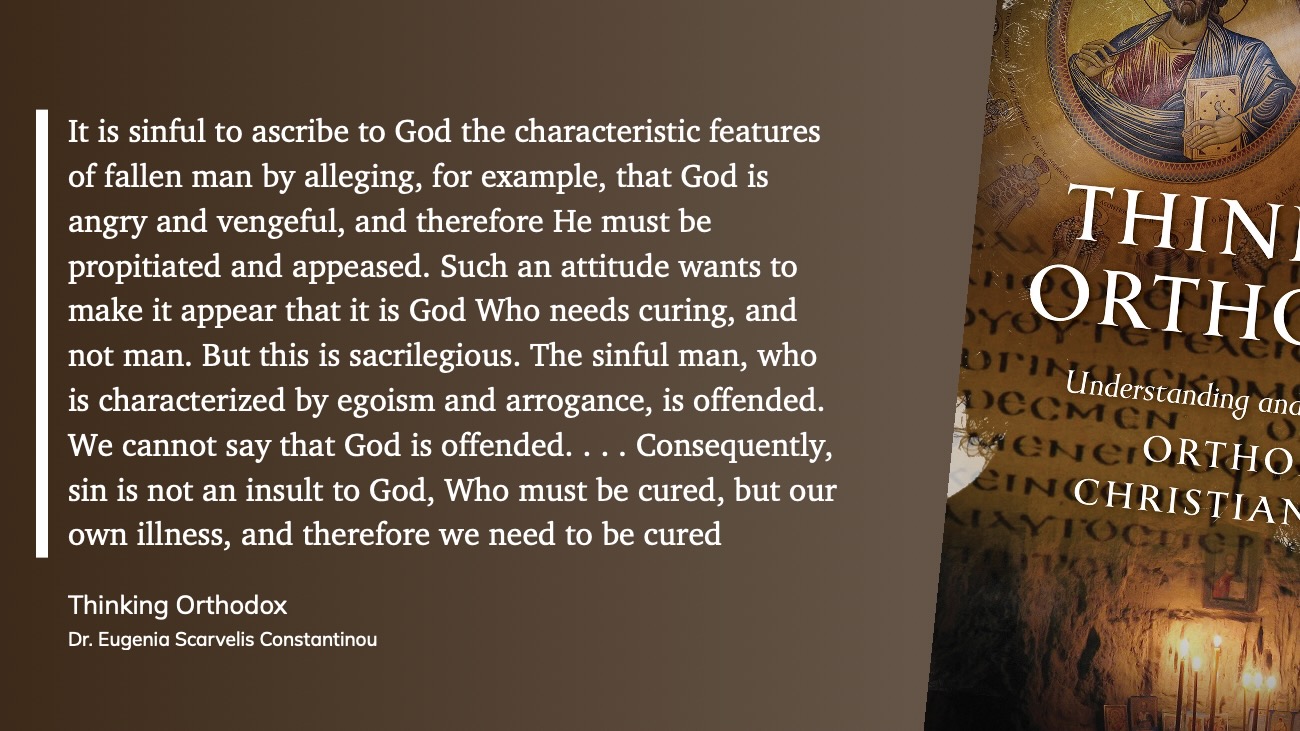
Dr. Eugenia Scarvelis Constantinou, Thinking Orthodox

Heresy, not secularism

Ten years ago I published a book called “Bad Religion: How We Became a Nation of Heretics,” which offered an interpretation of the country’s shifting religious landscape, the sharp post-1960s decline of institutional faith. Before the book’s anniversary slips away, I thought I would revisit the argument, to see how it holds up as a guide to our now more de-Christianized society.

What the book proposed was that secularization wasn’t a useful label for the American religious transformation. Instead, I wrote, American culture seems “as God-besotted today as ever” — still fascinated with the figure of Jesus of Nazareth, still in search of divine favor and transcendence. But these interests and obsessions are much less likely to be channeled through churches, Protestant and Catholic, that maintain some connection to historical Christian orthodoxies. Instead, our longtime national impulse toward heresy — toward personalized revisions of Christian doctrine, Americanized updates of the Gospel — has finally completed its victory over older Christian institutions and traditions.

Ross Douthat, The Americanization of Religion – The New York Times

Redemption (a venerable poem)

Having been tenant long to a rich lord,
Not thriving, I resolvèd to be bold,
And make a suit unto him, to afford
A new small-rented lease, and cancel th’ old.

In heaven at his manor I him sought;
They told me there that he was lately gone
About some land, which he had dearly bought
Long since on earth, to take possessiòn.

I straight returned, and knowing his great birth,
Sought him accordingly in great resorts;
In cities, theaters, gardens, parks, and courts;
At length I heard a ragged noise and mirth

Of thieves and murderers; there I him espied,
Who straight, Your suit is granted, said, and died.

(George Herbert, Redemption, via Sally Thomas at Today’s Poem).

I’m sorry that this won’t format exactly like the original I saw without using some coding that ends up rendering an ugly post.

The search for certainty

The Reformation is the first great expression of the search for certainty in modern times. As Schleiermacher put it, the Reformation and the Enlightenment have this in common, that ‘everything mysterious and marvellous is proscribed. Imagination is not to be filled with [what are now thought of as] airy images.’ In their search for the one truth, both movements attempted to do away with the visual image, the vehicle par excellence of the right hemisphere, particularly in its mythical and metaphoric function, in favour of the word, the stronghold of the left hemisphere, in pursuit of unambiguous certainty. … What is so compelling here is that the motive force behind the Reformation was the urge to regain authenticity, with which one can only be profoundly sympathetic. The path it soon took was that of the destruction of all means whereby the authentic could have been recaptured.

Iain McGilchrist, The Master and His Emissary

Pecking Order Ecclesiology

It isn’t strange to learn that Prestigious Scholar X on the law/econ/poli-sci faculty at Ivy League School Y is Roman Catholic. It is a bit of a surprise to learn that he’s an evangelical. The moment you hear it, though, you wonder (or ask) whether he’s an evangelical Anglican or some such.

Brad East, Conversions, Protestantism, and a New Mainline

Misinterpreting the Bible

Both the fundamentalist and the higher critic assume that it is possible to understand the biblical text without training, without moral transformation, without the confession and forgiveness that come about within the church. Unconsciously, both means of interpretation try to make everyone religious (that is, able to understand and appropriate scripture) without everyone’s being a member of the community for which the Bible is Scripture.

Stanley Hauerwas, Resident Aliens

It’s not just the “higher critics.” Lots of lazy unbelievers have their little proof-texts to illustrate that absurdity or barbarity of the Bible. But they read them as fundamentalists do, not as the historic Church does.

Balancing Rites

The campaign for same-sex marriage has triumphed, and I can’t imagine a successful counter-offensive (Maybe some day when I’m long dead and gone?). Meanwhile:

Maybe the prospective customers, like many Americans, do not see transcendent meaning in the ceremonial commencement of matrimony, because they associate a wedding as admittance to an institutional legal fiction that allows one access to nothing more than a cluster of political and social privileges not available to other friendships. So, given this understanding, it is not surprising that the customers see the provider’s refusal as a negative judgment on the public legitimacy of their union. Thus, it’s easy to see why the customers would be offended by the provider’s refusal and subsequently seek legal redress. But what the customers fail to see is that their demand that the courts force the providers to rescind their denial and be punished for it is really a demand that the state force the providers not to exercise their freedom of worship, the liberty not to participate in, or not provide assistance to, ceremonies that one believes have sacramental significance.

Francis J. Beckwith, Taking Rites Seriously

Convert shock

Steve Robinson on his initial experience in an Antiochian (f/k/a Syrian) Orthodox parish back when they weren’t really used to Protestant converts:

I can summarize the mutual culture shock, ours and theirs, over the next few years pretty succinctly: They didn’t know why we were so serious about Orthodoxy and we didn’t know why they weren’t. We had zeal with a little knowledge and no experience, they had some knowledge, a lifetime of experience, and little zeal (at least for the things WE thought “real Christians” should be zealous about). And for all of our decades of zealous “Christianity” we brought to the table, we didn’t know what love looked like.

This is one of the sorts of culture clashes that make Fr. Stephen De Young think that there will be no single “American Orthodox Church,” independent of traditional Orthodox lands, for a very long time — and a good thing it is! We converts (e.g., Steve Robinson, Fr. Stephen, me) are good for the Church, but we don’t have everything right. We might well push the “cradle Orthodox” aside in our arrogance and create something syncretistic under the “Orthodox” name.

More:

I came to the Church for respite and healing of my evangelical battle scars. After all, it is “the hospital for sinners” originally founded by The Great Physician, who organized and staffed it with his own hand picked specialists who were guided by an inspired Mission Statement.

I think of all I have learned in twenty six years, perhaps this is the most important: The Hospital is also The Arena. It is a place of a brutal, to the death cage fight with my demons and I will not finish the battle un-scarred. The Hospital treats my wounds with the sacramental medicine of immortality and arms me with the gifts of the Holy Spirit, sometimes in spite of the attending physician. I cannot pick only one wing of the building, they co-exist in the same place.

Standing, Still

Evangelical political theology

Though it feels rather remote now, it is important to recall that back in the 2000s and 2010s, popular level evangelical political theology basically did not exist. The two dominant paradigms on offer were a kind of lazy baptizing of conservative fusionism that was shockingly indifferent to historic Christian reflection or a watered down evangelical Hauerwasianism that attempted to locate Christian political witness within the church, all while being mostly unaware of how impoverished evangelical ecclesiology had become.

Jake Meador, Anti-Wokeness and the Evangelical Fracturing


Religious ideas have the fate of melodies, which, once set afloat in the world, are taken up by all sorts of instruments, some woefully coarse, feeble, or out of tune, until people are in danger of crying out that the melody itself is detestable.

George Elliot, Janet’s Repentance, via Alan Jacobs

[N]one of the things that I care about most have ever proven susceptible to systematic exposition.

Alan Jacobs, Breaking Bread With the Dead

You can read most of my more impromptu stuff here and here (both of them cathartic venting, especially political) and here (the only social medium I frequent, because people there are quirky, pleasant and real). All should work in your RSS aggregator, like Feedly or Reeder, should you want to make a habit of it.

Sunday April 6

Perennial favorite

I believe that I am not mistaken in saying that Christianity is a demanding and serious religion. When it is delivered as easy and amusing, it is another kind of religion altogether.

Neil Postman, Amusing Ourselves to Death

Religion I

In the pre-modern era in the West, as in much of the world today still, there was no such thing as ‘religion’. The Christian story was the basis of peoples’ understanding of reality itself: it was widely assumed that it represented the truth about existence, and that no part of life could therefore be outside of it. There was no ‘religion’, because there was no notion that this truth was somehow optional or partial, any more than we today might assume that gravity or the roundness of the Earth were facts we could choose to engage with only on Sunday mornings.

Paul Kingsnorth, The Migration of the Holy

Religion II

Another book, less exhaustive but both more enjoyable and more useful to me, is Before Religion: A History of a Modern Concept by Brent Nongbri. He begins by recounting a conversation with his father in India, asking what word in their own Khasi language corresponded to the English word “religion.” The answer was a loan-word from Bengali, meaning simply “customs.” They had no word of their own for the category of action English-speakers thought of as religion.

Father Silouan Thompson, Why I’m Religious, and Not Spiritual.

Morality

The nature of true morality does not consist in our sentiments – how we feel or imagine ourselves to think about right and wrong. It does not even consist in how we act. Rather, true morality consists in who we are. Another way of describing this is to understand true morality as the acquisition of virtue, the forming and shaping of our character in the image and likeness of Christ. Mere moral rules and norms in the hands of a person whose character is flawed is similar to a child with an AK-47. The outcome is always predictable.

Fr. Stephen Freeman

Is “Evangelical” a useful word?

I am still a newcomer to the world of Artificial Intelligence, but I’ve found that it’s kind of useful for giving me the broad contours of an issue.

This week, I posed the following question to three of the leading AI services:

Summarize, with hyperlinks, the discussions among American Evangelicals (and Evangelical-adjacent) on whether the label “evangelical” has any remaining utility.

I believe the following should be shareable links to the results:

What prompted my question was the seeming incoherence of using the same label to describe, for instance, prosperity gospel flake Paula White Kane and Tim Keller. Gemini was the only service that flagged the identity issue (the definition of “Evangelical”) explicitly.

Mind-bender

Our salvation doesn’t depend on our opinions. That’s hard to grasp. at least for someone formed as I was. I believe it, but don’t fully grasp it.

There have been orthodox Saints who spent their lives in heretical churches because the bishop in their area was a heretic. Today, I think “we” would tell them to leave and start an orthodox church. Their ecclesiology was stronger than ours.

I think this sort of thing ramifies more widely than I’ve yet grasped.

Grow up!

The man who denies his relationship with God, who refuses to be His son, is not a real man but a man stunted, the unfinished plan of a man.

Father Alexander Elchaninov, Diary of a Russian Priest


Religious ideas have the fate of melodies, which, once set afloat in the world, are taken up by all sorts of instruments, some woefully coarse, feeble, or out of tune, until people are in danger of crying out that the melody itself is detestable.

George Elliot, Janet’s Repentance, via Alan Jacobs

[N]one of the things that I care about most have ever proven susceptible to systematic exposition.

Alan Jacobs, Breaking Bread With the Dead

You can read most of my more impromptu stuff here and here (both of them cathartic venting, especially political) and here (the only social medium I frequent, because people there are quirky, pleasant and real). All should work in your RSS aggregator, like Feedly or Reeder, should you want to make a habit of it.

St. John Climacus, 2025

Denying our ancestry

Just as the Bishop of Oxford refused to consider that he might be descended from an ape, so now are many in the West reluctant to contemplate that their values, and even their very lack of belief, might be traceable back to Christian origins.

Tom Holland, Dominion

The virtue of essays

I write here not as a teacher to students but rather as a reader to other readers, a citizen to other citizens. I write because I think I have learned a few things in my teaching life that are relevant to our common life. You will see what those are if you read on.

My approach here is anything but systematic. Of all the literary genres, I am fondest of the essay, with its meandering course that (we hope) faithfully represents the meanderings of the human mind … certain images in advance and people will recur throughout this book, returning perhaps when you think we’re done with them. I write this way because none of the things that I care about most have ever proven susceptible to systematic exposition.

Alan Jacobs, Breaking Bread with the Dead. That last sentence is a gem.

Notional Evangelical Bibicism

As a public relations stunt, Trump’s Bible photo might seem unserious, but the president certainly understood the importance of Christian scripture to a significant voting bloc. Evangelicals are biblicists, and the extent to which American religiosity has been dominated by evangelical Protestantism correlates to the degree to which American culture has been shaped by the Bible.

Paul J. Gutacker, The Old Faith in a New Nation

I would be remiss were I not to recommend Brad East’s ‌Biblicist churches that don’t read the Bible — Brad East. Historian Gutaker may be missing something contemporary.

The one, true meaning of the text

When I try to explain to people why we need to recover patristic interpretation, the biggest obstacle I face is the desire of my interlocutors to establish the one, true meaning of the text. When I assert that there is no such thing, I provoke raised eyebrows: I must be playing fast and loose with the biblical text, making it echo my preconceptions. My insistence that biblical texts have multiple, even innumerable meanings contradicts our modern objectivism. My defense of patristic allegorizing likewise elicits fears of arbitrariness and subjectivism.

Hans Boersma, No Method but Christ

Whither the magisterial Reformation?

Nearly two decades ago, Bruce McCormack, professor of systematic theology at Princeton ­Seminary, wrote: “The situation in which Christian theology is done in the United States today is shaped most dramatically by the slow death of the Protestant churches.” He went on:

if current rates of decline in membership continue, all that will be left by mid-century will be Roman Catholic, Eastern Orthodox and non-denominational evangelical churches. . . . The churches of the Reformation will have passed from the scene—and with their demise, there will be no obvious institutional bearers of the message of the Reformation. What all of this means in practice is that it will become more and more necessary, for the sake of the future of Christianity, to establish stronger ecumenical relations with the Catholics and the ­Orthodox.

This is a grave prediction, but its sobriety makes it not just prescient but practical. Non-catholic varieties of Christendom are here for good, but Goldilocks Protestantism was always doomed to fail. It presumed too much, relying on a common inheritance—patristic, medieval, and cultural—that was bound to be called into question by future reformers in search of their own style of biblical renewal.

In any case, McCormack is right: Whether, in the coming decades, magisterial Christians look “up” or “down” for friendship and cooperation, they will be living in a world without Protestantism. In truth, they already are.

Brad East, Goldilocks Protestantism

Martyrdom

Many a man will live and die upon a dogma: no man will be a martyr for a conclusion.

John Henry Newman


Religious ideas have the fate of melodies, which, once set afloat in the world, are taken up by all sorts of instruments, some woefully coarse, feeble, or out of tune, until people are in danger of crying out that the melody itself is detestable.

George Elliot, Janet’s Repentance, via Alan Jacobs

You can read most of my more impromptu stuff here and here (both of them cathartic venting, especially political) and here (the only social medium I frequent, because people there are quirky, pleasant and real). All should work in your RSS aggregator, like Feedly or Reeder, should you want to make a habit of it.

Sunday, 1/26/25

Musings from a funeral

I went to a funeral on MLK Day (when there were unrelated festivities going on in Washington DC as well). I hadn’t seen the deceased probably in more than a quarter century, but I always liked him.

Apart from being dead, Tom looked good. Apart from her hair haven’t gone white, his wife looked great. It was good to see them again, though it does eventually get tiresome when you only see your old friends at funerals, especially when one is the guest of honor.

His daughter’s Remembrance dwelt at some lengths on Tom’s piety, and deservedly so in my experience. We got acquainted at our former Reformed church. When our church split planted a sister church with guitars and drums and plexiglass and repetitive praise songs and such, I think he went with the sister church instead of staying with us stick-in-the-muds. Eventually, he moved out of state, to a warmer and trendier place, to start his own business in a field he knew from 30 or so years’ experience. He remained firmly in the Reformed tradition, though he switched in his new home to the Presbyterian side rather than the continental.

And soon enough, the Orthodox Christian faith caught my serious attention and I, too, left — in an opposite direction from Tom.

Which brings me to my topic. Why me? Why did I get lucky? Why don’t more people like me find the Orthodox Christian faith?

I don’t really have an answer, but I have largely gotten over my convert-itis, my urge to harangue people about looking into Orthodoxy. I’m just not prepared to say that the world would be a better place if every pious Protestant was forever wringing his hands and anxiously poring over books to see if maybe he hadn’t picked (or been born into, or married into, or whatever) the true/best Church. There’s something to be said for settling down and practicing your faith, especially since the alternative of searching, searching, searching just might be unhealthier than settling down in the wrong place.

Or so it seems to me. I don’t mean to be cavalier about extra Ecclesiam nulla salus or to fudge the borders of Ecclesiam, but if I can hope for the salvation of all, and can get out of my left brain about distinctions, surely I can hope for the salvation of heterodox Christians.

Settling is what I had done 30-plus years ago. As I can attest, God knows how to unsettle you when you need it. So if you are feeling unsettled in your Church, come and see what’s up in your nearest Orthodox Church. Otherwise, stay put and be the best [fill in the blank] you can be.

And may God have mercy on me if this is the advice of a squish.

Before we forget the stunt …

Of Bishop Mariann Edgar Budde’s National Cathedral sermon (which turned to direct admonition of Donald Trump):

I must be one of the only people other than those actually in the cathedral to have listened to the entire thing. It was dry, high-minded, and Christ-light, and it built on a theme of “unity” in which all people drop their political differences and embrace a generalized, feel-good, Esperanto-like uni-faith, with everyone directing their prayers to Whom It May Concern.

Caitlin Flanagan


Religious ideas have the fate of melodies, which, once set afloat in the world, are taken up by all sorts of instruments, some woefully coarse, feeble, or out of tune, until people are in danger of crying out that the melody itself is detestable.

George Elliot, Janet’s Repentance, via Alan Jacobs

[N]one of the things that I care about most have ever proven susceptible to systematic exposition.

Alan Jacobs, Breaking Bread With the Dead

You can read most of my more impromptu stuff here and here (both of them cathartic venting, especially political) and here (the only social medium I frequent, because people there are quirky, pleasant and real). All should work in your RSS aggregator, like Feedly or Reeder, should you want to make a habit of it.

Sunday After Nativity

Intellectual converts

The Free Press yesterday published a longish item, How Intellectuals Found God by Peter Savodnik.

I was familiar with all the intellectuals named except Jordan Hall, and they all seem to fit Brad East’s year-old Conversions, Protestantism, and a new mainline commenting on the rarity of intellectual conversions to Protestantism as opposed to catholic traditions. Add to Brad East’s exploratory hypotheses about that phenomenon those of Fergus McCullough, Why don’t intellectuals convert to Protestantism?.

Tyler Cowen chimes in, in a somethat different key:

Not too long ago, I was telling Ezra Klein that I had noticed a relatively new development in classical liberalism. If a meet an intellectual non-Leftist, increasingly they are Nietzschean, compared to days of yore. But if they are classical liberal instead, typically they are religious as well. That could be Catholic or Jewish or LDS or Eastern Orthodox, with some Protestant thrown into the mix, but Protestants coming in last.

As an Orthodox Christian, I take no offense at intellectual converts gravitating in a catholic direction, but for a number of reasons, I’m not doing an end-zone dance about it, either, unlike one (Roman) Catholic bishop in Texas:

Catholicism will be nihilism’s last competitor on the dance floor of history, and Catholicism will see it drop from exhaustion as the orchestra plays on. The music itself will testify.

Bishop Daniel E. Flores of Brownsville, Texas

But so what?

Men are apt to prefer prosperous error to an afflicted truth.

Jeremy Taylor

Both quotes via R.R. Reno

Those evangelicals of intellectual bent should be wrestling with this question, though.

Carefully Rehearsed Spontaneity

The framers of the Directory [for the Publique Worship of God] were not unaware of its paradoxical stance vis-à-vis ritual, either. Its preface obliquely acknowledged the oddity of institutionalizing a prescribed means of praying when Puritan teaching held that converted people would pray aright by the Spirit, but offered it as “some help and furniture” to the minister, so that he might “furnish his heart and tongue with Materials of Prayer and Exhortation, as shall be needful” (7-8). The careful, italicized language of the Directory, meant to be paraphrased but not displaced altogether, embodies a sort of anxious, secret checking of spontaneity that is in fact part and parcel of its logic. In spite of the selection of a man who appeared a trustworthy minister of God’s word, not only might his prayers stray from sound doctrine, but more than that, they might not flow freely, spontaneously, and affectively at all. In referring to the guide as “help and furniture,” the Directory portrays what it believes should be a modern, rational, self-transparent, and spontaneous self, operating under what it figures as deformities, weaknesses, and handicaps: seeking to authenticate its goodness and wholeness, yet perennially afraid of its inner divisions, the demand of its repeated performance, and perhaps most of all of its silences.

In this way, the Directory also looks toward the spiraling anxiety. That is one of the enduring legacies of Protestant and English dissenting spirituality in the restoration and enlightenment. More paradoxically than the writers of the Directory, Dissenters later wrote a vast literature to instruct those within their camp in the art of praying spontaneously. This literature too begs the question of why free prayer needed coaching, a query many dealt with directly. But it also sets forth as its most common recommendation for achieving true prayer the collection of lists of phrases, usually from Scripture, which once memorized would roll off the tongue and be easily assembled into prayer on the spur of the moment. Where the Directory‘s very form expresses the implicit knowledge that spontaneity is no real guarantor of (doctrinal or spiritual) truth, these free-prayer guides murmur with the fear that spontaneity may not come at all. While they seek to fill the mind with scriptural phrases, constructing, in Matthew Henry’s words, a “Storehouse of Materials for Prayer,” they also speak another truth. Besides being furnished with nonorthodox materials, the self that flees performativity and ritual, looking inward for authentic substance, finds itself fluctuating and, in the face of the demands of performance and empirical, experimental repetition, often silent and empty.

[Matthew] Henry’s Method culminates with his most fascinating phrase-collection of all, “A Paraphrase on the Lord’s Prayer, in Scripture Expressions.” Christ’s own form of prayer given to his disciples had long been a thorn in Puritans’ sides, to be plucked out by being understood as only a general guideline. Henry’s strategy is to neutralize the prayer’s form in a similar method; he provides, for instance, and amazing two and a half pages of verses elaborating on the one phrase “Our Father, who art Heaven” (MP, 163-65), a general topos, he says, from which prayer begins. Many editions of the Method were printed as Henry intended, interleaved with one blank page between each printed one, to enable the reader to pen in his own collection of phrases to supplement Henry’s own. Like Bunyan’s demand for scrupulous sincerity, Henry’s lists and blank pages, figures of accumulation and abstraction, combine literally to efface the Lord’s Prayer and erase it from Dissenting practice.

The more individualized these spiritual practices became, like the personalized collections of scriptural phrases, the more readily their constructedness-their nonspontaneity-was apparent, opening the believer to a sense of isolation and perpetual, nearly neurotic self-critique …

Lori Branch, Rituals of Spontaneity, pp. 55-57, 60.

This fake spontaneity persists in verbal tics like “Father God, we just” this, that, or the other thing. It’s like refrigerator magnet poetry only less creative.

The sober prayers of the Book of Common Prayer always secretly guided me when, as a Calvinist Elder, I was to lead congregational prayer, and those of the Orthodox Prayer books had an outsized influence on my eventual embrace of Orthodoxy.

Watch what they do, not what they say

Paradoxically, therefore, the structures necessary for the Reformers to extend the sacred into all of life included a whole constellation of structures and practices that they undermined. For if everything is sacred, then in another sense, nothing is sacred. This struck me in a particularly visceral way one Sunday morning at the Calvinist church in Idaho. After the service, I went to use the restroom and found leftovers of Communion bread in the bathroom garbage. The clergy routinely gave leftover bread and wine to the children to consume as a snack, which the children could then take wherever they wished.

Robin Phillips, Rediscovering the Goodness of Creation


Sometimes this whole 2000-year-old faith seems like a living koan. Chew on this until you are enlightened. Keep walking.

Paul Kingsnorth

You can read most of my more impromptu stuff here and here (both of them cathartic venting, especially political) and here (the only social medium I frequent, because people there are quirky, pleasant and real). All should work in your RSS aggregator, like Feedly or Reeder, should you want to make a habit of it.

Sunday before Nativity, 2024

David Brooks

I have long admired David Brooks, and a few years ago I heard fairly detailed rumors about his embrace of Christian faith — without ceasing to identify as Jewish.

This week, he wrote at some length about his pilgrimage (unlocked article). So far as I know, this is his public “coming out”:

When I was an agnostic, I thought faith was primarily about belief. Being religious was about having a settled conviction that God existed and knowing that the stories in the Bible were true. I looked for books and arguments that would convince me that God was either real or not real.

Some people are spiritual but not religious; during that time, you could say I was religious but not spiritual.

When faith finally tiptoed into my life it didn’t come through information or persuasion but, at least at first, through numinous experiences …

Sometimes people hear about my religious journey and ask me about my “conversion,” but that word is a relic from the rationalist mentality — as if I traded one belief system for another. The process felt more like an inspiration, like someone had breathed life into those old biblical stories so that they now appeared true.

Today, I feel more Jewish than ever, but as I once told some friends, I can’t unread Matthew. For me, the Beatitudes are the part of the Bible where the celestial grandeur most dazzlingly shines through. So these days I’m enchanted by both Judaism and Christianity. I assent to the whole shebang. My Jewish friends, who have been universally generous and forbearing, point out that when you believe in both the Old and New Testaments, you’ve crossed over to Team Christian, which is a fair point.

We religious people talk about virtue so much you’d think we’d behave better than nonreligious people. But that’s not been my experience. Over the past decade, especially in the American church, I’ve seen religious people behaving more viciously, more dishonestly and, in some ways, more tolerant of sexual abuse. I sometimes joke that entering the church in 2013 was like investing in the stock market in 1929. My timing could have been better.

Still, I’ve been grateful to live in an enchanted world, to live toward someone I can seek and serve. I’ve been grateful to have to learn and relearn yet another startling truth, that faith is about yearning but it’s not about striving. You can’t earn God’s love with good behavior and lofty thoughts, because he’s already given it to you as the lavish gift that you don’t deserve. “I prayed for wonders instead of happiness, Lord,” Abraham Joshua Heschel wrote, “and you gave them to me.”

Three decades ago, I might have snorted and said “this guy is no Christian!” Or maybe I wouldn’t have. It’s hard to remember all of my past attitudes, and tempting to caricature them. But I’m confident that I would at least have felt that this account was alien and challenging to my then-understanding of Christian faith. Today, I find his account quite sympathetic, as, I think, the late Bishop Kallistos Ware would have as well:

Faith is not the supposition that something might be true, but the assurance that someone is there.

And I have it on reasonably good authority that most uses of “faith” in English-language Bibles would better be rendered as “faithfulness,” which is especially salient this morning as the gospel reading (on the Orthodox “new calendar”) is much of Hebrews chapter 11.

Chistianities: thin, sharp, thick

Jonathan Rauch, in conversation with David French (unlocked), divides Christianity in the US into thin, sharp, and thick versions. It’s of concern to him — gay, atheist and Jewish — because he has come to see that Christianity is congruent with liberal democracy and our liberal democracy may need it for survival.

I’ve rejected untold times the idea that Christianity is only important in publicly instrumental ways, but that doesn’t mean it isn’t important in those ways. And I thought Rauch’s descriptions of thin and sharp Christianities are pretty well on target.

It seems to me, though, that Rauch’s example of what constitutes thick (i.e., useful) Christianity is off-base:

This is what’s been missing. Christians have a teaching about how individuals should relate to the world around them. If there’s a hurricane in Asheville, the stories of what the church is doing are fantastic. But they don’t have a teaching about how to engage politics as Christians. And that leads me to realize what the Church of Jesus Christ of Latter-day Saints is actually modeling is a whole civic theology, and that’s what Christianity needs more of: teachings about how would Jesus approach politics.

I think my concern arises because Rauch is seeing Christianity largely in instrumental terms. Or maybe it’s because I’m having trouble figuring out how a Church stays thick while diverting attention to thinning civics (“teaching about how to engage politics as Christians”). Or maybe I recoil at the thought that anything good could come out of Salt Lake City.

The inevitability of ritual

In England, the two kinds of churches I do still see filling appear rather different. In a local baptist church the pews are crammed with young families having powerful, intimate encounters with their faith. Something immediate is being accommodated. I remember seeing a guy fresh from a building site, dusty with a high viz jacket. Family with him, arms outstretched, tears on his cheeks. It would bring a lump to your throat.

Then I see my own parish, hushed and seemingly antique, but with more young people than ever before. In both I see people who look spiritually fed. Then out there in the wider audit of emptying churches there seems often to be a sense of weariness, or simple lack of oomph. There will be exceptions to this last sentence, I have no sneer in writing it. I sometimes go sit in those congregations simply out of love for the yards they’ve put in as parishioners. Solidarity, a hand held across the fence to a fellow worker bee.

It seems, from a distance, the two churches are very different, and I am well aware of the theological wrestles that create distance. What I don’t go along with is the notion that one is completely improvisational and unencumbered by tradition, and the other set-and-only-set in a kind of endless, ancient theatre or lifeless ceremony. Dame Mary Douglas, a cultural anthropologist, encapsulates something she calls the ‘anti-ritualist’ approach:

The confirmed anti-ritualist mistrusts external expression. He values a man’s inner convictions. Spontaneous speech that flows from the heart, unpremeditated, irregular in form, even somewhat incoherent, is good because it bears witness to the speaker’s real intentions.

I think actually, ritual is inevitable, even when tacit. We are ceremony people, no matter how spontaneous we think we may be. There will be a loved formula, a linguistic groove long established, a shared initiatory language in common for any community that lasts. It’s about the dynamic counterpoints of tradition and innovation. We may have done away with the candles, offerings and holy smoke, but simply to feel safe repetition will always have value.

Martin Shaw.

Don’t forget the Christian East

It is noteworthy that no institutional form of religious persecution was ever introduced in the Christian East. Because of Western historiographical ignorance of the Orthodox Church, however, the inquisition would come to represent, for secular intellectuals in modern times, the illegitimacy of any civilization grounded in Christianity, whether Western or Eastern.

John Strickland, The Age of Division

Fully God, fully man

And from this we draw a refutation of Eutyches: since Christ is declared to be the fruit of the womb. And all fruit is of the same nature as the parent plant: so it follows that the Virgin also was of the same nature as the Second Adam, Who takes away the sins of the world. And let those be ashamed at the true child-bearing of the Mother of God, who have invented some fantastic notion concerning Christ’s Body; for the fruit proceeds from the very substance of the tree. And what of those who say that Christ passed through Mary as water through a channel? Let them hearken to the words of Elizabeth, who was filled with the Holy Ghost; saying that Christ was the fruit of the womb.

Severus (of Antioch) via Jonah (of micro.blog). Emphasis added because I heard somebody on WMBI say exactly that (actually, she said “pipe” rather than “channel”).

If Christ passed through Mary as water through a pipe, where did He get His humanity, which all Christians now confess? How do you get to “fully God and fully man” if Mary was just a pipe?

Denying Christ’s humanity is a pretty high price to pay for dodging her whose “fiat mihi secundum verbum tuum” is a crucial element in the story of our salvation.

A terrible choice

Christians in Germany will face the terrible alternative of either willing the defeat of their nation in order that Christian civilization may survive, or willing the victory of their nation and thereby destroying our civilization.

Dietrich Bonhoeffer


Sometimes this whole 2000-year-old faith seems like a living koan. Chew on this until you are enlightened. Keep walking.

Paul Kingsnorth

You can read most of my more impromptu stuff here and here (both of them cathartic venting, especially political) and here (the only social medium I frequent, because people there are quirky, pleasant and real). All should work in your RSS aggregator, like Feedly or Reeder, should you want to make a habit of it.

Sunday 11-3-24

Some ironies of American slavery

This was only one of many ironies in the debates over slavery, which saw Catholics ignoring or reinterpreting papal decrees, Episcopalians celebrating early American Puritans, Presbyterians defending medieval society while criticizing the Reformation, Baptists treating patristic exegesis as authoritative, and anticlerical abolitionists praising the pope. Not all of this irony was lost on contemporaries. As has been discussed, African American historians, in particular, took pleasure in pointing out the hypocrisy of proslavery authors who cited North African church fathers in their arguments for white supremacy.

Paul J. Gutacker, The Old Faith in a New Nation

No creed but the Bible?

Orthodoxy in America

Whatever else Orthodoxy in America is, it’s not bourgeois. It’s too weird for that. At the same time, bourgeois people like me come to it. The point is to be converted by it, to learn by the fasts, the prayers, and the way of Orthodox life to train our hearts to want what Christ says we should want.

Rod Dreher, Schmemann and Social Justice

Me too

I fear that I’m like the little girl in Flannery O’Connor’s short story, who was sure she could never be a saint, but thought she might could be a martyr if they killed her quick.

Rod Dreher, Sunday With St. Paraskeva


Religious ideas have the fate of melodies, which, once set afloat in the world, are taken up by all sorts of instruments, some woefully coarse, feeble, or out of tune, until people are in danger of crying out that the melody itself is detestable.

George Elliot, Janet’s Repentance, via Alan Jacobs

You can read most of my more impromptu stuff here and here (both of them cathartic venting, especially political) and here (the only social medium I frequent, because people there are quirky, pleasant and real). All should work in your RSS aggregator, like Feedly or Reeder, should you want to make a habit of it.

Sunday July 7

Why classical education? Why ecclesial Christianity?

(Sorry if this item feels a bit stream-of-consciousness. If you can’t get into my stream, it’s probably my fault. Skip to the next item if you get lost.)

A cyberfriend, who is both an Anglican rector and a classical school headmaster, posted this as an audio file, which I have (with a little help from VR) transcribed:

I occasionally find myself talking to folks who know that I moved into the classical Christian tradition from other educational models and they’re curious what the draw was into the classical Christian world.

Similarly, I find myself talking to many people who know that I moved into the Anglican tradition from the beginning of the century. from other Christian traditions and they have similar questions. What was it that drew you into the Anglican tradition?

Every once in a while, I also encounter people who are curious about both at the same time. Kind of what moved you into the classical Christian world while you were being moved into the Anglican world as it were, and in conversations with folks like that, I’ve begun to pinpoint some movements, some understandings of who God is, that moved me along in both of those worlds, the worlds of education and the world of Anglicanism.

Here’s one example. Seeing God as infinitely grand was one of those movement moments for me. Once I saw God as infinitely grand, I realized he could no longer be contained to a religion class or a Bible class, and all other disciplines just carry on as usual.

If God is infinitely grand, he must appear pretty thoroughly and visibly and noticeably across all disciplines, and that’s something that the classical Christian movement has focused on for some time. Seeing God in all disciplines.

Similarly, if God is infinitely grand, then he cannot be contained by words alone. We can’t worship him with just words if he’s infinitely grand. Our worship must capture more of the human person than just our words. We can’t fully grasp him, though we can sometimes helpfully describe him with words, but we can’t fully grasp him through doctrine alone. There has to be an element of mystery involved, and when we capture God in some ways through words, we do our best to be as broad as possible with those words. So a preference, for example, for something as broad and ancient as and as ecumenical as the Nicene Creed as a statement of faith, as opposed to some later post-enlightenment, more detailed statements of faith.

… Once I saw God as infinitely grand, that vision moved me both into the world of classical Christian education, where God is throughout all disciplines. It moved me more into a Catholic or Anglican tradition that is going to describe and understand and participate in worship of that infinitely grand God in ways that go beyond mere cognition and mere words.

Things like this make me feel much closer to Anglicans than I do to most Western Christian traditions — some of which I’ve been having trouble seeing even as authentically Christian, so far down Nathan Hatch’s Democratization road have they gone. (But then I go to the website of a Mount Pleasant, South Carolina Anglican parish, pastored by the newly-elected Anglican Presiding Bishop for North America, and find what looks like a cringey megachurch. If I had no Orthodox option, I personally would prefer a dignified Episcopal liturgy to any plexiglas-podium, praise-band “Anglican” operation.)

I don’t remember how far I’d gone along the road into Orthodox Christianity before I internalized that it didn’t have anything equivalent to, say, the massive and detailed Catechism of the Catholic Church, and that wasn’t just because they were too lazy to prepare one.

That was a surprise. I’d previous identified “orthodoxy” as detailed doctrinal rectitude. Now I was finding that it was like a high plateau, with dangerous cliffs all around it. The Nicene Creed was a fence to keep people from careening unwittingly over any of the cliffs; but the plateau was large, and diverse. The residents were not clones. Our priests and confessors may prescribe individual conduct on the plateau, but that can vary from person to person according to the discernment of priests and confessors.

Fr. Jon hints at why this is proper: God’s infinity makes Him apprehendable, but incomprehensible. We can’t fully define Him or cabin him, although doing so would make Him ever so more convenient and comforting. And it’s a fearful responsibility to be a spiritual guide who needs discernment, not just a rulebook with a good table of contents.

In fact, Orthodox (and orthodox) Christianity can feel kind of wild. Coincidentally, or likelier providentially, I’ve been getting a lot of exposure to that wildness lately in ways that I’m not (yet?) ready to articulate.

[John] Moriarty spoke of himself as a singing Christian. I would also suggest we may need to be grieving Christians, earthy Christians, happy Christians, and yes, on occasion, troublesome Christians. How did this Middle-Eastern mystery religion get so corralled?

Martin Shaw

Democratized heresies

Despite the variety of Christian idioms that flowered in the early republic, most seemed to spring from the common conception that Christian tradition since the time of the apostles was a tale of sordid corruption in which kingcraft and priestcraft wielded orthodoxy to enslave the minds of the people. Ties with Catholic and Protestant traditions were severed, with a heady sense that a restoration of the primitive church was at hand.

Nathan O. Hatch, The Democratization of American Christianity

21st Century Rabbinic Judaism isn’t New Testament Judaism

As explained at the outset of this chapter, scholars today commonly presume that a form of Rabbinic Judaism that uniformly promoted a form of unitarian monotheism predated Christianity. New Testament scholars who have accepted this incorrect presupposition and marginalized the Old Testament evidence to the contrary have produced all manner of conjectures to explain how a supposed “transition” to belief in the Holy Trinity must have come about.

Fr. Stephen DeYoung, Religion of the Apostles.

At least two things gave rise to Rabbinic Judaism in the centuries after Christ:

  1. Christ and Christians. From a controversial sect within the worship of the first century synagogue and temple, to the casting out of Christians therefrom, to the growth of Christianity and its eventual embrace by the emperor, Christ and Christianity haunted and bedeviled the Scribes and Pharisees and Rabbis.
  2. The final destruction of the Jerusalem temple in A.D. 70. No temple means no sacrifice. So what do we do now? That, along with “how do we repudiate these Christians?”, led to a refashioning along the lines we see today (though not in final form).

I am told that well-educated modern Rabbis will readily admit this, but cannot confirm it.

Not the only, or last, amnesiac

He was a pure product of the postwar period; his heroes were the post-Left French who suffered for their apostasies, like Aron and Furet and Revel. He was right to honor them.

Right, I say, in what he honored, but wrong in what he ignored. Even on his own terms, [Clive] James should have read, memorialized, and found profit in Dostoevsky, Kierkegaard, Maritain, Eliot, Belloc, Knox, Greene, Undset, Bonhoeffer, Barth, Weil, Mauriac, Bernanos, de Lubac, Auden, Lewis, Tolkien, Fermor, Solzhenitsyn, Ratzinger, Percy, Illich, Berry, MacIntyre, Taylor, Levertov, and so many others. Instead, it’s as if religion in any form except the severely private disappears from the world by the end of the long nineteenth century. You certainly wouldn’t know that theists of any kind put pen to page in the twentieth, much less that it was good, sometimes, and that their words and deeds regularly made a difference on the public stage.

A writer like James, for all his erudition, has amnesia of his own, both in the immediate past and in the distant past. It’s a deficit common to most of his peers: highbrow journalists and elite critics who can’t bother to glance in the direction of the pious (at least, not without cringing). The deficit may be understandable, but it’s not defensible. It renders all that they write incomplete from the outset, by definition. Not just their knowledge but their love is circumscribed artificially by choice, and this alienates them from every human culture of which we have evidence.

Brad East. I’ve quoted most of it, but it would be worth your time to read the rest. Clive James wasn’t the only, or the last, amnesiac.

IVF reconsidered

If you are uneasy about IVF, as am I, you may benefit from reading this brief against it on Christian grounds. I hope I’m not just being contrarian, pushing against a pro-IVF consensus whose “arguments” I find unpersuasive.

Miracles and science

Given the assumptions and endeavor of the modern natural sciences, the profound irony is that science precludes any possible verification of the claim that miracles worked by a transcendent God are impossible. Only a transgression of science understood as an empirical investigation of the natural world could rule out the possibility of miracles. The philosophical belief that natural laws are necessarily exceptionless is not empirically verifiable in our own or any conceivable configuration of human knowledge, because verification would require the observation of all natural events in all times and places.

Brad S. Gregory, The Unintended Reformation

America’s Puritanism

America’s Puritan …, while possessed of many virtues, also brought about deformations of central Christian themes and ideas. The danger of Puritanism lay not just in the incipient utopianism of the “city on a hill” metaphor, but in an excessively low view of nature and creation.

Gregory S. Wolfe, Beauty Will Save the World


… that Christ may dwell in your hearts through faith; that you, being rooted and grounded in love, may be able to comprehend with all the saints what is the width and length and depth and height — to know the love of Christ which passes knowledge; that you may be filled with all the fullness of God.

Ephesians 3:17-19 (NKJV)

You can read most of my more impromptu stuff here and here (both of them cathartic venting, especially political) and here (the only social medium I frequent, because people there are quirky, pleasant and real). All should work in your RSS aggregator, like Feedly or Reeder, should you want to make a habit of it.