
Culture
Bad Religion
More than three decades ago, Nathan Hatch published The Democratization of American Christianity, a history of the Second Great Awakening, arguably the most important religious episode in American history. At the recent Intercollegiate Studies Institute annual homecoming, I served on a panel that discussed the award-winning book. It was a pleasure to do so. Hatch gives a magisterial account of the upsurge of religious populism that shaped the new American republic in decisive ways. Anyone who wants to understand the last ten years of American politics should read The Democratization of American Christianity.
Denunciations of the “swamp” echo the Second Great Awakening’s polemics against the clerical establishment of its day, which itinerate preachers derided as complacent, more interested in high salaries and comfortable parsonages than in gospel preaching. Trump rallies follow in the tradition of raucous, call-and-response camp meetings. Commentators wonder at the fact that respectable people support Trump, not knowing that some of the most important leaders of the religious populism of the early 1800s were elites such as Barton Stone, who embraced the new, raw, and uncouth style of religious revival.
Elias Smith was a renegade preacher and journalist who, in 1808, launched America’s first religious newspaper, Herald of Gospel Liberty. He mocked and abused the Calvinist grandees, the “clerical hierarchy” that dominated Protestantism at that time. Establishment clergy like Lyman Beecher raged against preachers like Smith who were disturbing the religious landscape. It does not take much imagination to cast Tucker Carlson in the role of a latter-day Elias Smith. He thrills his populist devotees and outrages the guardians of political respectability such as George Will, a Lyman Beecher of our time.
Hatch raises larger themes. The Second Great Awakening took place during a time of rapid social change. The new republic gave rise to radicalisms of many sorts. People were on the move, as territories west of the Appalachian Mountains were settled. Old institutions and authorities lost their power. As I note above, recent decades have seen similar changes. Globalization, demographic change, the sexual revolution, social media, and other factors have precipitated a quite different but equally significant crisis of authority. We should not be surprised, therefore, that populism has returned, as it did in the late 1800s, when America was transformed by industrialization, urbanization, and swelling waves of immigrants.
Hatch documents that revivalist preachers were confident that their individualist, evangelical Christianity would fulfill the sacred mission of America. In their sermons and broadsides, populist religion mixed freely with populist politics, as was the case for William Jennings Bryan and subsequent American populists. Today’s Trumpian populism is different. To be sure, many pious people support Trump and other populist politicians. Avatars of popular religion like Paula White lurk on the peripheries. But the movement lacks an explicitly religious dimension, which is striking when we compare it to the administration of George W. Bush, an establishment figure who was not shy about his evangelical convictions.
Which makes me wonder: In spite of fascinating parallels to the outpouring of Christian enthusiasm and political radicalism in the Second Great Awakening, does today’s populism ironically contribute to an important elite ambition, the establishment of a post-Christian, entirely secular political culture in America? I hope not.
After several readings, I’m not sure what Reno is trying to say here. My impression until that penultimate paragraph was that he though our last decade’s populism just fine and dandy, as was the ferment of the 19th century; then he raises the possibility that the lack of a “religious dimension” is at least a bit worrisome.
But what an odd thing for a Catholic (or Orthodox) to believe. In case after case, the wake of the Great Awakenings was destructive of the Christian institutions that evidenced stability and left us, in the characterization of Ross Douthat, A Nation of Heretics.
Slinging slurs, pitching pity parties
I have no idea how one is supposed to respond to polling questions about the morality of changing one’s gender.
That’s mostly because I don’t think changing gender is possible. How can an impossible thing be immoral?
It’s also partly because I hold open the possibility that presenting as the opposite sex, with or without surgery and hormonal interventions, may for some individuals be the optimal way to quiet intractable gender dysphoria. (Who am I to condemn cosplaying in the cause of lessening psychic pain?)
But I’ll tell you something that is immoral. This kind of un-empathetic poor-mouthing about people disapproving (or denying the reality of) “trans lives”:
Is it morally acceptable to change your gender?
Just over half the country doesn’t think so — a proportion that has stayed fairly stable since 2021, the year after I disclosed my gender transition. It’s disheartening to reflect on the fact that every other person you meet, statistically speaking, disapproves of your existence.
Gina Chua. Nothing in the Gallup poll in question suggests that anyone disapproves the existence of people who’ve carried through on the putatively immoral decision to transition.
We are a low-down, debased people who have made ourselves indisposed toward intelligent discussion of issues. We sling slurs and pitch pity parties.
Journalistic murmurations
World Ends in Nuclear conflagration. Women and children most affected.
Something like this was an old jab at the New York Times’s stylistic preoccupations.
New era, new media, new preoccupations:
Inside the U.S. Government-Bought Tool That Can Track Phones at Abortion Clinics
H/T Nellie Bowles, who didn’t seem to think it the least bit odd that 404 Media’s fears turned immediately to red states tracking their handmaidens to blue state abortuaries.
Politics
MVP of Election 2024?
Bret Stephens hits back-to-back homeruns.
With insanity supporters like this, sanity may stand a chance
Tucker Carlson spoke at the Turning Point USA Trump rally this week and gave the absolute best anti-Trump speech I’ve ever heard. Tucker’s speech is here and excerpted below, somehow kinky and alarming and rousing at the same time:
“There has to be a point at which Dad comes home [crowd cheers]. Yeah, that’s right. Dad comes home, and he’s pissed. Dad is pissed. He’s not vengeful. He loves his children, disobedient as they may be. He loves them because they’re his children,” said Tucker Carlson, a grown man and a major respected figure on the right. “And when Dad gets home, you know what he says? ‘You’ve been a bad girl. You’ve been a bad little girl, and you’re getting a vigorous spanking right now. And no, it’s not gonna hurt me more than it hurts you. No, it’s not. I’m not gonna lie. It’s gonna hurt you a lot more than it hurts me. And you earned this. You’re getting a vigorous spanking because you’ve been a bad girl. And it has to be this way.’ ”
If someone spoke like this to me on the street, I would pepper spray them. If I heard someone speak like this to someone else, I would pepper spray them and myself. Tucker Carlson’s endorsement of Trump makes me want to mainline MSNBC. Tucker’s endorsement makes me think Democracy Is On the Line, and Christopher Steele is a respected member of the intelligence community, and I heard there was a box of White House stationery at Mar-a-Lago illegally. Tucker’s endorsement just made me start knitting a pussy hat. Trump is not daddy. America is not his little girl. I believe in free speech except when a grown man is saying the words bad little girl. And Tucker Carlson needs to keep his kinks private and shameful like the rest of us.
Nonsequiturland
Also from the echo chamber of Tucker Carlson’s Daily Caller:
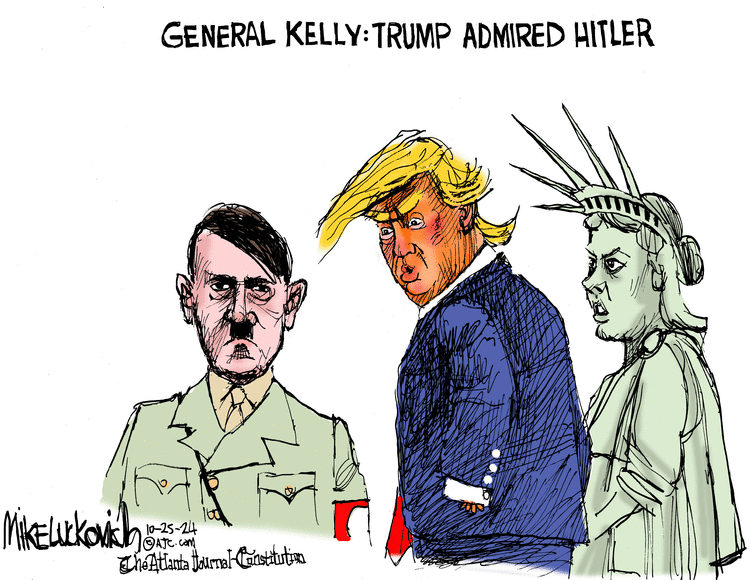
Democrats have continued to liken Trump to Adolf Hitler and assert he poses a grave “danger” to the planet if he is reelected, even after two recent assassination attempts against him.
(Jason Cohen)
How pray tell, Mr. Cohen, do two assassination attempts disprove Trump being a grave danger (or require suppression of the truth)? Do you tacitly call on Trump to cool it when his rhetoric generates death threats to election officials?
(Note that all the hyperlinks in my quote are to other Daily Caller stories; that’s why I thought “echo chamber” was apt.)
Would it help if it were done by image rather than words?
(If you don’t get the allusion, search for “distracted boyfriend même.)
Kamala F.B. Harris
- In The Bulwark, Jonathan V. Last thanked the vice president for taking on Trump: “I believe that for all her political ambition, Kamala Harris is carrying this burden for us. She’s not Barack Obama, basking in the warmth of a cultural moment en route to becoming a cultural icon. She’s more like Frodo Baggins, walking toward Mordor while carrying a millstone around her neck, in an attempt to save all of Middle-earth from a dark fate.” (Sally McDonald, Cairns, Australia)
Narcissism from a slightly different angle
I find his immodesty not only a serious character flaw but a danger to his governing ability. I don’t believe he wishes to abolish the Constitution, undermine our democracy, set himself up as dictator. But such full-court immodesty has to work against one’s perspective, make impossible anything resembling a sense of history, allow for necessary accommodations with reality. A man who sees no other picture but those with himself in the center is not a man you want to run your nation.
I quote this not to beat a dead horse, but because it is almost identical in its insight to one of the points I made long ago: Trump’a narcissism distorts his vision of the world, and that kind of distortion is intolerable in a POTUS. It’s so disqualifying that I don’t care what his “positions” are on “the issues.”
I suffer more from the humiliations inflicted by my country than from those inflicted on her.
Simone Weil, from a letter to Georges Bernanos.
I don’t do any of the major social media, but I have two sub-domains of the domain you’re currently reading: (a) You can read most of my reflexive stuff, especially political here. (b) I also post some things on the only social medium I frequent, because people there are quirky, pleasant and real.
 Tipsy Teetotaler ن