On an Australian podcast episode, exploring an emerging narrative that the American Orthodoxy is full of toxic, hypermasculine “Orthobros,” Khouria Frederica Matthewes-Green expressed appreciation for how Orthodox Christianity doesn’t change. Another participant, Fr. Doru Costache, challenged that by noting, correctly, that the Liturgy we do now isn’t exactly what the Orthodox Church used to do.
It’s possible that people raised in the Orthodox Church, “cradle Orthodox” (I’ll adopt Fr. Doru’s term), don’t see the Church’s essential changelessness like outsiders do, because they’ve never experienced the raucous, rending change that drove converts to their doors. I could only think, you have no idea what I mean by “change.”
Change is when your bishop says that the Theotokos was not a virgin, and the evangelist Matthew “invented the Virgin Birth to respond to criticism that Jesus was a bastard.”
Change is when your bishop says it wouldn’t matter if an archeologist found Jesus’ remains, because the Resurrection was not “a conjuring trick with bones.”
Change is when a Protestant pastor asks his bishop what he thinks of a famous bishop’s assertion that Jesus did not rise from the dead, and he replies, “I haven’t made up my mind about that yet.”
(This pastor told me, “I went home and started packing.” He ended up as an Orthodox priest.)
Change is when a national gathering of bishops doesn’t have enough votes to pass this resolution: “Clergy should abstain from sex outside of marriage.”
Change is when a diocesan convention doesn’t have enough votes to pass this resolution: “Jesus is the Way, the Truth, and the Life; no one comes to the Father except by him” (John 14:6).
Or, to go from tragedy to absurdity:
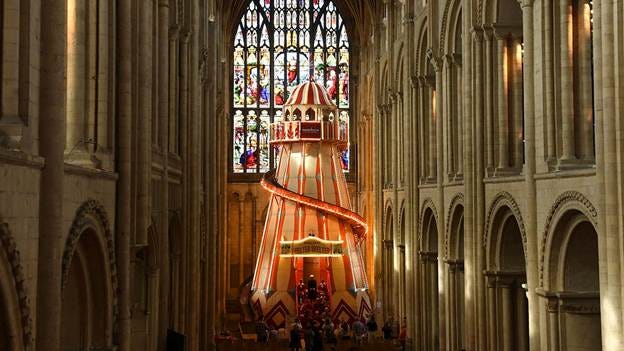
Change is when your bishop builds a giant “helter skelter” carnival ride inside the cathedral.
Isn’t there something really creepy about this? Creepy in a Tolkien sense. [Fox News 2019-8-8; photo PA News Agency, dist. by Associated Press]
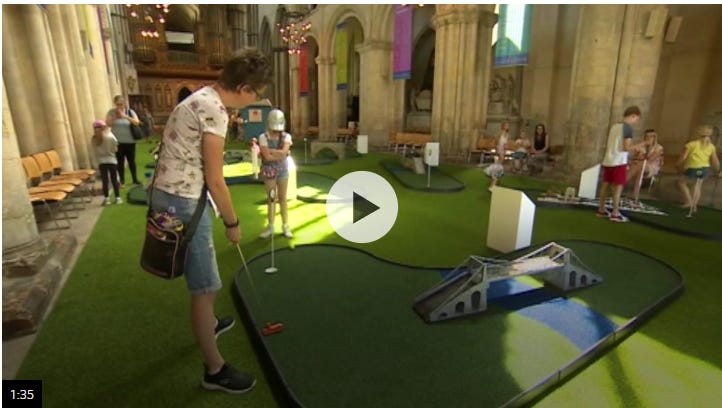
Change is when your bishop builds a mini-golf course inside the cathedral.
One clever journalist called it a “Fairway to Heaven.” [BBC.com, 2019-7-30]
Oh yes indeed, I know what change looks like. But the evolution of the Liturgy in the early centuries? That’s not what I mean by “change.”
The Changeless Core. When I say Orthodoxy is changeless, I mean that there is an inner core that persists across all nations and jurisdictions, across all centuries. It is a practical thing, a way to get closer to Christ. And that’s what I love about Orthodoxy, that it has brought me closer to him. (Fr. Doru asked “Why so much effervescence?” That’s why.) The Apostles must have known this deep-rooted longing, and it stretches from them to the present, through everyone who loves him, through all the ages.
Krouria Frederica’s blog post, Cradles, Converts, and Orthobros, is unusually long, and convincingly takes on some falsities in current media narratives about Orthodoxy.
I appreciate the narratives, perversely, as milestone of sorts. I entered the Church realizing how different it was, and that it was at least a tacit rebuke to modern Western Christianity (and culture). But almost nobody was attacking or critiquing it; we were too few, too “ethnic,” to be taken seriously. For an example, my Christian Reformed pastor, with whom I spoke about my interest in Orthodoxy, could only critique it as if it were Roman Catholicism.
So as I entered Orthodoxy, I braced myself for the day (for I had a gut feeling Orthodoxy was going to grow in America) when we were big enough to be attacked and critiqued more often.
So no, you can’t prove by me that there are any Orthobros in the Church (as opposed to internet noise or guys who show up with some twisted thinking but lose it in catechesis), but I appreciate that you’re taking us seriously enough now to concoct lurid narratives.
An aside: I notice on re-reading them, that the quotes above about real “change” all involve bishops. Khouria Frederica and her husband came to Orthodoxy from the Episcopal Church, ECUSA, which has long had notorious bishops (Bishop Pike being the first one I remember). So, much as I contrast Orthodoxy with Evangelicalism, she contrasts it, mostly, with Episcopalianism and progressive outposts in Roman Catholicism.
But don’t think that “lower” churches are exempt from baneful changes. Khouria Frederica, beginning with a section under the rubric “More masculine,” compared to what? writes about changes and distortions that, in my impression, mostly occur in Churches that try to avoid “liturgy” and denominational ties.
Back to the main subject, with a little stage-setting. I’m a Cantor in my parish. I have duties in my Parish that keep me from being a roving sociologist of Orthodoxy in America generally. I probably haven’t been in more than a dozen other parishes over my nearly thirty years in Orthodoxy, and I’ve only been in a handful of liturgies overseas during travels (and most of them were in monastic settings).
That my mental stage when I got to Khouria Frederica’s final thoughts, which opened new mental vistas for me (and made me suspect that my parish “vibe” is pretty typical of American Orthodoxy):
I tried to express this to Fr. Doru, but went overtime, and some of it was cut from the ending of the show. But here’s a summary of what I wanted to say, with some further thoughts that came to me, as I drove on into the night:
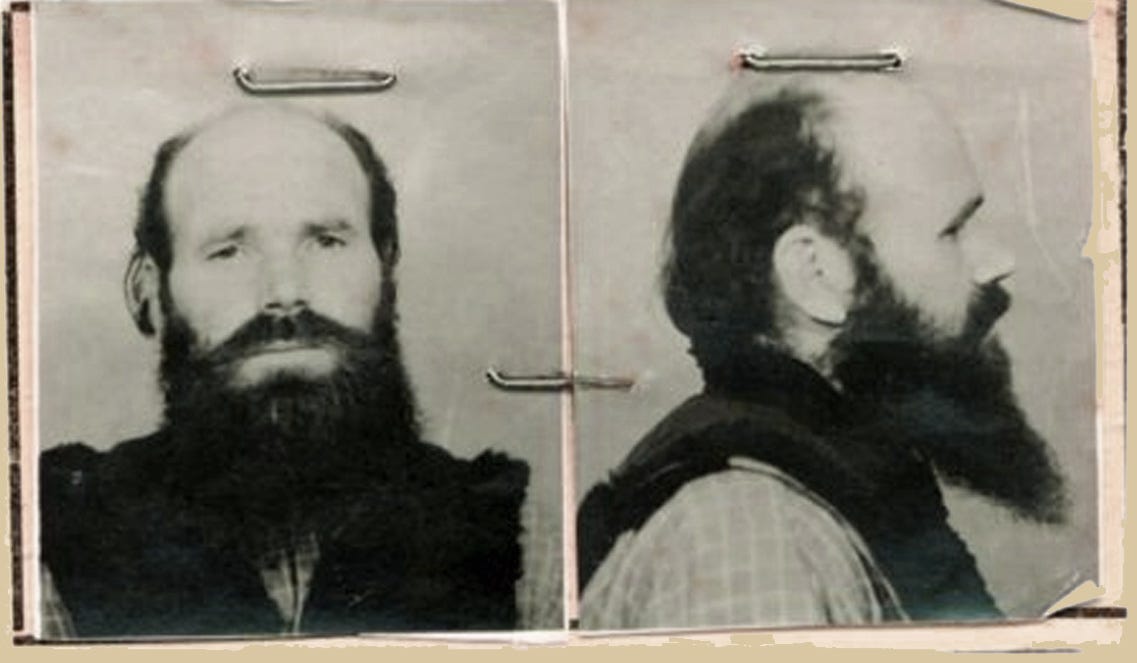
Penitence. I love Romanian Orthodoxy. I was blessed to have Fr. George Calciu, a survivor of Soviet torture, for my spiritual father. And I loved Fr Roman Braga, another survivor of the prisons. It was something Fr. Roman said that I’m thinking about now.
Fr. Roman Braga at his third arrest, 1958
Fr. Roman always said that every ethnic group has to work out its own kind of Orthodoxy. Americans will have to make an American Orthodoxy, and it won’t look like Romanian or Greek or any other kind. We will create our own American kind of Orthodoxy.
But I suspect that this American kind will be offensive, to some … We’re too loud, too bold, too informal. We smile too much … it’s just what Americans are like. We laugh, we’re loud, we’re expansive.
An example of the difference is that cradle Orthodox don’t want to have noisy children or babies in the church. People raised in Orthodoxy have a profound sense of awe about the temple, and treat the building itself with great respect. So they say, “Don’t bring a baby in the church! This is a holy temple, not a nursery!”
But Americans like having babies in church. They say, “If you can’t hear crying, the church is dying!” A church with wandering toddlers, and little boys gazing at a candle flame, and schoolgirls cuddling newborns—all that seems exactly right.
I know how beautiful Orthodoxy is, so I need to ask your forgiveness, because what Americans are going to do with it might look cheap to you. It might look like marketing. It might even look disrespectful. It won’t look like Romanian Orthodoxy. It will be the Orthodoxy that grows out of our distinctive American life. Forgive me, forgive us, for what we are nevertheless going to do, as we create this thing never seen before, American Orthodoxy.
It’s not just babies we welcome. It’s visitors, too. Come and see.
Apophatic
Orthodoxy theology defines only what is necessary and always leaves unspoken that which cannot be explained. This approach was part of the Christian faith from the beginning. But the Western phronema often suppresses, dismisses, minimizes, or ignores this stance. The Western mind is compelled to define and explain everything, since without a rational explanation a concept or fact cannot be considered true, or, conversely, all truth can be proven rationally.
Dr. Eugenia Scarvelis Constantinou, Thinking Orthodox.
I experienced this apophatic approach to theology, gradually over decades losing my tendency toward being the kind of person who today cataphatically thinks, oh, for instance, that he could create a computer administered questionnaire that would logically force people to confess the correct version of Christianity.*
Only then did I encounter neuroscientist and philosopher Iain McGilchrist. Getting to know McGilchrist confirms for me the deep wisdom of the Orthodox way, and I believe McGilchrist has been quoted as saying that if he became a Christian (in the narrow sense, not “culturally Christian”), he would be Orthodox.
In my mind, this is closely related to what I consider the Orthodox view of the Nicene Creed and the Ecumenical Councils more generally.
Ecumenical Councils are not summoned because Bishops need some way to spend their lavish expense accounts (as if!). They are called because of the perception that some rascally teacher or teaching is threatening the Church. A Council convenes, considers the matter, and declares the mind of the Church. At the Councils of Nicea and Constantinople, two of the earliest Councils, they considered the teachings of rascally Arius, condemned them, and set forth the Church’s mind in the form of the Nicene-Constantinopolitan Creed, typically shortened to “Nicene Creed.”
In Orthodoxy, we call the Creed “the Symbol of Faith,” which itself signals our view: the Creed is not, and was never intended to be, a precis of all mandatory parts of the faith.
As a consequence of this limited role of Councils, I view the Creed and the Canons to be markers of boundaries to keep the faithful safe — as if to say “this is a cliff; stay away!” or “here be dragons.” That leaves a whole lot of geography in which believers can and do move around fairly freely.
As in paradise, so many delights are allowed, so few forbidden — and even that for our good.
(* Actual delusion, but I was a Calvinist at the time.)
The cultural formations of western Christianity
Christianity as we see it in eighteenth-century Britain or twenty-first-century America is not Christianity as it has always been, and the more fundamental changes may not be those that the received history of religion narrates. The cultural formations of western Christianity, growing as they do in good part from binary, Protestant-Catholic debates, can be thrown into stark relief, for instance, when studied in comparison to that much neglected third term in Christendom: the Eastern Orthodox churches from which Rome severed itself nearly half a millennium before the Reformation, charting a course for Western Christianity wed to rationalism and enamored of individual authority, whether papal or personal.
Lori Branch, Conclusion: on the Religiousness of Criticism in her book Rituals of Spontaneity.
I just noticed, with much delight, Branch’s gimlet-eyed phrase “the Eastern Orthodox churches from which Rome severed itself” (italics added). This Great Schism is one of those fundamental changes that in received Church history in the West almost invariably inverts, by commentators Catholic, Protestant or unbelieving — who assume reflexively that four patriarchs in a pentarchy severed themselves from the fifth, which on the face of it is less plausible than the one severing from the four.
Something that sticks with me
Some decades ago, the late Richard John Neuhaus coined (so far as I know; I’d never heard it before) the term “ecclesial Christian.” He describe an ecclesial Christian as one for whom faith in Christ and faith in His Church is one act of faith, not two. (That may not be exact, but it’s how I’ve appropriated it for myself.)
I feel compelled to surface the term periodically to try popularizing it.
In the American fissiparous (there I go again!) nondenominational/megachurch/religiopreneur environment, the term is useful, and maybe even necessary, to demarcate the boundary between that sort chaos from a handful of Christian traditions in which the Church is central, not just more or less helpful to individual believers.
I was probably on the chaos side when I first encountered the term (I think it was the early ‘90s, the early days of First Things magazine) but it stuck with me, and I now, though firmly Orthodox, I feel a special kinship with ecclesial Christians outside my specific faith.
Christian America
Sociologists who look at American politics right now say that a major thing that’s driving our politics, maybe the major thing among white evangelicals, is that this is the group that has always assumed it should have the predominant role in American society. It’s the founding faith. It’s what the founders were.
No, the founders were not evangelicals, especially not in the contemporary devolved sense. That’s my story and I’m stickin’ to it. David Barton and his ilk have never persuaded me otherwise.
Far too good
The modern world is not evil; in some ways the modern world is far too good. It is full of wild and wasted virtues. When a religious scheme is shattered (as Christianity was shattered at the Reformation), it is not merely the vices that are let loose. The vices are, indeed, let loose, and they wander and do damage. But the virtues are let loose also; and the virtues wander more wildly, and the virtues do more terrible damage. The modern world is full of the old Christian virtues gone mad. The virtues have gone mad because they have been isolated from each other and are wandering alone. Thus some scientists care for truth; and their truth is pitiless. Thus some humanitarians only care for pity; and their pity (I am sorry to say) is often untruthful.
As a new convert, [St. Seraphim Rose] had some pretty strange views … Fr. Seraphim called it the “crazy convert” phase. But as he got older, more mature, he outgrew those views—as we hopefully do. And he helped his spiritual children to do the same. And that is what made him a saint.
He came to realize that what Orthodoxy had to offer isn’t a pure, unbroken tradition. It’s not a perfect adherence to the canons. It doesn’t make us better than everyone else. No! Fr. Seraphim said (and this is a quote):
The deepest and most attractive thing about Orthodoxy today is its message of love. The most discouraging thing about today’s world is that it has become so cold and heartless. In the Gospel of St. Matthew our Lord tells us that a leading characteristic of the last times will be that the love of many will grow cold. And the Apostle of love, St. John the Theologian, records our Lord as saying that the chief distinguishing mark of His disciples is the love they have one for another.
(…)
Being filled with the Gospel teaching and trying to live by it, we should have love and compassion for the miserable humanity of our days. Probably never have people been more unhappy than the people of our days, even with all the outward conveniences and gadgets our society provides us with. People are suffering and dying for the lack of God, and we can help give God to them. The love of many has truly grown cold in our days—but let us not be cold. As long as Christ sends us His grace and warms our hearts, we do not need to be cold.
Michael Warren Davis, on Monk-Priest Seraphim Rose, who reposed in 1982, and is now becoming officially recognized as an Orthodox Saint.
Protestantism thus gradually came to lose the primitive Christian horror of schism. As time went on, with the continuing multiplication of Protestant denominations, what now matters among them is purity of doctrine, not unity—and sometimes doctrine takes a back seat to lesser things. The concept of schism has all but vanished from the theological glossary of Evangelicals: if they don’t like their church, they simply leave and start another one down the street. What the Fathers decried as schism is now regarded as normal church growth. So long as the new church does not make a point of denying the Trinity, it remains a part of the una sancta.
I’ve mused for decades that calling schisms “church growth” was an attempt to make a virtue out of a wicked “necessity” (compulsive fissiparousness, rooted in disagreements about what the Bible teaches).
Will liberal Protestantism ever fail utterly?
For generations the more liberal-leaning Protestant denominations have been declining. But liberal Christianity is a renewable resource, as long as there are conservative Christianities to inspire rebellion and disillusionment.
The signs are everywhere. First, there’s the behavior of the savior himself, Donald Trump. On Monday of Holy Week, he compared himself to Jesus Christ, posting on Truth Social that he received a “beautiful” note from a supporter saying that it was “ironic” that “Christ walked through his greatest persecution the very week they are trying to steal your property from you.”
On Tuesday, he took to Truth Social to sell a $60 “God Bless the USA Bible” (the “only Bible endorsed by President Trump”), an edition of the King James Bible that also includes America’s founding documents. “Christians are under siege,” he said. The Judeo-Christian foundation of America is “under attack,” Trump claimed, before declaring a new variant on an old theme: “We must make America pray again.”
Two weeks ago, Charlie Kirk, the founder of Turning Point USA, told a Christian gathering that Democrats “want full and complete destruction of the United States of America.” Kirk is a powerful Trump ally. He has millions of followers on social media and is hoping to raise more than $100 million in 2024 to help mobilize voters for Trump.
“I do not think you can be a Christian and vote Democrat,” Kirk said, and “if you vote Democrat as a Christian, you can no longer call yourself a Christian.”
All of this is unfolding against the backdrop of so-called prophetic utterances that place Trump at the center of God’s plan to save America. According to these prophecies, Trump is God’s choice to lead America out of spiritual darkness, to save it from decline and despair. In this formulation, to oppose Trump is to stand against the will of God.
Yes, the signs are everywhere: Trump is an antichrist.
Oh wait! That’s not what French said! He said the signs were of this:
When people are angry and afraid, they will look for a savior. When that anger and fear is latched to faith and prophecy, they will yearn for a religious crusade.
There’s a version of this same story playing out in the United States, but because the anger and fear are so overwrought, the prophecies so silly, and the savior so patently absurd, we may be missing the religious and cultural significance of the moment. A significant part of American Christianity is spiraling out of control.
On my second reading, I lost my frustration that French was missing the point. I think he gets the antichrist point just fine, but that talk of “antichrist” is a little bit alien to a PCA Presbyterian and utterly alien to the New York Times. This is as clear as French and his employer can make it. Let him who has ears hear.
An distracting mistake
Roman Catholics, Anglicans and Orthodox Christians, who together claim around 1.5 billion members, describe the Bible as a final authority in matters of faith …
I cannot think of a sense in which Prof. McCaulley is correct here. Sola scriptura (the Bible as a final authority in matters of faith) was a Protestant Reformation novelty, not a claim of the ancient church. And McCaulley’s mistake contributes little or nothing to his argument about the outrage of Trump’s Holy Week endorsement of a MAGA Bible.
McCaulley continues:
… Evangelicals, who have overwhelmingly supported Mr. Trump over the course of three election cycles, are known for their focus on Scripture, too. None of these traditions cite or refer to any American political documents in their doctrinal statements — and for good reason.
Well, duh! You know what else Orthodox Christianity doesn’t say in its creed?* It doesn’t say that the Bible is an authority in the Christian faith at all.
Our practice shows how highly we regard the scriptures, as our liturgies and other services are pervaded with them. But scripture is not of creedal status. Indeed, the New Testament canon was not settled until decades or more after the Nicene Creed was formulated.
Again, Prof. McCaulley’s banal observation adds little to his argument about MAGA Bible.
[* Two eye-openers for me in the Orthodox Church were (1) the use of scripture and (2) the source and use of the creed and other decisions of ecumenical counsels. But those are beyond today’s scope.]
… that Christ may dwell in your hearts through faith; that you, being rooted and grounded in love, may be able to comprehend with all the saints what is the width and length and depth and height — to know the love of Christ which passes knowledge; that you may be filled with all the fullness of God.
You can read most of my more impromptu stuff here and here (both of them cathartic venting, especially political) and here (the only social medium I frequent, because people there are quirky, pleasant and real). All should work in your RSS aggregator, like Feedly or Reeder, should you want to make a habit of it.
Though most contemporary conservatives (who are really libertarians) would not agree, I think Berry is very much an old-fashioned conservative — so old that the moderns can’t recognize him. But the same thing could be said of Christianity in general these days.
Fr. Jonathan Tobias, recommending — nay, urging — his readers to read Wendell Berry’s Jayber Crow.
"Thinking"
The healing that is inherent in Christian salvation is not just found in what (Who) is known, but in the manner of knowing as well. The abstraction that we call “thinking,” etc., in the contemporary world is a diminishment of what it means to be human. We have learned to focus on a very narrow stream of information, and, in turn, have come to be possessed by the information on which we focus.
Thoughts on Pope Francis’s crackdown on the Traditional Latin Liturgy
Alan Jacobs
It is sad and strange to me that Francis can be so warm in his sympathy for those who openly reject his Church and its teachings, but so icy-cold, so corrosively skeptical, towards some of that Church’s most faithful sons and daughters. Sad, strange — and, I believe, profoundly unwise.
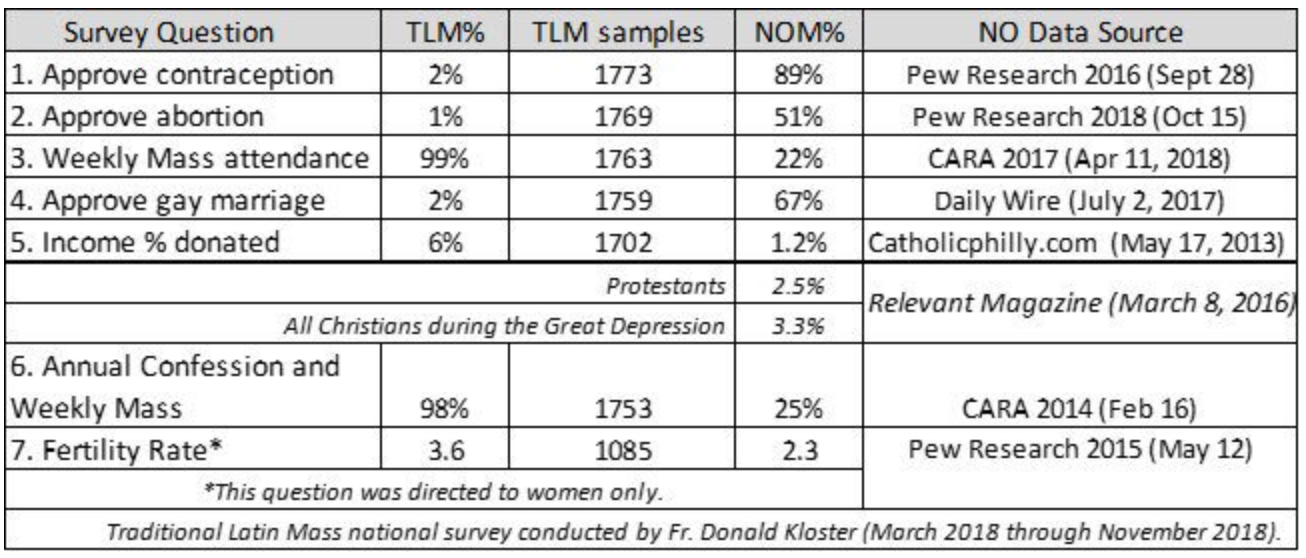
If this chart is accurate, "profoundly unwise" may be understatement. (TLM is Traditional Latin Mass; NOM is Novus Ordo Mass. Source via Rod Dreher.
Rorate Cæli
Bergoglio is in reality a man of vengeance. A pope of vengeance. An angry bitter Jesuit settling scores through vengeance.
What ought traditional Catholics to do in response to the latest attack on the Mass and all those who love tradition? Simply put: ignore it. Ignore its message. Ignore its motivation caused by pure hatred and vengeance. Keep calm and keep on going as if it does not even exist.
…
Ignore the Agent of Hatred and Vengeance, and all his works and all his pomps.
Commenting on Rorate Cæli (with which he sympatizes):
How can you do that and still be Catholic? How can you defy the Pope in good conscience, as if his order was never made? I honestly don’t know how one remains Catholic if that’s what one believes about the Pope and the exercise of his authority. The only truly stable thing within Catholicism of the last sixty years has been the papacy. If you cast that aside — and that’s what Rorate is calling for in effect here — what do you have left? If you defy the Pope, even in the name of Catholic orthodoxy, how are you not a de facto Protestant? How is that remotely tenable? Somebody needs to explain this to me.
It seems to me that some Trads are in the same place I was back in 2005 with regard to the faith. I found it impossible to believe — not just unpleasant to believe, but impossible to believe — that my salvation depended on being in communion with the Catholic bishops. I came to the conclusion that I had probably been wrong about papal infallibility, and about Catholic claims to exclusive authority ….
Moi
I have feelings about this — maybe even thoughts — but I try to take myself by the scruff of my neck and say "This is not your church and never was, so butt out." I’ll only say this:
The Novus Ordo mass is, per se, a big impediment to healing the Great Schism.
The traditional Latin Mass was not, per se, a big impediment to healing the Great Schism.
For all their claims to ancient wisdom, there’s nothing remotely countercultural about the Tolles and Winfreys and Chopras. They’re telling an affluent, appetitive society exactly what it wants to hear: that all of its deepest desires are really God’s desires, and that He wouldn’t dream of judging.