On an Australian podcast episode, exploring an emerging narrative that the American Orthodoxy is full of toxic, hypermasculine “Orthobros,” Khouria Frederica Matthewes-Green expressed appreciation for how Orthodox Christianity doesn’t change. Another participant, Fr. Doru Costache, challenged that by noting, correctly, that the Liturgy we do now isn’t exactly what the Orthodox Church used to do.
It’s possible that people raised in the Orthodox Church, “cradle Orthodox” (I’ll adopt Fr. Doru’s term), don’t see the Church’s essential changelessness like outsiders do, because they’ve never experienced the raucous, rending change that drove converts to their doors. I could only think, you have no idea what I mean by “change.”
Change is when your bishop says that the Theotokos was not a virgin, and the evangelist Matthew “invented the Virgin Birth to respond to criticism that Jesus was a bastard.”
Change is when your bishop says it wouldn’t matter if an archeologist found Jesus’ remains, because the Resurrection was not “a conjuring trick with bones.”
Change is when a Protestant pastor asks his bishop what he thinks of a famous bishop’s assertion that Jesus did not rise from the dead, and he replies, “I haven’t made up my mind about that yet.”
(This pastor told me, “I went home and started packing.” He ended up as an Orthodox priest.)
Change is when a national gathering of bishops doesn’t have enough votes to pass this resolution: “Clergy should abstain from sex outside of marriage.”
Change is when a diocesan convention doesn’t have enough votes to pass this resolution: “Jesus is the Way, the Truth, and the Life; no one comes to the Father except by him” (John 14:6).
Or, to go from tragedy to absurdity:
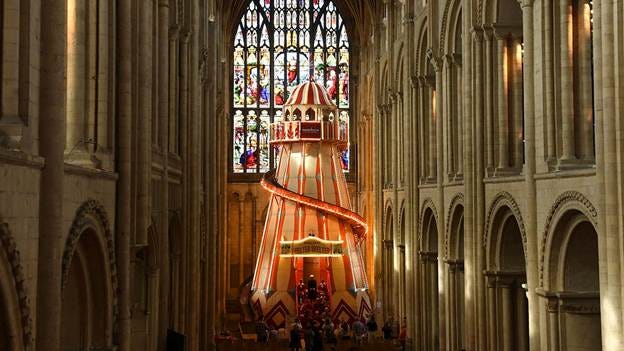
Change is when your bishop builds a giant “helter skelter” carnival ride inside the cathedral.
Isn’t there something really creepy about this? Creepy in a Tolkien sense. [Fox News 2019-8-8; photo PA News Agency, dist. by Associated Press]
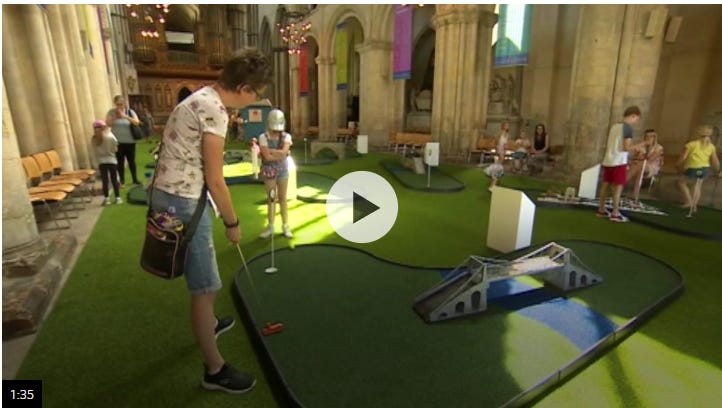
Change is when your bishop builds a mini-golf course inside the cathedral.
One clever journalist called it a “Fairway to Heaven.” [BBC.com, 2019-7-30]
Oh yes indeed, I know what change looks like. But the evolution of the Liturgy in the early centuries? That’s not what I mean by “change.”
The Changeless Core. When I say Orthodoxy is changeless, I mean that there is an inner core that persists across all nations and jurisdictions, across all centuries. It is a practical thing, a way to get closer to Christ. And that’s what I love about Orthodoxy, that it has brought me closer to him. (Fr. Doru asked “Why so much effervescence?” That’s why.) The Apostles must have known this deep-rooted longing, and it stretches from them to the present, through everyone who loves him, through all the ages.
Krouria Frederica’s blog post, Cradles, Converts, and Orthobros, is unusually long, and convincingly takes on some falsities in current media narratives about Orthodoxy.
I appreciate the narratives, perversely, as milestone of sorts. I entered the Church realizing how different it was, and that it was at least a tacit rebuke to modern Western Christianity (and culture). But almost nobody was attacking or critiquing it; we were too few, too “ethnic,” to be taken seriously. For an example, my Christian Reformed pastor, with whom I spoke about my interest in Orthodoxy, could only critique it as if it were Roman Catholicism.
So as I entered Orthodoxy, I braced myself for the day (for I had a gut feeling Orthodoxy was going to grow in America) when we were big enough to be attacked and critiqued more often.
So no, you can’t prove by me that there are any Orthobros in the Church (as opposed to internet noise or guys who show up with some twisted thinking but lose it in catechesis), but I appreciate that you’re taking us seriously enough now to concoct lurid narratives.
An aside: I notice on re-reading them, that the quotes above about real “change” all involve bishops. Khouria Frederica and her husband came to Orthodoxy from the Episcopal Church, ECUSA, which has long had notorious bishops (Bishop Pike being the first one I remember). So, much as I contrast Orthodoxy with Evangelicalism, she contrasts it, mostly, with Episcopalianism and progressive outposts in Roman Catholicism.
But don’t think that “lower” churches are exempt from baneful changes. Khouria Frederica, beginning with a section under the rubric “More masculine,” compared to what? writes about changes and distortions that, in my impression, mostly occur in Churches that try to avoid “liturgy” and denominational ties.
Back to the main subject, with a little stage-setting. I’m a Cantor in my parish. I have duties in my Parish that keep me from being a roving sociologist of Orthodoxy in America generally. I probably haven’t been in more than a dozen other parishes over my nearly thirty years in Orthodoxy, and I’ve only been in a handful of liturgies overseas during travels (and most of them were in monastic settings).
That my mental stage when I got to Khouria Frederica’s final thoughts, which opened new mental vistas for me (and made me suspect that my parish “vibe” is pretty typical of American Orthodoxy):
I tried to express this to Fr. Doru, but went overtime, and some of it was cut from the ending of the show. But here’s a summary of what I wanted to say, with some further thoughts that came to me, as I drove on into the night:
Penitence. I love Romanian Orthodoxy. I was blessed to have Fr. George Calciu, a survivor of Soviet torture, for my spiritual father. And I loved Fr Roman Braga, another survivor of the prisons. It was something Fr. Roman said that I’m thinking about now.
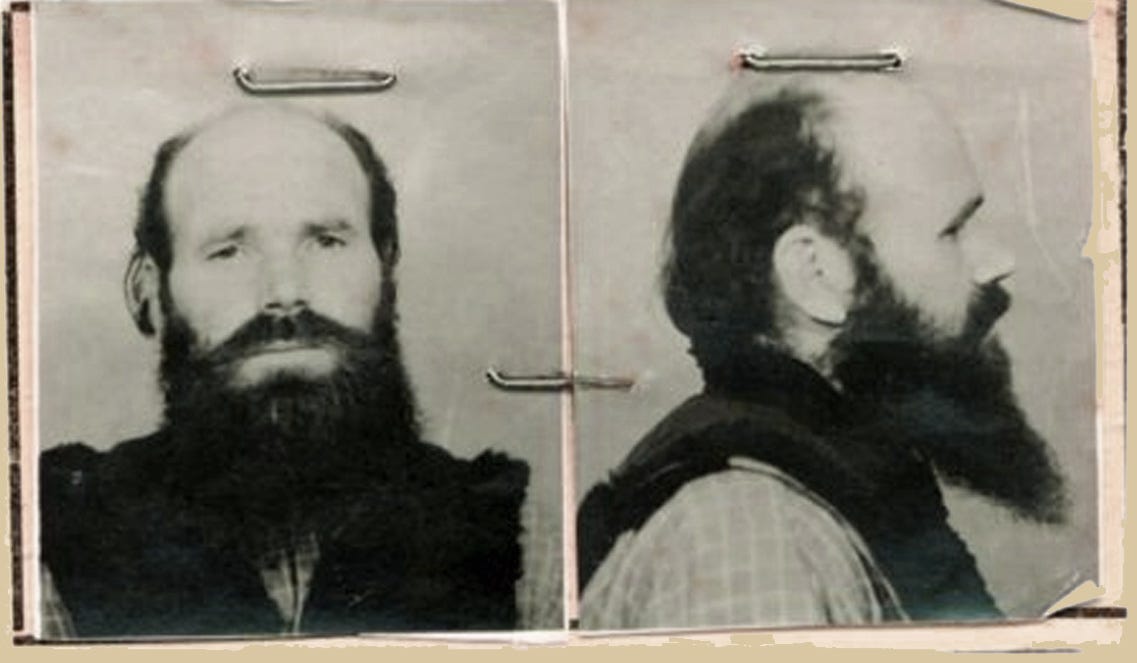
Fr. Roman Braga at his third arrest, 1958
Fr. Roman always said that every ethnic group has to work out its own kind of Orthodoxy. Americans will have to make an American Orthodoxy, and it won’t look like Romanian or Greek or any other kind. We will create our own American kind of Orthodoxy.
But I suspect that this American kind will be offensive, to some … We’re too loud, too bold, too informal. We smile too much … it’s just what Americans are like. We laugh, we’re loud, we’re expansive.
An example of the difference is that cradle Orthodox don’t want to have noisy children or babies in the church. People raised in Orthodoxy have a profound sense of awe about the temple, and treat the building itself with great respect. So they say, “Don’t bring a baby in the church! This is a holy temple, not a nursery!”
But Americans like having babies in church. They say, “If you can’t hear crying, the church is dying!” A church with wandering toddlers, and little boys gazing at a candle flame, and schoolgirls cuddling newborns—all that seems exactly right.
I know how beautiful Orthodoxy is, so I need to ask your forgiveness, because what Americans are going to do with it might look cheap to you. It might look like marketing. It might even look disrespectful. It won’t look like Romanian Orthodoxy. It will be the Orthodoxy that grows out of our distinctive American life. Forgive me, forgive us, for what we are nevertheless going to do, as we create this thing never seen before, American Orthodoxy.
It’s not just babies we welcome. It’s visitors, too. Come and see.
Apophatic
Orthodoxy theology defines only what is necessary and always leaves unspoken that which cannot be explained. This approach was part of the Christian faith from the beginning. But the Western phronema often suppresses, dismisses, minimizes, or ignores this stance. The Western mind is compelled to define and explain everything, since without a rational explanation a concept or fact cannot be considered true, or, conversely, all truth can be proven rationally.
Dr. Eugenia Scarvelis Constantinou, Thinking Orthodox.
I experienced this apophatic approach to theology, gradually over decades losing my tendency toward being the kind of person who today cataphatically thinks, oh, for instance, that he could create a computer administered questionnaire that would logically force people to confess the correct version of Christianity.*
Only then did I encounter neuroscientist and philosopher Iain McGilchrist. Getting to know McGilchrist confirms for me the deep wisdom of the Orthodox way, and I believe McGilchrist has been quoted as saying that if he became a Christian (in the narrow sense, not “culturally Christian”), he would be Orthodox.
In my mind, this is closely related to what I consider the Orthodox view of the Nicene Creed and the Ecumenical Councils more generally.
Ecumenical Councils are not summoned because Bishops need some way to spend their lavish expense accounts (as if!). They are called because of the perception that some rascally teacher or teaching is threatening the Church. A Council convenes, considers the matter, and declares the mind of the Church. At the Councils of Nicea and Constantinople, two of the earliest Councils, they considered the teachings of rascally Arius, condemned them, and set forth the Church’s mind in the form of the Nicene-Constantinopolitan Creed, typically shortened to “Nicene Creed.”
In Orthodoxy, we call the Creed “the Symbol of Faith,” which itself signals our view: the Creed is not, and was never intended to be, a precis of all mandatory parts of the faith.
As a consequence of this limited role of Councils, I view the Creed and the Canons to be markers of boundaries to keep the faithful safe — as if to say “this is a cliff; stay away!” or “here be dragons.” That leaves a whole lot of geography in which believers can and do move around fairly freely.
As in paradise, so many delights are allowed, so few forbidden — and even that for our good.
(* Actual delusion, but I was a Calvinist at the time.)
The cultural formations of western Christianity
Christianity as we see it in eighteenth-century Britain or twenty-first-century America is not Christianity as it has always been, and the more fundamental changes may not be those that the received history of religion narrates. The cultural formations of western Christianity, growing as they do in good part from binary, Protestant-Catholic debates, can be thrown into stark relief, for instance, when studied in comparison to that much neglected third term in Christendom: the Eastern Orthodox churches from which Rome severed itself nearly half a millennium before the Reformation, charting a course for Western Christianity wed to rationalism and enamored of individual authority, whether papal or personal.
Lori Branch, Conclusion: on the Religiousness of Criticism in her book Rituals of Spontaneity.
I just noticed, with much delight, Branch’s gimlet-eyed phrase “the Eastern Orthodox churches from which Rome severed itself” (italics added). This Great Schism is one of those fundamental changes that in received Church history in the West almost invariably inverts, by commentators Catholic, Protestant or unbelieving — who assume reflexively that four patriarchs in a pentarchy severed themselves from the fifth, which on the face of it is less plausible than the one severing from the four.
Something that sticks with me
Some decades ago, the late Richard John Neuhaus coined (so far as I know; I’d never heard it before) the term “ecclesial Christian.” He describe an ecclesial Christian as one for whom faith in Christ and faith in His Church is one act of faith, not two. (That may not be exact, but it’s how I’ve appropriated it for myself.)
I feel compelled to surface the term periodically to try popularizing it.
In the American fissiparous (there I go again!) nondenominational/megachurch/religiopreneur environment, the term is useful, and maybe even necessary, to demarcate the boundary between that sort chaos from a handful of Christian traditions in which the Church is central, not just more or less helpful to individual believers.
I was probably on the chaos side when I first encountered the term (I think it was the early ‘90s, the early days of First Things magazine) but it stuck with me, and I now, though firmly Orthodox, I feel a special kinship with ecclesial Christians outside my specific faith.
Christian America
Sociologists who look at American politics right now say that a major thing that’s driving our politics, maybe the major thing among white evangelicals, is that this is the group that has always assumed it should have the predominant role in American society. It’s the founding faith. It’s what the founders were.
No, the founders were not evangelicals, especially not in the contemporary devolved sense. That’s my story and I’m stickin’ to it. David Barton and his ilk have never persuaded me otherwise.
Far too good
The modern world is not evil; in some ways the modern world is far too good. It is full of wild and wasted virtues. When a religious scheme is shattered (as Christianity was shattered at the Reformation), it is not merely the vices that are let loose. The vices are, indeed, let loose, and they wander and do damage. But the virtues are let loose also; and the virtues wander more wildly, and the virtues do more terrible damage. The modern world is full of the old Christian virtues gone mad. The virtues have gone mad because they have been isolated from each other and are wandering alone. Thus some scientists care for truth; and their truth is pitiless. Thus some humanitarians only care for pity; and their pity (I am sorry to say) is often untruthful.
As a new convert, [St. Seraphim Rose] had some pretty strange views … Fr. Seraphim called it the “crazy convert” phase. But as he got older, more mature, he outgrew those views—as we hopefully do. And he helped his spiritual children to do the same. And that is what made him a saint.
He came to realize that what Orthodoxy had to offer isn’t a pure, unbroken tradition. It’s not a perfect adherence to the canons. It doesn’t make us better than everyone else. No! Fr. Seraphim said (and this is a quote):
The deepest and most attractive thing about Orthodoxy today is its message of love. The most discouraging thing about today’s world is that it has become so cold and heartless. In the Gospel of St. Matthew our Lord tells us that a leading characteristic of the last times will be that the love of many will grow cold. And the Apostle of love, St. John the Theologian, records our Lord as saying that the chief distinguishing mark of His disciples is the love they have one for another.
(…)
Being filled with the Gospel teaching and trying to live by it, we should have love and compassion for the miserable humanity of our days. Probably never have people been more unhappy than the people of our days, even with all the outward conveniences and gadgets our society provides us with. People are suffering and dying for the lack of God, and we can help give God to them. The love of many has truly grown cold in our days—but let us not be cold. As long as Christ sends us His grace and warms our hearts, we do not need to be cold.
Michael Warren Davis, on Monk-Priest Seraphim Rose, who reposed in 1982, and is now becoming officially recognized as an Orthodox Saint.
When Cardinal Newman was asked at a dinner party why he became a Catholic, he responded that it was not the kind of thing that can be properly explained between soup and the fish course.
An ecclesial Christian is one who understands with mind and heart, and even feels with his fingertips, that Christ and his Church, head and body, are inseparable. For the ecclesial Christian, the act of faith in Christ and the act of faith in the Church are not two acts of faith but one.
Across the street from the parsonage of St. John’s [Missouri Synod Lutheran Church] was an evangelical Protestant church. Also across the street lived my best friends, the Spooner brothers, who with their devoutly Catholic family attended St. Columkil’s Cathedral. I am sure it was unarticulated but self-evident to me by the time I was five years old that St. John’s and the cathedral had more in common than either had with the evangelical chapel. For one immeasurably momentous thing, our churches baptized babies. Then too, our being saved was something that God did through His Church; it was a given, a gift. It did not depend—as it did for Dougy Cahill, our evangelical friend—upon feelings or spiritual experience. It depended upon grace bestowed through things done.
One thing I’ve never quite understood about our Evangelical friends is why they are so susceptible to trendiness. A reader of this blog with whom I corresponded earlier this year told me that she and her family recently left their Evangelical megachurch to join an Orthodox congregation. A big part of it was that the church fell all over itself trying to accommodate the Next Big Thing in worship trends, and theological trends, to keep growing the church, and to keep people interested so they wouldn’t leave. Discipleship was neglected, and theologically, it became decadent. Though my correspondent is non-white, she became frustrated at how this multicultural megachurch’s leaders began putting race consciousness at the center of that congregation’s life. But then, that’s the contemporary trend.
What the Fathers decried as schism is now regarded as normal church growth. So long as the new church does not make a point of denying the Trinity, it remains a part of the una sancta.
This is one of the best things I’ve read in a long while – an unironic analysis of our tendency to analyze everything to death (“we murder to dissect”).
Iain McGilchrist would approve.
(And no, I don’t think this is out of place in a Sunday post. Getting caught up in rationalistic analysis of everything is spiritually stultifying.)
Religious ideas have the fate of melodies, which, once set afloat in the world, are taken up by all sorts of instruments, some woefully coarse, feeble, or out of tune, until people are in danger of crying out that the melody itself is detestable.
George Elliot, Janet’s Repentance, via Alan Jacobs
[N]one of the things that I care about most have ever proven susceptible to systematic exposition.
You can read most of my more impromptu stuff here and here (both of them cathartic venting, especially political) and here (the only social medium I frequent, because people there are quirky, pleasant and real and it has no-algorithms). All should work in your RSS aggregator, like Feedly or Reeder, should you want to make a habit of it.
Okay, this may seem out of place. My Sunday posts are usually “religious”- that undefinable, indispensable concept we apply to some ultimate concerns but not to others.
But there are two things I’d like to say about AI:
I like it quite a lot. I’m gradually finding more applications for it, and it can be very helpful.
I’m seriously concerned that misuse of AI can be spiritually damaging. That’s why I think this is a fit Sunday topic.
It’s not damaging because it’s demonic. I’d quit it if I thought that. I’m no demon-tamer. But there is one fairly sharp distinction between things it’s good for and things where using it can be deranging and rarely is helpful.
AI is an adjunct to the left hemisphere of your brain which can free up a lot of your time to go spend it on the right by loving other people. But we probably will screw it up by pretending that AI is your therapist, friend or lover, all of which are actually right-brain things. If you’re using it to help your right brain, you’re getting it wrong and your brain won’t be fooled. You will not fool yourself. Even if it passes the Turing test in your consciousness, in your subconscious you’ll become more anxious, more lonely, more afraid and more depressed.
I have not been using AI to do right-brain things, but neither was I thinking “Okay, having gotten all that tedious, analytical left-brain stuff out of the way, let’s do something right-brained.”
Brooks’ insistence against AI for right-brain stuff isn’t just ipse dixit. AI has no intuition, no meaning machine, no metaphysics, and all indications are that it never will. If you ask it a metaphysical question, it will do something like culling probable word sequences from college bull sessions that have been transcribed, from which it will spit out an “answer” of sorts, but not one that will prove satisfying.
This explains my sense of how spiritually dangerous it is when people take on AI boyfriends and girlfriends, or look to AI as a therapist.
So when you’ve freed up time by using AI appropriately, Brooks has six non-psychedelic ways of accessing your right hemisphere (volunteered when Andrew Sullivan, interviewing him, extolled the virtues of psilocybin for accessing meaning):
Ask questions that can’t be Googled. This is why college bull sessions were so valuable and happiness-making. If you ask a question that can be answered by AI (meaningfully, that is; AI will always make up some kind of “answer”), it’s not a right-hemisphere question.
Fall in love. Our becoming more left hemispheric is why more people are less capable and less interested in falling in love.
Worship. Look for the metaphysical. If you’re not religious, figure out what it means to transcend yourself.
Beauty. You need more beauty: moral, natural and artistic.
Look for a calling in what you do.
Find meaning in suffering.
I’ve almost entirely ignored Brooks’ Atlantic articles, assuming he was a male Oprah. I was very wrong. He’s a daily-mass Catholic on a mission from God and I intend to look at all his articles from here forward.
Not my God
Seventeenth-century thinkers, among whom “nearly all original philosophical minds were Nominalist,” showed that they could be quite loquacious when it came to talking about God based on reason. Apparently unbeknownst to some of them, it was no longer the transcendent God of traditional Christianity about whom they were speaking. Augustine had famously said in one of his sermons that “if you comprehended [cepisti], it is not God.
Brad S. Gregory, The Unintended Reformation.
On a related note, something from Father Patrick Henry Reardon has stuck with me for decades now. I can’t give an exact quote, but it was basically that every Christian heresy stems from efforts to make logical something meant to be received as mystery.
There is no need to be profane, my dear boy.
‘Is it possible you don’t know where you’ve been?’ ‘Now that you mention it, I don’t think we ever do give it a name. What do you call it?’ ‘We call it Hell.’ ‘There is no need to be profane, my dear boy. I may not be very orthodox, in your sense of that word, but I do feel that these matters ought to be discussed simply, and seriously, and reverently.’ ‘Discuss Hell reverently? I meant what I said. You have been in Hell: though if you don’t go back you may call it Purgatory.’
C.S. Lewis, The Great Divorce. Almost thou persuadest me of purgatory, Clive.
I’ve been a Lewis fan since college, though I’ve read most of his stuff so often that I rarely read it any more.
The exceptions are The Great Divorce and The Abolition of Man. The former is the Lewis book that most tangibly affected me. Lewis made it plausible that most of the day-trippers to Heaven got back on the bus to hell; I didn’t want to be like them. How that ramified is that rarest of things: something I intend to keep private.
Almost syllogistic
I enjoyed reading Martin Shaw’s latest retelling (I Saw Christ on a Hill) of his re-conversion to Christianity, settling in its Orthodox expression. It makes my own conversion (from Calvinism to Orthodoxy) look almost syllogistic in comparison.
God works in mysterious ways — perhaps especially so with dense, mythical/mystical mensches like Martin.
Shorts
But if the mainline was merely the DNC at prayer while crossing its fingers even during prayer, then why go? (Brad East)
It is hard to be saved if we have them; and impossible if we love them; and scarcely can we have them, but we shall love them inordinately. (St. Augustine on riches)
[This post was edited after first publication. The meaning doesn’t change, but when I read it after it posted, I found one awkward and redundant section.]
Iain McGilchrist’s The Master and His Emissary is, I’m pretty sure, the heftiest book I read in 2021. I’ve been reviewing my Readwise notes on-and-off now for a full day.
Selected notes are more than enough material for a blog the reader can really chew on for a while. While context is missing, I’ve tried to avoid notes that require the context for any understanding:
[B]y showing that the left hemisphere, which underwrites the fragmented vision, is both literally more limited in what it can see, and less capable of understanding what it does see, than the right – and, to cap it all, is less aware of its own limitations – the book gives the reader good reason to reappraise the left hemisphere’s world view, wherever it can be identified as such.
[S]ince the Industrial Revolution, but particularly in the last fifty years, we have created a world around us which, in contrast to the natural world, reflects the left hemisphere’s priorities and its vision.
A mountain that is a landmark to a navigator, a source of wealth to the prospector, a many-textured form to a painter, or to another the dwelling place of the gods, is changed by the attention given to it. There is no ‘real’ mountain which can be distinguished from these, no one way of thinking which reveals the true mountain. Science, however, purports to be uncovering such a reality. Its apparently value-free descriptions are assumed to deliver the truth about the object, onto which our feelings and desires are later painted. Yet this highly objective stance, this ‘view from nowhere’, to use Nagel’s phrase, is itself value-laden. It is just one particular way of looking at things, a way which privileges detachment, a lack of commitment of the viewer to the object viewed.
[I]t is the right hemisphere that has the intuitive sense of numbers and their relative size. However, the sense is approximate and does not have precision. The left hemisphere, by contrast, has precision, but it has no intuitive sense of what it is actually doing, other than following rules and manipulating symbols.
‘If language was given to men to conceal their thoughts, then gesture’s purpose was to disclose them.’ … one feels so hopeless relying on the written word to convey meaning in humanly important and emotionally freighted situations. … It is precisely its accuracy and definiteness that make speech unsuited for expressing what is too complex, changeful and ambiguous. … a right-hemisphere stroke, although not involving speech directly, is in practice more disabling than a left-hemisphere stroke, despite the fact that in a left-hemisphere stroke speech is usually lost.
[P]oetry evolved before prose … Prose was at first known as pezos logos, literally ‘pedestrian, or walking, logos’, as opposed to the usual dancing logos of poetry.
The belief that one cannot think without language is yet another fallacy of the introspective process, whereby thinking in words about language only serves to confirm the importance of the verbal process. When we consciously introspect, or retrospect, on our own thought processes, and try to construct what happens, how the mind works, we can do so only as we would under those circumstances try to achieve the task, consciously, putting it in words. But the mind is not like this. We carry out most mental processes that would normally constitute what we mean by thinking without doing anything consciously, or in language, at all.
[P]hilosophy in the West is essentially a left-hemisphere process. It is verbal and analytic, requiring abstracted, decontextualised, disembodied thinking, dealing in categories, concerning itself with the nature of the general rather than the particular, and adopting a sequential, linear approach to truth, building the edifice of knowledge from the parts, brick by brick. While such a characterisation is not true of most pre-Socratic philosophers, particularly Heraclitus, it is at least true of the majority of philosophers since Plato in the West until the nineteenth century, when, for example, Schopenhauer, Hegel and Nietzsche began to question the basis on which philosophy made its advances.
According to the left hemisphere, understanding is built up from the parts … According to the right hemisphere, understanding is derived from the whole ….
The statement that ‘there is no such thing as truth’ is itself a truth statement, and implies that it is truer than its opposite, the statement that ‘truth exists’. If we had no concept of truth, we could not state anything at all, and it would even be pointless to act.
The fact that in the twentieth century philosophers, like physicists, increasingly arrived at conclusions that are at variance with their own left-hemisphere methodology, and suggest the primacy of the world as the right hemisphere would deliver it, tells us something important.
It is only the left hemisphere that thinks there is certainty to be found anywhere.
It is not that one or other hemisphere ‘specialises in’, or perhaps even ‘prefers’, whatever it may be, but that each hemisphere has its own disposition towards it, which makes one or another aspect of it come forward – and it is that aspect which is brought out in the world of that hemisphere.
The world of the left hemisphere, dependent on denotative language and abstraction, yields clarity and power to manipulate things that are known, fixed, static, isolated, decontextualised, explicit, disembodied, general in nature, but ultimately lifeless. The right hemisphere, by contrast, yields a world of individual, changing, evolving, interconnected, implicit, incarnate, living beings within the context of the lived world, but in the nature of things never fully graspable, always imperfectly known – and to this world it exists in a relationship of care.
[T]he immediate pre-conceptual sense of awe can evolve into religion only with the help of the left hemisphere: though, if the process stops there, all one has is theology, or sociology, or empty ritual: something else.
With the advent of Romanticism, paradox became once more not a sign of error, but, as it had been seen by Western philosophers before Plato, and by all the major schools of thought in the East before and since, as a sign of the necessary limitation of our customary modes of language and thought, to be welcomed, rather than rejected, on the path towards truth. ‘Paradox is everything simultaneously good and great’, wrote Friedrich Schlegel.
The means of argument – the three Ls, language, logic and linearity – are all ultimately under left-hemisphere control, so that the cards are heavily stacked in favour of our conscious discourse enforcing the world view re-presented in the hemisphere which speaks, the left hemisphere, rather than the world that is present to the right hemisphere. Its point of view is always easily defensible, because analytic; the difficulty lies with those who are aware that this does not exhaust the possibilities, and have nonetheless to use analytic methods to transcend analysis. … Coupled with its preference for classification, analysis and sequential thinking, this makes [the left hemisphere] very powerful in constructing an argument. By contrast it is hard for the right hemisphere to be heard at all: what it knows is too complex, hasn’t the advantage of having been carved up into pieces that can be neatly strung together, and it hasn’t got a voice anyway.
Although language is the only way we can scientifically bridge the chasm between mind and brain, we should always remember that we humans are creatures that can be deceived as easily by logical rigour as by blind faith … It is possible that some of the fuzzier concepts of folk-psychology may lead us to a more fruitful understanding of the integrative functions of the brain than the rigorous, but constrained, languages of visually observable behavioural acts….
One can see the second process (a rejection of the right hemisphere’s world) in the way in which the decline of metaphoric understanding of ceremony and ritual into the inauthentic repetition of empty procedures in the Middle Ages prompted, not a revitalisation of metaphoric understanding, but an outright rejection of it, with the advent of the Reformation … The Reformation is the first great expression of the search for certainty in modern times. As Schleiermacher put it, the Reformation and the Enlightenment have this in common, that ‘everything mysterious and marvellous is proscribed … What is so compelling here is that the motive force behind the Reformation was the urge to regain authenticity, with which one can only be profoundly sympathetic. The path it soon took was that of the destruction of all means whereby the authentic could have been recaptured.
Decapitation of statues by the Reformers took place because of the confounding of the animate and the inanimate, and the impossibility of seeing that one can live in the other metaphorically. In a world where metaphoric understanding is lost we are reduced to ‘either/or’, as Koerner says. Either the statue is God or it is a thing: since it is ‘obviously’ not God, it must be a thing, and therefore ‘mere wood’, in which case it has no place in worship.
Protestantism being a manifestation of left-hemisphere cognition is – even though its conscious self-descriptions would deny this – itself inevitably linked to the will to power, since that is the agenda of the left hemisphere.
Removing the places of holiness, and effectively dispensing with the dimension of the sacred, eroded the power of the princes of the Church, but it helped to buttress the power of the secular state.
In essence the cardinal tenet of Christianity – the Word is made Flesh – becomes reversed, and the Flesh is made Word.
There are obvious continuities between the Reformation and the Enlightenment. They share the same marks of left-hemisphere domination: the banishment of wonder; the triumph of the explicit, and, with it, mistrust of metaphor; alienation from the embodied world of the flesh, and a consequent cerebralisation of life and experience.
The destruction of the sacerdotal power of the Church was a goal of the French Revolution, as it had been of the Reformation. The Reformation, however, had not been nakedly, explicitly, secular: it had purported to replace a corrupt religion with a purified one. All the same its effect had been to transfer power from the sacerdotal base of the Catholic Church to the state, an essential part of the relentless process of secularisation, in the broadest sense – by which I mean the re-presentation of human experience in purely rationalistic terms, necessarily exclusive of the Other, and the insistence that all questions concerning morality and human welfare can and should be settled within those terms – which I would see as the agenda of the left hemisphere.
The appeal to reason can lead to sweetness and light, but it can also be used to monitor and control, to constrict and repress, in keeping with my view that the aim of the left hemisphere is power. With time, a dark side to the Enlightenment became too obvious to conceal.
In Shakespeare, tragedy is no longer the result of a fatal flaw or error: time and again it lies in a clash between two ways of being in the world or looking at the world, neither of which has to be mistaken. In Shakespeare tragedy is in fact the result of the coming together of opposites.
Eichendorff said that Romanticism was the nostalgia of Protestants for the Catholic tradition.
You can read most of my more impromptu stuff here (cathartic venting) and here (the only social medium I frequent, because people there are quirky, pleasant and real). Both should work in your RSS aggregator, like Feedly or Reeder, should you want to make a habit of it.