Meatfare Sunday

One week from full Lent. Tomorrow, Orthodox Christians are to cease eating meat until Pascha/Easter.

How last Sunday began for me

A young man paced the sidewalk nervously as I approached Church for Matins. We exchanged names, his sounding middle-eastern.

“I’m an inquirer,” he said. “First time in an Orthodox Church?” “Yes.” “What drew you?”

Notable hesitation, then one word: “Repentance.”

“You picked a good Sunday for that. The theme is the parable of the Prodigal Son. Do you know it?”

“No. I just started reading Matthew.”

(Edited to make me sound slicker than I was.)

So I summarized the parable for him and then left to do my part in the services.

Seldom have we had someone starting with such a “clean slate,” innocent of any knowledge of the faith.

But remarkable, too, that seldom have we had someone give a confident answer that “repentance” is what drew him. That is probably the very best of all possible answers. I don’t know where he got it.

He stayed all three hours through the Divine Liturgy. I think God’s up to something in this young man.

His Catechist will have to change or abandon curricula crafted for Catechumens coming from other Christian traditions, sometimes with deep knowledge of scripture but always with some knowledge.

Speaking of repentance …

Repentance is everything you do to get sin, those inborn passions, out of you. It’s reading, thinking, praying, weeding out disruptive influences in your life, sharing time with fellow Christians, following the guidance of the saints. Repentance is the renunciation of what harms us and the acquisition of what is beneficial to us, writes a holy counselor.

Dee Pennock, God’s Path to Sanity

The full-meal deal

Almost all the good stuff in the spiritual life is risky, but although the Church knows this, she views the risk differently that Protestants do. Traditional forms of Protestantism are risk-averse; their tendency is to view all spiritual risk as impermissible. But the [Orthodox spirit] is that we should embrace all the good stuff while rejecting all the distortions. Don’t let the harmful things frighten you from enjoying the beneficial ones. Don’t let the false doctrines frighten you from embracing the true. From a[n Orthodox] point of view, that would be like cutting off one’s nose to spite one’s face.

For example, to avoid unhealthy attitudes toward the dead, an Evangelical will decline to invoke the intercession of the saints at all. To avoid the temptation of drunkenness, a Baptist will use grape juice, not wine, to commemorate the sacrifice of Christ. To avoid the danger of polytheism, an old-fashioned Unitarian will reject the doctrine of the Trinity ….

Adapted from J Budziszewski, who wrote these sentiments about Roman Catholicism rather than Orthodoxy.

This is one of the ways in which Catholicism retains much of the Orthodox spirit.

Thin memory

In churches with thin memory, Christianity quietly reorganizes itself around personalities … Authority is denied in principle and exercised constantly in practice. Someone still decides what matters, what counts as faithful, what gets emphasized—but those decisions are no longer accountable to anything older than the present moment.

When tradition is pushed aside, it doesn’t leave neutrality behind. It leaves a vacuum.

And into that vacuum rush charisma, moral urgency, cultural pressure, and the unspoken anxieties of the age.

I didn’t return to the creeds because I wanted certainty. I returned to them because I realized I couldn’t keep pretending faith was a solo project.

… Faith was never meant to be sustained alone. The creeds weren’t written to stifle thought or end conversation. They were written to ensure that what Christians confessed together remained recognizable across time and place.

When we say “I believe” together, we are admitting something deeply unfashionable: belief is not something we invent from scratch. It is something we receive. Something we are carried by when our own confidence runs out.

The Church remembers on our behalf. It holds words steady when our language falters. It confesses truths that do not depend on our clarity, enthusiasm, or emotional health.

Tradition does not eliminate authority. It restrains it. It binds teachers and leaders to something older than themselves.

Tradition does not promise certainty. It promises continuity.

Adam Finkney. As always, the caveat that “Mere Orthodoxy” is not an Orthodox site; it is a site full of thoughtful young Calvinistish guys (mostly) who sometimes stumble hearteningly close to the truly old truths.

The Orthodox difference

But how could we ever relate to God or, even more challenging, truly unite with Him? Of all religions, only Orthodox theology emphasizes union with God—in a real and actual sense—as the goal and purpose of all human life. We rarely speak of “going to heaven,” as though it were a destination. We do not speak of experiencing a “beatific vision” of God, as though God could be viewed but remained at some distance from us. Rather, Orthodox Christianity speaks of theosis, the divinization of the human person. We expect, hope, and strive for actual union with the perfect, infinite, eternal, omnipresent, and changeless God. But we are flawed, limited, and come into existence for a brief time; we are confined to one place at one time, and we are constantly changing. So how is union with God possible? The Incarnation, the enfleshment of the Son of God, gave us the ability to truly connect to God and become united with Him, transformed and illumined by Him, not simply because He died for us but because of the way He lived among us.

Dr. Eugenia Scarvelis Constantinou, Thinking Orthodox


You can read most of my more impromptu stuff here and here (both of them cathartic venting, especially political) and here (the only social medium I frequent, because people there are quirky, pleasant and real and it has no-algorithms). All should work in your RSS aggregator, like Feedly or Reeder, should you want to make a habit of it.
Sunday, 10/20/24

Good news for Kings and Princes

Predictably, secular authorities convinced by the reformers’ truth claims liked the distinction drawn between the necessity of obedience to them and of disobedience to Rome. They liked hearing “the Gospel” accompanied by such “good news”—it would allow them, for starters, to appropriate for themselves all ecclesiastical property, including the many buildings and lands that belonged to religious orders, and to use it or the money from its sale in whatever ways they saw fit. In two stages during the late 1530s, seizing for himself the vast holdings of all the hundreds of English monasteries and friaries, Henry VIII would demonstrate how thoroughly a ruler could learn this lesson without even having to accept Lutheran or Reformed Protestant doctrines about grace, faith, salvation, or worship.

Brad S. Gregory, The Unintended Reformation

Repentance in a nutshell

Repentance is everything you do to get sin, those inborn passions, out of you. It’s reading, thinking, praying, weeding out disruptive influences in your life, sharing time with fellow Christians, following the guidance of the saints. Repentance is the renunciation of what harms us and the acquisition of what is beneficial to us, writes a holy counselor.

Dee Pennock, God’s Path to Sanity

Prayer of Penitence

The prayer of penitence leads us to reflect critically on our own lives. If it is uttered sincerely, it leads us to repent in humility, not just of particular wrongs we have done, but of our whole shameful and degraded state of being. The paradox is that, far from leading to lethargy or despair, such penitence brings a new kind of strength. Sexual sin is never merely sexual, but always has motives that are rooted in the passions—whether the need to be loved, or the lust for domination, or the desire to prove oneself attractive, or any of a dozen other motives that come readily to mind.

Frederica Mathewes-Green & Rod Dreher, Healing Humanity

The worth of a man

… to believe that wealth is the only significant measure of the worth of an individual, a family, or a community is to reject the teaching of nearly every religion and wisdom tradition that ever was.

Mark Mitchell and Nathan Schlueter, The Humane Vision of Wendell Berry

Option preclusion

[T]he move from taking God for granted to disputing God’s existence is a move from naïve to reflective, from a position where one set of options is precluded to a position where that set of options is fully available. Underlying that move, however, is the move from porous to buffered selves, and that is a move from naïve to naïve. It is, in other words, a move from a position where one set of options is precluded to a position where another set of options is precluded.

William T. Cavanaugh, The Uses of Idolatry

Perdition

Miles Smith, Perdition. Potent.

Caveat: This touches on American electoral politics.

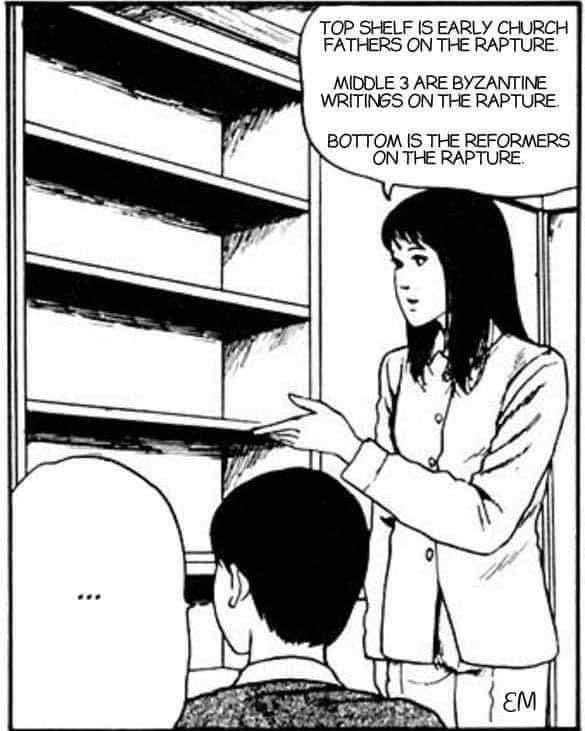
Historical views of the Rapture

Do you want to be like Tim?

If you are a writer or pastor who wants to preach like [the late Tim] Keller, you won’t get there if your strategy is “listen to Keller and copy him.” Keller himself would tell you that that’s a terrible idea.

Instead, do what Tim did: Go to seminary. After seminary, read everything George Whitefield wrote. Read Calvin’s Institutes and his sermons. Read The Lord of the Rings over and over and over. Read everything C. S. Lewis ever wrote. Read every Puritan paperback from Banner of Truth. Read sociology. Read social theory. Read Bavinck. Read current events books and a steady line up of journalists. Do all of that within the context of a family alongside your spouse and while talking to people facing ordinary life problems who are in need of counsel and aid and think about how to explain what you’re learning to them in ways that are sensible to them. Lewis had a rule that if he couldn’t say something in a way an ordinary British person could understand it meant that he wasn’t ready to say that thing yet. Follow that rule.

That is how you become a good missionary.

Jake Meador.

Heh, heh, heh! You had me going there for a minute, Jake. What’s the quick way to preaching like Tim Keller? I don’t want to be faithful for decades and decades with no assurance that I’ll ever become famous; I want a surefire to fame by next year.

East versus West

The thing is the cultural habit of rationalizing and abstracting has also made serious inroads into Catholic life and practice in the West. The crisis, Kingsnorth concluded, is not so much one of Catholic versus Protestant as it is of Eastern Christianity versus Western Christianity. It is a conclusion I arrived at not long after I left Catholicism for Orthodoxy in 2006, the result of a great spiritual trauma. I had thought of Catholicism as a mystic-friendly form of Christianity—which it is, but only by comparison to Protestantism. When seen from the East, both Catholicism and Protestantism—in the West, at least—are marooned primarily in the head and are futilely trying to think their way out of the civilizational shipwreck of the modern West.

Though Orthodoxy shares with Catholicism a fundamentally sacramental metaphysics, in practice Orthodoxy is far more mystical, emphasizing that the conversion of the heart must precede the conversion of the intellect. It does not deny the intellect, only orders it within an anthropological hierarchy.

One aspect of Orthodoxy that particularly appealed to Kingsnorth is its panentheism—the principle that God is, as the Orthodox prayer says, “everywhere present and filling all things.” It’s not the same as pantheism, which says that the material universe is God. Orthodoxy teaches that God is separate from his creation but also interpenetrates it with his energies, or his force. Consider how the warmth and pleasant glow of an English hillside on an August afternoon occur because the faraway sun penetrates the grass, the flowers, and the earth with its energies. The hillside is not the sun, but it testifies to the presence of the sun in its material being.

“The earth is not God, but God is there, present in nature, not in some far-off heaven,” Kingsnorth says. He goes on: “He’s deeply entwined in everything. Creation is the book of God, as Augustine said, I think. That is explicitly recognized in Orthodoxy. So what I was finding, weirdly enough, was a sort of ancestral Christianity that my ancestors in England would have had access to, and that the early Celtic saints certainly had access to. When I became Orthodox, a lot of people said to me, ‘Welcome home,’ and, strangely, it did feel like I was coming home. It felt like there’s something here that we had, that we lost.”

Rod Dreher.

I’ve been a fan of most of Rod Dreher’s books since Crunchy Cons. I want to distinguish his books from his columns, which I have frequently disagreed with. I also concede that one of his books was too raw, too transparent, too kiss-and-tell for my tastes.

Rod has been through a lot — openly for the last two years or so, quietly for a decade before that. Oh, heck: he’s been through a lot his whole life, much at the hands of family who lived in Louisiana at an extreme end of insularity. It’s hard to imagine a family that felt no pride in a member making it fairly big in New York City publishing because he dared to leave home, a family that affirmatively poisoned the minds of the next generation with refrains that Uncle Rod was uppity and no damn good.

I think he’s coming out of it, but he thought he had come out of it when he wrote How Dante Can Save Your Life. He’s voting for Donald Trump because Trump is the enemy of his enemies.. I cannot. I’m more with Miles Smith: “don’t tell me it is anything other than tragic that either of the two leading candidates for the presidency will eventually govern the American republic.”

Rod has a new book coming out tomorrow. It may be his most important; I’ve had it on pre-order for months.

This rave review struck me as capturing what’s special about Rod:

Dreher has an uncanny ability to articulate how religious conservatives feel, even to pre-empt it. Previous books gave us the Crunchy Cons (2006), whose eponymous conservatives want to turn the clock back; The Benedict Option (2017), which meant opting out of liberal culture; and Live Not By Lies (2020), which drew a line between “Marxist” and “woke”.

I can attest, spending much time among devout Christians, that Dreher has done it again, capturing our present mood: we’re trapped between wanting to throw ourselves into movement politics to defeat The Beast, or looking inwards in the hopes of becoming the change one wants to see in the world. Many of us are asking whether the best service we could do to Christianity is simply to become better Christians.

(Boldface added.) If you doubt that he has pre-empted conversations, ask yourself how often you’ve encountered the term “the Benedict Option,” which is literally his coinage.

These are a few of my favorite things

[N]one of the things that I care about most have ever proven susceptible to systematic exposition.

Alan Jacobs, Breaking Bread with the Dead

Christian fruits

“My people have been oppressed for nearly 2000 years. For 1200 years they endured Dhimmitude, a system of oppression made for the sole purpose of humiliating & breaking them. Today they face persecution in their homeland. And yet I don’t know of a single Coptic terrorist. Do you?”

Samuel Tadros.

Preaching the Gospel

“How do I get saved?” is not the gospel. And “So, would you like to get saved?” is not preaching the gospel.

Fr. Andrew Stephen Damick, Arise, O God

Pride

If you hide the gifts you have been given in order to appear humble, then you are very proud indeed. Wishing to appear humble is the worst form of pride.

Vassilios Papavassiliou, Thirty Steps to Heaven


Religious ideas have the fate of melodies, which, once set afloat in the world, are taken up by all sorts of instruments, some woefully coarse, feeble, or out of tune, until people are in danger of crying out that the melody itself is detestable.

George Elliot, Janet’s Repentance, via Alan Jacobs

You can read most of my more impromptu stuff here and here (both of them cathartic venting, especially political) and here (the only social medium I frequent, because people there are quirky, pleasant and real). All should work in your RSS aggregator, like Feedly or Reeder, should you want to make a habit of it.