I’ve paid closer attention (plus Substack subscription fees and book purchases) to Paul Kingsnorth since his conversion to Christianity and specifically to Orthodox Christianity. (No, he did not convert to “Romanian Orthodoxy,” though his regular parish is predominately Romanian. There is no substantial difference between Romanian, Serbian, Greek, Russian, Georgian, Syrian or other Orthodox ethnic identifiers.)
I’ve also paid closer attention (plus Substack subscription fees and a book purchase) to Martin Shaw since his reversion to Christianity, this time as Orthodox.
But I’ve been trying to keep in mind the scriptural cautions against putting novices on a pedestal Cf. I Timothy 3:6. Neither novice, Kingsnorth or Shaw, is a Christian authority – yet.
Mercifully, neither is claiming the prophet’s mantle, but careless readers can cloak them with it anyway.
I’m happy for Kingsnorth that his new polemic, Against the Machine, is selling well, and that he is getting blogged and podcasted by everyone and his brother. I’ve read the book, which was more than a stitching together of old internet posts. But if you read it, do also read some critiques, such as ‘Unnatural’ Doesn’t Mean ‘Wicked’, by non-Orthodox Christian Tara Isabella Burton.
Elites failing to reproduce
PhDs are falling: At Harvard, PhD programs are collapsing amid budget woes. The Faculty of Arts and Sciences just slashed the number of PhD student admissions slots by more than 75 percent in the Science division and 60 percent in the Arts & Humanities division for the next two years.
The PhD racket was always a weird one. These schools pushed their smartest, most annoyingly ambitious kids to get a PhD (there but for the grace of god go I). During that PhD, these guys do all the work of being a professor—teaching courses, grading papers. But they’re paid next to nothing. And then the clincher is that at the end, there are no jobs available. Maybe one English department job in Idaho for a group of 300 of them to battle to the death over. So I support this belt-tightening. We will have about 5,000 fewer antifa soldiers produced each year. They might even spend their 20s making money.
Over the past decade a new, and very revealing, locution has drifted from our universities into the media mainstream: Speaking as an X . . . This is not an anodyne phrase. It tells the listener that I am speaking from a privileged position on this matter. (One never says, Speaking as a gay Asian, I feel incompetent to judge this matter.) It sets up a wall against questions, which by definition come from a non-X perspective. And it turns the encounter into a power relation: the winner of the argument will be whoever has invoked the morally superior identity and expressed the most outrage at being questioned.
Mark Lilla, The Once and Future Liberal.
Legal realism
A new analysis of insurance data finds that more than one in ten of the women who take the abortion pill experience sepsis, infection, hemorrhaging, or another “serious adverse event.” The only reason regulators tolerate such a high level of danger to the mother is that the ability to kill her baby cheaply and conveniently trumps all considerations.
Wow, it really was a social contagion: As the great vibe shift sweeps our country, it turns out that the rise in transgender identities really was a fad—between 2022 and 2024, the number of trans-identifying young people has dropped in half. Last week, another study hinted at the same conclusion, but it was widely criticized due to its failure to distinguish between trans and nonbinary identities, which are obviously very different, you ignoramus. This week’s data from writer and psychology professor Jean Twenge proved that both identities are in free fall among the youth. …
This is good for a lot of reasons—but in particular, it’s good for trans people! Why? Because there have always been a small number of people who feel truly dysphoric in their sex. And the last thing you want is a horde of depressed teen girls latching on to your situation as a way to rage against their bodies, a stand-in for anorexia or cutting. I’ve never been more worried about my rights as a gay person than when all the angry youth started announcing they were gay or trans or queer because then I just knew backlash was coming. Anything funky they did, they called it gay. They wore a weird jacket and got creative with their haircuts and all of a sudden, they’re claiming my identity. I say, scram, kids! Get out of here! I’m putting up a border around Gay Territory and saying No more may enter. It’s me, it’s everyone in Provincetown, and it’s my dykes in the Midwest, and that’s it. We’re full up. Go see if the Mormons are taking applications.
The next two items are the most pointedly political in this post – and that’s not very pointed. I just don’t have it in me to spit into the wind recently.
A new presumption of bad faith
I was reminded by a New York Times guest editorial on the dangers of the Insurrection Act that our laws almost all assume that the law enforcer will be sane and will act in good faith. As a consequence of electing an insane and vengeful President, we now “enjoy” the full American expression of Joseph Stalin’s “show me the man and I’ll show you the crime.” My reflex is to disbelieve every word Trump says and to suspect invidious discrimination in all his Orders.
It might behoove our legislators to consider, before passing a law, what injustices could be wrought by bad actors wielding the proposed law.
Bring back hypocrisy
The Wall Street Journal has somehow decided to position its Editorial Page just slightly “left” (whatever those terms mean any more) of the Falun Gong’s Epoch Times. Thursday, it was Barton Swaim’s both-sides demi-defense of Trump’s lawfare against his perceived enemies.
I counter with “Yes, but Trump truly is worse because he does it right out in the open, shamelessly.” If hypocrisy is the tribute vice pays to virtue, it joins smoking and drinking on the very short list of vices Trump doesn’t practice. Otherwise, his brazenness coarsens every thing he touches and everyone who cheers him. For a guy so enamored of gold leaf, he’s oddly opposite King Midas.
I never thought I would lament the loss of hypocrisy.
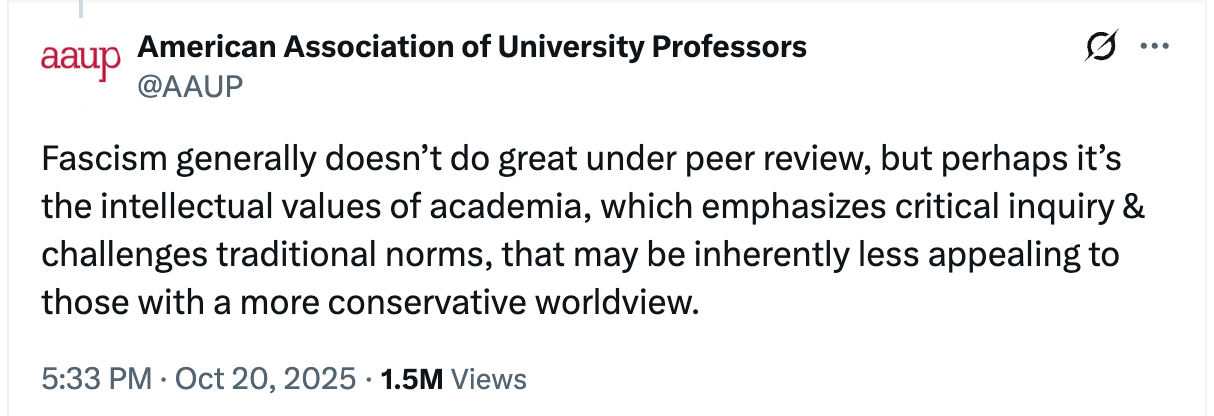
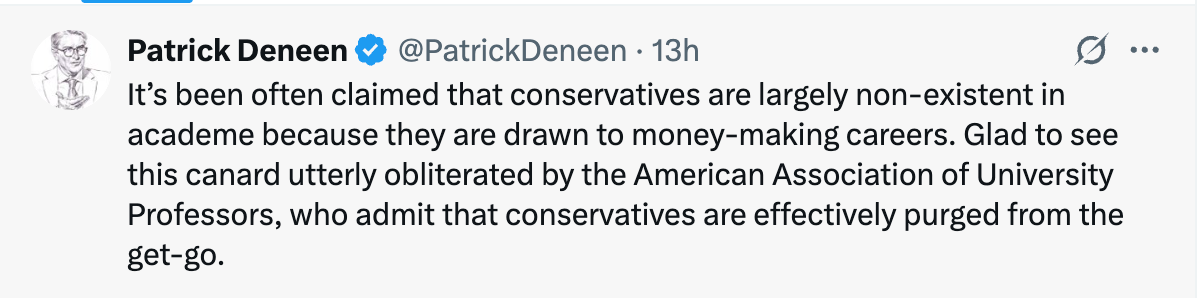
In the wider world, asking whether academia really skews left makes you look like an idiot or, slightly more charitably, like someone so encased in a bubble that they don’t even know what they’re missing. As for insisting on your right to complete self-governance, free from “secondary, external aims,” as Siraganian puts it … well, if you expect someone else to pay you to pursue truth, at some point, you must accept some secondary, external aims.
Academics tend to recoil from such a crass and mercenary idea, and fair enough, but the world is a crass and mercenary place. We talk about pursuing truth for its own sake, but most academics are pursuing it in exchange for money they can use to satisfy their many less elevated needs. The people who provide that money want something in return. Many will not be content to know that somewhere the global stock of Truth is increasing. Especially if one of the Truths you insist on is that they are dim-witted bigots.
Anyway, this is how the AAUP responds to the conversation on X:
The more I see institutional elites, in government and the private sector, the more I realize these people are like the pre-revolutionary Tsarist circles. They had no idea why so many people hated them, and what kind of precarious situation they were in.
They always invest in businesses that put them in the ‘trade routes’—controlling the linkages, and never getting involved in the creation of tangible value.
Kagi News, a new and useful aggregator, offers “Today in History as one of its tabs, with events at the top, people at the bottom.
For some reason, I find that a lot of composers and poets I had place mentally in the late-19th century were actually in early-19th century. Edgar Allen Poe never even saw the late-19th. Who knew?
Snippets
… the Conservative Political Action Conference, a kind of movable rent-a-troll event … (Anne Appelbaum via Frank Bruni)
The old Saudi brand was ‘austere theocracy,’ but the new one is ‘fun, fun, fun, but still with beheading.’” (Helen Lewis via Frank Bruni)
We live the given life and not the planned. (Wendell Berry, Sabbath poems 1994 number 3)
I love her more than evolution requires. (Charles Murray’s wife, reflecting on their first child. Attributed to others as well. The insight doubtless matters more than the source.)
Mad Ireland hurt you into poetry. (W. H. Auden, in memory of W. B. Yeats)
Music is a conspiracy to commit beauty. (Linda Ronstadt)
States, particularly liberal democracies, are heavily dependent on wars for moral coherence. (Stanley Hauerwas, Resident Aliens). Looking at the last 62 years of American history seems to confirm this.
Your enemies are not demonic, and they are not all-powerful and the right hasn’t always lost and the left hasn’t always won. But if you convince yourself of that, you give yourselves all sorts of permission to do a lot of stupid and terrible things under the rubric of “Do you know what time it is?”
[A] critical mass of the American people … no longer want[s] to govern themselves, … are sick of this republic and no longer want to keep it if it means sharing power with those they despise.
I don’t do any of the major social media, but I have two sub-domains of the domain you’re currently reading: (a) You can read most of my reflexive stuff, especially political here. (b) I also post some things on my favorite no-algorithm social medium.
Following the horrors of 9/11, Fukuyama and his ideas were derided as triumphalist nonsense. But he was only half wrong. Fukuyama, a Hegelian, argued that Western democracy had run out of “contradictions”: that is, of ideological alternatives. That was true in 1989 and remains true today. Fukuyama’s mistake was to infer that the absence of contradictions meant the end of history. There was another possibility he failed to consider. History could well be driven by negation rather than contradiction…
In the end, Trump was chosen precisely because of, not despite, his apparent shortcomings. He is the visible effect, not the cause, of the public’s surly and mutinous mood.
The State of the Union should be an easy topic for a writer. It’s a televised event; you watch it; you react.
But it’s actually quite challenging to find anything non-obvious to say about it, especially in 2024. Suspense around the address used to derive from what the president might say. Now, given his age, it derives from whether he might expire before the speech ends.
Joe Biden did not expire last night. Read any analysis today and that’s the top-line takeaway.
…
Then came Sen. Katie Britt to deliver the Republican rebuttal to Biden’s speech. Of her performance, the less said, the better. Watching it, I found myself wondering whether she had seized the opportunity to deliberately sabotage her chances of becoming Donald Trump’s running mate, mindful of how close the last guy who held that position came to being murdered.
There isn’t much else to say about Thursday night. Biden is plainly too old to serve competently for another four years, one “fiery and confident” address notwithstanding, and his agenda is too liberal to make any conservative happy.
I’ll be at the polls early on Election Day to vote for him.
I’ve probably said this before, but I plan to vote for neither. Why? The Electoral College.
I fully expect the polls to show that my fair state is going, again, to deliver its Electors to Donald Trump. Therefore, I’m at liberty to write in the American Solidarity Party slate.
That’s how I’ve calculated whether to hold my nose and vote for one of the major party candidates starting in 2008, when I chose John McCain over Barack Obama (whose affect I liked almost as much as I abhorred his brief political policy record) because the polls said my state was a toss-up (Obama won). I may have voted for Romney without holding my nose; I honestly don’t remember. If I did, it wasn’t under the misimpression that he was a stellar conservative.
The corrosion of American character
[Emmanuel] Todd is a critic of American involvement in Ukraine … He believes American imperialism has not only endangered the rest of the world but also corroded American character.
In interviews over the past year, Mr. Todd has argued that Westerners focus too much on one surprise of the war: Ukraine’s ability to defy Russia’s far larger army. But there is a second surprise that has been underappreciated: Russia’s ability to defy the sanctions and seizures through which the United States sought to destroy the Russian economy. Even with its Western European allies in tow, the United States lacked the leverage to keep the world’s big, new economic actors in line. India took advantage of fire-sale prices for Russian energy. China provided Russia with sanctioned goods and electronic components.
…
As Mr. Todd sees it, the West’s decision to outsource its industrial base is more than bad policy; it is also evidence of a project to exploit the rest of the world. But ringing up profits is not the only thing America does in the world — it also spreads a system of liberal values, which are often described as universal human rights. A specialist in the anthropology of families, Mr. Todd warns that a lot of the values Americans are currently spreading are less universal than Americans think.
…
Mr. Todd is not a moralizer. But he insists that traditional cultures have a lot to fear from the West’s various progressive leanings and may resist allying themselves on foreign policy with those who espouse them.
Rod Dreher elaborates on how the US pushes dubious “universal human rights:”
Boy, do we ever see that in Hungary, and throughout Eastern Europe. The US and the EU are fanatical about promoting LGBT. I mean, truly fanatical. When the Hungarian parliament in 2021 passed a law forbidding what it (accurately, in my view) sees as LGBT propaganda for children and minors, European elites went berserk. Mark Rutte, at the time the prime minister of the Netherlands, said that Hungary ought to be kicked out of the European Union over it.
Mind you, it’s routine for European governments to ban information aimed at children, who are (correctly) believed to be incapable of discerning truth and falsehood in them. In 2021, for example, the European Parliament voted to ban online advertising aimed at kids. So you can’t sell kids candy bars online, but Hungary’s refusal to allow people to sell transgenderism and sodomy to children is thought so egregious by European elites that many of them want the country thrown out of Europe.
Readers of this newsletter are well aware of how passionate the US State Department is about shoving LGBT in the faces of the world. Much of the world hates this, and sees it as a vivid sign of US cultural imperialism. Hungary is fairly tolerant on LGBT matters; same-sex couples can have registered partnerships, and almost every time I go out on the street in Budapest, I see at least one same-sex couple holding hands. But as we all know, in the eyes of these elites, to decline to accept the full and ever-changing panoply of LGBT demands is to be a horrible bigot not fit for civilized society.
(Emphasis added)
I’ll put in my 2 cents’ worth. I thought that surely 9/11 would open our eyes to how odious we are to much of the world. It didn’t. I’ve felt since then that we’re past the point of no return (I should add “humanly speaking”) when that became apparent. It hasn’t been an entirely unbroken descent; people have occasionally been red-pilled on some minor issue or another while the major trends continue downward.
I think it important to try to see the present calamity in a true perspective. The war creates no absolutely new situation; it simply aggravates the permanent human situation so that we can no longer ignore it. Human life has always been lived on the edge of a precipice. Human culture has always had to exist under the shadow of something infinitely more important than itself. If men had postponed the search for knowledge and beauty until they were secure, the search would never have begun. We are mistaken when we compare war with “normal life.” Life has never been normal. Even those periods which we think most tranquil, like the nineteenth century, turn out, on closer inspection, to be full of crises, alarms, difficulties, emergencies. Plausible reasons have never been lacking for putting off all merely cultural activities until some imminent danger has been averted or some crying injustice put right. But humanity long ago chose to neglect those plausible reasons. They wanted knowledge and beauty now, and would not wait for the suitable moment that never comes. Periclean Athens leaves us not only the Parthenon but, significantly, the Funeral Oration. The insects have chosen a different line: they have sought first the material welfare and security of the hive, and presumably they have their reward. Men are different. They propound mathematical theorems in beleaguered cities, conduct metaphysical arguments in condemned cells, make jokes on scaffolds, discuss the last new poem while advancing to the walls of Quebec, and comb their hair at Thermopylae. This is not panache; it is our nature.
I’d bet that if we are supernaturally spared the destruction I expect (which may be something like a definitive demotion from “indispensable nation” to “just another large chunk of geography” — “the end of a world,” not “the end of the world”), our supernatural saviors will make their activity deniable, so we can attribute it proximately to people who just faithfully kept on going, like humans rather than LARPing caricatures.
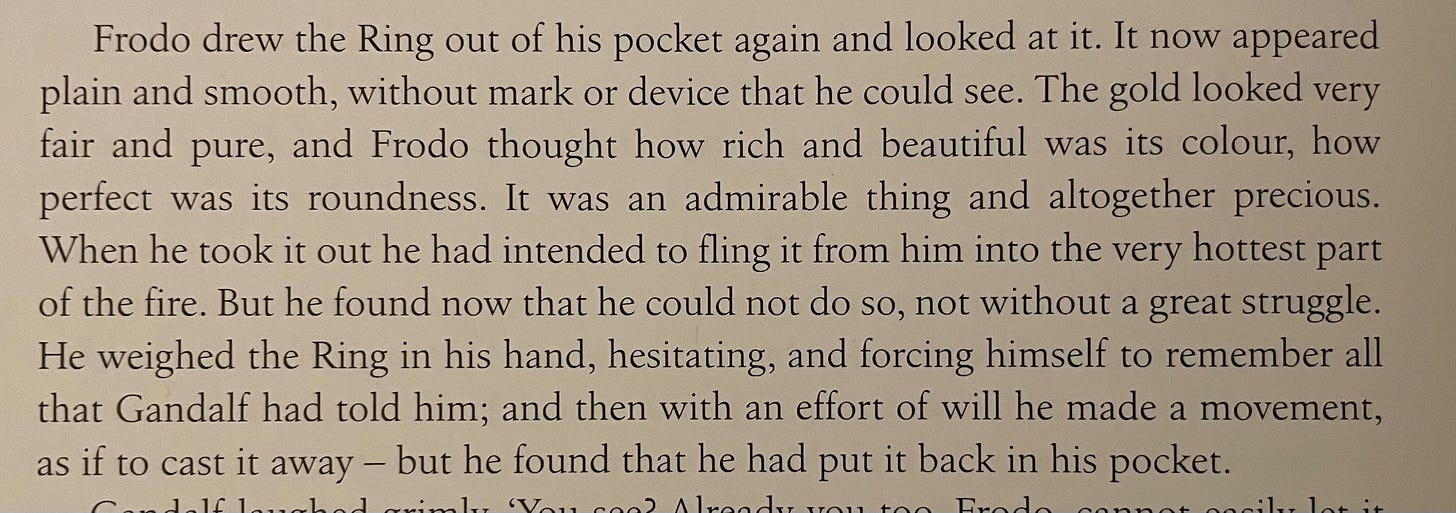
The One Phone of Power
I’ve been reading Tolkien again lately, and I’ve been struck by how easily one can substitute “smartphone” for “the Ring.” Take, for instance, this paragraph early on in which Gandalf invites Frodo to rid himself of the ring.
Above all, do not lose your desire to walk … every day I walk myself into a state of well-being and walk away from every illness; I have walked myself into my best thoughts, and I know of no thought so burdensome that one cannot walk away from it.
Above all, do not lose your desire to walk … every day I walk myself into a state of well-being and walk away from every illness; I have walked myself into my best thoughts, and I know of no thought so burdensome that one cannot walk away from it.
You can read most of my more impromptu stuff here and here (both of them cathartic venting, especially political) and here (the only social medium I frequent, because people there are quirky, pleasant and real). All should work in your RSS aggregator, like Feedly or Reeder, should you want to make a habit of it.

 Tipsy Teetotaler ن