
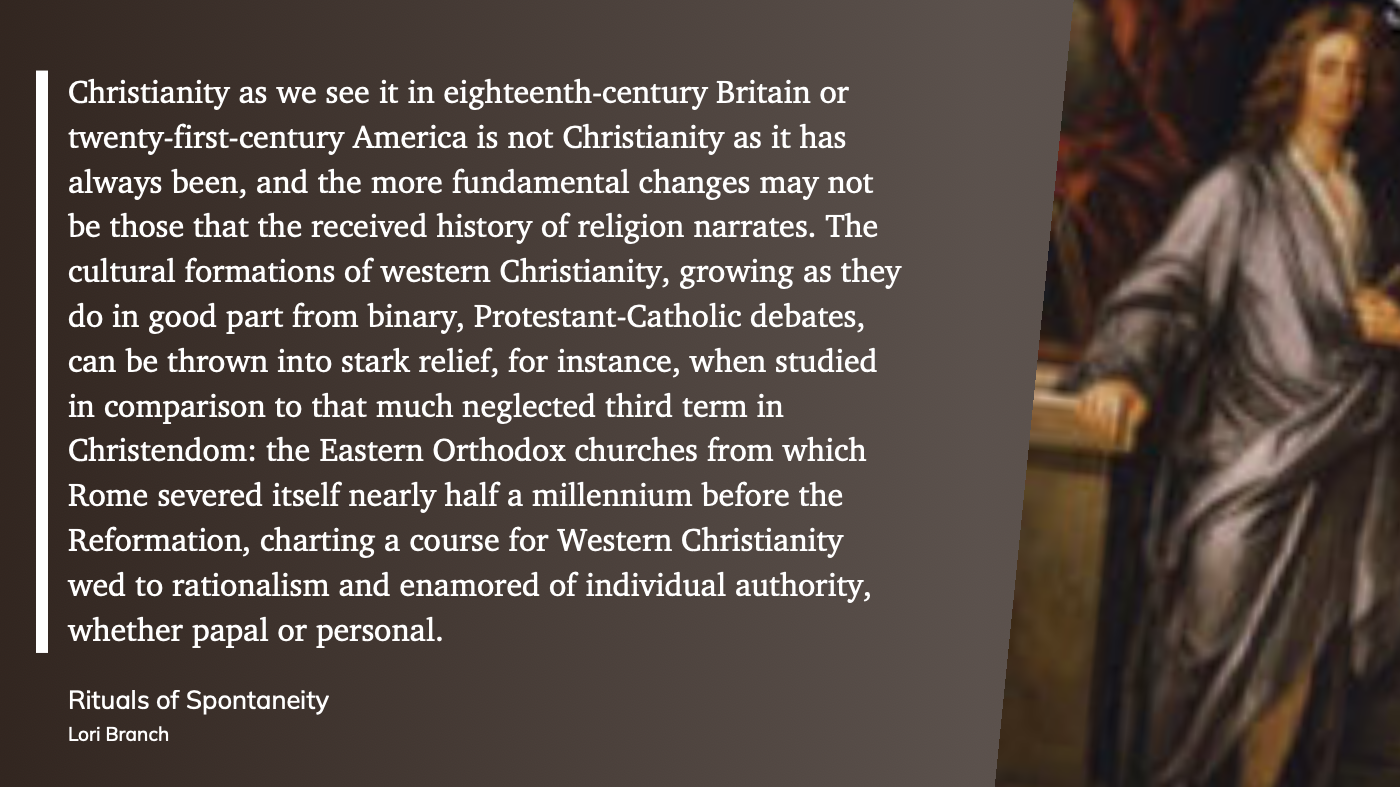
Theology isn’t all deductive
Catholics find it impossible to theologize without deductive reasoning—a characteristic shared by virtually all Western Christians…
Dr. Eugenia Scarvelis Constantinou, Thinking Orthodox
Puritan Phobia
The Puritans quickly developed a phobia about ritual, going so far as to resist “rote” recitation of the Lord’s Prayer:
Henry’s Method culminates with his most fascinating phrase-collection of all, “A Paraphrase on the Lord’s Prayer, in Scripture Expressions.” Christ’s own form of prayer given to his disciples had long been a thorn in Puritans’ sides, to be plucked out by being understood as only a general guideline. Henry’s strategy is to neutralize the prayer’s form in a pages of verses elaborating on the one phrase “Our Father, who art in similar method; he provides, for instance, an amazing two and a half Heaven” (MP, 163-65), a general topos, he says, from which begins. Many editions of the Method were printed as Henry intended, interleaved with one blank page between each printed one, to enable the reader to pen in his own collection of phrases to supplement Henry’s own. Like Bunyan’s demand for scrupulous sincerity, Henry’s lists and blank pages, figures of accumulation and abstraction, combine literally to efface the Lord’s Prayer and erase it from Dissenting practice.
Between the ledgerlike pages of Henry’s collected phrases and the blank sheets for scribbled lists of readers’ personal prayer phrases, one senses of variety of fears: that without this careful accounting, the business might go bankrupt, that in the copious, nervous quoting from God’s word to talk and talk and talk to God, God might not listen or respond at all.
Lori Branch, Rituals of Spontaneity
Hyperpluralism’s roots
Moreover, Reformation scholars tend analytically and in their division of labor to hive off the magisterial Reformation-Lutheranism, Reformed Protestantism, and the Church of England-from the radical Reformation. Consequently, whether oriented primarily toward theology or toward social history, they have overlooked the significance of the principle of sola scripture for contemporary hyperpluralism.
Brad S. Gregory, The Unintended Reformation
A catholic vision of Christian faith
When I first opened A Severe Mercy nearly 20 years ago I had needed a vision of Christian faith that was unapologetically devoted to Christian doctrine without being materialistic, more American than Christian, and completely uprooted from history. Up to that point, the expressions of Christianity I had encountered were simply different forms of sectarian faith—a vapid progressivism or a parochial and narrow fundamentalism. Vanauken gave me catholicity ….
Jake Meador (hyperlink added)
Know-it-alls
In practical terms, the Reformed commitment to the theological significance of everyday life led to the development of something like Protestant metaphysics, Protestant epistemology, Protestant science, Protestant politics, Protestant social and economic theory, Protestant art, and Protestant poetics. The development of these Reformed spheres of intellectual and cultural activity never occurred without substantial influence from sources not specifically religious. In Switzerland, the southern German regions, Hungary, Holland, and the British Isles, the Reformed perspective could be used to mask economic or political aggression. More commonly, it emerged from a complicated mix of sacred and secular motives. Yet wherever sufficient Reformed strength existed, the assumption also existed that biblical Christianity had something fairly definite to say about everything.
Mark A. Noll, America’s God
Some of us have been glued to the BBC on a Sunday evening this autumn watching Mark Rylance return mesmerically as Thomas Cromwell in the second series of Wolf Hall. This all takes place in the era of the Reformation, and a particular scene has stayed with me. Surrounded by crosses lifted from churches, Cromwell says the following:
The English will discover God in daylight, not hidden in a cloud of incense. They will hear his word in their own language from a minister who faces them, not turning his back and muttering in some obscure, foreign tongue…no one will ever believe the poor once bowed and scraped to stocks of wood, and prayed to lumps of plaster.
I have such a mixed response to this brilliant bit of writing.
I went to such a daylight church and could not find God there. I didn’t find him in a cloud of incense either. I found him in a moonlit, midnight forest. I found him in a place with almost no human imprint. That was where he suddenly said NOW.
And I suppose I have become someone who ‘bows and scrapes’ to icons and prays to ‘lumps of plaster’. But, of course, to reduce them as Cromwell does is to misunderstand their function, what they do to the spirit and heart of the faithful. It’s not to the wood or plasterness of them I am praying. It’s just that I am not entirely just a brain on legs fed by sermons. These scorned ‘lumps’ of Cromwell become luminous by attention and repetition, by their physicality, by their evocation of tradition, what exudes through them. They gather and focus devotion, taking it from a lyric (entirely personal) into an epic (collective) encounter with the divine. Their materials are not the thing.
I have sympathies with all that want to hear gospel in their own language, and I’m glad that happened. Surely we all, really, want a profound sense of both tradition and innovation?
Maybe we long for a God of daylight and moonlight, of lyric and epic, of straight talking and unknowable mystery. I’d find it hard to imagine someone who didn’t. We stand on the Mount of Olives with our teacher and surely all is possible. Surely anything less than this is just silly.
But human history is human history and we make our choices. They are rarely ideal, but we chew, we rail, then we decide.
A personal favorite
I have three lists of Maxims or such that I review regularly. This one, which I think was originally embedded in a longer blog post by Father Stephen Freeman, seems more precious (in the good sense, not the snarky sense) every time I read it:
- First, live as though in the coming of Jesus Christ, the Kingdom of God has been inaugurated into the world and the outcome of history has already been determined. (Quit worrying)
- Second, love people as the very image of God and resist the temptation to improve them.
- Third, refuse to make economics the basis of your life. Your job is not even of secondary importance.
- Fourth, quit arguing about politics as though the political realm were the answer to the world’s problems. It gives it power that is not legitimate and enables a project that is anti-God.
- Fifth, learn to love your enemies. God did not place them in the world for us to fix or eliminate. If possible, refrain from violence.
- Sixth, raise the taking of human life to a matter of prime importance and refuse to accept violence as a means to peace. Every single life is a vast and irreplaceable treasure.
- Seventh, cultivate contentment rather than pleasure. It will help you consume less and free you from slavery to your economic masters.
- Eighth, as much as possible, think small. You are not in charge of the world. Love what is local, at hand, personal, intimate, unique, and natural. It’s a preference that matters.
- Ninth, learn another language. Very few things are better at teaching you about who you are not.
- Tenth, be thankful for everything, remembering that the world we live in and everything in it belongs to God.
Sometimes this whole 2000-year-old faith seems like a living koan. Chew on this until you are enlightened. Keep walking.
You can read most of my more impromptu stuff here and here (both of them cathartic venting, especially political) and here (the only social medium I frequent, because people there are quirky, pleasant and real). All should work in your RSS aggregator, like Feedly or Reeder, should you want to make a habit of it.
 Tipsy Teetotaler ن