
As for the headline, IYKYK.
Culture
A lesson from a thick traveler
Thick travel has made me realise how much chaos we have here in the US, at a spiritual level, compared with the rest of the world. We are becoming a thin culture, obsessed with the surface, more and more in denial about the importance of what is beneath. We have forgotten that we need webs of meaning, eroding so many of them. People are left trying to cope with what we humans are not equipped to cope with — the isolation and chaos that follows from meaninglessness.
… My three years of thick travel, of trying to understand other cultures, has given me a much clearer picture of the problems here in the US. It’s made me aware just how deep they are. Our culture is harsh and transactional; it doesn’t respect the very human need for a deeper sense of meaning. The result is our epidemic of suicides, overdoses, and other early deaths.
Worse still is that culture, while easy to erode, is very hard to rebuild once gone. You can’t legislate back meaning. If thick travel teaches you anything, it’s that people don’t work that way.
Chris Arnade, Why you should be a thick traveller
Reflections on living abroad
It’s that mythical place where New World people come to lead different lives. For centuries, and no matter how much it has changed, Europe, for us, has meant art and architecture, science and philosophy, fashion and fame, sex and perfume — and some connection to the past that, in an unbridgeable way, is unavailable to us back home … To come abroad is to understand yourself as a product of your own culture, and to see just how specific that culture is. So much of what I thought of as my personality — whatever made me different from other people — turned out to pale in comparison with what made me similar to other people, especially other Americans.
Benjamin Moser, My Two Decades Living as an American in Europe
Yup.
Reflecting on Moser’s essay, Rod Dreher adds:
I’ve written here about how living in a small country for a length of time has revealed to me how the US throws its weight around in ways that strike me as bullying. Just today The Intercept reports on a secret Pakistani document purporting to reveal US pressure to remove prime minister Imran Khan (who was, in fact, forced from office) to punish him for being neutral towards US policy in Ukraine. That kind of thing really lands when you start to see the world through the eyes of others.
…
I meet young Europeans from time to time who can’t wait to get out of here and move to America, where they can have the fantasy life they imagine they can’t here. I try to dissuade them from their false impressions — its hard, for example, to make them understand how impossible most of the US, outside of a handful of East Coast cities, is to navigate without a car — but in the end, they should follow their dream if they have the opportunity to do so. What I find so interesting is that the thing that draws me to Europe — the weight of its history and culture — is precisely the thing that they want to escape by going to America. Who am I to say they are wrong?
…
[NB]one of these countries can absorb immigrants like America can, because the cultures are way too thick. Any American who thinks that European resistance to mass migration is due to nothing but racism is a fool who ought to have the experience of living here for a time. Assimilation is far, far more difficult here in these thick old cultures than in the thin culture of the United States. America is very different that way; most of the world is like Europe.
Yup again, though one need not live abroad to see the USA as others see it — something I began trying to do in the early 1990s by buying a world band radio when I was too poor (it’s all relative) and busy to travel. One of the blessings of the internet is the ability to get those other perspectives without leaving your armchair. You just need to care to do it.
Too good to last
The students weren’t allowed to take notes. At this stage the experience itself was more important than getting clear ideas and definitions down on paper for later. They had first of all, most of all, to delight and wonder.
…
Despite appearance, however, in their various meditations the professors were gently leading the students toward two goals. First, by pointing out so much beauty, they were bringing students in an experiential way toward the normal trust that the real is really real, delightful, mysterious, interesting—to wonder, as the program’s motto says …
The second goal was to bring students to the recognition that the Western cultural heritage could be a fountain from which to draw and not just a system to be dismantled …
Despite its popularity, a program so unapologetic in its embrace of traditional thought, values, and methods could not but find itself out of step with the priorities, agendas, and specializations of the modern research university. What’s more, in the eyes of administrators, an alarming number of students were converting to Catholicism. Some had even entered the monastic life! According to a summary report from an investigative committee, the program exhibited “a lack of tolerance for divergent points of view.” Through a series of bureaucratic manoeuvres and internal investigations, the program was slowly sidelined in the university curriculum and stripped of resources. Without the university’s support, and amid continuing hostility to its aims and purposes from administrators and professors, the program was shut down in 1979, not ten years after it had begun.
Fr. Francis Bethel, Let Them Be Born in Wonder
Online dangers
This week, I watched videos of people literally burning Harry Potter books, like latter-day Nazis, in the cause of transgender liberation. It’s safe to say, I think, that many of these people have lost their minds — just by staying online. And they not only think they’re perfectly sane; they think they’re heroes.
Andrew Sullivan, We Are All Algorithms Now (September 2020)
The risible Washington Post
The Washington Post opined that anti-LGBTQ+ moves in the Middle East were “echoing” those of the American culture wars—as if Turkey, Saudi Arabia, and Pakistan had been listed by the Human Rights Campaign as favored vacation destinations until their ruling elites started reading the website of Moms for Liberty.
Female defect, male defect
Idiocy is the female defect: intent on their private lives, women follow their fate through a darkness deep as that cast by malformed cells in the brain. It is no worse than the male defect, which is lunacy: they are so obsessed by public affairs that they see the world as by moonlight, which shows the outlines of every object but not the details indicative of their nature.
Rebecca West, Black Lamb and Grey Falcon
Well, duh!
Aaron Sibarium, a rising star reporter for The Washington Free Beacon, recently posted, “Whenever I’m on a career advice panel for young conservatives, I tell them to avoid group chats that use the N-word or otherwise blur the line between edgelording and earnest bigotry.”
…
To understand the cultural dynamic, I want to introduce you to an obscure online concept, no enemies to the right. A tiny fringe adopts this mind-set as a conscious ethos, but for a much larger group, it is simply their cultural reality. In their minds, the left is so evil — and represents such an existential threat — that any accommodation of it (or any criticism of the right) undermines the forces of light in their great battle against the forces of darkness. Attack the left in the most searing terms, and you’ll enjoy the thunderous applause of your peers. Criticize the new right, and you can experience a vicious backlash. The result is a relentless pull to the extremes.
… To the new right, their opposition to the left is so obviously correct that only moral cowardice or financial opportunism (“grifting”) can explain any compromise.
I don’t think there’s anything “obscure” or “online” about “no enemies to the right.” It’s been around long enough to have a French equivalent, pas d’ennemis à droite, and I suspect that the English version derived from the French. Moreover, don’t forget pas d’ennemis à gauche.
Unabashed dictionary
Thanks to Jesse Singal, (I Have To Admit I Still Don’t Fully Understand Why You Can’t Change Your Race), I have a new unabashed definition of a progressive:
One who, as of mid-2023, insisted vehemently that an individual cannot change race, which is wholly a fictitious social construct, but can change “gender.”
(This definition expires 12/31/23 if not repudiated sooner by the progressive hive-mind.)
Legalia
Pro tip
I suggest that you skip commentary on the latest Trump indictment (Fulton County, Georgia) for at least 24 hours, to August 16, unless you love being misled by rash hot-takes.
After all, the indictment is very long, factually and legally, complicated, based in part on a state RICO law that differs from Federal RICO and probably from any other state RICO.
We really need a top Georgia criminal lawyer who isn’t on either team in this indictment to suss out the RICO implications in particular, don’t we?
Fraud?
In response to those who say (in response to the latest next-to-latest federal Trump indictment) that “fraud” is limited to situations involving money or property; or who say that, “yes, there are cases holding that “fraud” is broader than that in §371, but we think this Supreme Court has been narrowing broad criminal statutes and we think they’ll narrow “fraud” in §371 if Trump is convicted under it”; I go out on a limb to say:
Lenity and other theories notwithstanding, if the Supreme Court narrows “fraud” under §371, it won’t be in reviewing a conviction of Donald Trump for his January 6 shennanigans. His behavior was just too wicked and the risk to the nation too great.
This is my foray into legal realism. And I don’t say there will be no dissents from upholding the (hypothetical) conviction.
Book bans
I wish they’d ban my book Cheerfulness so that more people would read it. I wrote it because the America I know and love is upbeat, enterprising, amiable to a fault, partial to jokes, and the mood of fracture and trauma seems fictitious to me, a far cry from the country that attracted our immigrant forebears. They didn’t cross the border in the hopes of taking vengeance.
Politics
Telltale
A telltale sign of the dishonest interlocutor is if they oppose your right to question them. Politicians who refuse interviews with the press, public health officials who demonize dissenters, activists who demand the muzzling of opposing opinions—such people are simply not to be trusted.
James Kirchick, Pinkwashing the Thought Police
That Lewis feller was pretty smart, warn’t he?
“You mean you’ve engineered the disturbances?” said Mark.
“That’s a crude way of putting it,” said Feverstone.
“But–what’s it all for?”
“Emergency regulations,” said Feverstone. “You’ll never get the powers we want at Edgestow until the Government declares that a state of emergency exists there.”
C. S. Lewis, That Hideous Strength
Encryption
Most Times reporters now also rely on some form of encrypted communication, particularly messaging apps like Signal and WhatsApp or the emailing service ProtonMail, to keep their sources and conversations confidential.
That is a remarkable shift. Encryption technologies became popular only a few years ago, after the former government security contractor Edward Snowden revealed the extent of what the United States government was doing to surveil its own citizens.
What We Learned About the Technology That Times Journalists Use.
I’d love to make Signal my default messaging app and Protonmail my default email app, but too few people, inexplicably, have adopted them. (Hint, hint.)
If you say you don’t trust the government but aren’t encrypting your online communications, I don’t believe you.
Subsidiarity in a nutshell
When government takes over a space formerly held by intermediating institutions or citizens acting through the democratic process, they promise dispassionate expertise, neutrality and justice. But what they deliver is a replacement ideology and a big stick to enforce adherence.
William P. Mumma, Chairman of Becket Law.
The politics of Jesus
I was scandalized by this poll graphic …
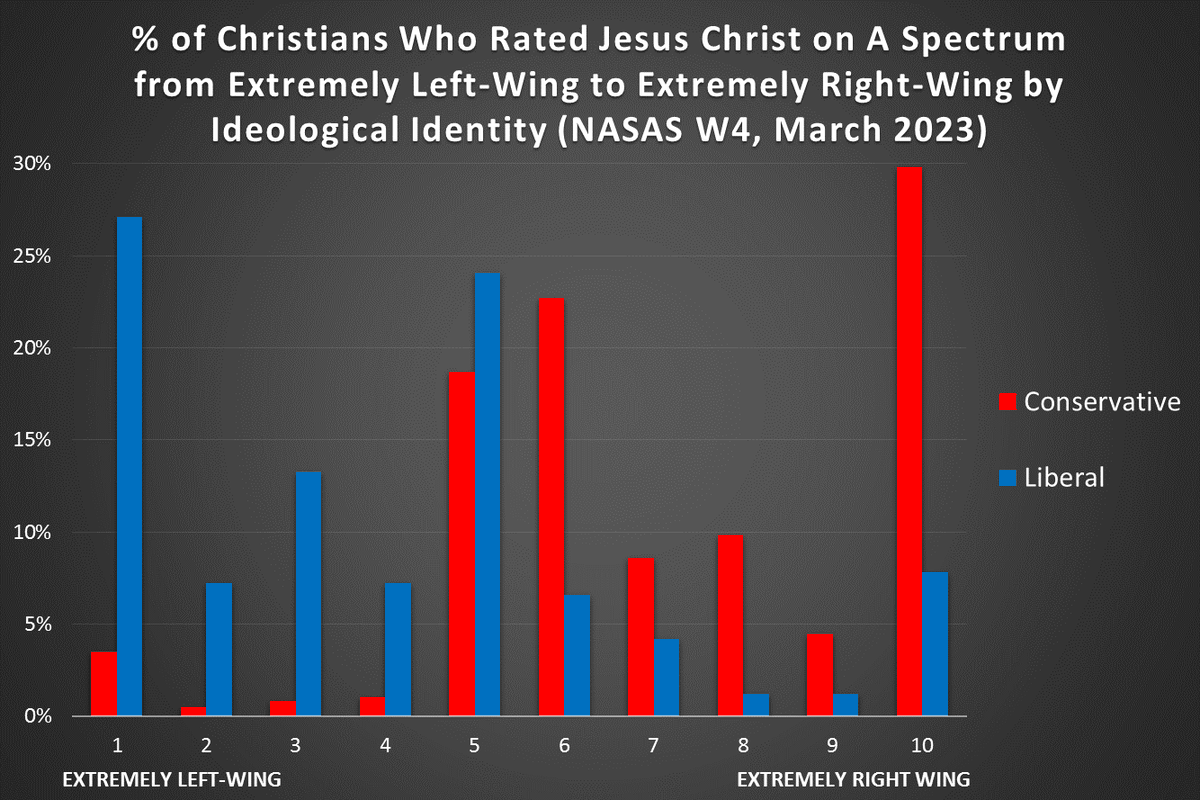
… until I realized that anyone who answered at all (i.e., accepted the premise that Jesus fits on a political scale) is of dubious sanity regardless of the answer.
I want to add “orthogonal” to my vocabulary, and “Jesus is orthogonal to politics as we conceive them” seems apt.
Postscript
Failure of imagination
The problem is that we cannot imagine a future where we possess less but are more.
We are in the grip of a grim, despairing rebellion against reality that imagines itself to be the engine of moral progress.
The end of the world as we know it is not the end of the world.
You can read most of my more impromptu stuff here (cathartic venting) and here (the only social medium I frequent, because people there are quirky, pleasant and real). Both should work in your RSS aggregator, like Feedly or Reeder, should you want to make a habit of it. I’m even playing around a bit here, but uncertain whether I’ll persist.
 Tipsy Teetotaler ن