Architecture and Starkitecture

In an era where Houston’s SuperDome can be a “church” for Joel Osteen and his followers, it’s good to know that there still are those who take Church design seriously. It’s especially good to know since I’m chairing my Parish’s Building Committee as we’ve outgrown our current quarters.

Our current quarters are in the American Orthodox genre of “hermit crab.” We take whatever shells other critters abandon – in this case, a “Kingdom Hall” abandoned by Jehovah’s Witnesses (I remember when it was new around 1960):
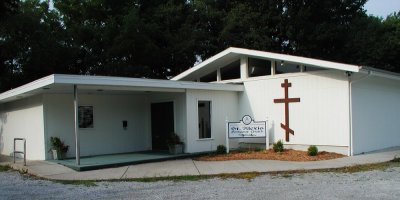
Our cast-off shell

I recall our Priest, Father Charles, lavishly dousing the interior with holy water, noting that it would take a lot to drive the heresy from the place. But even after adding the cost of holy water, the price was right.

But our next move, we think, should be to something permanent, and thus properly Orthodox. More on that later.

The Wall Street Journal reviews two designs of a Notre Dame-trained Architect, Duncan Stroik, working in a traditional Latin Church vocabulary (subscription may be required). While the Narthex view of The Shrine of Our Lady of Guadalupe left me lukewarm at best, I’m glad I clicked the slideshow link. The first aerial, showing the domed cruciform sanctuary behind the Narthex persuaded me to keep reading and looking, discovering “the splendor of the nave and sanctuary.”

The Thomas Aquinas College chapel is more appealing from the outside, but the interior disappoints with white painted plaster that reminds me too much of the Puritan minimalism of New England Congregational Churches. To be sure, the columns, flooring and aisles would give a Puritan the vapors, but the whiteness seems discordant to me – too “post-Vatican II.”

So why with such historic forms available have Catholics built modern monstrosities for the last 50 years?
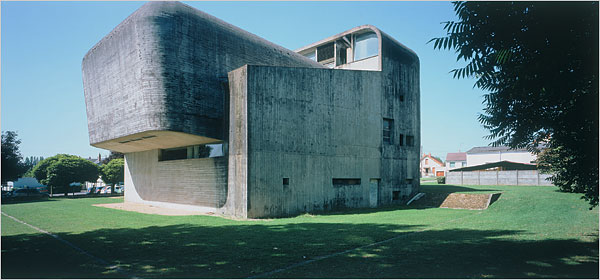
Is this excretion a sick joke?

I’ve never been Catholic, and I well know how easy it is to misunderstand a tradition from outside it, so I’ll not speculate.

Before I published this, Ross Douthat of the New York Times picked up the same Wall Street Journal story. Follow his links for proof that butt-ugly brutalism ain’t necessarily cheap.

Meanwhile, on my side of the Great Schism, we have a rising younger architectural star, Andrew Gould, whose temple designs have only been realized once so far. Orthodox parishes in America tend to be much smaller than Roman Catholic parishes, and our temples are proportionately smaller as a result. But an advantage we have, which I think militates in favor of “doing it right” when we build our temples, is that we aren’t liturgical innovators. Our Liturgies are extraordinarily stable. We don’t need to build something cheap so we can knock it down in a few decades to erect what the folks at Fuller Seminary tell us is the Big New Thing God Is Doing to Grow Your Church. My exploration of Church design-build firms for and with our Building Committee suggests that in the current Protestant world, design is often driven by sociological Church Growth theories, and that the big design-build firms promote those theories.

Andrew’s home parish, Holy Ascension near Charleston, may now look relatively stark on the interior, but those white wall are plaster, and will be covered with icons over the decades to come. It is a work in process in that sense, as I believe has been true of most Orthodox temples over the millennia. His whole portfolio of Ecclesial design work bespeaks permanence.

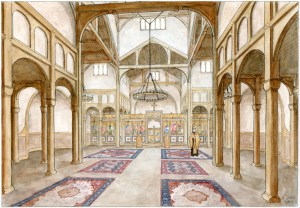
The plaster walls of the properly Orthodox temple Andrew designed and we hope to build, will also receive icons in the future:
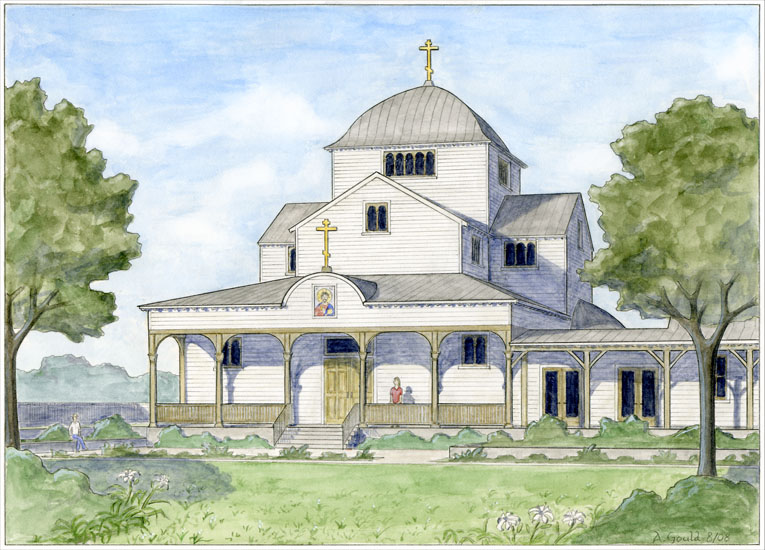
Proposed Saint Alexis Exterior
Proposed Saint Alexis Interior

The setting is rural – the source of some personal regret for me, since not one current member of our parish will be within walking or normal biking distance – and commodious. Though I wish we could have afforded a site closer in, I’m excited by the prospects. One of the deepest human needs, I’m convinced, is worship, and an architect whose designs aren’t conducive to that should be used for kindling. (The syntax of the prior sentence isn’t what I intended, but I’m going to let it stand, if you catch my drift. Call it serendipitous.)

Making dead men live

I really don’t intend to channel Fr. Stephen day-by-day. You can subscribe yourself, after all. I don’t even intend to have Orthodox testimonials as a regular feature. That’s a worthy goal, but I bring nothing unique to such efforts.

But for the second day in a row Fr. Stephen  has hit it out of the park, contrasting the Orthodox view of salvation to views common today – a theme that “recurs because it is so fundamental to the Christian faith and is at the same time largely unknown in our modern world.” Indeed it is.

Reduced to aphorism, the Orthodox view is that “Christ did not come to make bad men good, but to make dead men live.”

We have a problem that is rooted in the very nature of our existence, not in our behavior. We behave badly because of a prior problem. Good behavior will not correct the problem.

The sometimes tacit, sometimes explicit view that Christ indeed came to make bad men good strikes me as a variety of “Moralistic Therapeutic Deism.”

It is the deism that distinguishes the non-Orthodox view at issue today from the view that Christ came to secure the forensic declaration of our righteousness so we could get into heaven. This view I know first-hand to be common among evangelicals, fundamentalists and Calvinists – all of which I arguably have been in the past, though I would have denied being a fundamentalist.

Among the ramifications of the Orthodox view are some interesting comments Fr. Stephen makes about drinkin’ ‘n smokin’ and other fundy taboos.

Mere forgiveness or real change?

Father Stephen posted Wednesday one of his best blogs in weeks, by my lights.

This one captured eloquently a big factor in my embrace of Orthodoxy: salvation as ontological change more than forensic transaction.

There is no denying that grace is a free gift and that it is the true means of our salvation. But what if our problem is not to be primarily understood in legal terms? What if that which needs saving about us is not our guilt before the law of God, but the ravages worked within our heart and life from the presence of sin and death? This is probably the point where many discussions about salvation fall apart. If one person has in mind primarily a forensic salvation (I go to heaven, I don’t go to hell), while the other is thinking primarily in terms of an ontological change (I am corrupted and dying and were I to go to heaven I’d still be corrupted and dying). The debate comes down to a question of whether we need a change of status (forensic) or a change within our very heart.

The italicized parts are Father Stephen’s eloquent expression of what hit me early on the road to Orthodoxy. It’s a lot of what kept me on that road, in fact.

When I was in my Christian boarding school, I was taught that salvation could be broken down into justification, sanctification and glorification – a dim and dumb reflection of the more glorious truth. I now tend to think that justification – in the stark forensic sense of God pronouncing me righteous – is all but meaningless if I don’t cooperate with Him in beginning to become righteous in fact, not in legal fiction. And remarkably enough, it doesn’t feel like some sort of living martyrdom. There’s real, deep joy in the journey.

Unless I do get to work on becoming conformed to His image, becoming a “partaker of the divine nature,” I’d probably storm out of heaven, breaking a few plates or punching a hole in the wall on my way out, after spending my threescore and ten living entirely for myself and then finding out that heaven isn’t about me.

As Father Stephen puts it, “were I to go to heaven I’d still be corrupted and dying.” And I’ll make life a bit more nasty, and Christianity of my sort more distasteful, as I experience corruption and dying here, as poor Antsy McClain experienced one day:

Don’t miss his second (of three) potent points:

The life of grace is central to our existence as Christians and must not become secularized. In a secular understanding, the Church has a role to play in a larger scheme of things (the secular world).

No, the secular world is passing away. The Church is “the larger scheme of things.”

Can you identify the third major point? It’s the one I’ve been slowest making habitual to my thought patterns. I get about half of it, and I’m starting to get the other half. Maybe other people grasp it more readily.

“New Atheist” Christopher Hitchens’ Christian Brother, Peter

Tip of the hat to Ross Douthat for his link to Peter Hitchens’ How I found God and peace with my atheist brother.

The article is more interesting, in my estimation, than Douthat’s excerpt, interesting though that is. I was prepared from that excerpt for a manifesto of dubious orthodoxy. What I found instead was a sketch of a pilgrimage from banal atheism to thoughtful Christian faith.

Having never gone through an atheist or agnostic phase myself, I would commit stereotyping if I uttered this, but Hitchens has earned the right to name it:

We were sure that we, and our civilisation, had grown out of the nursery myths of God, angels and Heaven. We had modern medicine, penicillin, jet engines, the Welfare State, the United Nations and  ‘science’, which explained everything that needed to be explained.
The Britain that gave me this self-confidence was an extraordinarily safe place, or at least so it felt to me as a child.

But I can appreciate how “the old unsettling messages” became a wedge that gradually opened his mind and heart:

I no longer avoided churches. I recognised in the great English cathedrals, and in many small parish churches, the old unsettling messages.

One was the inevitability of my own death, the other the undoubted fact that my despised forebears were neither crude nor ignorant, but men and women of great skill and engineering genius, a genius not contradicted or blocked by faith, but enhanced by it.

…

I also knew I was losing my faith in politics and my trust in ambition, and was urgently in need of something else on which to build the rest of my life.

I don’t think the inevitability of my own death was a sufficiently conscious concern of mine until I found Orthodoxy (which coincided, of course, with my aging and the consequent, undeniable physical infirmities), but I was very aware that believers of old were not crude or ignorant and that politics and ambition were inadequate foundations for life.

Peter (I call him that not from faux familiarity, but because the other Hitchens is better known) pulls no punches in identifying the covert locus of much of today’s anti-Christian rage, and the culprit he fingers appears guilty to me:

[I]n recent times it has grown clear that the Christian religion is threatened with a dangerous defeat by secular forces which have never been so confident.

Why is there such a fury against religion now? Because religion is the one reliable force that stands in the way of the power of the strong over the weak. The one reliable force that forms the foundation of the concept of the rule of law. The one reliable force that restrains the hand of the man of power. In an age of power-worship, the Christian religion has become the principal obstacle to the desire of earthly utopians for absolute power.

But unlike Peter, I think the urge to power has an accomplice: the sort of facile faith that finds science a threat – a faith I once held, knowing no better way to live out devotion to Christ – and whose fear of The Other is expressed in demonization – of which I was mercifully guilty less often than many on the religious right. Facile faith invites facile atheism. Demonization invites counter-demonization. I think Peter may intuit that, as here:

I do not loathe atheists, as Christopher claims to loathe believers. I am not angered by their failure to see what appears obvious to me. I understand that they see differently. I do think that they have reasons for their belief, as I have reasons for mine, which are the real foundations of this argument.

Peter and I diverge stylistically about the utility of arguments over morality:

He [Christopher Hitchens] often assumes that moral truths are self-evident, attributing purpose to the universe and swerving dangerously round the problem of conscience – which surely cannot be conscience if he is right since the idea of conscience depends on it being implanted by God. If there is no God then your moral qualms might just as easily be the result of indigestion.

Yet Christopher is astonishingly unable to grasp that these assumptions are problems for his argument. This inability closes his mind to a great part of the debate, and so makes his atheist faith insuperable for as long as he himself chooses to accept it.

One of the problems atheists have is the unbelievers’ assertion that it is possible to determine what is right and what is wrong without God. They have a fundamental inability to concede that to be effectively absolute a moral code needs to be beyond human power to alter.

On this misunderstanding is based my brother Christopher’s supposed conundrum about whether there is any good deed that could be done only by a religious person, and not done by a Godless one. Like all such questions, this contains another question: what is good, and who is to decide what is good?

I do agree with Peter that a binding moral code needs grounding. Maybe there’s a gene for altruism, as the evolutionists recently seem to postulate. But what if I don’t have it, or mine’s mutated or unexpressed? What if I act the sociopath as a result? Society, made up of a majority where the gene is present and expressed, may have the raw power to squash me, but they cannot logically utter any moral condemnation – though they assuredly would do exactly that.

But Christopher Hitchens likely will never appreciate that unless he’s first blindsided by something else – maybe Rogier van der Weyden’s 15th Century Last Judgement (which blindsided Peter) or “the unexpected force of poetry, which can ambush the human heart at any time” (as Peter notes).

Finally, I really appreciate Peter’s succinct putdown of a stupid, stupid, canard that can only be uttered by somebody who didn’t notice the savagery of pagan Nazis and atheist Communists in the bloodiest damned century the world has ever seen:

Another favourite argument of the irreligious is that conflicts fought in the name of religion are necessarily conflicts about religion. By saying this they hope to establish that religion is of itself a cause of conflict.

This is a crude factual misunderstanding. The only general lesson that can be drawn is that Man is inclined to make war on Man when he thinks it will gain him power, wealth or land.

Amen, brother Peter. Only brother James – one of those crude and ignorant folks from 2000 years ago – rivals your brevity (James 4:1-2).

Speaking of Faith

A remarkable program airs on Public Radio in much of the country: Speaking of Faith, with Krista Tippett, from American Public Media. Our local NPR affiliate doesn’t carry it, but it is available as a podcast, too, and I’ve been listening for a few years now.

SOF is not where to go for Orthodoxy, large- or small-O. (If you want an orthodox Christian version, subscribe to Mars Hill Audio.) But in a country where public schools shun religion, even as an academic study, thus tacitly marking it off as singularly unimportant (or at least unworthy of study), it is heartening to have a significant public institution that recognizes, as does SOF, that (1) faith matters are important and (2) faith is not confined to organized religions.

I risk misunderstanding if I don’t digress for a moment:

  • I don’t mean by point 2 to deprecate organized religion. “I believe in one holy catholic and apostolic Church,” after all. My point is that many ideologies that purport to be secular are in practice part of the same genus as explicit religion. SOF seems to understand that by covering a wide array under its “Faith” umbrella.
  • I am not a fan of “religion” or “organized religion” in any generic sense, anyway. Ask me about a specific religion and I may have an opinion, but not about religion in general. Or even about “atheism.” (“What God don’t you believe in? … Ugh! Good for you! I don’t believe in that one, either.”)

Beyond the two heartening messages enumerated above, I find much at SOF that allows me empathically to understand common human yearnings that that most religions share. (I note that without intending to imply equivalence of religions in satisfying those yearnings.)

SOF programs range from unbearable (e.g., her show on Voodoo lacked any deep yearning I could relate to) to intriguing to delightful. Even the March 4, 2010 show, where Tippett interviews a guy with a bunch of Just-So Stories about the “Evolution of God” included some thought-provoking moments (sometimes a just-so story sounds plausible).

I should mention that the BBC has podcasts that repeatedly take up religious topics and discuss them at a fairly high level – higher that SOF when tends toward the touchy-feely. But I’m still grateful that SOF is on the American airwaves.

Why would a Muslim (or, f’rinstance, a Druid) become Christian?

Mosab Hassan Yousef, now 32, was the son of a key Hamas leader, who he seems still to admire despite having secretly embraced Christianity and then becoming a spy for Israel’s Shin Bet:

He’s a very moderate, logical person. What matters is not whether my father is a fanatic or not, he’s doing the will of a fanatic God. It doesn’t matter if he’s a terrorist or a traditional Muslim.

Living now around San Diego, Yousef

says he had reached the conclusion that terrorism can’t be defeated without a new understanding of Islam. Here he echoes other defectors from Islam such as the former Dutch parliamentarian and writer Ayaan Hirsi Ali.

So much for his theories about terrorism and Islam, which I offer to introduce Yousef and to provoke thought about Islam if the reader be so inclined.

What’s really interesting to me is Yousef’s reason for embracing Christianity:

“I found that I was really drawn to the grace, love and humility that Jesus talked about,” he says in “Son of Hamas.”

Mr. Yousef has some of the evangelist in him, even as he insists he is not a particularly devoted Christian and is still learning about his new religion. He wants Palestinians and Israelis to learn what he did from the Christian God.

…

“I converted to Christianity because I was convinced by Jesus Christ as a character, as a personality. I loved him, his wisdom, his love, his unconditional love. I didn’t leave [the Islamic] religion to put myself in another box of religion. At the same time it’s a beautiful thing to see my God exist in my life and see the change in my life. I see that when he does exist in other Middle Easterners there will be a change.

“I’m not trying to convert the entire nation of Israel and the entire nation of Palestine to Christianity. But at least if you can educate them about the ideology of love, the ideology of forgiveness, the ideology of grace. Those principles are great regardless, but we can’t deny they came from Christianity as well.”

I have an enduring intuition that there are millions in the United States – Muslims, Jews, New Agers, Wiccans, Druids, self-declared Agnostics and Atheists, and even lapsed Christians – who are secretly drawn to Jesus Christ “as a character, as a personality,” and who love him, his wisdom, his unconditional love.

But they hear from some prominent Churches (or is it many? I’ve lost touch with that subculture, but I know it was around within my lifetime) a message that sounds too much like Jonathan Edwards’ “Angry God,” a staple of English lit classes when I was younger.

Or just as likely, they see in mainstream Christianity or in the Megachurches (the effete spiritual descendants of Edwards; “Entropy: It’s Not Just About Physics Any More”) a moralistic therapeutic deism that they can do quite well without, thank you. I have an often-oblivious, sometimes-perceptive friend who was frank and perceptive when he said that the sermons in his mainstream Church were such smarmy encouragement they weren’t worth his time. He could do better, quicker, elsewhere if he wanted a pep talk.

Or maybe they catch on that their emotions are being manipulated, not their spirit nourished, through the praise band and other hubbub. Or maybe pick up a total con man, who promises fabulous wealth in return for a “word of faith” backed up with a generous donation. That’s a massive turnoff.

So such Christ-admirers must choose, they think, between (1) the Jesus they see in the New Testament, or (2) the Churches they know. There’s something seriously wrong with that picture. Christ promised, after all, to build and preserve His Church, so how can it be in conflict with Him?

I have another enduring intuition that the heart-longing of such conflicted people will find its home in Orthodox Christianity, which is not like anything most people in America have ever seen. Contrary to what it connoted to me 15 years ago (forbidding ritualism of some sort coupled with doctrinal rigidity), is all about Jesus Christ (“it is sooooo not ‘about me’!” one visitor exclaimed) and becoming His worthy image and likeness by the healing of the human soul (Greek “nous”). (Matthew Gallatin coincidentally has a current podcast that vividly but fairly contrasts the Orthodox view of salvation from that typified by Jonathan Edwards. Orthodoxy’s different on the surface partly because it’s different deep down on such things.)

Do I dissemble? Didn’t I just tacitly fault “moralistic therapeutic deism”? How does Orthodox “healing of the soul” differ from MTD?

Well, first, it’s not moralistic. Really. (Once you really get the hang of it, you live far more by love than by rule.)

Second, it’s not deism.

Third, the therapy/healing in Orthodoxy starts not with faddish self-esteem and positive thinking, as in MTD, but with repentance.

John Romanides, in the posthumous collection of his Greek University Lectures on Patristic Theology, summarized Orthodox dogma:

  1. God became man. (No deism there!)
  2. There’s no repentance after death.

I don’t think either point is ever lost in any Orthodox Church, or could ever be lost if the cycle of services is maintained, though it can be obscured by human foibles.

Though repentance may sound grim (that presumably is why is has disappeared from Krustianity), it is a seed, and then a spiritual horticulture, that flowers into the glorious and all-laudable Saints. There’s no shortcut.

And ironically, that soul healing in the end really is about the worshipper, whose real, deepest needs are met, after years of worship and asceticism (that’s what deep repentance looks like), even if the Divine Liturgy does not immediately appear much of a balm for yesterday’s pink slip, dust-up with a lover or such. (I do recall, though, in addition to a riot of sensory impressions at my first Orthodox Liturgy, my first taste of Orthodoxy’s healing calm.)

I pray, too, that Yousef may find Orthodox Christianity, as I think he’ll find some real Krustian shortcomings in Southern California Evangelicalism. (Some of it in his vocabulary in the interview may foreshadow that, though he acknowledges that he’s “still learning about his new religion.”)

Can we trust peer-review? Still?

Interesting thoughts on the scientific idea of “peer review.” This is not meant to bash “climate science” in particular, though it is a recent, high-profile example of a peer review process that may have been rigged. (I have no horse in the climate-science race because we’re running out of fossil-fuels and need major adjustments in how we live regardless of climate effects.)

That self-interest skews the peer review process shows, I think, the folly of thinking that a process (e.g., peer review) can ever make virtue (e.g., gimlet-eyed objectivity and honesty) obsolete. Virtue is, among other things, what allows us to do the right thing even when it’s not in our self-interest.