Can these bones live?

I sometimes have trouble focusing. My mind careens around like a pinball. I see connections between X and Y and my mind races off to how Y connects to Z and so forth. Or it can be as simple as “what’s the next thing to sing in this long Good Friday service?” So I sometimes miss things.

I have it on pretty good authority that I’m not alone in this, by the way, and that single-mindedness is part of that toward which our salvation – our spiritual healing and restoration – tends.

But last night, my mind stopped racing for a moment. John nearby was chanting Ezekiel chapter 37 – “the Spirit of the Lord … set me in the midst of the plain, which was full of human bones ….”

I thought that was a prophecy of the restoration of Israel! What’s it doing in a Good Friday service!?

The Fathers taught that it prophesies the Final Resurrection:

Great is the lovingkindness of the Lord, that the prophet is taken as a witness of the future resurrection, that we, too might see it with his eyes … We notice here how the operations of the Spirit of life are again resumed; we know after what manner the dead are raised from the opening tombs … And finally, he who has believed that the dead shall rise again ‘in a moment, in the twinkling of an eye, at the last trump (for the trumpet shall sound) … shall be caught up among the first in the clouds to meet Christ in the air’; he who has not believed shall be left, and subject himself to the sentence by his own unbelief.

(Ambrose of Milan via the Orthodox Study Bible.)

Again, this except from the daily Dynamis devotional:

Ezekiel 37:1-14    (4/3-4/16)     Prophecy at Lamentations Orthros of Great &Holy Saturday

The Mystery of Resurrection: Ezekiel  37:1-14 SAAS, especially vs. 3: “Then He said to me, ‘Son of man, can these bones live?’ So I answered, ‘O Lord, You know this.’” God speaks through His Prophet Ezekiel to show us …a great multitude of bones on the face of the plain.  They were very dry (Ezek. 37:1,2). We confront bleak death. Can it be undone?

Archpriest Georges Florovsky faces the vast plain of dry death, and he adds a notable disclaimer: “Human death did not belong to the Divine order of Creation.  It was not normal or natural for man to die.”  Death is not according to the will of God.  It is alien, an enemy in league with the father of lies, the purveyor of death.  Father Florovsky recalls that in Scripture death is “the wages of sin” (Rom. 6:23).  Therefore, he stoutly refuses the conception of death “…as a release of an immortal soul out of the bondage of the body.”  Rather, he counters with the great truth that “…death is not a release, it is a catastrophe,” following the world-view of Scripture.

By bringing us into the valley of dead, dry bones, God sets a mystery before us:  “Can these bones live?” (Ezek. 37:3).  Cancer, heart attacks, tsunamis, suicide bombers, earthquakes, and the graves of our war dead press us to say, “Unlikely!”  But the Prophet does not answer this way.  He defers to the power, mercy, and boundless love of God.  “O Lord, You know this” (vs.3).  Yes, death defies us and the image of God within us.  We cry out, “What of death, O Lord?”  Is the end just weathered bones on the valley floor of hades?

But, the word of the Lord stops the mind to arrest our attention: “Thus says the Lord to these bones: ‘Behold, I will bring the Spirit of life upon you. I will put muscles on you and bring flesh upon you.  I will cover you with skin and put my Spirit into you.  Then you shall live and know that I am the Lord’”(vss. 4-6).  The Prophet Ezekiel was a deported slave. The life of Israel was virtually ended by conquest and deportation.  Still, God promised, “Thus says the Lord: Behold, I will open your tombs, bring you up from your graves, and bring you into the land of Israel” (vs. 12).

God’s promise was no less incredible for the disciples scattered at the arrest and  crucifixion of the Lord Jesus.  He died on the cross.  He crossed into the plain of dry bones. Where was God with His promise?  Learn from Ezekiel.  The Prophet obeyed God: “So I prophesied as He commanded me, and the Spirit entered into them and they lived and stood upon their feet, and exceeding great assembly” (vs. 10).  Likewise, the Lord Jesus kept His promise as well: “They will scourge Him and kill Him.  And the third day He will rise again” (Lk. 18:33).  “Christ is risen from the dead, and has become the first fruits of those who have fallen asleep….even so in Christ all shall be made alive” ( 1 Cor. 15:20,22).  Ezekiel discloses the way. The Lord Jesus’ Resurrection is just the beginning.  And many shall follow!

The gates of Hades didst Thou shatter, O Lord, and by Thy death Thou didst destroy death.  And Thou didst free the race of man, granting life and great mercy to the world.

Jason Peters on the Krustian sell-a-bration of Eester

Item 983 on my growing list of reasons I’m blessed to have stumbled onto Orthodox Christianity.

This kind of stuff, I’m afraid, is the entropic eventuality of Protestantism. We experienced it as “Worship Wars” in my Protestant church before I left, eventually giving one group reluctant leave to “plant” a new church to its tastes. “Church planting” was the lipstick we put on the pig of splitting up.

I look back now and think neither side knew what real worship looked like, but one was more clueless than the other.

I hesitate to use the term “entropy” with Roman Catholicism, which has endured for a rather long time now. But they’ve got some boundary-setting to do, as in this (I shudder to use the term) Liturgy in Los Angeles:

I don’t mind singing in an empty Church

Well, technically, I’m not sure the Church is ever really empty. There’s always that great cloud of witnesses.

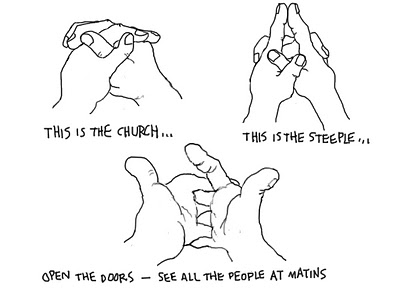
But apart from them, the Church is sometimes empty except for Priest and Cantor (me). We rarely have more than the “clergy” (Priest, Deacon, Cantor and maybe another Reader) at the very beginning  of Matins. Occasionally that will happen in a weekday service, too. Usually one or two will arrive soon after the start, though. The inspired doodle above is (from Steve Robinson at Pithless Thoughts, shall we say, reality-based.

But it doesn’t bother me, at least not in the sense of “why do I bother?” I may regret that many who could be present don’t bother, and miss out (missing out on what is the point of this posting – read on). But many really can’t come, and that’s okay. We’re a small Parish, with lots of young families with children. I’d think there was something seriously wrong if those families dragged their young ones to Matins, which combined with Liturgy routinely runs almost 3 hours. Others commute as much as an hour each way. So I don’t expect them to come.

But by coming and singing, I myself – hard of hearing and heart – steep in the teaching and mind of the Church. Slowly, I’m absorbing it. That counts for quite a lot since I’m serious about my faith but have nearly 5 decades of baggage from other Christian traditions, each misguided about many things, to unload.

One of those pieces of baggage is how to approach scripture. I had already begun to write this when Father Stephen posted on “the hearing of the word.” It illustrates beautifully how the Church approaches scripture:

I am convinced after years of preaching and listening to preaching that the bulk of Scripture has become lost to our ears. We hear it, but fail to “hear” it ….

Much of my conviction on this matter has come in the last 12 years or more and my immersion into the services of the Orthodox Church. These services, long and with ample “hymnography” that is but a poetic commentary on the Scriptures and doctrines that surround any particular feast, are probably the richest surviving engagement with the Word of God to be found in a 21st century Church. Here no Reformation has occurred and reduced all Scripture to a “riff” on Justification by Faith, or a subset of Calvin’s paradigms. Here no Enlightenment has shown with its darkness of doubt and obfuscation.

Instead, there is a constant wonderment at the Scriptures themselves, as if the hymnographer were discovering something for the first time or had found a rare gem to share to any willing to listen – and all in the form of praise and thanksgiving to God.

It is true to say that in Orthodoxy, “Theology sings.” ….

…In our modern context most people have either been shaped by fundamentalist literalism; by modernist historical criticism; or by nearly nothing at all. In each case the Scriptures will not sing – they will not yield up their treasures.

I was struck by a particular case this evening – at the Vigil for  Palm Sunday. The gospel account in question was the Matthean version of Christ’s entry into Jerusalem:

“And when they drew near to Jerusalem and came to Bethphage, to the Mount of Olives, then Jesus sent two disciples, saying to them, “Go into the village opposite you, and immediately you will find an ass tied, and a colt with her; untie them and bring them to me. If any one says anything to you, you shall say, `The Lord has need of them,’ and he will send them immediately.” This took place to fulfil what was spoken by the prophet, saying, “Tell the daughter of Zion, Behold, your king is coming to you, humble, and mounted on an ass, and on a colt, the foal of an ass.” The disciples went and did as Jesus had directed them; they brought the ass and the colt, and put their garments on them, and he sat thereon.”

Modern historical criticism hears in this only the “foolishness” of Matthew. Matthew has cited the prophecy in Zechariah that “your king is coming to you…mounted on an ass, and on a colt, the foal of an ass,” and has crafted his story in precisely that manner, placing Jesus astride two animals. The same critics will note that in other gospel accounts Christ is only on a “foal of an ass,” i.e., one animal. Historical Critics have a field day with such problems (I was first confronted with this “discrepancy” in my sophomore year of college – it was presented as if the professor had noticed something no one had ever seen before). Modern fundamentalists will rush to defend the integrity of the gospel accounts, “Two different eye-witnesses reported on the same thing and one emphasized one thing and the other emphasized another.”

Both explanations lack imagination and are precisely the sort of blindness that afflicts so much modern reading of Scripture. Listening to the hymnody for the Vigil of Palm Sunday, the hymnographer, without apology for the discrepancy, races to it and declares:

“O gracious Lord, who ridest upon the cherubim, who art praised by the seraphim, now Thou dost ride like David on the foal of an ass, The children sing hymns worthy of God, while the priests and scribes blaspheme against Thee. By riding an untamed colt, Thou hast prefigured the salvation of the Gentiles, those wild beasts, who will be brought from unbelief to faith! Glory to Thee, O merciful Christ. Our King and the Lover of man!”

the ancient hymnographer has come closer to the heart of Scripture than either the modern sceptic or the modern literalist will ever know.

… The writers of the New Testament believed that everything in the Old, when read rightly would yield insight into the Messiah and the mystery of our salvation. But their creative insight (again, I believe it is inspired) is far removed from the flat-footed nonsense that we hear out of modern fundamentalist “prophetic” scholars, whose reading of the Old Testament is almost as poorly constructed as the 19th century false prophecies of the book of Mormon! Neither bear any resemblance to the treatment of prophecy found in the New Testament.

And thus I return to my original point. We have become deaf. We listen with ears either hardened by modernist scepticism, or by a false literalism that has substituted Darbyite nonsense for the Apostolic faith, or reduced Scripture to delicate harmonizations. None of them have the boldness and audacity of the patristic hymnographers who stood in the proper line of succession, proclaiming the faith as it had been taught and received and continuing to expound its mysteries. Thank God that somewhere in this modern world, you can still stand and listen to the wonders of our salvation, sung and unraveled before the unbelieving heart of man. Glory to God who has so loved mankind!

So, whether there’s a single soul besides me in church, I’m singing theology. I’m singing poetry. I’m expounding the mysteries of the faith. I’m unraveling the wonders of our salvation before my own unbelieving heart, made dull by 48 years of desparate harmonizations – “flat-footed nonsense.”

[If this sampling from Father Stephen has whetted your appetite, probably the most target-rich zone of audacious expounding of the Old Testament is the Great Canon of St. Andrew of Crete, sung in segments during the first week of Lent and then sung in its entirety Thursday of the 5th week. Download and savor.]

And in a sense that I’m slowly and dimly beginning to apprehend, we are doing the reconciling work of God. This gets into a sacramental view of the world, which I am unqualified to address and would surely botch if I tried. Perhaps another day.

Although I’m occasionally bone-weary when I go to sing, it’s always a very great privilege, and I benefit as much as anyone.

Culture war update

My posting that used my spiritual doppelganger Frank Schaeffer as a launching pad was in the works for several days, but coincidentally, the AOI blog featured Schaeffer’s odd behavior as its centerpiece just a day later.

I underestimated the depth of the problem, having only sampled what Schaeffer offers to wallow in. There’s something seriously wrong when an Orthodox Christian of Schaeffer’s reported status can write this generally and this in particular:

The [Manhattan] declaration was the brainchild of a far right Reconstructionist extremist, Roman Catholic scholar, Robert P. George. George is a Princeton University professor of jurisprudence and probably the most influential Reconstructionist thinker to try to derail our democracy … Of course George would disavow being called a Reconstructionist. Rather he would claim he’s an advocate of the so-called Natural Law school of Roman Catholic theology.

Well, yes, Frank: George would deny being a Reconstructionist. Because he isn’t one. And he’d claim the Natural Law mantle. Because it fits.

And if you don’t know that, I’ve got bad news for you: you’re an idiot. (Shall I write that slower? You. Are. An. Idiot.)

Or as George put it:

I remember meeting him [Schaeffer] only once. Admittedly, it was a memorable experience. We were on a panel together at Princeton discussing contemporary politics in the midst of the 2008 presidential election. I knew nothing about the man, but he immediately struck me as an odd and, frankly, somewhat creepily emotive character who, as they say, “had issues.” He seemed pathetically desperate to be important or, at least, to be regarded as important in elite intellectual circles. I’ll leave it to the psychiatrists to decide whether this had to do with his being reared by fundamentalist Christian parents, a fact which, for some reason, he insisted on making a very big deal out of in his remarks. His speech was an emotional tirade that was perhaps the most self-referential piece of oratory I’ve ever heard. It was, you see, all about . . . him! We were supposed to be talking about the election, but what the audience got from Frank Schaeffer was autobiography—an account of the life and deeds of Frank Schaeffer. (Evidently, he was once himself connected to those dreadful right-wing fundamentlists until he “realized just how anti-American they are,” which led him to forums like the the Rachel Maddow Show and the Huffington Post where he warns the Enlightened about the nefarious plans of his former comrades in arms “to derail democracy.”)  It was so painfully embarrassing that even people on his side (that would be the pro-Obama side) were rolling their eyes to make clear to the rest of us that they found his behavior as peculiar and embarrassing as we did.

Schaeffer once said Orthodoxy was his last stop in Christianity – as if he’d apostatize entirely if Orthodoxy didn’t suit him. So as a litany in the St. Ambrose Prayer Book has it:

On those who at this moment are in danger of losing Thee forever, Lord have mercy!

It’s safe to go back in the water again

(This brief blog likely will be of interest only to Orthodox readers.)

I had unsubscribed to the Ochlophobist blog for a while because he got off, it seemed to me, on an unedifying prolonged rant against the Antiochian Archdiocese. But I can report that it’s relatively safe to go back in the water again, and that this March 8 posting made me wince in a most edifying way. And of his past 25 blogs, the only one that poked at things Antiochian seemed fairly well-placed.

Conscientious Objector to the Culture Wars

(This may be the most controversial and polemical thing I’ve posted. I’ll tell you in advance, and in conclusion, that I’m disinclined to be dogmatic about most of it. Your mileage may vary.)

* * *

One of the minor irritants in my life is Franky Schaeffer. I’ll go long spells without thinking of him, and then I get a catalogue from his publishing company, or maybe he pops up in the news (having once again found limelight). And I seethe.

But lots of people love limelight. Why does he, of all people, irritate me? Probably because his life is so parallel to mine, through all the twists and turns.

  • Evangelical: Check.
  • Produced the movie Whatever Happened to the Human Race; watched the movie as a turning point.
  • Now Orthodox: Check.
  • Religious Right activist: Check.
  • No longer Religious Right activist: Check.
  • 60-something years old: Check.

But he’s too strident and angry. He’s sort of a Christian James Howard Kunstler (another approximate contemporary of mine) but without Kunstler’s ubiquitous F-Bombs. Kunstler acknowledges that his speeches are a form of theater (listen to Kunstlercast #103 here); I think that’s true of Schaeffer, too, though he’d probably deny it.

I sense, too, that my reasons for dropping out of the culture wars are different than Schaeffer’s. I sense that partly because he seemingly just changed sides, now inveighing against his former friends, writing screeds, kiss and tell books, dubious fiction (his Calvin Becker fiction trilogy was quite calculatedly ambiguous about the extent to which it was autobiographical), paranoid apologies for Barack Obama, and sucking up to media personages who call him things like “a former leader of the anti-choice movement.” (They just love to get some sound-bites from an angry ex-whatever.)

But I really dropped out because:

  1. The culture wars are unwinnable on the present terms.
  2. I suspect that the strident tactics make most things worse rather than better.
  3. I don’t really trust my former allies.
  4. I don’t really trust the candidates we’re supposed to vote for.
  5. I still don’t trust my former adversaries.
  6. If I’m a prominent culture warrior, it will spill over harmfully into other areas.
  7. Maybe I’m just a worn out old hippie pacifist.

1. The culture wars are unwinnable on the present terms. We may get a majority vote for the “right” side on this issue or that, but that will not end the war. There will be other battles. There will be guerilla warfare. There will be no peace, and there’s only a minimal chance for the “Right” to win. Not until the Right’s own culture changes.

Changing culture is the work I’m about now – feeling my way rather than barreling ahead. That’s much subtler work than culture war. I’m not sure how good I am at it. But I’m convinced, to take just one Culture War example, that we won’t stop abortion until we change the toxic combination of unchastity and avarice that gets women pregnant and then justifies aborting the innocent child to maintain prosperity (greater or lesser).

The Right is not with us on that. Fox Radio recently aired an ad, between Glen Beck and Bill O’Reilly, for an online service for married men seeking adulterous affairs. (I didn’t hear it, but read about it from someone who didn’t note the incongruity of this appearing on a putatively conservative news source.)

Whaddya think? I’m betting that the ad wasn’t there for the 13 liberals who were eavesdropping on Fox that day, but for the red-meat, red state regulars.

TownHall.com syndicated columnist pages every day have ads for “conservative” slogan t-shirts draped on attractive young lasses, selling conservative politics, like everything else, with sex. Today there’s a sexy avatar for some video game, too. It’s all a racket.

This could as well go under the caption “I don’t really trust my former allies.” But on present terms I think the idiocy of modern pseudo-conservatives belongs in this “unwinnable” category, if only because their position on the sexual side of the culture wars seems to be “anything goes, so long as it’s not gay.” That’s a losing position long-term as well as being a sign of untrustworthiness.

2. The Culture Wars are unwinnable on present terms partly because stridency and contempt beget stridency, contempt and alienation.

Whichever side of the Culture Wars you’re on, think about the fundraising letters you get. Are you edified by their tone? Do you appreciate the sober, educational emphasis? Do you find yourself walking away with something of substance to ruminate on?

If so, I’ve got bad news for you: you’re an idiot. (Shall I write that slower? You. Are. An. Idiot.)

The groups who used to send me fairly sober letters have gone strident. The groups that used to send me strident letters are now frothing at the mouth. And I’m sure the other side is doing the same. Shrill is the new green.

I don’t care who fired the first volley. That’s lost in the mists of history like the instigation of the Hatfields versus the McCoys. I’d like the shooting to stop. I’d like artificial divisions to end. I suspect there’s more common ground than either side presently will admit because of how things have been framed. Let’s tone it down a bit and then explore what the real divisions are. The more we insult the other side, the more we paint both sides into corners from which dialog, let alone truce, is impossible.

3. The culture wars are unwinnable on the present terms, too, because there’s darned little difference between the two sides on some of the deep presuppositions.

They’re both, ironically, secular. One side is secular because they don’t believe in any divine rules. You know which side I’m talking about. (Hint)

The other side – my side – is mostly secular because they functionally believe that God’s only presence in the world is His rules. They “honor” Him by keeping his rules – sort of the way a rank amateur “paints” by number. That’s why I don’t really trust them. The tranformative significance of the Incarnation: God the Son, Who took on our flesh forever – qui sedes ad dexteram patrem (who sits at the right hand of the Father) in resurrected human flesh – is lost on them. God is up to something more than commandment monitoring and forgiving transgression of the commandments. The incarnation changes everything.

“Love God and do as you will” would strike them as modern relativism. They’re very anti-relativist. Except on Ecclesiology. Then they’re apt to utter Babbitry like “Isn’t it swell that there’s a church for every taste!

At the other end from the relativist “conservatives,” there’s a Protestant Church in my home town that produces a disproportionate share of Religious Right activists. Several of them have been elected to public office. But they’re theonomists, or more specifically Reconstructionists. If they had their way, there would be 18 Old Testament Capital Crimes in our law books – including sassing parents. They’d shut down my Church and desecrate its icons. They might, for all I know, execute me for one of those 18 capital offenses for the icons in my home prayer corner.

“And what more shall I say? For the time would fail me to tell of …” the folks I encountered who dreamed of kingdoms, feigned righteousness, broke promises, shot off their mouths, tried to set fires, escaped the edge of euphemisms …. (Cf. Hebrews 11:32-34) These are the folks with whom I’d be a “co-belligerent” (Francis Schaeffer’s coinage to distinguish temporary and unreliable political friends from reliable “allies”) were I to continue in the culture wars. And they outnumber many-fold any well-formed Christians of historical and liturgical bent.

We Orthodox have been here before. After the attempted union with the Roman Catholic Church at the Council of Florence (see also here), the Orthodox decided they’d risk rule by Sultan over rule by Pope.

That is not a throw-away line: I’m not so sure a secularist regime would be worse than what Christian Reconstructionists would bring upon me and my fellow Orthodox Christians that I’m willing to be bedfellows with Recontructionists.

4. In the current terms of the Culture War, the highest form of involvement, other than sending money in response to strident or frenzied letters, is to vote for Republicans. Any Republican.

In 2000 and 2004, it was Dubya. He was, we were told, a good Evangelical Christian. He cited Jesus as his favorite philosopher. He talked about America walking humbly in the foreign policy world.

Then 9-11 came, and he turned into a fierce Commander In Chief. And, oddly, Imam-In-Chief, as he assured us that “true Islam is a religion of peace.” (Well I’m glad he cleared that up!)

And then came, too, the second inaugural, when he declared as U.S. policy the eradication of tyranny from the world and the planting of democracy. If you don’t understand how delusional that is, read it again: eradicating tyranny from the world. As national policy.

Many Religious Right figures in 2008 backed Mitt Romney, Mormon and heir of a 50s moderate Republican, George Romney. Mitt was, deep down, one of us – despite his left-leaning administration as governor of Massachusetts – they assured us. Now they’re pushing Sarah Palin, about whom I’ll not say much except that I do not now support her and see no sign that she has the goods to gain my support later. (I don’t even think she’s all that “hot,” for whatever that’s worth.)

I’m not gonna play Charlie Brown the placekicker to the GOP’s Lucy Van Pelt any more.

5. I still believe pretty much what I believed before on what makes for good living and a just society. I’ve even kept a hand in the debates by writing letters to the editor on a few hot-button issues. Those letters are far less demonizing of the opposition than the sort of letters I used to write. But I check the online comboxes and see that the other side has no lack of equally-but-oppositely mad partisans of its own, leveling vitriolic attacks on me, no matter how reasoned my argument, just because I reach conclusions they don’t like.

But even at more elite levels than smalltown cyberpaper comboxes, I’m still convinced that the other side is untrustworthy. One occasionally will catch one of them committing candor, as has Chai Felblum of Georgetown law school. Imagine a constitutional case with this issue:

Whether the inferred right to marry a member of the same sex, which is inferred from the right to engage in homosexual sodomy, which is inferred from the right to privacy, which is inferred from penumbra of he 4th, 9th, 10th, 14th and other consitutional amendments, is of sufficient constitutional gravity to warrant compromise of the explicit constitutional command against laws prohibiting the free exercise of religion?

Chai Feldblum would answer “yes.” I’m not making up her response (though I did make up the highly tendentious – but brutally accurate – faux issue statement). I appreciate her candor.

But her candor tells me that there’s no home for me in the left where Frank Schaeffer has seemingly pitched his tent.

The Orthodox Wedding service includes, for just one example, “grant unto these Your servants …a peaceful life, length of days, chastity, love for one another in a bond of peace, offspring long‑lived, fair fame by reason of their children, and a crown of glory that does not fade away.” You can’t pray that with integrity over a same-sex coupling, whatever you might think of it otherwise.

So while the Chai Feldblums of the world might not smash my icons like the Reconstructionists, they’ll soon enough take away my Church’s tax exemption, or otherwise put on the squeeze, because they’ll consider us a hate group for continuing the two-millennia-long practice of connecting marriage to procreation.

6. If I’m a prominent culture warrior, it will spill over harmfully into other areas of life. I was reminded Sunday how diverse my parish is. We have Romanians and Russians who were born, or even came of age, under communism. We have Greeks who think that 2nd Amendment mania is barbaric (in at least one case with justification that I can’t gainsay – a family member gunned down in cold blood by someone who went postal). We have young people and middle-aged academics who lean left. We have demographically unknown visitors most Sundays. I have something to learn from some of them.

Just as I don’t want someone to ask me “why are you here since you’re not Greek?,” I don’t want people of Right-leaning disposition to come up to me at Church and make some dismissive remark, which they assume I’ll find hilarious or profound, about a Left-leaning idea that may be held by another parishioner within earshot. I don’t want there to be ethnic, racial, socio-economic or political barriers to people. Political trash talk about trifles at Church is apt to drive people away though we have a faith in common and should be together on Sunday.

7. Maybe I should try a bit more empathy. Maybe I’m not angry because, unlike Frank Schaeffer, I have a day job, with a comfortable living, and don’t have to raise a fuss to sell my newest book. Maybe a brain or personality disorder prompted Franky to call Barack Obama’s election “miraculous” and to prophesy epochal political healing on Obama’s watch.

Maybe Frank’s suburban Boston parish (I think he’s in Brookline, Michael Dukakis‘ hometown) has a leftist litmus test and he caved in. Or maybe he’s rebelling against his upbringing in neutral Switzerland as I declare myself a Swiss-like neutral in the Culture Wars.

Or maybe I’m not angry, by and large, because I’m a child of the 60s, a former Conscientious Objector to conventional war, and now old enough that I’m kind of tired of fighting of all sorts – worn out, if you will. Maybe we really need young, testosterone-crazed Christian guys (and gals crazed by whatever crazes women) who still are eager for a fight. I see my role as one to ask questions of any such young hotheads from the perspective six decades gives. Such as the ones implied by what I’ve just written.

* * *

So who am I hangin’ out with these days if not with the Alliance Defense Fund and the acolytes of R.J. Rushdoony? Check the bloglinks to the right* – Especially Front Porch Republic (“Place. Limits. Liberty.”), Distributist Review  (guardedly). Small Is Beautiful has taken on new meaning for me. (My benighted generation got a few things right before we sold out or got complacent – and appreciating E.F. Schumaker was one of them).

I can’t even rule out Father Stephen. Nothing he writes is “about politics,” but everything he writes is about sane, human and humane living, which surely connects up somehow.

Basically, I’m going back and rethinking all things political and cultural. I’m wisdom-hunting. I read Wendell Berry essays and poetry, Bill Kauffman books, Russell Kirk’s Conservative Mind, Matthew Crawford’s Shop Class as Soulcraft, Scott Cairns’ Poetry, W.H. Auden (“For the Time Being” is now on my list for every Advent).

My conversion to Orthodox Christianity started it in a way. I soon realized that the Church has not always prevailed, and has produced martyrs in every century. And that’s okay. Better we should lose honorably than win by selling our souls.

  • (Note: When I changed my blog theme, the sidebar went away and anachronistically renamed my blog, which was “Tipsy Teetotaler” when this was written.)
  • Update 6/14/24: I opened with “I’m disinclined to be dogmatic about most of it,” but I re-read it today and it stands up awfully well. It meanders, stream-of-consciousness style, but I still feel the same way. And, by the way, I don’t consider Trumpist ascendancy a “win” for what I considered the Right when I wrote.

Making dead men live

I really don’t intend to channel Fr. Stephen day-by-day. You can subscribe yourself, after all. I don’t even intend to have Orthodox testimonials as a regular feature. That’s a worthy goal, but I bring nothing unique to such efforts.

But for the second day in a row Fr. Stephen  has hit it out of the park, contrasting the Orthodox view of salvation to views common today – a theme that “recurs because it is so fundamental to the Christian faith and is at the same time largely unknown in our modern world.” Indeed it is.

Reduced to aphorism, the Orthodox view is that “Christ did not come to make bad men good, but to make dead men live.”

We have a problem that is rooted in the very nature of our existence, not in our behavior. We behave badly because of a prior problem. Good behavior will not correct the problem.

The sometimes tacit, sometimes explicit view that Christ indeed came to make bad men good strikes me as a variety of “Moralistic Therapeutic Deism.”

It is the deism that distinguishes the non-Orthodox view at issue today from the view that Christ came to secure the forensic declaration of our righteousness so we could get into heaven. This view I know first-hand to be common among evangelicals, fundamentalists and Calvinists – all of which I arguably have been in the past, though I would have denied being a fundamentalist.

Among the ramifications of the Orthodox view are some interesting comments Fr. Stephen makes about drinkin’ ‘n smokin’ and other fundy taboos.

Mere forgiveness or real change?

Father Stephen posted Wednesday one of his best blogs in weeks, by my lights.

This one captured eloquently a big factor in my embrace of Orthodoxy: salvation as ontological change more than forensic transaction.

There is no denying that grace is a free gift and that it is the true means of our salvation. But what if our problem is not to be primarily understood in legal terms? What if that which needs saving about us is not our guilt before the law of God, but the ravages worked within our heart and life from the presence of sin and death? This is probably the point where many discussions about salvation fall apart. If one person has in mind primarily a forensic salvation (I go to heaven, I don’t go to hell), while the other is thinking primarily in terms of an ontological change (I am corrupted and dying and were I to go to heaven I’d still be corrupted and dying). The debate comes down to a question of whether we need a change of status (forensic) or a change within our very heart.

The italicized parts are Father Stephen’s eloquent expression of what hit me early on the road to Orthodoxy. It’s a lot of what kept me on that road, in fact.

When I was in my Christian boarding school, I was taught that salvation could be broken down into justification, sanctification and glorification – a dim and dumb reflection of the more glorious truth. I now tend to think that justification – in the stark forensic sense of God pronouncing me righteous – is all but meaningless if I don’t cooperate with Him in beginning to become righteous in fact, not in legal fiction. And remarkably enough, it doesn’t feel like some sort of living martyrdom. There’s real, deep joy in the journey.

Unless I do get to work on becoming conformed to His image, becoming a “partaker of the divine nature,” I’d probably storm out of heaven, breaking a few plates or punching a hole in the wall on my way out, after spending my threescore and ten living entirely for myself and then finding out that heaven isn’t about me.

As Father Stephen puts it, “were I to go to heaven I’d still be corrupted and dying.” And I’ll make life a bit more nasty, and Christianity of my sort more distasteful, as I experience corruption and dying here, as poor Antsy McClain experienced one day:

Don’t miss his second (of three) potent points:

The life of grace is central to our existence as Christians and must not become secularized. In a secular understanding, the Church has a role to play in a larger scheme of things (the secular world).

No, the secular world is passing away. The Church is “the larger scheme of things.”

Can you identify the third major point? It’s the one I’ve been slowest making habitual to my thought patterns. I get about half of it, and I’m starting to get the other half. Maybe other people grasp it more readily.

Why would a Muslim (or, f’rinstance, a Druid) become Christian?

Mosab Hassan Yousef, now 32, was the son of a key Hamas leader, who he seems still to admire despite having secretly embraced Christianity and then becoming a spy for Israel’s Shin Bet:

He’s a very moderate, logical person. What matters is not whether my father is a fanatic or not, he’s doing the will of a fanatic God. It doesn’t matter if he’s a terrorist or a traditional Muslim.

Living now around San Diego, Yousef

says he had reached the conclusion that terrorism can’t be defeated without a new understanding of Islam. Here he echoes other defectors from Islam such as the former Dutch parliamentarian and writer Ayaan Hirsi Ali.

So much for his theories about terrorism and Islam, which I offer to introduce Yousef and to provoke thought about Islam if the reader be so inclined.

What’s really interesting to me is Yousef’s reason for embracing Christianity:

“I found that I was really drawn to the grace, love and humility that Jesus talked about,” he says in “Son of Hamas.”

Mr. Yousef has some of the evangelist in him, even as he insists he is not a particularly devoted Christian and is still learning about his new religion. He wants Palestinians and Israelis to learn what he did from the Christian God.

“I converted to Christianity because I was convinced by Jesus Christ as a character, as a personality. I loved him, his wisdom, his love, his unconditional love. I didn’t leave [the Islamic] religion to put myself in another box of religion. At the same time it’s a beautiful thing to see my God exist in my life and see the change in my life. I see that when he does exist in other Middle Easterners there will be a change.

“I’m not trying to convert the entire nation of Israel and the entire nation of Palestine to Christianity. But at least if you can educate them about the ideology of love, the ideology of forgiveness, the ideology of grace. Those principles are great regardless, but we can’t deny they came from Christianity as well.”

I have an enduring intuition that there are millions in the United States – Muslims, Jews, New Agers, Wiccans, Druids, self-declared Agnostics and Atheists, and even lapsed Christians – who are secretly drawn to Jesus Christ “as a character, as a personality,” and who love him, his wisdom, his unconditional love.

But they hear from some prominent Churches (or is it many? I’ve lost touch with that subculture, but I know it was around within my lifetime) a message that sounds too much like Jonathan Edwards’ “Angry God,” a staple of English lit classes when I was younger.

Or just as likely, they see in mainstream Christianity or in the Megachurches (the effete spiritual descendants of Edwards; “Entropy: It’s Not Just About Physics Any More”) a moralistic therapeutic deism that they can do quite well without, thank you. I have an often-oblivious, sometimes-perceptive friend who was frank and perceptive when he said that the sermons in his mainstream Church were such smarmy encouragement they weren’t worth his time. He could do better, quicker, elsewhere if he wanted a pep talk.

Or maybe they catch on that their emotions are being manipulated, not their spirit nourished, through the praise band and other hubbub. Or maybe pick up a total con man, who promises fabulous wealth in return for a “word of faith” backed up with a generous donation. That’s a massive turnoff.

So such Christ-admirers must choose, they think, between (1) the Jesus they see in the New Testament, or (2) the Churches they know. There’s something seriously wrong with that picture. Christ promised, after all, to build and preserve His Church, so how can it be in conflict with Him?

I have another enduring intuition that the heart-longing of such conflicted people will find its home in Orthodox Christianity, which is not like anything most people in America have ever seen. Contrary to what it connoted to me 15 years ago (forbidding ritualism of some sort coupled with doctrinal rigidity), is all about Jesus Christ (“it is sooooo not ‘about me’!” one visitor exclaimed) and becoming His worthy image and likeness by the healing of the human soul (Greek “nous”). (Matthew Gallatin coincidentally has a current podcast that vividly but fairly contrasts the Orthodox view of salvation from that typified by Jonathan Edwards. Orthodoxy’s different on the surface partly because it’s different deep down on such things.)

Do I dissemble? Didn’t I just tacitly fault “moralistic therapeutic deism”? How does Orthodox “healing of the soul” differ from MTD?

Well, first, it’s not moralistic. Really. (Once you really get the hang of it, you live far more by love than by rule.)

Second, it’s not deism.

Third, the therapy/healing in Orthodoxy starts not with faddish self-esteem and positive thinking, as in MTD, but with repentance.

John Romanides, in the posthumous collection of his Greek University Lectures on Patristic Theology, summarized Orthodox dogma:

  1. God became man. (No deism there!)
  2. There’s no repentance after death.

I don’t think either point is ever lost in any Orthodox Church, or could ever be lost if the cycle of services is maintained, though it can be obscured by human foibles.

Though repentance may sound grim (that presumably is why is has disappeared from Krustianity), it is a seed, and then a spiritual horticulture, that flowers into the glorious and all-laudable Saints. There’s no shortcut.

And ironically, that soul healing in the end really is about the worshipper, whose real, deepest needs are met, after years of worship and asceticism (that’s what deep repentance looks like), even if the Divine Liturgy does not immediately appear much of a balm for yesterday’s pink slip, dust-up with a lover or such. (I do recall, though, in addition to a riot of sensory impressions at my first Orthodox Liturgy, my first taste of Orthodoxy’s healing calm.)

I pray, too, that Yousef may find Orthodox Christianity, as I think he’ll find some real Krustian shortcomings in Southern California Evangelicalism. (Some of it in his vocabulary in the interview may foreshadow that, though he acknowledges that he’s “still learning about his new religion.”)