[A]s has been the case since Mr Trump’s political rise began, the surest protection against his return to the White House would be for other Republican leaders to tell the truth, as [key GOP] state officials did after the 2020 election.
The more I think about it, the more I view Mitch McConnel’s wimping out on the second Trump impeachment as a terrible, terrible chapter in a distinguished political life. We could have avoided this narcissistic madman running for office again had the GOP any real balls.
Scienter and Trump’s deranged mind
In criminal law, “scienter” involves knowledge and intention. Premeditated murder is more serious than involuntary homicide, for instance.
Against that background, I think Peggy Noonan put her finger on something that could become important in the prosecution of last Tuesday’s indictment of Donald Trump”
It is argued that the indictment goes, uncomfortably, at Mr. Trump’s thinking: Did he believe what he said about the stolen election, or was he lying? This speaks to intent. His defenders argue that he believed it, and that even if he didn’t, he’d still be operating under First Amendment protections …
The question of what Mr. Trump believed strikes me as beside the point. Based on long observation, he doesn’t “believe”; he’s not by nature a believer. His longtime method of operation is to deploy concepts and approaches strategically to see what works. Put another way, he makes something up, sticks with it if it flies, drops it if it doesn’t, and goes on to “believe” something else.
I’m not sure how that will play out in the hands of prosecutors, but it strikes me as astute and potentially an achilles heel for Trump.
A somewhat different take, or perhaps a different approach to the same basic take, is that of Michael Wolf, who has written three books about Trump:
… Mr. Trump’s unmediated fire hose of verbiage, an unstoppable sequence of passing digressions, gambits and whims, more attuned to the rhythms of his voice than to any obligation to logic or, often, to any actual point or meaning at all and hardly worth taking notice of.
…
I’ve had my share of exposure to his fantastic math over the years — so did almost everyone around him at Mar-a-Lago after the election — and I don’t know anyone who didn’t walk away from those conversations at least a little shaken by his absolute certainty that the election really was stolen from him.
…
The chaos he creates is his crime; there is, however, no statute against upsetting the dependable order. Breaking the rules — often seemingly to no further purpose than just to break the rules as if he were a supreme nihilist or simply an obstreperous child — is not much of a grand criminal enterprise, even though for many, it’s infuriating coming from someone charged with upholding the rules.
…
[T]he larger pattern, clear to anyone who has had firsthand experience with the former president, is that he will say almost anything that pops into his head at any given moment, often making a statement so confusing in its logic that to maintain one’s own mental balance, it’s necessary to dismiss its seriousness on the spot or to pretend you never heard it.
Politics
BoBos in Purgatory
The author of Bobos in Paradise takes a critical look at his own class:
[W]e’re the bad guys. We built an entire social order that sorts and excludes people on the basis of the quality that we possess most: academic achievement. It’s easy to understand why people in less-educated classes would conclude that they are under economic, political, cultural and moral assault—and why they’ve rallied around Trump as their best warrior against the educated class. He understood that it’s not the entrepreneurs who seem most threatening to workers; it’s the professional class. Trump understood that there was great demand for a leader who would stick his thumb in our eyes on a daily basis and reject the whole epistemic regime that we rode in on. If distrustful populism is your basic worldview, the Trump indictments seem like just another skirmish in the class war between the professionals and the workers, another assault by a bunch of coastal lawyers who want to take down the man who most aggressively stands up to them.
Yet wokeness is not just a social philosophy, but an elite status marker, a strategy for personal advancement. You have to possess copious amounts of cultural capital to feel comfortable using words like intersectionality, heteronormativity, cisgender, problematize, triggering, and Latinx. By navigating a fluid progressive cultural frontier more skillfully than their hapless Boomer bosses and by calling out the privilege and moral failings of those above them, young, educated elites seek power within elite institutions. Wokeness becomes a way to intimidate Boomer administrators and wrest power from them.
I can’t blame him for a bit of repetition or variations on a theme. Some things once seen can’t be unseen, and a sincere writer is apt to want others to really see them, too.
Of course, such sobriety can’t stand unchallenged, so at least one article I read opined that Brooks is wrong.
Late-stage democratic collapse
The 45-page indictment, in this respect, is simply sickening. But just as sickening has been the response from the right. National Review penned a disgraceful and error-ridden editorial, providing cover for behavior that no Constitutional conservative could ever defend. (At least they published an internal dissent from Noah Rothman.) The Wall Street Journal was mealy-mouthed. Right-Twitter was unhinged. Two desperate arguments were invoked: that the contrast with the prosecution of Hunter Biden by a Trump-appointed prosecutor proved a two-tier justice system (for all Hunter’s depravity and corruption, it does nothing of the kind); and that organizing an attempt to nullify a fair election was protected under the First Amendment (seriously?). Butters is even declaring that a jury is somehow invalid because of where it will be convened — another assault on the rule of law.
There is no rationality at work here; merely rationalization. But it is a rationalization powered by a tribalism so intense it now obliterates everything before it: truth, reality, civility, and every virtue, large and small, that keeps a liberal democracy intact. This is not a democratic debate or discussion anymore. It is not a fight within our existing system. It is the effective delegitimization of the entire system — because its procedures and norms cannot validate one deranged man’s sick psyche.
…
We are entering late-stage democratic collapse, where tribalism overwhelms reason, common trust evaporates, debate is gone, norms destroyed, and all that matters is the purity of the extremes, and who can win power by any means. The latest indictment of Trump — and more specifically, the reaction to it — is proof that the “extinction-level event” of liberal democracy is here. Future historians may look back and conclude, in fact, that it has already happened.
I wish I thought Sullivan was wrong. I’m too old and too married to emigrate, though, so I’ll just keep riding this out, remembering that the end of America as we’ve known it isn’t the end of the world.
I read a few Pollyannas, but find declinism more compelling.
American Postliberal says the silent part out loud
I think it is the beginning of a new cold war. I think the Russians will gradually react quite adversely and it will affect their policies … I think it is a tragic mistake. There was no reason for this whatsoever … Of course there is going to be a bad reaction from Russia, and then (the NATO expanders) will say that we always told you that is how the Russians are — but this is just wrong. This has been my life, and it pains me to see it so screwed up in the end.
I agree that Donald Trump is a “threat to democracy,” in the sense that one generally means. But you know, I live now in a Western democracy — Hungary — in which the people have voted in four consecutive elections for Viktor Orban and his party, much to the chagrin of Washington. So, the media and the Washington ruling class condemns Orban as an enemy of democracy because he keeps winning free and fair elections. In fact, the head of USAid came over in February to deliver $20 million to anti-government NGOs in the name of defending democracy (that is, to foment a Color Revolution). Whenever I hear people from the transatlantic ruling class talk about their commitment to democracy, in the same breath that they condemn Hungary and Poland for supposedly being its enemies, I have exactly the same confidence as I do when I hear these same people talking about how we need to go to war again to defend democracy: None.
It is extremely difficult to maintain the freedom of the press, when that is used by different parties to advocate the assassination of each other’s leaders. It is extremely difficult not to throw people into prison without trial if disorder is so great that the law courts dare not convict the most guilty disturbers of the peace. And the King could not discuss his difficulties with his liberal subjects, because he was incapable of understanding intellectuals.
Rebecca West, Black Lamb and Grey Falcon, writing about early 20th-century in the Balkans.
Moral equivalence?
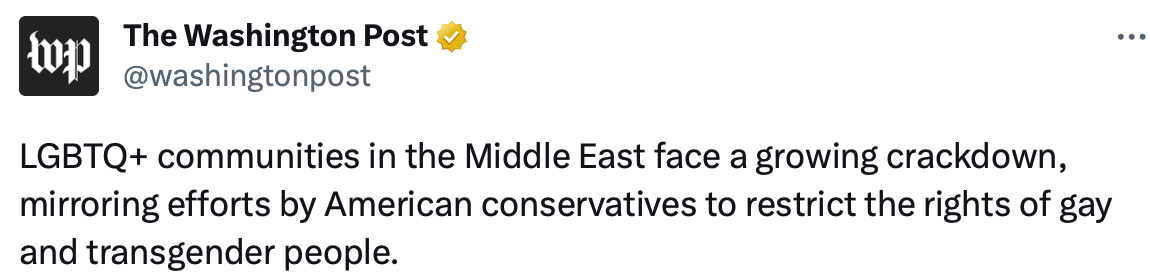
Okay, last crazy headline: Apparently ISIS is anti-gay the same way as America’s conservative Christians are.
As Seth Mandel summarized it: “Iran hangs gays from construction cranes because America still has separate sports leagues for men and women.” I think a lot of the young newspaper writers who argue America is just as bad as Al-Qaeda and that our conservatives are literally ISIS should simply go visit Syria. Frolic in Egypt. Rock out in Yemen. When an American soldier saves you, I doubt you’ll be worrying about whether he’s a Southern Baptist.
Amazon’s Shiny Happy People: Duggar Family Secrets was a documentary waiting to happen ever since the Josh Duggar scandal broke eight years ago. In many ways, it is a documentary that needed to be made. It discusses real problems within the homeschooling movement that many homeschoolers would prefer to ignore. It tells the stories of women and men whose upbringing ranged from deeply flawed to abusive; and it helps to illustrate how one of the most religiously conservative elements in American society, the homeschooling community, might actually contribute to the rise of the Nones. For all this, however, the documentary suffers from a fundamental flaw: it fails to say anything about the millions of ordinary homeschoolers who are raising children in perfectly healthy (and sometimes quite secular) ways.
There is no “fundamental flaw” in failing to balance a story to the satisfaction of every possible critic with an obsession. It’s perfectly legitimate to tell a story about failure without telling a parallel story about success.
I did not view Shiny Happy People as a screed against home schooling, and I think you’d need to be pretty prickly and ideological to view it so. Sadly, many homeschoolers do seem to be prickly and ideological.
Winding up for his pitch, he describes my attitude toward Rufo (emphasis added):
Christopher F. Rufo is what is sometimes known as a shit-stirrer—a particular type of troublemaker whose game is to find something stinky, then waft its fumes toward the noses of those mostly likely to be outraged by it … Even those who find their behavior outrageous often find Rufo’s tactics distasteful as well.
Soon comes the key paragraph:
Your appreciation of this book will depend in part on whether you prefer Rufo the carnival barker, luring in members of the public to see the lefty freakshow he curates, or Rufo the intellectual historian. The first is more fun but the second is just as biased. His description of the careers of these intellectual figures is meant for readers who know nothing of their work, and do not care to learn about it from a sympathetic source. The narrative is meant to build them up only to villainize them—and this is not difficult. Like Rufo’s TikTok freaks, his woke progenitors often said and did things that need no additional commentary to make them into villains.
I’ll take a pass. It has been, I think, more than a decade now since I stopped reading stuff with the tacit goal of winding myself up.
Hippie collectives and corporations
Why did the Dutch publishing outfit need a receptionist? Because a company has to have three levels of command in order to be considered a “real” company. At the very least, there must be a boss, and editors, and those editors have to have some sort of underlings or assistants—at the very minimum, the one receptionist who is a kind of collective underling to all of them. Otherwise you wouldn’t be a corporation but just some kind of hippie collective.
David Graeber, Bullshit Jobs
Property
‘C‘est un bon pays; personne n’est riche là-bas mais tout le monde a des biens.‘
Via Rebecca West, Black Lamb and Grey Falcon. This could be the Distributist Vision Statement: This is a good land; nobody’s rich but everyone has property.
A great modern factory is a waste from the point of view of the need of property; for it is unable to provide either the workers, or the manager who is paid his salary by the board of directors, or the members of the board who never visit it, or the shareholders who are unaware of its existence, with the least satisfaction in connexion with this need.
Simone Weil, The Need for Roots (italics added)
Shorts
Dianne Feinstein, 90, Cedes Power of Attorney to Daughter—But Still Serves in Congress
You can read most of my more impromptu stuff here (cathartic venting) and here (the only social medium I frequent, because people there are quirky, pleasant and real). Both should work in your RSS aggregator, like Feedly or Reeder, should you want to make a habit of it. I’m even playing around a bit here, but uncertain whether I’ll persist.

 Tipsy Teetotaler ن