
- Trendier than Thou; less devout, too.
- Beauty makes a comeback?
- Nicholas Kristof is not just another limousine liberal.
- OWS gets its sea legs, at least a little.
- New blog discovery.
- Another poem touching on aging.
- How extensive is the state’s imperial reach.
- On writing.
Is it just me, or is Frank Bruni’s New York Times column, celebrating Portugal’s adoption of Same-Sex Marriage, oddly open about the rolls of trendiness and calculated impiety?
- “’It’s because we’re married,’ she said. That legal blessing — that loftiest of imprimaturs — has changed little between them but a lot around them.” Note that an “imprimatur,” in its primary meaning, is given by the Roman Catholic Church, which consistently opposes SSM, not from the state. The Right isn’t the only political side blurring church/state lines.
- [Noting the oddity that South Africa, Spain, Portugal and Argentina are among the 10 nations now allowing SSM] “Why those four countries? … [E]ach spent a significant period of the late 20th century governed by a dictatorship or brutally discriminatory government, and each emerged from that determined to exhibit a modernity and concern for human rights that put the past to rest.”
- “Spain’s big step also reflected the tenuousness of the Vatican’s hold on the everyday mores and behaviors in many developed democracies still spoken of as Roman Catholic.” Hillaire Belloc tells of how the British nobility embraced the Reformation to their own wealth their relative political power. I think I hear echoes.
- “The idea that Portugal should do no less than Spain came up repeatedly in my conversations with those who pushed for the Portugal measure, and so did the insistence that Portugal was much more cosmopolitan than many outsiders gave it credit for being.”
- “[F]or many highly educated and young people in Portugal … same-sex marriage became a badge of sophistication, affirming their country as an enlightened place.”
- “Promotion of same-sex marriage branded the party as adaptable and future-oriented.”
- “Portugal was (and to some extent still is) playing catch-up.”
All is not well, however, in Bruni’s eyes: “But progress comes in fits, starts and half steps. Lesbians in Portugal, even married ones, can’t get fertility treatments. Same-sex couples can’t adopt. Some say there are ways in which they envy America, or at least open-minded corners of it.”
“Fertility treatments”?!?! I think Bruni just gave birth to a new euphemism for the commodification of babies!
Reflections on the legacy of Steve Jobs continue. Ross Douthat places him in the ranks, if not in the vanguard, of visionaries bringing America “Up from Ugliness.”
FROM the 1960s through the 1980s, the United States of America conducted a long experiment in ugliness. Our architects grew bored with beauty, our designers tired of elegance, our urban planners decided that function should trump form. We bulldozed row houses and threw up housing projects. We built public buildings out of raw concrete. We wore leisure suits and shoulder pads, buried heart-of-pine floors under shag carpeting, and paneled our automobiles with artificial wood.
This is the world in which Steve Jobs came of age. It was, not coincidentally, a world in which it became easy to believe that the United States was in decline. Our churches looked like recreation centers, and our rec centers looked like re-education camps. Our campuses and civic spaces were defaced by ziggurats of cement. Our cities had crime-ridden towers and white elephant shopping centers where the neighborhoods used to be. Our suburbs were filled with what James Howard Kunstler described as the “junk architecture” of strip malls and ranch houses.
Then, gradually and haltingly, beauty began to make a comeback …
When we think about what Jobs meant to turn-of-the-millennium America, this is the place to start: not just with the technical wizardry behind Macs and iPhones and iPads, but with the Apple founder’s eye for grace and style, and his recognition of the deep connection between beauty and civilization …
You can see a version of this peril in our politics as well. In a sense, Barack Obama’s 2008 march to the White House was the iPhone of political campaigns: a perfect marriage of aesthetics, spectacle and social media, a revival of the old New Frontier excitement, the natural culmination of glamour’s post-1970s comeback in American life. But three years later much of that looks like an illusion — a temporary echo of liberalism’s golden age, evoking successes that today’s Democratic Party can’t recapture.
I’m not sure Douthat’s column is very coherent – it feels like an obligatory Steve Jobs piece – but I think he’s onto something about the return of beauty after a very conspicuous absence.
Some of my conservative friends seems content to dismiss New York Times columnist Nicholas Kristof as just another liberal. I think they’re wrong. Do not click that link if your world is perfectly in balance and you don’t want anything messing with your Karma.
I write partly to figure out what I think about things. I’m a work in process.
Maybe other people have to raise a little hell, and then write, to figure out (and communicate) what they think about things.
In any event, I think, tentatively, that Occupy Wall Street may be marginally increasing its coherence as it lurches along. For instance, here and here, which is somewhat more coherent, and more literate, than what I mocked here.
And, be it noted, I consider this photo markup a pretty lame effort to hang the pretty lame label “hypocrite” on the demonstrators:
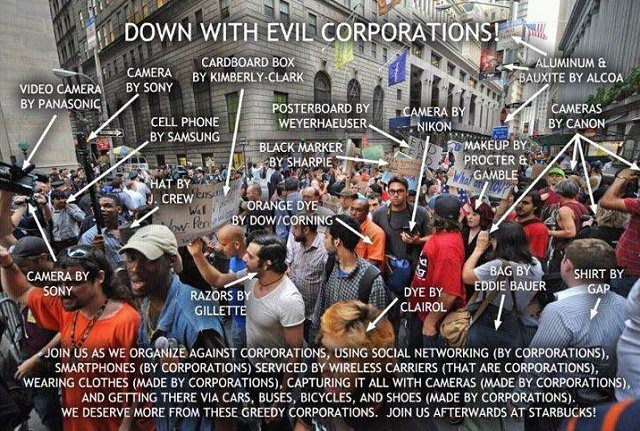
(Sorry, Dave; I call ’em as I see ’em.)
I take great pleasure seeing that there are right-minded Distributist well-wishers as well.
Forecast: Occupy Wall Street, having gained its little coherence from the arrival of labor union support, will reject the Distributist invitation because labor unions live in symbiosis with overreaching corporations. In other words, the Unions will hijack OWS and the GOP “movement conservatives” hijacked the Tea Party.
Ain’t America great?
I was very relieved to find that The Moral Minefield blog, which I just discovered today, is not a solo effort.
Holy Smokes! A lot of links to interesting stuff, if you’re interested in that kind of stuff. Check it out.
“Lovely” is not at all the right word for the poem Jane, at Writer’s Almanac, but as it’s about aging, and as that’s a subject to which I devote much of my professional life, I pass it along with commendation – especially to any whippersnappers reading this.
We curmudgeons should already understand.
I don’t think the question “Are religious groups entitled to disobey the law?” is terribly useful … It reminds me of Marci Hamilton’s efforts to place “the rule of law” front and center in church autonomy debates, and it leaves me unsatisfied for similar reasons. To say that churches should obey “the law” is to raise the very question what “the law” is and what it requires. We can imagine more or less fancy versions of this question. A basic version would have to argue about what “the law” is given the First Amendment. A more elaborate version would ask about the scope and reach of “the law.” No one would think that because American law requires the enforcement of civil rights laws, the United States should seek to enforce Title VII in Saudi Arabia in a case involving Saudi employees of a Saudi company with no connections to the United States. It would be understood to be absurd, even if the statutory text did not mention territoriality or citizenship, because no one understands American law to reach that far. One of the broader arguments made by some champions of the ministerial exception–myself included–is that this case raises questions about the reach of American law, and whether the fundamental church-state settlement that is as much a part of “the law” as anything else really reaches into the internal employment relations of churches with their ministers. We could reverse Griffin’s question somewhat by asking: “Just how extensive is the imperial reach of the state? How far does ‘law’s empire’ go?”
Paul Horwitz on the issues in the Hosana-Tabor religious freedom (or antidiscrimination, if you insist) case argued this week in the Supreme Court.
“Writing is…that oddest of anomalies: an intimate letter to a stranger.” Pico Iyer (HT Writer’s Almanac)
* * * * *
Bon appetit!
If it’s “too big to fail,” break it up into harmless little pieces.
“It is appointed unto men once to die, but after this the judgment.”
(To save time on preparing this blog, which some days consumes way too much time, I’ve asked some guy named @RogerWmBennett to Tweet a lot of links about which I have little or nothing to add. Check the “Latest Tweets” in the upper right pane or follow him on Twitter.)
 Tipsy Teetotaler ن