
There’s a bill in France proposing that “no one can wear a garment intended to hide the face in the public space”.
Unless it’s a fashion show, I guess:
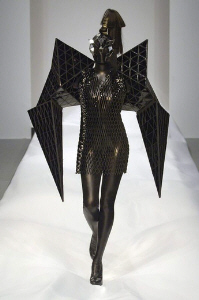
The good folks over at Mercator.net ask if what’s going on really has to do the dignity of women as persons:
[I]t is difficult to escape the impression that the real issue at stake for the French is not the oppression of Muslim women but the visibility of Muslim culture and the way it challenges feminist and secularist assumptions.
Those assumptions also produce blind spots when it comes to the dignity of women. A person who takes that dignity seriously is more likely to be offended by the dress sense of the crowd rather than of an isolated Muslim in a burqa, for the typical European/American/Australian woman today also goes about with something that obscures her face: the exposed breast cleavage just below it.
As western women cling to fashions that aim to reveal everything about the body, they too are depersonalised. The stranger’s eye is not drawn to the face where they might encounter the person, but to the body as a sexual object. And this leads also to oppression, even if the woman, just like the one in the burqa, does not understand that she is oppressed.
Oppressed or not, Muslim women are fighting back. Some who wear the face veil told a group of reporters in France this week that they would not obey the ban (which is expected to come into force next year) and they would not leave the country. They say it is tantamount to denying freedom to practice one’s religion. They talked about having recourse to the European Court of Human Rights if arrested.
As for their dignity, they say it cannot be dictated by the state. The secularism of the state should guarantee religious freedom, they argue. Also, they ask, if the French are such feminists, why do women make up less than 20 per cent of the 577 members of the National Assembly, the lower house of parliament?
Good points, ladies. But the truth that human dignity is not defined by decrees of the state does not mean it is defined by the customs of any particular group, either. For all that some women embrace it willingly, there is something very undignified about hiding the face. The dignity of a woman is the dignity of a person, and the face veil suggests, quite simply, that the wearer is not a person — for her husband and children, maybe, but not for you and me.
This is a sad state of affairs but not one that governments can solve with bans. If anything, these will provoke resentment among Muslims at large and rebellion among the young (watch for more veils appearing, not less). As Muslim leaders themselves say, the answer lies with the education and empowerment of Muslim women.
What would help a lot is a decision by European women to dress and conduct themselves in a style consistent with feminine dignity. Half-bared bosoms and burqa rage are definitely not the way to persuade our Muslim sisters to give up the veil.
Despite all our surface feminism, we really don’t treat women with dignity.
(But do we treat men with dignity, either?)
 Tipsy Teetotaler ن
One thought on “Faces, Burquas and Decolletage”
Comments are closed.