
Quest for certainty
The Reformation is the first great expression of the search for certainty in modern times. As Schleiermacher put it, the Reformation and the Enlightenment have this in common, that ‘everything mysterious and marvellous is proscribed. Imagination is not to be filled with [what are now thought of as] airy images.’ In their search for the one truth, both movements attempted to do away with the visual image, the vehicle par excellence of the right hemisphere, particularly in its mythical and metaphoric function, in favour of the word, the stronghold of the left hemisphere, in pursuit of unambiguous certainty. … What is so compelling here is that the motive force behind the Reformation was the urge to regain authenticity, with which one can only be profoundly sympathetic. The path it soon took was that of the destruction of all means whereby the authentic could have been recaptured.
Iain McGilchrist, The Master and His Emissary
If I were inclined to doubt this analysis, I’d only need to think of the ubiquitous Evangelical insistence that real Christians have assurance of salvation and “eternal security,” whereas I have fear and trembling as I work out my salvation.
Orestes Brownson on “Bible alone”
Orestes Brownson, who was on the verge of leaving behind a checkered career as Protestant, freethinker, and transcendentalist for the Roman Catholic Church, issued a challenge to American Bible-believers in his new role as a Catholic apologist: “We are … never in a condition to rely on the Bible alone. We never go to it wholly devoid of preliminary instructions, and therefore of prepossessions.” Given this circumstance, as Brownson saw the matter, “for the most part, when we do come to study the Bible, we find little else in it than the faith, we have brought to it, so that we may be said to put our faith into the Bible, not to obtain our faith from it.”
Mark A. Noll, America’s God
Brash Jimmy Swaggart
Swaggart’s empire, with receipts of over $150 million annually, fell suddenly in 1989 when he was found with a prostitute in a Baton Rouge motel, caught by a rival preacher whose adultery Swaggart had challenged. Swaggart’s denomination, the Assemblies of God, put him on a on disciplinary probation, which he initially accepted, admitting to decades of sexual struggles, but later rejected when it was prolonged. Instead, he effusively and tearfully on television admitted he had sinned, and then he resumed his ministry. But his church emptied, the dollars shrank, the television contracts ended. He was again discovered with a prostitute in 1991, after which he offered no public apologies. He was still doing the Lord’s work. Swaggart embodied the growing rejection of denominations by increasingly individualistic American Christians. Before the internet, there was television ministry, which made denominations, and even physical church, seem inconsequential to many.
Mark Tooley, Jimmy Swaggart & Brash USA Christianity (bold added)
Unlike some of my acquaintances, I was never a Swaggart devoteé. I was aware of him; he bought (or was given) air time on a Christian Radio station I listened to during a part-time desk job, but he wasn’t why I tuned in — more a bug than a feature (J. Vernon McGee was the feature).
My priors about southern charismatics left me unsurprised at his Fall, though his emotionalism was very skillful and even convincing at times, unlike, say, Jim and Tammy Fay.
God is, as always, merciful and loves humankind. Requiescat in pace, y’all.
Another take on Swaggart
Rod Dreher encountered Jimmy Swaggart after Swaggart’s first unmasking as a user of prostitutes:
I was there, at the Family Worship Center, for this electrifying sermon. I was a student at LSU, and a writer for the campus newspaper. Swaggart had been under fire, and word got out that he was going to make a big announcement on Sunday morning. I went to hear it. I was not a Christian then, in any real sense, though I was making my way towards the faith. I certainly had nothing but contempt for the man back then.
But a strange thing happened to me as I heard his sermon. I was sitting up in the rafters, and expected to feel a sense of Schadenfreude over the fire-and-brimstone televangelist’s downfall. In the moment, though, I looked around me, and saw a crowd of broken people. They were crying, or at least sitting there in shock and disbelief. I noticed that these were not well-dressed people, but men and women wearing the clothes of working-class and lower middle class folks. The kind of people that I came from. And they were in pain.
I didn’t stick around. I remember walking out to my car, feeling awful. I had no sympathy at all for Swaggart, but I felt bad for all those who had believed in him, and been conned. This surprised me. It’s one thing to see a man one regarded as a religious charlatan brought low, but to see the pain of simple people in the face of their spiritual leader’s unmasking? Well, it made my liberal triumphalism seem like a shameful, immature thing. I didn’t know what to do with that.
I’m not convinced that Swaggart was a charlatan insofar as that implies conscious deception at a pretty deep level. I’ve got too many incidents of my own I’d be mortified to have brought under bright lights. You probably do, too. But I don’t think that made me a charlatan. It just proved that I was spiritually immature and formed in part by what my particular Christian upbringing legalistically forbade – and what it thereby tacitly allowed. Imagine growing up with Jerry Lee Lewis and Mickey Gilley as cousins.
I’ll stop there lest I lapse into a confessional essay that would do nobody any good.
The oneness of God
One might say that while for the Greeks there is one God because there is one Father, for the Latins there is one God because there is one Essence, one divine and entirely simple Being.
It can now be seen how, as the presuppositions of the respective views of the Latins and Greeks differed, so did their ways of envisaging the ‘structure’ of the Trinity; and how, further, given the ‘absoluteness’ of these presuppositions, the rival representations of the Trinity which derived from them must also appear absolute. If the Greeks assumed as axiomatic, first, their understanding of the Essence; second, their understanding of the distinction between the Essence and the powers and energies of the Divinity, and hence between the Essence and hypostatic powers of each Person of the Trinity; and, third, their idea that the cause and principle of being in the Trinity is the hypostasis of the Father, it was impossible for them to admit that the Spirit proceeds from both Father and Son, for this would have implied a violation of their axioms. In the same way, if the Latins took as axiomatic the idea that Essence and Being and power form a single and entirely simple divine nature, it was impossible for them not to conclude that the Spirit proceeds from the Father and the Son.
Philip Sherrar, The Greek East and the Latin West, p. 70
American efficiency
What the Japanese Imperial government could not do in 250 years of persecution (destroy Japanese Christianity) American Christians did in 9 seconds.
Gary G. Kohls, MD, Unwelcome Truths for Church and State Concerning the Bombing of Nagasaki August 9, 1945
Discerning Christ in the Old Testament
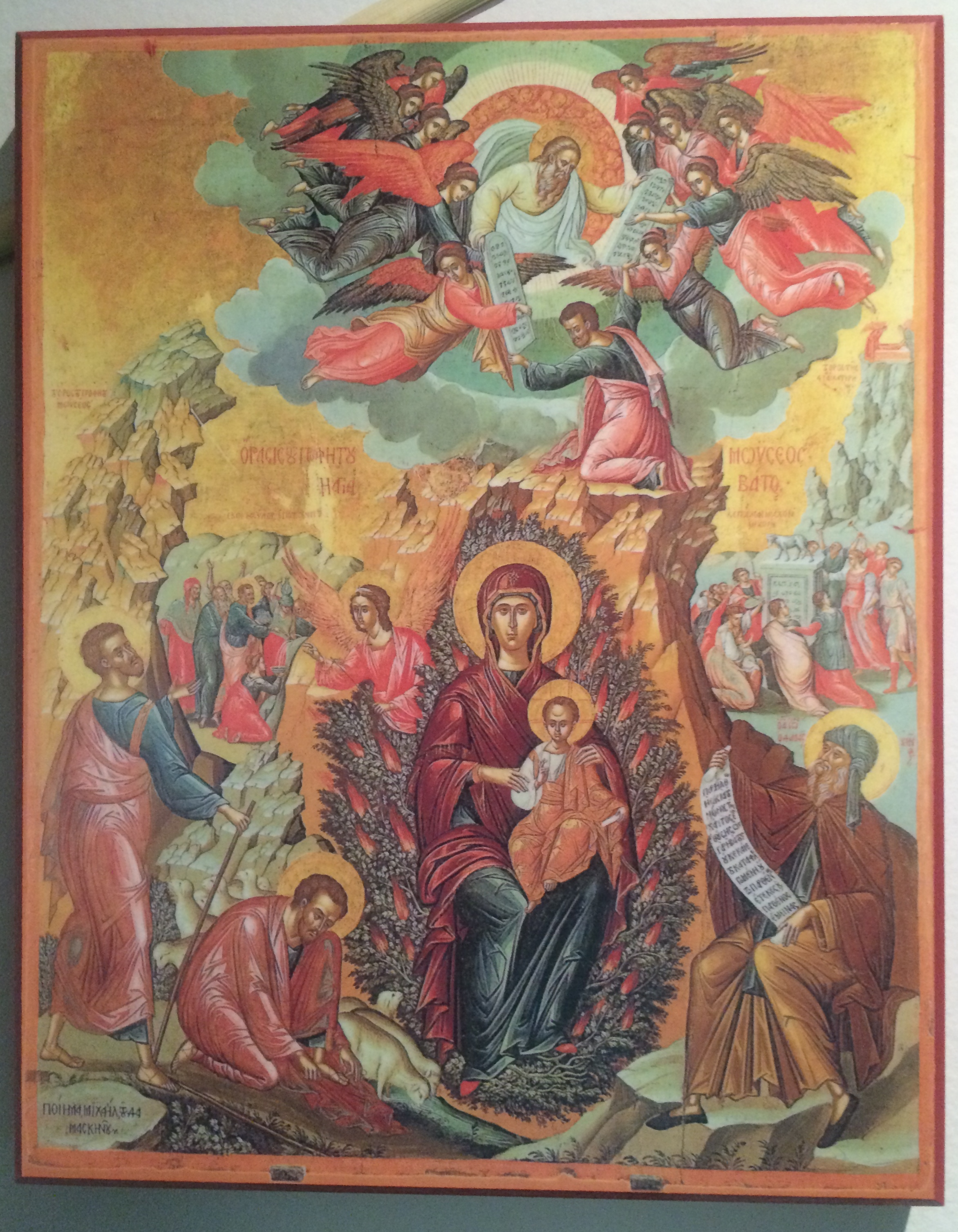
What was the mind that could see Christ in the Passover Lamb? Indeed, what was the mind that could see Christ’s death and resurrection as a fulfillment of Passover itself? Beneath the letter of the Old Testament, beneath the surface of its poetry, its historical stories, its prophetic works, the primitive Church discerned Christ Himself and the shape of the story which we now know as the gospel.
The shape of the gospel story is not derived from the Old Testament. It is discerned within the Old Testament, after the resurrection of Christ and His subsequent teaching …
For example, that “Christ died for our sins,” is not obvious. It can be discerned in the Old Testament if one comes to understand, for example, that the “Servant Songs” in Isaiah are actually referencing Christ. … When that tradition is accepted and “received” (more about this in a moment), then passages like the Servant Songs begin to open up and yield their deeper meaning.
When a gospel writer shares a story about Christ and adds, “This was done that the saying in Isaiah might be fulfilled…,” we are reading the tradition in its operation. But the passages in Isaiah do not themselves give a clue for their interpretation. …
The giving of this tradition is described in Luke 24:44-48:
Then He said to them, “These are the words which I spoke to you while I was still with you, that all things must be fulfilled which were written in the Law of Moses and the Prophets and the Psalms concerning Me.” And He opened their understanding [nous], that they might comprehend the Scriptures. Then He said to them, “Thus it is written, and thus it was necessary for the Christ to suffer and to rise from the dead the third day, “and that repentance and remission of sins should be preached in His name to all nations, beginning at Jerusalem. “And you are witnesses of these things. (Luke 24:44-48)
It is important to see that this new insight into the Scriptures is described as a noetic event. It is not described as technique or style of interpretation that is taught and learned. It is specifically referred to as a change of the nous. In the same manner, the continued understanding of the gospel is, properly, a noetic exercise.
That noetic perception is the common thread of the liturgical texts and hymns of the Orthodox faith. The liturgical life of the Church has a two-fold purpose: the worship of God and the spiritual formation of the people of God. As cited earlier, there must be a movement from “flesh and blood” to “spirit and life.” It is this spiritual transfiguration that is operative in the life of the Church.
This is the same reason that I have written against popular notions of morality. The Christian life does not consist of flesh and blood struggling to behave better. Rather, it is the transformation of flesh and blood into spirit and life. Only a “new creation” (2 Cor. 5:17) sees and understands and lives the new life of the resurrected Christ.
This spiritual ability to see beneath the letter and perceive the truth continues in the life of the Church, unabated. It is particularly evident in the dogmatic formulations of subsequent centuries. Only a nous, properly illumined, could learn to profess the Trinity in the fullness of its mystery. The same is true of Christ’s God/Manhood and the nature of our salvation through the Divine Union.
In the Orthodox Church, the story of Christ’s resurrection appearance on the road to Emmaus is a frequent reading. The thing that rivets me is that Christ had to walk through the Old Testament with his disciples, teaching them about the “things concerning Himself.” They weren’t all obvious, but they were precious. And oddly enough, they never were systematically enscripturated. But the Church knows them deep in its bones now.
Religious ideas have the fate of melodies, which, once set afloat in the world, are taken up by all sorts of instruments, some woefully coarse, feeble, or out of tune, until people are in danger of crying out that the melody itself is detestable.
George Elliot, Janet’s Repentance, via Alan Jacobs
[N]one of the things that I care about most have ever proven susceptible to systematic exposition.
Alan Jacobs, Breaking Bread With the Dead
You can read most of my more impromptu stuff here and here (both of them cathartic venting, especially political) and here (the only social medium I frequent, because people there are quirky, pleasant and real). All should work in your RSS aggregator, like Feedly or Reeder, should you want to make a habit of it.
 Tipsy Teetotaler ن