Thursday, 1/22/26

Political Theory

The next two items, though illustrated by our present political circumstances, are intended to make points that will continue to be important in new circumstances.

Integrity matters

The health of the American experiment rests far more on the integrity of any given American president than we realized.

We trusted that presidents would impose accountability on the executive branch. We trusted that presidents wouldn’t abuse their pardon power — or, if they did, then Congress could impeach and convict any offenders. And so we manufactured doctrine after doctrine, year after year, that insulated the executive branch from legal accountability.

It’s hard to overstate how much this web of immunities — combined with the failure of Congress to step up and fulfill its powerful constitutional role — has made the United States vulnerable to authoritarian abuse.

In Federalist No. 51, James Madison wrote some of the most famous words of the American founding. “If men were angels, no government would be necessary,” Madison wrote. “If angels were to govern men, neither external nor internal controls on government would be necessary. In framing a government which is to be administered by men over men, the great difficulty lies in this: You must first enable the government to control the governed; and in the next place oblige it to control itself.”

David French (shared link)

The Prerogative State

The David French column continues. I broke it in two because I thought it was important, once again, to warn against ever again electing high officials of such low character.

But there’s a specific ramification I hadn’t identified:

[Y]ou can see the emerging dual state in action in Minneapolis right now. In much of the city, life is routine. People create new businesses, enter into contracts, file litigation and make deals as if life were completely normal and the rule of law exists, untainted by our deep political divide.

But if you interact with ICE, suddenly you risk coming up against the full force of the prerogative state. One of the most heartbreaking aspects of the ICE agent’s video of the fatal encounter between Renee Good and ICE is that it’s plain that Good thinks she’s still in the normative state. She has no idea of the peril she’s in.

She seems relaxed. She even seems to have told the agent that she’s not mad at him. In the normative state, your life almost never depends on immediate and unconditional compliance with police commands.

But she wasn’t in the normative state. She had crossed over the border to the prerogative state, and in that state you can be shot dead recklessly, irresponsibly and perhaps even illegally, and no one will pay the price. You might even be rewarded with more than $1 million in donations from friends and allies.

David French (shared link)

Competing, revealing, metaphors

In February … I spoke at a gathering of conservatives in London called the Alliance for Responsible Citizenship …

As the conference went on, I noticed a contest of metaphors. The true conservatives used metaphors of growth or spiritual recovery. Society is an organism that needs healing, or it is a social fabric that needs to be rewoven. A poet named Joshua Luke Smith said we needed to be the seeds of regrowth, to plant the trees for future generations. His incantation was beatitudinal: “Remember the poor. Remember the poor.”

But others relied on military metaphors. We are in the midst of civilizational war. “They”—the wokesters, the radical Muslims, the left—are destroying our culture. There were allusions to the final epochal battles in The Lord of the Rings. The implication was that Sauron is leading his Orc hordes to destroy us. We are the heroic remnant. We must crush or be crushed.

The warriors tend to think people like me are soft and naive. I tend to think they are catastrophizing narcissists. When I look at Trump acolytes, I see a swarm of Neville Chamberlains who think they’re Winston Churchill.

David Brooks, I Should Have Seen This Coming, April, 2025.

Occasionally, I achieve a complete mind-meld with Brooks. This was one of those times, at least for the first third of his article; after that, he notes some things that I hadn’t noticed until he pointed them out.

Sanctuary City primer

So-called “sanctuary cities” and “sanctuary states” choose not to assist the federal government in finding or deporting illegal aliens, and they have a constitutional right to make that choice.

What does noncooperation look like on the ground? A flash point involves immigration detainer orders, which call on state and local law enforcement agents to transfer into ICE custody illegal aliens who are about to be released from state custody.

The administration says that Minnesota is refusing to honor ICE detainers and has released hundreds of illegal aliens “onto the streets” instead of turning them over to ICE. Minnesota denies this accusation and insists that it’s honoring all immigration detainers.

Whichever side is correct, federal courts have held that ICE detainers issued to state agencies are “requests,” not “orders.” …

The federal government does have a mechanism for getting states and cities to voluntarily do what they can’t be forced to do. It’s called money. Congress could deny states or cities certain funds unless they abolish their sanctuary policies. There are limits to this strategy: Washington can’t shut off unrelated funds that states or cities need to keep functioning. But immigrant-related federal funding—for example, money devoted to sheltering new, legal immigrants—could presumably be denied to states and cities that maintain sanctuary policies.

On Tuesday, President Donald Trump declared that after February 1, “We are not making any payments to sanctuary cities or states having sanctuary cities.” But while Congress could condition state and local funding on cooperation with ICE, the president’s powers are more limited. Trump has tried this strategy before. Both in his first term and second, he issued executive orders calling for sanctuary states and cities to be denied federal monies. Except in narrow circumstances, courts have not been receptive, holding that without congressional approval, the president could not unilaterally deny states money that Congress had already appropriated for them.

Jed Rubenfeld

The name “Sanctuary City” has always struck me as a bit preening, but the principle that that cities and states are not (normally, though if there are exceptions, I can’t think of one) obliged to assist in enforcement of federal law or in advancement of federal priorities. A non-immigration example is marijuana legalization by the states, whereas marijuana remains illegal in national law. If and when the DEA comes to bust up a dispensary, local officials presumably won’t help, but the principle doesn’t allow them to interfere, either.

Of being a conservative radio talk-show host back in the day

So for years, when someone sent me something that was a conspiracy theory, or false, or just misleading or unfair, I would be able to push back and say “this is not true; there are not bodies stacked up in the Clinton warehouses; no this is not happening over here,” and people would say “thank you, Charlie for setting me straight” …

[I]n 2015 and 2016, what I found, very gradually but very forcefully, was that it became harder and harder to push back; it became harder and harder to give them any information that would change their mind.

And that’s when I realized that we had been too successful, that we had destroyed all the immune system to false information, to this kind of propaganda. And this was kind of an “Oh, shit!” moment for me.

Charlie Sykes, interviewed by Andrew Sullivan.

Morality, Law and Religion

The public should be absolutely concerned about whether a nominee for judicial office will be willing and able to set aside personal preferences. That’s not a challenge just for religious people. That’s a challenge for everyone.

Amy Coney Barrett (italics added)

Pet peeve: The idea that “separation of church and state” requires religious public officials and employees to set aside their religious beliefs when conducting public business. The tacit message in that is either that (1) morality and law are completely separate or (2) that religion is inherently irrational whereas other moral beliefs are not. In truth, there is no neutral, preference‑free judicial standpoint, and the available standpoints all are larded with moral intuitions that either can be accused of irrationality.

Yes, I have advocated in public meetings where I wished that others on “my side” would shut up if all they had to contribute was dubiously-applicable Bible proof-texts. But those kinds of folks never get nominated for any federal bench, and they’d be eaten alive if they were.

Consequences

The yield spread between three-month Treasury bills and 10-year bonds has widened by some 0.6 percentage points since early November. “The Fed may want lower interest rates, but the market ain’t buying it,” said Willian Adler, an Elliott Wave technical analyst.

He warns that the conditions are in place for a serious sell-off across risk assets. It could be similar to the bond rout that spooked Trump after the “liberation day” tariffs.

This rising spread may simply reflect fears of resurgent inflation as front-loaded stimulus from the “one big beautiful bill” juices the economy over the coming months, with the risk of full-blown overheating if Trump hands out $2,000 a head as a pre-electoral bribe.

But it may also be the first sign that America is starting to pay a price for the collapse of political credibility.

(Telegraph UK via John Ellis)

Unpopular opinions

I keep a private list of my truly unpopular opinions – opinions so far outside the Overton Window that I could lose friends if I voiced them.

I review and supplement the list occasionally, but never before have I decided that something doesn’t belong on the list any more (or maybe never belonged on it in the first place). This one probably never belonged on the list:

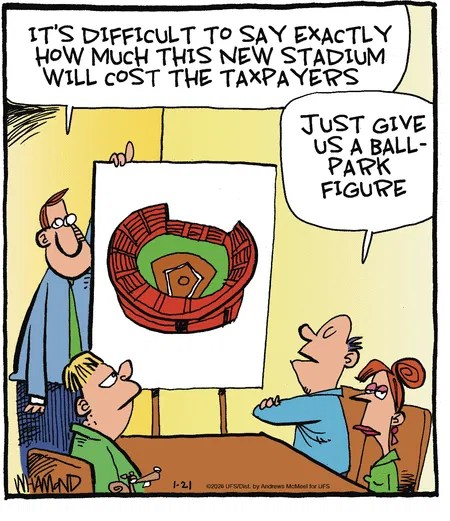
1. Subsidies for pro sports, including stadium construction, are damnable boondoggles. I would vote against every one of them until the franchise-owning billionaires ran me out of office.
While I’m at it, these too can come off the list:

2. Abolitions I supported that may well have hurt America:

  • The military draft Politicians who have anything to do with war policy should have skin in the game, even if it’s the skin of their descendants.
  • The Fairness Doctrine. We opened Pandora’s box before cable TV and the internet obliterated it. I don’t see a way back to sanity through reinstating the policy.

While I’m on a roll, here’s one that’s never been on the list:

3. The states should stop running primary elections. Neither major party is worth the powder to blow it up. Let them run their own elections or go back to “smoke-filled rooms” (which incidentally yielded better candidates than crackpot “base voters” have been yielding).

Logic mincing

Q: Which is better: a ham sandwich or complete happiness in life?
A: A ham sandwich, of course! Nothing is better than complete happiness in life and a ham sandwich is better than nothing.

  1. Something must be done!
  2. This is something.
  3. This must be done!

Shorts

  • No one is really working for peace unless he is working primarily for the restoration of wisdom. The assertion that “foul is useful and fair is not“ is the antithesis of wisdom. (E.F. Shumacher) Small Is Beautiful is a classic for good reason.
  • The national emergency is avoiding a national emergency. (Treasury Secretary Scott Bessent, citing the president’s authority to impose tariffs in an economic emergency, arguing that America’s supposed need to control Greenland is a national emergency.)
  • The health of the American experiment rests far more on the integrity of any given American president than we realized. (David French)
  • The pervasiveness of legal sports gambling can make an undefeated season and a 6-point victory in the national championship game feel like a loss if “the margin” was 7.5. (Moi)
  • At some point, we’ll reach the bottom of this dystopian populist abomination, but no one thinks we’re there yet, do they? (Nick Catoggio)
  • “The Trump Denmark letter is his Biden debate moment,” one Twitter user claimed.
  • Donald Trump is a peacock among the dull buzzards of American politics. (Martin Gurri, The Revolt of the Public and the Crisis of Authority in the New Millennium).
  • A clown with a flame thrower still has a flamethrower. (Charlie Sykes to Andrew Sullivan)
  • When you light a candle, you also cast a shadow. (Ursula K. Le Guin)
  • TikTok is still a danger. America no longer cares.
  • The souvenir is a fetish object that substitutes for the finite experience of the destination. (William T. Cavanaugh, The Uses of Idolatry)

Elsewhere in Tipsyworld


A devil is no less a devil if the lie he tells flatters you and stands to help you defeat your enemies and achieve power.

Rod Dreher

I don’t do any of the major social media, but I have two sub-domains of the domain you’re currently reading: (a) You can read most of my reflexive stuff, especially political here. (b) I also post some things on my favorite no-algorithm social medium.

CRT! (and some other stuff)

I’m trying out a new theme for the appearance of this blog. I often want to do quotes-within-quotes, and my current theme not only doesn’t do that (at least with Markdown files as the source), but makes the attempt look amateurish. I hope the new theme does better.

Mediocrities everywhere!

The 1984 film, Amadeus, tells the story of the child genius, Mozart. IMdB describes it in this manner:

The life, success and troubles of Wolfgang Amadeus Mozart, as told by Antonio Salieri, the contemporaneous composer who was insanely jealous of Mozart’s talent and claimed to have murdered him…

Mozart’s genius is so profound that it is little more than a toy in the hands of a very spoiled and immature boy/man. Salieri feels that, in Mozart’s existence, God is mocking him. He has dedicated his life to his work, even “to the glory of God,” and nothing he produces can be compared to the slightest trifle of Mozart’s irreverent gift. In the last scene of the film, Salieri, now confined to a mental institution (from where he is relating the tale) blesses the world:

“Mediocrities everywhere! I absolve you!”

Salieri implicates the whole of the world in his crime, describing himself as the “patron saint of mediocrities.” It is one of the most deeply affecting scenes I have ever encountered.

His crime is driven by envy. It is a story that brilliantly exposes the reality that envy is the product of shame and our inability, or unwillingness, to bear it …

[M]ost of the time throughout history, there is a slow and steadfast persistence of grace that, on the one hand, sustains us in our existence, and, on the other, constantly makes the fruit of our lives exceed the quality of our work. We offer him what is mediocre, at best, and He yields back to us thirty-fold, sixty-fold, a hundred. Indeed, we fail to understand that what some might judge to be “mediocre” is itself a work of grace.

… We are beloved mediocrities who have been commanded to become gods (by grace).

Fr. Stephen Freeman, ‌Mediocrity, Envy, and Grace

CRT! CRT! CRT!

CRT is far from the most important topic in this blog installment (see above for something far more important), but it seems to be click-baity.

Seriously, I’m trying for more than click-bait here. We have too much of that on this topic.

The “zero-sum” race mistake

Virulent racists and anti-racist activists would seem to have little in common, but in fact they tend to agree on one mistaken premise: Race relations are a zero-sum game. If whites are doing well, it’s at the expense of members of other races. If members of other races are doing well, it’s at the expense of whites.

On the racist (or “white nationalist”) side, this assumption means that members of other groups need to be subordinated so that whites can thrive. For anti-racists, this means that since whites have benefited at the expense of other groups, whites will now have to give up their “privilege” and reduce their own standard of living to allow other groups to thrive.

In fact, whites, as a group, don’t benefit from discrimination against, or oppression of, other groups, except perhaps psychologically if such discrimination and oppression make them feel superior and such feelings of superiority make them happy. But from a purely economic perspective, wealth comes from gains from trade, and the wealthier your trading partners, the more wealth you can accrue.

David Bernstein, Racists and (Many) Anti-Racists Make the Same “Zero Sum” Mistake – Reason.com

Stumbling over their own anti-CRT feet

I think my point is clear at this point. The defenses of anti-CRT laws are time and again running aground on the rocky shoals of … the actual anti-CRT laws. Welcome to the incredible difficulty of drafting speech codes. For decades, some of the smartest minds in higher education, Big Tech, and elsewhere have been trying hard to draft laws that ban the ideas they don’t like without sweeping too broadly or creating unintended consequences.

The allure is obvious. If we have the power to ban harmful speech, why not ban harmful speech? But the execution is always clumsy and dangerous if it’s broad, and narrow to the point of irrelevance if it’s precise. Another National Review pal, Ramesh Ponnuru, put things well in his own contribution to the debate in Bloomberg. “But regulation can be defensible in principle,” he says, “without a particular regulation being wise in practice. Some of the provisions in these bills are vague and sweeping.”

Yes, yes they are. But then Ramesh makes this vital point: “The more precisely these laws are written, though, the less they will proscribe and the easier they will be to evade.”

Yup. And that’s exactly why I circle back to my proposal—better curriculums and civil rights litigation. Thus you give teachers the confidence to teach something concrete and real without creating a fear that even their own course materials might suddenly be illegal …

David French, Even the Defenses of Anti-CRT Speech Codes Show the Problems With Anti-CRT Speech Codes

What’s really inflaming the CRT fights?

Again, I want to start with what the new progressivism is interested in changing. One change involves increasingly familiar terms like “structural” and “systemic” racism, and the attempt to teach about race in a way that emphasizes not just explicitly racist laws and attitudes, but also how America’s racist past still influences inequalities today.

In theory, this shift is supposed to enable debates that avoid using “racist” as a personal accusation — since the point is that a culture can sustain persistent racial inequalities even if most white people aren’t bigoted or biased.

… [T]he basic claim that structural racism exists has strong evidence behind it, and the idea that schools should teach about it in some way is probably a winning argument for progressives. (Almost half of college Republicans, in a recent poll, supported teaching about how “patterns of racism are ingrained in law and other institutions.”) Especially since not every application of the structural-racist diagnosis implies left-wing policy conclusions: The pro-life and school choice movements, for instance, regularly invoke the impact of past progressive racism on disproportionately high African-American abortion rates and underperforming public schools.

What’s really inflaming today’s fights, though, is that the structural-racist diagnosis isn’t being offered on its own. Instead it’s yoked to two sweeping theories about how to fight the problem it describes.

First, there is a novel theory of moral education, according to which the best way to deal with systemic inequality is to confront its white beneficiaries with their privileges and encourage them to wrestle with their sins.

Second, there is a Manichaean vision of public policy, in which all policymaking is either racist or antiracist, all racial disparities are the result of racism — and the measurement of any outcome short of perfect “equity” may be a form of structural racism itself.

The first idea is associated with Robin DiAngelo, the second with Ibram X. Kendi, and they converge in places like the work of Tema Okun, whose presentations train educators to see “white-supremacy culture” at work in traditional measures of academic attainment.

Ross Douthat, ‌The Excesses of Antiracist Education (bold added)

CRT dissent

I don’t even think the far left’s attempt to dismantle liberal democracy through critical race theory has been entirely a bad thing. It has revealed a consensus too: that we need to do better in telling the brutal truth about our white supremacist past. It’s been encouraging that even Republicans now agree that the Tulsa Massacre, one of the darkest moments in American history, should be taught without any attempt to disguise its evil. If this helps historians — and not critical race theorists — to uncover more of this shame, and to reckon with it, we will be a stronger country for it. It’s a real gain to have bipartisan support for a new federal holiday celebrating Juneteenth. And it’s also clear that the stealth campaign to indoctrinate children in the methods of CRT has begun to meet a real obstacle: parents of all races and backgrounds appalled by its racism.

Andrew Sullivan, Reasons To Be Cheerful, Part III. This one was near the top for me personally: Boring news cycle deals blow to partisan media – Axios

Angels on the head of a pin

A glib speaker in the Brains Trust once entertained his audience (and reduced the late Charles Williams to helpless rage) by asserting that in the Middle Ages it was a matter of faith to know how many archangels could dance on the point of a needle. I need not say, I hope, that it never was a “matter of faith”; it was simply a debating exercise, whose set subject was the nature of angelic substance: were angels material, and if so, did they occupy space?

Dorothy L. Sayers, The Lost Tools of Learning

Elusive expression

The humanists felt that literature was closer to life, that it provided a better lens onto the moral and spiritual life of man. In short, they elevated imagination to its rightful place alongside faith or reason as one of the fundamental faculties of human nature. Erasmus often vented his frustration when his comic and satirical works were attacked and misunderstood. Those “whose ears are only open to propositions, conclusions, and corollaries” are deaf to the more subtle literary techniques of irony and ambiguity.

Gregory Wolfe, Beauty Will Save the World

Propositional truth, once a hallmark of evangelicalism, is making way for more elusive means of expression, such as narrative, image, and symbol.

Hans Boersma, Heavenly Participation

Trump’s legacy

Wehner: What do you think is the most important legacy that Trump will leave?

Rauch: In the world I’m thinking and writing about, it’s that he has modeled for all time to come how to apply Russian-style disinformation in U.S. politics. And although he may have particular genius at doing that, this is an art that lots of people can practice. The KGB practiced it very successfully for a long time, not because they were geniuses, but because they had technicians who knew how to do it.

So it’s not just Trump anymore. I think he’s transformed the Republican Party into an institutionalized propaganda outlet; I think he’s had the same effect on conservative media, and that’s very hard to pull back in. Because once people start doing that, and they know it works, they continue to do it. And also the Republican base is in on it. They like it.

Disinformation is a participatory sport, not a spectator sport. It’s fun to tell yourselves narratives about how you really won; the other side cheated; you’re heroically taking back democracy; you’re in an existential fight against evil; you’re saving the country. This is way more fun than the boring truth. So the base now has picked up this style of spinning conspiracy tales, telling them to itself, acting on it; and the base is now leading the politicians. I don’t know how you put that genie back in the bottle. I think that’s maybe his most important contribution.

Peter Wehner, Jonathan Rauch on America’s Competing Totalistic Ideologies

Politics of loneliness

Work more often involves analysis of symbols (ideas and numbers) and takes place mostly within our own heads, mediated by technology, with remote work also becoming more common in recent years.

Damon Linker, ‌The politics of loneliness is totalitarian.

Linker lists several likely culprits for the surge of friendlessness over the past 30 years, but this one converged (I think) with other reading I’m currently doing.

Giving up on prohibition

Michael Pollan, whose writing about food I’ve admired, is turning to the “D” in FDA these days, advocating (with some nuance) for legalization of may currently illicit drugs. He’s especially fascinated by hallucinogenics, but hasn’t overlooked opioids:

Many people (myself included) are surprised to learn that the overwhelming majority of people who take hard drugs do so without becoming addicted. We think of addictiveness as a property of certain chemicals and addiction as a disease that people, in effect, catch from those chemicals, but there is good reason to believe otherwise. Addiction may be less a disease than a symptom — of trauma, social disconnection, depression or economic distress. As the geography of the opioid and meth crises suggests, one’s environment and economic prospects play a large role in the likelihood of becoming addicted; just look at where these deaths of despair tend to cluster or the places where addiction to crack cocaine proliferated.

Two findings underscore this point, both described in Johann Hari’s 2015 book on drug addiction, “Chasing the Scream.” Much of what we know, or believe we know, about drug addiction is based on experiments with rats. Put a rat in a cage with two levers, one giving it heroin or cocaine, the other sugar water, and the rat will reliably opt for the drug until it is addicted or dead. These classic experiments seemed to prove that addiction is the inevitable result of exposure to addictive drugs, a simple matter of biology. But something very different happens when that experimental rat is sprung from solitary confinement and moved to a larger, more pleasant cage outfitted with toys, good food and companions to play and have sex with. This is the so-called rat park experiment, devised by a Canadian psychologist named Bruce Alexander in the 1970s. He and his colleagues found that in this enriched environment, rats will sample the morphine on offer but will consume a small fraction of the amount consumed by rats living in isolation, in some cases five milligrams a day instead of 25. Dr. Alexander came to see that drug abuse isn’t a disease; it’s an adaptation to one’s environment and circumstance — to the condition of one’s cage.

The second phenomenon Mr. Hari recounts took place at the end of the Vietnam War. Some 20 percent of U.S. troops became addicted to heroin while in-country. With the war coming to an end, experts worried about tens of thousands of addicts flooding America’s streets. But something unexpected happened when the addicted service members got home: Ninety-five percent of them simply stopped using. It made no difference whether or not they received drug treatment. This is not to minimize the harm done by heroin to those who couldn’t quit; it is only to suggest that there is much more to addiction than exposure to an addictive drug

Michael Pollan, How Should We Do Drugs Now? (The New York Times)

I think Pollan is right that legalization of a lot of drugs is where the country is headed. I’m far from convinced that it’s a good trend, but am leaning toward “opposed but not distraught”.

Pollan:

We shouldn’t forget that two of the most destructive drugs in use today — alcohol and tobacco — have long been perfectly legal. Having wisely given up on prohibition, we’ve worked hard as a society to regulate their use, deploying both laws and customs. Recognizing the dangers of tobacco, we’ve desocialized its use over the past 50 years, devising rules and taboos about when and where one may smoke. Along with high taxes, these expressions of cultural disapproval have substantially reduced tobacco use …

There’s enough libertarian in me for that to sound pretty good, and that’s without getting into how enforcement of drug laws disparately affects some minority groups — part of the “systemic racism” that’s hard to deny.

New construct: “Luxury Surveillance”

I am not without sin when it comes to Luxury Surveillance, the willingness, if not eagerness, to adorn oneself and one’s life with tools of surveillance capitalism.

On the good side, I shut off the microphone on my Amazon Echo so Alexa can’t listen in on daily life. (A lot of people say Amazon started sending ads for things that had been discussed in Alexa’s hearing.) On the bad side, I was drooling over Apple Watch this week — an itch I ended up scratching with a $30 Casio dumb watch.

But really, read the article Luxury Surveillance and see if you want to play in this game. Or if you can’t change your life without getting furious, you can read ‌Delete Your Amazon Prime Account. Now..

Debriefing Covid

The last thing I would say is sort of a core failure is Zoom. I think many people think Zoom is what liberated us—were it not for Zoom, how bad would this pandemic have been? But my counterfactual is different. Zoom allowed a lot of upper-middle-class white-collar people the ability to work and make money and not lose their jobs, and to exclude themselves from society. That fundamentally changed the pandemic. If you went back 15 years ago, and you didn’t have Zoom, you would be facing unprecedented layoffs of wealthy, upper-middle-class people. I think a lot of businesses would have had staggered schedules and improved ventilation. Schools would have pushed to reopen. Amazon Prime and Zoom and all these things in our lives allowed a certain class of people to be spared the pains of COVID-19, taking them out of the game, and making them silent on many of the issues that affected other communities.

The closing of those schools doesn’t have a relationship to the spread of the virus, or the hospitalizations, or the deaths. It’s only really related to the political valence of the town, and the strength of the teachers union. Strong union towns that are left-leaning were far more likely to be closed than right-of-center places that have weaker unions. What sense does that make? That’s certainly not a virus driving that decision. It’s a policy decision. It’s playing politics with kids.

Vinay Prasad, associate professor in Epidemiology and Biostatistics at the University of California San Francisco, interviewed (along with others) by Emily Yoffe in ‌What We Got Wrong (and Right) About COVID-19

Orbital obliquity

SciTech Daily:

Planets which are tilted on their axis, like Earth, are more capable of evolving complex life. This finding will help scientists refine the search for more advanced life on exoplanets. […]

“The most interesting result came when we modeled ‘orbital obliquity’ — in other words how the planet tilts as it circles around its star,” explained Megan Barnett, a University of Chicago graduate student involved with the study. She continued, “Greater tilting increased photosynthetic oxygen production in the ocean in our model, in part by increasing the efficiency with which biological ingredients are recycled. The effect was similar to doubling the amount of nutrients that sustain life.”

“Orbital obliquity” is one of those scientific terms — like “persistence of vision” and “angle of repose” — that just cries out for metaphorical application.

All of the writers and thinkers I trust most are characterized by orbital obliquity. They are never quite perpendicular; they approach the world at a slight angle. As a result their minds evolve complex life.

(Alan Jacobs, orbital obliquity – Snakes and Ladders)

Weary of hearing what he has never heard

The worst judge of all is the man now most ready with his judgements; the ill-educated Christian turning gradually into the ill-tempered agnostic, entangled in the end of a feud of which he never understood the beginning, blighted with a sort of hereditary boredom with he knows not what, and already weary of hearing what he has never heard.

G.K. Chesterton, The Everlasting Man


You can read most of my more impromptu stuff at here. It should work in your RSS aggregator, like Feedly, should you want to make a habit of it.