May 9, 2025

Trump, Trumpism

Two Americas in a nutshell

America continues divided into two groups. One thinks, “He is something that happened to us.” The tone is shocked, still, and bewildered: Did I live in this country all this time and not understand it? The other thinks, “He is something we did.” The tone is pride and, still, surprise: I didn’t know we could seize things back.

Peggy Noonan

Ends and means

How can it be wrong when it feels so right?

I’ve now listened to two podcasts in which journalist Batya Ungar-Sargon defends Trump.

I don’t think she really believes it. Some verbal tics when challenged suggest she doesn’t really believe it (notably, her repeated retreats into “I’m just a journalist explaining why people like him” when that’s plainly false). I suspect she has just found a niche (Center-Left Journalist Becomes Ardent Trump Defender!) that gets attention.

But whether or not she believes it, most of it is gibberish, nonsense-on-stilts — and it ignores Trump’s norm-breaking, due process and other constitutional violations, focusing on the (supposed) policy goals which (refrain) 80% of voters want, so they’re entitled to it immediately.

Well no, they’re not necessarily entitled to it at all, let alone immediately. The Constitution of the United States is deliberately counter-majoritarian in several of its structural provisions (e.g., the Electoral College and the Senate) and even more of the Bill of Rights.

Even the “right” policy, if executed unconstitutionally, is wrong.

I’m resolved not to inflict Batya Ungar-Sargon on myself again. She’s a vexation to my soul. But I’m still waiting for a coherent defense of Trump. Surely I’m missing something.

Conservative critics of Trumpism

Perhaps the most frustrating thing about being a conservative critic of Trumpism is that you often start by agreeing with Trumpworld about ends while disagreeing about means.

This pleases nobody. The left, broadly speaking, considers the ends as illegitimate as the means, and the pro-Trump right thinks that if you’re against the means you really don’t desire the ends. I’m against the abuse of power, even for my own “side.”

Jonah Goldberg, Right Ends, Wrong Means

Gangster government

When Amazon reportedly considered displaying the added cost of tariffs on the price of items, Trump was furious. Here’s what an official anonymously told CNN: “Of course he was pissed. Why should a multibillion-dollar company pass off costs to consumers?” Fascinating. This is like when socialists, during the pandemic inflation, were talking about how greedy grocery store owners were to let prices go up. This is so phenomenally economically illiterate. Their argument is that Amazon should absorb the cost of the tariffs? What they really want is for Amazon not to point the tariffs out.

So Trump called Jeff Bezos, perhaps threatening to use the full weight of the U.S. government to make his life miserable (though Trump later described him as a “good guy” and said that Bezos “solved the problem very quickly.”). Amazon then told CNN “this was never approved and [was] not going to happen.” Right. . . so we’re in a gangster government now. The White House will personally target you if you don’t comply with their harebrained schemes. That’s a nice logistics and web services company you got there, Jeff, would be a real shame if the U.S. government went after it. Even Jeff Bezos—a man who is flying ladies to space for fun—caved. Our gangster government means conservative values are whatever Trumpo says they are, capisce? And Trumpo says it’s tariffs—or your other option is to buy $MELANIA coin, do you hear me? [Knee digs deeper into neck.] Am I not being clear, Jeff? Do I gotta enunciate more, Jeff?

Speaking of gangsters, a new private club for MAGA has launched in D.C. It’s called Executive Branch, and the membership fee is $500,000. Well, do you want your corporate merger approved or not?

Nellie Bowles

The great film menace

Of Trump’s Tweeted Truthed declaration Sunday, declaring that foreign flicks are a National Security threat and authorizing institution of “a 100% Tariff on any and all Movies coming into our Country that are produced in Foreign Lands.” (Since when do we tariff national security threats, by the way!?)

Hollywood and its foreign counterparts are “reeling” today from Sunday’s post, with studio executives reportedly convening emergency calls to plot a way forward financially. Billions of dollars and countless jobs here and abroad will turn on a random thought that the president had, one which he may or may not lift a finger to follow through on … We’re all living in a demented baby boomer’s endless nostalgia trip.

Nick Catoggio (emphasis added).

It never was about antisemitism

What you will not find in the [Secretary of Education Linda] McMahon letter [to Harvard] is any mention of the original justification for the Trump administration’s ongoing assault on elite universities: anti-Semitism. As a legal pretext for trying to financially hobble the Ivy League, anti-Semitism had some strategic merit. Many students and faculty justifiably feel that these schools failed to take harassment of Jews seriously enough during the protests that erupted after the October 7, 2023, terrorist attack on Israel by Hamas. By centering its critique on that issue, the administration was cannily appropriating for its own ends one of the progressive left’s highest priorities: protecting a minority from hostile acts.

Now, however, the mask is off. Aside from one oblique reference to congressional hearings about anti-Semitism (“the great work of Congresswoman Elise Stefanik”), the letter is silent on the subject. The administration is no longer pretending that it is standing up for Jewish students. The project has been revealed for what it is: an effort to punish liberal institutions for the crime of being liberal.

Rose Horowitch, Trump Finally Drops the Anti-Semitism Pretext

Crypto

Were I not already leery of cryptocurrency as a scam, Trump’s creation of a même-coin on the cusp of his second term, and the way it’s being openly used to buy access to him (putting untold millions of actual U.S. dollars into his pockets), would have made me leery.

Another impeachable offense (foreign emoluments clause, for instance), but I’m pissing into the wind to note that.

Congress’ default

Congress is not doing its job, and the vacuum that its dereliction has created is encouraging presidential and judicial overreach. Congress’s weakness is our deepest constitutional problem, because it is not a function of one man’s whims and won’t pass with one administration’s term. It is an institutional dynamic that has disordered our politics for a generation. It results from choices that members of Congress have made, and only those members can improve the situation. It is hard to imagine any meaningful constitutional renewal in America unless they do.

[Newt] Gingrich advanced an almost-parliamentary model of the House of Representatives. He empowered the speaker and majority leader at the expense of the policy-focused committees, and set in motion a process that robbed most members of the opportunity for meaningful legislative work. His moves dramatically accelerated what was by then a 20-year trend toward the centralization of authority in the hands of congressional leaders. House leaders of both parties have pushed further in that direction in this century, and the Senate has largely followed suit. These efforts were intended to make Congress more effective, but in practice, they rendered most legislators almost irrelevant.

As a result, many ambitious members of Congress have concluded that their path to prominence must run not through policy expertise and bargaining in committees but through political performance art on social media and punditry on cable news. Our broader political culture has pushed in the same direction, encouraging performative partisanship. And the narrowing of congressional majorities has put a premium on party loyalty, further empowering leaders, and leaving many members wary of the cross-partisan bargaining that is the essence of legislative work.

In his first 100 days, Donald Trump signed only five bills into law—fewer than any other modern president. In a period rife with constitutional conflict in Washington, the first branch has done essentially nothing.

Yuval Levin

Since Levin wrote this, Congress has gotten on the stick by passing the vital bill to rename the Gulf of Mexico. Marjorie Taylor Greene led the charge. And if that’s not serious enough for you, you’re probably out of luck.

Excerpts from Sully

  • “The Trump admin was about to send a former POLICE OFFICER to be imprisoned in El Salvador without trial because an ICE officer looked at his social media and said his ‘hand gestures’ meant he was a gang member,” – Aaron Reichlin-Melnick.
  • Bonus track (Not Suitable For Work) about the decor of the Trump Oval Office.

Andrew Sullivan

Without Comment

Other stuff

Transing the gay away isn’t entirely new

“It is of interest to note that [the patient’s family] were all reassured to discover that George was not a homosexual. The diagnosis of ‘transexual’ provided an explanation for his feminine behavior and was, especially for the parents, psychologically relieving,” – a 1970 report on teen transition..

Andrew Sullivan

Sports stadiums, data servers, and other boondoggles

Writing in Reason, Marc Oestreich explores what data server farms and new sports stadiums have in common. “The recent announcement that Microsoft is investing over a billion dollars into a vast new data center campus in La Porte, [ Indiana], is expected to be transformational for the town of 22,000 people. Microsoft was given a 40-year tax abatement on equipment, a renewable state sales tax exemption through 2068, and just $2.5 million of payments in lieu of taxes (PILOT) over four years—roughly 30 percent of what it would normally owe. After that? Nothing. Local utilities would cover the infrastructure.” For Oestreich, this sounds familiar. “Just 60 miles up the toll road sits Soldier Field, home of the Chicago Bears. The stadium’s 2002 post-modern renovation cost $587 million, $387 million of which was shouldered by taxpayers. Two decades and two dozen quarterbacks later, Chicago only has $640 million (thanks to $256 million in interest) left to pay,” Oestreich writes. “Today’s stadium boondoggle is a server farm … The sales pitch is nearly identical to the stadium era: ‘It’ll create jobs. It’ll put us on the map. It’s worth the investment.’”

The Dispatch

NYT stylesheet

A friend drew my attention to a January 21, 2025 article in the New York Times. The topic was the Trump administration’s effort to limit the scope of birthright citizenship, the constitutional provision that accords citizenship to anyone born in the United States. The article’s title: “Undocumented Women Ask: Will My Unborn Child be a Citizen?” When the issue is abortion, the New York Times would never dream of referring to an “unborn child.” Apparently, that editorial discretion falls away when illegal immigration is under discussion.

R.R. Reno (hyperlink added)

Datapoint

College is just how well I can use ChatGPT at this point.

Quoted in the Dispatch from a New York Magazine article.

A lighter note

We have seen some of the most grotesque costumes, along the line of the railroad, that can be imagined. I am glad that no possible combination of words could describe them, for I might then be foolish enough to attempt it.

Mark Twain, The Innocents Abroad


Your enemies are not demonic, and they are not all-powerful and the right hasn’t always lost and the left hasn’t always won. But if you convince yourself of that, you give yourselves all sorts of permission to do a lot of stupid and terrible things under the rubric of “Do you know what time it is?”

Jonah Goldberg.

Regarding said “lot of stupid and terrible things,” my failure to call out anything about the current regime does not mean I approve. There’s just too much, and on some of the apparent illegalities I don’t want to abuse my credentials without thinking it through.

I don’t do any of the major social media, but I have two sub-domains of the domain you’re currently reading: (a) You can read most of my reflexive stuff, especially political here. (b) I also post some things on the only social medium I frequent, because people there are quirky, pleasant and real.
Bright Thursday

I don’t know about your Inbox, but mine tends to fill up especially on Friday. So I’m posting this now rather than in the wee hours tomorrow.

Trump 2.0

I haven’t been able to eliminate sharp criticism of Trump from today’s post because there are too many issues and I’ve read too much that isn’t just “same old same old.” As has become my habit, I’ve posted most of my anti-Trump stuff here.

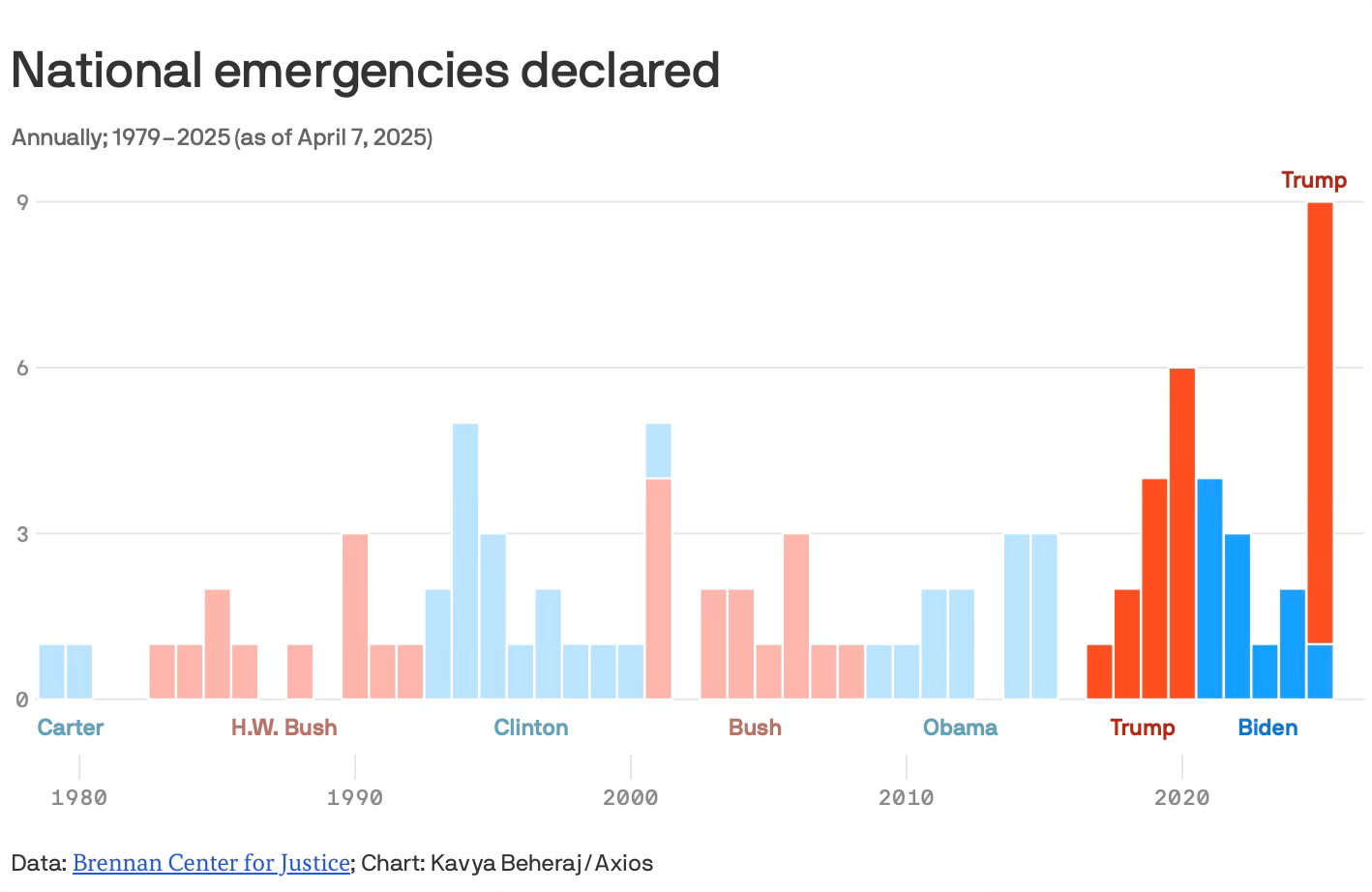
National “Emergencies”

Source: Andrew Sullivan

The Meta-Concern about summary deportation

United States law allows for a quite expedited process to remove people from the country, to deport them. You don’t get a big trial. You don’t get a jury trial. You are moved rapidly because the theory of the case is: First, you don’t have a right to immigrate to the United States, so you have not been deprived of your rights. And secondly, once you’re removed from the United States, you remain a free person. You are sent back to the place you came from or some other place to which you have some connection, and then you’re free to go about your business. You’re not sent to a prison—not sent to a prison for life.

But as I talk about this, the thing that has most gripped my mind with worry and anxiety is not only the effect on the individuals themselves, some of whom may be genuinely innocent, but the effect on those who are sending human beings to a prison without a hearing.

You know, the United States government is now building an apparatus of lawyers, of officials of all kinds, who plan and think every day, How can we apprehend people on American soil and bundle them to a prison without giving them any show of a hearing? They’re building skills and competencies at non-due-process forms of arrest and incarceration that are going to be very hard to limit.

… I remember when I was a Canadian citizen in the United States on a student visa, we were warned if you got into a bar fight, you could theoretically lose your student visa. Now, in those days, that meant that you’d have to go back to Canada and go to school in Canada, which is not the end of the world. In today’s America, that could mean you could lose your student visa and be accused of terrorism, and a bag put over your head and be put into a car and sent to a prison in El Salvador for the rest of your life.

Now, maybe that doesn’t happen in every case. Maybe that doesn’t happen in many cases. But there are people in the employ of the United States government, paid by taxpayers to think about how can we daily broaden the category of people who can be arrested and detained and imprisoned without any showing to any authority at all, without any opportunity to make themselves heard, without any evaluation by an independent fact finder—by any of the things we call due process.

David Frum, introducing a terrific conversation about The Crisis of Due Process with Peter Keisler. (bold added)

Do we really believe in free speech?

Trump 2.0 has been deporting foreign students and others for constitutionally protected speech, using as its current go-to bad-faith excuse that the speech is antisemitic.

The late British-American journalist Christopher Hitchens is a more recent testament to the long tolerance of America toward foreign dissent. Before becoming a U.S. citizen in 2007, Hitchens spent decades as a legal resident—and as one of America’s most acerbic public intellectuals. He accused Ronald Reagan of being “a liar and trickster,” called Israel America’s “chosen surrogate” for “dirty work” and “terrorism,” lambasted Bill Clinton as “almost psychopathically deceitful,” and accused the George W. Bush administration of torture and illegal surveillance. If a student can be deported for writing a campus op-ed critical of Israel, any of Hitchens’ views could have been used to justify deporting him.

Jacob Mchangama, A New McCarthyism

Law and its limits

This isn’t how our system is supposed to work. When a president does the kinds of things Donald Trump is doing, his popularity should sink so low that Congress will feel empowered to stand up to him. Ideally, they would impeach and remove him from office for attempting to govern like an absolute monarch. Short of that, Congress and the courts would be working in tandem to impose and enforce constraints on the wayward executive until the next election strengthens their hand against him.

But none of this is happening—because our system has broken down. The parties are ideologically sorted, with almost no remaining overlap. And Trump has transformed the GOP into a cult of personality more loyal to him personally than to the Republican Party, the other institutions of American democracy, the law, or the Constitution.

In a situation like this, the only thing preventing the president from transforming himself into a tyrant is his own willingness to do it. The courts can tell him to stop. But will he? If he does, democracy survives, at least for the time being. If he doesn’t, democracy is over, at least until it can be reconstituted at some point in the future.

One should never hope to live through a moment of great political precarity like our own. But one tiny compensation is that such moments bring clarity about certain fundamental matters. How has the United States managed to survive for nearly 250 years without evolving into a dictatorship? The answer really may be this simple: By never electing a man willing to do what it takes to effectuate the change.

Until now.

Damon Linker

It’s not clear that the courts will suffice, but the courts — having already, and deservedly, come to treat the Administration as bad-faith, untrustworthy actors — will provide partial deterrence and may help sway public opinion by the cogency (and sometimes, the tartness) of their reasoning.

[I]f you want a really extraordinary example of that, you would look at the order that the Court issued at 1 a.m. on Saturday morning this last weekend, because even though they had held that everybody has to be given meaningful notice before they could be removed in this way, there was credible evidence that the administration was loading people onto buses without giving them anything like the notice that was required. And the ACLU went to the Supreme Court and said, you know, Please, as you listen to the rest of this case and get briefing, stop this from happening.

And if the administration were a normal administration and had compiled a record so far of being a normal administration, the Court would’ve said, Well, I can be confident they’re not going to do this while we are hearing your petition, so let’s give the government a chance to respond. Let’s see what they say, and then we’ll decide what to do. Because, of course, the government wouldn’t spirit these people away while we are actually in the process of deciding whether it can do so on this emergency application you filed. But they knew that the government had done exactly that with the first 200 or so people they had sent away.

The case was before a district judge, and they rushed to secretly get the people out before he could issue an order. And they didn’t quite succeed on that, which is why you have these issues of contempt floating around now. But at 1 a.m., the Court by a 7–2 vote said, Don’t remove anybody in the class represented by these lawyers until you hear otherwise from us.

And that shows that there is a cost to the administration of acting the way it’s acting towards the courts, because if you squander the reputation that governments of both parties have had for credibility and fair dealing and honest brokering with the Court, then they’re going to treat you different because they know they can’t quite trust you.

Peter Keisler with David Frum

Miscellany

The new Republican coalition

Thus we have arrived at a new Republican coalition that looks like this:

  • The tech right, which is essentially a weirder and more evil upgrade of the pro-business libertarians
  • The barstool right, which is a genuinely new constituency made up of hedonistic anti-woke libertarians that has replaced the Christian conservatives
  • The neo-conservative foreign policy hawks, who are the weakest member of the coalition, but can still get what they want on certain issues, as seen with the attacks on the Houthis as well as the saber rattling regarding Greenland

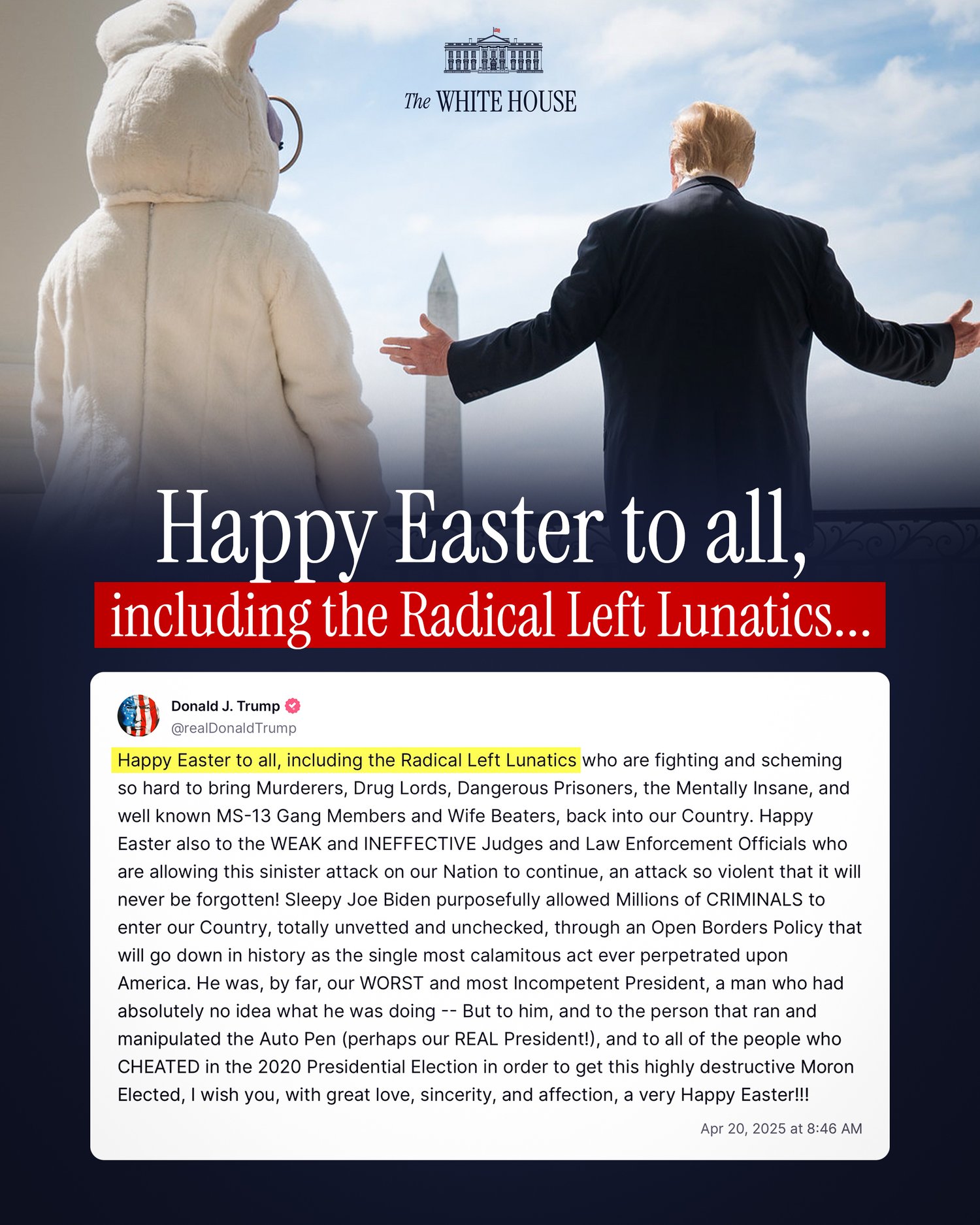
In other words, the Christian influence on actual Republican policy items and their political vision is going to be exceedingly negligible going forward. Sure, Vice President Vance will make an appearance at the March for Life. President Trump will show up to the National Prayer Breakfast. But even when he does acknowledge a Christian event, it often will come loaded with hatred and vile self-aggrandizement, as seen yesterday:

And ultimately when push comes to shove on the policy level, Christian concerns will always be backgrounded or eliminated relative to the priorities of the three above groups, as we have already seen on abortion, marriage, and PEPFAR.

Jake Meador

I originally thought to post this on a Sunday, when my focus is narrower, but it didn’t fit there because I don’t value “religion” for its instrumental partisan-political value.

It was a very few years ago when I warned (as had others) “If you don’t like the Religious Right, just wait ‘till you see the irreligious Right.” Well you’ve been seeing them in power for three months now.

Beta-testing tyranny in the Sunshine State

Ron DeSantis walked so that Donald Trump could run. When the time came to formulate a policy response to the woke left, no one mattered more than the governor of Florida.

He tried to ban critical race theory in education. He sharply limited discussion of gender and sexuality in public schools. He tried to limit the free speech of university professors. He retaliated against Disney when it had the audacity to exercise its freedom of speech to criticize the governor’s policies.

And through it all, DeSantis declared that Florida was the place where “woke goes to die.”

In his second term, Trump is a scaled-up version of DeSantis. Every element of the DeSantis model has been deployed against Trump’s ideological enemies …

At first I was optimistic about the anti-woke right. Their free speech argument resonated with me. I’d spent decades litigating free speech cases, after all, and I’d never really seen anything like a mass movement for free expression.

But my optimism quickly faded. In 2021, the anti-woke right embraced a series of state laws that were designed to ban critical race theory. Rather than meet critical race theorists in the marketplace of ideas, the right chose to try to suppress their expression.

A movement that had spent decades fighting speech codes on college campuses was now enacting speech codes of its own. States that once passed laws meant to protect free speech on campus were now passing laws suppressing the discussion of so-called divisive concepts about race.

By this time I was familiar with the right’s authoritarian turn — and getting very worried about it. In 2019, parts of the intellectual right were consumed with a fight over liberalism itself, with the new right arguing that liberal values — freedom of speech and free trade, for example — were hollowing out American culture, creating a nation of atomized individuals who were consumed with self-actualization (and consumption itself) at the expense of family and community.

David French, The Anti-Woke Right and the Free Speech Con

Context

Ironically, the left, now alarmed by the federal government’s intrusive reach [into, say, Harvard], bears direct responsibility for crafting the very legal weapons wielded against the universities it dominates. Almost four decades ago, progressive legislators demanded sweeping amendments to civil rights law, expanding federal oversight over higher education. The sequence of events reveals a cautionary tale of political hubris: progressive confidence that state power would reliably serve their ends overlooked the reality that governmental authority, once unleashed, recognizes no ideological master. Today’s circumstances starkly illustrate how expansive federal control over civil society, originally celebrated by progressives, returns to haunt its architects. The left’s outrage ought to focus not on this particular administration but on its own reckless empowerment of the state.

Yet for all its courage, Harvard’s response stopped short of making the argument that would best protect the values for which it was fighting. It defended the university’s independence without explaining why that independence deserves protection. It invoked values like “pluralism” and “inquiry,” but it did not fully explain why those values are essential to a liberal democratic society. The letter therefore missed an opportunity to articulate what a university is for — not just to students or donors, but to the country. And this matters, because Trump’s attack against this and other universities is not only about the balance of power between universities and the government. It is, at bottom, about the legitimacy of higher education as a public good.

Alan Jacobs, quoting, respectively, John O. McGinnis and Edward Frame

Dangers of debunking

The danger of being a professional exposer of the bogus is that, encountering it so often, one may come in time to cease to believe in the reality it counterfeits.

Alan Jacobs, The Year of Our Lord 1943


Your enemies are not demonic, and they are not all-powerful and the right hasn’t always lost and the left hasn’t always won. But if you convince yourself of that, you give yourselves all sorts of permission to do a lot of stupid and terrible things under the rubric of “Do you know what time it is?”

Jonah Goldberg.

Regarding said “lot of stupid and terrible things,” my failure to call out anything about the current regime does not mean I approve. There’s just too much, and on some of the apparent illegalities I don’t want to abuse my credentials without thinking it through.

I don’t do any of the major social media, but I have two sub-domains of the domain you’re currently reading: (a) You can read most of my reflexive stuff, especially political here. (b) I also post some things on the only social medium I frequent, because people there are quirky, pleasant and real.