
Mark this day on your calendar. I’m about to write something good about a Dispensationalist. Continue reading “Lord’s Day, December 2, 2012”
Category: Orthodoxy
Tuesday, November 27, 2012

I enjoy singing good Christmas carols about as much as I enjoy singing anything. With a bit of sentimentality, many of them communicate powerfully about that most transformative of events, God’s entry into human history, in human flesh no less.
But Tipsy’s URL is “intellectualoid” for a reason. As my amateur community chorus prepares for Lessons and Carols, the distinct flavor of Adam Lay Ybounden, a Middle English Christmas Carol – especially verses 3 and 4 – jumped out at me.
Adam lay ybounden,
Bounden in a bond;
Four thousand winter,
Thought he not too long.And all was for an apple,
An apple that he took.
As clerkes finden,
Written in their book.Ne had the apple taken been,
The apple taken been,
Ne had never our ladie,
Abeen heav’ne queen.Blessed be the time
That apple taken was,
Therefore we moun singen.
Deo gracias!
There’s a common belief (not dogma, I don’t believe; how could a counterfactual become a dogma?) that “our ladie” would have “abeen heav’ne queen” even if the apple “ne had been taken.” I think that belief may be a bit more common in the Christian east than in the west, but it’s present both places. An opposite view is hymned in the carol:
The third verse suggests the subsequent redemption of man by the birth of Jesus Christ by Mary, who was to become the Queen of Heaven as a result,[6]and thus the song concludes on a positive note hinting at Thomas Aquinas‘ concept of the “felix culpa” (blessed fault).[5] Paul Morris suggests that the text’s evocation of Genesis implies a “fall upwards.[7]
It’s not a question to which it’s easy to find western and eastern answers counterposed on the web, so let me just echo an unauthoritative source, Batteddy of Combox:
that Christ would have become incarnate whether man sinned or not, and that this was the whole point of creation, and the occasion for the envy and pride of the devil.
Anything that offends the devil is good by me. I hope he’s mightily offended by our new bishop, enthroned today.
* * * * *
Lord’s Day – Orthodox Vignettes – 11/25/12
Lord’s Day, November 18, 2012
A Personally Important Anniversary
15 years ago today I was received into the Orthodox Church. Continue reading “A Personally Important Anniversary”
Thor’s Day, November 8, 2012
Change, certainty and salvation
Orthodoxy often gets the back-handed compliment of complaints that it hasn’t changed. For every such compliment, I’m grateful.
But Chris Castaldo pays us the same compliment intentionally:
The notion that Rome doesn’t modify authoritative teaching such as the articles and canons of Trent is, with all due respect, out of step with reality. If you were looking for an example of a church that hasn’t changed for over a millennium, you’ll want to consider Eastern Orthodox Churches, not Rome.
It’s kind of odd after that affirmation to see Castaldo tear into Rome, instead of lovingly caressing Orthodoxy. But I guess Rome’s the 800 pound gorilla against which all western Evangelicals must contend – especially if one was raised Catholic, rather as I tend to obsess a bit about the subspecie of Evangelicalism in which I was instructed beginning in boarding school.
But it’s still puzzling. Castaldo works in a pretty smart setting: Wheaton College and formerly College Church of Wheaton, with both of which I’m pretty familiar. Why doesn’t it occur to him to question the magisterial Reformation not having turned Eastward? Why does he accept (as I assume he does) Evangelicalism’s break with the Magisterial Reformation during and after the First and Second Great Awakenings? (Maybe if I had followed his blog over time, I’d find that he has questioned all this and still come out where he is.)
But he does a good job of arguing that Rome changes. Really. It sounds to me as if Rome is nowhere to go if you want stable, clear doctrine, P.R. to the contrary notwithstanding.
On the one hand, for instance, you’ve got extra Ecclesiam nulla salus, but then it’s a matter of disputed and changing interpretation just who is extra Ecclesiam.
You have a purportedly infallible Magisterium, but nobody to interpret what the Magisterium truly teaches, or even whether Pope so-and-so was speaking ex cathedra when he uttered this or that. And in this election season, I’d be remiss not to note that liberal Catholics cite Catholic social teaching on the preferential option for the poor to justify voting for a feticidal maniac while conservative Catholics insist that voting for feticidal maniacs is intrinsically evil, whereas the best approach to helping the poor is a matter of prudential judgments. (It’s not my fight, but I give the edge to the conservatives there, in case my scrupulously neutral contrast left you wondering.)
That doesn’t sound to me like much of an improvement over an infallible Bible with no infallible interpreter. Infallibility – of Bible or of Magisterium – is a nice dogmatic theory, but not much practical use, it seems. (Calvinists have the same tap-dancing problem. When one of The Elect apostasizes, it just goes to prove he wasn’t really Elect. Some “eternal security,” huh?)
Good form seems to dictate that I now pronounce that you should come to Orthodoxy for stable, clear doctrine. But I won’t. “Stable” we’ve got down pat. “Clear,” not so much. Or so it seems to me.
But I don’t think the faith is about certainty about everything. What’s certainty got to do with union with God? Devils know the right factoids about God, for goodness sake.
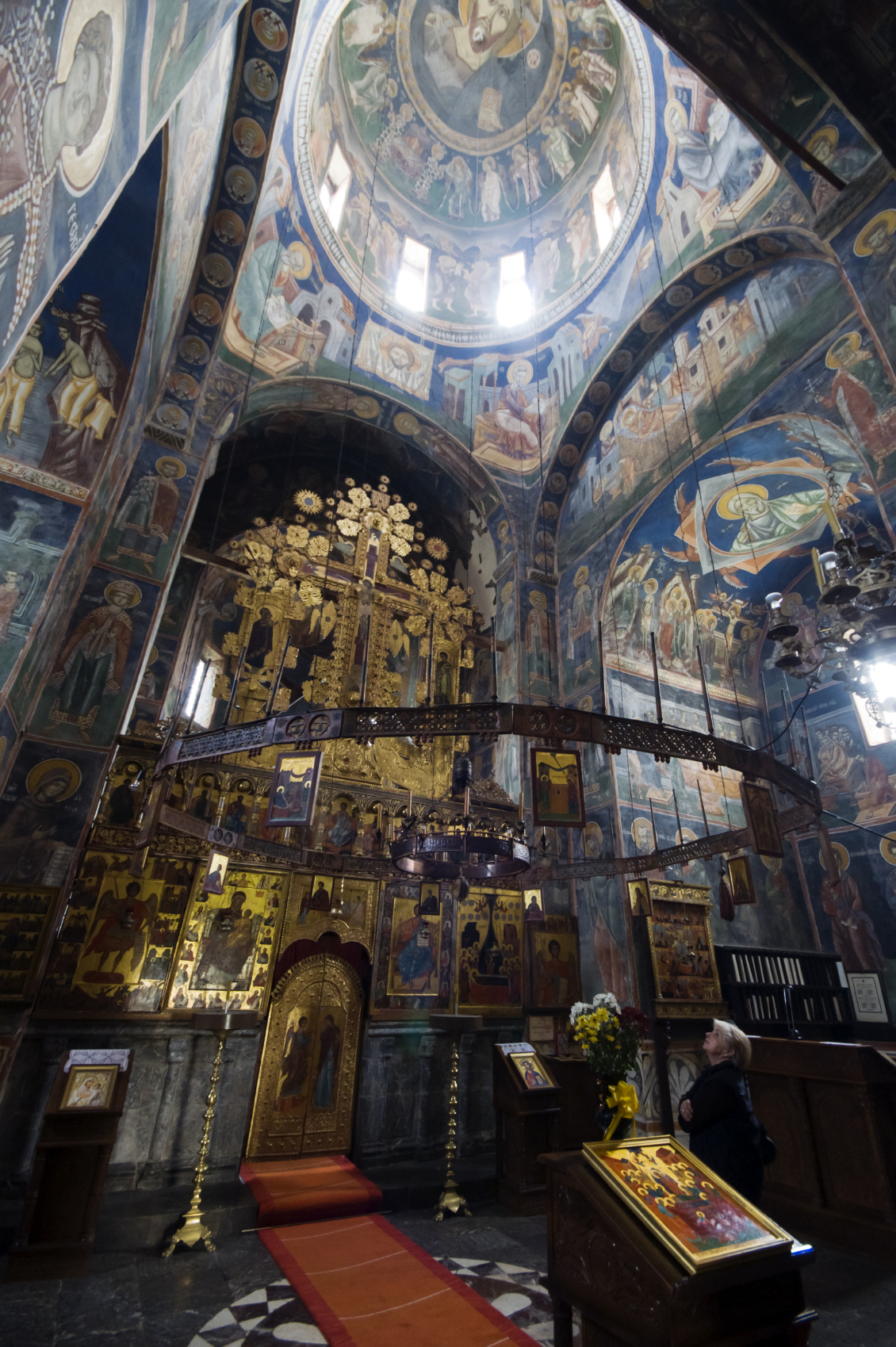
Lack of certainty about some things doesn’t mean I’m confused about what matters. I know what I should do this morning first thing when I get up: thank God for another day to repent as my feet hit the floor, say my morning prayers and read today’s epistle reading. The morning prayers are pretty much universal; the Bible reading’s there because I’ve decided that’s when I’ll do it daily (if no other time). I know what I should do at mealtimes: more prayers. I know what I should do at bedtime. Still more prayers. Seven times a day would be good, actually. “Without ceasing” better still. And repentance, not pride, through it all. (I’m lousy at living this out. I’ll never be saved by my own effort.)
Saturday night? Vespers. Sunday morning? Matins and Liturgy. The texts are set. The music is sober, in whatever musical tradition it’s done. It’s a privilege to be obligated as a Reader (the lowest level of Clergy) to do these services. They form me; they shape my soul.
The Creed? Definitely. It keeps me away from cliffs over which souls have been plunging for 2000 years. But it doesn’t tell me exactly where inside the protective fence I should be. It doesn’t tell me a lot of things about which I might feel idle curiosity. It wasn’t meant to be a Procrustean bed. And that’s okay.
So, what’s the conclusion? I’m not sure. I’ve only been Orthodox 15 years this month, and I had 49 years of bad habits to break. They’re not all broken yet. I’ve noticed for about 14.9 years that the Church isn’t pumping me full of right answers to rattle off to any question or objection, just like all the other ideologues on the block. I sometimes long for greater certainty, but then I’m ashamed of the pride that feels entitled to know instead of trusting.
I may be selling certainty and clarity short. But it seems to me that much as Abraham was told “get thee up into a land I shall show thee,” we walk by faith, not by the sight of a detailed roadmap with reservations staked out each night along the way. It that scandalizes you, and if I’m wrong, then I pray you’ll stumble onto someone who’ll set the record straight.
That someone would be in an Orthodox Church, by the way.
Reformation Day thoughts
Today is Reformation Day. In 5 years, there presumably will be a huge shindig for the 500th anniversary of Luther’s 95 Theses.
Some people take this very seriously, as do I (it’s hard to understand America without it), but some are invested in it so much as to take it very, very seriously.
In the “very seriously” camp is Russell Saltzman, “dean of the Great Plains Mission District of the North American Lutheran Church, an online homilist for the Christian Leadership Center at the University of Mary, and author of The Pastor’s Page and Other Small Essays.” How he took it seriously is the subject of a recent essay:
The post in question was called “Why Can’t Lutherans Take Catholic Communion?” which would seem to be self-explanatory. Nevertheless, Reverend Saltzman explains how he, a Lutheran, came to receive Holy Communion in a Catholic church. (Hint: It required an archbishop.) He goes on to lament that, while Catholics are free in most cases to receive the sacrament in Lutheran churches, Lutherans are still barred from receiving in Catholic churches.
I read the same Saltzman essay Strange Herring (who’s in the “very, very seriously” camp) read, and had some of the same reactions. But since I am not now, nor have I ever been, a card-carrying member of the Lutheran party, I did not take time to do the take-down Strange Herring presented, from which the preceding block quote is taken.
I particularly like his quote of “Mary,” who commented on Saltzman’s essay:
Lutherans are welcome to take Communion on the same terms as everyone else. Make your profession of faith at the Easter Vigil and be received.
If you think your differences from us are too big for that, they are too big for you to receive.
The eventuality of Saltzman’s way of thinking – that no serious differences remain between Lutheran belief and Roman Catholic belief – if one takes schism as seriously as the Church always did until the centrifugal force of sola scriptura required turning it into a virtue, is what the late Richard John Neuhaus did 22 years ago: return to Rome.
My take on the Reformation is “Why, oh why, didn’t Luther & Co. return to the Church from which Rome is in schism?”
The One True Sadness
The one true sadness is “that of not being a saint,” and how often the “moral” Christians are precisely those who never feel, never experience this sadness, because their own “experience of salvation,” the feeling of “being saved” fills them with self-satisfaction; and whoever has been “satisfied” has received already his reward and cannot thirst and hunger for that total transformation and transfiguration of life which alone makes us “saints.”
Fr. Alexander Schmemann, For the Life of the World.
Modern Ironies
Two of the ironies of our era:
- Newspapers unmistakably designed for people who can’t or don’t want to read.
- Churches unmistakably designed for people who can’t or don’t want to worship.
(H/T Terry Mattingly in a talk from several years ago.)
It’s thus no coincidence that 20% of Americans now identify as religiously unaffiliated. If worship is merely a second-rate rock or smooth jazz show with a moralistic therapeutic deist “be nice now” admonition (or political exhortation) thrown in, then to hell with it. Homo adorans needs more.
That 20% unaffiliation makes us, by the ironic way, more irreligious that our old atheist nemesis Russia, where believers of one sort or another are 88%. Might it have something to do with the dominant religion there being famous for the profundity and beauty of its worship?
* * * * *

