
The cultural formations of western Christianity
Christianity as we see it in eighteenth-century Britain or twenty-first-century America is not Christianity as it has always been, and the more fundamental changes may not be those that the received history of religion narrates. The cultural formations of western Christianity, growing as they do in good part from binary, Protestant-Catholic debates, can be thrown into stark relief, for instance, when studied in comparison to that much neglected third term in Christendom: the Eastern Orthodox churches from which Rome severed itself nearly half a millennium before the Reformation, charting a course for Western Christianity wed to rationalism and enamored of individual authority, whether papal or personal.
Lori Branch, Rituals of Spontaneity (italics added).
The italicized phrase warms my heart because almost every non-Orthodox writer in the West, including anti-Catholic polemicists, inverts it to Orthodox Churches severing themselves from Rome.
A well I keep returning to
It’s mind-bending in a good way to consider the possibility that Protestantism is effectively dead because the nondenominational megachurchy world is something, or some things, else:
Imagine a world without Protestantism.
I don’t mean a world without Christians who are neither Catholic nor Orthodox. I mean a world in which there are only two groups of Christians. The first group encompasses believers who belong to ancient fellowships led by bishops and ordained priests, who confess the Creed and their sins and celebrate the Eucharist in a traditional liturgy of word and sacrament. These believers hand on tradition, petition the saints, venerate icons, and baptize their babies. Call them “catholic.”
Call the other group “evangelicals.” They have no creed but the Bible. They have no bishops or priests; instead, they have ministers and elders, who are rarely ordained. They baptize not infants but adults, who can make a public declaration of faith. They reject the interposition of anyone or anything between the individual and Jesus, who is known immediately in the soul and clearly through the Scriptures.
Imagine a world in which every Christian is either catholic or evangelical, with nothing in between. It is a world without Protestantism—for the religion of the magisterial Reformers in the sixteenth century did not desire, commend, or practice either of these options. Theirs was a via media. They baptized babies, recited the Creed, ordained pastors to the service of word and sacrament, practiced baptism and communion as sacraments (not as symbols), and insisted on the validity of the early councils.
The world I invite you to imagine, then, is one in which this middle way—neither Roman nor Anabaptist, both traditional and reformed—has vanished. Is such a world possible? It is. In fact, we are living in it right now. Ours is a world without Protestantism.
Brad East, Goldilocks Protestantism, First Things.
Stumbled onto this …
As a 14-year-old I had embraced Jesus as my Savior but had confused the abundant Christian life with the great American dream: I was a Christian and would lose weight, get good grades, get voted captain of the hockey team, go to college, marry a wonderful man who made $250,000 a year, and we’d have 2.5 children. It was me-focused: What can God do for me? I almost thought I had done God a great big favor by accepting Jesus ….
I recently got a digital subscription to Christianity Today, a magazine I’ve known all my life, in order to keep up a little with doings in the non-Orthodox Christian world. Eareckson Tada was a big deal in the Evangelical tradition decades ago and apparently has remained so, living a remarkably long life for a quadriplegic – perhaps because she has kept so busy with her talents.
Related: Frederika Matthewes-Green reported in one of her books the comment of a first-time visitor to an Orthodox Church: “Wow! That was soooo not about me!”
Duly Noted
A line is being crossed in Canterbury. I share a communication published by a priest who received it:
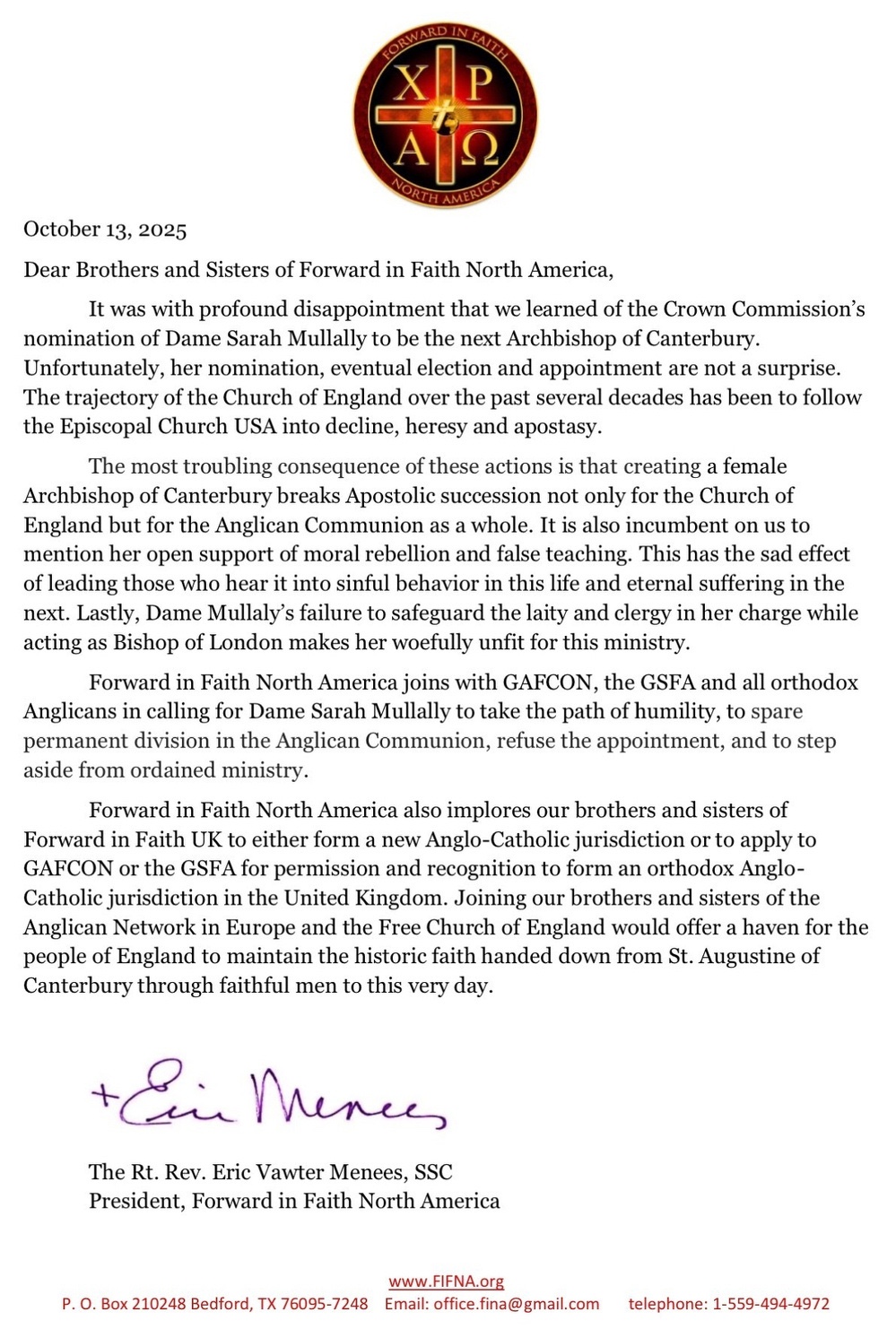
Almost inevitably, these “Forward in Faith” and other GAFCON Anglicans will be painted in the popular press as schismatic for not going along with a radical provocation. I hope, but faintly, that the popular press will report their claim (encountered elsewhere) that they are the Anglican Church.
I make no facile prediction that “history will vindicate them,” but I’d rather be among them than the innovators when, at the end of history, Christ comes from heaven to judge the living and the dead.
Not every wound is PTSD
Therapists themselves are noting that if every time a soldier confesses his soul wound from combat we then label him with PTSD, that we will find ourselves recommending psychological therapies and prescribing psychiatric medications when what is needed is something like a religious ritual of purification and forgiveness.
Timothy Patitsas, The Ethics of Beauty.
Note to Peter Thiel
In the Lateran, at a council held in 1513, a formal prohibition had been issued against preaching the imminence of Antichrist.
Tom Holland, Dominion
Evangelicals and Calvinists
A lot of the evangelical world leaves the dirty work to the Calvinists.
Derek Rishmawi, Calvinist.
Caveat: Political Application is Patent
On Sundays, I rarely post things with pointed political applications. For that matter, I rarely post political items with explicit Christian underpinnings on Mondays through Saturdays. Today marks an exception where I judged that these fit Sunday better than weekdays because my target readers are specifically Christians.
Salt & Light
Christians who vote for Republicans are called to be salt and light within the Republican Party. That means being a voice calling the Republican Party to obey the rule of law. Yours should be the loudest voice condemning Trump’s pardon for January 6 rioters and pushing against his challenge to the checks and balances that are supposed to constrain the executive . You should speak up in favor of the poor and powerless and against the culture of cruelty, spite, and vengefulness Trump cultivates. It corrodes our public square and demeans our shared citizenship even as it poses more specific dangers to those targeted by Trump’s weaponization of federal law enforcement. If you do not speak up, you are both credulous and culpable, complicit with the party’s sins—including those yet to come.
Paul D. Miller, A Confessing Church for America’s Weimar Moment
MAGA Christianity
In last Sunday’s “Dispatch Faith” Column, Paul D. Miller asks Is MAGA Christianity True Christianity?, and essentially answers “no”: MAGA Christianity often mixes Christian symbols and Scripture with partisan rhetoric and calls to fight enemies, producing superficially Christian religion that departs on key theological and ethical points.
Commenting on The Charle Kirk Moment, Nijay Gupta resurrected a saying I’m pretty sure I last heard decades ago:
What you win them with is what you win them to.
Gupta’s role in this podcast was that of a more progressive Christian, relatively skeptical of the work of Charlie Kirk, and this comment had in view Kirk’s interweaving of conservative politics and evangelism.
I repeat from prior posts: I knew very, very little about Kirk until he was killed. From what I’ve learned since, I suspect he’d have insisted that conservative politics is such a concomitant of Christian faith that it is meet and right to interweave them from the podium/pulpit. (He said repeatedly that one cannot be a Christian and vote for Democrats.)
That is a message I’ve heard (though almost always tacitly) most of my life, and have resisted for almost as long. Despite my impression that most conservative Christians in North America lean right, and acknowledging that I, too, do so (though the meaning of “right” grows ever fuzzier), I nevertheless endorse the shared thrust of Miller and of Gupta.
And that’s why I consciously avoid political talk at Church coffee hour. All are welcome, regardless of politics, though some politics will prove to be baggage that must eventually be shed, as I’ve had to shed some of my own baggage.
Religious ideas have the fate of melodies, which, once set afloat in the world, are taken up by all sorts of instruments, some woefully coarse, feeble, or out of tune, until people are in danger of crying out that the melody itself is detestable.
George Elliot, Janet’s Repentance, via Alan Jacobs
[N]one of the things that I care about most have ever proven susceptible to systematic exposition.
Alan Jacobs, Breaking Bread With the Dead
You can read most of my more impromptu stuff here and here (both of them cathartic venting, especially political) and here (the only social medium I frequent, because people there are quirky, pleasant and real and it has no-algorithms). All should work in your RSS aggregator, like Feedly or Reeder, should you want to make a habit of it.
 Tipsy Teetotaler ن