Thursday, 11/17/22

Embodied Perception

To emphasize the role that our bodies play in determining how we inhabit and therefore perceive the world, and to entertain the notion of cognitive extension, is to put oneself on a collision course with the central tenets of the official anthropology of the West. As we have already noted, embodied perception poses a direct challenge to the idea that representation is the fundamental mental process by which we apprehend the world.

Matthew Crawford, The World Beyond Your Head

I think Crawford calls this “the official anthropology of the West” because of our fetish that everyone must go to college to encounter more representations of the world, less actual world.

Long-term readers may justly suspect that, in my behavior, I am slave to this official anthropology. I tend to prefer reading to getting up and going for a walk or making something with my hands.

An opportunity, not a death knell

Let’s start with what the pro-life pessimists get right. Tuesday’s results confirm the anti-abortion movement’s fundamental disadvantages: While Americans are conflicted about abortion, a majority is more pro-choice than pro-life, the pro-choice side owns almost all the important cultural megaphones, and voters generally dislike sudden unsettlements of social issues.

You can strategize around these problems to some extent, contrasting incremental protections for the unborn with the left’s pro-choice absolutism. But when you’re the side seeking a change in settled arrangements, voters may still choose the absolutism they know over the uncertainty of where pro-life zeal might take them.

However, when abortion wasn’t directly on the ballot, many of those same voters showed no inclination to punish politicians who backed abortion restrictions. Any pro-choice swing to the Democrats was probably a matter of a couple of points in the overall vote for the House of Representatives; meanwhile, Republican governors who signed “heartbeat” legislation in Texas, Georgia and Ohio easily won re-election, and there was no dramatic backlash in red states that now restrict abortion.

In other words, Republicans in 2022 traded a larger margin in the House and maybe a Senate seat or two for a generational goal, the end of Roe v. Wade. And more than that, they demonstrated that many voters who might vote pro-choice on an up-down ballot will also accept, for the time being, pro-life legislation in their states.

For a movement that’s clearly a moral minority, that’s an opportunity, not a death knell ….

Ross Douthat

FTX

I have generally avoided getting into discussions about cryptocurrencies, because I am a perennial late-adopter who never understands how the big new thing is supposed to work or why anyone would even be interested in it. Aware of that bias, the fact that crypto always struck me as an elaborate Ponzi scheme wasn’t quite enough for me to be sure that it was an elaborate Ponzi scheme. Besides, even if I was sure, that wouldn’t be reason enough to confidently predict collapse; flim-flam operations sometimes get bought by companies with real businesses—or may even monetize their hype into real currency that they use to buy real companies—and thereby achieve something like an enduring presence in the business landscape that they might not have been able to achieve on their own merits.

So what interests me primarily about the collapse of FTX is this business could ever have been idealized. The premise behind FTX is that, even though nobody is totally sure what crypto is ultimately good for, people love to trade it, and to concoct ever more elaborate schemes for leveraging waves of investor enthusiasm.

Noah Millman

Priorities

My wife and I had a conversation one day with a pleasant couple who were much younger, and much more prosperous, than we were.  Husband and wife were both high-dollar attorneys.  She expressed strong frustration because the kids were in day care, but she wanted to stay with them herself.  “Why don’t you?” we asked.  They answered that they had expenses.  “Like what?” we asked.  Well, they had to keep up the payments on their big, expensive boat and their big, expensive house on the lake.

The difference between her facial expression and his were intriguing.  She became nervous.  He became alarmed.  There was some history here, and he didn’t want his wife going down this road.  She didn’t want to displease him.  We changed the subject.

To one degree or another, almost all husbands and wives divide labor, and they are generally happier doing so.  Obviously, not all women desire an exclusively domestic life, and there is nothing wrong with that.  But there is a great deal wrong with the fact that we force women to act against their domestic inclinations for reasons that have nothing to do with their fulfillment.  We call it being liberated, but it is really about serving the interests of men — and economic managers.

J Budziszewski I have seen another variation on this: high-earners who “can’t afford” to pay the tuition they agreed for private Christian education.

Letting the cat out of the bag

It is important that we start on time. We are training our children for the work force.

Remark from the school on a first-grader’s report card, via Jonathan Malesic, When Work and Meaning Part Ways

There’s another cat in the bag, too. We’re training our children in a second role of consumers. A hyperbolic account:

[S]trange to think that even in Our Ford’s day most games were played without more apparatus than a ball or two and a few sticks and perhaps a bit of netting. Imagine the folly of allowing people to play elaborate games which do nothing whatever to increase consumption. It’s madness. Nowadays the Controllers won’t approve of any new game unless it can be shown that it requires at least as much apparatus as the most complicated of existing games.

Aldous Huxley, Brave New World.

This is one of the reasons I think Huxley far surpasses Orwell as a prophet of dystopia (although I’m pretty sure I had no opinion either way before the year 1984.)

Things they told you that weren’t, now that you think about it, true.

On a note related to the preceding item, this:

The transformation of work into a spiritual enterprise, the site of our highest aspirations—to transcend ourselves, to encounter a higher reality, to serve others—is the work ethic’s cruelest unfulfilled promise.

Jonathan Malesic, When Work and Meaning Part Ways

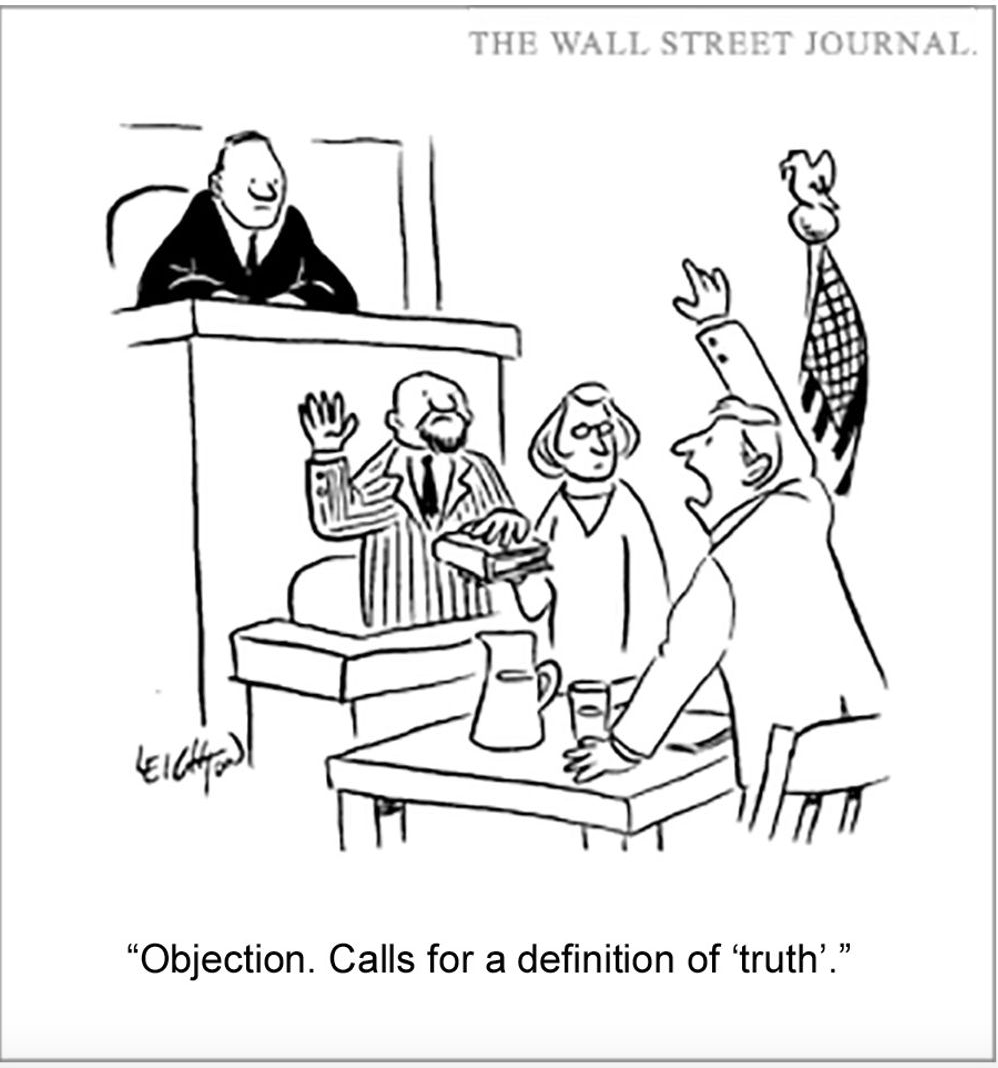
Speaking of truth, the Wall Street Journal’s Pepper & Salt cartoon is one of few cartoons I view regularly. Wednesday’s gave me a rueful chuckle:
Guilty and unashamed

Caffeine is so widely used and normalised that we don’t think of it as a drug or notice how it alters our minds. Research into its effects is often hampered by the difficulty of finding people who aren’t already dependent on it.

Sophie McBain, The psychoactive plants that change our consciousness, reviewing Michael Pollan, This is Your Mind on Plants.

A Hoosier teetotaler on the Isle of Islay

I opened my first-ever bottle of Laphroaig, “the most richly flavoured of all Scotch whiskies,” Monday night, as nightcap and to usher in the Nativity Fast that began Tuesday (a sort of personal “fat Monday”).

Wow! Now I think I know what Cutty Sark was trying to do when it produced a liquor that tasted like Listerine. In fact, that’s what the smell of Laphroaig reminded me of. Mercifully, the taste is not Cutty Sark.

Laphroaig is to every other scotch I’ve had as Dogfish Head 120 minute IPA is to Bud Light. It’s more — much more — but not just more. It’s different, too. From the label, that difference may be peat and smoke, but I’m forever hearing scotch afficianados talk about “peatiness,” so maybe I’m way off base. My palate and liquor vocabulary reflect my teetotaler roots.

Truth be told, I’m not sure how well I really like it. I’m not exactly alone. It was a shock. But I’ll know by the end of the bottle in a few months.

My last two items are about someone I hate even to name. Skip them if you like.

Trumpism without Trump?

Trumpism can survive without Mr. Trump.

Peter Wehner, Never-Trumper from the early days.

Isolating this phrase, I could hope that we get “Trumpism without Trump,” but that totally depends what one means by that phrase.

I could, and probably would, endorse the GOP continuing toward making itself the party of working-class middle-Americans of all races. Highlighting their plight is one of the (few, but consequential) good things Trump did.

Wehner, though, means by “Trumpism without Trump” a GOP that is malicious, dishonest and destructive. No thanks.


[S]ubordinating truth to politics is a game which tyrants and bullies always win.

Jonathan Rauch, The Constitution of Knowledge

The Orthodox "phronema" [roughly, mind-set] cannot be programmitized or reduced to shibboleths.

Fr. Jonathan Tobias

You can read most of my more impromptu stuff here (cathartic venting) and here (the only social medium I frequent, because people there are quirky, pleasant and real). Both should work in your RSS aggregator, like Feedly or Reeder, should you want to make a habit of it.

It’s about time

Jonathan H. Adler, Trump Lawyers Sanctioned for Frivolous Lawsuit Against Political Opponents

There’s apparently no deterring Trump, but maybe his legal prostitutes (that’s what I consider lawyers who file frivolous lawsuits just because a client is willing to pay them to do so) can be deterred.

Tuesday, 7/12/22

Sunday was the day of my quarterly review of articles I’ve tagged for re-reading. Among other things, I’m reminded of why I subscribed to a Yorkshireman with the pen name FFatalism (who hasn’t floated my boat very high in recent weeks).

Our epistemic default setting

Objectivism is, according to philosopher Esther Meek, our “defective epistemic default setting” as modern westerners. This is our problem. We wrongly think of knowledge as facts, information, proofs, and propositions. Real, true knowledge, we think, can always be explicitly put into words and sentences.

[Michael] Polanyi recognized how disastrous this view of knowledge really is. He already had an inchoate–or, tacit–sense that this was wrong by 1916 …

There is a hint here of what would become Polanyi’s most famous phrase: “We can know more than we can tell.”

Cameron Combs, Michael Polanyi: Epistemological Therapist for a Secular Age

This is a conviction that I’m trying to get from my head into my bones. It seems gradually to be happening, aided by realization that it is impossible to tell a Protestant or Catholic what they should know about Eastern Orthodox Christianity until they’ve had a few weeks experiencing the Divine Liturgy. (This is excellent, but it’s no substitute for the experience of Liturgy.)

Everyone knows the fall is coming

I am a poor listener. I only know the same thing that everyone does: the current order cannot go on. We express this knowledge in ten thousand ways. Some people concentrate on climate change, others on the collapse of moral language, and others on the unavailability of energy to sustain the modern regime. Historical narratives of civilisational collapse become increasingly salient. Parents do not expect the world to be as friendly to their children as it was to them. Nobody believes that the next 50 years will follow the upward arc of the last 50. We hang for a moment in the air, waiting for gravity.

Everyone knows the fall is coming, but our politics cannot say it. The language of continual progress is too entrenched. The UK government talks of ‘levelling up’ the country. Their opposition wants to ‘build a future that everyone in Britain can be proud of’. The social justice set want to build a ‘more equitable’ future. Their opposition wants to ‘return to classical liberalism’. Whether left or right, whether a political party or a political movement, all seek to guide the upwards arc of the future to ensure that we land in just the right spot. This is bullshit. We have never been able to guide the Machine, and everyone knows that we’re reaching the top of the arc. We are going to fall. The language of progress isn’t there because anyone still believes it. It is a habit, a behavioural leftover that betrays a ‘catastrophic failure of imagination’.

[T]here will still be politics after the fall. Human beings cannot avoid their political nature … But in this moment, post-collapse politics are hard to imagine. We face the situation that Jonathan Lear, in Radical Hope, describes the Crow Indians facing in the 19th century ….

FFatalism, Yorkshire, afterwards

This article, with the articles it links and discusses, is very important for those who want to have some kind of “secular” hope for rebuilding after the coming collapse. There’s precedent in those Crow Indians, folks.

Deeper into the spectacle

In the older sense of ‘politics’, the connections between people are mediated through networks of other social relations. I know you as one of the Jones family, you live on the other side of town, you are a member of the same union as me, you are also a member of local Methodist congregation, and so on. In the modern sense of ‘politics’, the connections between people are mediated through images, chunks of decontextualised pictures and text. You share an emotionally moving video, you have an emoji by your twitter username, you despise a politician that you will never meet, you share your opinions on the geopolitics of country that you will never visit, and so on. This second set of social relations are part of what Guy Debord called the spectacle. Even in 1967, he could see that the spectacle gradually degrades the ideal of human fulfilment from being about who you are to how you appear.

We are now deeper into the spectacle. The combination of social media, internet shopping, and working from home allows the comfortable classes to almost entirely replace the directly lived set of social relations that constitute real politics with social relations mediated by images. The rest of society seems to be moving along the same path. Anxiety about the effects of the internet, particularly on teenagers, is widespread; but the social relations that have created this technology and are furthered by it are not new. They are the same spectacle that Debord analysed half a century ago. Debord ends the first part of his book by remarking that the ‘spectacle is capital accumulated to the point that it becomes images’. This now sounds like he was prophesising the Metaverse and non-fungible tokens. He was not. They are bullshit and nothing new.

It is because we are so deep in the spectacle, and have been for so long, that anyone concerned with localism must ask whether people are still capable of politics: whether we are still the kind of people who can organise ourselves into ‘households’, ‘villages’, and ‘political communities’ or whether we are only capable of relating to one another in the temporary and conditional ways that the spectacle requires.

Here, I am using an idea of Simone Weil’s, and her ideas can be subtle and tricky to grasp. When I say ‘the spectacle makes paying attention hard’, it perhaps makes you think of a busy social media feed that distracts you from sitting and talking to your spouse or neighbour. That is not really what I’m getting at. On that picture of things – I don’t talk to my spouse because I am too busy with virtual relationships – paying attention is seen as a sort of activity, a thing that you do. I’m paying attention to social media, not my spouse. Weil, though, would say that when you’re on social media, then you are not paying attention to anything at all.

For Weil, attention is not something that you do. It is something that occurs only when you stop doing and start ‘waiting’: in her poetic language, ‘the soul empties itself of all its own contents in order to receive into itself the being it is looking at’.

… Humans need to be part of something more than the spectacle. It is difficult because truly paying attention to others is hard and scary and it leaves us vulnerable. Politics demands more from each of us, not just from Westminster or the political hate-figures of the moment.

FFatalism, ‌‘Politics’ is not politics

… just wait till you see the non-religious Right

I used to say “If you don’t like the Religious Right, just wait until you see the non-religious Right.”

I read this article a bit over a month ago, but the coin just dropped when I re-read it (skimmed it, actually): The Republican Party in 2022 is the non-religious Right.:

What is occurring on the right, then, is a partial realization of the program that the hard-right writer Sam Francis championed in his 1994 essay “Religious Wrong.” He argued that cultural, ethnic and social identities “are the principal lines of conflict” between Middle Americans and progressive elites and that the “religious orientation of the Christian right serves to create what Marxists like to call a ‘false consciousness’ for Middle Americans.” In other words, political Christianity prevented the right-wing base from fully understanding the culture war as a class war — a power struggle between Middle America and a hostile federal regime. He saw Christianity’s universalist ideals as at odds with the defense of the American nation, which was being dispossessed by mass immigration and multiculturalism. “Organized Christianity today,” he wrote in 2001, “is the enemy of the West and the race that created it.”

Mr. Francis’ position, of course, has always been far outside the mainstream of conservative opinion. Conservatives have traditionally viewed religion as foundational to Western heritage, and they have seen its moderating influence on identitarian conflicts as a crucial component of civic harmony. But as a description of recent trends, his assessment holds some weight: The decline of organized religion on the right has, in fact, supercharged the culture war.

Many observers — including Mr. Francis, whose writing became more openly white nationalist toward the end of his career — have been quick to suggest that this new energy is, in essence, white identity politics. It’s true that the decline of religion as an organizing force on the right has made other forms of identity more prominent — and in the absence of a humanizing Christian ethic, white racial consciousness could fill the void. There are and always have been strains of white-supremacist politics that reject Christianity for that reason. (The American eugenicist Madison Grant, for example, echoed Friedrich Nietzsche in denouncing Christianity as “the religion of the slave, the meek and the lowly.” Christianity tends “to break down class and race distinctions,” Mr. Grant wrote in 1916. “Such distinctions are absolutely essential to the maintenance of race purity in any community when two or more races live side by side.”)

Terms of engagement

We’re allowed to participate in the public sphere as long as we chemically neuter ourselves during our peak childbearing years. We agree to participate in a market in which the commercial production and care of children are both considered normal parts of an educated woman’s life. When our children are the smallest and most vulnerable, we agree to place them in the care of others, often strangers; that is, if we’re lucky enough to have children. If we’re unable to conceive when we’re finally ready professionally and financially, we agree to submit our bodies to the expensive, degrading, and possibly dangerous trauma of artificial reproductive technology. These technologies may include artificially over-stimulating our ovaries, retrieving our eggs, creating embryos, freezing them for unspecified periods of time, and watching a large percentage of our tiny children not survive these processes. Maybe, just maybe, at the end of all this, we might give birth to a healthy baby.

Jennifer Roback Moss, The Sexual State.

I read this book in anticipation of a conference at which the author was one of three keynote speakers. Despite my approval of this broad-brush passage, the unrelenting shrillness of this author overall was a key factor in deciding that the conference was not worth winter travel.

Leo Strauss

“Knowledge of ignorance,” [Leo] Strauss added, “is not ignorance. It is knowledge of the elusive character of the truth, of the whole.” The philosopher in this sense views human beings “in the light of the mysterious character of the whole,” which is to say in the light “of the fundamental and permanent problems.” Questions, not answers. Problems, not solutions.

Strauss’ Socratic skepticism differs from many other styles of skepticism in not being primarily a consequence of the limitations of human reason or some other defect of the human mind—as if another, less imperfect mind could discover an underlying coherence or fuller knowledge that eludes us. On the contrary, as one scholar has written, Socratic skepticism is a response to “the character of the world” itself. Elusiveness, hiddenness, confounding riddles, the primacy of questions to answers and problems to solutions—all of this “is a property of being itself.”

To champion moral virtue in a modern liberal democracy is to sound like a conservative. To champion it while also advocating a form of philosophy that undermines the foundations of moral virtue is to sound like a uniquely cynical form of conservative—one who deploys conservative rhetoric as a mere subterfuge or “noble lie” for popular consumption. This has become one of the most common accusations critics make against Strauss. But his position is actually more complicated than that—and more interesting.

Damon Linker, launching an intriguing series on Leo Strauss and the various contemporary American Straussians. I’m looking forward to reading the series.

Steve Bannon

Former Trump adviser Steve Bannon has agreed to testify before the congressional committee investigating the January 6, 2021 attack on the Capitol, and Trump’s efforts to overturn the 2020 election. Bannon previously cited executive privilege as a reason to refuse the Committee’s subpoena. But he has changed that position after Trump sent a letter agreeing to waive the privilege if Bannon reaches an agreement with the Committee.

Inspired by Trump’s generous waiver, I hereby officially proclaim and declare that I am waiving the share of the spice revenue of Arrakis due to me as Sublime Padishah Emperor of the Known Universe! Are you not impressed by my generosity? If not, it might be because I’m not actually an Emperor, and do not actually have any spice revenue.

Josh Blackman, Trump and Steve Bannon Waive Executive Privilege they do not Have

A lighter moment

Seems Joe Biden is forgetting how to use a teleprompter:

“The only thing we have to fear, is fear itself.” — FDR

“Mr. Gorbachev, tear down this wall.” — Reagan.

“End of quote. Repeat the line.” — Joe Biden.

H/T The Morning Dispatch

Kudos to V.P. Harris and Sec. Becera for not spewing their coffee.


If people have always said it, it is probably true; it is the distilled wisdom of the ages. If people have not always said it, but everybody is saying it now, it is probably a lie; it is the concentrated madness of the moment.

Anthony Esolen, Out of the Ashes

You can read most of my more impromptu stuff here (cathartic venting) and here (the only social medium I frequent, because people there are quirky, pleasant and real). Both should work in your RSS aggregator, like Feedly or Reeder, should you want to make a habit of it.

Essentially unrelated

My dear Socrates … you know why they are putting you to death? It is because you make people feel stupid for blindly following habits, instincts, and traditions. You may be occasionally right. But you may confuse them about things they’ve been doing just fine without getting in trouble. You are destroying people’s illusions about themselves. You are taking the joy of ignorance out of the things we don’t understand. And you have no answer; you have no answer to offer them.

Nassim Nicholas Taleb, Antifragile


Most poets in the West believe that some sort of democracy is preferable to any sort of totalitarian state and accept certain political obligations, to pay taxes, to vote for the best man or programme, to serve as jurymen, to write letters of protest against this or that act of injustice or vandalism, but I cannot think of a single poet of consequence whose work does not, either directly or by implication, condemn modern civilisation as an irremediable mistake, a bad world which we have to endure because it is there and no one knows how it could be made into a better one, but in which we can only retain our humanity in the degree to which we resist its pressures.

W.H. Auden in Encounter (April 1954), via Alan Jacobs


The term civil religion was introduced by Rousseau in the eighteenth century. In the last chapter of The Social Contract, Rousseau proposes an explicit civil religion as a cure for the divisive influence of Christianity, which had divided people’s loyalties between church and state. Rousseau does not wish to erase Christianity entirely, but to reduce it to a “religion of man” that “has to do with the purely inward worship of Almighty God and the eternal obligations of morality, and nothing more.”

William T. Cavanaugh, The Myth of Religious Violence

Oh. Only "inward" worship and yada, yada, yada. Nothing to see here. Move along now.


On so many topics, the legacy press has forcibly limited the scope of legitimate discussion. The downstream effect of this is is as obvious as it is alarming: It denigrates trust in institutions that are meant to be in the business of pursuing the truth. And it drives curious people to dark corners of the Web, where conversations about the origins of the virus mix easily with those about the Rothschilds.

Bari Weiss, ‌Did Covid Come From the Lab? Mike Pompeo says Yes.


Dr. Russell Moore is leaving the Ethics and Religious Liberty Commission of the Southern Baptist Convention. A lot of Southern Baptists considered him a liberal for deny 45’s suitability for the office of POTUS and for answers like this one, which forever endeared him to me.


Russell Moore isn’t the only Evangelical who warned against 45:

The day after his inauguration, I wrote, “A man with illiberal tendencies, a volatile personality and no internal checks is now president. This isn’t going to end well.” And it didn’t.

Peter Wehner, arguing that we’re not out of the violent woods yet.


I often think that the famous Orthodox answer to certain questions, “It’s a mystery,” … is not a statement that means, “I do not know,” but, rather, “I know, but there are no words for it.”

Fr. Stephen Freeman, ‌The Verbal Icon of Christ


You can read most of my more impromptu stuff at here. It should work in your RSS aggregator, like Feedly, should you want to make a habit of it.