Musings, 2/21/25

Can there be a lawful order to act unethically?

I’m struggling with the agreement between Sarah Isgur and David French on the Advisory Opinions podcast that the orders from the Trump Department of Justice to dismiss the charges against New York City Mayor Eric Adams was a lawful order, even if compliance by federal prosecutors would have been unethical. I’d like to think that an order to a professional to do something unethical is ipso facto not a lawful order.

If nothing else, this confirms the wisdom of not allowing non-lawyers to own a law firm (e.g., Model Rules of Professional Conduct 1.17(b)) lest this kind of thing pervade the legal profession rather than remaining an application of the unitary executive theory to the Department of Justice.

This is why we can’t have nice things

Speaking of unitary executive theory, I have more or less been persuaded to become a “soft unitarian.” But the test case that Donald Trump has set up by firing the head of the Special Counsel’s office is straining my recently-acquired conviction.

Mafia Don has fired Hampton Dellinger, current head of the Office of Special Counsel, without invoking “inefficiency, neglect of duty, or malfeasance in office” as required by statute. A federal District Court has ordered that he be reinstated. A federal Court of Appeals has rejected Trump’s appeal on technical grounds (the District Court decision is only preliminary, not final). He now seeks review by the US Supreme Court.

I shudder because unitary executive theory makes the substance of his appeal plausible.

So here’s the deal on the Constitutional issues.

The Constitution establishes three branches of the federal government: Congress (Article I), the Executive (Article II), and the Judiciary (Article III). The opening words of Article II are “The executive Power shall be vested in a President of the United States of America.“

So what is the status of supposedly “independent” agencies, created by Congress, like the Office of Special Council? Are they a fourth branch of government, hiding in the shadows of the constitution, or are they simply unconstitutional because all executive power is vested in the presidency? If the latter (which is substantially the position of President after President since the Office was created, but nobody before The Don cared so little about chaos to provoke a fight over it), then what checks the power of the Presidency? Are we doomed to live under a kakistocracy if the President goes haywire?

The conventional answer is that Congress’s impeachment power checks the power of the presidency. If you are satisfied that this Congress has the cojones to impeach this president, you are living in a different reality than I am.

As I sit here in my easy chair, six years retired and 43 years out of law school, the best response I can come up with for SCOTUS is (1) refuse to hear the case because the District Court decision is only preliminary or (2) take the case and rule that independent agencies are not exercising executive power, but rather are serving as a check on executive power, and thus really are “hiding in the shadows” of the Constitution.

I think this would be a satisfactory ground to uphold the District Court. But I remember how conservatives derided Justice Harry Blackmun’s finding a right to abortion in the “emanations of the penumbrae” of the constitution?

The electorate having decided that Mafia Don was the lesser evil (a perception I gradually came to find defensible within the 5 or 6 months preceding January 20) has thrust us into the Constitutional crisis of an utterly corrupt President who will never be impeached because not only can he suborn and fund primary candidates against those who would impeach him, but he can with winks, nods, and stochastically violent rhetoric unleash fanatics that make Congressmen literally fear for their families if they cross him.

A decision either way from the Supreme Court will deepen the crisis.
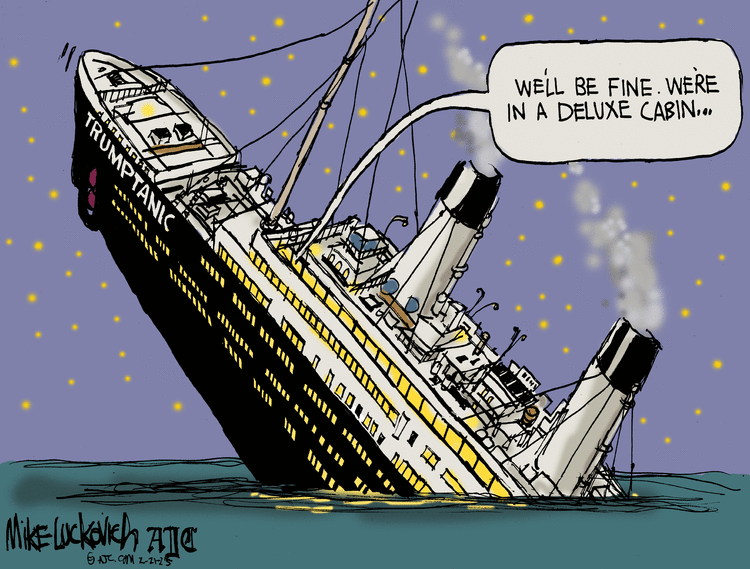
First, they came for the radical liberal communists …

Pundit tribalism

That issue—how intellectuals are supposed to comport themselves in their political engagements—is one that matters a lot to me. On top of the policy disagreements, what drove me away from the intellectual right two decades ago was the expectation, as an editor for First Things magazine, that I defend a political line in public. I wasn’t allowed to write a conservative case for not invading Iraq, for example, because that would risk making myself and the magazine appear “unreliable.” There was simply too much at stake, my boss told me, to risk a dissent from the conservative movement and its presidential champion. The War on Terror had to be won—and even more fundamentally, George W. Bush needed to have a successful presidency. We couldn’t risk contributing to its failure by directing criticisms its way.

Damon Linker

I’m very sympathetic to Linker about this kind of tribalism.

Our local rag used to have a very lively letters to the editor section (they don’t even have an opinion page anymore). When my religious Right co-belligerents expressed particularly idiotic opinions or called for perverse boycotts (example omitted because it was so idiotic you wouldn’t believe me), I tended to refute them vigorously, and at least once received an anonymous phone call implying that I was a Judas (no threat, just bile).

Why can’t the world be unanimously sane and moderate, just like Damon Linker and me?

Our four-party system

I enjoyed Ezra Klein’s little essay the other day as a partial explanation of how polarization got worse:

The two-party system of the 20th century was really a four-party system. The Democrats were split between the liberals we know today and the Dixiecrats, whose primary goal was upholding segregation. The Republicans were split between conservatives and Northern liberals. It is astonishing from our vantage point, but it was true for much of the 20th century: To say you were a Republican or a Democrat didn’t reveal whether you were a liberal or a conservative. As a senator, Joe Biden opposed the Roe v. Wade decision in 1973. President Richard Nixon proposed a universal health care bill and created the Environmental Protection Agency. George Wallace started out as a Democrat. Politics was different then.

Parties that contained so many different places and ideologies could not act in lock step, and so bipartisanship was common. The Civil Rights Act of 1964 was pushed by a Democratic president, but congressional Republicans were crucial to its passage. When Watergate began coming to light, Congress acted as a collective. Only four House Republicans voted against opening the impeachment inquiry into Nixon, and a delegation of congressional Republicans ultimately persuaded him to resign.

And it wasn’t just impeachment. When Nixon refused to spend the money Congress had appropriated — a policy known as impoundment — Congress acted to protect its power: The Congressional Budget and Impoundment Control Act of 1974 passed the House with only six “no” votes; it passed the Senate without a single vote in opposition.

(Emphasis added) I remember guys like Scoop Jackson, Dick Gephart, Mark Hatfield, Nelson Rockefeller, John Lindsey. Joe Manchin proves there’s no room for that kind any more. There’s just two tribes, each controlled from the wings, not the center.

Clamoring aboard the ARC

A Jordan Peterson-adjacent, Christian-coded “Alliance for Responsible Citizenship” recently convened. Two Orthodox Christian friends have diverging thoughts:

As I wrote yesterday, it is strange that it has taken a non-believing clown like Donald Trump to be the Great Disrupter. We do not have to agree with everything he does …, but I believe people like me can work with people like him in ways we simply could not do with those who were in power before.

Rod Dreher, whose “responsible citizen” culture-warring is a bone of contention between him and his friend Kingsnorth:

Jesus didn’t come to Earth to teach us how to be ‘responsible citizens’, of any political stripe. Responsible citizens don’t leave their own fathers unburied. They don’t hate their own mother and father, or give away all of their wealth, or compare the religious authorities to whitewashed tombs full of rotting flesh. And they don’t usually end up being crucified.

Paul Kingsnorth commenting in advance.

My sympathies lie almost completely with Kingsnorth, but I understand Dreher’s point — though I would rephrase it as “Unlike the Democrats, Trump is not actively and operationally hostile toward America’s motley array of ‘conservative’ Christians.”

Back in the days when I blogged longer-form original material more than curating other folks’ stuff, I declared myself a “Conscientious Objector to the Culture Wars” (a status that’s hard to maintain consistently) in a long-form blog that holds up well as a description of why I disengaged. This was about 80% Kingsnorthian a decade before I’d heard of the guy. It’s a posture that has spared me the ignominy of ever hallucinating that “we can work with” Trump 2.0 toward any truly edifying end.

(By the way: my shift from longer-form original material toward curation is, I think, a recognition that I’ve blogged most of my idées fixes in long-form and to my personal satisfaction; there’s no need to inflict them on others constantly, though I’m toying with a blogroll of my landmark posts.)

Just because …

… I thought this image was beautiful.

Jozef Pankiewicz, Market Square of Warsaw by Night, 1892 (Wikimedia Commons)


O Lord of hosts be with us, for we have none other help in times of sorrow but Thee. O Lord of hosts, have mercy on us.

I don’t do any of the major social media, but I have two sub-domains of the domain you’re currently reading: (a) You can read most of my reflexive stuff, especially political here. (b) I also post some things on the only social medium I frequent, because people there are quirky, pleasant and real.

Saturday, 1/21/23

Culture

Journalism

If you think the decline in local newspapers is only an abstract story, or that Facebook posts can make up for local investigations, ladies and gentlemen, we give you New York’s Third Congressional District.

Peggy Noonan

(New York’s Third Congressional District is represented by a fellow who may be named George Santos.)

Enneagrams

I have heard or read many mentions of enneagrams, but only very recently did I look up the topic in the most authoritative source in the history of the cosmos.

It’s clear to me that my “characteristic role” is “reformer, perfectionist.” I also have a pretty good dose of “investigator, observer.” These tendencies correspond to particular besetting sins, of which I was well aware without the enneagram framework.

Beyond that, I’d feel as uncomfortable getting deeply into enneagrams as I would getting into QAnon. Maybe that’s unfair, but I’m not interested in wading into either enneagrams or QAnon to find out for myself.

David Crosby

If you care about such things, you’re probably aware that David Crosby died Wednesday night at age 81. It’s a gift to the rest of us that he lived so long despite the antics of his younger self.

I have a very soft spot for him, and I can identify three reasons without even breaking a sweat:

  1. The music. He was a great and creative folk-pop artist, and his music generally features great jazz-influenced harmonizations.
  2. The candor. Crosby appeared to be utterly candid about his self-inflicted injuries. Better that he’d not inflicted them in the first place, but afterward he certainly didn’t glamorize them.
  3. The sense of purpose. Marveling that he’d lived so long (see item 2), Crosby felt duty-bound to realize all the good music he had in him in his remaining days.

It’s my understanding that not all will be saved, but that I’m permitted to hope for the salvation of all. Requiescat in pacem; et lux perpetua dona eis domine. I’m not even going to spell-check that.

Why the Machine won’t win

I don’t think that the Machine will win … I don’t think it can. The drive to control is like the old lady who swallowed a fly. The solutions only exacerbate the problem. For the Machine, the problem is contingency: the sheer unpredictability of the world. To kill that fly, it swallowed the spider of hierarchy, the top-down view; but that was not enough. Centuries later, under mechanical influence, we cram down a T-Rex of lies just to convince ourselves that our social world makes sense. It doesn’t.

What do I mean by contingency? The living world is like a tree. Structures and shapes reappear at different scales. Look at a tree and it has pattern, form, wholeness. Look at a single leaf and, though only a tiny part of the tree, it too has pattern, form, wholeness. If your only interest in the tree is firewood, then the wholeness of the leaf doesn’t matter. If, though, you wish to understand a living tree, you get nowhere until you see the wholeness of the leaf. This is the source of contingency. What happens at leaf-level is almost infinitely variable, but reverberates up all the scales to the biggest. And this is the Machine’s great weakness. If its eyes were allowed to see the fractal subtlety of the leaf, then its mind could not devise a system for controlling the tree. It would be lost in contemplation. So it abstracts out the life. Leaves becomes Lego pieces and people become numbers. Rather than measure the world, the Machine always measures a proxy. This is how it will fail.

How do I know this? The Machine itself is an organism, although it does not know it, and organisms die.

It doesn’t matter whether you tear your empire to pieces in a frenzy of revolutions or allow it to slowly collapse under its own bureaucratic weight. Either way, it dies. It would be better to learn acceptance. The end of a civilisation is not the end of the world. It is not even the end of the human world. It is merely the end of the the culture of the cities: a passing phase that encloses even the most remote countryside now, but which is not all we have been or can be.

FFatalism, Against cyberpunk. For barbarism.

Law

Forensic lawyering

I don’t know that I’ve coined many phrases in my life, but I claim credit (after watching hired-gun “forensic witnesses”) for labeling the proverbial “world’s oldest profession” as “forensic dating.”

In that sense, our former President has long kept a stable of forensic lawyers — hired guns ready to file any damnfool nonsense to punish his critics.

But every lawyer is ethically obliged not knowingly to file lawsuits based on false facts or lacking any plausible legal theory in support. In other words, many of Trump’s lawsuits were unethical. But he and his lawyers never (or virtually never) got called on it. In my experience, a high proportion of lawsuits are unethical and should get sanctioned, but Trump is not alone; Judges tend be pretty lax on idiotic lawsuits from people who don’t pretend to be billionaires, too.

I was once a defendant in one of those idiotic lawsuits. The facts were roughly thus: Zoning ordinances forbade sexually-oriented businesses within X feet of residential neighborhoods (I think). Anyhow, someone set up a porn shop <X feet from whatever it was. I signed a petition asking My Fair City to enforce the zoning law.

So the city sued me, and everyone else who signed the petition, and the filthmonger, saying essentially “we don’t know what the ordinance requires us to do; let the people who annoy us fight it out with the filthmongers.

I knew the odds were against sanctions, so I just fought my way out of the suit and then glared even more than usual at the corrupt City Attorney who filed it.

So nobody could be happier than I that a judge has finally called Trump’s lawyers on an unethical lawsuit, and imposed big-dollar sanctions ($900,000+) on his lawyer and on him personally for a frivolous lawsuit against Hillary Clinton (every silver lining must have a cloud) and others:

“This case should never have been brought,” U.S. District Judge Donald M. Middlebrooks wrote in a 46-page ruling. “Its inadequacy as a legal claim was evident from the start. No reasonable lawyer would have filed it. Intended for a political purpose, none of the counts of the amended complaint stated a cognizable legal claim.”

“Mr. Trump is a prolific and sophisticated litigant who is repeatedly using the courts to seek revenge on political adversaries,” Judge Middlebrooks wrote. “He is the mastermind of strategic abuse of the judicial process, and he cannot be seen as a litigant blindly following the advice of a lawyer. He knew full well the impact of his actions.”

Mr. Trump’s claims were “a hodgepodge of disconnected, often immaterial events, followed by an implausible conclusion,” the judge wrote, adding, “This is a deliberate attempt to harass; to tell a story without regard to facts.”

Michael S. Schmidt, Maggie Haberman, Judge Orders Trump and Lawyer to Pay Nearly $1 Million for Bogus Suit; see also Jonathan H. Adler, Trump Lawyers Sanctioned AGAIN for Frivolous Suit Against Political Opponents

Universal Principles

“NHL player Ivan Provorov shouldn’t have to wear a pride jersey for the same reason Colin Kaepernick shouldn’t have to stand for the anthem. … [T]he universal principle is free expression over compelled speech,” – Nicholas Grossman via Andrew Sullivan.

Complicating Grossman’s attractive categorical statement is that this is the NHL, not the government. But I like free speech culture, not just free speech law.

Politics

Manichean fanaticism, left and right

The right is not unique in conspiratorial delusion, of course. The refusal of many on the left to accept Tump’s legitimate victory in 2016 was real and widespread. Both Hillary Clinton and John Lewis declared Trump an illegitimate president. Remember the Diebold machines of 2004? Not far from the Dominion stuff today. And the intensity of the belief on the left in an unfalsifiable “white supremacist” America has a pseudo-religious fervor to it. The refusal of [Eric] Metaxas to allow any Republican to remain neutral or skeptical is mirrored by Ibram X. Kendi’s Manichean fanaticism on the far left.

But the long-established network of evangelical churches and pastors, and the unique power of an actual religion to overwhelm reason, gives the right an edge when it comes to total suspension of disbelief.

Andrew Sullivan, Christianism and Our Democracy

Cet animal est tres mechant; quand on l’attaque, il se defend

The far right thus fixates on whatever controversy is dominating politics at the time.

How America’s far right flits from issue to issue | The Economist

The Economist is generally sane and smart. But that block-quote amounts, doesn’t it, to “the far right engages whatever cause progressives have thrust onto center stage”?

Cet animal est tres mechant; quand on l’attaque, il se defend.

Davos

“It was, and is, a corrupt circle-jerk,” – Jill Abramson on Davos via Andrew Sullivan.

Wordplay

Economist’s Words of the week:

  • Reichsbürger, a German far-right extremist group that rejects the legitimacy of the federal republic in favour of the German Reich of 1871. Read the full story here.
  • Friendshoring, a kind of reverse offshoring in which supply chains are redirected to stable, ideally allied countries. Read the full story.

Economists’ Words of the Year:

Aridification: the long-term drying of a region; a term applied when “drought,” or even “megadrought,” are no longer sufficient.

Productivity paranoia: an affliction of home workers afraid of being seen as shirkers, and bosses afraid that home-workers are indeed shirking.

TWaT city: one where many commuters travel to the office only on Tuesdays, Wednesdays and Thursdays.

Battery belt: a green-friendly revitalised form of America’s “Rust Belt” through investment in industries such as electric-car manufacturing and “gigafactories” that make batteries for electric cars.

Vertiport: where multirotor drones that are large enough to carry people, also known as flying cars, take off and land.

At war with decadent dictionaries

I will never relent! “Literally” means literally, not “virtually” or “damn straight!” If we let them get away with changing that meaning, 55 years of my life are in vain!


Tradition is a bulwark against the power of commerce and the dissolving acid of money, and by removing these, all revolutions in the modern period have ended up accelerating the commercial and technological shift towards the Machine.

Paul Kingsnorth

You can read most of my more impromptu stuff here (cathartic venting) and here (the only social medium I frequent, because people there are quirky, pleasant and real). Both should work in your RSS aggregator, like Feedly or Reeder, should you want to make a habit of it.