If you believe that all reactions ought to be ‘rational’, which means open to examination by calculative reason, then all reactions which stem from felt intuition, but which reason has trouble explaining, are at a disadvantage. This explains why a mystic will never win a debate with an atheist: he may have a truth on his side, but it will not be demonstrable through anything other than personal experience, and that doesn’t count. Therefore, he loses.
I understand why we developed a social convention that one is only obligated to believe things that can be rationally proven. But I do not understand the irrational corollaries that one is barely permitted to believe what one cannot rationally prove and certainly may not try to persuade others of it.
I don’t think those corollaries are straw men, but I have no rational proof at hand that they’re real.
One person seeks to be admired for the clothes he is wearing; another seeks the same admiration in priestly vestments. One wishes to be admired for singing on stage, another for chanting in church. One wants to be thought of as tough and cool, another as prayerful and humble. It is the same vainglory in them all.
Vassilios Papavassiliou, Thirty Steps to Heaven
More Anecdata
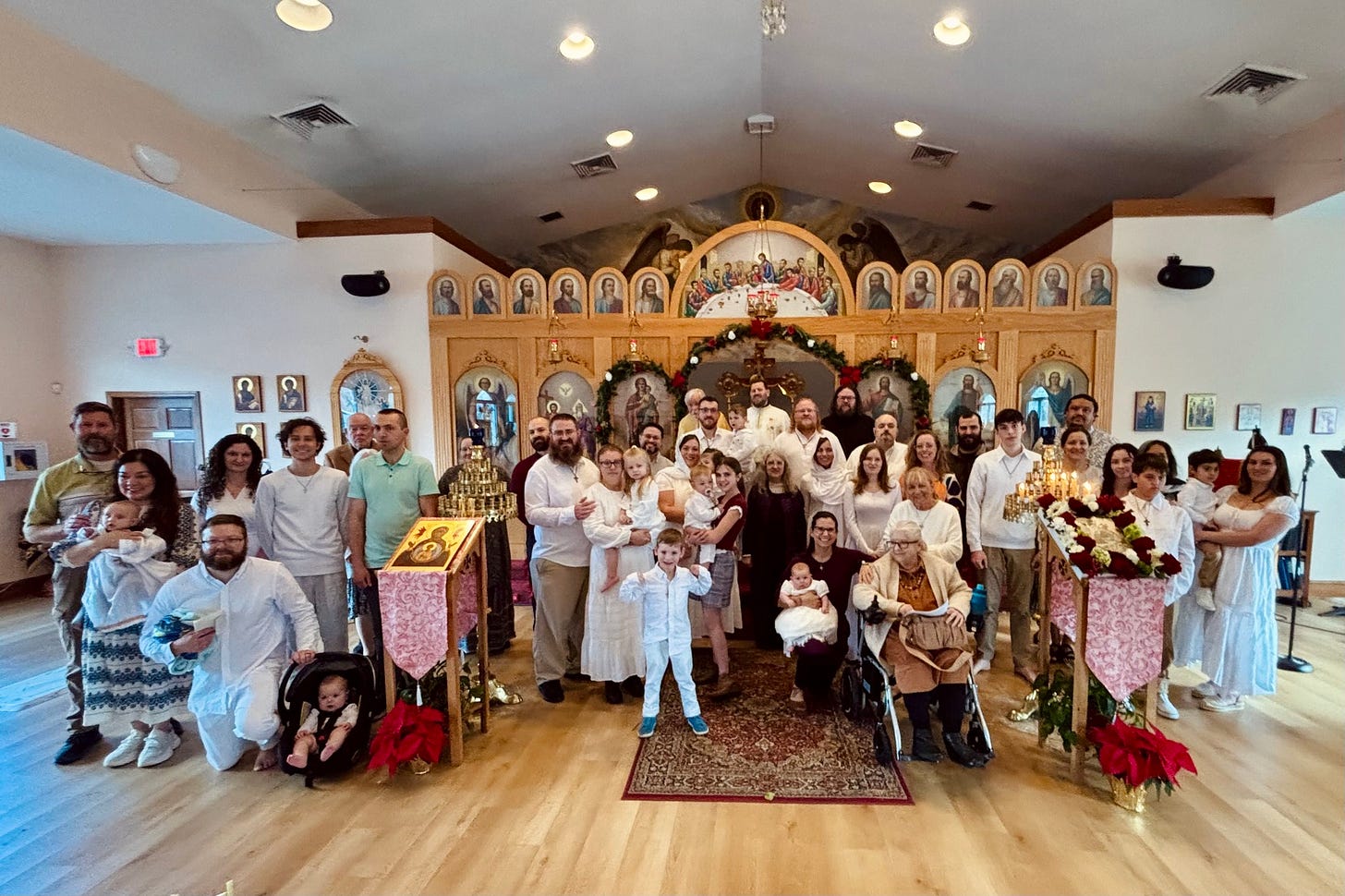
A congregation that is overflowing. On Christmas Eve morning we baptized 25 adults and 2 babies. We borrowed a second adult-size immersion “font” (actually, a Rubbermaid cattle trough) from a neighboring church, and the two priests just kept baptizing side-by-side till they got through them all.
Also, you can see that the majority of the baptized, wearing white, are young. This is going on all over the country. It’s a fine time to be Orthodox, just as a wave is rising. It’s not always been this way in the past, and may not always be this way in days to come; but right now, it’s pretty terrific.
Iona remained a place of pilgrimage, until the Protestant Reformation snuffed out its monastic life. The abbey was dissolved, and its traditions dispersed.
Nothing makes me angrier at the Protestant Reformation than two sentences like this, which recur depressingly in history.
Orthodox Christianity is the branch of the Christian faith that split from Roman Catholicism in the Great Schism of 1054.
Nothing makes me angrier at lazy journalists than a sentence like this, which recurs depressingly in stories about Orthodox Christianity.
The Orthodox side had four patriarchs. The Roman Catholic side had one patriarch, who had increasingly claimed supremacy over the four others. Prima facie, if you know nothing but that, who’s likelier to have been schismatic: the one or the four?
The Journalist even knows better, though he hasn’t bothered connecting the dots:
[Orthodox Christianity] retains the early creeds, sacraments, and saints of Western Christianity; but where the Western faith has diverged, its theology, liturgy, and rhythms of life have remained unchanged.
UPDATE: I left a thought hanging. The second sentence makes me angry because the Protestant Reformation sometimes bore an uncanny resemblance to ISIS, destroying anything “religious” it didn’t understand, including genuine and venerable Christian practices and symbols its bad religion disallowed. See Eamon Duffy, The Stripping of the Altars: Traditional Religion in England, 1400-1580.
Reaching the lost as a journeyman trade
Finney’s Lectures on Revivals of Religion (1835), which is discussed at greater length below in chapter 15, was important for summarizing a new approach toward reaching the lost. Since God had established reliable laws in the natural world and since humans were created with the ability to discern those laws, it was obvious that the spiritual world worked on the same basis. Thus, to activate the proper causes for revivals was to produce the proper effects: “The connection between the right use of means for a revival and a revival is as philosophically [i.e., scientifically] sure as between the right use of means to raise grain and a crop of wheat. I believe, in fact, it is more certain, and there are fewer instances of failure.”
Because the world spiritual was analogous to the world natural, observable cause and effect must work in religion as well as in physics. The wine of revival—confidence in God’s supernatural ability to convert the sinner—may have looked the same in antebellum America as it had in earlier centuries, but the wineskin was of recent manufacture.
This account of Finney’s stunningly presumptuous theory of revival is in a section of Noll’s book titled “Assumptions and Assertions of American Theology.” I strongly suspect that this theory is how we got the foregrounding of manipulative rhetorical technique:
The rising and falling of the preaching voice; the shouting followed by the whisper
dimmed lights
“every head bowed and every eye closed” altar calls,
If manipulating people to an emotional climax, to get insta-saved, is your metric for “revival,” I suppose Finney was right. But I’ve lived too long and seen to much to think that such manipulated response is in any very meaningful sense a conversion to Christian faith. The wiser course is the Orthodox catechumenate.
What St. John Chrysostom knew that Jefferson Davis wanted to forget
Chrysostom’s Homilies posed problems for slaveholders, as elsewhere in this work the bishop instructed Christians to educate their slaves and manumit them as soon as possible.
Paul Gutacker, The Old Faith in a New Nation. I had never heard of St. John Chrysostom until I entered an Orthodox Church for a Sunday observance of his Liturgy. He was perhaps the greatest preacher in Christian history — in the 4th century.
Credit where credit is due: though Gutacker is neither Orthodox nor Roman Catholic, he knows of Chrysostom.
Is Christianity a Religion?
I recall the formulation, uttered many times in my presence (or written many times in sources I read), that “Christianity is not a religion; it’s a relationship.”
As best as I can recall, I thought that was facile, though not entirely worthless, and was formulated in response to a then-current cultural bias that religion was bad (which bias I think I never shared).
But here’s a weightier explanation of why Christianity is not a religion:
Nowhere in the New Testament, in fact, is Christianity presented as a cult or as a religion. Religion is needed where there is a wall of separation between God and man. But Christ who is both God and man has broken down the wall between man and God. He has inaugurated a new life, not a new religion.
Unlike immediately after the Protestant Reformation, almost all Christians today are happy to affirm that Protestants or Catholics or the Orthodox are truly Christians—and are thereby burdened to explain why their differences actually matter. The partial success but overall failure of the modern ecumenical movement has meant that many members of churches, especially Protestant, have become fundamentally post-denominational in their outlook. When churches can acknowledge that other churches from whom they are separated are equally valid as Christian churches, but don’t overcome the actual divisions, the unintended message is that the divisions are evidently not so theologically important after all, and the result is a church culture of consumer choice about where to worship and what to believe. But a faith decision based on preference is no faith decision at all—it permits no authority. The agony of those with faith is to respond to authority in this situation of choice.
Matthew Burdette, Zero Gravity. I struggled with “the unintended message is that the divisions are evidently not so theologically important after all.” It seemed to me that the unintended message is that that divisions are important — almost like we’re just being polite when we acknowledge that other traditions are Christian, too. But he said “that the divisions are … not so … important,” not “that doctrine is not important.” We’re too dismissive of the grave sin of schism seems to be his meaning.
I’m going to forego my temptation to theorize why we’re dismissive of schism.
No, on second thought, I’m going to give the short answer: we’re “making a virtue of necessity.” We can’t stop doing it, and we’re good people, aren’t we? So how can it be all that bad?
Religious ideas have the fate of melodies, which, once set afloat in the world, are taken up by all sorts of instruments, some woefully coarse, feeble, or out of tune, until people are in danger of crying out that the melody itself is detestable.
George Elliot, Janet’s Repentance, via Alan Jacobs
[N]one of the things that I care about most have ever proven susceptible to systematic exposition.
You can read most of my more impromptu stuff here and here (both of them cathartic venting, especially political) and here (the only social medium I frequent, because people there are quirky, pleasant and real and it has no-algorithms). All should work in your RSS aggregator, like Feedly or Reeder, should you want to make a habit of it.
The best thing about New Years Day 2026 is that it means 2025 is over. President Ozymandias really hit the ground running for his second term, having surrounded himself with evil, shrewd, and power-hungry operatives this time instead of Republican normies who muted his bellowing. It’s hard to imagine (knocks on wood) that the worst of the self-aggrandizing vandalism isn’t over now.
Wordplay
Aphorisms
A platitude is a placebo for the mind; an aphorism is a wake-up call. Aphorisms provoke debate; they don’t promote dogma. Though they’re short, aphorisms spur considered reflection, not Pavlovian partisanship. At a time when polarization is so amped up, aphorisms can serve as psychological circuit breakers, interrupting our comfortable assumptions and prodding us to open our minds, unclench our fists, and think for ourselves.
In The Washington Post, Dana Milbank responded to some Republicans’ suggestion that the D.C. Metro be renamed the “Trump Train”: “It’s a great idea. Qatar will donate the subway cars, which will be powered by coal. Passengers will pay for fares with cryptocurrency after first showing proof of citizenship. And the trains will reverse themselves regularly and without warning — never quite reaching their original destination.” (Mary Ellen Maher-Harkins, Orwigsburg, Pa.)
In The Atlantic, David A. Graham processed the addition of “Trump” to “Kennedy” in the moniker for Washington’s premier performing arts center: “He asks not what he can do for his country, but what his country can name for him.” (Darrell Ing, Honolulu)
In Esquire, Dave Holmes acknowledged that Senator Lindsey Graham was maybe joking that Trump should be the next pope — but maybe not: “You can’t be tongue-in-cheek when you are actively licking the boot. There is just not enough tongue for both jobs.” (Susan Fitzgerald, Las Cruces, N.M.)
In The Wall Street Journal, Jason Gay rued the effect of obsessive replays on the determination of what, in pro football, constitutes a catch. “It’s the affliction of overthinking: If it walks like a duck, and talks like a duck, wait, hold on, it must be a chandelier,” he wrote. “It’s further evidence humans can ruin the spirit of anything, if given the time and technology.” (Bill Sclafani, Rockport, Mass.)
\[I\]n The Washington Post, Ron Charles assessed “The Little Book of Bitcoin,” by the supremely self-confident pitchman Anthony Scaramucci: “In one passage, he touts the convenience of transporting $500 million in Bitcoin on a thumb drive, which is the best news I’ve heard since my yacht got a new helipad.” (Stephen S. Power, Maplewood, N.J., and Hannah Reich, Queens, among others)
Charles also observed that the scolds who ban books have taken issue with “Maurice Sendak’s ‘In the Night Kitchen,’ which has been proven in the state of Florida to turn straight white Christian boys into polygender Marxists who eat only quinoa.” (Jill Gaither, St. Louis, and John Jacoby, North Andover, Mass.)
In The Times, Kevin Roose worried that when it comes to regulations, the stately metabolism of institutions is no match for the velocity of A.I.: “It feels, at times, like watching policymakers on horseback, struggling to install seatbelts on a passing Lamborghini.” (Conrad Macina, Landing, N.J.)
In The Times, A.O. Scott sang a similar song: “Occam’s razor, the venerable philosophical principle that the truest explanation is likely to be the simplest, has been thrown away. We’re living in the age of Occam’s chain saw, when the preferred answer is the one that makes the loudest noise and generates the most debris.” (Charles Kelley, Merrimack, N.H., and Trisha Houser, Durham, N.C., among others)
I saved three of Bruni’s best as personal favorites:
Also in The Times, Matt Hongoltz-Hetling considered the importance of an annual communal feast to a Vermont town’s special fellowship: “Whether a vibrant community created the potluck or the potluck created a vibrant community is like asking which came first, the fried chicken or the deviled egg.” (Stacey Somppi, Cottonwood, Ariz., and Hillary Ellner, Durham, N.C., among others)
In The Times, James Hamblin parodied the typical message and script of a television drug ad: “You will frolic on the beach at sunset psoriasis-free, with a golden retriever, smiling into the distance. You also may experience sudden loss of cardiac function, seizures of the arms or intermittent explosive ear discharge. Talk to your doctor.” (Susan Casey, Palm City, Fla.)
In The Dispatch, Kevin D. Williamson gave thanks for academia, despite its flaws: “The American university system is the envy of the world, and we are burning it down because there’s a couple of nonbinary gender studies professors at Bryn Mawr who say crazy stuff from time to time and there is a brain-dead gaggle of Jew-hating weirdos at Columbia. Of course, there is room for reform. But you don’t have to love every feather on the goose when it is laying golden eggs.” (Dan Markovitz, Corte Madera, Calif.)
The first just feels perfect; “explosive ear discharge” in the second was the only thing in the list that made me laugh uncontrollably; Kevin Williamson captures perhaps the single most tragic thing about what “we” are doing, (purely by coincidence, of course, during the second reign of the orange barbarian).
Finally: “Some of you should walk a mile in my shoes, because then you would be a mile away from me. Keep the shoes.” (Encountered by my wife on Pinterest)
My 2025
Reading
As I always note in my footer, I blog and socialize at micro.blog in addition to here. One of my friendlies at MB, an uncommonly sane Evangelicalish pastor in Chicagoland (very keen on racial reconciliation is he), posted his 2025 reading list and inquired about what others read this year.
My response:
At 77, I feel the Grim Reaper breathing down my neck, and I already own more books than I’ll get read before he wins. Further, I’ve read many, many books in my life already, including multiple books on many perennial themes. And although I love poetry, I either had poor teachers or was too barbarian to learn how to read demanding examples.
So I don’t have much toleration for books that are cumulative of what I already understand, or are neither pleasurable nor (so far as I can tell after reading a bit) profitable, including ones that many good people were raving about.
To avoid performative listing, then (e.g., Geoffrey Hill poetry, which defeated me utterly), I’ve eliminated all the books I abandoned part way in. Finally, listing a volume of poetry doesn’t mean I’ve read it all yet.
Book
Author
Rings Trilogy
Tolkien
Albion’s Seed
David Hackett Fischer
The World After Liberalism
Matthew Rose
Coracle
Kenneth Steven
Table for Two
Amor Towles
Till We Have Faces
C.S. Lewis
Godric
Beuckner
Stalingrad
Anthony Beever
Small Is Beautiful
Schumacher
Rilke Poetry
Rilke
Apocrypha
Stephen De Young
The Greek East and the Latin West: A Study in the Christian Tradition
Philip Sherrard
A Time of Gifts
Patrick Leigh Fermor
The New Science of the Enchanted Universe
Marshall Sahlins
Bread & Water, Wine & Oil
Fr. Meletios Webber
Lost in the Cosmos
Walker Percy
Giovanni’s Room
James Baldwin
The Long Loneliness
Dorothy Day
The innocence of Father Brown
G.K. Chesterton
Against the Machine
Paul Kingsnorth
You Have Arrived at Your Destination
Amor Towles
The Air We Breathe: How We All Came to Believe in Freedom, Kindness, Progress, and Equality
Extra pills are piling up across America. Excessive refills by U.S. pharmacies cost Medicare and patients $3 billion between 2021 and 2023, according to a WSJ analysis of Medicare prescription data.
WSJ. Based on my own rigorous anecdata, this is 1000% true. Which means that although mail-order pharmacies may have started it, brick-and-mortar local pharmacies are in the game now, too.
I really would rather not manually refill every prescription, but my pharmacy seems incapable of waiting 90 days to refill a 90-day prescription, and when I get a text that a prescription is ready for pick-up, I go pick it up (with rare exceptions, like a post-op opioid painkiller I definitely did not need).
Sam Altman, OpenAI’s chief executive, said in a recent podcast he can see ways that seeking companionship from an AI chatbot could go wrong, but that the company plans to give adults leeway to decide for themselves.
Nothing in her political career before September inclined me to cut Marjorie Taylor Green any slack whatever, but something has happened since then.
Her political conversion story, if you can call it that (it’s not about changing from MAGA to progressive or any other political position), rings true.
It started at the Charlie Kirk Memorial service:
What stayed with Greene long afterward were the last two speakers who took the stage. First there was Kirk’s widow, Erika, who stood in white before the crowd filling the Arizona stadium, lifted her tear-filled eyes and said that she forgave her husband’s killer. And then there was President Trump. “He was a missionary with a noble spirit and a great, great purpose,” he said of Kirk. “He did not hate his opponents. He wanted the best for them. That’s where I disagreed with Charlie. I hate my opponent, and I don’t want the best for them.”
“That was absolutely the worst statement,” Greene wrote to me in a text message months after the memorial service. And the contrast between Erika Kirk and the president was clarifying, she added. “It just shows where his heart is. And that’s the difference, with her having a sincere Christian faith, and proves that he does not have any faith.”
I thought at the time that should have been a wake-up call for every “Christian” Trump supporter in America. I still do. It speaks ominous things about our religious and political culture that it seems to have awoken so few.
But Marjorie Taylor Green, of all people, recognized it! And it appears that she has genuinely repented of her role in stoking hatred and division!
Time will tell; she’s been taking the potent MAGA pill for a long time, and withdrawal may prove too hard. But it’s looking good so far.
I wish her what I wished for Jimmy Carter on January 20, 1981: a long and happy and private life — plus a sustained repentance.
Paganism with worship music
We seem to be entering a pagan century. It’s not only Trump. It’s the whole phalanx of authoritarians, all those greatness-obsessed macho men like Vladimir Putin and Xi Jinping. It’s the tech bros. It’s Christian nationalism, which is paganism with worship music. (If you ever doubt the seductive power of paganism, remember it has conquered many of the churches that were explicitly founded to reject it.)
“If you dislike the religious right, wait till you meet the post-religious right,” Ross Douthat warned presciently at the dawn of Trumpism in 2016. … What Douthat calls the “post-religious right” certainly is more obnoxious and morally degenerate than its Bush-era forebear was, but it’s not correct to call a movement that’s developed its own alternate morality “post-religious.” It’s not even correct to call it “post-Christian,”…
The modern right is boisterously Christian, but without Christ. It extols Christianity aggressively but has ditched most of the moral content …
…
The purest expression of Christianity without Christ came from Trump himself, not coincidentally. At Charlie Kirk’s memorial service, shortly after Kirk’s widow, Erika, moved viewers by publicly forgiving her husband’s killer, the president strode to the mic and said, “That’s where I disagreed with Charlie. I hate my opponents, and I don’t want the best for them. I’m sorry.” That’s the literal antithesis of Christian morality …
But there were no mass defections by Christians from the president’s camp after his heresy. Erika Kirk herself remains a loyal Trump ally in good standing. And why not? Hating one’s enemies is squarely in line with the three purposes of post-Christ right-wing Christianity. The first is establishing the right’s cultural hegemony over other American factions; the second is narrowing the parameters of the right-wing tribe to exclude undesirables; and the third is deemphasizing morality as a brake on ruthlessness toward one’s opponents.
Almost everything written about the “alternative right” has been wrong in one respect. The alt-right is not stupid; it is deep. Its ideas are not ridiculous; they are serious. To appreciate this fact, one needs to inquire beyond its presence on social media, where its obnoxious use of insult, obscenity, and racism has earned it a reputation for moral idiocy.
Matthew Rose, A World After Liberalism
At the outset of debate
If we are willing to grant, at the outset, that the people we’re debating agree about ends—that they want a healthy and prosperous society in which all people can flourish—then we can converse with them, we can see ourselves as genuine members of a community. And even if at the end of the day we have to conclude that we all do not want the same goods (which can, alas, happen), it is better that we learn it at the end of the day than decide it before sunrise.
Would we necessarily say that government, civic life, the media, or high finance work better now than in the mid-20th century? We can scorn the smug WASP blue bloods from Groton and Choate—and certainly their era’s retrograde views of race and gender—but their leadership helped produce the Progressive movement, the New Deal, victory in World War II, the Marshall Plan, NATO, and the postwar Pax Americana. After the meritocrats took over in the 1960s, we got quagmires in Vietnam and Afghanistan, needless carnage in Iraq, the 2008 financial crisis, the toxic rise of social media, and our current age of political dysfunction.
We are also offended by the contumely of allies as well as foes, who refuse to regard our prosperity as fruit and proof of our virtue but suggest that it may be the consequence of our vulgar Philistinism.
Reinhold Niehbur, The Irony of American History
Read the fine print
On the surface, it would seem that the assurances given in the Declaration of the Rights of the Peoples of Russia were clear and unequivocal. But lurking in the shadowy annals of communist polemics there was a catch. To paraphrase, but not distort, Lenin’s position, nations have the right to self-determination, but only the proletariat has the right to decide. And, as if that were not enough, only the Communist Party can speak for the proletariat.
Jack Matlock, Autopsy on an Empire
Raising the bar for Tinhorn Dictators
Ramsey’s intolerance for dissent has created what former employees call a cultlike environment, where leaders proclaim their love for staff and then fire people at a moment’s notice.
A new crop of moderate Democrats is trying to counter both President Trump and progressive influence in their own party. (WSJ) May their tribe increase.
And so we have before us one of the characteristic political necessities of our time: to take seriously what we cannot respect. (Wendell Berry, The Unsettling of America)
Conservative and mainstream media were drifting apart, not just ideologically but epistemically… (Jonathan Rauch, The Constitution of Knowledge) This epistemic drift (of the Right, I think, not the mainstream) tempts me to despair.
“The only thing we have to fear is fear itself,” … was a damned funny thing for Franklin Roosevelt to say in 1933, the year Adolf Hitler came to power. (Kevin D. Williamson)
The face of my fear is not a new Hitler but the Old Adam. It is the face in the mirror. (Kevin D. Williamson)
One category I used to apply to some of my posts became obsolete almost overnight around 1/20/2017: Zombie Reaganism. You never see that any more, and I miss it more than I thought I would.
I don’t do any of the major social media, but I have two sub-domains of the domain you’re currently reading: (a) You can read most of my reflexive stuff, especially political here. (b) I also post some things on my favorite no-algorithm social medium.

 Tipsy Teetotaler ن