I hesitate to share this, but not knowing who my readers are, I can’t know that somebody doesn’t need this as a wake-up call:
Writing for Christianity Today, Russell Moore unpacked how the evangelical subculture rejected virtue, “driven specifically by the very same white evangelical subculture that once insisted that personal character—virtue, to use a now distant-sounding word the American founders knew well—matters.” He continued: “Part of the vulgarization of the Right is due to the Barstool Sports/Joe Rogan secularization of the base, in which Kid Rock is an avatar more than Lee Greenwood or Michael W. Smith. But much more alarmingly, the coarsening and character-debasing is happening among politicized professing Christians. The member of Congress joking at a prayer breakfast about turning her fiancé down for sex to get there was there to talk about her faith and the importance of religious faith and values for America. The member of Congress telling a reporter to ‘f— off’ is a self-described ‘Christian nationalist.’ We’ve seen ‘Let’s Go Brandon’—a euphemism for a profanity that once would have resulted in church discipline—chanted in churches. If we are hated for attempted Christlikeness, let’s count it all joy. But if we are hated for our cruelty, our sexual hypocrisy, our quarrelsomeness, our hatefulness, and our vulgarity, then maybe we should ask what happened to our witness. Character matters. It is not the only thing that matters. But without character, nothing matters.”
[W]ere he to emerge today, [Ned] Flanders would face withering mockery for his moral scruples—but more likely by his white evangelical co-religionists than by his beer-swilling secular cartoon neighbors.
On the other hand …
This makes sense to me. Evangelical Christianity emphasizes the personal relationship with Christ. It puts more emphasis on what Kierkegaard said was the core Christian way of responding to the Gospel: as something to be lived out actively, requiring personal conversion, not just a social habit.
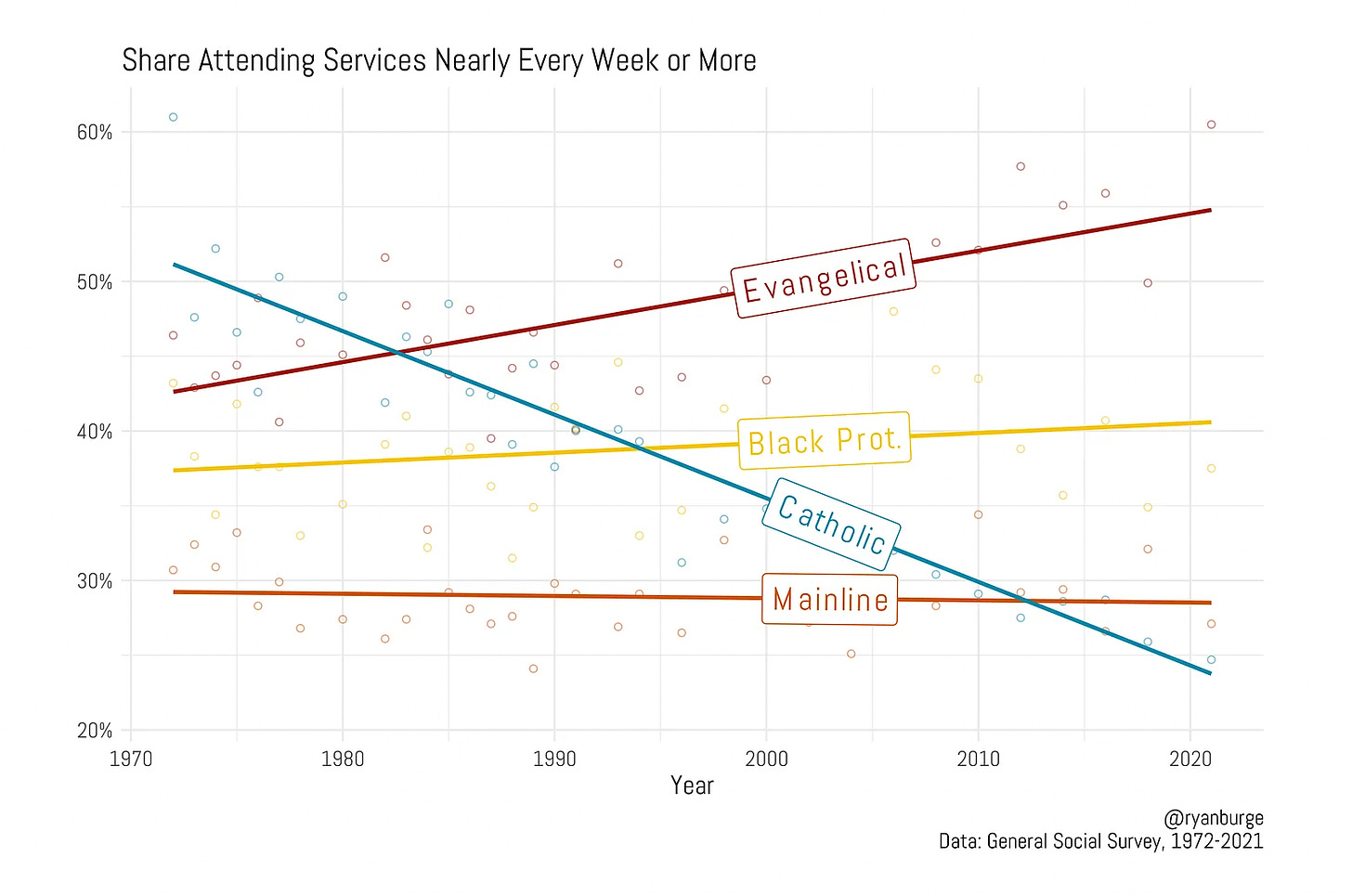
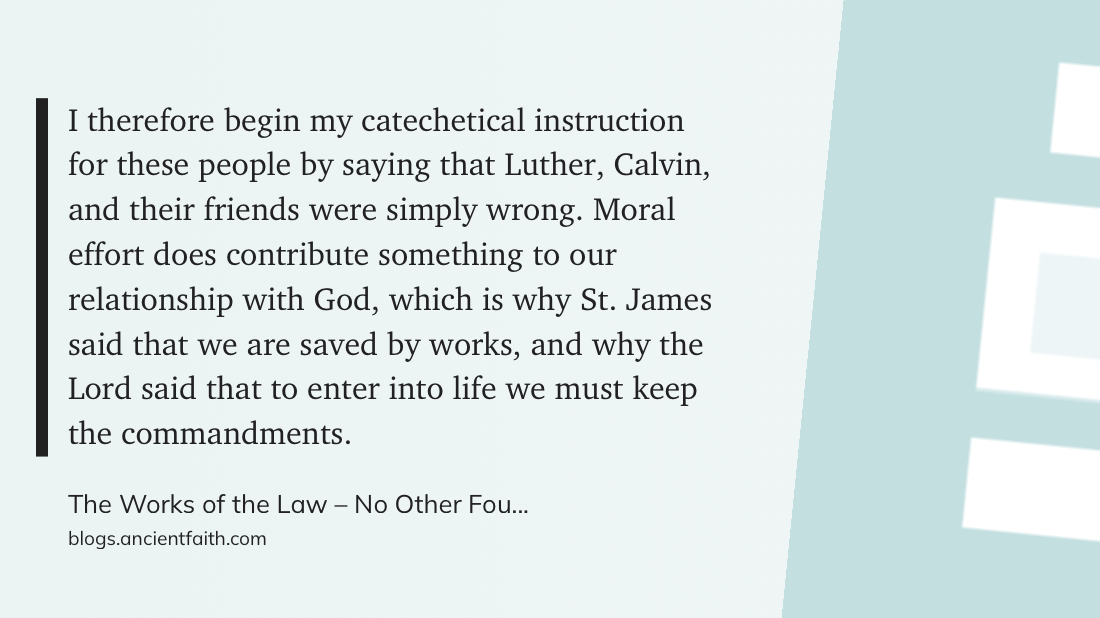
It is, as they say, ironic. Evangelical theology is almost antinomian in terms of salvation having anything to do with what you do, versus the notions in your head (what you “believe”).
But there they are, bless their hearts, in Church oftener than not.
But I just discovered that one of my favorite Orthodox bloggers, Fr. Stephen Freeman, has noticed the same democratizing theme:
[I]n contemporary Christianity, it is said that “every man is a Pope.” Whereas a few generations ago, people asserted that the Bible alone had authority, today, that, too, has been overthrown. Each person is his own authority. And I will add, that if every person is his own authority, then there is no authority.
…
I am fully sympathetic with the political place of democracy …
I am, however, deeply interested in the spiritual disease that accompanies the interiorizing of the democratic project. We have not only structured our political world in a “democratic” manner, we have spiritualized the concept and made of it a description for how the world truly is and how it should be. The assumptions of democracy have become the assumptions of modern morality and the matrix of our worldview …
…
Much of what today passes for Protestantism is nothing of the sort. Rather, it is a thinly veiled cloak for the democratic spirit at “prayer.” “Salvation by grace through faith” is a slogan for individualism, a Christianity “by right.” There are no works, no requirements, only a “grace-filled” entitlement. For the ultimate form of democracy is the person who needs no one else: no Church, no priest, no sacrament, only the God of my understanding who saves me by grace and guarantees that I can do it alone.
…
It is a great spiritual accomplishment to not be “conformed to this world.” The ideas and assumptions of modern consumer democracies permeate almost every aspect of our culture. They become an unavoidable part of our inner landscape. Only by examining such assumptions in the light of the larger Christian tradition can we hope to remain faithful to Christ in the truth. Those who insist on the absence of spiritual authority, or demand that nothing mediate grace will discover that their lives serve the most cruel master of all – the spirit of the age.
Nevin and Schaff also discerned certain common intellectual patterns and reflexes beneath the rampant pluralism of American Protestantism. They attributed the breakdown of theological coherence to attitudes that American Christians had assumed. These two felt that a radical Bible-centeredness was the reigning theory among Protestant sects. After surveying the statements of belief of fifty-three American denominations, Nevin surmised that the principle “no creed but the Bible” was the distinctive feature of American religion.
Nathan O. Hatch, The Democratization of American Christianity
Fifty-three denominations that just follow the Bible but cannot agree on what it means. What’s wrong with this picture?
Christianity generally
A constant temptation
Christianity in this instance is no longer even a worldview—or what John Rawls calls a “fully comprehensive doctrine”—much less an institutionalized worldview. It is conceived as one wedge in the pie of an individual life, a matter not of shared obedience to the Word incarnate with eternal life in the balance, but of preferred inclination toward the “company or conversation of those whose Customs and Humours, whose Talk and Disposition they like best.”
Brad S. Gregory, The Unintended Reformation
An article I keep coming back to
This is an article I’ve been revisiting and wrestling with regularly:
There is a reason why so many evangelical and Protestant graduate students in theology move toward “higher church” traditions. Intellectually, they discover thinkers and writings their own “lower church” traditions either ignore or lack; liturgically, they discover practices handed down century after century that function like a lifeline in a storm. Reading Saint Ignatius or Saint Justin or Saint Irenaeus or Saint Augustine, it occurs to them that they don’t have to imagine what the church’s ancient liturgy looked and felt like; they can simply visit a church down the street.
…
It isn’t strange to learn that Prestigious Scholar X on the law/econ/poli-sci faculty at Ivy League School Y is Roman Catholic. It is a bit of a surprise to learn that he’s an evangelical. The moment you hear it, though, you wonder (or ask) whether he’s an evangelical Anglican or some such.
For those whose churches don’t have formal confession, understand that we confess our sins without suggesting that they were justified by our neighbor’s provocation. It sounds so easy, but not being able to self-justify, not even a eensy-weensy bit, can be surprisingly hard.
East and West
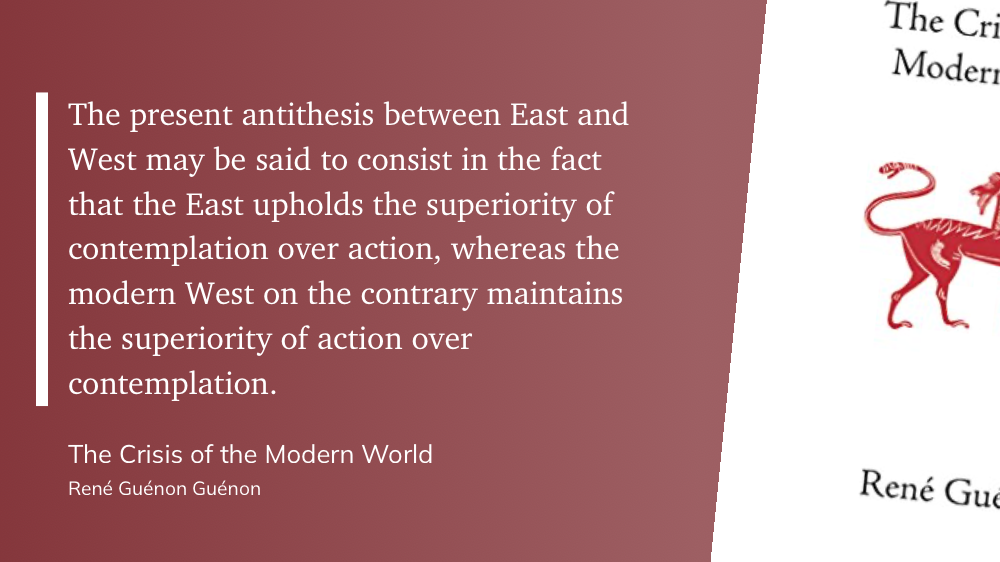
I don’t think his focus was Christianity, but Guenon was (inadvertently?) not wrong about the relative emphasis in Western versus Eastern Christianity.
… that Christ may dwell in your hearts through faith; that you, being rooted and grounded in love, may be able to comprehend with all the saints what is the width and length and depth and height — to know the love of Christ which passes knowledge; that you may be filled with all the fullness of God.
You can read most of my more impromptu stuff here and here (both of them cathartic venting, especially political) and here (the only social medium I frequent, because people there are quirky, pleasant and real). All should work in your RSS aggregator, like Feedly or Reeder, should you want to make a habit of it.


 Tipsy Teetotaler ن