
This has been my lucky week, as I’ve encountered several articles (here, here and here, especially) that gave me some new perspectives to mull over. This latest is from Ethika Politika. It’s a bit long by today’s internet standards, but don’t think my following points or quotes capture it all.
- “Pope John Paul II … In Centesimus Annus … posed the following question: With the failure of the “Marxist solution,” ought capitalism to be seen as the way toward true economic and civic progress, particularly in the case of developing nations?” His answer basically was that it depends on what you mean by “capitalism.”
- “I take Catholicism to be utterly destructive of socialism while being merely corrective of liberalism (or democratic capitalism, or liberal democracy, etc.).”
- “'[L]iberalism’—not unlike ‘capitalism’ … is so often poorly defined that … discussions about it often turn into little more than pillow fights in the dark.”
- “The weakness of this critique is that it treats liberalism as both a coherent intellectual project and tradition and as a decidedly indeterminate muddle of contradictory—or at the very least, inadequate—claims about human nature and society. ‘Liberalism’ can be more or less adequately defined as either; I do not see how it can be both at the same time.”
- “The problem with [Patrick] Deneen’s definition of liberalism is not that such deep anthropological assumptions do not exist—indeed they are widespread, to terrible effect—it’s that there is a great deal more to liberal societies and institutions as they actually exist than these two errors suggest.”
- “[T]he indeterminacy of liberalism leaves it vulnerable to relativism. As Pope Benedict XVI famously observed, such relativism easily becomes decidedly illiberal, even dictatorial. In the absence of any agreed-upon truth, reconciliation of competing claims becomes impossible except by force and politics devolves into a zero sum game wherein varying parties and interests seek alternately to impose their wills each upon the other. In such an environment, solidarity withers.”
- “Attempts to increase social solidarity while neglecting or trampling subsidiarity invariably produce the opposite effect: social disintegration.”
(Stephen P. White, Our Only Option, at Ethika Politika, emphasis added)
UPDATE: A reader reports a dead link to Ethika Politika, and that appears to be accurate. I don’t know what happened to the article, but here is a link to the version I copied to my Evernote account.
“Free speech is not a left-right thing; it is a free-unfree thing” (Mark Steyn)
The Brisbane Courier Mail published a forum in June 2011 entitled “Gay marriage: the case for and against” and I was asked to give the case against.
For arguing that it is wrong to deprive a child of her mother through allowing two men to marry and start a family, I was accused by a gay activist of “vilifying the homosexual community” and compelled under section 124A of the Queensland Anti-Discrimination Act 1991 to attend “conciliation”. Of course I had nothing to conciliate. I said to the complainant: “You are a gay activist; I am a family activist – so we disagree! Free citizens argue their case; they don’t set government lawyers onto their opponent.”
That worthless complaint was withdrawn unconditionally, but not until the process had cost me time and money. As Steyn points out, that is the whole point: “the process is the punishment”. I relished this opportunity to push back against such contemptible laws, but for many people the experience would have been intimidating.
(David van Gend at Mercatonet.com, emphasis added) Expect to see lots of this kind of intimidation. Note that the Newspaper was not hailed before the government commission. Our American newspapers, if current trends hold, will be siding with the intimidators even as they profit by stirring the pot.
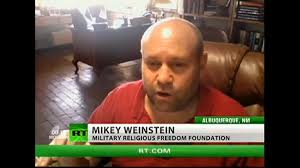
The walking, talking pestilence, g*d’s gift to tin-hat makers, Mikey Weinstein, scourge of United States Air Force Academy fundamentalists and hyperfundamentalists, real and especially imagined, has succeeded in eradicating terrifying Christianist hate speech from the personal white board outside the dorm room of a cadet:
I have been crucified with Christ therefore I no longer live, but Christ lives in me.
Oh. The. Horror.
“Had it been in his room — not a problem,” Weinstein told me. “It’s not about the belief. It’s about the time, the place and the manner.”
He said the Bible verse on the cadet’s personal whiteboard created a hostile environment at the academy.
“It clearly elevated one religious faith [fundamentalist Christianity] over all others at an already virulently hyper-fundamentalist Christian institution,” he said. “It massively poured fundamentalist Christian gasoline on an already raging out-of-control conflagration of fundamentalist Christian tyranny, exceptionalism and supremacy at USAFA.”
Exactly two hours and nine minutes after Weinstein complained to Air Force Academy Superintendent Michelle Johnson, the Bible verse was erased from the cadet leader’s whiteboard.
USAFA is “virulently hyper-fundamentalist,” leaving no room on the extreme of the spectrum for, say, Bob Jones University. Makes about as much sense as calling a Prom photo “hard-core pornography” if the gown’s strapless. Bill Donohue has definitely met his grievance-mongering match.
That somebody as patently unhinged as Weinstein actually exerts some influence reminds me that “it [fascism, totalitarianism] can’t can surely happen here.”
Young, gay writer Brandon Ambrosino is apparently, by being a fairly normal human being, breaking some gay taboos, whence a hysterical campaign against him analogous to Mikey Weinstein’s obsessive, frothing-at-the-mouth attacks on all things visibly Christian.
I’m quite unfamiliar with his work at this point, and if you want to know more, I’ll refer you to Rod Dreher here and here. I tend to agree with Dreher on the shamefulness of the attacks on him and on how hard it will be for him not to cave it and start flying a freak flag to show that he’s normal by an entirely different standard of normalcy: that of the exhibitionists at the most notorious gay pride parades.
That somebody as patently unhinged as some of Abrosino’s critics – Oh! I’m repeating myself! Sorry!
Q: Which countries, either now or in the past, have gotten it right, in your view, on preserving religious liberty? What are the specific policies and results?
A: I’ll wax patriotic for a moment: I think America has (mostly) “gotten it right,” in ways that few other countries can equal. We’ve had a de facto religious consensus at times (Mainline Protestantism at various points in the 19th century, “Judeo-Christianity” in the Eisenhower era) and spasms of anti-Catholicism, anti-Mormonism, and the like, but we’ve mostly maintained what I think is the crucial balancing act of separating church and state without trying to separate religion from politics and public life. Which means that relative to many other countries and cultures, we’ve managed to reap the benefits of religious idealism – through our many religiously-motivated reform movements, from the abolitionists to the populists to the civil rights movement to (or so I would say) the pro-life movement, and then also through the social, civic benefits of a thriving religious marketplace– without enabling the worst forms of religious intolerance. And we’ve also avoided the kind of left-wing anti-clerical politics that emerged in reaction to that intolerance in Europe, and that created an atmosphere of constant church-state conflict throughout the 19th and 20th centuries.
My general anxiety, underlying the specific religious-liberty issues that we’re debating these days, is that this achievement may be slipping away from us – that as the country has become somewhat less religious overall, and as the two parties have become not only ideologically but religiously polarized, a sort of Europeanization of American church-state issues has become visible in our politics. You can see this on the religious right, in the appeal of an ahistorical nostalgia for a Christian America that never really was, and then you can see it on the irreligious left, in the appeal of an ahistorical view that the Constitution somehow bars religious people from bringing their theological convictions into politics. And I think the latter impulse is pushing liberalism in an increasingly anti-clerical direction, toward a narrowed view of religious freedom in which that freedom stops when the Sunday (or Saturday) service ends, and a narrow view of religious pluralism that sees religious schools and charities and hospitals mostly as potential threats to individual liberty, rather than important non-state servants of the common good. How far this impulse will take liberalism I don’t know – you should ask a liberal! But I don’t think current trends are good news for what Robert Putnam calls the“grace” that religious freedom has offered our society these last few hundred years.
* * * * *
“The remarks made in this essay do not represent scholarly research. They are intended as topical stimulations for conversation among intelligent and informed people.” (Gerhart Niemeyer)
 Tipsy Teetotaler ن
Can’t link to the Ethika Politika article! Did a search on their site too.