
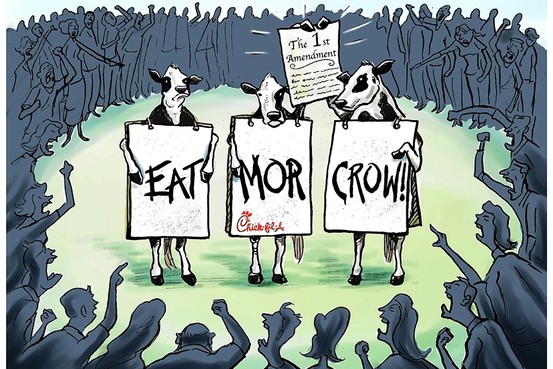
The Wall Street Journal’s William McGurn opines on the resumption of the Chick-fil-A wars – the one where politicians try to bully Chick-fil-A with threats of barring them from starting new outlets:
Whether the means involve Federal Election Commission disclosure requirements, Securities and Exchange Commission rules on shareholder resolutions, or simply tagging those with opposing views as “hate groups,” the object is clear: to limit debate by forcing one side off the playing field.
For a long time, the prevailing idea was that you encourage free speech with regulations ensuring full transparency. While this may sound fine in theory, in practice these requirements can conflict with the right of people to come together in free association. Certainly that was the Supreme Court’s understanding in 1958, when it rejected the state of Alabama’s demand that the National Association for the Advancement of Colored People turn over its membership list.
In like manner, Bradley A. Smith says that what he saw as head of the Federal Election Commission under George W. Bush led him to conclude that some of our government requirements limit rather than encourage free speech. “Today we have too many people saying not only ‘I disagree with you,’ but ‘I hate your message and you shouldn’t be allowed to say it,'” notes Mr. Smith, who now runs the Center for Competitive Politics. “The more ruthless then use disclosure laws to seek out and target those who hold contrary views.”
Mr. Smith says that many Americans who favor disclosure do not perceive that these requirements might make them targets. For example, if you were a gay-marriage supporter working in the midst of an evangelical Christian business in a deep-red state, would you want your boss and co-workers to know you gave $100 for a gay-rights referendum? Obversely, if you were a young professor at Harvard up for a tenure vote, how comfortable would you be with your colleagues’ knowing you had contributed to a tea-party initiative?
This game is bipartisan. It needs to stop.
I trust that it won’t come as too great a shock to learn that Evangelicals (whatever and whoever they are) consider that label a religious identity, not a political one.
But who and what religiously are my erstwhile co-religionists? That’s a fundamental but difficult question for anyone who wants to conduct a valid sociological study, such as Robert Putnam and David Campbell in American Grace: How Religion Divides and Unites Us.
James R. Rogers at First Things discusses their working usage:
Putnam and Campbell include in this group churches as diverse as the Assemblies of God (charismatic), the Christian Reformed Church (Calvinist), Church of the Nazarene (Wesleyan), Four Square Gospel Church (fundamentalist), Southern Baptist, Seventh-Day Adventist, Pentecostal Churches, the Lutheran Church-Missouri Synod, and many more. They distinguish this set of churches from Mainline Protestant, Black Protestant, and Catholic.
What fundamental Evangelical principles, doctrines or attitudes unite this disparate group? One of their own, not normally glib, called their unity “orthopathy,” “right feelings,” in contradistinction from “orthodoxy.” But Putnam and Campbell discern at least a bit more:
- “[A] consensus on a set of basic doctrines—the resurrection and ascension of Jesus Christ, his deity, his virgin birth, his second return, etc.”
- Orientation toward reading the scriptures.
- For the most part, they reject infant baptism (and those Evangelicals who practice it are baffling to those who reject it).
- They are, at least anecdotally, more likely to be involved in service like prison ministries.
A few comments:
- Few of the groups listed as Evangelical observe Ascension Day, one of the great feasts of the Church – a baffling omission if by “ascension” they mean anything more than “Jesus went up in the air and disappeared.” It’s not like Ascension day is one of the “too Catholic” feasts of Mary.
- I have heard Evangelical presentations that recount Mary’s pregnancy and virgin birth in such a way as to, for all practical purposes, deny Christ’s true humanity, although Evangelicals uniformly affirm his deity. To me, Evangelical “Christology” is thus shockingly indifferent to the struggles, and consequent doctrinal formulations, of the first centuries of the Church. Most other sound Christian doctrine flows from Christology. Get that wrong, or get lax, and you get apostate eventually. That’s why the Church struggled so hard to put up fences (“dogma”) at the edge of the abyss.
- On Christ’s second coming, Evangelicals are united only in believing that it will happen (“Jesus will come back down and reappear in the air” more or less). There is little about the time and manner of his second coming on which the relatively sober (and more historically-rooted) Missouri Synod Lutherans and Christian Reformed agree with sensationalist Evangelicals like Hal Lindsey and Tim LaHaye.
James Rogers concludes that there really is a “there, there” in Evangelicalism. But when Evangelicals of various sub-traditions sit down together to enjoy their orientation toward reading the Scriptures, they’re coming up with much different content once they go beyond formal assent to some very minimal doctrinal affirmations bequeathed them by the historic Church.
A brief note from Tipsy. Blogging is almost certain to be lighter for a while if not permanently. If I told you why, I’d have to kill you to protect the secret, so don’t ask.
* * * * *
 Tipsy Teetotaler ن