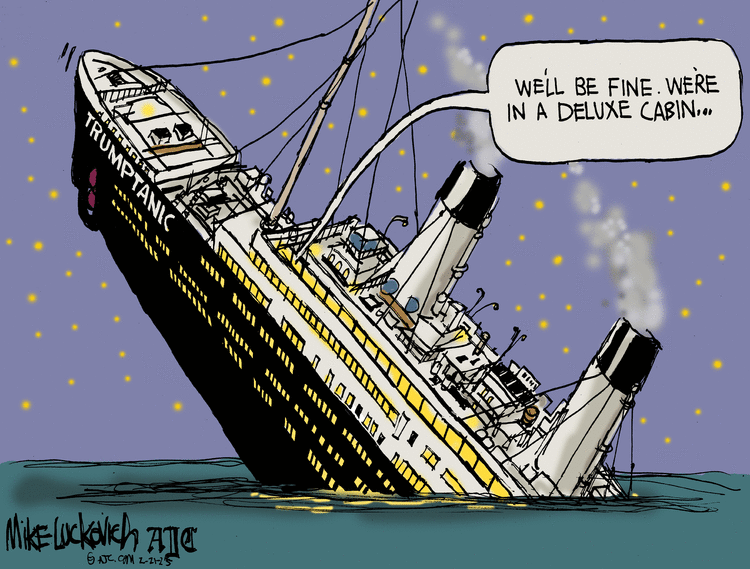
It’s no secret that I detest Donald Trump, but I’ve been trying to move anti-Trump content off of this, my main blog. Today, however, I had things to say that are not bog standard TDS, including, believe it, or not, exonerating him of criming by one of the most outrageous middle-fingers he’s raised to the nation and crediting his crassness with bringing a legal theory from the vapor down to the ground.
There oughta be a law
The administration has recently been running “public service announcements” that tout the president’s achievements. They have the look and feel of campaign ads—but they’ve been paid for with government funds. In fact, one of the “public service announcements” is a repurposed 2024 Trump campaign ad. If Joe Biden had done this in 2024, Republicans would have screamed about it. These ads should be clearly illegal, but alas, they are not.
Those arguing these ads are illegal cannot point to a simple federal statute prohibiting officeholders from running ads designed to influence an election paid for with government money, because there isn’t one.
There is a legal saying that “the law isn’t made until first it’s broken.” No prior President has been so contemptuous of his oath of office and of behavioral norms that he would run “grand exalted leader demigod” ads at government expense. But Orange Sauron, like honey badger, don’t care. [UPDATE: Jack Goldsmith and Bob Bauer think it is a crime already without any new law or revision of old law.]
Such norm-shattering has born some fruit in court, too. No prior President was so contemptuous of norms as to fire the heads of agencies created by Congress that were supposed to have some expertise, and continuity, beyond the power-grabbing grasp of a president who prefered lackeys at the heads of agencies. And so, we now have seen vindicated the “Unitary Executive Theory” (put simply, there’s only three branches of the U.S. Government, and Congress doesn’t execute the laws, so agencies are under the head of the Executive branch) that had been floating in theoretical ether for a fairly long time, untested by norm-breakers.
Denying the Faith
[Jack] Smith himself praised GOP witnesses to the 2020 coup plot who helped him build a case against the president. That was an opportunity for congressional Republicans to distinguish their party from its leader, something they’d reeeeeally like to do before voting begins. But they declined, and honestly, I understand why: Some beliefs, like the alleged illegitimacy of Smith’s prosecution, are so central in the modern right-wing catechism that to deny them is to deny the faith itself.
You can’t be a Christian without accepting Christ’s divinity, and you can’t be a Trumpist without believing that Trump’s obvious, overt criminality is some sort of Democratic “hoax.”
Chief Justice John Roberts has accomplished so much of his agenda that it’s not easy, as he begins his 22nd Supreme Court term, to think of what unfinished business might remain.
One of the things I don’t like about Linda Greenhouse’s Supreme Court commentary is right there under your nose: since when do Justices, even Chief Justices, have “agendas”?
What makes Sauron evil is not that he has a ring of power, but that he, like Saruman, has a mind comprised only of metal and gears and is concerned only with domination and his own Ring is inherently constrained by his own hatred and vanity.
I don’t do any of the major social media, but I have two sub-domains of the domain you’re currently reading: (a) You can read most of my reflexive stuff, especially political here. (b) I also post some things on my favorite no-algorithm social medium.
I’m struggling with the agreement between Sarah Isgur and David French on the Advisory Opinions podcast that the orders from the Trump Department of Justice to dismiss the charges against New York City Mayor Eric Adams was a lawful order, even if compliance by federal prosecutors would have been unethical. I’d like to think that an order to a professional to do something unethical is ipso facto not a lawful order.
If nothing else, this confirms the wisdom of not allowing non-lawyers to own a law firm (e.g., Model Rules of Professional Conduct 1.17(b)) lest this kind of thing pervade the legal profession rather than remaining an application of the unitary executive theory to the Department of Justice.
Mafia Don has fired Hampton Dellinger, current head of the Office of Special Counsel, without invoking “inefficiency, neglect of duty, or malfeasance in office” as required by statute. A federal District Court has ordered that he be reinstated. A federal Court of Appeals has rejected Trump’s appeal on technical grounds (the District Court decision is only preliminary, not final). He now seeks review by the US Supreme Court.
I shudder because unitary executive theory makes the substance of his appeal plausible.
So here’s the deal on the Constitutional issues.
The Constitution establishes three branches of the federal government: Congress (Article I), the Executive (Article II), and the Judiciary (Article III). The opening words of Article II are “The executive Power shall be vested in a President of the United States of America.“
So what is the status of supposedly “independent” agencies, created by Congress, like the Office of Special Council? Are they a fourth branch of government, hiding in the shadows of the constitution, or are they simply unconstitutional because all executive power is vested in the presidency? If the latter (which is substantially the position of President after President since the Office was created, but nobody before The Don cared so little about chaos to provoke a fight over it), then what checks the power of the Presidency? Are we doomed to live under a kakistocracy if the President goes haywire?
The conventional answer is that Congress’s impeachment power checks the power of the presidency. If you are satisfied that this Congress has the cojones to impeach this president, you are living in a different reality than I am.
As I sit here in my easy chair, six years retired and 43 years out of law school, the best response I can come up with for SCOTUS is (1) refuse to hear the case because the District Court decision is only preliminary or (2) take the case and rule that independent agencies are not exercising executive power, but rather are serving as a check on executive power, and thus really are “hiding in the shadows” of the Constitution.
I think this would be a satisfactory ground to uphold the District Court. But I remember how conservatives derided Justice Harry Blackmun’s finding a right to abortion in the “emanations of the penumbrae” of the constitution?
The electorate having decided that Mafia Don was the lesser evil (a perception I gradually came to find defensible within the 5 or 6 months preceding January 20) has thrust us into the Constitutional crisis of an utterly corrupt President who will never be impeached because not only can he suborn and fund primary candidates against those who would impeach him, but he can with winks, nods, and stochastically violent rhetoric unleash fanatics that make Congressmen literally fear for their families if they cross him.
A decision either way from the Supreme Court will deepen the crisis.
First, they came for the radical liberal communists …
Pundit tribalism
That issue—how intellectuals are supposed to comport themselves in their political engagements—is one that matters a lot to me. On top of the policy disagreements, what drove me away from the intellectual right two decades ago was the expectation, as an editor for First Things magazine, that I defend a political line in public. I wasn’t allowed to write a conservative case for not invading Iraq, for example, because that would risk making myself and the magazine appear “unreliable.” There was simply too much at stake, my boss told me, to risk a dissent from the conservative movement and its presidential champion. The War on Terror had to be won—and even more fundamentally, George W. Bush needed to have a successful presidency. We couldn’t risk contributing to its failure by directing criticisms its way.
I’m very sympathetic to Linker about this kind of tribalism.
Our local rag used to have a very lively letters to the editor section (they don’t even have an opinion page anymore). When my religious Right co-belligerents expressed particularly idiotic opinions or called for perverse boycotts (example omitted because it was so idiotic you wouldn’t believe me), I tended to refute them vigorously, and at least once received an anonymous phone call implying that I was a Judas (no threat, just bile).
Why can’t the world be unanimously sane and moderate, just like Damon Linker and me?
Our four-party system
I enjoyed Ezra Klein’s little essay the other day as a partial explanation of how polarization got worse:
The two-party system of the 20th century was really a four-party system. The Democrats were split between the liberals we know today and the Dixiecrats, whose primary goal was upholding segregation. The Republicans were split between conservatives and Northern liberals. It is astonishing from our vantage point, but it was true for much of the 20th century: To say you were a Republican or a Democrat didn’t reveal whether you were a liberal or a conservative. As a senator, Joe Biden opposed the Roe v. Wade decision in 1973. President Richard Nixon proposed a universal health care bill and created the Environmental Protection Agency. George Wallace started out as a Democrat. Politics was different then.
Parties that contained so many different places and ideologies could not act in lock step, and so bipartisanship was common. The Civil Rights Act of 1964 was pushed by a Democratic president, but congressional Republicans were crucial to its passage. When Watergate began coming to light, Congress acted as a collective. Only four House Republicans voted against opening the impeachment inquiry into Nixon, and a delegation of congressional Republicans ultimately persuaded him to resign.
And it wasn’t just impeachment. When Nixon refused to spend the money Congress had appropriated — a policy known as impoundment — Congress acted to protect its power: The Congressional Budget and Impoundment Control Act of 1974 passed the House with only six “no” votes; it passed the Senate without a single vote in opposition.
(Emphasis added) I remember guys like Scoop Jackson, Dick Gephart, Mark Hatfield, Nelson Rockefeller, John Lindsey. Joe Manchin proves there’s no room for that kind any more. There’s just two tribes, each controlled from the wings, not the center.
Clamoring aboard the ARC
A Jordan Peterson-adjacent, Christian-coded “Alliance for Responsible Citizenship” recently convened. Two Orthodox Christian friends have diverging thoughts:
As I wrote yesterday, it is strange that it has taken a non-believing clown like Donald Trump to be the Great Disrupter. We do not have to agree with everything he does …, but I believe people like me can work with people like him in ways we simply could not do with those who were in power before.
Rod Dreher, whose “responsible citizen” culture-warring is a bone of contention between him and his friend Kingsnorth:
Jesus didn’t come to Earth to teach us how to be ‘responsible citizens’, of any political stripe. Responsible citizens don’t leave their own fathers unburied. They don’t hate their own mother and father, or give away all of their wealth, or compare the religious authorities to whitewashed tombs full of rotting flesh. And they don’t usually end up being crucified.
My sympathies lie almost completely with Kingsnorth, but I understand Dreher’s point — though I would rephrase it as “Unlike the Democrats, Trump is not actively and operationally hostile toward America’s motley array of ‘conservative’ Christians.”
Back in the days when I blogged longer-form original material more than curating other folks’ stuff, I declared myself a “Conscientious Objector to the Culture Wars” (a status that’s hard to maintain consistently) in a long-form blog that holds up well as a description of why I disengaged. This was about 80% Kingsnorthian a decade before I’d heard of the guy. It’s a posture that has spared me the ignominy of ever hallucinating that “we can work with” Trump 2.0 toward any truly edifying end.
(By the way: my shift from longer-form original material toward curation is, I think, a recognition that I’ve blogged most of my idées fixes in long-form and to my personal satisfaction; there’s no need to inflict them on others constantly, though I’m toying with a blogroll of my landmark posts.)
Just because …
… I thought this image was beautiful.
Jozef Pankiewicz, Market Square of Warsaw by Night, 1892 (Wikimedia Commons)
O Lord of hosts be with us, for we have none other help in times of sorrow but Thee. O Lord of hosts, have mercy on us.
I don’t do any of the major social media, but I have two sub-domains of the domain you’re currently reading: (a) You can read most of my reflexive stuff, especially political here. (b) I also post some things on the only social medium I frequent, because people there are quirky, pleasant and real.